A Knowledge Theory of Capital:The Value of Natural and Artificial Intelligence, Volume 1
Pith reviewed 2026-06-30 10:36 UTC · model grok-4.3
The pith
Modern wealth depends not only on capital accumulation but on how productive knowledge is governed.
A machine-rendered reading of the paper's core claim, the machinery that carries it, and where it could break.
Core claim
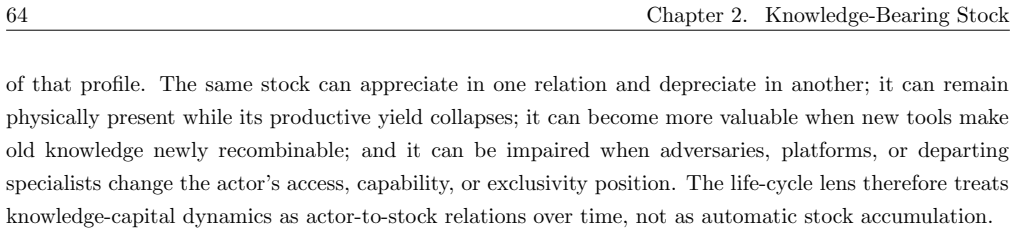
The paper claims that knowledge-bearing stock is the central object in modern economies, and that wealth depends not only on capital accumulation but on how productive knowledge is governed through its generation, conversion, deployment, feedback improvement, enclosure or sharing, measurement, impairment, and reuse as input.
What carries the argument
Knowledge-bearing stock, the productive capacity in software, data, models, routines, expertise, platforms, organizations, commons, and public epistemic infrastructure that can be converted, governed, and recombined.
If this is right
- Governance choices on whether knowledge remains commons or becomes enclosed will directly shape the rate at which productive capacity expands.
- Systems that fail to measure or capture feedback from knowledge use will systematically understate or impair future output.
- Distinctions among knowledge forms make it possible to analyze why some knowledge scales while other knowledge remains embodied or localized.
- Impairment through expected knowledge loss becomes a measurable drag on wealth comparable to physical depreciation.
Where Pith is reading between the lines
- The framework suggests testable metrics for how open versus proprietary AI models affect aggregate productivity when capital stocks are held constant.
- It connects directly to questions of how public epistemic infrastructure alters the returns to private knowledge investment.
- One extension would be to derive accounting adjustments that make knowledge-bearing stock visible in national accounts and test whether those adjustments improve growth forecasts.
Load-bearing premise
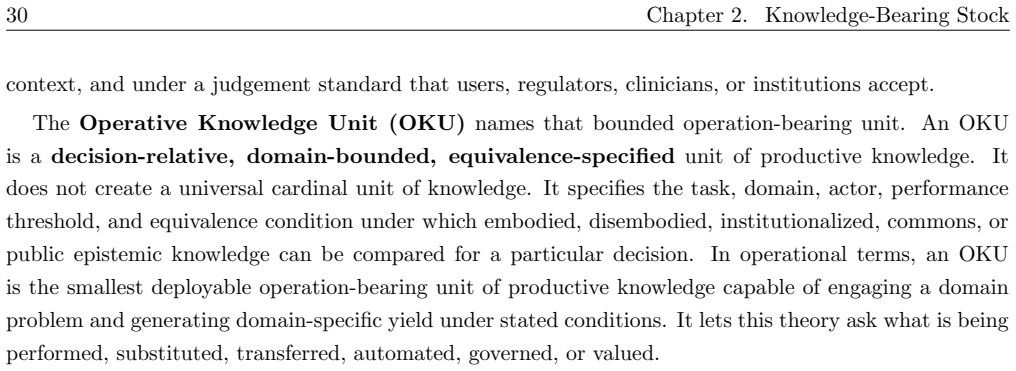
Knowledge can be usefully treated as stock-like, mobile across forms, scalable, governable, recombinable, and imperfectly visible in accounting, allowing distinctions between embodied, disembodied, institutionalized, commons, and public forms to structure analysis.
What would settle it
An empirical comparison of economies or sectors with matched physical capital stocks but measurably different knowledge governance regimes (for example, differing rates of cognitive enclosure or feedback capture) that shows no corresponding difference in productivity growth or wealth would falsify the central claim.
Figures


















read the original abstract
This volume develops a knowledge theory of capital for economies in which productive capacity increasingly resides in software, data, models, routines, expertise, platforms, organizations, commons, and public epistemic infrastructure. Beginning from Adam Smith's theory of labour, stock, specialization, and market extent, it asks what changes when knowledge becomes stock-like, mobile across forms, scalable, governable, recombinable, and imperfectly visible in accounting. The book introduces knowledge-bearing stock as the central object and analyses how it is generated, converted into governable form, deployed, improved through feedback, enclosed or shared, measured, impaired, and used as input to future production. It distinguishes embodied, disembodied, institutionalized, commons, and public knowledge forms and develops concepts such as first conversion, cognitive enclosure, feedback capture, dark capital, and expected knowledge loss. The argument is conditional and testable: modern wealth depends not only on capital accumulation, but on how productive knowledge is governed.
Editorial analysis
A structured set of objections, weighed in public.
Referee Report
Summary. The manuscript develops a knowledge theory of capital by extending Adam Smith's concepts of labour, stock, specialization, and market extent to modern economies where productive capacity resides in software, data, models, routines, expertise, platforms, organizations, commons, and public epistemic infrastructure. It posits knowledge-bearing stock as the central object and examines its generation, conversion into governable form, deployment, improvement through feedback, enclosure or sharing, measurement, impairment, and use as input to future production. The work distinguishes embodied, disembodied, institutionalized, commons, and public knowledge forms while introducing concepts such as first conversion, cognitive enclosure, feedback capture, dark capital, and expected knowledge loss. The central claim is framed as conditional and testable: modern wealth depends not only on capital accumulation but on how productive knowledge is governed.
Significance. If the distinctions among knowledge forms and the associated processes can be shown to be non-circular and to yield operational, falsifiable implications, the framework could provide a coherent extension of classical capital theory to contemporary issues of AI, data governance, and epistemic infrastructure. The explicit conditional framing and positioning as preparatory for later testing are strengths that facilitate future empirical work.
major comments (1)
- [Abstract] Abstract: The definition of knowledge-bearing stock relies on the properties 'stock-like, mobile across forms, scalable, governable, recombinable, and imperfectly visible in accounting,' which are then used to structure the analysis of how such stock 'is generated, converted into governable form, deployed, improved through feedback, enclosed or shared, measured, impaired, and used as input.' This risks circularity, as the distinctions (embodied/disembodied/etc.) and processes presuppose the very mobility, governability, and recombinability they are intended to explain.
minor comments (1)
- [Abstract] Abstract: Several novel terms (first conversion, cognitive enclosure, feedback capture, dark capital, expected knowledge loss) are introduced without even brief parenthetical characterizations, which reduces immediate accessibility.
Simulated Author's Rebuttal
We thank the referee for the careful reading and constructive feedback. The concern about potential circularity in the abstract is noted, and we address it directly below. The manuscript's conditional framing remains unchanged.
read point-by-point responses
-
Referee: [Abstract] Abstract: The definition of knowledge-bearing stock relies on the properties 'stock-like, mobile across forms, scalable, governable, recombinable, and imperfectly visible in accounting,' which are then used to structure the analysis of how such stock 'is generated, converted into governable form, deployed, improved through feedback, enclosed or shared, measured, impaired, and used as input.' This risks circularity, as the distinctions (embodied/disembodied/etc.) and processes presuppose the very mobility, governability, and recombinability they are intended to explain.
Authors: We agree the abstract phrasing risks suggesting circularity. The properties are intended as empirically observed characteristics of knowledge assets in contemporary economies (extending Smith's stock concept), which then motivate analysis of governance processes. To remove any appearance of circular reasoning, we will revise the abstract to first characterize knowledge-bearing stock via its stock-like and mobile properties, then separately describe the processes these properties enable. The distinctions among forms will be presented as derived from these properties rather than presupposed. This change will be made in the revised manuscript. revision: yes
Circularity Check
No significant circularity; framework is definitional but conditional and non-derivational
full rationale
The manuscript is a conceptual extension of Smith's framework to knowledge-bearing stock, introducing distinctions and processes as analytical tools rather than deriving predictions from equations or fitted parameters. The central claim is explicitly conditional and positioned as preparatory for testing, with no load-bearing steps that reduce by construction to self-defined inputs, self-citations, or renamed empirical patterns. The abstract and description contain no equations, uniqueness theorems, or ansatzes that presuppose the target results. This is the normal case of a self-contained conceptual analysis without the enumerated circularity patterns.
Axiom & Free-Parameter Ledger
axioms (1)
- domain assumption Knowledge becomes stock-like, mobile across forms, scalable, governable, recombinable, and imperfectly visible in accounting when productive capacity resides in software, data, models, routines, expertise, platforms, organizations, commons, and public epistemic infrastructure.
invented entities (6)
-
knowledge-bearing stock
no independent evidence
-
first conversion
no independent evidence
-
cognitive enclosure
no independent evidence
-
feedback capture
no independent evidence
-
dark capital
no independent evidence
-
expected knowledge loss
no independent evidence
Reference graph
Works this paper leans on
-
[1]
A model of growth through creative destruction , journaltitle =
Aghion, Philippe and Howitt, Peter , year =. A model of growth through creative destruction , journaltitle =
-
[2]
, year =
Arrow, Kenneth J. , year =. Economic welfare and the allocation of resources for invention , editor =. The rate and direction of inventive activity: Economic and social factors , pages =
-
[3]
Brian , year =
Arthur, W. Brian , year =. The nature of technology: What it is and how it evolves , publisher =
-
[4]
, year =
Barney, Jay B. , year =. Firm resources and sustained competitive advantage , journaltitle =
-
[5]
, year =
Baumol, William J. , year =. Entrepreneurship: Productive, unproductive, and destructive , journaltitle =
-
[6]
, year =
Becker, Gary S. , year =. Human capital: A theoretical and empirical analysis, with special reference to education , publisher =
-
[7]
The coming of post-industrial society: A venture in social forecasting , publisher =
Bell, Daniel , year =. The coming of post-industrial society: A venture in social forecasting , publisher =
-
[8]
, year =
Bessen, James and Meurer, Michael J. , year =. Patent failure: How judges, bureaucrats, and lawyers put innovators at risk , publisher =
-
[9]
, year =
Boldrin, Michele and Levine, David K. , year =. Against intellectual monopoly , publisher =
-
[10]
, year =
Bond, Stephen and Cummins, Jason G. , year =. The stock market and investment in the new economy: Some tangible facts and intangible fictions , journaltitle =
-
[11]
, year =
Coase, Ronald H. , year =. The nature of the firm , journaltitle =
-
[12]
and Levinthal, Daniel A
Cohen, Wesley M. and Levinthal, Daniel A. , year =. Absorptive capacity: A new perspective on learning and innovation , journaltitle =
-
[13]
Measuring capital and technology: An expanded framework , editor =
Corrado, Carol and Hulten, Charles and Sichel, Daniel , year =. Measuring capital and technology: An expanded framework , editor =. Measuring capital in the new economy , series =
-
[14]
, year =
Dasgupta, Partha and David, Paul A. , year =. Toward a new economics of science , journaltitle =
-
[15]
Working in public: The making and maintenance of open source software , publisher =
Eghbal, Nadia , year =. Working in public: The making and maintenance of open source software , publisher =
-
[16]
, year =
Grant, Robert M. , year =. Toward a knowledge-based theory of the firm , journaltitle =
-
[17]
and Jaffe, Adam B
Hall, Bronwyn H. and Jaffe, Adam B. and Trajtenberg, Manuel , year =. The
-
[18]
Capitalism without capital: The rise of the intangible economy , publisher =
Haskel, Jonathan and Westlake, Stian , year =. Capitalism without capital: The rise of the intangible economy , publisher =
-
[19]
, year =
Hayek, Friedrich A. , year =. The use of knowledge in society , journaltitle =
-
[20]
and Eisenberg, Rebecca S
Heller, Michael A. and Eisenberg, Rebecca S. , year =. Can patents deter innovation?
-
[21]
and Lerner, Josh , year =
Jaffe, Adam B. and Lerner, Josh , year =. Innovation and its discontents: How our broken patent system is endangering innovation and progress and what to do about it , publisher =
-
[22]
Intangibles: Management, measurement, and reporting , publisher =
Lev, Baruch , year =. Intangibles: Management, measurement, and reporting , publisher =
-
[23]
Lucas, Robert E. Jr. , year =. On the mechanics of economic development , journaltitle =
-
[24]
The production and distribution of knowledge in the
Machlup, Fritz , year =. The production and distribution of knowledge in the
-
[25]
Craig , year =
MacKinlay, A. Craig , year =. Event studies in economics and finance , journaltitle =
-
[26]
The gifts of
Mokyr, Joel , year =. The gifts of
-
[27]
and Winter, Sidney G
Nelson, Richard R. and Winter, Sidney G. , year =. An evolutionary theory of economic change , publisher =
-
[28]
The knowledge-creating company: How
Nonaka, Ikujiro and Takeuchi, Hirotaka , year =. The knowledge-creating company: How
-
[29]
Governing the commons: The evolution of institutions for collective action , publisher =
Ostrom, Elinor , year =. Governing the commons: The evolution of institutions for collective action , publisher =
-
[30]
Coping with tragedies of the commons , journaltitle =
Ostrom, Elinor , year =. Coping with tragedies of the commons , journaltitle =
-
[31]
, year =
Penrose, Edith T. , year =. The theory of the growth of the firm , publisher =
-
[32]
and Shih, Willy C
Pisano, Gary P. and Shih, Willy C. , year =. Restoring
-
[33]
The tacit dimension , publisher =
Polanyi, Michael , year =. The tacit dimension , publisher =
-
[34]
The information economy: Definition and measurement , type =
Porat, Marc Uri , year =. The information economy: Definition and measurement , type =
-
[35]
Platform competition in two-sided markets , journaltitle =
Rochet, Jean-Charles and Tirole, Jean , year =. Platform competition in two-sided markets , journaltitle =
-
[36]
, year =
Romer, Paul M. , year =. Endogenous technological change , journaltitle =
-
[37]
, year =
Schumpeter, Joseph A. , year =. The theory of economic development: An inquiry into profits, capital, credit, interest, and the business cycle , translator =
-
[38]
, year =
Schumpeter, Joseph A. , year =. Capitalism, socialism and democracy , publisher =
-
[39]
, year =
Shapiro, Carl and Varian, Hal R. , year =. Information rules: A strategic guide to the network economy , publisher =
-
[40]
Using massive online choice experiments to measure changes in well-being , journal =
Brynjolfsson, Erik and Collis, Avinash and Eggers, Felix , year =. Using massive online choice experiments to measure changes in well-being , journal =
-
[41]
An inquiry into the nature and causes of the wealth of nations , volumes =
Smith, Adam , year =. An inquiry into the nature and causes of the wealth of nations , volumes =
-
[42]
, year =
Solow, Robert M. , year =. Growth theory and after , journaltitle =
-
[43]
, year =
Teece, David J. , year =. Explicating dynamic capabilities: The nature and microfoundations of (sustainable) enterprise performance , journaltitle =
-
[44]
and Pisano, Gary and Shuen, Amy , year =
Teece, David J. and Pisano, Gary and Shuen, Amy , year =. Dynamic capabilities and strategic management , journaltitle =
-
[45]
and Farrell, Joseph and Shapiro, Carl , year =
Varian, Hal R. and Farrell, Joseph and Shapiro, Carl , year =. The economics of information technology: An introduction , publisher =
-
[46]
, year =
Weitzman, Martin L. , year =. Recombinant growth , journaltitle =
-
[47]
A resource-based view of the firm , journaltitle =
Wernerfelt, Birger , year =. A resource-based view of the firm , journaltitle =
-
[48]
, year =
Williamson, Oliver E. , year =. The economic institutions of capitalism: Firms, markets, relational contracting , publisher =
-
[49]
and von Hippel, Eric , year =
Baldwin, Carliss Y. and von Hippel, Eric , year =. Modeling a paradigm shift: From producer innovation to user and open collaborative innovation , journaltitle =
-
[50]
Democratizing innovation , publisher =
von Hippel, Eric , year =. Democratizing innovation , publisher =
-
[51]
Open source software and firm productivity , journaltitle =
Nagle, Frank , year =. Open source software and firm productivity , journaltitle =
-
[52]
Nagle, Frank and Dana, James and Hoffman, Jennifer and Randazzo, Steven and Zhou, Yanuo , year =
-
[53]
Adaptation, specialization, and the theory of the firm: Foundations of the resource-based view , publisher =
Wernerfelt, Birger , year =. Adaptation, specialization, and the theory of the firm: Foundations of the resource-based view , publisher =
-
[54]
, year =
Romer, Paul M. , year =. The origins of endogenous growth , journaltitle =
-
[55]
As we may think , journaltitle =
Bush, Vannevar , year =. As we may think , journaltitle =
-
[56]
, year =
Merton, Robert K. , year =. The sociology of science: Theoretical and empirical investigations , editor =
-
[57]
, year =
Kuhn, Thomas S. , year =. The structure of scientific revolutions , publisher =
-
[58]
The methodology of scientific research programmes , publisher =
Lakatos, Imre , year =. The methodology of scientific research programmes , publisher =
-
[59]
and Leike, Jan and Brown, Tom B
Christiano, Paul F. and Leike, Jan and Brown, Tom B. and Martic, Miljan and Legg, Shane and Amodei, Dario , year =. Deep reinforcement learning from human preferences , booktitle =
-
[60]
The nature and value of knowledge: Three investigations , publisher =
Pritchard, Duncan and Millar, Alan and Haddock, Adrian , year =. The nature and value of knowledge: Three investigations , publisher =
-
[61]
, year =
Olsson, Erik J. , year =. Reply to Kvanvig on the swamping problem , journaltitle =
-
[62]
When is true belief knowledge? , publisher =
Foley, Richard , year =. When is true belief knowledge? , publisher =
-
[63]
, year =
Nash, John F. , year =. Equilibrium points in n-person games , journaltitle =
-
[64]
, year =
Schultz, Theodore W. , year =. Investment in human capital , journaltitle =
-
[65]
1980 , howpublished =
1980
-
[66]
, year =
Akerlof, George A. , year =. The market for ``lemons'': Quality uncertainty and the market mechanism , journaltitle =
-
[67]
Job market signaling , journaltitle =
Spence, Michael , year =. Job market signaling , journaltitle =
-
[68]
, year =
Stiglitz, Joseph E. , year =. Information and the theory of economic development , institution =
-
[69]
, year =
Mincer, Jacob A. , year =. Schooling, experience, and earnings , publisher =
-
[70]
Information and the Coase theorem , journaltitle =
Farrell, Joseph , year =. Information and the Coase theorem , journaltitle =
-
[71]
, year =
Grant, Robert M. , year =. The resource-based theory of competitive advantage: Implications for strategy formulation , journaltitle =
-
[72]
, year =
Peteraf, Margaret A. , year =. The cornerstones of competitive advantage: A resource-based view , journaltitle =
-
[73]
and Callen, Jeffrey L
Aivazian, Varouj A. and Callen, Jeffrey L. , year =. The
-
[74]
, year =
Coase, Ronald H. , year =. The problem of social cost , journaltitle =
-
[75]
The Humira patent thicket, the Noerr-Pennington doctrine, and antitrust's patent problem , howpublished =
Knox, Robin , year =. The Humira patent thicket, the Noerr-Pennington doctrine, and antitrust's patent problem , howpublished =
-
[76]
In the thick(et) of it: Addressing biologic patent thickets using antitrust law , journaltitle =
Zhou, Andrew , year =. In the thick(et) of it: Addressing biologic patent thickets using antitrust law , journaltitle =
-
[77]
, year =
Romer, Paul M. , year =. Increasing returns and long-run growth , journaltitle =
-
[78]
, year =
North, Douglass C. , year =. Institutions, institutional change and economic performance , publisher =
-
[79]
, year =
Heller, Michael A. , year =. The tragedy of the anticommons: Property in the transition from
-
[80]
The productivity paradox of information technology , journaltitle =
Brynjolfsson, Erik , year =. The productivity paradox of information technology , journaltitle =
discussion (0)
Sign in with ORCID, Apple, or X to comment. Anyone can read and Pith papers without signing in.