Ultra-High-Resolution Astronomy with the Solar Gravitational Lens
Pith reviewed 2026-06-26 23:14 UTC · model grok-4.3
The pith
Spacecraft at the solar gravitational lens focal line can reconstruct images of compact sources like white dwarfs and AGN rings with SSIM values above 0.9 under stated assumptions.
A machine-rendered reading of the paper's core claim, the machinery that carries it, and where it could break.
Core claim
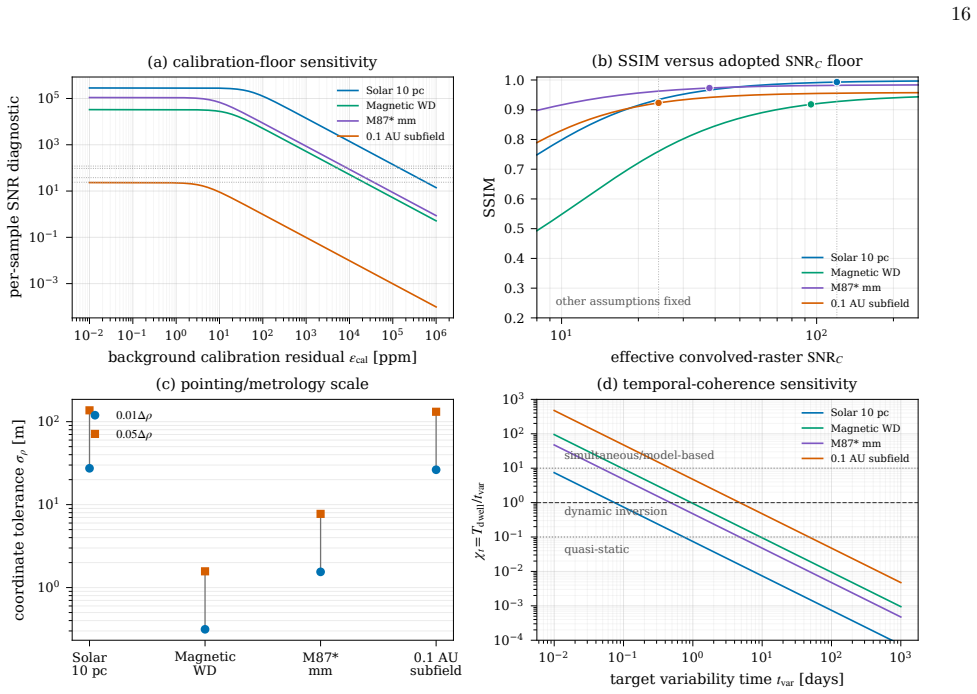
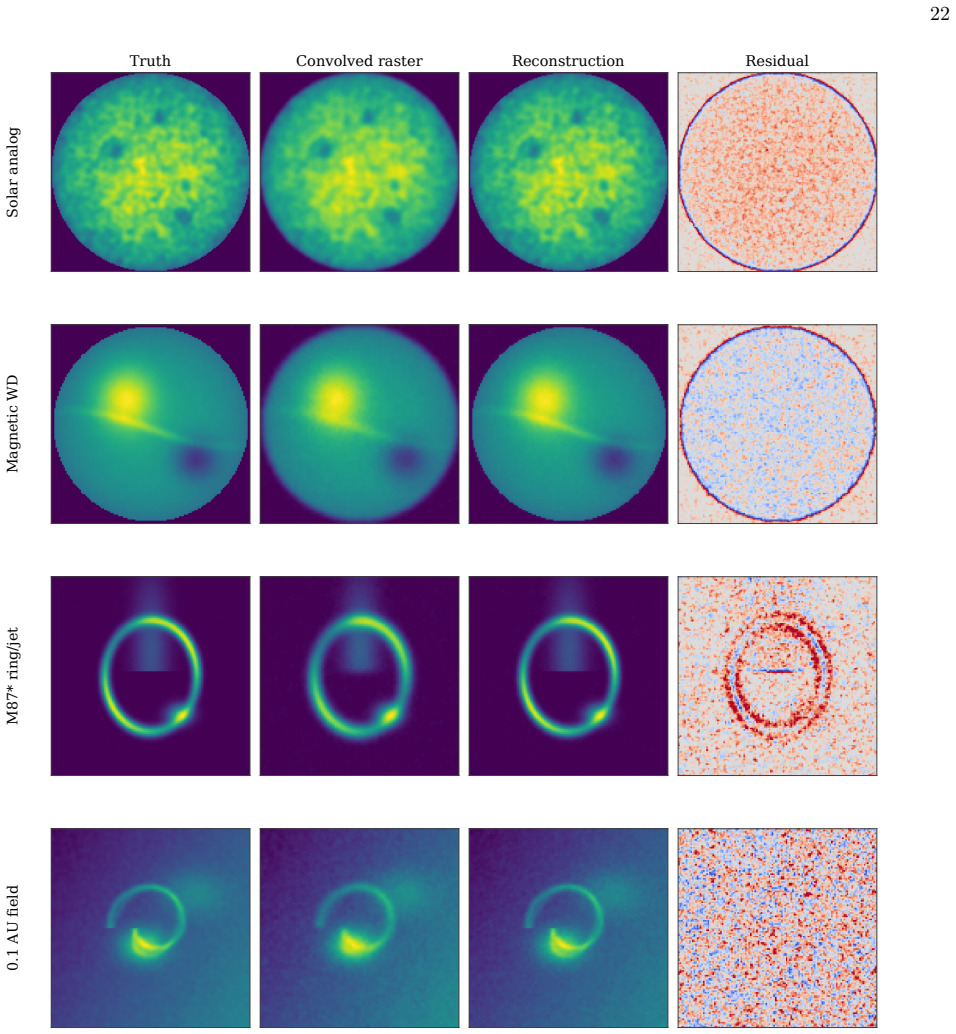
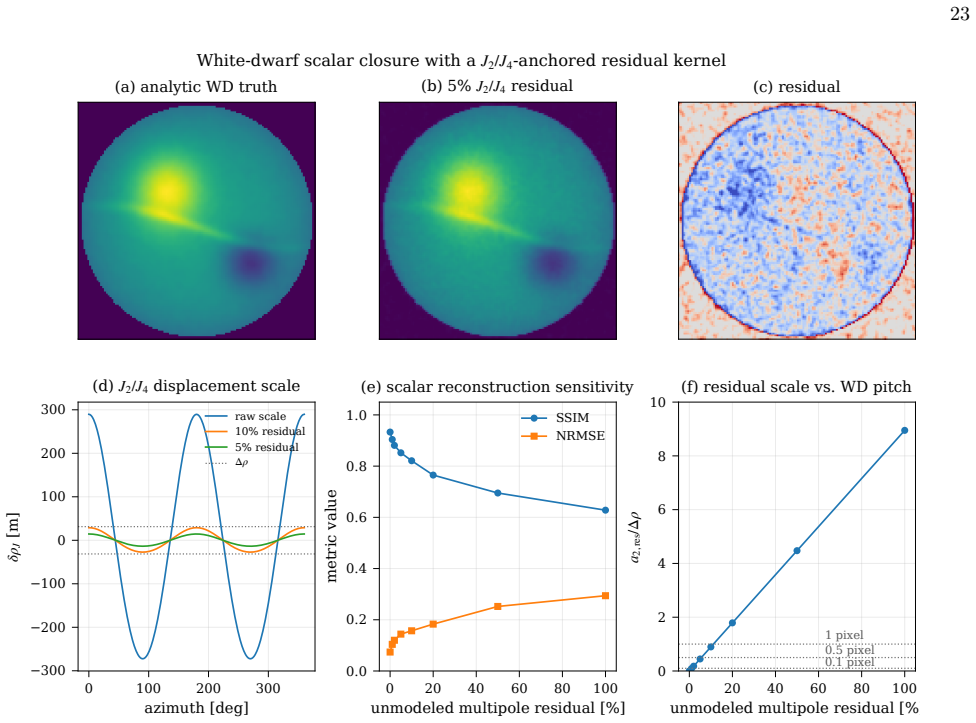
The central claim is that the solar gravitational lens supplies a target-specific observatory whose viability for non-exoplanet targets is governed by image-plane scale, raster pitch, finite-source gain, source-to-background ratio, temporal coherence, PSF knowledge, calibration, metrology, and focal-line access; separating the vector Poisson measurement operator from the scalar convolution used for benchmarks allows four analytic scenes to be reconstructed with SSIM values of 0.993, 0.918, 0.973, and 0.923 under the listed kernel-mismatch, background, calibration-floor, support-mask, sampling, regularization, and information-floor assumptions.
What carries the argument
The observability framework that separates the vector Poisson measurement operator from the scalar convolution benchmark to quantify inverse conditioning for SGL scenes.
If this is right
- The strongest bounded cases are white-dwarf surface and magnetic mapping, nearby stellar surfaces, compact AGN/black-hole structure with long-wavelength instrumentation, velocity-resolved broad-line-region mapping, and planet-forming subfields.
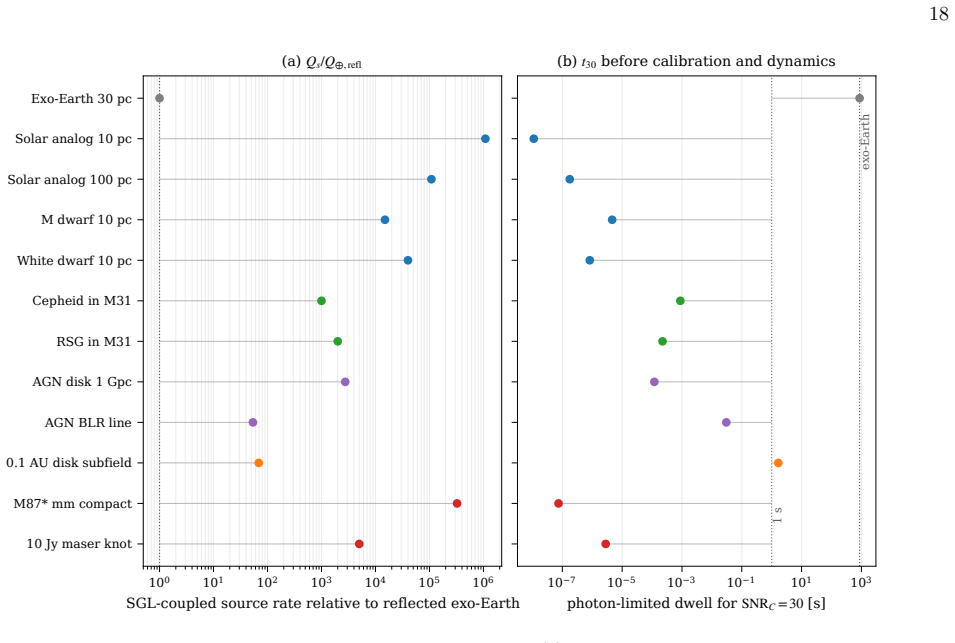
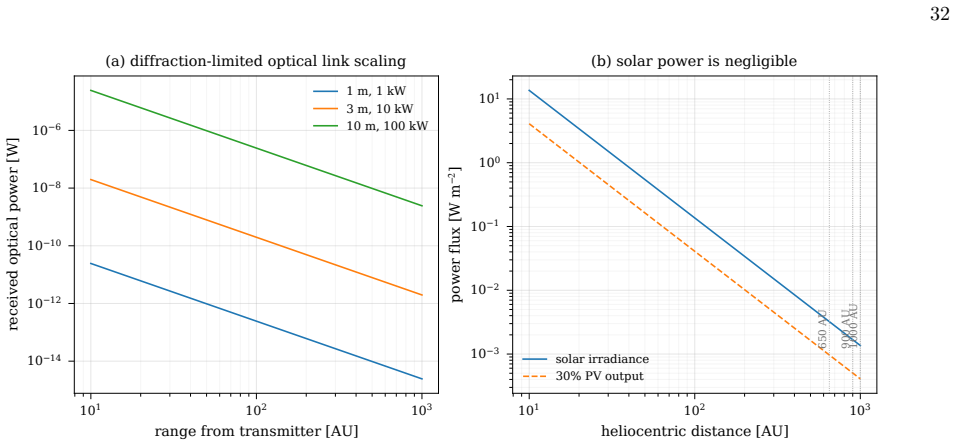
- Many self-luminous compact targets are not photon-starved relative to a reflected-light exo-Earth reference.
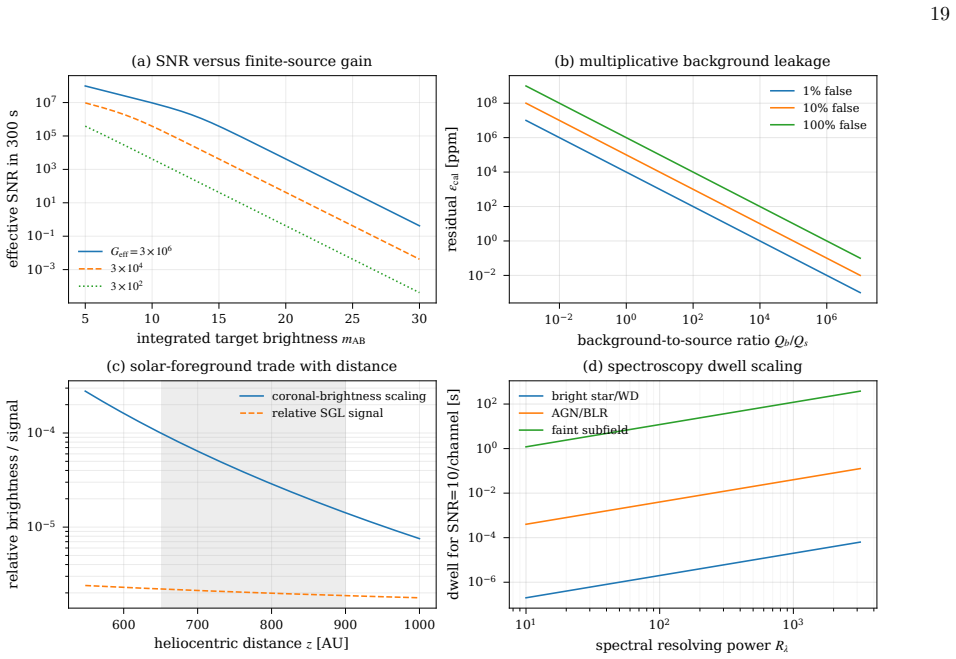
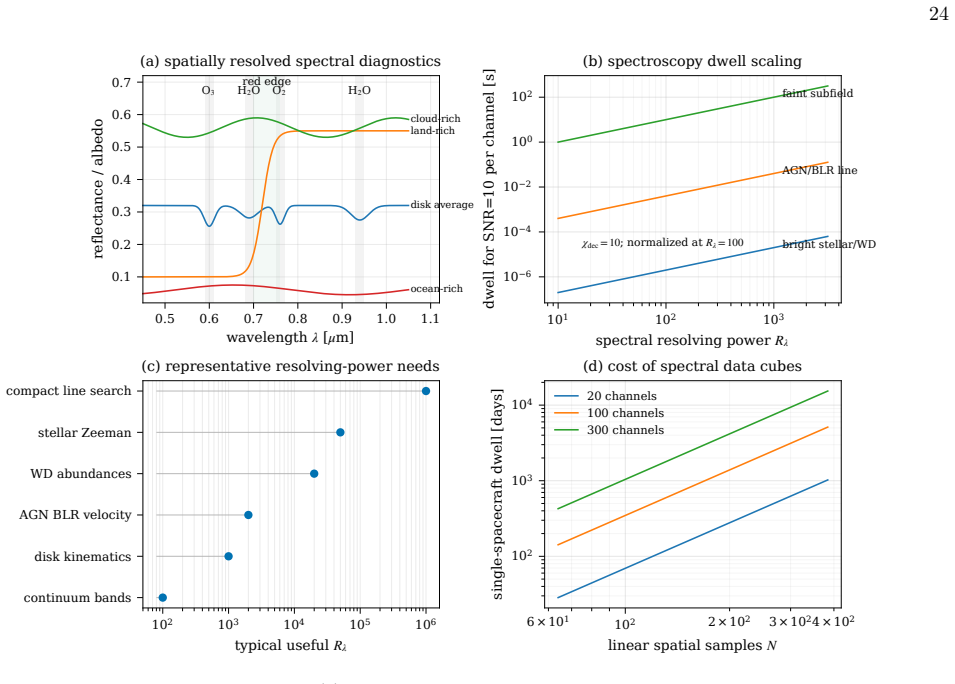
- Dominant requirements shift from photon collection to ring extraction, coronal subtraction, detector dynamic range, PSF knowledge, cadence, spectroscopy, metrology, scan overhead, and access.
- The priority enabling program is SGL transfer-function characterization measuring solar-multipole, plasma, extended-Sun, and instrumental response.
Where Pith is reading between the lines
- If the separation of operators holds in flight data, the same framework could be adapted to test whether extended solar corona effects limit reconstruction at longer wavelengths.
- The reported SSIM values quantify conditioning under synthetic kernels; actual metrology errors on focal-line position would provide a direct test of whether the information floor can be maintained.
- The emphasis on compact self-luminous sources suggests the method could complement, rather than compete with, interferometric arrays for velocity-resolved mapping of broad-line regions.
Load-bearing premise
Viability holds only if the vector Poisson operator can be cleanly separated from scalar convolution and if image-plane scale, raster pitch, PSF knowledge, calibration, and metrology remain within the stated bounds.
What would settle it
A real focal-line observation of one of the four scenes that yields an SSIM below 0.85 after applying the actual solar multipole and plasma response would falsify the claimed reconstruction performance.
Figures
read the original abstract
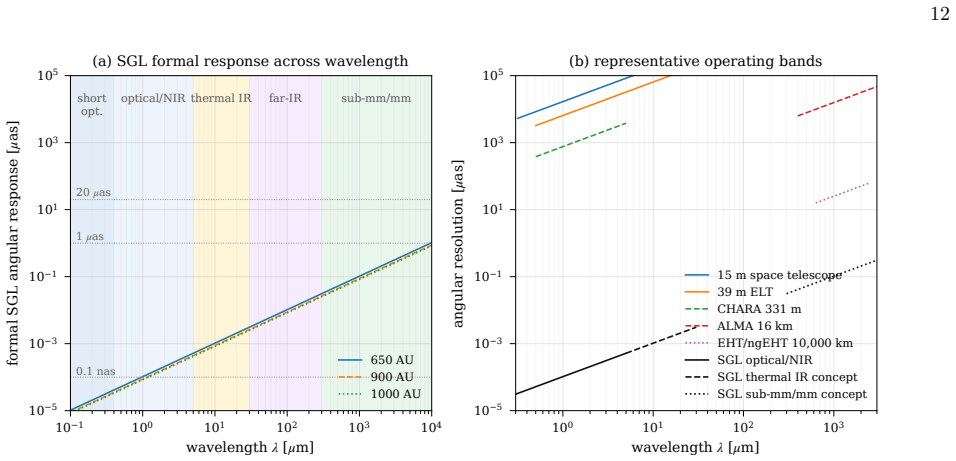
The solar gravitational lens (SGL) is a target-specific observatory: the Sun supplies the wave-optical element, while spacecraft provide occultation, annular photometry, sampling, metrology, and inverse reconstruction. We develop an observability framework for non-exoplanet SGL astronomy. Viability is set by image-plane scale, raster pitch, finite-source gain, source-to-background ratio, temporal coherence, PSF knowledge, calibration, metrology, and focal-line access. We separate the vector Poisson measurement operator from the scalar convolution used for benchmarks. Four analytic scenes are propagated and reconstructed: a solar analog and magnetic white dwarf at 10 pc, an M87*-scale millimeter ring/jet source, and a bright 0.1 AU protoplanetary subfield at 140 pc. Under stated kernel-mismatch, background, calibration-floor, support-mask, sampling, regularization, and imposed information-floor assumptions, the scalar reconstructions give SSIM values of 0.993, 0.918, 0.973, and 0.923. These metrics quantify scalar inverse conditioning, not delivered flight performance; FRC50, support-leakage, and information-floor sensitivity diagnostics expose the dependence on assumptions. Many self-luminous compact targets are not photon-starved relative to a reflected-light exo-Earth reference, shifting the dominant requirements to ring extraction, coronal subtraction, detector dynamic range, PSF knowledge, cadence, spectroscopy, metrology, scan overhead, and access. The strongest bounded cases are white-dwarf surface and magnetic mapping, nearby stellar surfaces, compact AGN/black-hole structure with long-wavelength instrumentation, velocity-resolved broad-line-region mapping, and planet-forming subfields. The priority enabling program is SGL transfer-function characterization: measuring solar-multipole, plasma, extended-Sun, and instrumental response needed for scientifically interpretable imaging.
Editorial analysis
A structured set of objections, weighed in public.
Referee Report
Summary. The manuscript develops an observability framework for non-exoplanet astronomy with the solar gravitational lens (SGL). The Sun provides the wave-optical element while spacecraft handle occultation, photometry, sampling, metrology, and reconstruction. Viability is governed by image-plane scale, raster pitch, finite-source gain, source-to-background ratio, temporal coherence, PSF knowledge, calibration, metrology, and focal-line access. The vector Poisson measurement operator is separated from the scalar convolution used for benchmarks. Four analytic scenes (solar analog and magnetic white dwarf at 10 pc, M87*-scale mm ring/jet, 0.1 AU protoplanetary subfield at 140 pc) are propagated and reconstructed, yielding SSIM values of 0.993, 0.918, 0.973, and 0.923 under stated assumptions on kernel mismatch, background, calibration floor, support mask, sampling, regularization, and information floor. These metrics are presented as quantifying scalar inverse conditioning rather than flight performance; FRC50, support-leakage, and sensitivity diagnostics are supplied. The paper concludes that many compact self-luminous targets are not photon-starved relative to exo-Earth references and prioritizes SGL transfer-function characterization.
Significance. If the conditional results hold, the framework supplies a quantitative structure for assessing SGL target viability and shifts emphasis from photon collection to ring extraction, coronal subtraction, detector dynamic range, PSF knowledge, cadence, spectroscopy, metrology, and scan overhead. The explicit separation of the vector Poisson operator from scalar benchmarks, together with FRC50, support-leakage, and information-floor sensitivity diagnostics, strengthens the analysis by exposing dependence on modeling choices. The work provides a useful reference for mission-concept studies of ultra-high-resolution imaging of compact sources.
minor comments (3)
- Abstract: the four SSIM values are listed without mapping them to the four scenes; adding the correspondence (e.g., “solar analog: 0.993, white dwarf: 0.918 …”) would improve immediate readability.
- The manuscript states that the SSIM values quantify scalar inverse conditioning rather than delivered performance, but the transition between the vector Poisson operator and the scalar benchmark convolution is described only at a high level; a short paragraph or equation block clarifying the operator separation would reduce ambiguity for readers.
- The priority list in the final paragraph (ring extraction, coronal subtraction, detector dynamic range, etc.) is presented without quantitative thresholds; adding even order-of-magnitude estimates for the dominant requirements would make the conclusions more actionable.
Simulated Author's Rebuttal
We thank the referee for their positive assessment of the manuscript, detailed summary of its contributions, and recommendation for minor revision. No specific major comments requiring response were provided in the report.
Circularity Check
No significant circularity identified
full rationale
The paper presents a simulation-based observability framework that separates the vector Poisson measurement operator from the scalar convolution benchmark and reports SSIM values (0.993, 0.918, 0.973, 0.923) explicitly as conditional outputs from propagating four analytic scenes under stated assumptions on kernel mismatch, background, calibration, sampling, regularization, and information floor. These metrics quantify inverse conditioning rather than being fitted to or defined by the target results themselves. Viability factors are listed transparently without any reduction of the central claims to self-referential inputs, self-citation chains, or ansatzes smuggled via prior work. The derivation chain is self-contained as a modeling exercise with explicit diagnostics (FRC50, support-leakage, sensitivity) and does not exhibit any of the enumerated circular patterns.
Axiom & Free-Parameter Ledger
axioms (2)
- domain assumption Separation of the vector Poisson measurement operator from the scalar convolution is valid for benchmark reconstructions.
- domain assumption The listed viability factors (image-plane scale, PSF knowledge, metrology, etc.) fully determine observability.
Reference graph
Works this paper leans on
-
[1]
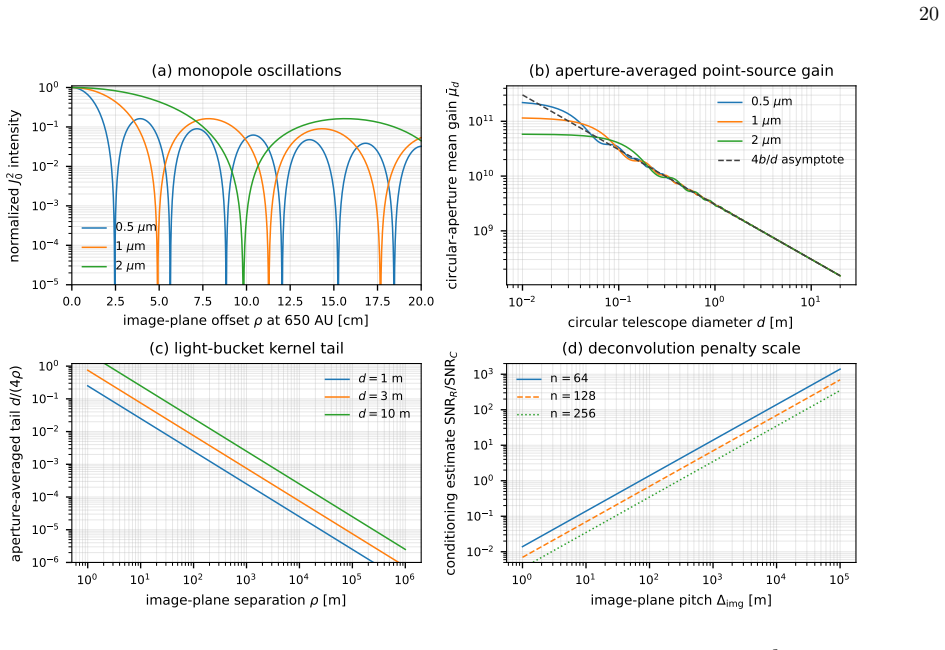
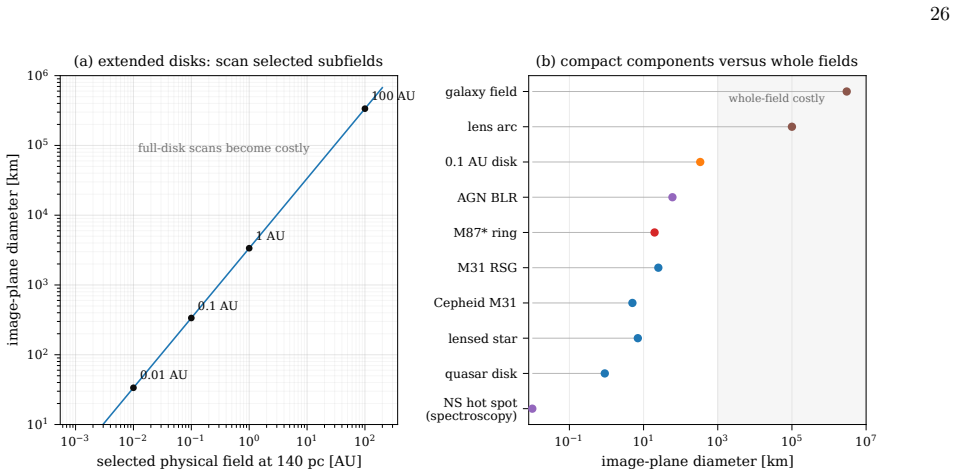
The mapping from source-plane coordinateξto image-plane coordinateρis ρ=− z z0 ξ,(A1) with scalar image-plane diameter Dimg = zΘ and pitch ∆ img = Dimg/n
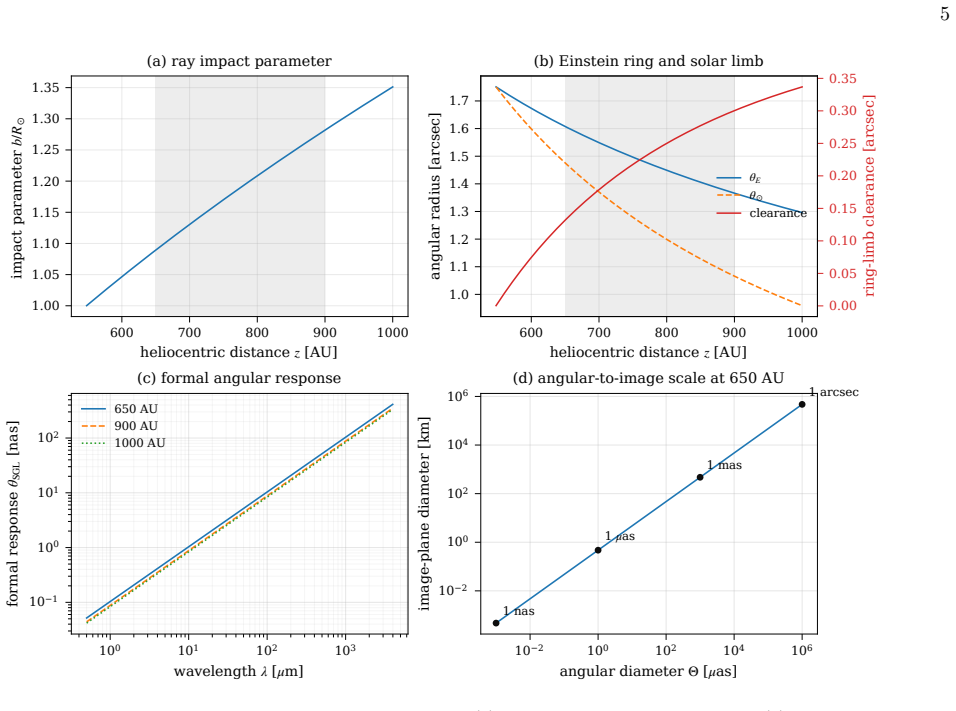
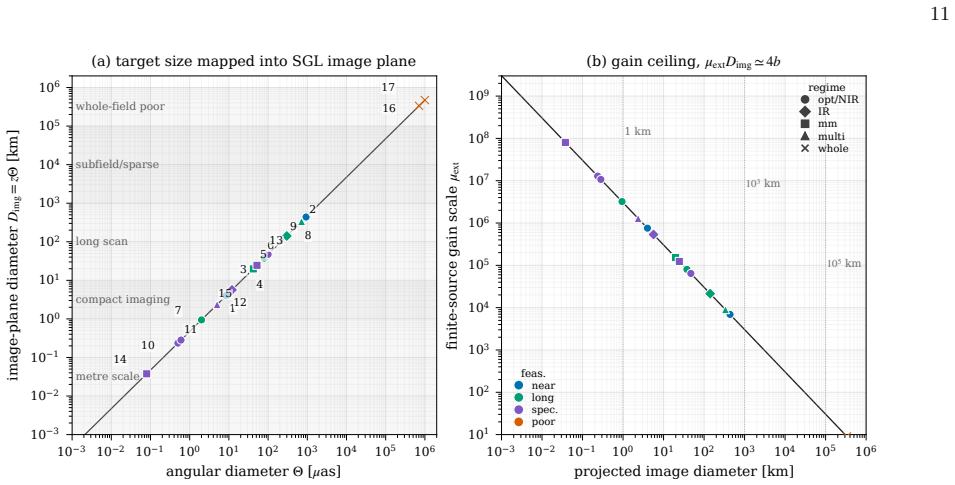
Common grid, mapping, and normalization Each source scene is represented on an n×n Cartesian grid in the SGL image plane, with total sample count N = n2. The mapping from source-plane coordinateξto image-plane coordinateρis ρ=− z z0 ξ,(A1) with scalar image-plane diameter Dimg = zΘ and pitch ∆ img = Dimg/n. This is the same physical image-plane sampling q...
-
[2]
The solar analog uses a limb-darkened disk, a granulation-like random field filtered to suppress pixel-scale noise, dark spot components, and bright plage-like components
Benchmark scenes and preprocessing The analytic scenes contain only dimensionless morphology before radiometric scaling. The solar analog uses a limb-darkened disk, a granulation-like random field filtered to suppress pixel-scale noise, dark spot components, and bright plage-like components. The white-dwarf scene uses a limb-darkened compact disk with bro...
-
[3]
The truth kernel is obtained by applying Eq
Kernel construction and PSF perturbations The nominal scalar kernel is the aperture-averaged light-bucket kernel K0(0) = 1, K 0(ρ >0) = d 4ρ ,(A2) 37 computed on the same image-plane grid, truncated at the computational field, and normalized to conserve total kernel weight on that field. The truth kernel is obtained by applying Eq. (32) and renormalizing ...
-
[4]
The variance of ni and the ampli- tude of si are scaled so that the convolved raster has the target SNRC in Table V
Noise, background, and calibration floors For each benchmark, the scalar measurement is yi = (HtrueO)i +b i +n i +s i,(A3) where bi is the mean residual background, ni is a Gaussian approximation to photon noise at the adopted source/background rate, and si is a low-frequency structured residual field. The variance of ni and the ampli- tude of si are scal...
-
[5]
Effective-SNR sensitivity diagnostic The SSIM-versus-SNRC curves in Fig. 4(b) are generated by holding the scalar scenes, masks, kernel family, support priors, and regularization convention fixed while varying only the effective convolved-raster information floor. The reported benchmark SSIM values are used as anchor points at the adopted SNRC values in T...
-
[6]
(21) using the nominal kernel K0
Reconstruction and regularization The baseline reconstruction is the Fourier/Wiener inverse in Eq. (21) using the nominal kernel K0. The regularization parameter γ is selected from the adopted noise level and the kernel transfer function, not from the hidden truth. A deterministic implementation can use a logarithmic grid in γ, choose the L-curve corner [...
-
[7]
(35)–(37)
Evaluation metrics Metrics are computed on the mask M using Eqs. (35)–(37). SSIM uses the same photometric normalization and dynamic range as NRMSE. FRC50 is obtained by Fourier-transforming the masked truth and reconstruction, computing the normalized cross-correlation in annuli of spatial frequency, and converting the first crossing of 0.5 to the natura...
-
[8]
S. G. Turyshev, Direct High-Resolution Imaging of Earth-Like Exoplanets, Phys. Rev. D113, 023034 (2026), arXiv:2506.20236 [astro-ph.IM]
arXiv 2026
-
[9]
S. G. Turyshev, Direct High-Resolution Imaging of Earth-like Exoplanets with the Solar Gravitational Lens (2026), arXiv:2606.14899 [astro-ph.IM]
arXiv 2026
-
[10]
Einstein, Lens-Like Action of a Star by the Deviation of Light in the Gravitational Field, Science84, 506 (1936)
A. Einstein, Lens-Like Action of a Star by the Deviation of Light in the Gravitational Field, Science84, 506 (1936)
1936
-
[11]
V. R. Eshleman, Gravitational Lens of the Sun: Its Potential for Observations and Communications over Interstellar Distances, Science205, 1133 (1979)
1979
-
[12]
S. G. Turyshev, Wave-Theoretical Description of the Solar Gravitational Lens, Phys. Rev. D95, 084041 (2017), arXiv:1703.05783 [gr-qc]
Pith/arXiv arXiv 2017
-
[13]
S. G. Turyshev and V. T. Toth, Diffraction of Electromagnetic Waves in the Gravitational Field of the Sun, Phys. Rev. D 96, 024008 (2017), arXiv:1704.06824 [gr-qc]
Pith/arXiv arXiv 2017
-
[14]
S. G. Turyshev and V. T. Toth, Photometric Imaging with the Solar Gravitational Lens, Phys. Rev. D101, 044025 (2020), arXiv:1909.03116 [gr-qc]
arXiv 2020
-
[15]
S. G. Turyshev and V. T. Toth, Image Formation Process with the Solar Gravitational Lens, Phys. Rev. D101, 044048 (2020), arXiv:1911.03260 [gr-qc]
arXiv 2020
-
[16]
S. G. Turyshev and V. T. Toth, Image Formation for Extended Sources with the Solar Gravitational Lens, Phys. Rev. D 102, 024038 (2020), arXiv:2002.06492 [astro-ph.IM]
arXiv 2020
-
[17]
V. T. Toth and S. G. Turyshev, Image Recovery with the Solar Gravitational Lens, Phys. Rev. D103, 124038 (2021), arXiv:2012.05477 [astro-ph.IM]
arXiv 2021
-
[18]
S. G. Turyshev and V. T. Toth, Resolved Imaging of Exoplanets with the Solar Gravitational Lens, Mon. Not. R. Astron. Soc.515, 6122 (2022), arXiv:2204.04866 [astro-ph.EP]
arXiv 2022
-
[19]
S. G. Turyshev and V. T. Toth, Spectrally Resolved Imaging with the Solar Gravitational Lens, Phys. Rev. D106, 044059 (2022), arXiv:2206.03037 [gr-qc]
arXiv 2022
-
[20]
V. T. Toth and S. G. Turyshev, Imaging Rotating and Orbiting Exoplanets with the Solar Gravitational Lens, Mon. Not. R. Astron. Soc.525, 5846 (2023), arXiv:2306.07832 [astro-ph.EP]
arXiv 2023
-
[21]
T. A. ten Brummelaar, H. A. McAlister, S. T. Ridgway, W. G. Bagnuolo, N. H. Turner, L. Sturmann, J. Sturmann, D. H. Berger, C. E. Ogden, R. Cadman, W. I. Hartkopf, C. H. Hopper, and M. A. Shure, First Results from the CHARA Array. II. A Description of the Instrument, Astrophys. J.628, 453 (2005), arXiv:astro-ph/0504082
Pith/arXiv arXiv 2005
-
[22]
J. D. Monnier, M. Zhao, E. Pedretti, N. Thureau, M. Ireland, P. Muirhead, J.-P. Berger, R. Millan-Gabet, G. Van Belle, T. ten Brummelaar,et al., Imaging the Surface of Altair, Science317, 342 (2007), arXiv:0706.0867 [astro-ph]
Pith/arXiv arXiv 2007
-
[23]
R. M. Roettenbacher, J. D. Monnier, H. Korhonen, A. N. Aarnio, F. Baron, X. Che, R. O. Harmon, Z. K˝ ov´ ari, S. Kraus, G. H. Schaefer,et al., No Sun-like Dynamo on the Active Star ζ Andromedae from Starspot Asymmetry, Nature533, 217 (2016), arXiv:1709.10107 [astro-ph.SR]
Pith/arXiv arXiv 2016
-
[24]
S. V. Berdyugina, Starspots: A Key to the Stellar Dynamo, Liv. Rev. Solar Phys.2, 8 (2005)
2005
-
[25]
J.-F. Donati and J. D. Landstreet, Magnetic Fields of Nondegenerate Stars, Ann. Rev. Astron. Astrophys.47, 333 (2009), arXiv:0904.1938 [astro-ph.SR]
Pith/arXiv arXiv 2009
-
[26]
D. T. Wickramasinghe and L. Ferrario, Magnetism in Isolated and Binary White Dwarfs, Publ. Astron. Soc. Pac.112, 873 (2000)
2000
-
[27]
L. Ferrario, D. de Martino, and B. T. G¨ ansicke, Magnetic White Dwarfs, Space Science Reviews191, 111 (2015), arXiv:1504.08072 [astro-ph.SR]. 39
Pith/arXiv arXiv 2015
-
[28]
Event Horizon Telescope Collaboration, First M87 Event Horizon Telescope Results. I. The Shadow of the Supermassive Black Hole, Astrophys. J. Lett.875, L1 (2019), arXiv:1906.11238 [astro-ph.GA]
Pith/arXiv arXiv 2019
-
[29]
Event Horizon Telescope Collaboration, First M87 Event Horizon Telescope Results. IV. Imaging the Central Supermassive Black Hole, Astrophys. J. Lett.875, L4 (2019), arXiv:1906.11241 [astro-ph.GA]
Pith/arXiv arXiv 2019
-
[30]
Event Horizon Telescope Collaboration, First Sagittarius A* Event Horizon Telescope Results. I. The Shadow of the Supermassive Black Hole in the Center of the Milky Way, Astrophys. J. Lett.930, L12 (2022), arXiv:2311.08680 [astro- ph.HE]
Pith/arXiv arXiv 2022
-
[31]
GRAVITY Collaboration, Spatially Resolved Rotation of the Broad-Line Region of a Quasar at Sub-Parsec Scale, Nature 563, 657 (2018), arXiv:1811.11195 [astro-ph.GA]
Pith/arXiv arXiv 2018
-
[32]
Sturm, Y
GRAVITY Collaboration, E. Sturm, Y. Cao, Y. Cl´ enet, R. Davies, J. Dexter, A. Eckart, F. Eisenhauer, R. Genzel, D. Gratadour,et al., The Core of the Matter—Spatially Resolving Active Galactic Nuclei with GRAVITY, The Messenger 188, 20 (2022)
2022
-
[33]
R. D. Blandford and C. F. McKee, Reverberation Mapping of the Emission Line Regions of Seyfert Galaxies and Quasars, Astrophys. J.255, 419 (1982)
1982
-
[34]
B. M. Peterson, Reverberation Mapping of Active Galactic Nuclei, Publ. Astron. Soc. Pac.105, 247 (1993)
1993
-
[35]
ALMA Partnership, C. L. Brogan, L. M. P´ erez, T. R. Hunter, W. R. F. Dent, A. S. Hales, R. E. Hills, S. Corder, E. B. Fomalont, C. Vlahakis, Y. Asaki,et al., The 2014 ALMA Long Baseline Campaign: First Results from High Angular Resolution Observations toward the HL Tau Region, Astrophys. J. Lett.808, L3 (2015), arXiv:1503.02649 [astro-ph.SR]
Pith/arXiv arXiv 2014
-
[36]
S. M. Andrews, J. Huang, L. M. P´ erez, A. Isella, C. P. Dullemond, N. T. Kurtovic, V. V. Guzm´ an, J. M. Carpenter, D. J. Wilner, S. Zhang,et al., The Disk Substructures at High Angular Resolution Project (DSHARP). I. Motivation, Sample, Calibration, and Overview, Astrophys. J. Lett.869, L41 (2018), arXiv:1812.04040 [astro-ph.SR]
Pith/arXiv arXiv 2018
-
[37]
N. Dalal and C. S. Kochanek, Direct Detection of Cold Dark Matter Substructure, Astrophys. J.572, 25 (2002), arXiv:astro- ph/0111456
arXiv 2002
-
[38]
S. Vegetti and L. V. E. Koopmans, Bayesian Strong Gravitational-Lens Modelling on Adaptive Grids: Objective Detection of Mass Substructure in Galaxies, Mon. Not. R. Astron. Soc.392, 945 (2009), arXiv:0805.0201 [astro-ph]
Pith/arXiv arXiv 2009
-
[39]
D. Gilman, S. Birrer, T. Treu, A. Nierenberg, and A. Benson, Probing Dark Matter Structure Down to 10 7 Solar Masses: Flux Ratio Statistics in Gravitational Lenses with Line-of-Sight Haloes, Mon. Not. R. Astron. Soc.487, 5721 (2019), arXiv:1901.11031 [astro-ph.CO]
Pith/arXiv arXiv 2019
-
[40]
J. Wambsganss, Gravitational Microlensing, inGravitational Lensing: Strong, Weak and Micro, Saas-Fee Advanced Courses, Vol. 33, edited by G. Meylan, P. Jetzer, and P. North (Springer, Berlin, Heidelberg, 2006) pp. 453–540, arXiv:astro- ph/0604278
arXiv 2006
-
[41]
C. S. Kochanek, Quantitative Interpretation of Quasar Microlensing Light Curves, Astrophys. J.605, 58 (2004), arXiv:astro- ph/0307422
arXiv 2004
-
[42]
A. G. Riess, W. Yuan, L. M. Macri, D. Scolnic, D. Brout, S. Casertano, D. O. Jones, Y. Murakami, L. Breuval, T. G. Brink, et al., A Comprehensive Measurement of the Local Value of the Hubble Constant with 1 km s−1 Mpc−1 Uncertainty from the Hubble Space Telescope and the SH0ES Team, Astrophys. J. Lett.934, L7 (2022), arXiv:2112.04510 [astro-ph.CO]
Pith/arXiv arXiv 2022
-
[43]
S. G. Turyshev and V. T. Toth, Imaging Point Sources with the Gravitational Lens of an Extended Sun, Phys. Rev. D104, 044032 (2021), arXiv:2104.08442 [gr-qc]
arXiv 2021
-
[44]
S. G. Turyshev and V. T. Toth, Imaging Faint Sources with the Extended Solar Gravitational Lens, Phys. Rev. D107, 104063 (2023), arXiv:2301.07495 [astro-ph.IM]
arXiv 2023
-
[45]
F. P. Pijpers, Helioseismic determination of the solar gravitational quadrupole moment, Mon. Not. R. Astron. Soc.297, L76 (1998), arXiv:astro-ph/9804258
Pith/arXiv arXiv 1998
-
[46]
R. Mecheri, T. Abdelatif, A. Irbah, J. Provost, and G. Berthomieu, New values of gravitational moments J2 and J4 deduced from helioseismology, Solar Physics222, 191 (2004), arXiv:0911.5055 [astro-ph.SR]
Pith/arXiv arXiv 2004
-
[47]
F. M. Walter, S. J. Wolk, and R. Neuh¨ auser, Discovery of a Nearby Isolated Neutron Star, Nature379, 233 (1996)
1996
-
[48]
F. ¨Ozel and P. Freire, Masses, Radii, and the Equation of State of Neutron Stars, Ann. Rev. Astron. Astrophys.54, 401 (2016), arXiv:1603.02698 [astro-ph.HE]
Pith/arXiv arXiv 2016
-
[49]
R. A. Remillard and J. E. McClintock, X-Ray Properties of Black-Hole Binaries, Ann. Rev. Astron. Astrophys.44, 49 (2006), arXiv:astro-ph/0606352
Pith/arXiv arXiv 2006
-
[50]
J. Casares and P. G. Jonker, Mass Measurements of Stellar and Intermediate-Mass Black Holes, Space Science Reviews 183, 223 (2014), arXiv:1311.5118 [astro-ph.HE]
Pith/arXiv arXiv 2014
-
[51]
L. D. Friedman, D. Garber, S. G. Turyshev, H. Helvajian, T. Heinsheimer, J. McVey, and A. R. Davoyan, A Mission to Nature’s Telescope for High-Resolution Imaging of an Exoplanet, Exp. Astron.57, 1 (2024), arXiv:2107.11473 [astro-ph.IM]
arXiv 2024
-
[52]
H. Helvajian, A. Rosenthal, J. Poklemba, T. A. Battista, M. D. DiPrinzio, J. M. Neff, J. P. McVey, V. T. Toth, and S. G. Turyshev, Mission Architecture to Reach and Operate at the Focal Region of the Solar Gravitational Lens, J. Spacecr. Rockets60, 829 (2023), arXiv:2207.03005 [astro-ph.IM]
arXiv 2023
-
[53]
Z. Wang, A. C. Bovik, H. R. Sheikh, and E. P. Simoncelli, Image quality assessment: From error visibility to structural similarity, IEEE Transactions on Image Processing13, 600 (2004)
2004
-
[54]
van Heel and M
M. van Heel and M. Schatz, Fourier Shell Correlation Threshold Criteria, Journal of Structural Biology151, 250 (2005)
2005
-
[55]
D. E. Winget and S. O. Kepler, Pulsating White Dwarf Stars and Precision Asteroseismology, Ann. Rev. Astron. Astrophys. 46, 157 (2008), arXiv:0806.2573 [astro-ph]
Pith/arXiv arXiv 2008
-
[56]
C. W. Morgan, C. S. Kochanek, N. D. Morgan, and E. E. Falco, The Quasar Accretion Disk Size–Black Hole Mass Relation, Astrophys. J.712, 1129 (2010), arXiv:0707.0305 [astro-ph]. 40
Pith/arXiv arXiv 2010
-
[57]
J. Jim´ enez-Vicente, E. Mediavilla, J. A. Mu˜ noz, and C. S. Kochanek, A Robust Determination of the Size of Quasar Accretion Disks Using Gravitational Microlensing, Astrophys. J.751, 106 (2012), arXiv:1201.3187 [astro-ph.CO]
Pith/arXiv arXiv 2012
-
[58]
K. Asada and M. Nakamura, The Structure of the M87 Jet: A Transition from Parabolic to Conical Streamlines, Astrophys. J. Lett.745, L28 (2012), arXiv:1110.1793 [astro-ph.HE]
Pith/arXiv arXiv 2012
-
[59]
L. Wang and J. C. Wheeler, Spectropolarimetry of Supernovae, Ann. Rev. Astron. Astrophys.46, 433 (2008), arXiv:0811.1054 [astro-ph]
Pith/arXiv arXiv 2008
-
[60]
P. L. Kellyet al., Multiple Images of a Highly Magnified Supernova Formed by an Early-Type Cluster Galaxy Lens, Science 347, 1123 (2015), arXiv:1411.6009 [astro-ph.CO]
Pith/arXiv arXiv 2015
-
[61]
P. L. Kellyet al., Deja Vu All Over Again: The Reappearance of Supernova Refsdal, Astrophys. J. Lett.819, L8 (2016), arXiv:1512.04654 [astro-ph.CO]
Pith/arXiv arXiv 2016
-
[62]
I. Labb´ eet al., A Population of Red Candidate Massive Galaxies∼600 Myr after the Big Bang, Nature616, 266 (2023), arXiv:2207.12446 [astro-ph.GA]
arXiv 2023
-
[63]
J. Mattheeet al., Little Red Dots: An Abundant Population of Faint Active Galactic Nuclei at z∼ 5 Revealed by the EIGER and FRESCO JWST Surveys, Astrophys. J.963, 129 (2024), arXiv:2306.05448 [astro-ph.GA]
arXiv 2024
-
[64]
J. E. Greeneet al., UNCOVER Spectroscopy Confirms the Surprising Ubiquity of Active Galactic Nuclei in Red Sources at z >5, Astrophys. J.964, 39 (2024), arXiv:2309.05714 [astro-ph.GA]
arXiv 2024
-
[65]
V. Kokorevet al., A Census of Photometrically Selected Little Red Dots at 4 < z < 9 in JWST Blank Fields, Astrophys. J. 968, 38 (2024), arXiv:2401.09981 [astro-ph.GA]
arXiv 2024
-
[66]
P. C. Hansen, Analysis of Discrete Ill-Posed Problems by Means of the L-Curve, SIAM Review34, 561 (1992)
1992
-
[67]
G. H. Golub, M. Heath, and G. Wahba, Generalized Cross-Validation as a Method for Choosing a Good Ridge Parameter, Technometrics21, 215 (1979)
1979
discussion (0)
Sign in with ORCID, Apple, or X to comment. Anyone can read and Pith papers without signing in.