Starter-Iterator Neural Operator: A Unified Architecture for High-Fidelity Forward and Inverse PDE Problems
Pith reviewed 2026-06-27 00:12 UTC · model grok-4.3
The pith
The Starter-Iterator Neural Operator combines frequency-domain initialization with time-domain iteration to solve forward and inverse PDE problems more accurately than single-domain methods.
A machine-rendered reading of the paper's core claim, the machinery that carries it, and where it could break.
Core claim
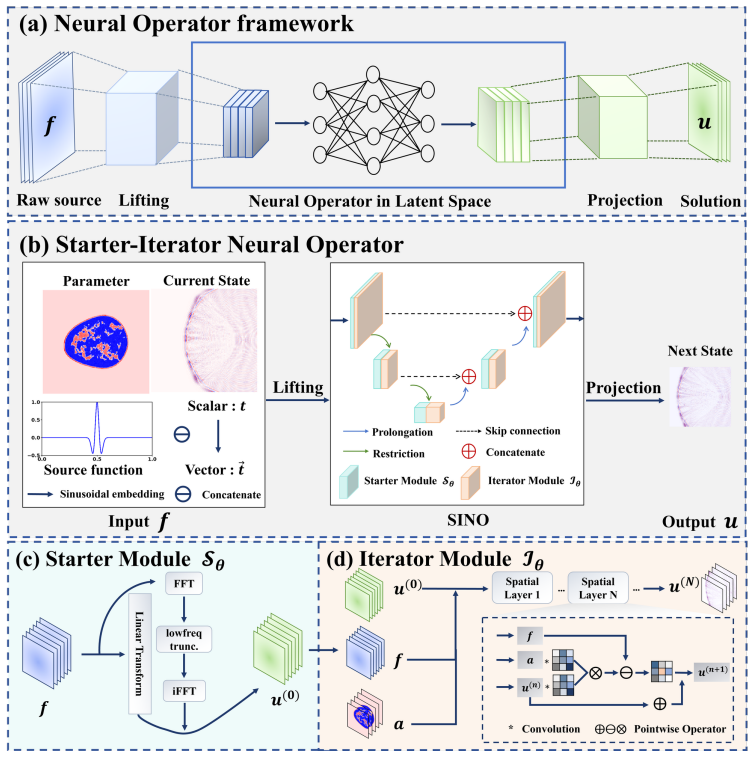
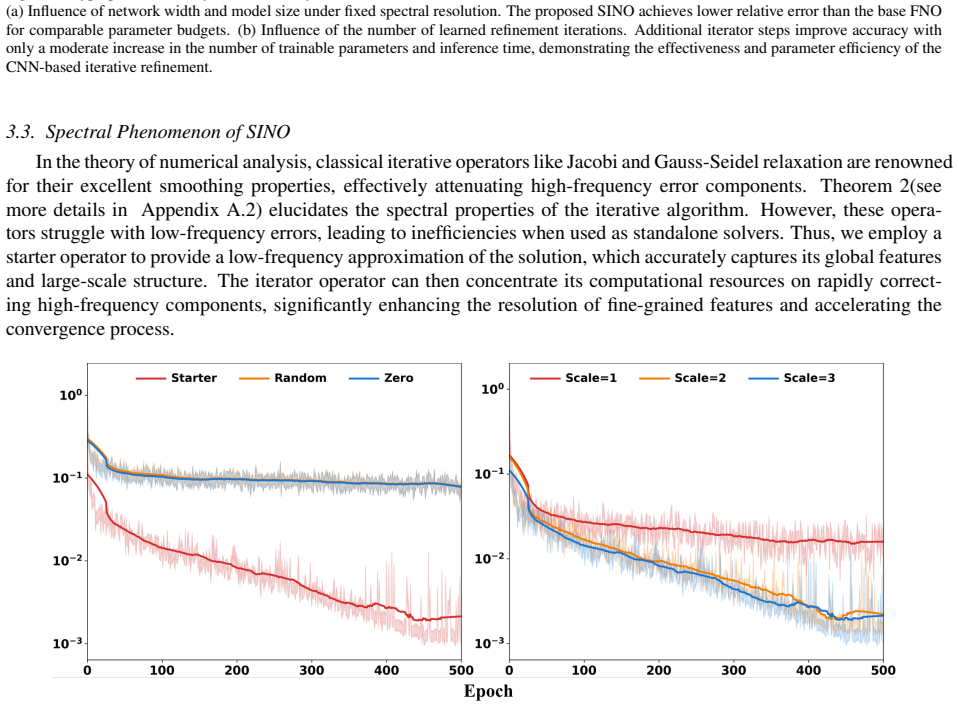
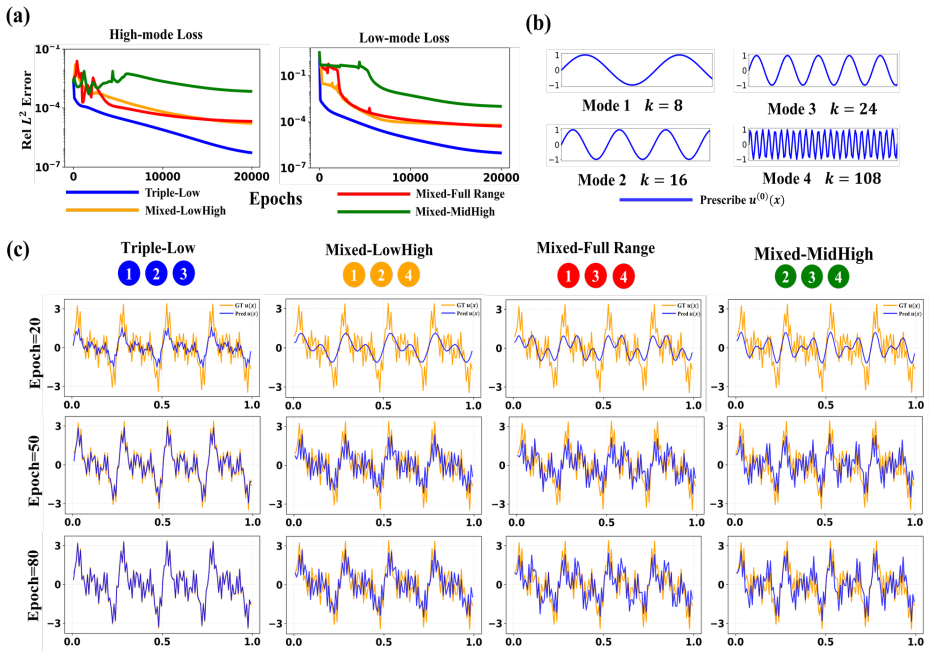
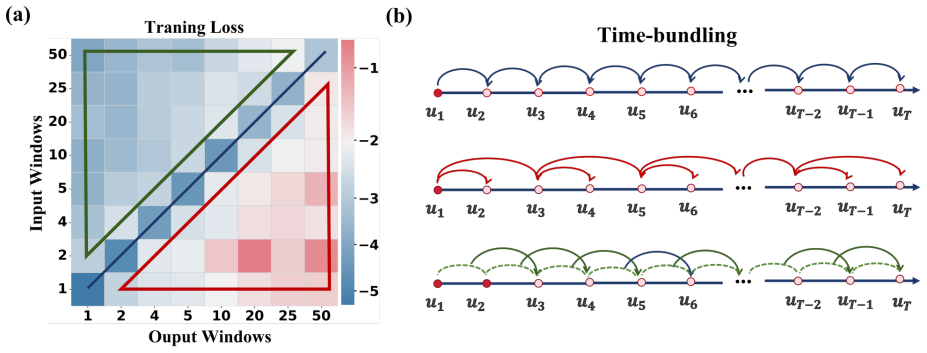
SINO reinterprets initialization strategies and iterative formats of traditional iterative methods through neural networks to create an efficient spectral-spatiotemporal collaborative modeling approach, where the frequency-domain initialization module captures globally stable low-frequency features and the time-domain learning module focuses on optimizing local solution residuals.
What carries the argument
Frequency-domain initialization module paired with time-domain learning module inside the Starter-Iterator Neural Operator for spectral-spatiotemporal collaborative modeling of PDE operators.
If this is right
- The architecture supplies a unified framework that meets the stringent accuracy needs of both forward simulation and inverse inference within a single model.
- It delivers a better trade-off between computational complexity and approximation accuracy for many-query tasks such as real-time prediction and parameter sweeps.
- Practical applications including super-resolution imaging and weather forecasting gain measurable improvements in robustness and generalization.
- The dual-module design directly mitigates precision bottlenecks that arise when complex boundaries or extended time horizons are present.
Where Pith is reading between the lines
- The same frequency-plus-time decomposition could be tested on other classes of operator-learning problems that currently suffer from domain-specific drift.
- If the modules prove additive, hybrid initialization schemes might be explored for additional dynamical systems not covered in the reported experiments.
- The unified forward-inverse capability suggests potential use in closed-loop control or data-assimilation pipelines that alternate between the two problem types.
Load-bearing premise
The frequency-domain initialization and time-domain learning modules effectively overcome the limitations of single-domain modeling for complex boundaries and long-term evolution.
What would settle it
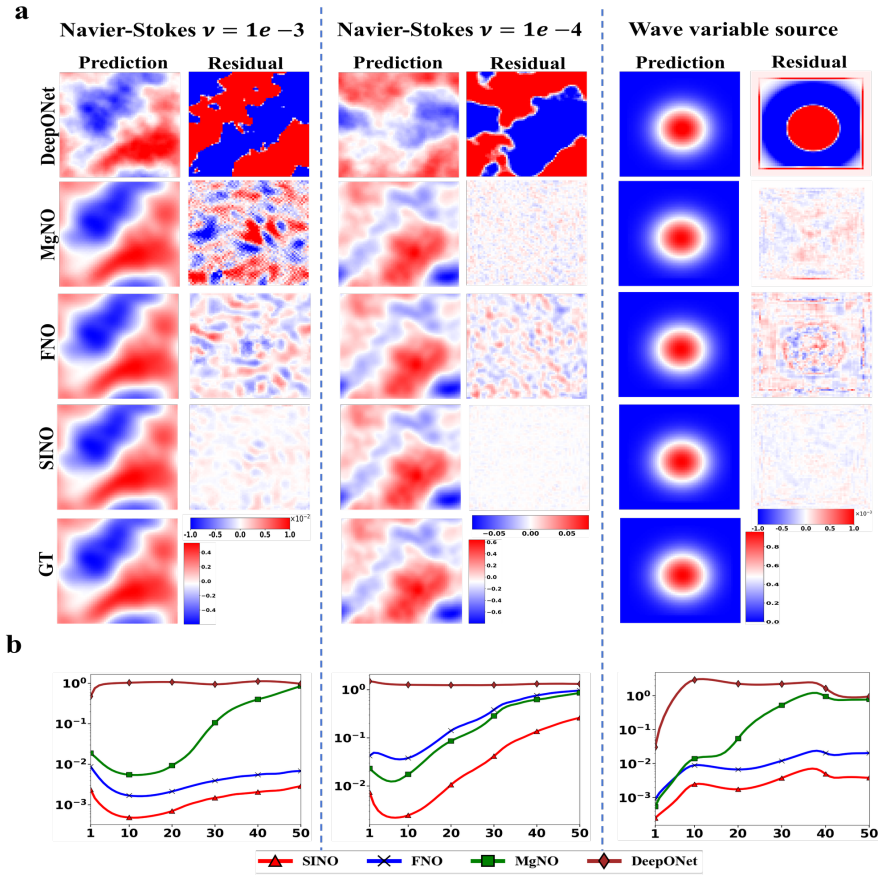
A controlled test on long-term evolution of the Navier-Stokes equations in which SINO shows no accuracy or generalization improvement over existing operator learning baselines would falsify the central performance claim.
Figures
read the original abstract
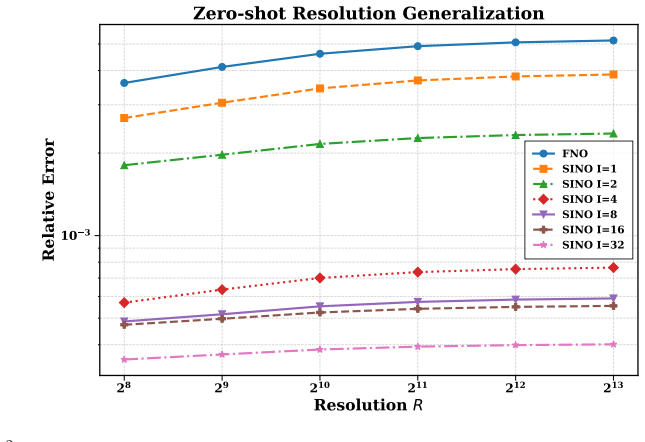
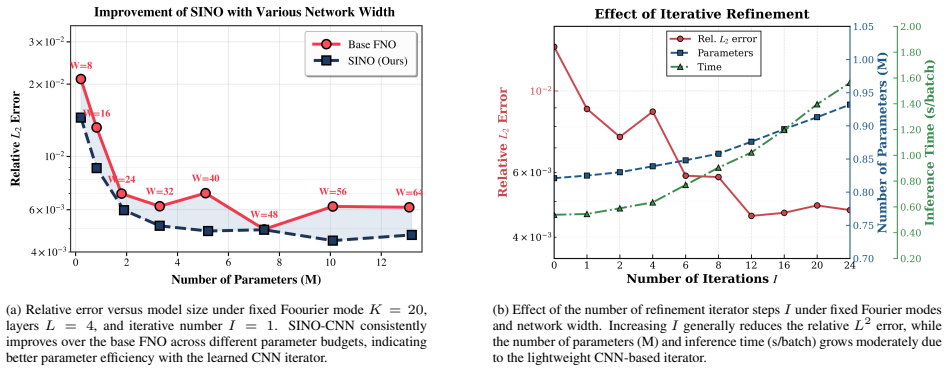
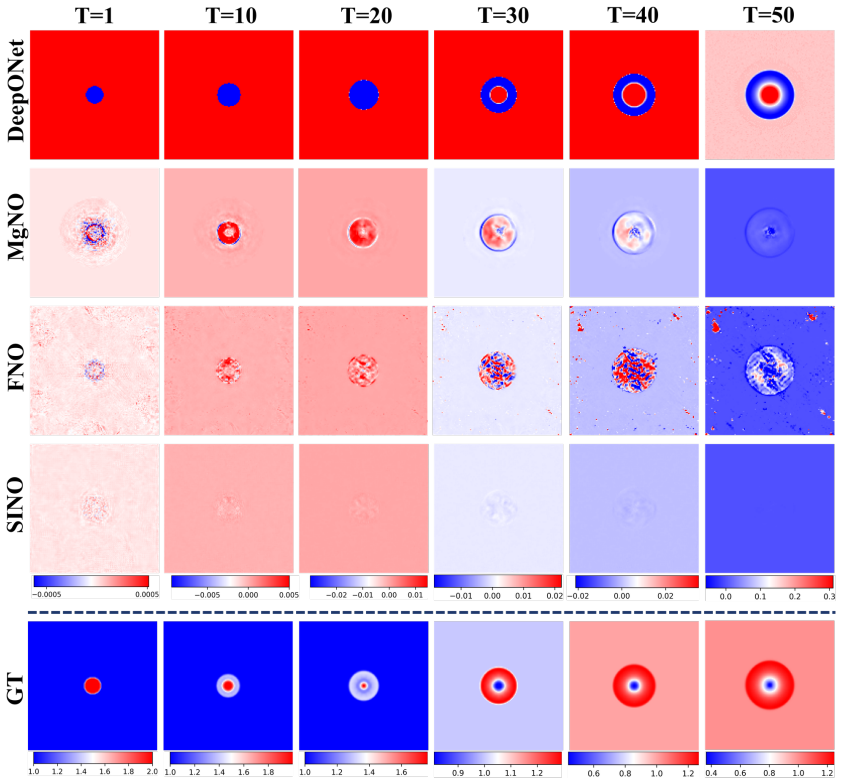
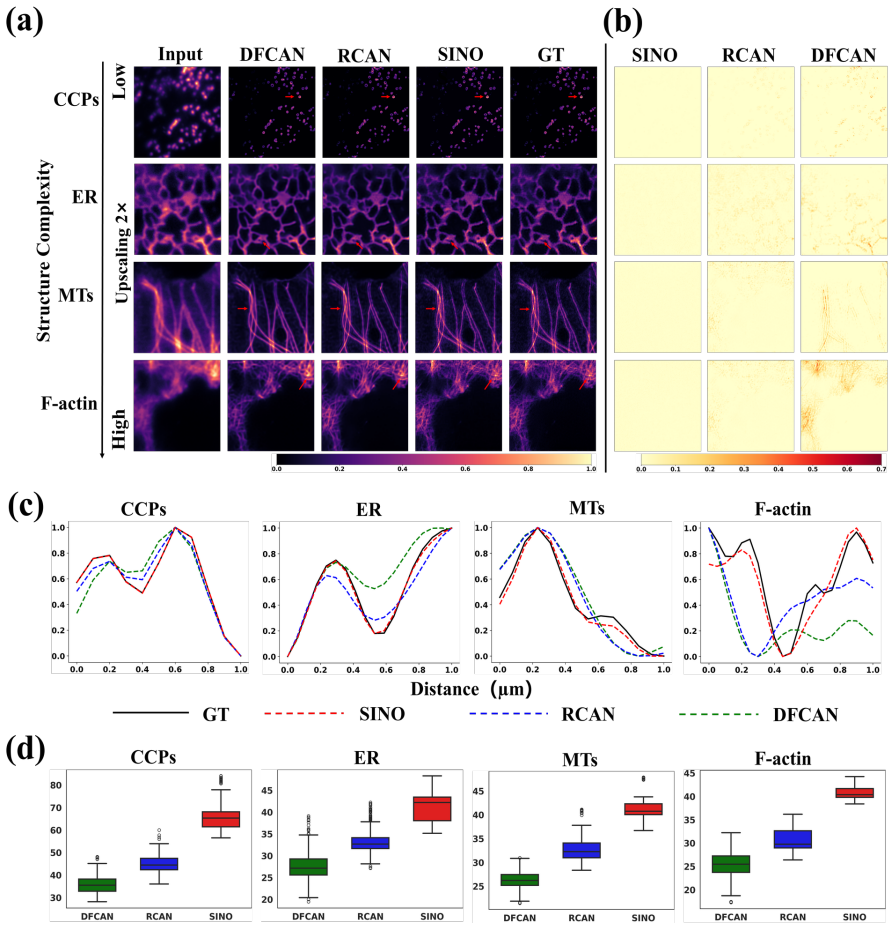
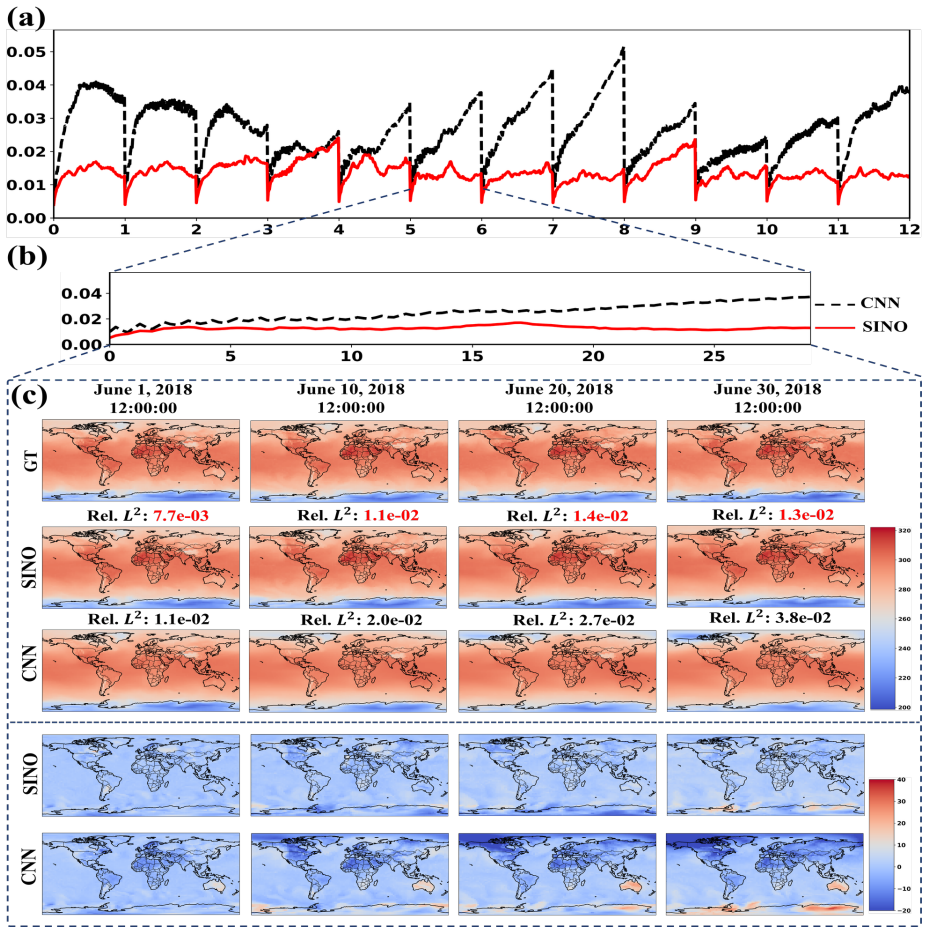
Operator learning is an emerging interdisciplinary field that integrates machine learning with scientific computing. By mapping infinite-dimensional function spaces, this approach provides an efficient surrogate modeling framework for high-dimensional partial differential equations (PDEs). Compared to traditional numerical solvers, it achieves a superior trade-off between computational complexity and approximation accuracy, demonstrating significant advantages in many-query tasks such as real-time prediction and parameter sweeps. Given the stringent accuracy requirements of both forward simulation and inverse inference, as well as the precision bottlenecks of existing operator learning methods in handling complex boundaries or long-term evolution, we propose the Starter-Iterator Neural Operator (SINO). Our framework reinterprets the initialization strategies and iterative formats of traditional iterative methods through neural networks, establishing an efficient approach for spectral-spatiotemporal collaborative modeling. Specifically, the frequency-domain initialization module captures globally stable low-frequency features, while the time-domain learning module focuses on optimizing local solution residuals, thereby effectively overcoming the inherent limitations of conventional single-domain modeling approaches. Extensive experiments on typical dynamical systems such as the Navier-Stokes equations and acoustic wave equations, as well as practical applications including super-resolution imaging and weather forecasting, demonstrate that SINO achieves outstanding performance in numerical accuracy, generalization capability, and robustness.
Editorial analysis
A structured set of objections, weighed in public.
Referee Report
Summary. The manuscript proposes the Starter-Iterator Neural Operator (SINO), a unified neural architecture for high-fidelity forward and inverse PDE problems. It reinterprets initialization and iteration from traditional solvers via neural networks, using a frequency-domain initialization module to capture globally stable low-frequency features and a time-domain learning module to optimize local residuals for spectral-spatiotemporal collaborative modeling. The central claim is that this overcomes limitations of single-domain approaches for complex boundaries and long-term evolution, with extensive experiments on Navier-Stokes equations, acoustic wave equations, super-resolution imaging, and weather forecasting demonstrating outstanding numerical accuracy, generalization, and robustness.
Significance. If the performance claims hold with rigorous validation, SINO could advance operator learning by offering an efficient surrogate framework that improves the accuracy-complexity trade-off for many-query PDE tasks. The spectral-spatiotemporal split addresses a recognized gap in existing methods and, if substantiated, would strengthen the case for hybrid domain modeling in scientific machine learning.
minor comments (3)
- The abstract asserts 'outstanding performance' and 'extensive experiments' without any quantitative error metrics, baseline comparisons, or dataset details; adding a concise summary of key results (e.g., relative L2 errors versus FNO or DeepONet) would strengthen the summary paragraph.
- Notation for the frequency-domain and time-domain modules is introduced at a high level; a dedicated subsection or diagram clarifying the exact network architectures, activation functions, and how the starter and iterator components are combined would improve reproducibility.
- The manuscript should explicitly state the training loss, optimizer settings, and hyperparameter ranges used across all experiments to allow direct comparison with prior operator-learning work.
Simulated Author's Rebuttal
We thank the referee for the positive assessment of our manuscript and the recommendation for minor revision. The recognition of SINO's potential to advance hybrid domain modeling in scientific machine learning is appreciated.
Circularity Check
No significant circularity in derivation chain
full rationale
The paper presents SINO as a proposed neural architecture that reinterprets traditional iterative methods via neural networks for spectral-spatiotemporal modeling of PDEs. No equations, uniqueness theorems, or fitted parameters are shown to reduce by construction to the inputs or to self-citations; performance claims rest on experimental validation across Navier-Stokes, wave equations, and applications rather than any self-definitional or load-bearing derivation step. The architecture description and results are self-contained against external benchmarks.
Axiom & Free-Parameter Ledger
Reference graph
Works this paper leans on
-
[1]
J. Li, Y . Xue, Y . Li, H. Jia, Z. Zhou, L. Yang, S. Ren, J. Chen, Y . He, K. Xue, et al., Fully analog iteration for solving matrix equations with in-memory computing, Science Advances 11 (7) (2025) eadr6391
2025
-
[2]
Y . Tang, R. Chen, M. Lou, J. Fan, C. Yu, A. Nonaka, Z. Yao, W. Gao, Optical neural engine for solving scientific partial differential equations, Nature Communications 16 (1) (2025) 4603
2025
-
[3]
K. Ding, J. Yu, J. Huang, Y . Yang, Q. Zhang, H. Chen, Scitoolagent: a knowledge-graph-driven scientific agent for multitool integration, Nature Computational Science (2025) 1–11
2025
-
[4]
W. He, J. Li, X. Kong, L. Deng, Multi-level physics informed deep learning for solving partial differential equations in computational structural mechanics, Communications Engineering 3 (1) (2024) 151
2024
-
[5]
K. L. Tsakmakidis, T. P. Stefa ´nski, Discovery of the exact 3d one-way wave equation, Nature Communications 16 (1) (2025) 5719
2025
-
[6]
Allen, S
A. Allen, S. Markou, W. Tebbutt, J. Requeima, W. P. Bruinsma, T. R. Andersson, M. Herzog, N. D. Lane, M. Chantry, J. S. Hosking, et al., End-to-end data-driven weather prediction, Nature 641 (8065) (2025) 1172– 1179
2025
-
[7]
Bauer, P
P. Bauer, P. Dueben, M. Chantry, F. Doblas-Reyes, T. Hoefler, A. McGovern, B. Stevens, Deep learning and a changing economy in weather and climate prediction, Nature Reviews Earth & Environment 4 (8) (2023) 507– 509
2023
-
[8]
Aarts, K
G. Aarts, K. Fukushima, T. Hatsuda, A. Ipp, S. Shi, L. Wang, K. Zhou, Physics-driven learning for inverse problems in quantum chromodynamics, Nature Reviews Physics 7 (3) (2025) 154–163
2025
-
[9]
Tarantola, Inverse problem theory and methods for model parameter estimation, SIAM (2005)
A. Tarantola, Inverse problem theory and methods for model parameter estimation, SIAM (2005)
2005
-
[10]
C. Lyu, B. Romanowicz, L. Zhao, Y . Masson, Efficient hybrid numerical modeling of the seismic wavefield in the presence of solid-fluid boundaries, Nature Communications 16 (1) (2025) 1722. 31
2025
-
[11]
H. Zhao, Z. Liu, J. Tang, B. Gao, Q. Qin, J. Li, Y . Zhou, P. Yao, Y . Xi, Y . Lin, et al., Energy-efficient high-fidelity image reconstruction with memristor arrays for medical diagnosis, Nature Communications 14 (1) (2023) 2276
2023
-
[12]
Carleo, I
G. Carleo, I. Cirac, K. Cranmer, L. Daudet, M. Schuld, N. Tishby, L. V ogt-Maranto, L. Zdeborová, Machine learning and the physical sciences, Reviews of Modern Physics 91 (4) (2019) 045002
2019
-
[13]
S. L. Brunton, J. N. Kutz, Promising directions of machine learning for partial differential equations, Nature Computational Science 4 (7) (2024) 483–494
2024
-
[14]
Kontolati, S
K. Kontolati, S. Goswami, G. Em Karniadakis, M. D. Shields, Learning nonlinear operators in latent spaces for real-time predictions of complex dynamics in physical systems, Nature Communications 15 (1) (2024) 5101
2024
-
[15]
Zappala, A
E. Zappala, A. H. d. O. Fonseca, J. O. Caro, A. H. Moberly, M. J. Higley, J. Cardin, D. v. Dijk, Learning integral operators via neural integral equations, Nature Machine Intelligence 6 (9) (2024) 1046–1062
2024
-
[16]
Georgiou, C
K. Georgiou, C. Siettos, A. N. Yannacopoulos, Fredholm neural networks, SIAM Journal on Scientific Comput- ing 47 (4) (2025) C1006–C1031
2025
-
[17]
Azizzadenesheli, N
K. Azizzadenesheli, N. Kovachki, Z. Li, M. Liu-Schiaffini, J. Kossaifi, A. Anandkumar, Neural operators for accelerating scientific simulations and design, Nature Reviews Physics 6 (5) (2024) 320–328
2024
-
[18]
B. Wu, C. Liu, B. Eckart, J. Kautz, Neural interferometry: Image reconstruction from astronomical interferom- eters using transformer-conditioned neural fields, in: Proceedings of the AAAI Conference on Artificial Intelli- gence, V ol. 36, 2022, pp. 2685–2693
2022
-
[19]
J. N. Reddy, An introduction to the finite element method, New York 27 (14) (1993)
1993
-
[20]
G. D. Smith, Numerical solution of partial differential equations: finite difference methods, Oxford University Press (1985)
1985
-
[21]
Eymard, T
R. Eymard, T. Gallouët, R. Herbin, Finite volume methods, Handbook of numerical analysis 7 (2000) 713–1018
2000
-
[22]
J. Shen, T. Tang, L.-L. Wang, Spectral methods: algorithms, analysis and applications, Springer Science & Business Media (2011)
2011
-
[23]
Zhang, A
E. Zhang, A. Kahana, A. Kopani ˇcáková, E. Turkel, R. Ranade, J. Pathak, G. E. Karniadakis, Blending neural operators and relaxation methods in pde numerical solvers, Nature Machine Intelligence 6 (11) (2024) 1303– 1313
2024
-
[24]
A. Jiao, H. He, R. Ranade, J. Pathak, L. Lu, One-shot learning for solution operators of partial differential equations, Nature Communications 16 (1) (2025) 8386
2025
-
[25]
J. M. Ortega, M. L. Rockoff, Nonlinear difference equations and gauss-seidel type iterative methods, SIAM Journal on Numerical Analysis 3 (3) (1966) 497–513
1966
-
[26]
Saad, Krylov subspace methods for solving large unsymmetric linear systems, Mathematics of computation 37 (155) (1981) 105–126
Y . Saad, Krylov subspace methods for solving large unsymmetric linear systems, Mathematics of computation 37 (155) (1981) 105–126
1981
-
[27]
M. R. Hestenes, E. Stiefel, et al., Methods of conjugate gradients for solving linear systems, Journal of research of the National Bureau of Standards 49 (6) (1952) 409–436
1952
-
[28]
Y . Saad, M. H. Schultz, Gmres: A generalized minimal residual algorithm for solving nonsymmetric linear systems, SIAM Journal on scientific and statistical computing 7 (3) (1986) 856–869
1986
-
[29]
A. H. Sherman, On newton-iterative methods for the solution of systems of nonlinear equations, SIAM Journal on Numerical Analysis 15 (4) (1978) 755–771
1978
-
[30]
Molinaro, Y
R. Molinaro, Y . Yang, B. Engquist, S. Mishra, Neural inverse operators for solving pde inverse problems, in: Proceedings of the 40th International Conference on Machine Learning, ICML’23, JMLR.org, 2023
2023
-
[31]
Z. Li, H. Zheng, N. Kovachki, D. Jin, H. Chen, B. Liu, K. Azizzadenesheli, A. Anandkumar, Physics-informed neural operator for learning partial differential equations, ACM/IMS Journal of Data Science 1 (3) (2024) 1–27. 32
2024
-
[32]
X. Liu, H. Tang, Difffno: Diffusion fourier neural operator, in: Proceedings of the Computer Vision and Pattern Recognition Conference, 2025, pp. 150–160
2025
-
[33]
Kovachki, Z
N. Kovachki, Z. Li, B. Liu, K. Azizzadenesheli, K. Bhattacharya, A. Stuart, A. Anandkumar, Neural operator: Learning maps between function spaces with applications to pdes, Journal of Machine Learning Research 24 (89) (2023) 1–97
2023
-
[34]
J. S. Hesthaven, S. Ubbiali, Non-intrusive reduced order modeling of nonlinear problems using neural networks, Journal of Computational Physics 363 (2018) 55–78
2018
-
[35]
Bhattacharya, B
K. Bhattacharya, B. Hosseini, N. B. Kovachki, A. M. Stuart, Model reduction and neural networks for parametric pdes, The SMAI journal of computational mathematics 7 (2021) 121–157
2021
-
[36]
O’Leary-Roseberry, U
T. O’Leary-Roseberry, U. Villa, P. Chen, O. Ghattas, Derivative-informed projected neural networks for high- dimensional parametric maps governed by pdes, Computer Methods in Applied Mechanics and Engineering 388 (2022) 114199
2022
-
[37]
L. Lu, P. Jin, G. Pang, Z. Zhang, G. E. Karniadakis, Learning nonlinear operators via deeponet based on the universal approximation theorem of operators, Nature machine intelligence 3 (3) (2021) 218–229
2021
-
[38]
J. He, S. Koric, D. Abueidda, A. Najafi, I. Jasiuk, Geom-deeponet: A point-cloud-based deep operator network for field predictions on 3d parameterized geometries, Computer Methods in Applied Mechanics and Engineering 429 (2024) 117130
2024
-
[39]
W. Xu, Y . Lu, L. Wang, Transfer learning enhanced deeponet for long-time prediction of evolution equations, in: Proceedings of the AAAI Conference on Artificial Intelligence, V ol. 37, 2023, pp. 10629–10636
2023
-
[40]
L. Lu, X. Meng, S. Cai, Z. Mao, S. Goswami, Z. Zhang, G. E. Karniadakis, A comprehensive and fair comparison of two neural operators (with practical extensions) based on fair data, Computer Methods in Applied Mechanics and Engineering 393 (2022) 114778
2022
-
[41]
Z. Li, N. B. Kovachki, K. Azizzadenesheli, B. liu, K. Bhattacharya, A. Stuart, A. Anandkumar, Fourier neural operator for parametric partial differential equations, in: International Conference on Learning Representations, 2021
2021
-
[42]
V . S. Fanaskov, I. V . Oseledets, Spectral neural operators, in: Doklady Mathematics, V ol. 108, Springer, 2023, pp. S226–S232
2023
-
[43]
Tripura, S
T. Tripura, S. Chakraborty, Wavelet neural operator for solving parametric partial differential equations in com- putational mechanics problems, Computer Methods in Applied Mechanics and Engineering 404 (2023) 115783
2023
-
[44]
Q. Cao, S. Goswami, G. E. Karniadakis, Laplace neural operator for solving differential equations, Nature Ma- chine Intelligence 6 (6) (2024) 631–640
2024
-
[45]
K. Li, W. Ye, D-fno: A decomposed fourier neural operator for large-scale parametric partial differential equa- tions, Computer Methods in Applied Mechanics and Engineering 436 (2025) 117732
2025
-
[46]
Lehmann, F
F. Lehmann, F. Gatti, M. Bertin, D. Clouteau, 3d elastic wave propagation with a factorized fourier neural operator (f-fno), Computer Methods in Applied Mechanics and Engineering 420 (2024) 116718
2024
-
[47]
M. A. Rahman, Z. E. Ross, K. Azizzadenesheli, U-NO: U-shaped neural operators, Transactions on Machine Learning Research (2023)
2023
-
[48]
J. He, X. Liu, J. Xu, Mgno: Efficient parameterization of linear operators via multigrid, in: The Twelfth Interna- tional Conference on Learning Representations, 2024
2024
-
[49]
B. M. DeBlois, Linearizing convection terms in the navier-stokes equations, Computer methods in applied me- chanics and engineering 143 (3-4) (1997) 289–297
1997
-
[50]
J. M. Borwein, G. Li, M. K. Tam, Convergence rate analysis for averaged fixed point iterations in common fixed point problems, SIAM Journal on Optimization 27 (1) (2017) 1–33. 33
2017
-
[51]
J. Ho, A. Jain, P. Abbeel, Denoising diffusion probabilistic models, Advances in neural information processing systems 33 (2020) 6840–6851
2020
-
[52]
Vaswani, N
A. Vaswani, N. Shazeer, N. Parmar, J. Uszkoreit, L. Jones, A. N. Gomez, Ł. Kaiser, I. Polosukhin, Attention is all you need, Advances in neural information processing systems 30 (2017)
2017
-
[53]
Stevens, L
E. Stevens, L. Antiga, T. Viehmann, Deep Learning with PyTorch: Build, train, and tune neural networks using Python tools, Manning, 2020
2020
-
[54]
Xu, Iterative methods by space decomposition and subspace correction, SIAM review 34 (4) (1992) 581–613
J. Xu, Iterative methods by space decomposition and subspace correction, SIAM review 34 (4) (1992) 581–613
1992
- [55]
-
[56]
Takamoto, T
M. Takamoto, T. Praditia, R. Leiteritz, D. MacKinlay, F. Alesiani, D. Pflüger, M. Niepert, Pdebench: An exten- sive benchmark for scientific machine learning, Advances in Neural Information Processing Systems 35 (2022) 1596–1611
2022
-
[57]
M. J. Rust, M. Bates, X. Zhuang, Sub-diffraction-limit imaging by stochastic optical reconstruction microscopy (storm), Nature methods 3 (10) (2006) 793–796
2006
-
[58]
Betzig, G
E. Betzig, G. H. Patterson, R. Sougrat, O. W. Lindwasser, S. Olenych, J. S. Bonifacino, M. W. Davidson, J. Lippincott-Schwartz, H. F. Hess, Imaging intracellular fluorescent proteins at nanometer resolution, science 313 (5793) (2006) 1642–1645
2006
-
[59]
D. Li, L. Shao, B.-C. Chen, X. Zhang, M. Zhang, B. Moses, D. E. Milkie, J. R. Beach, J. A. Hammer III, M. Pasham, et al., Extended-resolution structured illumination imaging of endocytic and cytoskeletal dynamics, Science 349 (6251) (2015) aab3500
2015
-
[60]
C. Qiao, D. Li, Y . Guo, C. Liu, T. Jiang, Q. Dai, D. Li, Evaluation and development of deep neural networks for image super-resolution in optical microscopy, Nature methods 18 (2) (2021) 194–202
2021
-
[61]
Zhang, K
Y . Zhang, K. Li, K. Li, L. Wang, B. Zhong, Y . Fu, Image super-resolution using very deep residual channel attention networks, in: Proceedings of the European conference on computer vision (ECCV), 2018, pp. 286– 301
2018
-
[62]
L. Chen, X. Zhong, F. Zhang, Y . Cheng, Y . Xu, Y . Qi, H. Li, Fuxi: a cascade machine learning forecasting system for 15-day global weather forecast, npj climate and atmospheric science 6 (1) (2023) 190
2023
-
[63]
K. Bi, L. Xie, H. Zhang, X. Chen, X. Gu, Q. Tian, Accurate medium-range global weather forecasting with 3d neural networks, Nature 619 (7970) (2023) 533–538
2023
-
[64]
Kurth, S
T. Kurth, S. Subramanian, P. Harrington, J. Pathak, M. Mardani, D. Hall, A. Miele, K. Kashinath, A. Anandku- mar, Fourcastnet: Accelerating global high-resolution weather forecasting using adaptive fourier neural opera- tors, in: Proceedings of the platform for advanced scientific computing conference, 2023, pp. 1–11
2023
-
[65]
K. Lin, X. Li, Y . Ye, S. Feng, B. Zhang, G. Xu, Z. Wang, Spherical neural operator network for global weather prediction, IEEE Transactions on Circuits and Systems for Video Technology 34 (6) (2023) 4899–4913
2023
-
[66]
S. Rasp, P. D. Dueben, S. Scher, J. A. Weyn, S. Mouatadid, N. Thuerey, Weatherbench: a benchmark data set for data-driven weather forecasting, Journal of Advances in Modeling Earth Systems 12 (11) (2020) e2020MS002203
2020
-
[67]
Gilton, G
D. Gilton, G. Ongie, R. Willett, Deep equilibrium architectures for inverse problems in imaging, IEEE Transac- tions on Computational Imaging 7 (2021) 1123–1133
2021
-
[68]
Y . Yang, Q. Gao, Y . Duan, Low-resolution prior equilibrium network for ct reconstruction, Inverse Problems 40 (8) (2024) 085010. 34
2024
-
[69]
T. Chen, H. Chen, Universal approximation to nonlinear operators by neural networks with arbitrary activation functions and its application to dynamical systems, IEEE transactions on neural networks 6 (4) (1995) 911–917
1995
-
[70]
Kovachki, S
N. Kovachki, S. Lanthaler, S. Mishra, On universal approximation and error bounds for fourier neural operators, Journal of Machine Learning Research 22 (290) (2021) 1–76
2021
-
[71]
Monga, Y
V . Monga, Y . Li, Y . C. Eldar, Algorithm unrolling: Interpretable, efficient deep learning for signal and image processing, IEEE Signal Processing Magazine 38 (2) (2021) 18–44
2021
-
[72]
Z.-Q. J. Xu, Y . Zhang, Z. Zhou, An overview of condensation phenomenon in deep learning, arXiv preprint arXiv:2504.09484 (2025)
work page internal anchor Pith review Pith/arXiv arXiv 2025
- [73]
-
[74]
D. I. Ketcheson, K. Mandli, A. J. Ahmadia, A. Alghamdi, M. Q. De Luna, M. Parsani, M. G. Knepley, M. Em- mett, Pyclaw: Accessible, extensible, scalable tools for wave propagation problems, SIAM Journal on Scientific Computing 34 (4) (2012) C210–C231. 35 Figure D.12: Summary of the time-evolution PDE benchmarks considered in this work, including the govern...
2012
discussion (0)
Sign in with ORCID, Apple, or X to comment. Anyone can read and Pith papers without signing in.