Late-time JWST/NIRCam Observations of the Extremely Long-duration GRB 250702B/EP 250702a and Its Host Galaxy
Pith reviewed 2026-06-26 22:46 UTC · model grok-4.3
The pith
Late-time JWST observations of GRB 250702B yield marginal detections in F150W and F200W that would indicate light-curve flattening if real.
A machine-rendered reading of the paper's core claim, the machinery that carries it, and where it could break.
Core claim
If the ~3 sigma detections in F150W (~27.9 AB) and F200W (~27.4 AB) are secure, they indicate late-time light curve flattening consistent with jetted TDEs or a supernova plus GRB afterglow model.
What carries the argument
Forced photometry performed on the JWST/NIRCam images in the F150W and F200W bands at the transient position near the host dust lane.
If this is right
- The detections would favor models in which the transient is a jetted tidal disruption event rather than a standard collapsar-driven GRB.
- The host would stand as the most massive and luminous GRB host known at similar redshift under a collapsar interpretation.
- If the signals are instead upper limits they remain consistent with an unbroken power-law afterglow decline.
- Template imaging is required to remove the ambiguity between transient emission and host light.
Where Pith is reading between the lines
- Confirmation of flattening would require re-examination of other ultra-long GRBs for possible TDE contributions.
- The marginal nature of the signals illustrates that even deep infrared observations can leave the physical origin of extreme transients unresolved without repeated epochs.
Load-bearing premise
The ~3 sigma signals in F150W and F200W represent real transient emission rather than noise, host contamination, or reduction artifacts.
What would settle it
Late-time template observations with JWST/NIRCam that either recover the same flux levels or show the source has faded below the reported magnitudes.
Figures
read the original abstract
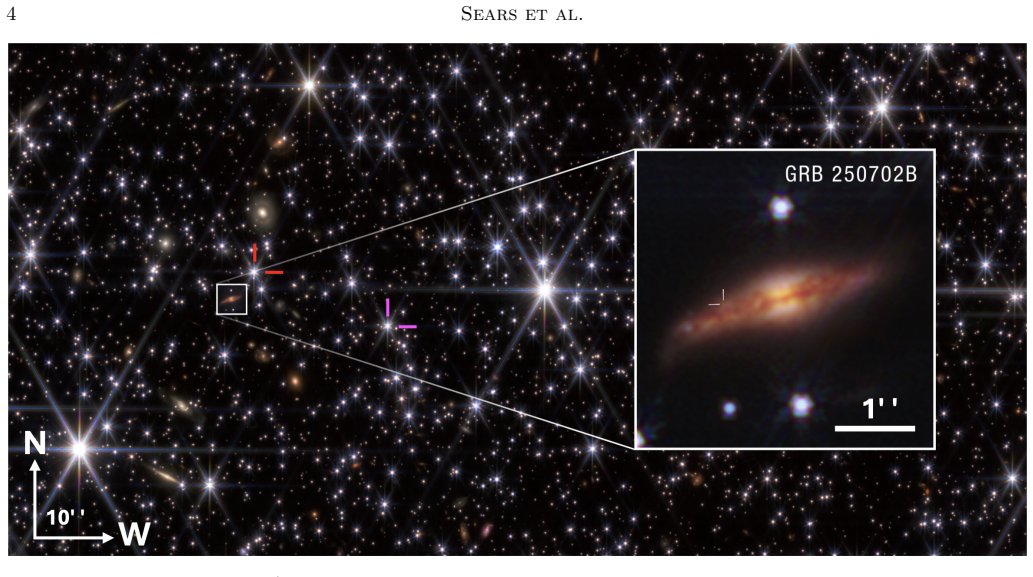
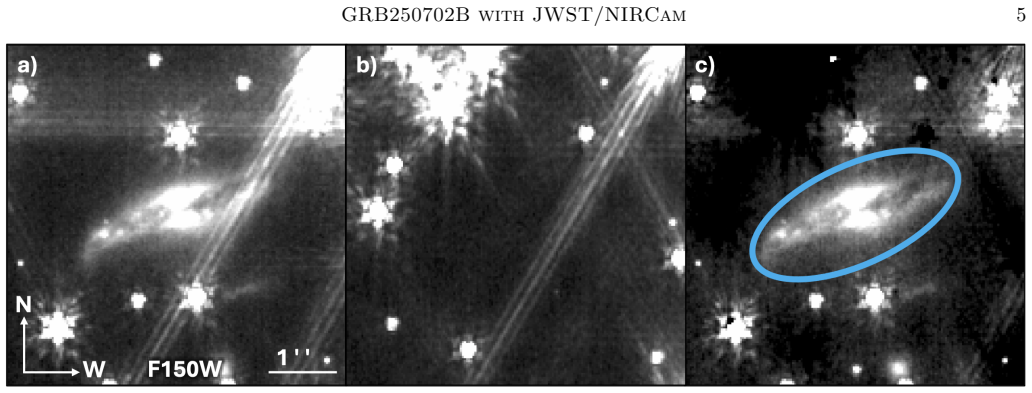
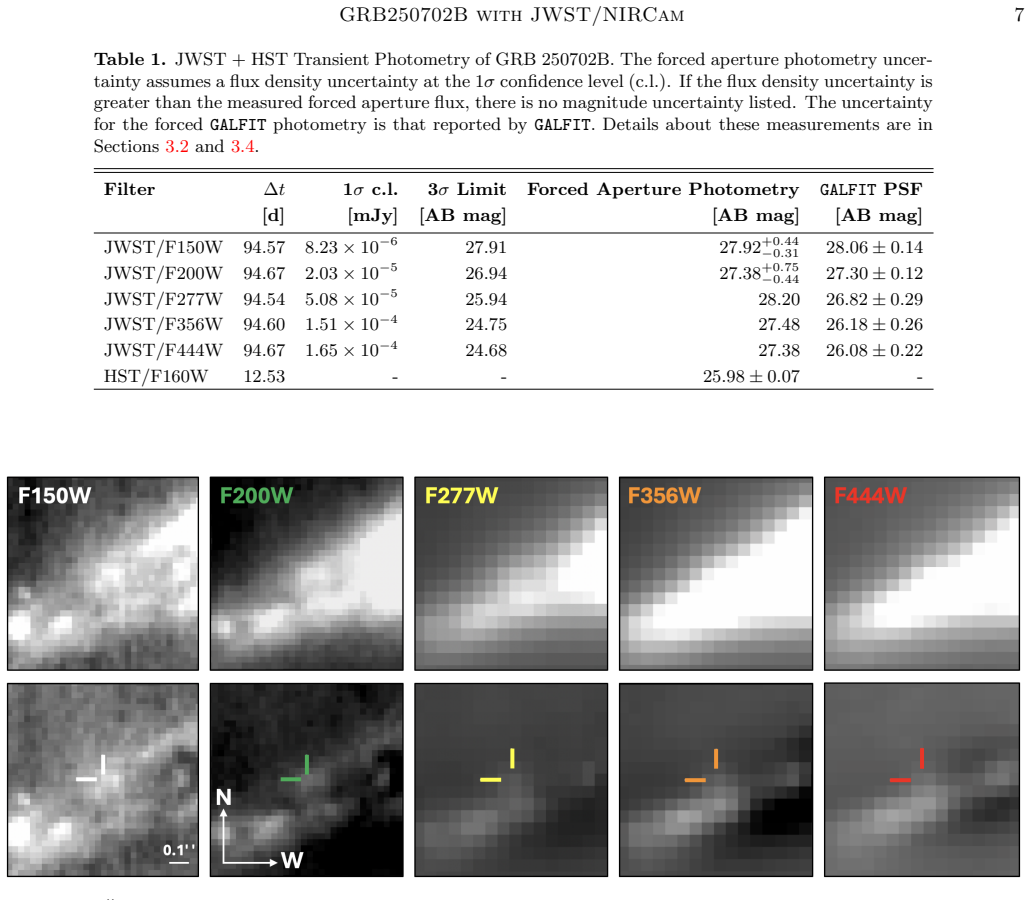
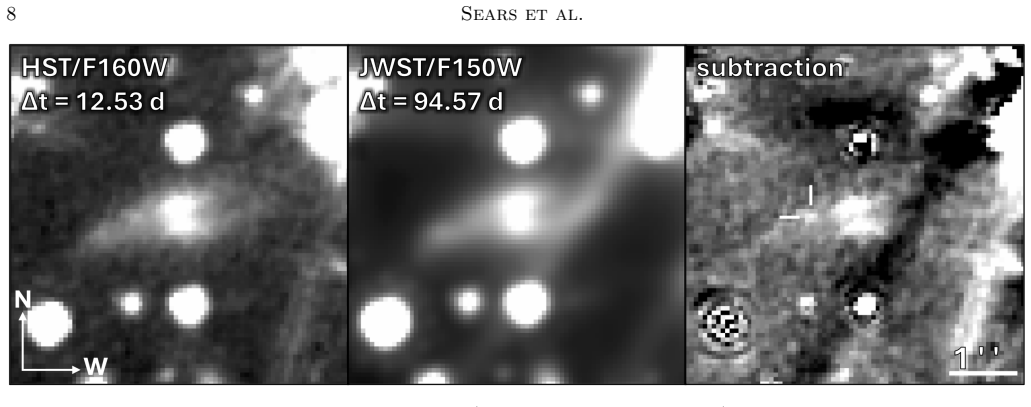
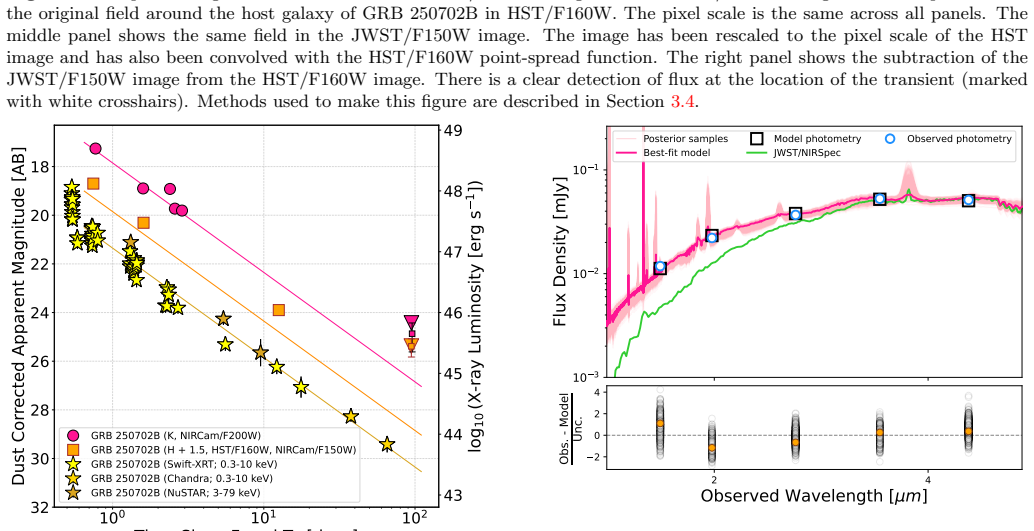
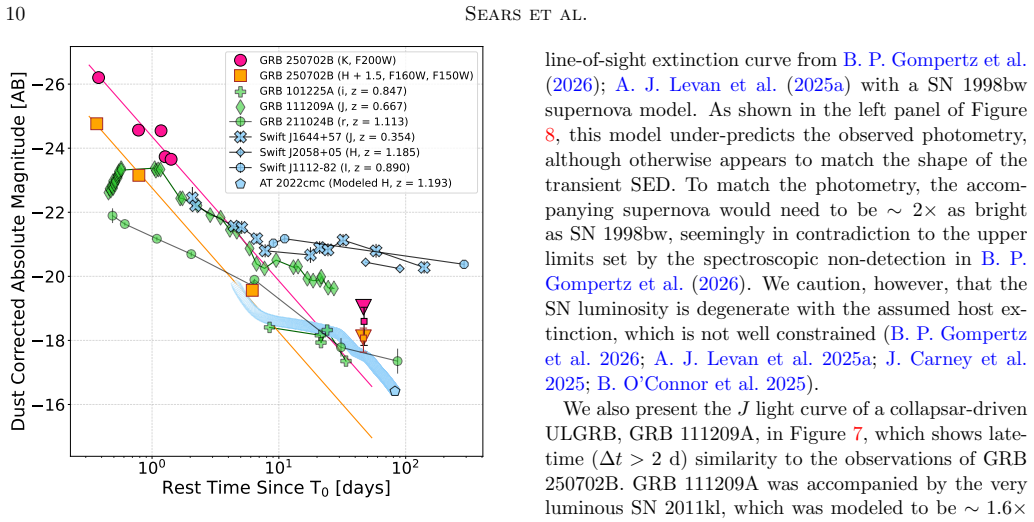
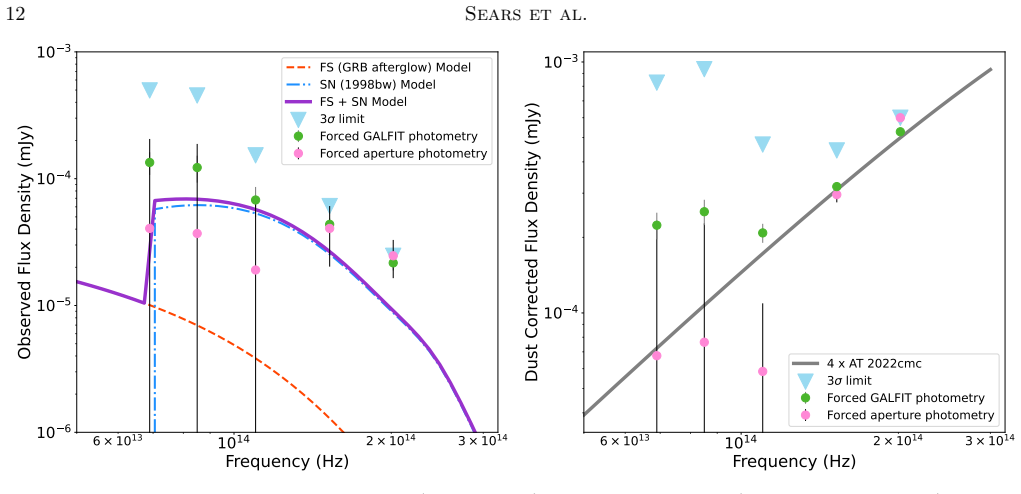
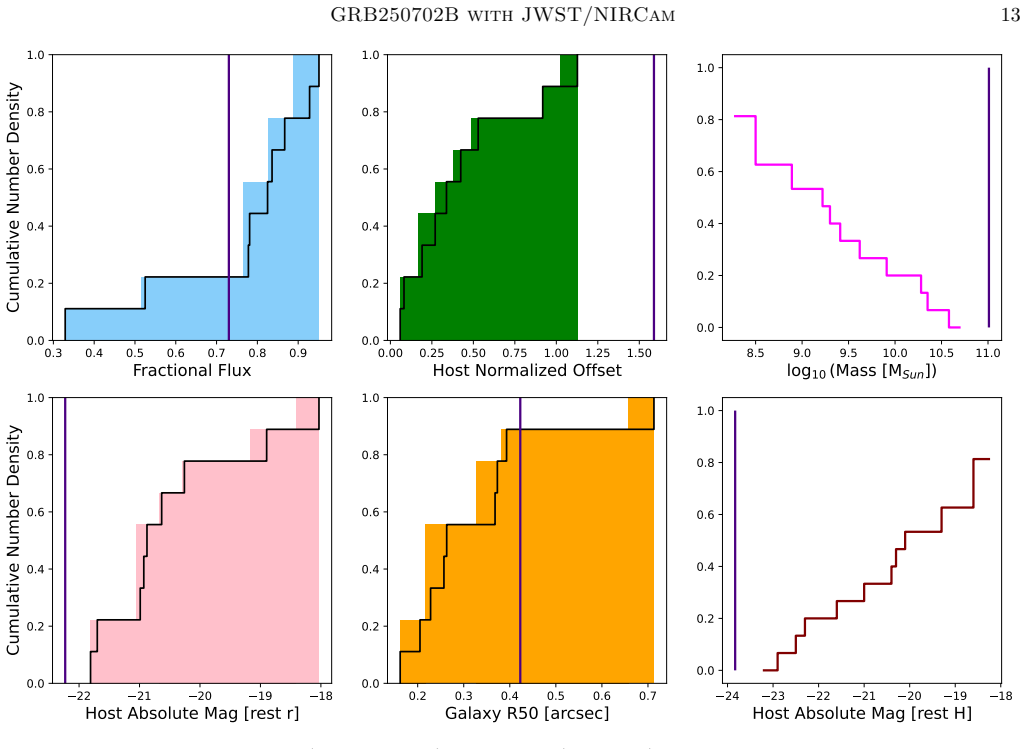
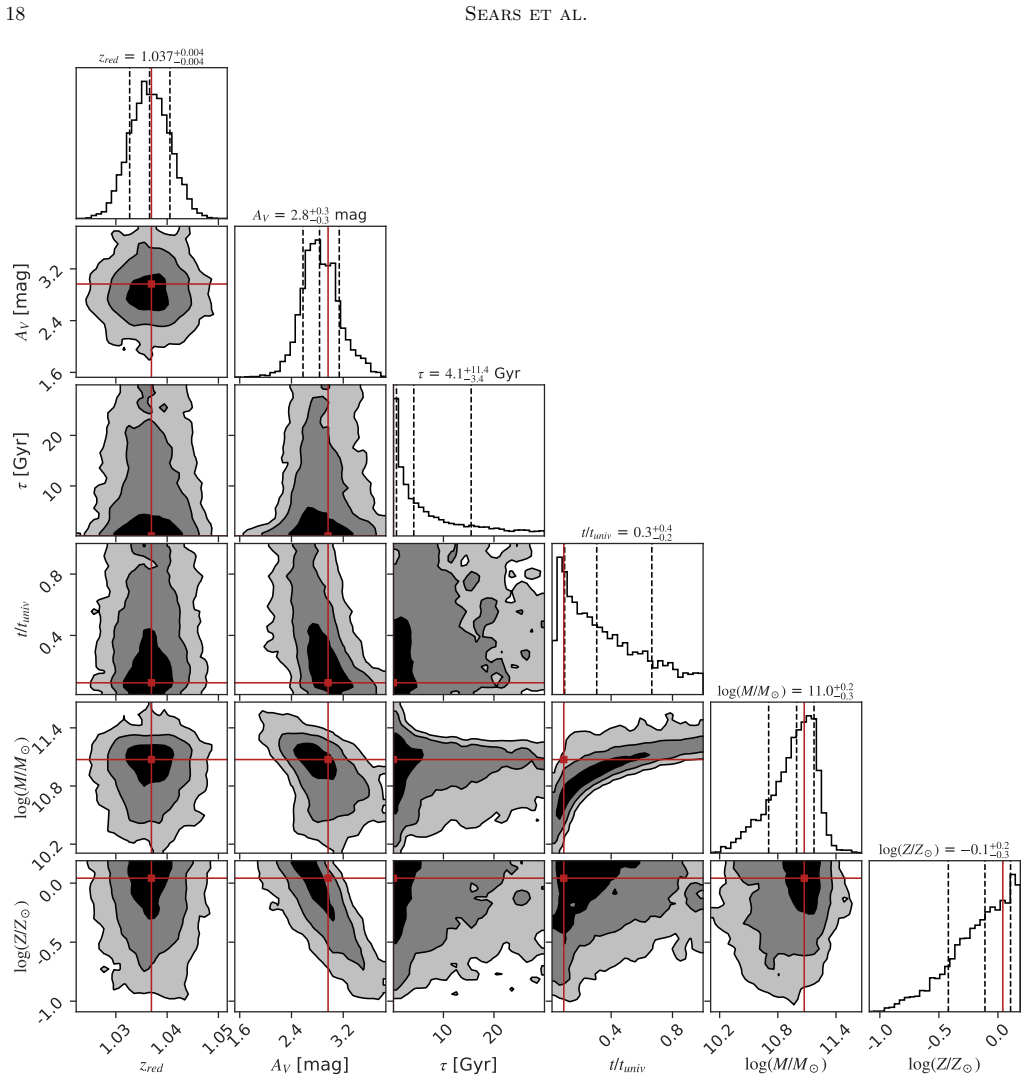
We present JWST/NIRCam observations of the extremely long-duration gamma-ray burst (GRB) 250702B taken at ~ 95 days post-GRB (observer frame). The observations of the host galaxy reveal a single galaxy with a prominent dust lane observed nearly edge-on. Prospector modeling of the host galaxy photometry finds a high stellar mass (log(M_*/M_Sun) = 11.0 +0.2/-0.3) and large dust column (A_V = 2.8 +/- 0.3 mag), in agreement with previous results. If GRB 250702B is a collapsar-driven GRB, the host galaxy is the brightest (in rest-frame r and rest-frame H) and most massive compared to GRB hosts at similar redshifts. The transient localization is near the dust lane, and while we find no evidence for transient emission in F277W, F356W, and F444W, forced photometry in F150W and F200W reveals possible ~ 3 sigma detections of the transient at m_{F150W} ~ 27.9 AB mag and m_{F200W} ~ 27.4 AB mag. If these are secure detections, they are indicative of a late-time light curve flattening. This behavior is consistent with that of jetted tidal disruption events (TDEs); however, it is also consistent with a supernova plus GRB afterglow model. Alternatively, if these are upper limits, they are consistent with, but do not further constrain, the extrapolated power-law decline of the afterglow. The ambiguity of the possible detection of the transient in F150W and F200W highlights the need for late-time template observations with JWST/NIRCam.
Editorial analysis
A structured set of objections, weighed in public.
Referee Report
Summary. The manuscript reports JWST/NIRCam observations of GRB 250702B at ~95 days post-burst. The host is a single galaxy with a prominent dust lane viewed nearly edge-on; Prospector modeling yields log(M*/M⊙) = 11.0 +0.2/-0.3 and AV = 2.8 ± 0.3 mag, making it the brightest and most massive GRB host at similar redshifts if the event is a collapsar. Forced photometry shows no transient in F277W/F356W/F444W but possible ~3σ signals at mF150W ~27.9 AB and mF200W ~27.4 AB near the dust lane. If secure, these indicate late-time flattening consistent with jetted TDEs or SN+GRB afterglow; if upper limits, they remain consistent with afterglow decline. The paper stresses the ambiguity and need for template imaging.
Significance. If the marginal detections are real, the result would be significant for linking extreme long-duration GRBs to alternative channels such as jetted TDEs and for characterizing unusually massive GRB hosts. The manuscript's standard host photometry and modeling, together with its explicit conditional framing of the transient signals, constitute a strength. The work supplies useful late-time data on a rare event while correctly identifying the requirement for follow-up observations.
minor comments (1)
- [Abstract] Abstract: the description of the forced photometry in F150W and F200W would be strengthened by a brief statement on the error treatment and any checks against reduction artifacts, even if only to reiterate the ~3σ and ambiguous status already noted.
Simulated Author's Rebuttal
We thank the referee for their positive and constructive report on our manuscript. We appreciate the recommendation for minor revision and the recognition of the work's strengths in host modeling and conditional framing of the transient signals. Since no specific major comments were raised, we provide no point-by-point responses below.
Circularity Check
No significant circularity; purely observational report
full rationale
The manuscript is an observational report presenting JWST/NIRCam photometry of GRB 250702B and its host, with standard Prospector SED fitting applied to the host photometry to derive stellar mass and dust attenuation. No derivations, predictions, or model outputs are claimed that reduce by construction to fitted parameters or self-citations; the central statements remain conditional on the security of the ~3σ F150W/F200W signals and explicitly flag ambiguity requiring future template imaging. No load-bearing steps match any of the enumerated circularity patterns.
Axiom & Free-Parameter Ledger
free parameters (2)
- log stellar mass =
11.0
- A_V dust extinction =
2.8
axioms (1)
- domain assumption Prospector stellar population synthesis models accurately recover mass and dust for edge-on dusty galaxies at the relevant redshift
Reference graph
Works this paper leans on
-
[1]
Ahumada, T., Singer, L. P., Anand, S., et al. 2021, Nature Astronomy, 5, 917, doi: 10.1038/s41550-021-01428-7
-
[2]
Andreoni, I., Coughlin, M. W., Perley, D. A., et al. 2022, Nature, 612, 430, doi: 10.1038/s41586-022-05465-8 GRB250702B with JWST/NIRCam15
-
[3]
2015,, Astrophysics Source Code Library, record ascl:1504.004 http://ascl.net/1504.004
Becker, A. 2015,, Astrophysics Source Code Library, record ascl:1504.004 http://ascl.net/1504.004
2015
-
[4]
Beniamini, P., Perets, H. B., & Granot, J. 2026, The Open Journal of Astrophysics, 9, 57985, doi: 10.33232/001c.157985
-
[5]
Bertin, E., & Arnouts, S. 1996, A&AS, 117, 393, doi: 10.1051/aas:1996164
-
[6]
2002, in Astronomical Society of the Pacific Conference Series, Vol
Bertin, E., Mellier, Y., Radovich, M., et al. 2002, in Astronomical Society of the Pacific Conference Series, Vol. 281, Astronomical Data Analysis Software and Systems XI, ed. D. A. Bohlender, D. Durand, & T. H. Handley, 228
2002
-
[7]
Blanchard, P. K., Berger, E., & Fong, W.-f. 2016, ApJ, 817, 144, doi: 10.3847/0004-637X/817/2/144
-
[8]
Bloom, J. S., Giannios, D., Metzger, B. D., et al. 2011, Science, 333, 203, doi: 10.1126/science.1207150
-
[9]
2025,, 2.2.0 Zenodo, doi: 10.5281/zenodo.14889440
Bradley, L., Sip˝ ocz, B., Robitaille, T., et al. 2025,, 2.2.0 Zenodo, doi: 10.5281/zenodo.14889440
-
[10]
Brown, G. C., Levan, A. J., Stanway, E. R., et al. 2015, MNRAS, 452, 4297, doi: 10.1093/mnras/stv1520
-
[11]
Brown, G. C., Levan, A. J., Stanway, E. R., et al. 2017, MNRAS, 472, 4469, doi: 10.1093/mnras/stx2193
-
[12]
2011, Astronomische Nachrichten, 332, 262, doi: 10.1002/asna.201111531
Bufano, F., Benetti, S., Sollerman, J., Pian, E., & Cupani, G. 2011, Astronomische Nachrichten, 332, 262, doi: 10.1002/asna.201111531
-
[13]
2012, ApJ, 753, 67, doi: 10.1088/0004-637X/753/1/67
Bufano, F., Pian, E., Sollerman, J., et al. 2012, ApJ, 753, 67, doi: 10.1088/0004-637X/753/1/67
-
[14]
2023, ApJL, 946, L31, doi: 10.3847/2041-8213/acc39c
Burns, E., Svinkin, D., Fenimore, E., et al. 2023, ApJL, 946, L31, doi: 10.3847/2041-8213/acc39c
-
[15]
Burrows, D. N., Kennea, J. A., Ghisellini, G., et al. 2011, Nature, 476, 421, doi: 10.1038/nature10374
-
[16]
The Dust Content and Opacity of Actively Star-Forming Galaxies
Calzetti, D., Armus, L., Bohlin, R. C., et al. 2000, The Astrophysical Journal, 533, 682, doi: 10.1086/308692
work page internal anchor Pith review doi:10.1086/308692 2000
-
[17]
Campana, S., Mangano, V., Blustin, A. J., et al. 2006, Nature, 442, 1008, doi: 10.1038/nature04892
-
[18]
2011, ApJ, 740, 41, doi: 10.1088/0004-637X/740/1/41
Cano, Z., Bersier, D., Guidorzi, C., et al. 2011, ApJ, 740, 41, doi: 10.1088/0004-637X/740/1/41
-
[19]
2025, ApJL, 994, L46, doi: 10.3847/2041-8213/ae1d67
Carney, J., Andreoni, I., O’Connor, B., et al. 2025, ApJL, 994, L46, doi: 10.3847/2041-8213/ae1d67
-
[20]
Cenko, S. B., Krimm, H. A., Horesh, A., et al. 2012, ApJ, 753, 77, doi: 10.1088/0004-637X/753/1/77
-
[21]
2006, ApJL, 645, L113, doi: 10.1086/506271
Natarajan, P. 2006, ApJL, 645, L113, doi: 10.1086/506271
-
[22]
E., Conroy, C., & Gunn, J
Conroy, C., Gunn, J. E., Conroy, C., & Gunn, J. E. 2010, ascl, ascl:1010.043. https://ui.adsabs.harvard.edu/abs/ 2010ascl.soft10043C/abstract
2010
-
[23]
Decleir, M., Gordon, K. D., Andrews, J. E., et al. 2022, ApJ, 930, 15, doi: 10.3847/1538-4357/ac5dbe Della Valle, M., Chincarini, G., Panagia, N., et al. 2006, Nature, 444, 1050, doi: 10.1038/nature05374
-
[24]
Eftekhari, T., Tchekhovskoy, A., Alexander, K. D., et al. 2024, ApJ, 974, 149, doi: 10.3847/1538-4357/ad72ea
-
[25]
Eyles-Ferris, R. A. J., King, A., Starling, R. L. C., et al. 2026, MNRAS, 546, stag005, doi: 10.1093/mnras/stag005
-
[26]
Clayton, G. C. 2019, ApJ, 886, 108, doi: 10.3847/1538-4357/ab4c3a
-
[27]
2024, ApJ, 977, 197, doi: 10.3847/1538-4357/ad8886
Fu, S.-Y., Xu, D., Lei, W.-H., et al. 2024, ApJ, 977, 197, doi: 10.3847/1538-4357/ad8886
-
[28]
Fynbo, J. P. U., Watson, D., Th¨ one, C. C., et al. 2006, Nature, 444, 1047, doi: 10.1038/nature05375
-
[29]
Gal-Yam, A., Fox, D. B., Price, P. A., et al. 2006, Nature, 444, 1053, doi: 10.1038/nature05373
-
[30]
Tremonti, C. A. 2005, Monthly Notices of the Royal Astronomical Society, 362, 41, doi: 10.1111/j.1365-2966.2005.09321.x
-
[31]
Gehrels, N., Norris, J. P., Barthelmy, S. D., et al. 2006, Nature, 444, 1044, doi: 10.1038/nature05376
-
[32]
Goad, M. R., Page, K. L., Godet, O., et al. 2007, A&A, 468, 103, doi: 10.1051/0004-6361:20066874
-
[33]
Gompertz, B. P., Levan, A. J., Laskar, T., et al. 2026, ApJL, 997, L4, doi: 10.3847/2041-8213/ae2ed9
-
[34]
Gordon, K. D. 2024, Journal of Open Source Software, 9, 7023, doi: 10.21105/joss.07023
-
[35]
D., Cartledge, S., & Clayton, G
Gordon, K. D., Cartledge, S., & Clayton, G. C. 2009, ApJ, 705, 1320, doi: 10.1088/0004-637X/705/2/1320
-
[36]
Gordon, K. D., Clayton, G. C., Decleir, M., et al. 2023, ApJ, 950, 86, doi: 10.3847/1538-4357/accb59
-
[37]
Gordon, K. D., Misselt, K. A., Bouwman, J., et al. 2021, ApJ, 916, 33, doi: 10.3847/1538-4357/ac00b7
-
[38]
B., Gill, R., Beniamini, P., & O’Connor, B
Granot, J., Perets, H. B., Gill, R., Beniamini, P., & O’Connor, B. 2026, MNRAS, 547, stag328, doi: 10.1093/mnras/stag328
-
[39]
Greiner, J., Mazzali, P. A., Kann, D. A., et al. 2015, Nature, 523, 189, doi: 10.1038/nature14579
-
[40]
2025, A&A, 703, A101, doi: 10.1051/0004-6361/202556663
Guidorzi, C., Maccary, R., Maistrello, M., et al. 2025, A&A, 703, A101, doi: 10.1051/0004-6361/202556663
-
[41]
Hammerstein, E., Cenko, S. B., Andreoni, I., et al. 2026, ApJ, 996, 143, doi: 10.3847/1538-4357/ae1838
-
[42]
2013, ApJS, 208, 19, doi: 10.1088/0067-0049/208/2/19
Hinshaw, G., Larson, D., Komatsu, E., et al. 2013, ApJS, 208, 19, doi: 10.1088/0067-0049/208/2/19
work page internal anchor Pith review doi:10.1088/0067-0049/208/2/19 2013
-
[43]
2025, arXiv e-prints, arXiv:2501.09580, doi: 10.48550/arXiv.2501.09580
Jin, C.-C., Li, D.-Y., Jiang, N., et al. 2025, arXiv e-prints, arXiv:2501.09580, doi: 10.48550/arXiv.2501.09580
-
[44]
2024, doi: 10.5281/ZENODO.12447779
Johnson, B., Foreman-Mackey, D., Sick, J., et al. 2024, doi: 10.5281/ZENODO.12447779
-
[45]
D., Leja, J., Conroy, C., & Speagle, J
Johnson, B. D., Leja, J., Conroy, C., & Speagle, J. S. 2021, ApJS, 254, 22, doi: 10.3847/1538-4365/abef67 16Sears et al
work page internal anchor Pith review doi:10.3847/1538-4365/abef67 2021
-
[46]
D., Leja, J
Johnson, B. D., Leja, J. L., Conroy, C., & Speagle, J. S. 2019,, Astrophysics Source Code Library, record ascl:1905.025 http://ascl.net/1905.025
2019
-
[47]
Kann, D. A., Schady, P., Olivares, E. F., et al. 2018, A&A, 617, A122, doi: 10.1051/0004-6361/201731292
-
[48]
A., Schady, P., Olivares E., F., et al
Kann, D. A., Schady, P., Olivares E., F., et al. 2019, A&A, 624, A143, doi: 10.1051/0004-6361/201629162
-
[49]
Lazzati, D. 2005, MNRAS, 357, 722, doi: 10.1111/j.1365-2966.2005.08687.x
-
[50]
Speagle, J. S. 2019a, The Astrophysical Journal, 876, 3, doi: 10.3847/1538-4357/AB133C
work page internal anchor Pith review doi:10.3847/1538-4357/ab133c
-
[51]
2017, ApJ, 837, 170, doi: 10.3847/1538-4357/aa5ffe
Byler, N. 2017, ApJ, 837, 170, doi: 10.3847/1538-4357/aa5ffe
-
[52]
Leja, J., Johnson, B. D., Conroy, C., et al. 2019b, The Astrophysical Journal, 877, 140, doi: 10.3847/1538-4357/AB1D5A
-
[53]
Leung, J. K., Salafia, O. S., Spingola, C., et al. 2026, ApJ, 996, 22, doi: 10.3847/1538-4357/ae1956
-
[54]
Levan, A. J. 2015, Journal of High Energy Astrophysics, 7, 44, doi: 10.1016/j.jheap.2015.05.004
-
[55]
Levan, A. J., Tanvir, N. R., Cenko, S. B., et al. 2011, Science, 333, 199, doi: 10.1126/science.1207143
-
[56]
Levan, A. J., Tanvir, N. R., Starling, R. L. C., et al. 2014, ApJ, 781, 13, doi: 10.1088/0004-637X/781/1/13
-
[57]
Levan, A. J., Tanvir, N. R., Brown, G. C., et al. 2016, ApJ, 819, 51, doi: 10.3847/0004-637X/819/1/51
-
[58]
Levan, A. J., Gompertz, B. P., Salafia, O. S., et al. 2024, Nature, 626, 737, doi: 10.1038/s41586-023-06759-1
-
[59]
J., Martin-Carrillo, A., Laskar, T., et al
Levan, A. J., Martin-Carrillo, A., Laskar, T., et al. 2025a, ApJL, 990, L28, doi: 10.3847/2041-8213/adf8e1
-
[60]
2026, Science Bulletin, 71, 538, doi: 10.1016/j.scib.2025.12.050
Li, D., Zhang, W., Yang, J., et al. 2026, Science Bulletin, 71, 538, doi: 10.1016/j.scib.2025.12.050
-
[61]
Li, W., Christy, C. T., Alexander, K. D., et al. 2026, arXiv e-prints, arXiv:2606.06595. https://arxiv.org/abs/2606.06595
Pith/arXiv arXiv 2026
-
[62]
Lin, D., Strader, J., Carrasco, E. R., et al. 2018, Nature Astronomy, 2, 656, doi: 10.1038/s41550-018-0493-1
-
[63]
2021, ARA&A, 59, 155, doi: 10.1146/annurev-astro-112420-030742 Micha lowskI, M
Margutti, R., & Chornock, R. 2021, ARA&A, 59, 155, doi: 10.1146/annurev-astro-112420-030742 Micha lowskI, M. J., Xu, D., Stevens, J., et al. 2018, A&A, 616, A169, doi: 10.1051/0004-6361/201629942
-
[64]
Modjaz, M., Stanek, K. Z., Garnavich, P. M., et al. 2006, ApJL, 645, L21, doi: 10.1086/505906
-
[65]
2024, MNRAS, 527, 2452, doi: 10.1093/mnras/stad3001
Mummery, A., van Velzen, S., Nathan, E., et al. 2024, MNRAS, 527, 2452, doi: 10.1093/mnras/stad3001
-
[66]
Fenimore, E. E. 1991, Nature, 350, 592, doi: 10.1038/350592a0
-
[67]
Neights, E., Burns, E., Fryer, C. L., et al. 2026, MNRAS, 545, staf2019, doi: 10.1093/mnras/staf2019 O’Connor, B., Gill, R., DeLaunay, J., et al. 2025, ApJL, 994, L17, doi: 10.3847/2041-8213/ae1741
-
[68]
Ofek, E. O., Cenko, S. B., Gal-Yam, A., et al. 2007, ApJ, 662, 1129, doi: 10.1086/518082 Olivares E., F., Greiner, J., Schady, P., et al. 2012, A&A, 539, A76, doi: 10.1051/0004-6361/201117929
-
[69]
Pasham, D. R., Cenko, S. B., Levan, A. J., et al. 2015, ApJ, 805, 68, doi: 10.1088/0004-637X/805/1/68
-
[70]
Peng, C. Y., Ho, L. C., Impey, C. D., & Rix, H.-W. 2010, AJ, 139, 2097, doi: 10.1088/0004-6256/139/6/2097
work page internal anchor Pith review doi:10.1088/0004-6256/139/6/2097 2010
-
[71]
A., Kr¨ uhler, T., Schulze, S., et al
Perley, D. A., Kr¨ uhler, T., Schulze, S., et al. 2016a, ApJ, 817, 7, doi: 10.3847/0004-637X/817/1/7
-
[72]
Perley, D. A., Tanvir, N. R., Hjorth, J., et al. 2016b, ApJ, 817, 8, doi: 10.3847/0004-637X/817/1/8
-
[73]
Pian, E., Mazzali, P. A., Masetti, N., et al. 2006, Nature, 442, 1011, doi: 10.1038/nature05082
-
[74]
Rastinejad, J. C., Gompertz, B. P., Levan, A. J., et al. 2022, Nature, 612, 223, doi: 10.1038/s41586-022-05390-w
-
[75]
Rhodes, L., Bright, J. S., Fender, R., et al. 2023, MNRAS, 521, 389, doi: 10.1093/mnras/stad344
-
[76]
2021, ApJL, 916, L18, doi: 10.3847/2041-8213/ac1170
Ricarte, A., Tremmel, M., Natarajan, P., & Quinn, T. 2021, ApJL, 916, L18, doi: 10.3847/2041-8213/ac1170
-
[77]
2020, in XIV.0 Scientific Meeting (virtual) of the Spanish Astronomical Society, 182
Rodrigo, C., & Solano, E. 2020, in XIV.0 Scientific Meeting (virtual) of the Spanish Astronomical Society, 182
2020
-
[78]
2012,, IVOA Working Draft 15 October 2012 doi: 10.5479/ADS/bib/2012ivoa.rept.1015R
Rodrigo, C., Solano, E., & Bayo, A. 2012,, IVOA Working Draft 15 October 2012 doi: 10.5479/ADS/bib/2012ivoa.rept.1015R
-
[79]
Rodrigo, C., Cruz, P., Aguilar, J. F., et al. 2024, A&A, 689, A93, doi: 10.1051/0004-6361/202449998
-
[80]
2024,, 3.4 https://web.eecs.utk.edu/ ∼dcostine/ personal/PowerDeviceLib/DigiTest/index.html
Rohatgi, A. 2024,, 3.4 https://web.eecs.utk.edu/ ∼dcostine/ personal/PowerDeviceLib/DigiTest/index.html
2024
discussion (0)
Sign in with ORCID, Apple, or X to comment. Anyone can read and Pith papers without signing in.