A Prototypical Signature Approach for Writer-Independent Offline Signature Verification
Pith reviewed 2026-06-27 00:35 UTC · model grok-4.3
The pith
Prototypical signatures provide more informative negative samples than random selection for writer-independent offline signature verification.
A machine-rendered reading of the paper's core claim, the machinery that carries it, and where it could break.
Core claim
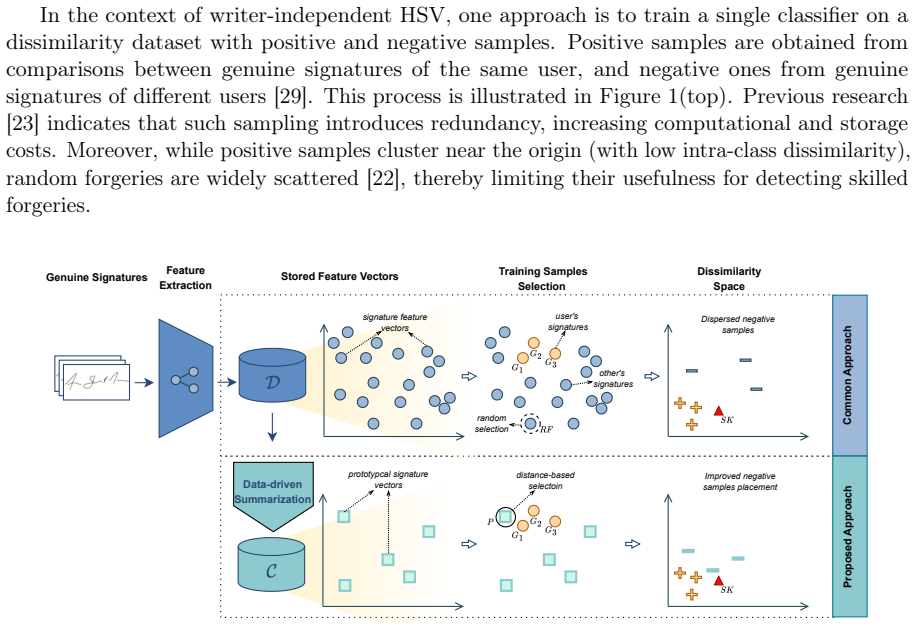
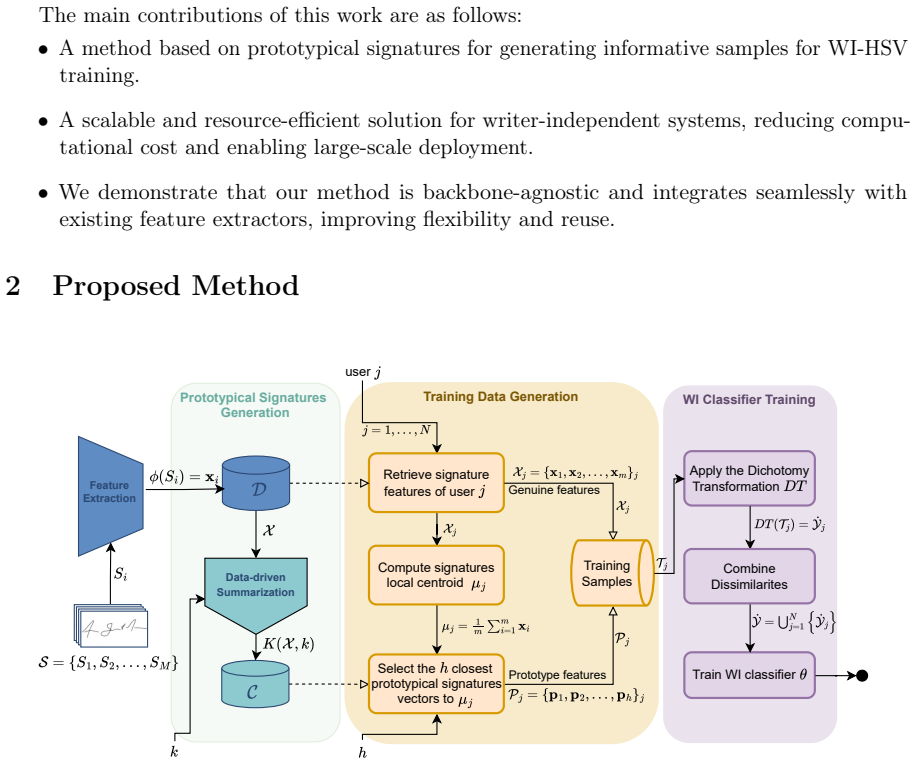
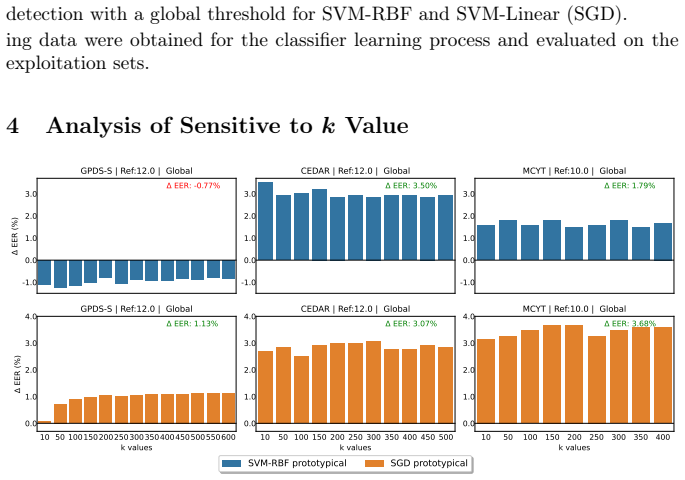
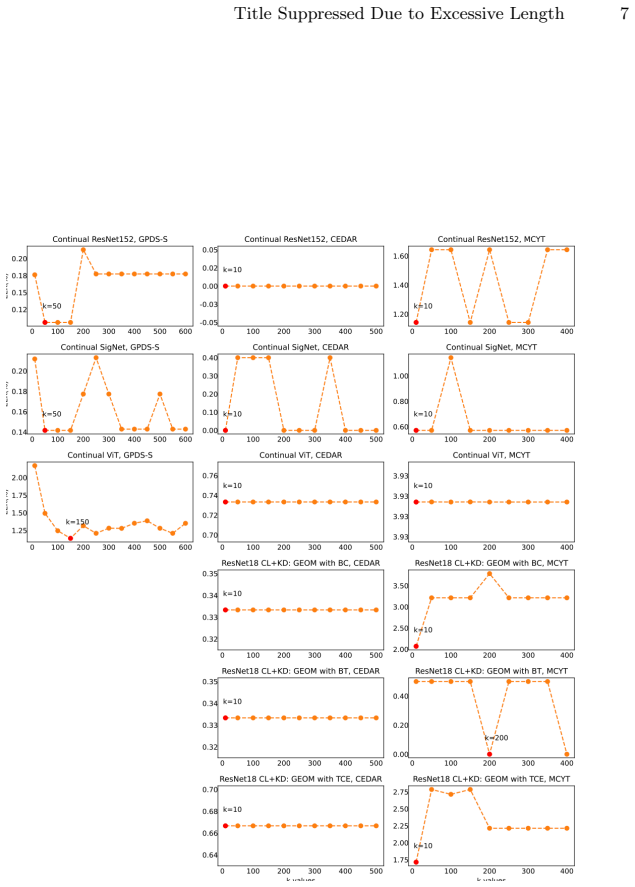
A data-driven strategy generates diverse negative samples from prototypical signatures, defined as compact non-identifiable summaries of genuine signature features. Experiments establish that these samples improve skilled forgery detection, that the method works across architectures, and that pairing it with a primal-form linear SVM yields an efficient alternative to RBF-based models.
What carries the argument
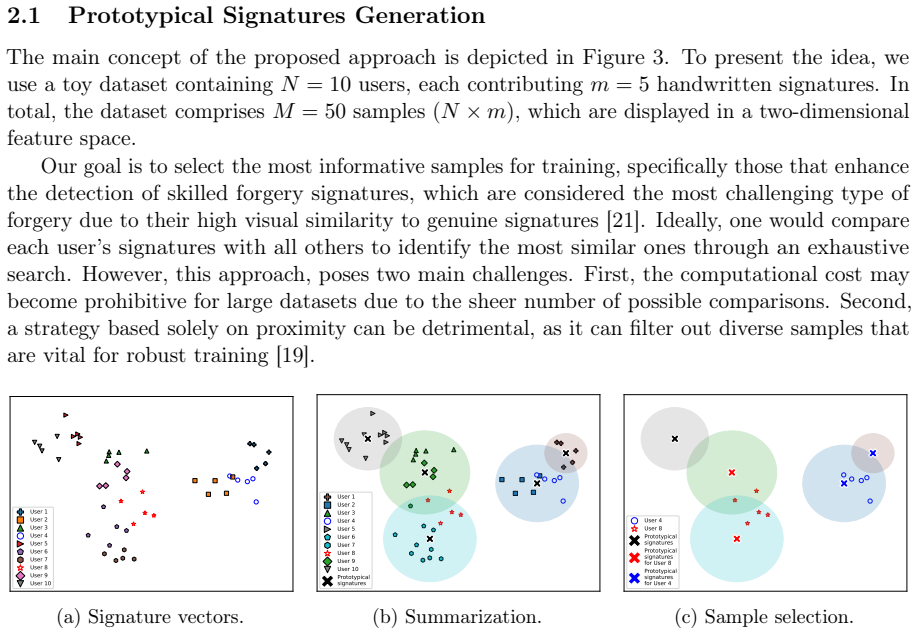
prototypical signatures as compact non-identifiable summaries of genuine signature features that generate negative training samples
If this is right
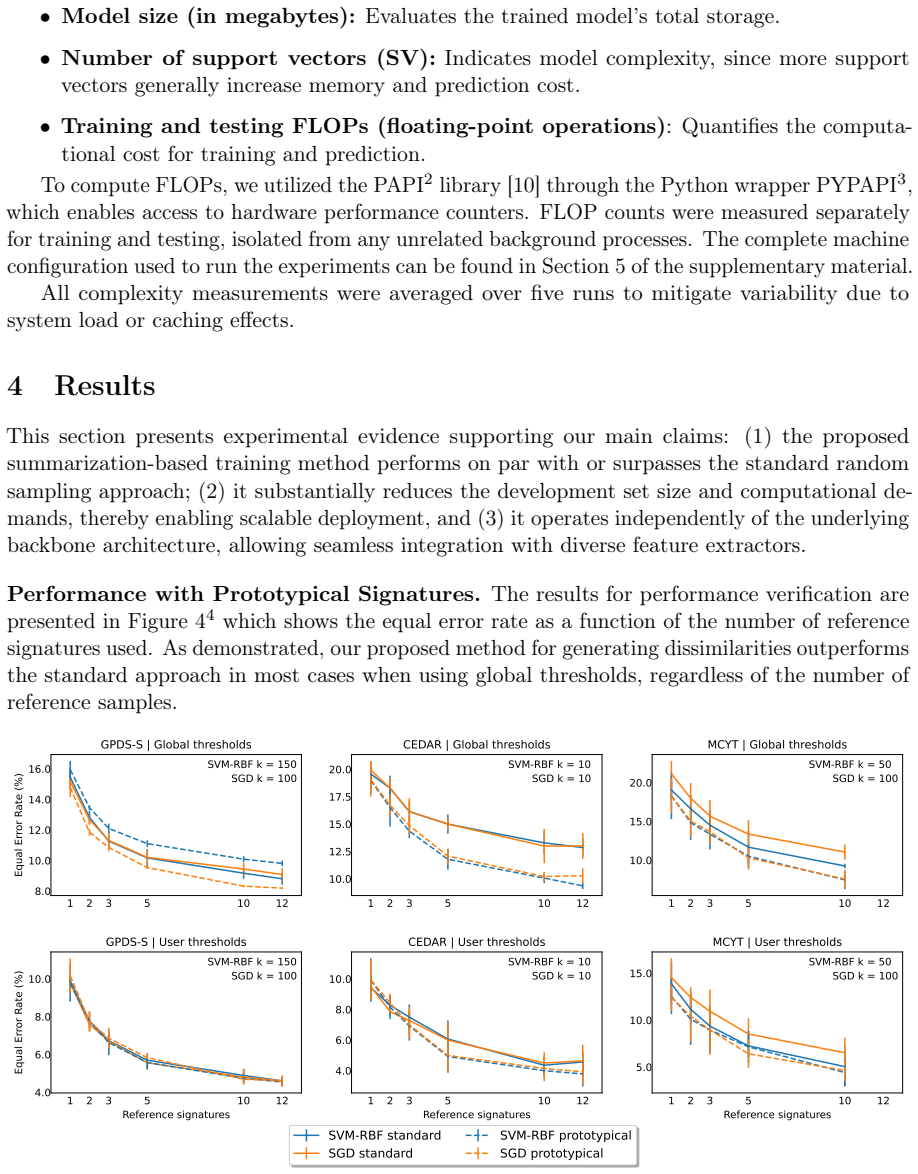
- Skilled forgeries are detected at higher rates than with random negative samples.
- Performance remains stable when different backbone architectures are substituted.
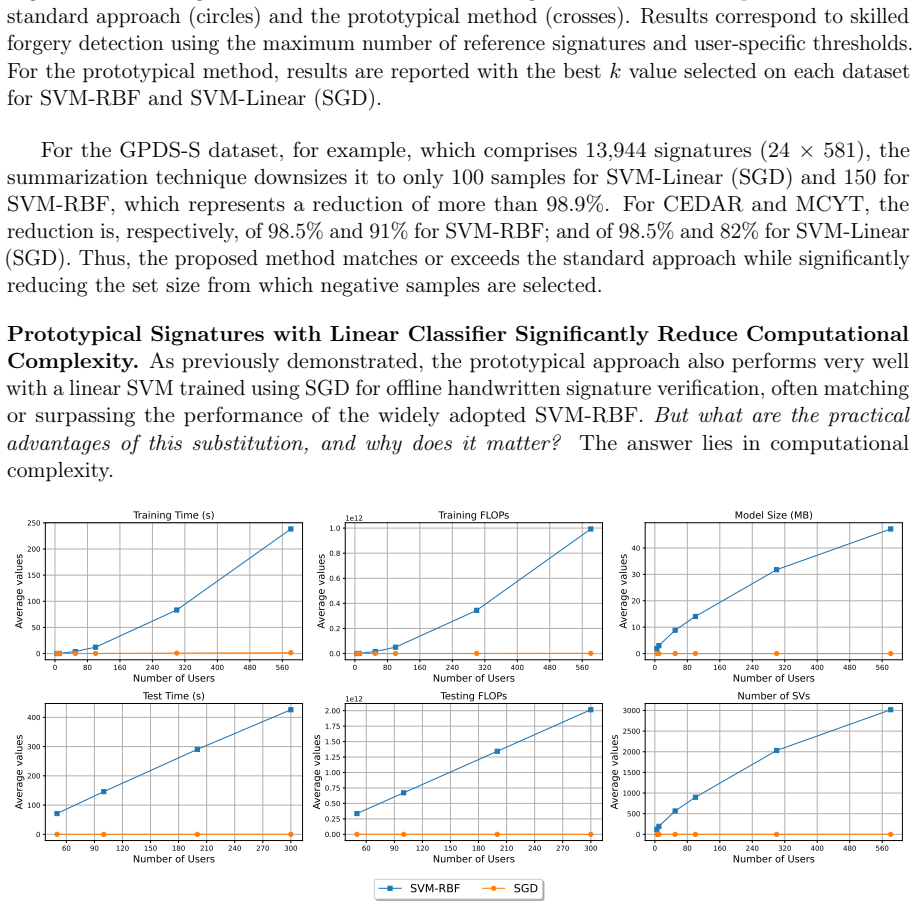
- A primal-form linear SVM becomes a practical substitute for RBF kernels with large gains in scalability and speed.
- Training redundancy and computational cost drop because the generated negatives carry more information per sample.
Where Pith is reading between the lines
- The same generation step could supply negative examples for other writer-independent biometric tasks where forgeries are scarce.
- Non-identifiable prototypes may reduce privacy exposure when sharing training data across institutions.
- The method might lower the total number of genuine signatures needed to reach a target detection level.
Load-bearing premise
That prototypical signatures can be generated in a data-driven way that produces negative samples with sufficient diversity and informativeness to improve forgery detection without introducing new biases or losing critical discriminative information.
What would settle it
A controlled experiment in which prototypical-signature negatives produce no measurable gain in skilled-forgery detection accuracy over random selection from other users' genuine signatures would falsify the central claim.
Figures
read the original abstract
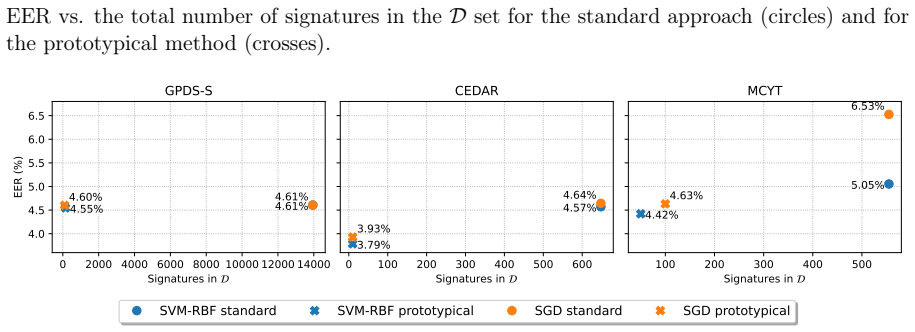
Offline handwritten signature verification aims to distinguish genuine from forged signatures using static images. Since real forgeries are rarely available, negative samples are usually randomly drawn from genuine signatures of other users to create training data. However, this random selection often lacks diversity, increases redundancy, and escalates computational cost, leading to inefficient training. We propose a data-driven strategy to generate diverse, informative negative samples using prototypical signatures, which are compact, non-identifiable summaries of genuine signature features. Based on the experiments results, we conclude that (i) prototypical signatures yield more informative negative samples, improving the detection of skilled forgeries; (ii) the proposed approach is backbone-agnostic, showing robustness across architectures; and (iii) when combined with a primal-form linear SVM, it serves as an alternative to RBF-based models while significantly improving scalability and computational efficiency. Implementation of the method is available at https://github.com/kdmoura/proto_hsv.
Editorial analysis
A structured set of objections, weighed in public.
Referee Report
Summary. The manuscript proposes a data-driven strategy to generate prototypical signatures—compact, non-identifiable summaries of genuine signature features—as negative samples for writer-independent offline signature verification, replacing random draws from other users' genuines. The authors conclude from experiments that (i) this yields more informative negatives and improves skilled forgery detection, (ii) the approach is backbone-agnostic, and (iii) pairing it with a primal-form linear SVM provides a scalable alternative to RBF kernels with better computational efficiency. Code is released at a GitHub repository.
Significance. If the results hold, the work addresses a practical bottleneck in signature verification training by improving negative sample quality and efficiency, which could benefit biometric document authentication systems. The open implementation is a clear strength for reproducibility and follow-up work.
major comments (2)
- Abstract: The three experimental conclusions are asserted without any metrics (e.g., EER, AUC), dataset names, baseline comparisons, or references to tables/figures, preventing assessment of whether the claimed improvements in skilled forgery detection are load-bearing or statistically meaningful.
- Method section (prototypical signature generation): The central claim (i) depends on the data-driven procedure producing negatives with greater diversity and informativeness than random selection while remaining non-identifiable and bias-free. No formal definition, algorithm, equations, or validation (e.g., feature variance or information retention metrics) is provided, leaving open the possibility that the procedure collapses to low-variance summaries and undermines the improvement.
minor comments (1)
- Abstract: The GitHub link for the implementation is a positive addition that supports reproducibility.
Simulated Author's Rebuttal
We thank the referee for the constructive comments on our manuscript. We address each major point below and will revise the manuscript accordingly to strengthen clarity and rigor.
read point-by-point responses
-
Referee: Abstract: The three experimental conclusions are asserted without any metrics (e.g., EER, AUC), dataset names, baseline comparisons, or references to tables/figures, preventing assessment of whether the claimed improvements in skilled forgery detection are load-bearing or statistically meaningful.
Authors: We agree that the abstract would be strengthened by including quantitative support. In the revised manuscript we will update the abstract to report key metrics (EER and AUC improvements), name the primary datasets (e.g., GPDS, CEDAR), reference the relevant tables/figures, and note the baseline comparisons that establish the gains in skilled forgery detection. revision: yes
-
Referee: Method section (prototypical signature generation): The central claim (i) depends on the data-driven procedure producing negatives with greater diversity and informativeness than random selection while remaining non-identifiable and bias-free. No formal definition, algorithm, equations, or validation (e.g., feature variance or information retention metrics) is provided, leaving open the possibility that the procedure collapses to low-variance summaries and undermines the improvement.
Authors: We acknowledge that the current text presents the generation process at a high level without formalization. In the revision we will add a dedicated subsection containing: (i) a mathematical definition of prototypical signatures (e.g., as embedding-space centroids), (ii) the generation algorithm in pseudocode, (iii) the governing equations, and (iv) quantitative validation (feature variance, information retention) confirming greater diversity than random selection while preserving non-identifiability. revision: yes
Circularity Check
No circularity: empirical validation of data-driven method
full rationale
The paper introduces a data-driven strategy to generate prototypical signatures as negative samples and draws conclusions (i)-(iii) directly from experimental comparisons on forgery detection, backbone robustness, and SVM efficiency. No equations, derivations, or predictions are presented that reduce by construction to fitted inputs or self-citations. The central claims rest on external experimental benchmarks rather than self-referential logic, satisfying the default expectation of a non-circular empirical contribution.
Axiom & Free-Parameter Ledger
invented entities (1)
-
prototypical signatures
no independent evidence
Reference graph
Works this paper leans on
-
[1]
Frontiers in Handwriting Recognition (ICFHR), 2014 14th International Conference on , pages=
Real-time segmentation of on-line handwritten arabic script , author=. Frontiers in Handwriting Recognition (ICFHR), 2014 14th International Conference on , pages=. 2014 , organization=
2014
-
[2]
Soft Computing and Pattern Recognition (SoCPaR), 2014 6th International Conference of , pages=
Fast classification of handwritten on-line Arabic characters , author=. Soft Computing and Pattern Recognition (SoCPaR), 2014 6th International Conference of , pages=. 2014 , organization=
2014
-
[3]
arXiv preprint arXiv:1804.09028 , year=
Estimate and Replace: A Novel Approach to Integrating Deep Neural Networks with Existing Applications , author=. arXiv preprint arXiv:1804.09028 , year=
-
[4]
Online Handwritten Signature Verification , isbn =
Garcia-Salicetti, Sonia and Houmani, Nesma and Ly-Van, Bao and Dorizzi, Bernadette and Alonso-Fernandez, Fernando and Fierrez, Julian and Ortega-Garcia, Javier and Vielhauer, Claus and Scheidat, Tobias , year =. Online Handwritten Signature Verification , isbn =
-
[5]
Souza and Adriano L.I
Victor L.F. Souza and Adriano L.I. Oliveira and Rafael M.O. Cruz and Robert Sabourin , keywords =. A white-box analysis on the writer-independent dichotomy transformation applied to offline handwritten signature verification , journal =. 2020 , issn =
2020
-
[6]
The dissimilarity approach: a review , volume =
Costa, Yandre and Bertolini, Diego and Jr, Alceu and Cavalcanti, George and Soares de Oliveira, Luiz , year =. The dissimilarity approach: a review , volume =. Artificial Intelligence Review , kk_doi=
-
[7]
Multi-script Writer Identification using Dissimilarity , kk_doi=
Bertolini, Diego and Soares de Oliveira, Luiz and Sabourin, Robert , year =. Multi-script Writer Identification using Dissimilarity , kk_doi=
-
[8]
Learning Features for Offline Handwritten Signature Verification using Deep Convolutional Neural Networks , volume =
Hafemann, Luiz Gustavo and Sabourin, Robert and Soares de Oliveira, Luiz , year =. Learning Features for Offline Handwritten Signature Verification using Deep Convolutional Neural Networks , volume =. Pattern Recognition , kk_doi=
-
[9]
Label noise detection under Noise at Random model with ensemble filters , kk_url=
Moura, Kecia Gomes , year =. Label noise detection under Noise at Random model with ensemble filters , kk_url=
-
[10]
Label noise detection under Noise at Random model with ensemble filters , school =
Moura, Gomes Kecia , year =. Label noise detection under Noise at Random model with ensemble filters , school =
-
[11]
Biometrics in a data stream context , author=
-
[12]
Minku and João Gama and Jerzy Stefanowski and Michał Woźniak , keywords =
Bartosz Krawczyk and Leandro L. Minku and João Gama and Jerzy Stefanowski and Michał Woźniak , keywords =. Ensemble learning for data stream analysis: A survey , journal =. 2017 , issn =
2017
-
[13]
and Ahmad, Rodina and Mat Kiah, Miss Laiha and Murtaza, Ghulam , year =
Hameed, M. and Ahmad, Rodina and Mat Kiah, Miss Laiha and Murtaza, Ghulam , year =. Machine learning-based offline signature verification systems: A systematic review , volume =. Signal Processing: Image Communication , kk_doi=
-
[14]
and Sabourin, Robert and Oliveira, Luiz S
Hafemann, Luiz G. and Sabourin, Robert and Oliveira, Luiz S. , booktitle=. Offline handwritten signature verification — Literature review , year=
-
[15]
and Impedovo, Donato and Malik, Muhammad Imran and Pirlo, Giuseppe and Plamondon, R\'
Diaz, Moises and Ferrer, Miguel A. and Impedovo, Donato and Malik, Muhammad Imran and Pirlo, Giuseppe and Plamondon, R\'. A Perspective Analysis of Handwritten Signature Technology , year =. ACM Comput. Surv. , month =
-
[16]
Signature segmentation and recognition from scanned documents , year=
Mandal, Ranju and Roy, Partha Pratim and Pal, Umapada and Blumenstein, Michael , booktitle=. Signature segmentation and recognition from scanned documents , year=
-
[17]
Chapter 2.1 - Preprocessing of hyperspectral and multispectral images , editor =
José Manuel Amigo and Carolina Santos , keywords =. Chapter 2.1 - Preprocessing of hyperspectral and multispectral images , editor =. 2019 , booktitle =
2019
-
[18]
International journal of engineering research and technology , year=
Static Signature Authentication based on J48 and Random Forest , author=. International journal of engineering research and technology , year=
-
[19]
2020 , issn =
A framework for offline signature verification system: Best features selection approach , journal =. 2020 , issn =
2020
-
[20]
Large-scale offline signature recognition via deep neural networks and feature embedding , journal =
Nurullah Çalik and Onur Can Kurban and Ali Rıza Yilmaz and Tülay Yildirim and Lütfiye. Large-scale offline signature recognition via deep neural networks and feature embedding , journal =. 2019 , issn =
2019
-
[21]
and Hegadi, Ravindra S
Jagtap, Amruta B. and Hegadi, Ravindra S. Eigen Value Based Features for Offline Handwritten Signature Verification Using Neural Network Approach. Recent Trends in Image Processing and Pattern Recognition. 2017
2017
-
[22]
Shekar, B. H. and Bharathi, R. K. and Pilar, Bharathi. Local Morphological Pattern Spectrum Based Approach for Off-line Signature Verification. Pattern Recognition and Machine Intelligence. 2013
2013
-
[23]
Kumar, Rajesh and Kundu, Lopamudra and Chanda, Bhabatosh and Sharma, J. D. , title =. Proceedings of the First International Conference on Intelligent Interactive Technologies and Multimedia , pages =. 2011 , isbn =
2011
-
[24]
Panayiotou and Marios M
Kleanthis Malialis and Christos G. Panayiotou and Marios M. Polycarpou , keywords =. Nonstationary data stream classification with online active learning and siamese neural networks , journal =. 2022 , issn =
2022
-
[25]
Handwritten Signature Verification using Haar Cascade Classifier Approach , year=
AbdelRaouf, Ashraf and Salama, Diana , booktitle=. Handwritten Signature Verification using Haar Cascade Classifier Approach , year=
-
[26]
International Conference on Graphic and Image Processing , year=
Offline signature verification using convolution Siamese network , author=. International Conference on Graphic and Image Processing , year=
-
[27]
Hybrid User-Independent and User-Dependent Offline Signature Verification with a Two-Channel CNN , year=
Yilmaz, Mustafa Berkay and Öztürk, Kagan , booktitle=. Hybrid User-Independent and User-Dependent Offline Signature Verification with a Two-Channel CNN , year=
-
[28]
Score level fusion of classifiers in off-line signature verification , journal =
Mustafa Berkay Yılmaz and Berrin Yanıkoğlu , keywords =. Score level fusion of classifiers in off-line signature verification , journal =. 2016 , note =
2016
-
[29]
and Kasetwar, Abhay R , booktitle=
Jaiswal, Snehil G. and Kasetwar, Abhay R , booktitle=. Off-line signature verification using global & local features with neural networks , year=
-
[30]
Multimedia Tools and Applications , year=
Chandra, Subhash and Maheshkar, Sushila , title=. Multimedia Tools and Applications , year=
-
[31]
Zois and Linda Alewijnse and George Economou , keywords =
Elias N. Zois and Linda Alewijnse and George Economou , keywords =. Offline signature verification and quality characterization using poset-oriented grid features , journal =. 2016 , issn =
2016
-
[32]
and Pirlo, G
Impedovo, D. and Pirlo, G. and Sarcinella, L. and Stasolla, E. and Trullo, C.A. , booktitle=. Analysis of Stability in Static Signatures Using Cosine Similarity , year=
-
[33]
Zois and Alex Alexandridis and George Economou , keywords =
Elias N. Zois and Alex Alexandridis and George Economou , keywords =. Writer independent offline signature verification based on asymmetric pixel relations and unrelated training-testing datasets , journal =. 2019 , issn =
2019
-
[34]
Handcraft and Learned Feature Extraction Techniques for Robust Face Recognition : A Review , year=
Srisuk, Sanun and Boonkong, Apiwat and Arunyagool, Damrongsak and Ongkittikul, Surachai , booktitle=. Handcraft and Learned Feature Extraction Techniques for Robust Face Recognition : A Review , year=
-
[35]
Offline signature verification using classifier combination of HOG and LBP features , year=
Yilmaz, Mustafa Berkay and Yanikoglu, Berrin and Tirkaz, Caglar and Kholmatov, Alisher , booktitle=. Offline signature verification using classifier combination of HOG and LBP features , year=
-
[36]
A robust offline handwritten signature verification system using writer independent approach , year=
Kumar, Ashok and Bhatia, Karamjit , booktitle=. A robust offline handwritten signature verification system using writer independent approach , year=
-
[37]
Offline Signature Verification and Forgery Detection Approach , year=
Ghanim, Taraggy M and Nabil, Ayman M , booktitle=. Offline Signature Verification and Forgery Detection Approach , year=
-
[38]
Journal of Ambient Intelligence and Humanized Computing , year=
Roy, Sourodeep and Sarkar, Debjit and Malakar, Samir and Sarkar, Ram , title=. Journal of Ambient Intelligence and Humanized Computing , year=
-
[39]
Jain, Shambhavi and Kumar, B. L. Sunil and Shettigar, Ramesha , booktitle=. Comparative study on SIFT and SURF face feature descriptors , year=
-
[40]
and Sabourin, Robert and Oliveira, Luiz S
Hafemann, Luiz G. and Sabourin, Robert and Oliveira, Luiz S. , booktitle=. Writer-independent feature learning for Offline Signature Verification using Deep Convolutional Neural Networks , year=
-
[41]
A Survey of Offline Handwritten Signature Verification Based on Deep Learning , year=
Muhtar, Yusnur and Kang, Wenxiong and Rexit, Aliya and Mahpirat and Ubul, Kurban , booktitle=. A Survey of Offline Handwritten Signature Verification Based on Deep Learning , year=
-
[42]
Das, Sourya and Ladia, Himanshu and Kumar, Vaibhav and Mishra, Shivansh , year =
-
[43]
Learning the micro deformations by max-pooling for offline signature verification , journal =
Yuchen Zheng and Brian Kenji Iwana and Muhammad Imran Malik and Sheraz Ahmed and Wataru Ohyama and Seiichi Uchida , keywords =. Learning the micro deformations by max-pooling for offline signature verification , journal =. 2021 , issn =
2021
-
[44]
and Oliveira, Luiz S
Hafemann, Luiz G. and Oliveira, Luiz S. and Sabourin, Robert , title=. International Journal on Document Analysis and Recognition (IJDAR) , year=
-
[45]
Offline Signature Verification Using Convolutional Neural Network , year=
Bonde, S V and Narwade, Pradeep and Sawant, Rajendra , booktitle=. Offline Signature Verification Using Convolutional Neural Network , year=
-
[46]
Very Deep Convolutional Networks for Large-Scale Image Recognition , journal =
Simonyan, Karen and Zisserman, Andrew , year =. Very Deep Convolutional Networks for Large-Scale Image Recognition , journal =
-
[47]
Souza, Victor L. F. and Oliveira, Adriano L. I. and Cruz, Rafael M. O. and Sabourin, Robert , booktitle=. An Investigation of Feature Selection and Transfer Learning for Writer-Independent Offline Handwritten Signature Verification , year=
-
[48]
and Ghosh, Suman and Lladós, Josep and Pal, Umapada , year =
Dey, Sounak and Dutta, Anjan and Toledo, J. and Ghosh, Suman and Lladós, Josep and Pal, Umapada , year =
-
[49]
and Sabourin, Robert and Granger, Eric , title =
Eskander, George S. and Sabourin, Robert and Granger, Eric , title =. IET Biometrics , volume =. https://ietresearch.onlinelibrary.wiley.com/doi/pdf/10.1049/iet-bmt.2013.0024 , abstract =
-
[50]
Souza, Victor L. F. and Oliveira, Adriano L. I. and Sabourin, Robert , booktitle=. A Writer-Independent Approach for Offline Signature Verification using Deep Convolutional Neural Networks Features , year=
-
[51]
and Justino, Edson and Sabourin, Robert , booktitle=
Oliveira, Luiz S. and Justino, Edson and Sabourin, Robert , booktitle=. Off-line Signature Verification Using Writer-Independent Approach , year=
-
[52]
and Ferrer, M
Vargas, F. and Ferrer, M. and Travieso, C. and Alonso, J. , booktitle=. Off-line Handwritten Signature GPDS-960 Corpus , year=
-
[53]
And Srihari, Sargur And Xu, Aihua , title =
Kalera, Meenakshi K. And Srihari, Sargur And Xu, Aihua , title =. International Journal of Pattern Recognition and Artificial Intelligence , volume =. 2004 , kk_doi=
2004
-
[54]
and Fierrez, Julian and Simon, Danilo and Gonzalez, J
Ortega-Garcia, J. and Fierrez, Julian and Simon, Danilo and Gonzalez, J. and Faundez-Zanuy, Marcos and Espinosa, Vito and Satue, A. and Hernáez, Inmaculada and Igarza, Juan and Vivaracho-Pascual, Carlos and Escudero, David and Moro-Sancho, Q.Isaac , year =. MCYT baseline corpus: a bimodal biometric database. , journal =
-
[55]
and Bortolozzi, F
VFreitas, C. and Bortolozzi, F. and Sabourin, R. and Facon, J , booktitle=. Bases de dados de cheques bancarios brasileiros , year=
-
[56]
and Diaz-Cabrera, Moises and Morales, Aythami , journal=
Ferrer, Miguel A. and Diaz-Cabrera, Moises and Morales, Aythami , journal=. Static Signature Synthesis: A Neuromotor Inspired Approach for Biometrics , year=
-
[57]
Soleimani, Amir and Fouladi, Kazim and Araabi, Babak N. , title =. IET Biometrics , volume =. https://ietresearch.onlinelibrary.wiley.com/doi/pdf/10.1049/iet-bmt.2015.0058 , abstract =
-
[58]
Performance of an Off-Line Signature Verification Method Based on Texture Features on a Large Indic-Script Signature Dataset , year=
Pal, Srikanta and Alaei, Alireza and Pal, Umapada and Blumenstein, Michael , booktitle=. Performance of an Off-Line Signature Verification Method Based on Texture Features on a Large Indic-Script Signature Dataset , year=
-
[59]
Elisa van den and Chen, Xiaohong and Berger, Charles and Stoel, Reinoud and Blumenstein, Michael and Found, Bryan , booktitle=
Liwicki, Marcus and Malik, Muhammad Imran and Heuvel, C. Elisa van den and Chen, Xiaohong and Berger, Charles and Stoel, Reinoud and Blumenstein, Michael and Found, Bryan , booktitle=. Signature Verification Competition for Online and Offline Skilled Forgeries (SigComp2011) , year=
-
[60]
ICDAR 2013 Competitions on Signature Verification and Writer Identification for On- and Offline Skilled Forgeries (SigWiComp 2013) , year=
Malik, Muhammad Imran and Liwicki, Marcus and Alewijnse, Linda and Ohyama, Wataru and Blumenstein, Michael and Found, Bryan , booktitle=. ICDAR 2013 Competitions on Signature Verification and Writer Identification for On- and Offline Skilled Forgeries (SigWiComp 2013) , year=
2013
-
[61]
, title =
Krizhevsky, Alex and Sutskever, Ilya and Hinton, Geoffrey E. , title =. Commun. ACM , month =. 2017 , issue_date =
2017
-
[62]
Spatial Pyramid Pooling in Deep Convolutional Networks for Visual Recognition
He, Kaiming and Zhang, Xiangyu and Ren, Shaoqing and Sun, Jian. Spatial Pyramid Pooling in Deep Convolutional Networks for Visual Recognition. Computer Vision -- ECCV 2014. 2014
2014
-
[63]
Weihua Chen and Xiaotang Chen and Jianguo Zhang and Kaiqi Huang , title =. 2017. 2017 , url =. doi:10.1109/CVPR.2017.145 , timestamp =
-
[64]
Kumar, Rakesh and Saraswat, Mala and Ather, Danish and Mumtaz Bhutta, Muhammad Nasir and Basheer, Shakila and Thakur, R. N. , title=. Computational Intelligence and Neuroscience , year=
-
[65]
Applied Sciences , VOLUME =
Kao, Hsin-Hsiung and Wen, Che-Yen , TITLE =. Applied Sciences , VOLUME =. 2020 , NUMBER =
2020
-
[66]
Rethinking the Inception Architecture for Computer Vision , year=
Szegedy, Christian and Vanhoucke, Vincent and Ioffe, Sergey and Shlens, Jon and Wojna, Zbigniew , booktitle=. Rethinking the Inception Architecture for Computer Vision , year=
-
[67]
Zois and George Economou , keywords =
Dimitrios Tsourounis and Ilias Theodorakopoulos and Elias N. Zois and George Economou , keywords =. From text to signatures: Knowledge transfer for efficient deep feature learning in offline signature verification , journal =. 2022 , issn =
2022
-
[68]
Election Assistance Commission , institution =
U.S. Election Assistance Commission , institution =. Election Administration and Voting Survey 2024 Comprehensive Report , year=
2024
-
[69]
Election Assistance Commission , institution =
U.S. Election Assistance Commission , institution =. Election Administration And Voting Survey 2022 Comprehensive Report , year=
2022
-
[70]
Election Assistance Commission , institution =
U.S. Election Assistance Commission , institution =. Election Administration And Voting Survey 2020 Comprehensive Report , year=
2020
-
[71]
Election Assistance Commission , institution =
U.S. Election Assistance Commission , institution =. Election Administration And Voting Survey 2018 Comprehensive Report , year=
2018
-
[72]
Election Law Journal: Rules, Politics, and Policy , volume =
Janover, William and Westphal, Tom , title =. Election Law Journal: Rules, Politics, and Policy , volume =. 2020 , kk_doi=
2020
-
[73]
Signature Verification and Mail Ballots: Guaranteeing Access While Preserving Integrity - A Case Study of California’s Every Vote Counts Act
Standford Law School - Law and Policy Lab. Signature Verification and Mail Ballots: Guaranteeing Access While Preserving Integrity - A Case Study of California’s Every Vote Counts Act
-
[74]
Behind the Scenes of Mail Voting: Signature Verification and Witness Requirements in the 2020 Elections , year=
Bloomgardenand Ali and Arushi Gupta and Garrett Jensenand Zahavah Levine and Chris Middleton and Kyra Sikora , institution =. Behind the Scenes of Mail Voting: Signature Verification and Witness Requirements in the 2020 Elections , year=
2020
-
[75]
Mail Ballot Signature Rejections: Household Members Signing Each Other's Ballots
Craig Wilding. Mail Ballot Signature Rejections: Household Members Signing Each Other's Ballots
-
[76]
Voting Outside the Polling Place: Absentee, All-Mail and other Voting at Home Options , year=
NCSL , institution =. Voting Outside the Polling Place: Absentee, All-Mail and other Voting at Home Options , year=
-
[77]
Chapter 8.3
California Code of Regulations. Chapter 8.3. Signature Verification, Ballot Processing, and Ballot Counting
-
[78]
Herron and Daniel A
David Cottrell and Michael C. Herron and Daniel A. Smith , title =. American Politics Research , volume =. 2021 , kk_doi=
2021
-
[79]
Smith , institution =
Daniel A. Smith , institution =. Vote-By-Mail Ballots Cast in Florida. ACLU Florida , year=
-
[80]
Factbox: U.S
Reuter. Factbox: U.S. counties using automated signature verification software
discussion (0)
Sign in with ORCID, Apple, or X to comment. Anyone can read and Pith papers without signing in.