Ground- and excited-state energies extraction via Trotterization on IBM quantum computers
Pith reviewed 2026-06-26 23:51 UTC · model grok-4.3
The pith
Trotterized constant-depth circuits allow extraction of multiple Ising model eigenenergies on IBM quantum computers.
A machine-rendered reading of the paper's core claim, the machinery that carries it, and where it could break.
Core claim
By implementing the Hadamard test with Trotterized time-evolution operators, the authors extract ground- and excited-state energies of the TFIM and TLFIM on IBM quantum computers. The TFIM admits constant-depth circuits for arbitrary time, enabling location of a large number of eigen-energies for up to six spins. For the three-spin TLFIM, circuit synthesis yields constant-depth structure, allowing extraction of the ground and first-excited state energies from its dynamics. Complications from noise and discrete Fourier transform are addressed to improve reliability.
What carries the argument
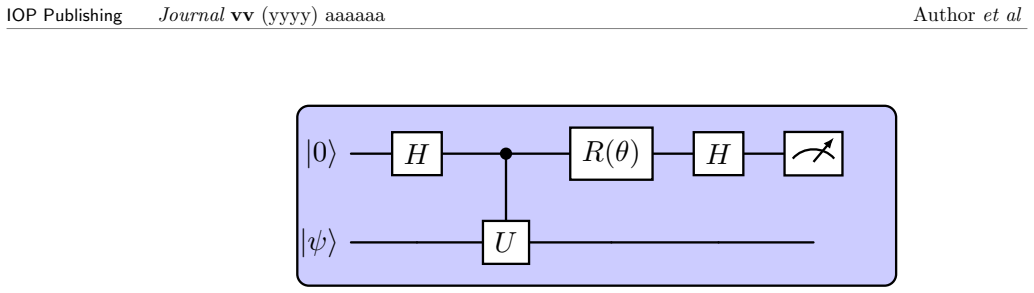
The Hadamard test applied to Trotterized time-evolution operators that support constant-depth circuits for the transverse field Ising model.
If this is right
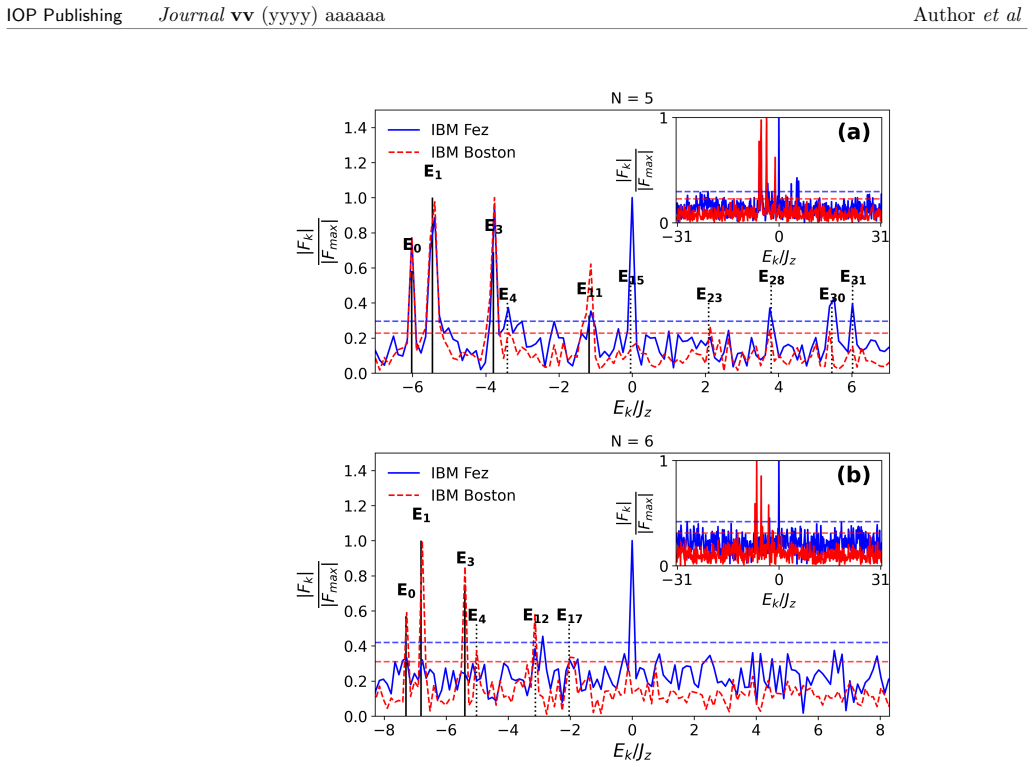
- A large number of eigen-energies can be located above background noise for TFIM systems up to six spins.
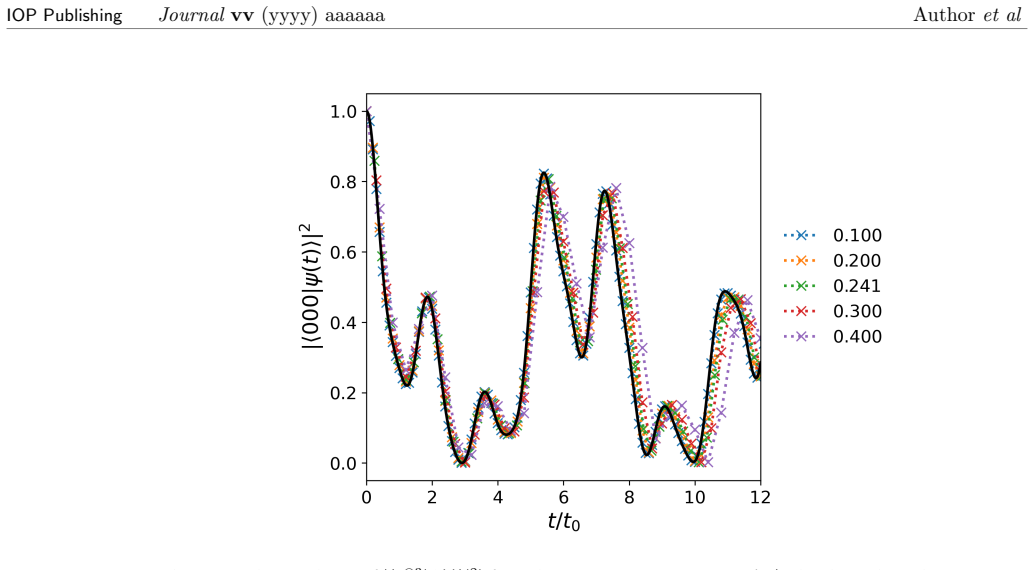
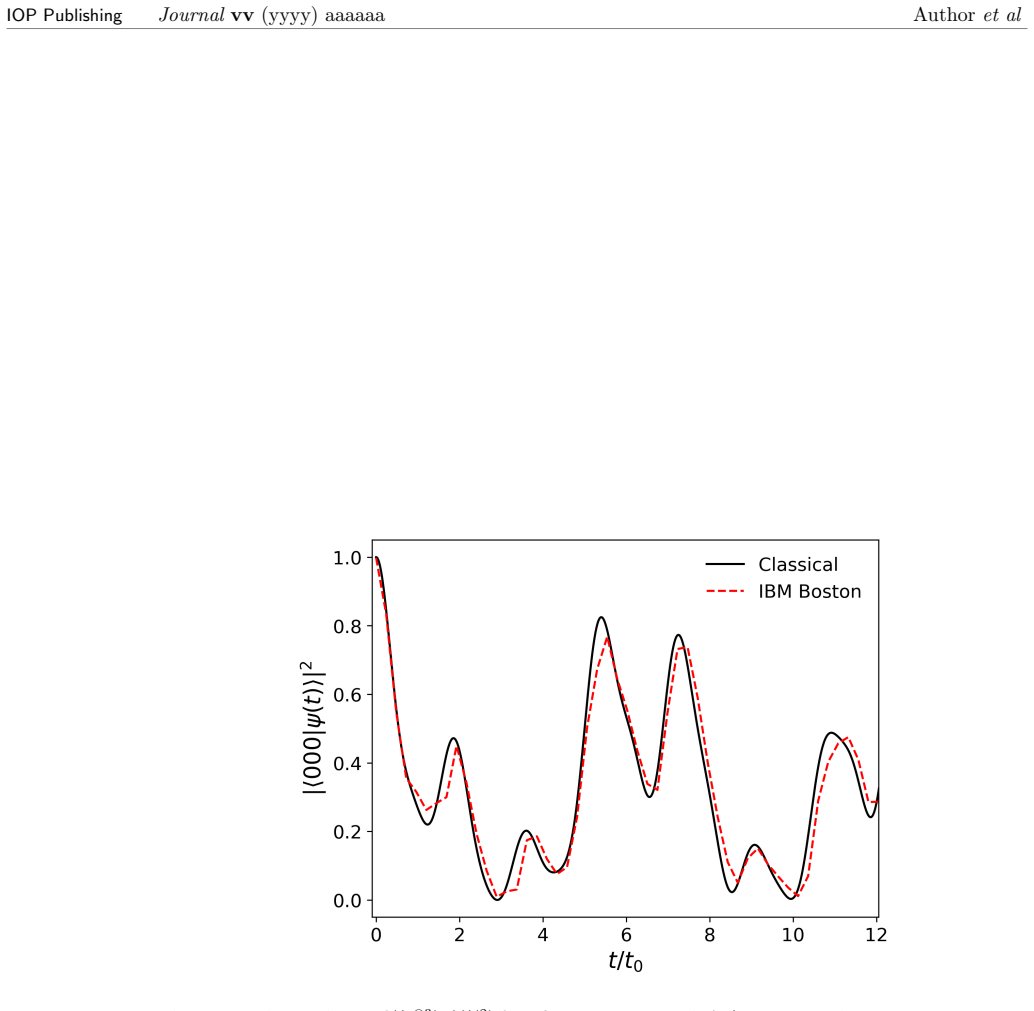
- Ground and first-excited state energies can be extracted for the three-site TLFIM via its dynamics.
- The constant-depth property holds for TFIM at arbitrary evolution times.
- Extraction reliability improves when noise and discrete Fourier transform complications are addressed.
- Newer generations of IBM hardware yield better results than older ones.
Where Pith is reading between the lines
- If constant-depth Trotter structures can be found or synthesized for other Hamiltonians, the method could apply beyond the two Ising variants studied here.
- The fixed depth might allow repeated measurements on the same hardware without accumulating extra gate errors as system size grows modestly.
- Comparing the extracted spectra across different hardware generations suggests that further noise reduction could increase the number of reliably resolved states.
- The approach could be checked on non-Ising models that admit similar constant-depth decompositions to test generality.
Load-bearing premise
That the noisy background and discrete Fourier transform effects can be mitigated enough for the extracted energies to be reliable.
What would settle it
If the energy values obtained from the Fourier peaks of the Hadamard test signals do not match the analytically known eigenvalues of the TFIM or TLFIM within the hardware's error bars for small systems.
Figures





read the original abstract
We implement the Hadamard test with Trotterized time-evolution operators on IBM quantum computers to simultaneously extract ground- and excited-state energies of the transverse field Ising model (TFIM) and transverse longitudinal field Ising model (TLFIM). The Trotterization circuits for the TFIM admit constant-depth circuits (CDCs) for arbitrary time, allowing us to locate a large number of eigen-energies above the background noise for up to six spins. Via circuit synthesis we show that the three-spin TLFIM has constant-depth structure although it does not meet the known CDC criteria. The CDCs enable the extraction of the ground and first-excited state energies of the three-site TLFIM via its dynamics. We also address complications from the noisy background and discrete Fourier transform to enhance the reliability of the extraction process and compare the results from different generations of IBM hardware to highlight the improvement.
Editorial analysis
A structured set of objections, weighed in public.
Referee Report
Summary. The manuscript reports an experimental demonstration of the Hadamard test combined with Trotterized time-evolution operators executed on IBM quantum hardware. The goal is simultaneous extraction of ground- and excited-state energies for the transverse-field Ising model (TFIM) and transverse-longitudinal-field Ising model (TLFIM). Constant-depth circuits (CDCs) are identified for the TFIM (arbitrary time, up to N=6) and, via synthesis, for the three-spin TLFIM; the authors state that these enable location of multiple eigenenergies above background after addressing noisy-background and discrete-Fourier-transform artifacts, with comparisons across hardware generations.
Significance. If the reported energy extractions are shown to be reliable (i.e., peaks are demonstrably separated from hardware noise and DFT artifacts), the work would constitute a concrete experimental advance in using quantum dynamics for multi-eigenenergy extraction on NISQ devices. The identification of CDCs for both models and the hardware-generation comparison are positive features that could be cited in future studies of Trotter-based spectroscopy.
major comments (2)
- [Abstract / results section] The central claim (abstract and § on results) that “a large number of eigen-energies” can be located above background for N=6 TFIM and that ground plus first-excited states are extracted for the 3-site TLFIM rests on the effectiveness of the noise-background and DFT mitigation steps. No quantitative metrics (peak widths, signal-to-noise ratios, comparison to exact diagonalization, or error bars) are referenced in the abstract; without these, it is impossible to verify that residual decoherence or aliasing does not broaden peaks sufficiently to undermine the multi-energy claim.
- [Methods / data-analysis subsection] The manuscript states that complications from the noisy background and discrete Fourier transform are addressed, yet the load-bearing mitigation procedure (filtering, windowing, or post-processing) is not described with sufficient algorithmic detail or pseudocode to allow reproduction or independent assessment of whether the extracted energies are free of circular fitting artifacts.
minor comments (2)
- [CDC construction] Notation for the constant-depth circuit construction should be clarified (e.g., explicit gate counts or depth scaling with N and t).
- [Figures] Figure captions should include the number of shots, Trotter steps, and exact hardware device used for each data set.
Simulated Author's Rebuttal
We thank the referee for the constructive feedback on our manuscript. The comments correctly identify areas where additional quantitative support and methodological detail would strengthen the presentation of our results on eigenenergy extraction via Trotterized Hadamard tests. We address each major comment below and have prepared revisions to incorporate the suggested improvements.
read point-by-point responses
-
Referee: [Abstract / results section] The central claim (abstract and § on results) that “a large number of eigen-energies” can be located above background for N=6 TFIM and that ground plus first-excited states are extracted for the 3-site TLFIM rests on the effectiveness of the noise-background and DFT mitigation steps. No quantitative metrics (peak widths, signal-to-noise ratios, comparison to exact diagonalization, or error bars) are referenced in the abstract; without these, it is impossible to verify that residual decoherence or aliasing does not broaden peaks sufficiently to undermine the multi-energy claim.
Authors: We agree that the abstract would benefit from explicit reference to quantitative metrics to support the central claims. The results section already contains comparisons to exact diagonalization, peak-width estimates, signal-to-noise ratios, and error bars derived from hardware runs; these will now be summarized in the abstract as well. This change will make the reliability of the extracted energies clearer without altering the underlying data or conclusions. revision: yes
-
Referee: [Methods / data-analysis subsection] The manuscript states that complications from the noisy background and discrete Fourier transform are addressed, yet the load-bearing mitigation procedure (filtering, windowing, or post-processing) is not described with sufficient algorithmic detail or pseudocode to allow reproduction or independent assessment of whether the extracted energies are free of circular fitting artifacts.
Authors: We acknowledge that the current description of the background-subtraction and DFT-mitigation steps lacks the algorithmic detail needed for full reproducibility. In the revised manuscript we will expand the methods subsection to include a precise step-by-step account of the filtering, windowing, and post-processing pipeline together with pseudocode for the key operations. This will allow independent verification that the reported energies are free of the artifacts mentioned. revision: yes
Circularity Check
No circularity: experimental hardware demonstration with independent validation
full rationale
The paper reports an experimental implementation of Hadamard-test circuits with Trotterized evolution on IBM quantum processors to extract TFIM and TLFIM eigenenergies. All load-bearing steps (circuit construction, hardware execution, DFT post-processing, and noise mitigation) are performed on physical devices and compared across hardware generations; none reduce by definition or self-citation to quantities fitted from the same dataset. The abstract and described methods contain no self-definitional loops, fitted-input predictions, or load-bearing self-citations. The work is therefore self-contained against external hardware benchmarks.
Axiom & Free-Parameter Ledger
Reference graph
Works this paper leans on
-
[1]
Optimized qubo formulation methods for quantum computing.Quantum Science and Technology, 11(1):015056, feb 2026
Dario De Santis, Salvatore Tirone, Stefano Marmi, and Vittorio Giovannetti. Optimized qubo formulation methods for quantum computing.Quantum Science and Technology, 11(1):015056, feb 2026
2026
-
[2]
Towards solving large qubo problems using quantum algorithms: Improving the logq scheme
Yagnik Chatterjee and J´ er´ emie Messud. Towards solving large qubo problems using quantum algorithms: Improving the logq scheme. In2025 IEEE International Conference on Quantum Computing and Engineering (QCE), volume 01, pages 1997–2003, 2025
1997
-
[3]
Range dependent hamiltonian algorithms for numerical qubo formulation.Scientific Reports, 15(1):8819, Mar 2025
Hyunju Lee and Kyungtaek Jun. Range dependent hamiltonian algorithms for numerical qubo formulation.Scientific Reports, 15(1):8819, Mar 2025
2025
-
[4]
Best practices for portfolio optimization by quantum computing, experimented on real quantum devices.Scientific Reports, 13(1):19434, Nov 2023
Giuseppe Buonaiuto, Francesco Gargiulo, Giuseppe De Pietro, Massimo Esposito, and Marco Pota. Best practices for portfolio optimization by quantum computing, experimented on real quantum devices.Scientific Reports, 13(1):19434, Nov 2023
2023
-
[5]
Solving linear systems on quantum hardware with hybrid hhl++.Scientific Reports, 14(1):20610, Sep 2024
Romina Yalovetzky, Pierre Minssen, Dylan Herman, and Marco Pistoia. Solving linear systems on quantum hardware with hybrid hhl++.Scientific Reports, 14(1):20610, Sep 2024
2024
-
[6]
Lov K. Grover. A fast quantum mechanical algorithm for database search. InProceedings of the Twenty-Eighth Annual ACM Symposium on Theory of Computing, STOC ’96, page 212–219, New York, NY, USA, 1996. Association for Computing Machinery
1996
-
[7]
I. M. Georgescu, S. Ashhab, and Franco Nori. Quantum simulation.Rev. Mod. Phys., 86:153–185, Mar 2014
2014
-
[8]
Exponential quantum speedup for simulating classical lattice dynamics.Phys
Xiantao Li. Exponential quantum speedup for simulating classical lattice dynamics.Phys. Rev. Lett., 135:080602, Aug 2025
2025
-
[9]
Anthony Ransford, M. S. Allman, Jake Arkinstall, J. P. Campora III, Samuel F. Cooper, Robert D. Delaney, Joan M. Dreiling, Brian Estey, Caroline Figgatt, Alex Hall, Ali A. Husain, Akhil Isanaka, Colin J. Kennedy, Nikhil Kotibhaskar, Ivaylo S. Madjarov, Karl Mayer, Alistair R. Milne, Annie J. Park, Adam P. Reed, Riley Ancona, Molly P. Andersen, Pablo Andre...
2025
-
[10]
Warner, Jeffrey Holzgrafe, Beatriz Yankelevich, David Barton, Stefano Poletto, C
Hana K. Warner, Jeffrey Holzgrafe, Beatriz Yankelevich, David Barton, Stefano Poletto, C. J. Xin, Neil Sinclair, Di Zhu, Eyob Sete, Brandon Langley, Emma Batson, Marco Colangelo, Amirhassan Shams-Ansari, Graham Joe, Karl K. Berggren, Liang Jiang, Matthew J. Reagor, and Marko Lonˇ car. Coherent control of a superconducting qubit using light.Nature Physics,...
2025
-
[11]
Modeling error correction with lindblad dynamics and approximate channels.Phys
Zohar Schwartzman-Nowik, Liran Shirizly, and Haggai Landa. Modeling error correction with lindblad dynamics and approximate channels.Phys. Rev. A, 111:022613, Feb 2025
2025
-
[12]
Noisy gates for simulating quantum computers.Phys
Giovanni Di Bartolomeo, Michele Vischi, Francesco Cesa, Roman Wixinger, Michele Grossi, Sandro Donadi, and Angelo Bassi. Noisy gates for simulating quantum computers.Phys. Rev. Res., 5:043210, Dec 2023
2023
-
[13]
Quantum error correction: an introductory guide.Contemporary Physics, 60(3):226–245, 2019
Joschka Roffe. Quantum error correction: an introductory guide.Contemporary Physics, 60(3):226–245, 2019
2019
-
[14]
Abanin, Laleh Aghababaie-Beni, Igor Aleiner, Trond I
Rajeev Acharya, Dmitry A. Abanin, Laleh Aghababaie-Beni, Igor Aleiner, Trond I. Andersen, Markus Ansmann, Frank Arute, Kunal Arya, Abraham Asfaw, Nikita Astrakhantsev, Juan Atalaya, Ryan Babbush, Dave Bacon, Brian Ballard, Joseph C. Bardin, Johannes Bausch, Andreas Bengtsson, Alexander Bilmes, Sam Blackwell, Sergio Boixo, Gina Bortoli, Alexandre Bourassa,...
2025
-
[15]
Dalzell, Sam McArdle, Mario Berta, Przemyslaw Bienias, Chi-Fang Chen, Andr´ as Gily´ en, Connor T
Alexander M. Dalzell, Sam McArdle, Mario Berta, Przemyslaw Bienias, Chi-Fang Chen, Andr´ as Gily´ en, Connor T. Hann, Michael J. Kastoryano, Emil T. Khabiboulline, Aleksander Kubica, Grant Salton, Samson Wang, and Fernando G. S. L. Brand˜ ao.Quantum Algorithms: A Survey of Applications and End-to-end Complexities. Cambridge University Press, April 2025
2025
-
[16]
Quantum algorithms: an overview.npj Quantum Information, 2(1):15023, Jan 2016
Ashley Montanaro. Quantum algorithms: an overview.npj Quantum Information, 2(1):15023, Jan 2016
2016
-
[17]
Quantum Computing in the NISQ era and beyond.Quantum, 2:79, August 2018
John Preskill. Quantum Computing in the NISQ era and beyond.Quantum, 2:79, August 2018
2018
-
[18]
Kottmann, Tim Menke, Wai-Keong Mok, Sukin Sim, Leong-Chuan Kwek, and Al´ an Aspuru-Guzik
Kishor Bharti, Alba Cervera-Lierta, Thi Ha Kyaw, Tobias Haug, Sumner Alperin-Lea, Abhinav Anand, Matthias Degroote, Hermanni Heimonen, Jakob S. Kottmann, Tim Menke, Wai-Keong Mok, Sukin Sim, Leong-Chuan Kwek, and Al´ an Aspuru-Guzik. Noisy intermediate-scale quantum algorithms.Rev. Mod. Phys., 94:015004, Feb 2022
2022
-
[19]
Kenneth M
Jr. Kenneth M. Merz, Akhil Shajan, Danil Kaliakin, Fangchun Liang, Yuichi Otsuka, Tomonori Shirakawa, Lukas Broers, Han Xu, Miwako Tsuji, Mitsuhisa Sato, Seiji Yunoki, Ryo Wakizaka, Yukio Kawashima, Jun Doi, Toshinari Itoko, Hiroshi Horii, Thaddeus Pellegrini, Javier Robledo Moreno, Kevin J. Sung, Ella Fejer, Robert Walkup, Seetharami Seelam, and Mario Mo...
2026
-
[20]
Abrams and Seth Lloyd
Daniel S. Abrams and Seth Lloyd. Quantum algorithm providing exponential speed increase for finding eigenvalues and eigenvectors.Phys. Rev. Lett., 83:5162–5165, Dec 1999
1999
-
[21]
Dutoi, Peter J
Al´ an Aspuru-Guzik, Anthony D. Dutoi, Peter J. Love, and Martin Head-Gordon. Simulated quantum computation of molecular energies.Science, 309(5741):1704–1707, 2005
2005
-
[22]
Terhal, and Thomas E
Alicja Dutkiewicz, Barbara M. Terhal, and Thomas E. O’Brien. Heisenberg-limited quantum phase estimation of multiple eigenvalues with few control qubits.Quantum, 6:830, October 2022
2022
-
[23]
Quantum phase estimation of multiple eigenvalues for small-scale (noisy) experiments.New Journal of Physics, 21(2):023022, feb 2019
Thomas E O’Brien, Brian Tarasinski, and Barbara M Terhal. Quantum phase estimation of multiple eigenvalues for small-scale (noisy) experiments.New Journal of Physics, 21(2):023022, feb 2019
2019
-
[24]
Georges, Marius Bothe, Christoph S¨ underhauf, Bjorn K
Timothy N. Georges, Marius Bothe, Christoph S¨ underhauf, Bjorn K. Berntson, R´ obert Izs´ ak, and Aleksei V. Ivanov. Quantum simulations of chemistry in first quantization with any basis set.npj Quantum Information, 11(1):55, Apr 2025
2025
-
[25]
Berry, Nathan Wiebe, Jarrod McClean, Alexandru Paler, Austin Fowler, and Hartmut Neven
Ryan Babbush, Craig Gidney, Dominic W. Berry, Nathan Wiebe, Jarrod McClean, Alexandru Paler, Austin Fowler, and Hartmut Neven. Encoding electronic spectra in quantum circuits with linear t complexity.Phys. Rev. X, 8:041015, Oct 2018
2018
-
[26]
Harwood, Tanvi P
Dimitar Trenev, Pauline J Ollitrault, Stuart M. Harwood, Tanvi P. Gujarati, Sumathy Raman, Antonio Mezzacapo, and Sarah Mostame. Refining resource estimation for the quantum computation of vibrational molecular spectra through Trotter error analysis.Quantum, 9:1630, February 2025
2025
-
[27]
Benchmarking quantum simulation methods, 2025
Calvin Ku, Yu-Cheng Chen, Alice Hu, and Min-Hsiu Hsieh. Benchmarking quantum simulation methods, 2025
2025
-
[28]
Guang Hao Low and Isaac L. Chuang. Hamiltonian Simulation by Qubitization.Quantum, 3:163, July 2019
2019
-
[29]
Daan Camps, Ermal Rrapaj, Katherine Klymko, Hyeongjin Kim, Kevin Gott, Siva Darbha, Jan Balewski, Brian Austin, and Nicholas J. Wright. Quantum computing technology roadmaps and capability assessment for scientific computing - an analysis of use cases from the nersc workload. Technical report, Lawrence Berkeley National Laboratory (LBNL), Berkeley, CA (Un...
2025
-
[30]
Y. S. Weinstein, M. A. Pravia, E. M. Fortunato, S. Lloyd, and D. G. Cory. Implementation of the quantum fourier transform.Phys. Rev. Lett., 86:1889–1891, Feb 2001
2001
-
[31]
Swart, James G
Abhijith J., Adetokunbo Adedoyin, John Ambrosiano, Petr Anisimov, William Casper, Gopinath Chennupati, Carleton Coffrin, Hristo Djidjev, David Gunter, Satish Karra, Nathan Lemons, Shizeng Lin, Alexander Malyzhenkov, David Mascarenas, Susan Mniszewski, Balu 20 IOP PublishingJournalvv(yyyy) aaaaaa Authoret al Nadiga, Daniel O’malley, Diane Oyen, Scott Pakin...
2022
-
[32]
Methodology for replacing indirect measurements with direct measurements.Phys
Kosuke Mitarai and Keisuke Fujii. Methodology for replacing indirect measurements with direct measurements.Phys. Rev. Res., 1:013006, Aug 2019
2019
-
[33]
Cleve, A
R. Cleve, A. Ekert, C. Macchiavello, and M. Mosca. Quantum algorithms revisited.Proceedings of the Royal Society A: Mathematical, Physical and Engineering Sciences, 454(1969):339–354, 01 1998
1969
-
[34]
Blunt, Laura Caune, R´ obert Izs´ ak, Earl T
Nick S. Blunt, Laura Caune, R´ obert Izs´ ak, Earl T. Campbell, and Nicole Holzmann. Statistical phase estimation and error mitigation on a superconducting quantum processor.PRX Quantum, 4:040341, Dec 2023
2023
-
[35]
Classically optimized hamiltonian simulation.Phys
Conor Mc Keever and Michael Lubasch. Classically optimized hamiltonian simulation.Phys. Rev. Res., 5:023146, Jun 2023
2023
-
[36]
Maurits S. J. Tepaske, Dominik Hahn, and David J. Luitz. Optimal compression of quantum many-body time evolution operators into brickwall circuits.SciPost Phys., 14:073, 2023
2023
-
[37]
Matrix product operator representations.New Journal of Physics, 12(2):025012, feb 2010
B Pirvu, V Murg, J I Cirac, and F Verstraete. Matrix product operator representations.New Journal of Physics, 12(2):025012, feb 2010
2010
-
[38]
Tensor-based phase difference estimation on time-series analysis.Phys
Shu Kanno, Kenji Sugisaki, Rei Sakuma, Jumpei Kato, Hajime Nakamura, and Naoki Yamamoto. Tensor-based phase difference estimation on time-series analysis.Phys. Rev. A, 113:052433, May 2026
2026
-
[39]
Lindsay Bassman Oftelie, Roel Van Beeumen, Ed Younis, Ethan Smith, Costin Iancu, and Wibe A. de Jong. Constant-depth circuits for dynamic simulations of materials on quantum computers.Materials Theory, 6(1):13, Mar 2022
2022
-
[40]
The one-dimensional ising model with a transverse field.Annals of Physics, 57(1):79–90, 1970
Pierre Pfeuty. The one-dimensional ising model with a transverse field.Annals of Physics, 57(1):79–90, 1970
1970
-
[41]
Chakrabarti, Uma Divakaran, Thomas F
Amit Dutta, Gabriel Aeppli, Bikas K. Chakrabarti, Uma Divakaran, Thomas F. Rosenbaum, and Diptiman Sen.Quantum Phase Transitions in Transverse Field Spin Models: From Statistical Physics to Quantum Information. Cambridge University Press, 2015
2015
-
[42]
Haghshenas, E
R. Haghshenas, E. Chertkov, M. Mills, W. Kadow, S.-H. Lin, Y. H. Chen, C. Cade, I. Niesen, T. Beguˇ si´ c, M. S. Rudolph, C. Cirstoiu, K. H´ emery, C. Mc Keever, M. Lubasch, E. Granet, C. H. Baldwin, J. P. Bartolotta, M. Bohn, J. J. Burau, J. Cline, M. DeCross, J. M. Dreiling, C. Foltz, D. Francois, J. P. Gaebler, C. N. Gilbreth, J. Gray, D. Gresh, A. Hal...
2026
-
[43]
O. F. de Alcantara Bonfim, B. Boechat, and J. Florencio. Ground-state properties of the one-dimensional transverse ising model in a longitudinal magnetic field.Phys. Rev. E, 99:012122, Jan 2019
2019
-
[44]
Global quantum discord in an ising model with transverse and longitudinal magnetic fields.Quantum Information Processing, 23(10):347, Oct 2024
Wenyuan Xiao, Wenqiong Zhang, Longhui Shen, Jia Bao, and Bin Guo. Global quantum discord in an ising model with transverse and longitudinal magnetic fields.Quantum Information Processing, 23(10):347, Oct 2024
2024
-
[45]
Mixed-order transition in the antiferromagnetic quantum ising chain in a field.Phys
P´ eter Lajk´ o and Ferenc Igl´ oi. Mixed-order transition in the antiferromagnetic quantum ising chain in a field.Phys. Rev. B, 103:174404, May 2021
2021
-
[46]
Ishmam Mohtashim, Arnav Das, Turbasu Chatterjee, and Farhan T
S. Ishmam Mohtashim, Arnav Das, Turbasu Chatterjee, and Farhan T. Chowdhury. A near-term quantum simulation of the transverse field ising model hints at glassy dynamics.The European Physical Journal Special Topics, 234(20):6309–6322, Dec 2025. 21 IOP PublishingJournalvv(yyyy) aaaaaa Authoret al
2025
-
[47]
Theory and simulation for equilibrium glassy dynamics in cellular potts model of confluent biological tissue.Phys
Souvik Sadhukhan and Saroj Kumar Nandi. Theory and simulation for equilibrium glassy dynamics in cellular potts model of confluent biological tissue.Phys. Rev. E, 103:062403, Jun 2021
2021
-
[48]
Ed Younis, Costin C. Iancu, Wim Lavrijsen, Marc Davis, and Ethan Smith. Berkeley quantum synthesis toolkit (bqskit) v1. [Computer Software] https://doi.org/10.11578/dc.20210603.2, apr 2021
-
[49]
Leap: Scaling numerical optimization based synthesis using an incremental approach.ACM Transactions on Quantum Computing, 4(1), February 2023
Ethan Smith, Marc Grau Davis, Jeffrey Larson, Ed Younis, Lindsay Bassman Oftelie, Wim Lavrijsen, and Costin Iancu. Leap: Scaling numerical optimization based synthesis using an incremental approach.ACM Transactions on Quantum Computing, 4(1), February 2023
2023
-
[50]
Campbell
Kianna Wan, Mario Berta, and Earl T. Campbell. Randomized quantum algorithm for statistical phase estimation.Phys. Rev. Lett., 129:030503, Jul 2022
2022
-
[51]
Quantum eigenvalue estimation via time series analysis.New Journal of Physics, 21(12):123025, dec 2019
Rolando D Somma. Quantum eigenvalue estimation via time series analysis.New Journal of Physics, 21(12):123025, dec 2019
2019
-
[52]
Huili Zhang, Yibin Guo, Guanglei Xu, Yulong Feng, Jingning Zhang, Hai-feng Yu, and S.P. Zhao. Simultaneous determination of multiple low-lying energy levels on a superconducting quantum processor.Phys. Rev. Appl., 25:034066, Mar 2026
2026
-
[53]
Improved ising meson spectroscopy simulation on a noisy digital quantum device, 2025
Hao-Ti Hung, Isabel Nha Minh Le, Johannes Knolle, and Ying-Jer Kao. Improved ising meson spectroscopy simulation on a noisy digital quantum device, 2025
2025
-
[54]
Phase estimation with partially randomized time evolution, 2025
Jakob G¨ unther, Freek Witteveen, Alexander Schmidhuber, Marek Miller, Matthias Christandl, and Aram Harrow. Phase estimation with partially randomized time evolution, 2025
2025
-
[55]
Adam Smith, M. S. Kim, Frank Pollmann, and Johannes Knolle. Simulating quantum many-body dynamics on a current digital quantum computer.npj Quantum Information, 5(1):106, Nov 2019
2019
-
[56]
Symmetric trotterization in digital quantum simulation of quantum spin dynamics.Journal of the Korean Physical Society, 82(5):479–485, Mar 2023
Yeonghun Lee. Symmetric trotterization in digital quantum simulation of quantum spin dynamics.Journal of the Korean Physical Society, 82(5):479–485, Mar 2023
2023
-
[57]
J. J. Sakurai and Jim Napolitano.Modern Quantum Mechanics. Addison Wesley Longman, Boston, MA, 2 edition, 2010
2010
-
[58]
Finding exponential product formulas of higher orders
Naomichi Hatano and Masuo Suzuki. Finding exponential product formulas of higher orders. In Arnab Das and Bikas K. Chakrabarti, editors,Quantum Annealing and Other Optimization Methods, pages 37–68. Springer Berlin Heidelberg, Berlin, Heidelberg, 2005
2005
-
[59]
Bennett, Richard Cleve, David P
Adriano Barenco, Charles H. Bennett, Richard Cleve, David P. DiVincenzo, Norman Margolus, Peter Shor, Tycho Sleator, John A. Smolin, and Harald Weinfurter. Elementary gates for quantum computation.Phys. Rev. A, 52:3457–3467, Nov 1995
1995
-
[60]
DiVincenzo
David P. DiVincenzo. Quantum gates and circuits.Proceedings of the Royal Society A: Mathematical, Physical and Engineering Sciences, 454(1969):261–276, 01 1998
1969
-
[61]
Terhal and David P
Barbara M. Terhal and David P. DiVincenzo. Classical simulation of noninteracting-fermion quantum circuits.Phys. Rev. A, 65:032325, Mar 2002
2002
-
[62]
Davis, Ethan Smith, Ana Tudor, Koushik Sen, Irfan Siddiqi, and Costin Iancu
Marc G. Davis, Ethan Smith, Ana Tudor, Koushik Sen, Irfan Siddiqi, and Costin Iancu. Towards optimal topology aware quantum circuit synthesis. In2020 IEEE International Conference on Quantum Computing and Engineering (QCE), pages 223–234, 2020
2020
-
[63]
Sornborger, and Patrick J
Sumeet Khatri, Ryan LaRose, Alexander Poremba, Lukasz Cincio, Andrew T. Sornborger, and Patrick J. Coles. Quantum-assisted quantum compiling.Quantum, 3:140, May 2019
2019
-
[64]
Dalla Torre
Matan Ben-Dov, David Shnaiderov, Adi Makmal, and Emanuele G. Dalla Torre. Approximate encoding of quantum states using shallow circuits.npj Quantum Information, 10(1):65, Jul 2024
2024
-
[65]
Quantum circuit optimization and transpilation via parameterized circuit instantiation
Ed Younis and Costin Iancu. Quantum circuit optimization and transpilation via parameterized circuit instantiation. In2022 IEEE International Conference on Quantum Computing and Engineering (QCE), pages 465–475, 2022
2022
-
[66]
Parallelizing quantum circuit synthesis.Quantum Science and Technology, 1(1):015003, oct 2016
Olivia Di Matteo and Michele Mosca. Parallelizing quantum circuit synthesis.Quantum Science and Technology, 1(1):015003, oct 2016. 22 IOP PublishingJournalvv(yyyy) aaaaaa Authoret al
2016
-
[67]
Lectures on quantum field theory on a quantum computer, 2025
Aninda Sinha and Ujjwal Basumatary. Lectures on quantum field theory on a quantum computer, 2025
2025
-
[68]
Demuth, F
M. Demuth, F. Hanauska, M. Hansmann, and G. Katriel. Estimating the number of eigenvalues of linear operators on banach spaces.Journal of Functional Analysis, 268(4):1032–1052, 2015
2015
-
[69]
M. Domokos. Hermitian matrices with a bounded number of eigenvalues.Linear Algebra and its Applications, 439(12):3964–3979, 2013
2013
-
[70]
Shannon’s sampling theorem.Current Science, 63(5):253–260, 1992
Maurice Dodson. Shannon’s sampling theorem.Current Science, 63(5):253–260, 1992
1992
-
[71]
A.J. Jerri. The shannon sampling theorem—its various extensions and applications: A tutorial review.Proceedings of the IEEE, 65(11):1565–1596, 1977
1977
-
[72]
Schoukens and J
J. Schoukens and J. Renneboog. Modeling the noise influence on the fourier coefficients after a discrete fourier transform.IEEE Transactions on Instrumentation and Measurement, IM-35(3):278–286, 1986
1986
-
[73]
Detecting crosstalk errors in quantum information processors.Quantum, 4:321, Sept 2020
Mohan Sarovar, Timothy Proctor, Kenneth Rudinger, Kevin Young, Erik Nielsen, and Robin Blume-Kohout. Detecting crosstalk errors in quantum information processors.Quantum, 4:321, Sept 2020
2020
-
[74]
Fasciati, Michele Piscitelli, Paul C
Mohammed Alghadeer, Shuxiang Cao, Simone D. Fasciati, Michele Piscitelli, Paul C. Gow, James C. Gates, Mustafa Bakr, and Peter J. Leek. Low crosstalk in a scalable superconducting quantum lattice.EPJ Quantum Technology, 13(1):19, Jan 2026
2026
-
[75]
Cross-talk in superconducting qubit lattices with tunable couplers—comparing transmon and fluxonium architectures.Quantum Science and Technology, 11(1):015020, dec 2025
Florian Lange, Lukas Heunisch, Holger Fehske, David P DiVincenzo, and Michael J Hartmann. Cross-talk in superconducting qubit lattices with tunable couplers—comparing transmon and fluxonium architectures.Quantum Science and Technology, 11(1):015020, dec 2025
2025
-
[76]
Varga.Gerˇ sgorin and His Circles
Richard S. Varga.Gerˇ sgorin and His Circles. Springer Berlin, Heidelberg, 2010
2010
-
[77]
David Slepian and Henry J. Landau. A note on the eigenvalues of hermitian matrices.SIAM Journal on Mathematical Analysis, 9(2):291–297, 1978
1978
-
[78]
Optimizing gershgorin for symmetric matrices.Linear Algebra and its Applications, 577:360–383, 2019
Lee DeVille. Optimizing gershgorin for symmetric matrices.Linear Algebra and its Applications, 577:360–383, 2019
2019
-
[79]
Dover Publications, Mineola, New York, 2020
Edgar Giraldus Phillips.Functions of a Complex Variable. Dover Publications, Mineola, New York, 2020
2020
-
[80]
Fractional gates
IBM Quantum. Fractional gates. https://quantum.cloud.ibm.com/docs/en/guides/fractional-gates, 2025. Accessed: 2026-05-18
2025
discussion (0)
Sign in with ORCID, Apple, or X to comment. Anyone can read and Pith papers without signing in.