REVIEW 2 major objections 2 minor 14 references
Analytics for Quality Assurance for Item Pools (AQuAP): Monitoring and Maintaining Item Bank Health in AI-Driven Assessment Systems
T0 review · 2 major / 2 minor · reviewed 2026-06-26 · grok-4.3
Pith's one-line read AQuAP introduces Effective Bank Size to quantify how many independent test sessions an item pool can support before content repetition occurs.
desk verdict AQuAP is a descriptive framework that names a dashboard and metrics like Effective Bank Size for AI item banks, but the work stops at definitions with no validation data or benchmarks against real exposure or repetition events. read the letter →
The pith
A machine-rendered reading of the paper's core claim, the machinery that carries it, and where it could break.
The reading
What carries the argument
Effective Bank Size (EBS), which counts the number of independent test sessions constructible before content repetition occurs.
What would settle it
Data from live testing programs showing that Effective Bank Size values do not predict observed rates of content repetition or security breaches would undermine the central claim.
Extended reading notes
Core claim
AQuAP supplies operational analytics that convert psychometric ideas into quality-assurance signals; its central indicator, Effective Bank Size, counts the number of independent test sessions that can be formed from an item pool before repetition becomes necessary, while companion measures such as maximum conditional exposure and the rarely-administered fraction complete the view of pool utilization.
Load-bearing premise
The newly defined metrics translate psychometric ideas into usable quality-assurance signals without further empirical checks or outside benchmarks.
Editorial extensions
If this is right
- Item pools can be monitored continuously for vitality using EBS together with exposure metrics.
- Maximum conditional exposure flags items that risk over-use in specific test forms.
- The rarely-administered fraction signals under-utilized content that may need review or retirement.
- Adjusted EBS values incorporate usage patterns to refine estimates of remaining pool capacity.
Reading between the lines
- The same dashboard structure could extend to item pools outside language testing.
- Automated alerts based on these metrics might trigger item generation or retirement rules.
- Longitudinal tracking of EBS could reveal how AI generation speed affects bank longevity.
Editorial analysis
A structured set of objections, weighed in public.
Referee Report
Summary. The manuscript presents Analytics for Quality Assurance for Item Pools (AQuAP), a dashboard for monitoring item quality and bank health in AI-driven assessment systems. It positions AQuAP as supporting the Item Factory framework for large-scale item generation in high-stakes tests such as the Duolingo English Test (DET). The paper defines and highlights the Effective Bank Size (EBS) metric, which quantifies the number of independent test sessions constructible before content repetition occurs, and introduces related bank-health metrics including maximum exposure, maximum conditional exposure, adjusted effective bank size, and rarely-administered fraction. These are presented as tools that translate psychometric concepts into operational QA signals for security, diversity, and efficiency.
Significance. If empirically validated, the AQuAP framework and EBS metric could supply practical, operational tools for maintaining vitality in large AI-generated item banks, addressing a real need in high-volume testing programs. The manuscript correctly notes the integration with existing DET/Item Factory workflows as a strength, but the complete absence of data, simulations, or external benchmarks means the claimed actionability remains untested.
major comments (2)
- [Abstract and EBS definition section] Abstract and the section introducing Effective Bank Size (EBS): the claim that EBS 'quantifies how many independent test sessions can be constructed before content repetition occurs' and, when coupled with exposure metrics, 'provides insight into item bank security, diversity, and efficiency' rests solely on definitional statements with no reported simulations, real-world data, or validation against observed repetition or exposure events.
- [Broader metric framework section] Section on the broader metric framework: no error analysis, sensitivity checks, or benchmark comparisons are supplied for maximum conditional exposure, rarely-administered fraction, or adjusted EBS, so the assertion that these metrics deliver 'actionable quality-assurance signals' is unsupported by evidence.
minor comments (2)
- [Metrics definitions] The relationship between EBS and 'adjusted effective bank size' is described but not given an explicit formula or worked numerical example, which would aid reproducibility.
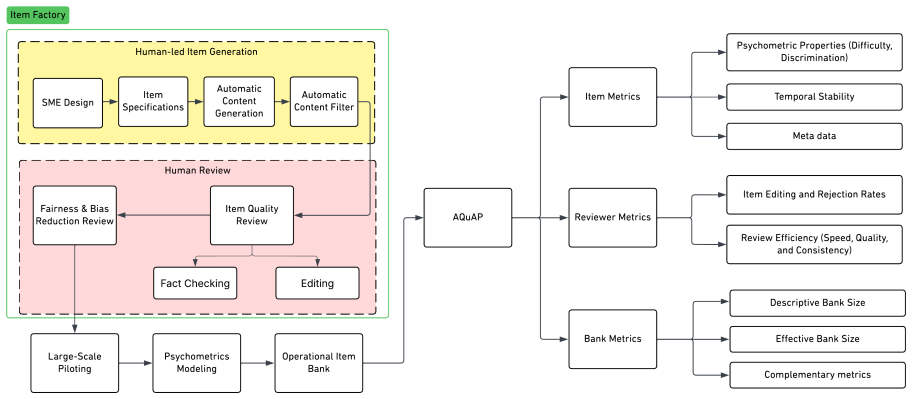
- [Throughout] Figure captions or workflow diagrams illustrating how AQuAP integrates with the Item Factory would improve clarity of the operational claims.
Simulated Author's Rebuttal
We thank the referee for the review and for identifying the distinction between definitional contributions and empirical validation. The manuscript is a conceptual and methodological description of the AQuAP framework and its metrics, illustrated with DET processes; it does not present simulations or observational data. We address the two major comments below.
read point-by-point responses
-
Referee: [Abstract and EBS definition section] Abstract and the section introducing Effective Bank Size (EBS): the claim that EBS 'quantifies how many independent test sessions can be constructed before content repetition occurs' and, when coupled with exposure metrics, 'provides insight into item bank security, diversity, and efficiency' rests solely on definitional statements with no reported simulations, real-world data, or validation against observed repetition or exposure events.
Authors: The EBS metric is introduced through its formal definition as the effective number of non-overlapping test sessions supportable by the current item utilization distribution. The stated insights into security, diversity, and efficiency are direct logical consequences of that definition when combined with the exposure metrics also defined in the paper. The manuscript makes no claim of empirical validation or simulation results; its contribution lies in translating established psychometric exposure concepts into an operational dashboard for AI-generated item banks. We therefore see no need to add data or simulations to the current work. revision: no
-
Referee: [Broader metric framework section] Section on the broader metric framework: no error analysis, sensitivity checks, or benchmark comparisons are supplied for maximum conditional exposure, rarely-administered fraction, or adjusted EBS, so the assertion that these metrics deliver 'actionable quality-assurance signals' is unsupported by evidence.
Authors: The additional metrics (maximum conditional exposure, rarely-administered fraction, adjusted EBS) are presented as straightforward extensions of the core EBS definition to capture different facets of bank utilization. Their actionability is argued on the basis of how they map directly onto operational decisions already made within the Item Factory and DET workflows. No sensitivity or benchmark analyses are included because the paper’s scope is the definition and integration of the metric suite rather than its statistical properties or comparative performance. We maintain that the framework description stands on its own without these analyses. revision: no
Circularity Check
Metrics introduced by definition; no derivation chain or self-referential reduction present
full rationale
The paper presents AQuAP and metrics such as Effective Bank Size (EBS), maximum conditional exposure, and rarely-administered fraction as new operational definitions for item-bank monitoring. No equations, fitted parameters, or predictive derivations are described that could reduce to inputs by construction. The central contribution is definitional translation of psychometric ideas into QA signals, illustrated with DET processes, without any load-bearing self-citation chains or ansatz smuggling. This matches the default expectation of no significant circularity.
Assumptions & free parameters
invented entities (1)
-
Effective Bank Size (EBS)
Cite this review
Pith. "Pith review of Analytics for Quality Assurance for Item Pools (AQuAP): Monitoring and Maintaining Item Bank Health in AI-Driven Assessment Systems." pith.science (2026). https://pith.science/paper/UNJUEGNV
@misc{pith2026260618536,
  author       = {Pith},
  title        = {Pith review of: Analytics for Quality Assurance for Item Pools (AQuAP): Monitoring and Maintaining Item Bank Health in AI-Driven Assessment Systems},
  year         = {2026},
  howpublished = {\url{https://pith.science/paper/UNJUEGNV}},
  note         = {Machine review of arXiv:2606.18536}
}
read the original abstract
The large-scale digitization of educational assessment has made the continuous oversight of item banks both essential and complex. This paper presents Analytics for Quality Assurance for Item Pools (AQuAP), a dashboard environment for monitoring item quality and item bank health. AQuAP supports the operational implementation of the large scale item generation procedures for high-stakes tests as included in the Item Factory, a framework for automated and human-supported test development. The paper describes AQuAP in relationship with the process of item development, outlines the broader metric framework for item-pool quality assurance, and highlights the Effective Bank Size (EBS) as one central indicator of pool vitality. EBS quantifies how many independent test sessions can be constructed before content repetition occurs and, when coupled with exposure and usage metrics, provides insight into item bank security, diversity, and efficiency. We further introduce bank-health metrics, such as maximum exposure, maximum conditional exposure, adjusted effective bank size, and the rarely-administered fraction, all of which extend this picture of item utilization. AQuAP illustrates how operational analytics can translate psychometric concepts into quality assurance tools for high-volume, AI-enabled testing programs. This work is illustrated with the Duolingo English Test (DET) processes.
Figures


Figures from the paper (1 more)

Reference graph
Works this paper leans on
-
[1]
and Thissen, D
Orlando, M. and Thissen, D. , title =. Applied Psychological Measurement , year =
-
[2]
and Johnson, M
Sinharay, S. and Johnson, M. S. , title =. 2003 , number =
2003
-
[3]
and Lewis, C
Lee, Y.-H. and Lewis, C. and von Davier, A. A. , title =. Computerized Multistage Testing: Theory and Applications , editor =. 2014 , pages =
2014
-
[4]
and Lee, Y.-H
Lewis, C. and Lee, Y.-H. and von Davier, A. A. , title =. Test Fraud, Statistical Detection and Methodology , editor =. 2014 , pages =
2014
-
[5]
and Liu, M
Lee, Y.-H. and Liu, M. and von Davier, A. A. , title =. New Developments in Quantitative Psychology: Presentations from the 77th Annual Psychometric Society Meeting , editor =. 2014 , pages =
2014
-
[6]
and van Rijn, P
Wanjohi, R. and van Rijn, P. and von Davier, A. A. , title =. New Developments in Quantitative Psychology: Presentations from the 77th Annual Psychometric Society Meeting , editor =. 2014 , pages =
2014
-
[7]
von Davier, A. A. and Attali, Y. and Runge, A. and Church, J. and Park, Y. and LaFlair, G. , title =. Machine Learning, Natural Language Processing, and Psychometrics , editor =. 2024 , pages =
2024
-
[8]
von Davier, A. A. and Mislevy, R. J. and Hao, J. , title =. 2021 , publisher =
2021
Show all 14 references
-
[9]
and Church, J
Attali, Y. and Church, J. and Park, Y. , title =
-
[10]
, title =
Burstein, J. , title =. 2023 , url =
2023
-
[11]
and Attali, Y
Liao, M. and Attali, Y. and Lockwood, J. R. and von Davier, A. A. , title =. Frontiers in Education , year =
-
[12]
and Attali, Y
Liao, M. and Attali, Y. and von Davier, A. A. and Lockwood, J. R. , title =. Quantitative Psychology: The 86th Annual Meeting of the Psychometric Society, Virtual, 2021 , publisher =. 2022 , pages =
2021
-
[13]
and Teague, C
Allaire, J. and Teague, C. and Scheidegger, C. and Xie, Y. and Dervieux, C. and Woodhull, G. , title =. 2025 , doi =
2025
-
[14]
2026 , eprint=
S2A3: Thompson Sampling and Stochastic Exposure Control for High-Stakes CATs , author=. 2026 , eprint=
2026
Reviewed June 26, 2026 · model on record in the stance chip above.
Discussion (0). Continue with ORCID to comment.