Streamlining Analysis and Design of Two-Dimensional Electronic Spectroscopy using Machine Learning
Pith reviewed 2026-06-26 19:22 UTC · model grok-4.3
The pith
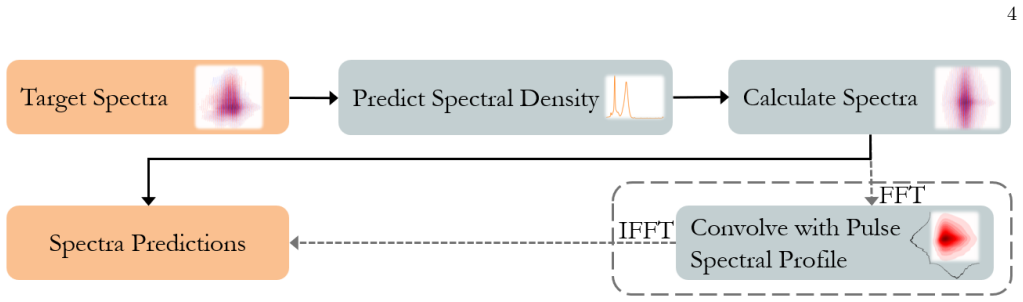
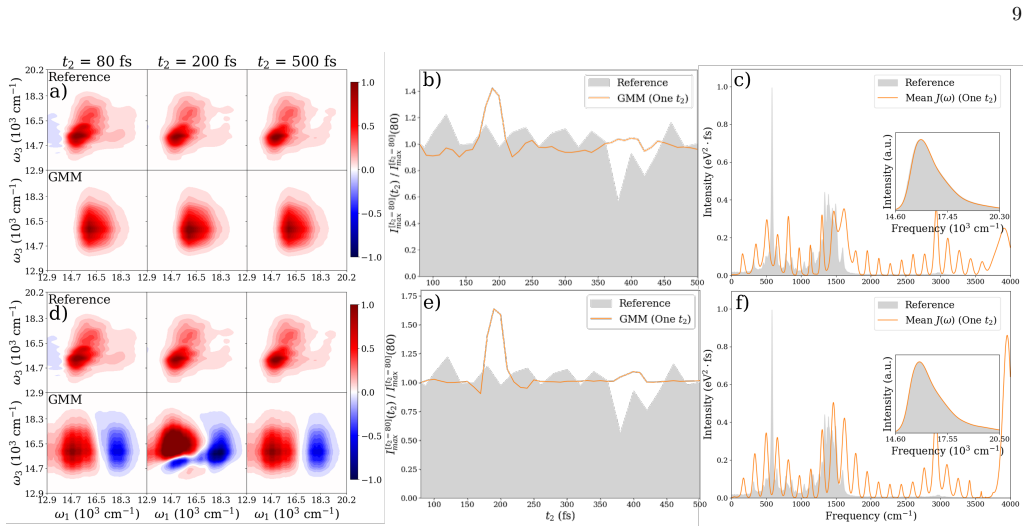
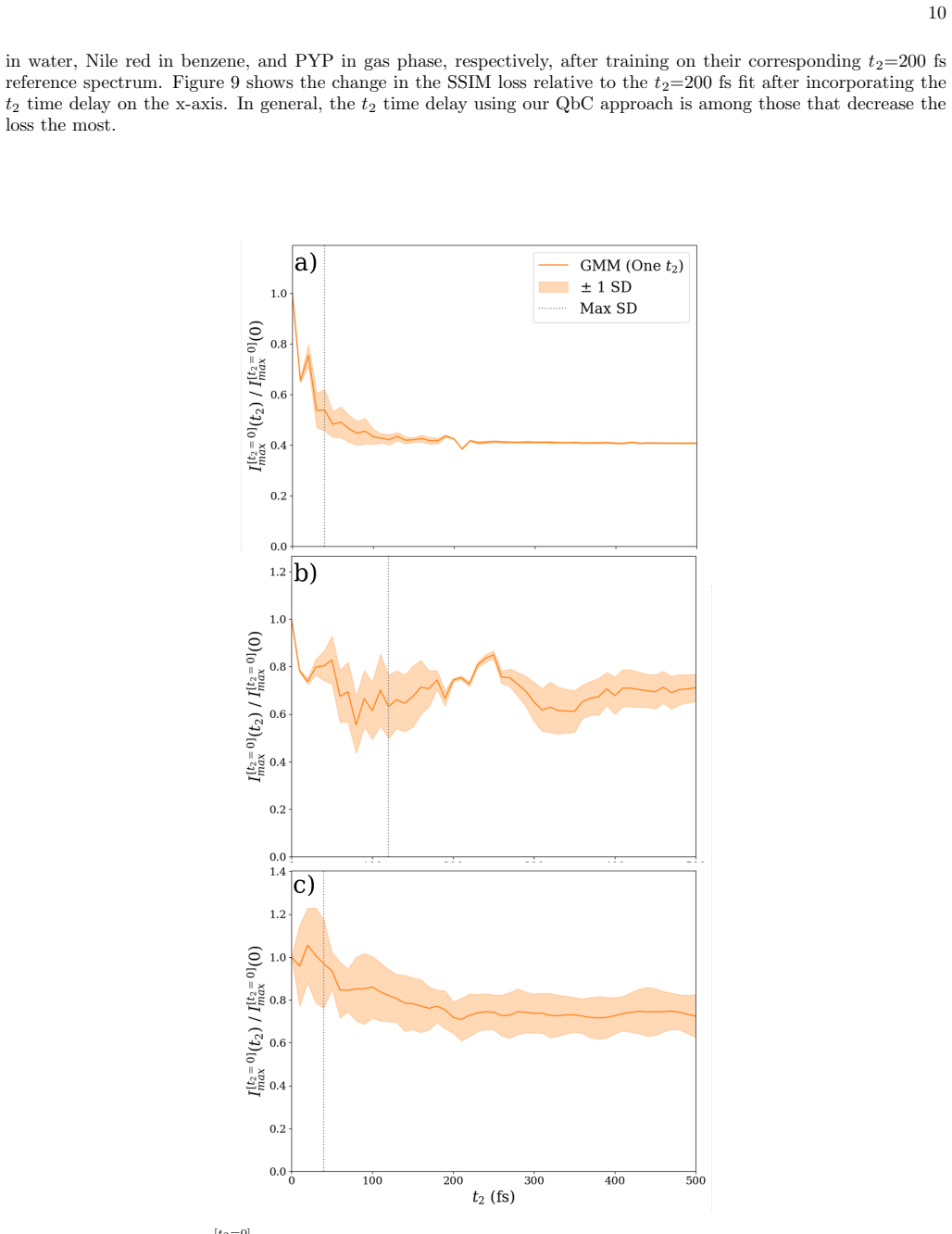
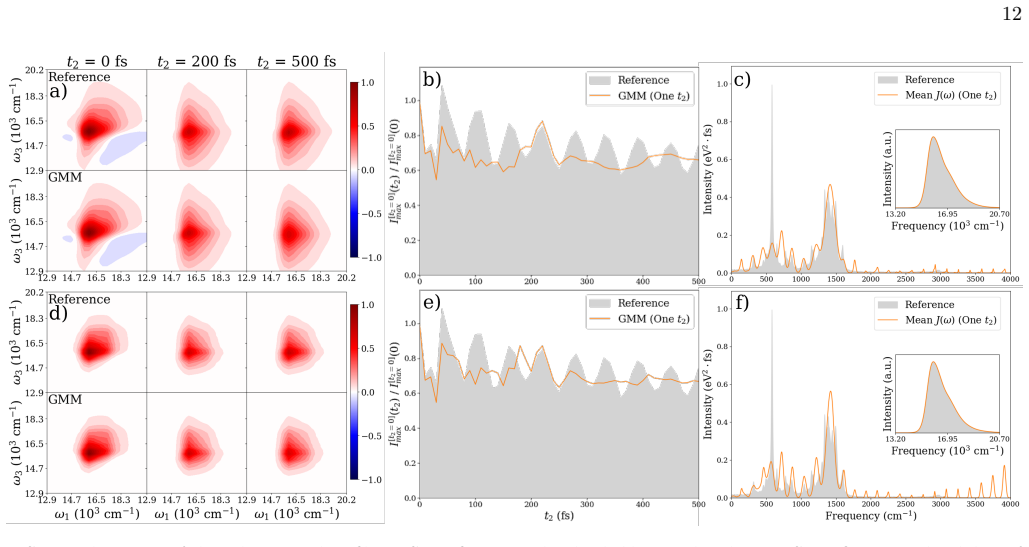
A Gaussian mixture model learns the spectral density from 2DES measurements to extract vibronic couplings and predict spectra at other times.
A machine-rendered reading of the paper's core claim, the machinery that carries it, and where it could break.
Core claim
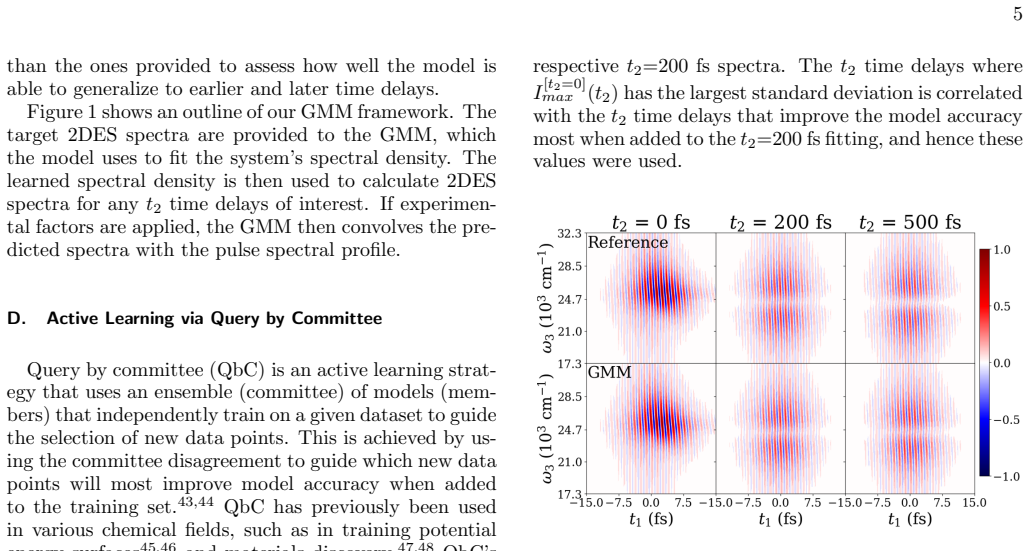
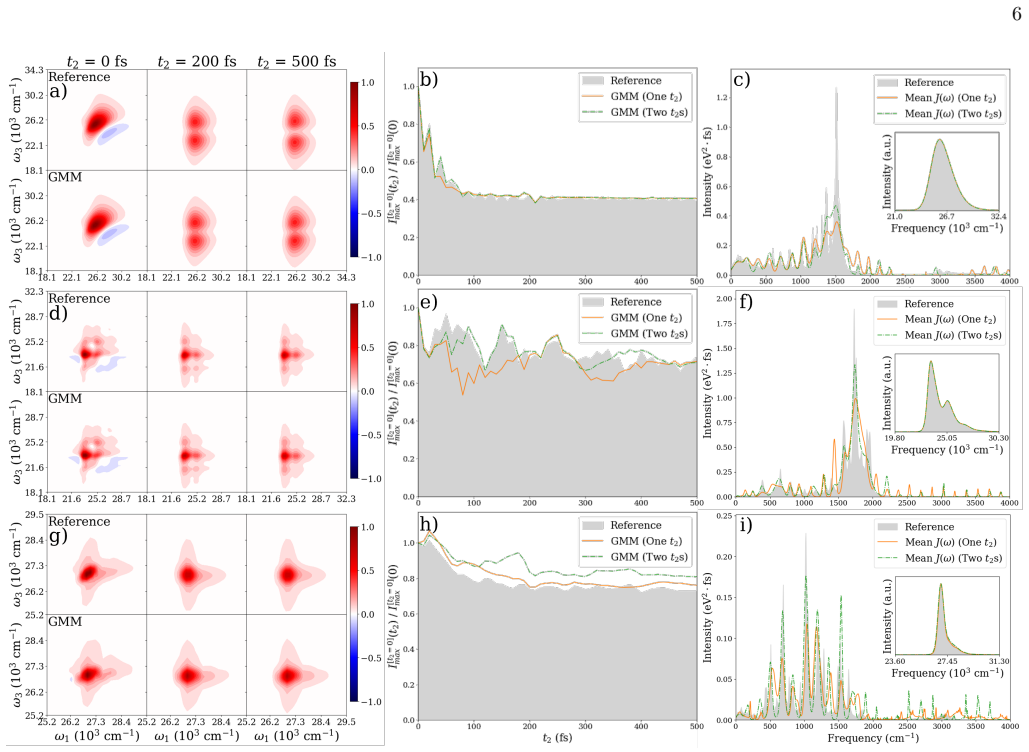
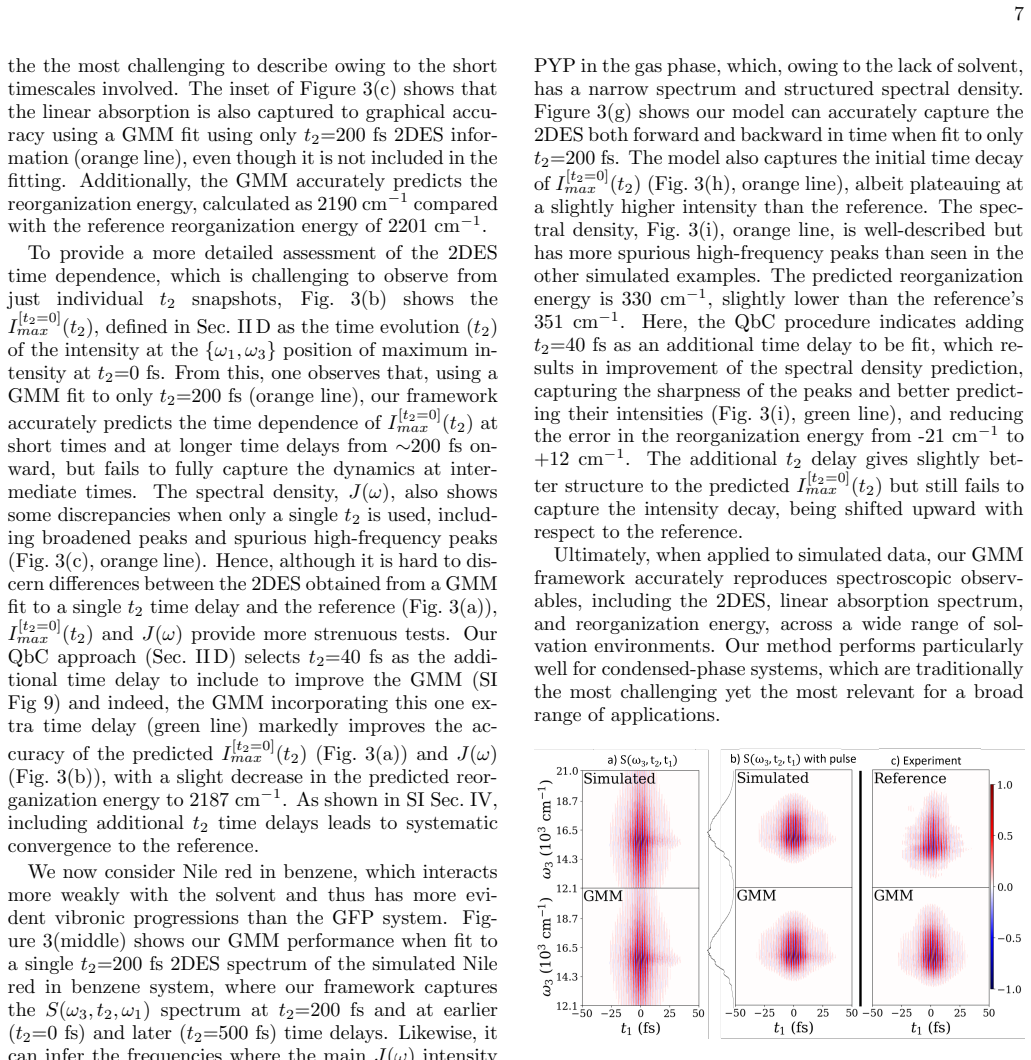
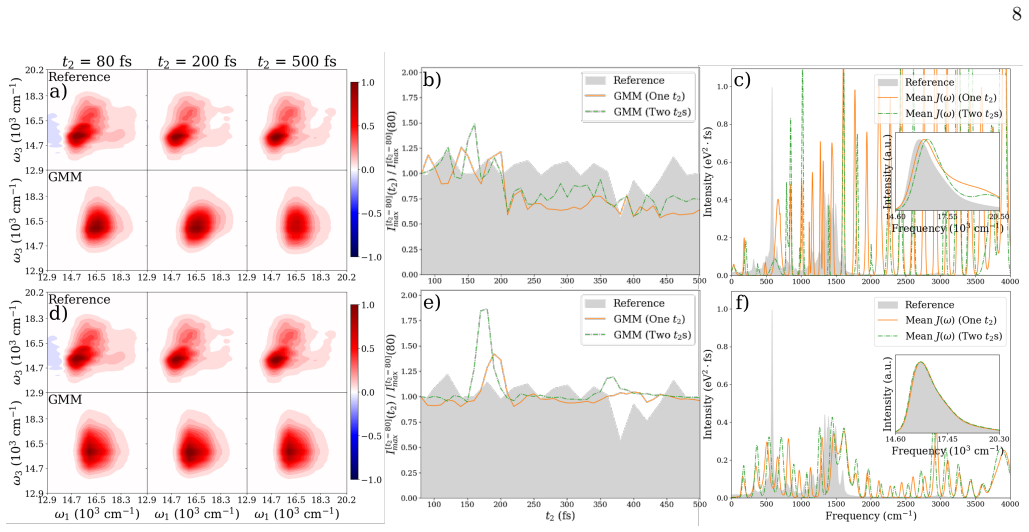
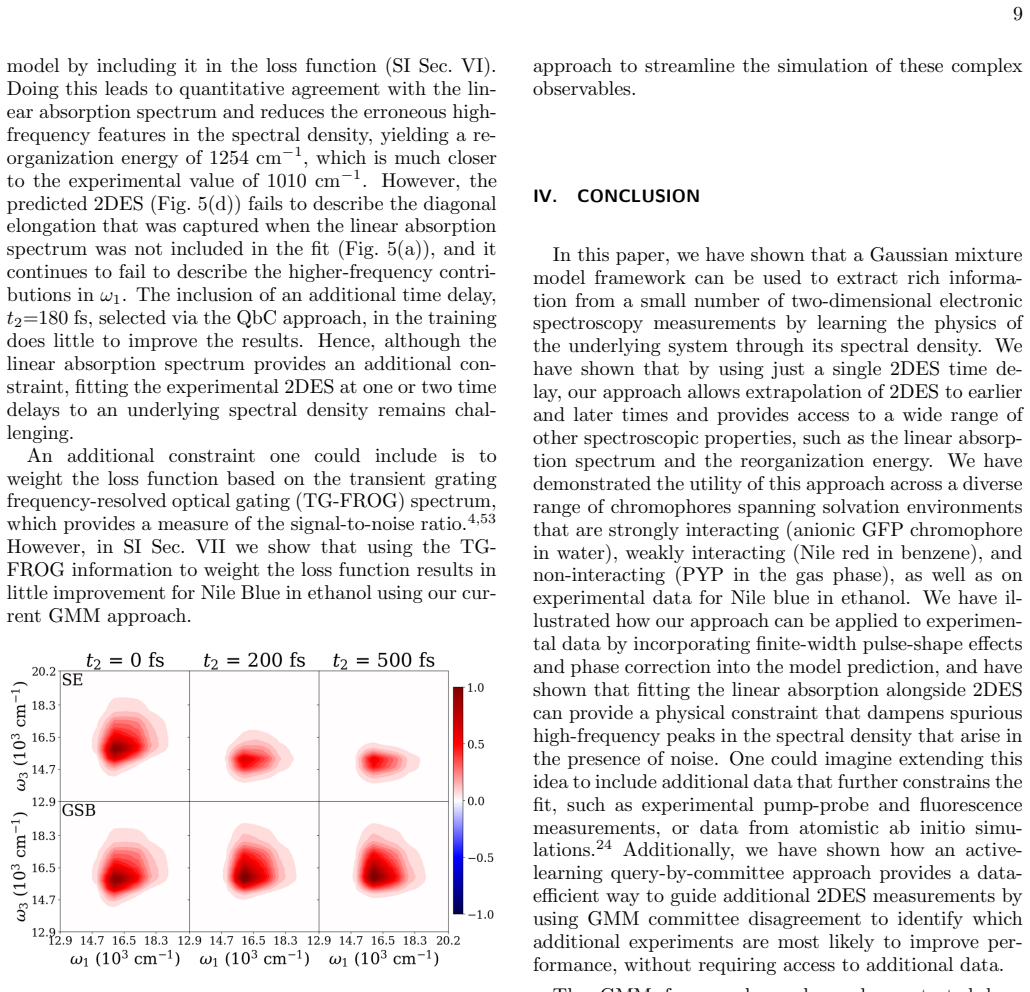
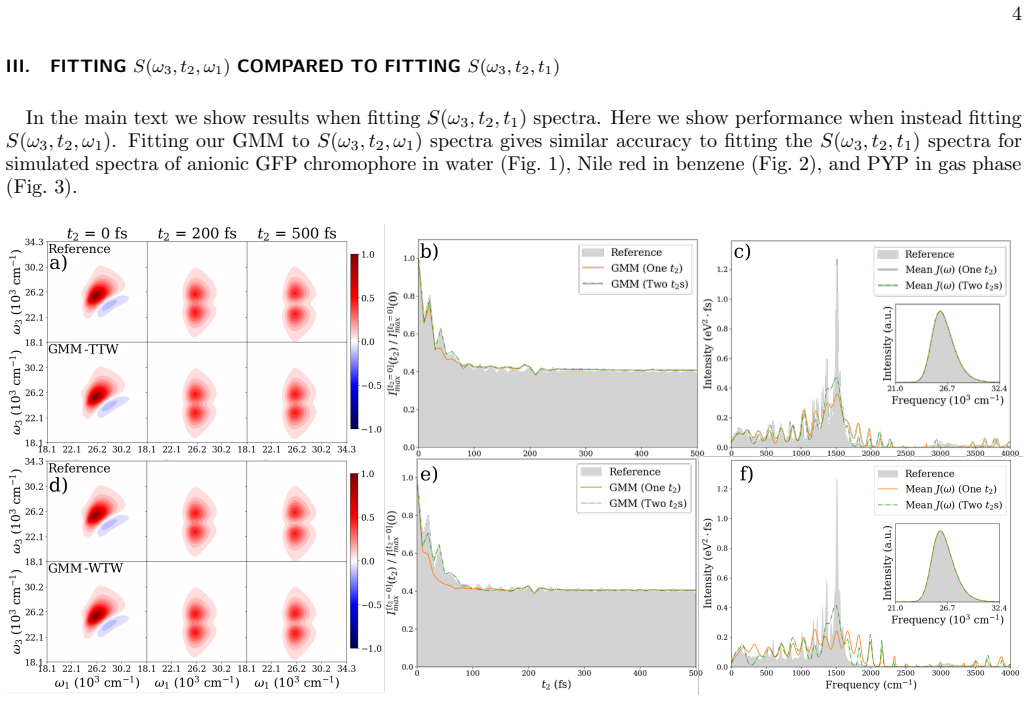
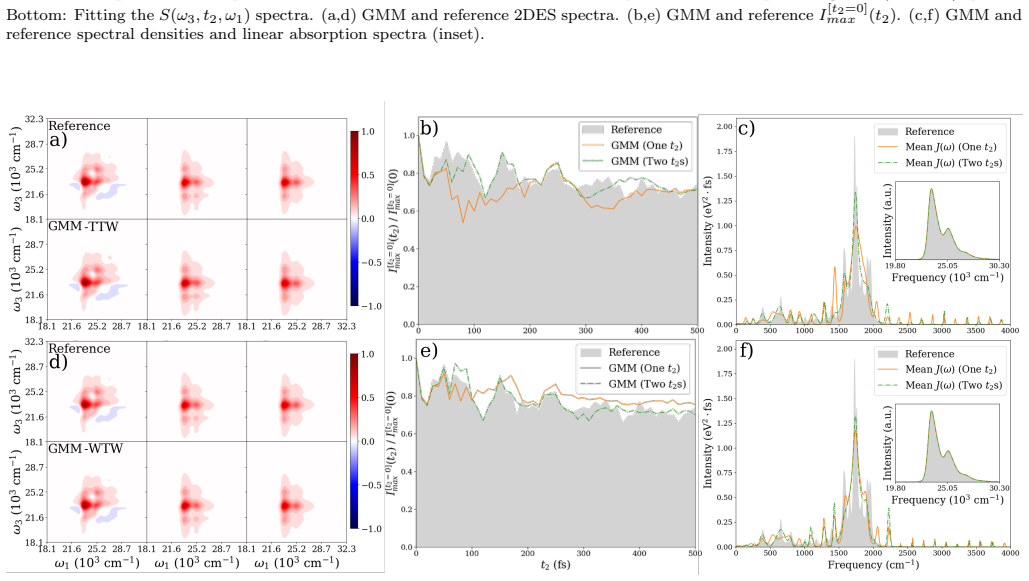
The central claim is that a Gaussian mixture model can be used to learn the underlying spectral density of a system from 2DES data. This allows extraction of vibronic couplings, extrapolation of spectra to other time delays, and selection of additional measurements for better accuracy. The approach succeeds on simulations from photoactive yellow protein to Nile red to green fluorescent protein chromophore in water, and on experiments with Nile blue in ethanol.
What carries the argument
Gaussian mixture model for representing and learning the spectral density from 2DES measurements.
If this is right
- Vibronic couplings are extracted directly from the learned model.
- 2DES spectra are extrapolated to unmeasured time delays.
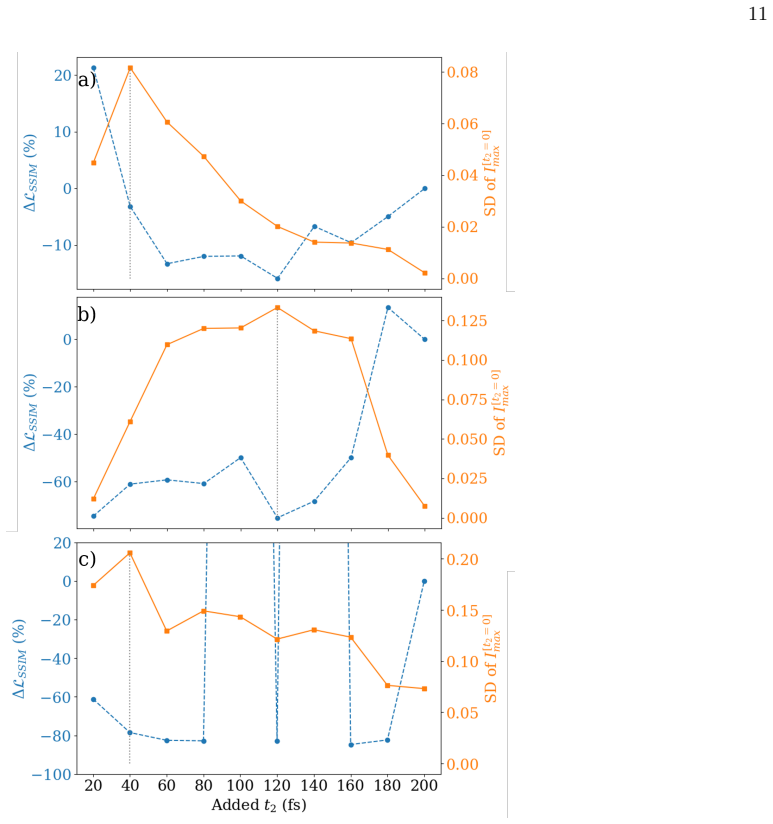
- Additional measurements can be selected to improve model accuracy.
- Accurate results hold for multiple simulated molecular systems and one experimental case.
Where Pith is reading between the lines
- The method could shorten the time needed for complete 2DES characterization by focusing measurements.
- It might extend to other types of spectroscopy that involve dense sampling in time or frequency.
- If the Gaussian mixture representation proves general, it could lead to automated analysis tools for experimentalists.
Load-bearing premise
The spectral density can be adequately represented by a finite number of Gaussian components that generalize from the tested systems to others.
What would settle it
A case where the true spectral density has features that cannot be captured by a Gaussian mixture, causing inaccurate coupling extraction or poor spectral predictions at new times.
Figures
read the original abstract
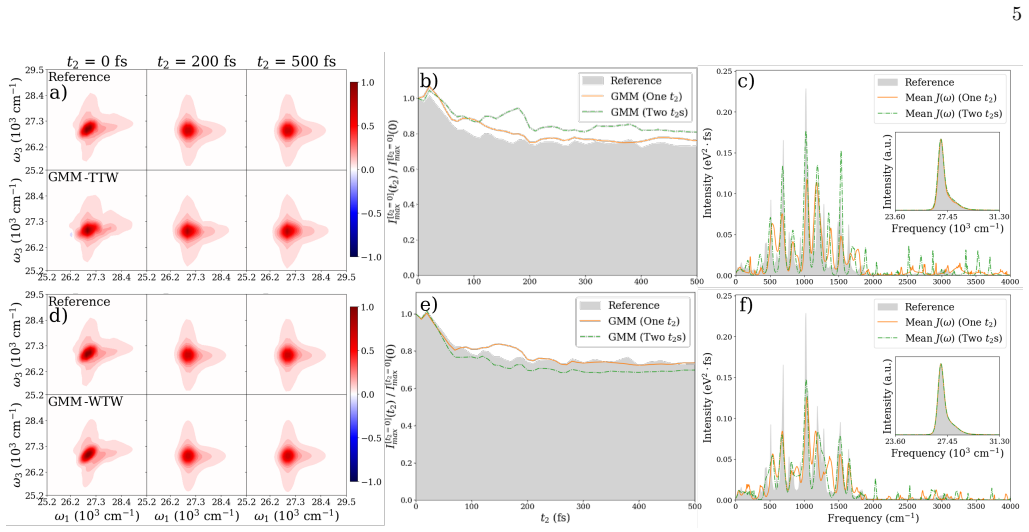
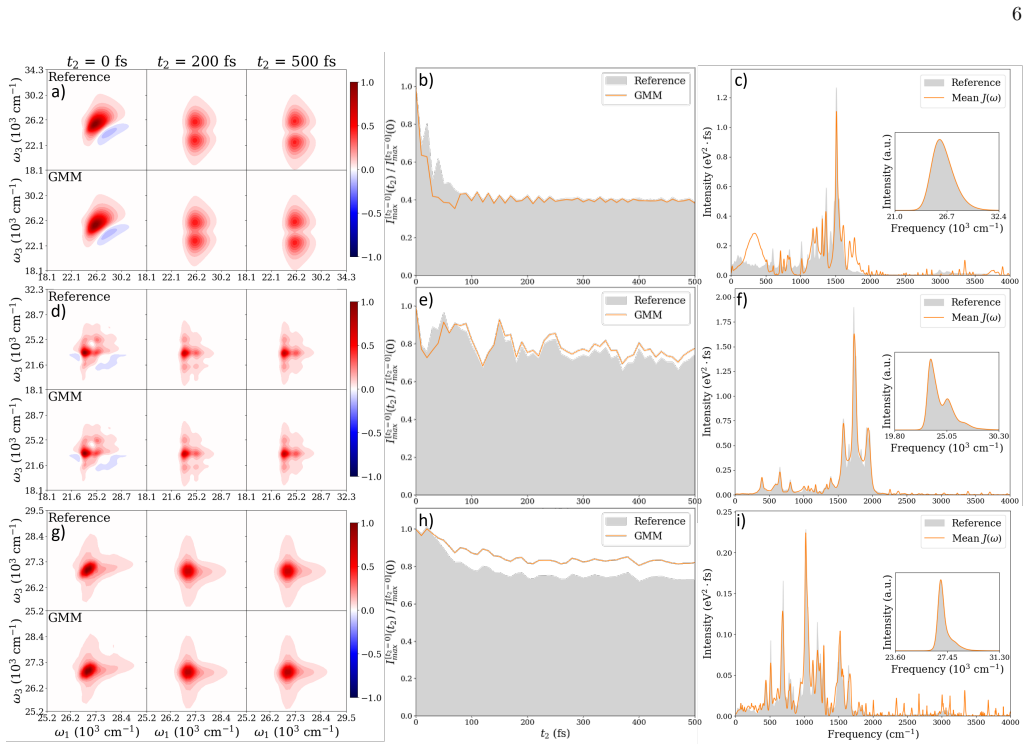
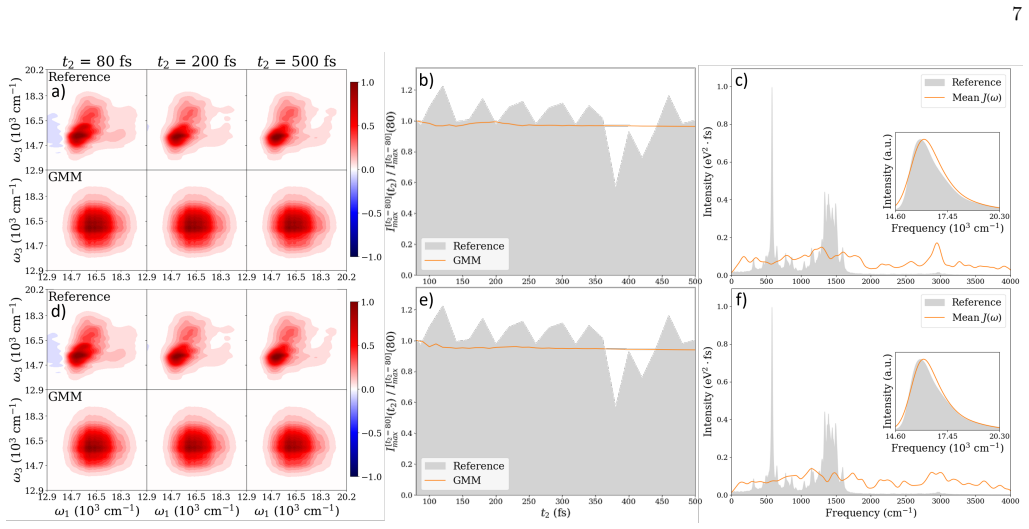
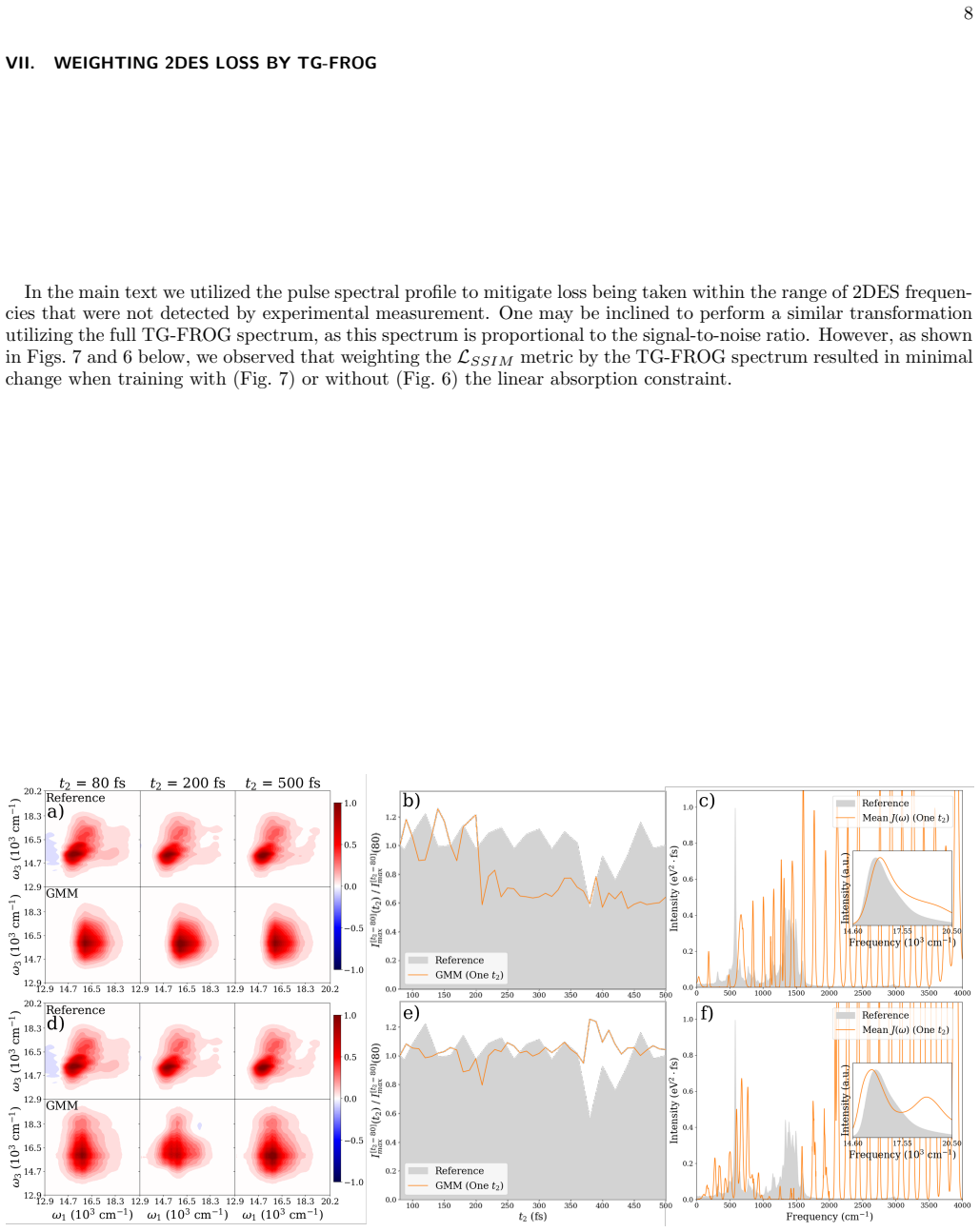
Two-dimensional electronic spectroscopy (2DES) offers unique insights into the coupling between electronic and nuclear motion and dynamics, making it a key technique in diverse fields, including materials science and biology. Obtaining 2DES data requires a series of measurements that involve multiple pulses to construct the full picture - a time-consuming task that often necessitates working with limited or noisy data. Here we introduce a machine-learning based framework that aims to maximize the data that can be extracted from 2DES experiments and provides guidance towards the selection of additional experiments. We design a Gaussian mixture model to learn the underlying spectral density of a system, allowing the extraction of vibronic couplings and the extrapolation of the 2DES spectra to other time delays beyond those measured, and demonstrate how our framework can be used to select additional measurements to further improve the accuracy. We show that our approach yields accurate results on a variety of systems, including simulations ranging from photoactive yellow protein in the gas phase to Nile red in benzene to the anionic green fluorescent protein chromophore in water, and experiments on Nile blue in ethanol. Our work provides an efficient route to extract maximum insights from 2DES while incurring minimal experimental costs.
Editorial analysis
A structured set of objections, weighed in public.
Referee Report
Summary. The manuscript introduces a machine-learning framework using a Gaussian mixture model (GMM) to recover the underlying spectral density J(ω) from 2DES measurements. This enables extraction of vibronic couplings, extrapolation of spectra to unmeasured time delays, and selection of additional experiments to improve accuracy. The approach is demonstrated on gas-phase and solvated simulations (photoactive yellow protein, Nile red, anionic GFP chromophore) and on an experiment with Nile blue in ethanol.
Significance. If the central claims hold, the work provides a practical route to reduce the number of 2DES measurements required while still recovering key physical parameters, which would lower experimental costs in photochemistry and biophysics. The explicit use of a GMM to parameterize the spectral density and the demonstration across both simulated and experimental data are concrete strengths.
major comments (3)
- [Methods (GMM construction and spectral-density recovery)] The finite-GMM representation of J(ω) is load-bearing for all downstream claims (coupling extraction and extrapolation). The manuscript must show that truncation to a small number of Gaussians does not introduce systematic bias when the true density contains asymmetric or continuous solvent-reorganization features; a controlled test on a known non-Gaussian bath (e.g., Ohmic or Drude-Lorentz with added power-law tail) is required.
- [Results (validation and accuracy statements)] Abstract states that the framework 'yields accurate results' on multiple systems, yet no quantitative validation metrics, error bars, train/test splits, or cross-validation procedure are described. Without these, it is impossible to judge whether the reported accuracy supports the extrapolation and measurement-selection claims.
- [Measurement-selection algorithm] The claim that the GMM enables reliable selection of additional measurements rests on the recovered spectral density being unique and faithful. The paper should quantify how sensitive the selected delays are to GMM initialization or to the number of components; otherwise the guidance procedure risks being under-determined.
minor comments (2)
- [Throughout] Ensure all acronyms (2DES, GMM, PYP, GFP) are defined at first use and that figure captions explicitly state which panels show simulation versus experiment.
- [Methods] The number of Gaussian components is listed as a free parameter; the manuscript should report the criterion or cross-validation procedure used to choose it for each system.
Simulated Author's Rebuttal
We thank the referee for their constructive and detailed comments. We address each major point below and have revised the manuscript to incorporate additional validation where needed.
read point-by-point responses
-
Referee: The finite-GMM representation of J(ω) is load-bearing for all downstream claims (coupling extraction and extrapolation). The manuscript must show that truncation to a small number of Gaussians does not introduce systematic bias when the true density contains asymmetric or continuous solvent-reorganization features; a controlled test on a known non-Gaussian bath (e.g., Ohmic or Drude-Lorentz with added power-law tail) is required.
Authors: We agree that explicit validation against non-Gaussian baths strengthens the claims. In the revised manuscript we have added controlled tests on an Ohmic spectral density and a Drude-Lorentz model augmented with a power-law tail. These demonstrate that, for the number of components used in our applications, the recovered couplings and extrapolated spectra remain within the error tolerances relevant to the experimental systems studied. revision: yes
-
Referee: Abstract states that the framework 'yields accurate results' on multiple systems, yet no quantitative validation metrics, error bars, train/test splits, or cross-validation procedure are described. Without these, it is impossible to judge whether the reported accuracy supports the extrapolation and measurement-selection claims.
Authors: The original submission did not include explicit quantitative metrics or validation protocols. We have now added mean-squared-error values for recovered J(ω) and extracted couplings, error bars derived from repeated optimizations, a description of the train/test partitioning, and the cross-validation procedure in both the Methods and Results sections of the revised manuscript. revision: yes
-
Referee: The claim that the GMM enables reliable selection of additional measurements rests on the recovered spectral density being unique and faithful. The paper should quantify how sensitive the selected delays are to GMM initialization or to the number of components; otherwise the guidance procedure risks being under-determined.
Authors: We have performed additional robustness checks by varying the number of Gaussian components and repeating the optimization from multiple random initializations. The variability in the selected time delays is now quantified and reported in a new supplementary section; the selected delays remain stable across these variations and produce consistent improvements in spectral accuracy. revision: yes
Circularity Check
No significant circularity detected
full rationale
The paper trains a Gaussian mixture model on measured 2DES signals to recover an underlying spectral density, then applies the recovered density to extract vibronic couplings and extrapolate spectra at new time delays. This is a conventional supervised fitting-plus-prediction workflow on held-out or new conditions; the extrapolation targets are not statistically forced by the training fit itself, nor is any quantity defined in terms of its own output. No load-bearing self-citations, uniqueness theorems, or ansatzes imported from prior author work appear in the derivation chain. The central claims are supported by performance on independent simulation and experimental test cases rather than by any reduction of the claimed results to the inputs by construction.
Axiom & Free-Parameter Ledger
free parameters (1)
- number of Gaussian components
axioms (1)
- domain assumption The spectral density can be modeled as a sum of Gaussians
Reference graph
Works this paper leans on
-
[2]
, date =
Trebino, R. , date =. Frequency-Resolved Optical Gating: The Measurement of Ultrashort Laser Pulses: The Measurement of Ultrashort Laser Pulses , isbn =
-
[4]
Li, Junnan and Li, Dongxu and Savarese, Silvio and Hoi, Steven , urldate =. doi:10.48550/arXiv.2301.12597 , shorttitle =. 2301.12597 [cs] , keywords =
work page internal anchor Pith review Pith/arXiv arXiv doi:10.48550/arxiv.2301.12597
-
[5]
Baliyan, Ankur and Imai, Hideto , urldate =. Machine Learning based Analytical Framework for Automatic Hyperspectral Raman Analysis of Lithium-ion Battery Electrodes , volume =. doi:10.1038/s41598-019-54770-2 , abstract =
-
[6]
Fang, Shiyan and Wu, Siyi and Chen, Zhou and He, Chang and Lin, Linley Li and Ye, Jian , urldate =. Recent progress and applications of Raman spectrum denoising algorithms in chemical and biological analyses: A review , volume =. doi:10.1016/j.trac.2024.117578 , shorttitle =
-
[7]
Savitzky, Abraham. and Golay, M. J. E. , urldate =. Smoothing and Differentiation of Data by Simplified Least Squares Procedures. , volume =. doi:10.1021/ac60214a047 , pages =
-
[8]
Baseline correction using adaptive iteratively reweighted penalized least squares , volume =
Zhang, Zhi-Min and Chen, Shan and Liang, Yi-Zeng , date =. Baseline correction using adaptive iteratively reweighted penalized least squares , volume =. doi:10.1039/b922045c , abstract =
-
[9]
A Comprehensive Review on Raman Spectroscopy Applications , volume =
Orlando, Andrea and Franceschini, Filippo and Muscas, Cristian and Pidkova, Solomiya and Bartoli, Mattia and Rovere, Massimo and Tagliaferro, Alberto , urldate =. A Comprehensive Review on Raman Spectroscopy Applications , volume =. doi:10.3390/chemosensors9090262 , abstract =
-
[11]
Winter, Robin and Montanari, Floriane and Noé, Frank and Clevert, Djork-Arné , urldate =. Learning continuous and data-driven molecular descriptors by translating equivalent chemical representations , volume =. doi:10.1039/C8SC04175J , abstract =
-
[12]
machine learning box - Google Search , url =
-
[13]
Noutahi, Emmanuel and Gabellini, Cristian and Craig, Michael and Lim, Jonathan S. C. and Tossou, Prudencio , urldate =. Gotta be. doi:10.1039/D4DD00019F , shorttitle =
-
[14]
De novo molecular structure elucidation from mass spectra via flow matching , url =
Mqawass, Ghaith and Le, Tuan and Theis, Fabian and Clevert, Djork-Arné , urldate =. De novo molecular structure elucidation from mass spectra via flow matching , url =. doi:10.48550/arXiv.2602.19912 , abstract =. 2602.19912 [cs] , keywords =
-
[15]
Evaluation of approximate lineshape theories for photosynthetic light-harvesting antennae , volume =
Saraceno, Piermarco and Bhartiya, Akhil and Seibt, Joachim and Renger, Thomas and Kramer, Tobias and Cupellini, Lorenzo , urldate =. Evaluation of approximate lineshape theories for photosynthetic light-harvesting antennae , volume =. doi:10.1063/5.0310361 , abstract =
-
[16]
and Lee, Yi-Hsien and Louie, Steven G
Guo, Liang and Wu, Meng and Cao, Ting and Monahan, Daniele M. and Lee, Yi-Hsien and Louie, Steven G. and Fleming, Graham R. , urldate =. Exchange-driven intravalley mixing of excitons in monolayer transition metal dichalcogenides , volume =. doi:10.1038/s41567-018-0362-y , abstract =
-
[17]
Stochastic Interpolants: A Unifying Framework for Flows and Diffusions
Albergo, Michael S. and Boffi, Nicholas M. and Vanden-Eijnden, Eric , urldate =. Stochastic Interpolants: A Unifying Framework for Flows and Diffusions , url =. doi:10.48550/arXiv.2303.08797 , shorttitle =. 2303.08797 [cs] , keywords =
work page internal anchor Pith review Pith/arXiv arXiv doi:10.48550/arxiv.2303.08797
-
[18]
Differentiating through Stochastic Differential Equations: A Primer , url =
Leburu, Rishi and Nurbekyan, Levon and Ruthotto, Lars , urldate =. Differentiating through Stochastic Differential Equations: A Primer , url =. doi:10.48550/arXiv.2601.08594 , shorttitle =. 2601.08594 [math] , keywords =
-
[19]
Optimizing Decoding Paths in Masked Diffusion Models by Quantifying Uncertainty , url =
Chen, Ziyu and Jiang, Xinbei and Sun, Peng and Lin, Tao , urldate =. Optimizing Decoding Paths in Masked Diffusion Models by Quantifying Uncertainty , url =. doi:10.48550/arXiv.2512.21336 , abstract =. 2512.21336 [cs] , keywords =
-
[20]
Prasad, Sachin and Tan, Howe-Siang , urldate =. A study on cross peaks in two-dimensional optical spectroscopy: Quantum cross-correlation functions and interplay with excitonic coupling , volume =. doi:10.1063/5.0303086 , shorttitle =
-
[21]
Berne, B. J. and Harp, G. D. , editor =. On the Calculation of Time Correlation Functions , volume =. Advances in Chemical Physics , publisher =. doi:10.1002/9780470143636.ch3 , pages =
-
[22]
Comparative Analysis of Formula and Structure Prediction from Tandem Mass Spectra , rights =
Che, Xujun and Du, Xiuxia and Xu, Depeng , urldate =. Comparative Analysis of Formula and Structure Prediction from Tandem Mass Spectra , rights =. doi:10.48550/ARXIV.2601.00941 , abstract =
-
[26]
Bidirectional Normalizing Flow: From Data to Noise and Back , url =
Lu, Yiyang and Sun, Qiao and Wang, Xianbang and Jiang, Zhicheng and Zhao, Hanhong and He, Kaiming , urldate =. Bidirectional Normalizing Flow: From Data to Noise and Back , url =. doi:10.48550/arXiv.2512.10953 , shorttitle =. 2512.10953 [cs] , keywords =
-
[27]
Basri, Omer M. and Raz, Oren , urldate =. Thermodynamic Geometry Through Second Order Phase Transitions , url =. doi:10.48550/arXiv.2512.01936 , abstract =. 2512.01936 [cond-mat] , keywords =
-
[28]
Engineer coherent oscillatory modes in Markovian open quantum systems , url =
Leung, Chun Hei and Fong, Pak-Tik and Yan, Tianyi and Li, Weibin , urldate =. Engineer coherent oscillatory modes in Markovian open quantum systems , url =. doi:10.48550/arXiv.2512.10144 , abstract =. 2512.10144 [quant-ph] , keywords =
-
[29]
Exact Non-Markovian Master Equations: A Generalized Derivation for Gaussian Systems
-
[30]
Exact Non-Markovian Master Equations: A Generalized Derivation for Gaussian Systems , volume =
D’Abbruzzo, Antonio , date =. Exact Non-Markovian Master Equations: A Generalized Derivation for Gaussian Systems , volume =. doi:10.1103/cb7c-5f66 , shorttitle =
-
[31]
Cao, Ziying and Suarez, Victor A. and Kretchmer, Joshua S. , urldate =. A ring polymer molecular dynamics extension of the mapping approach to surface hopping: Incorporation of nuclear quantum effects , rights =. doi:10.26434/chemrxiv-2025-xps2g , shorttitle =
-
[32]
Zeng, Jinzhe and Giese, Timothy J. and Götz, Andreas W. and York, Darrin M. , urldate =. The. doi:10.1038/s41597-025-04972-3 , abstract =
-
[36]
Sebastian and Shamir, Eli and Tishby, Naftali , urldate =
Freund, Yoav and Seung, H. Sebastian and Shamir, Eli and Tishby, Naftali , urldate =. Information, Prediction, and Query by Committee , volume =. Advances in Neural Information Processing Systems , publisher =
-
[39]
Encoder-Decoder Diffusion Language Models for Efficient Training and Inference , url =
Arriola, Marianne and Schiff, Yair and Phung, Hao and Gokaslan, Aaron and Kuleshov, Volodymyr , urldate =. Encoder-Decoder Diffusion Language Models for Efficient Training and Inference , url =. doi:10.48550/arXiv.2510.22852 , abstract =. 2510.22852 [cs] , keywords =
-
[40]
Atomic Diffusion Models for Small Molecule Structure Elucidation from
Xiong, Ziyu and Zhang, Yichi and Alauddin, Foyez and Cheng, Chu Xin , langid =. Atomic Diffusion Models for Small Molecule Structure Elucidation from
-
[43]
doi:10.48550/arXiv.2510.20615 , shorttitle =
Han, Yang and Wang, Pengyu and Yu, Kai and Chen, Xin and Chen, Lu , urldate =. doi:10.48550/arXiv.2510.20615 , shorttitle =. 2510.20615 [cs] , keywords =
-
[44]
A Spectrum-to-Structure Diffusion Model for De Novo Small Molecule Generation , rights =
Zong, Guohao and Gao, Jun and Qi, Yuanyuan and Zhao, Haifeng and Feng, Weihua and Hu, Bin and Ma, Ji and Du, Lan and Han, Jinsong , urldate =. A Spectrum-to-Structure Diffusion Model for De Novo Small Molecule Generation , rights =. doi:10.1021/acs.analchem.5c05374 , pages =
-
[45]
Orahoske, Cody and Lusk, Hanna and Pickard, Shanel C. and Wu, Alan H. B. , editor =. Fundamentals of Mass Spectrometry , isbn =. Practical Guide to Implementing Liquid Chromatography Mass Spectrometry in Clinical Laboratories , publisher =. doi:10.1007/978-3-032-03852-4_2 , abstract =
-
[46]
An introduction to Markovian open quantum systems , url =
Dutta, Shovan , urldate =. An introduction to Markovian open quantum systems , url =. doi:10.48550/arXiv.2510.26530 , abstract =. 2510.26530 [quant-ph] , keywords =
-
[47]
Diffusion Models: A Mathematical Introduction , url =
Maleki, Sepehr and Pourmoazemi, Negar , urldate =. Diffusion Models: A Mathematical Introduction , url =. doi:10.48550/arXiv.2511.11746 , shorttitle =. 2511.11746 [cs] , keywords =
-
[48]
Kalamkar, Prathamesh and Letcher, Ned and Chami, Meissane and Lad, Sahger and Mohanty, Shayan and Pendse, Prasanna , urldate =. The Tokenization Bottleneck: How Vocabulary Extension Improves Chemistry Representation Learning in Pretrained Language Models , url =. doi:10.48550/arXiv.2511.14365 , shorttitle =. 2511.14365 [cs] , keywords =
-
[49]
Li, Chen and Requist, Ryan and Gross, E. K. U. , urldate =. Beyond Born-Oppenheimer Time-Dependent Density Functional Theory , url =. doi:10.48550/arXiv.2511.09899 , abstract =. 2511.09899 [physics] , keywords =
-
[50]
Efficiently Learning at Test-Time: Active Fine-Tuning of
Hübotter, Jonas and Bongni, Sascha and Hakimi, Ido and Krause, Andreas , urldate =. Efficiently Learning at Test-Time: Active Fine-Tuning of. doi:10.48550/arXiv.2410.08020 , shorttitle =. 2410.08020 [cs] , keywords =
-
[51]
Continuous Autoregressive Language Models
-
[52]
Breaking
Li, Gen and Cai, Changxiao , langid =. Breaking
-
[53]
Zhang, Yiwen and Ding, Keyan and Wu, Yihang and Zhuang, Xiang and Yang, Yi and Zhang, Qiang and Chen, Huajun , urldate =. Breaking the Modality Barrier: Generative Modeling for Accurate Molecule Retrieval from Mass Spectra , url =. doi:10.48550/arXiv.2511.06259 , shorttitle =. 2511.06259 [cs] , keywords =
-
[54]
Mukamel, Shaul and Abramavicius, Darius , urldate =. Many-Body Approaches for Simulating Coherent Nonlinear Spectroscopies of Electronic and Vibrational Excitons , volume =. doi:10.1021/cr020681b , pages =
-
[55]
Many-Body Approaches for Simulating Coherent Nonlinear Spectroscopies of Electronic and Vibrational Excitons
-
[56]
Discrete State Diffusion Models: A Sample Complexity Perspective
Srikanth, Aadithya and Gaur, Mudit and Aggarwal, Vaneet , urldate =. Discrete State Diffusion Models: A Sample Complexity Perspective , url =. doi:10.48550/arXiv.2510.10854 , shorttitle =. 2510.10854 [cs] , keywords =
work page internal anchor Pith review Pith/arXiv arXiv doi:10.48550/arxiv.2510.10854
-
[57]
Nonequilibrium Macroscopic Response Relations for Counting Statistics , url =
Zheng, Jiming and Lu, Zhiyue , urldate =. Nonequilibrium Macroscopic Response Relations for Counting Statistics , url =. doi:10.48550/arXiv.2511.02041 , abstract =. 2511.02041 [cond-mat] , keywords =
-
[58]
Duarte, Luís and Lamas Frejo, Iker and Bäuerle, Dominik and Shareef, Saeed and Curti, Mariano and Romero, Elisabet , urldate =. Unraveling Charge-Transfer States and their Ultrafast Dynamics in Artificial Light- Harvesting Complexes , rights =. doi:10.26434/chemrxiv-2025-h05q8 , abstract =
-
[59]
Grell, Gilbert and González-Vázquez, Jesús and Fernández-Villoria, Francisco and Palacios, Alicia and Martín, Fernando , urldate =. Modeling the Evolution of Laser-Induced Electronic Coherences with Trajectory Surface Hopping , rights =. doi:10.1021/acs.jctc.5c00531 , pages =
-
[60]
An Almost Analytical Approach to Simulating 2D Electronic Spectra
Bhattacharyya, Pallavi and Ananth, Nandini , urldate =. An Almost Analytical Approach to Simulating 2D Electronic Spectra , url =. doi:10.48550/arXiv.1705.00738 , abstract =. 1705.00738 [quant-ph] , keywords =
work page internal anchor Pith review Pith/arXiv arXiv doi:10.48550/arxiv.1705.00738
-
[62]
Sun, Qiming and Chan, Garnet Kin-Lic , urldate =. Quantum Embedding Theories , volume =. doi:10.1021/acs.accounts.6b00356 , abstract =
-
[65]
and Kelly, Joseph and Runeson, Johan E
Lieberherr, Annina Z. and Kelly, Joseph and Runeson, Johan E. and Markland, Thomas E. and Manolopoulos, David E. , urldate =. Two-dimensional electronic spectra from trajectory-based dynamics: pure-state Ehrenfest and spin-mapping approaches , url =. doi:10.48550/arXiv.2508.19377 , shorttitle =. 2508.19377 [physics] , keywords =
-
[68]
doi:10.1073/pnas.0408813102 , shorttitle =
Quantum corrections in vibrational and electronic condensed phase spectroscopy: Line shapes and echoes , url =. doi:10.1073/pnas.0408813102 , shorttitle =
-
[69]
Shedge, Sapana V. and Zuehlsdorff, Tim J. and Khanna, Ajay and Conley, Stacey and Isborn, Christine M. , urldate =. Explicit environmental and vibronic effects in simulations of linear and nonlinear optical spectroscopy , volume =. doi:10.1063/5.0038196 , abstract =
-
[71]
Taming the third order cumulant approximation to linear optical spectroscopy
-
[73]
Test-Time Tuned Language Models Enable End-to-end De Novo Molecular Structure Generation from
Mismetti, Laura and Alberts, Marvin and Krause, Andreas and Graziani, Mara , urldate =. Test-Time Tuned Language Models Enable End-to-end De Novo Molecular Structure Generation from. doi:10.48550/arXiv.2510.23746 , abstract =. 2510.23746 [cs] , keywords =
-
[74]
Wit, Roosmarijn de and Keeling, Jonathan and Lovett, Brendon W. and Chin, Alex W. , urldate =. Extracting Coupling-Mode Spectral Densities with Two-Dimensional Electronic Spectroscopy , url =. doi:10.48550/arXiv.2503.21685 , abstract =. 2503.21685 [physics] , keywords =
-
[76]
Ban, Tae-Won , urldate =. A Video Frame Extrapolation Scheme Using Deep Learning-Based Uni-Directional Flow Estimation and Pixel Warping , volume =. doi:10.1109/ACCESS.2023.3319660 , abstract =
-
[77]
Action-detected 2D specroscopy , author =
-
[80]
Unraveling electronic absorption spectra using nuclear quantum effects: Photoactive yellow protein and green fluorescent protein chromophores in water
-
[86]
Kim, Taeyeon and Lin, Chenjian and Schultz, Jonathan D. and Young, Ryan M. and Wasielewski, Michael R. , urldate =. π-Stacking-Dependent Vibronic Couplings Drive Excited-State Dynamics in Perylenediimide Assemblies , volume =. doi:10.1021/jacs.2c03993 , abstract =
-
[87]
Halpin, Alexei and Johnson, Philip J. M. and Tempelaar, Roel and Murphy, R. Scott and Knoester, Jasper and Jansen, Thomas L. C. and Miller, R. J. Dwayne , urldate =. Two-dimensional spectroscopy of a molecular dimer unveils the effects of vibronic coupling on exciton coherences , volume =. doi:10.1038/nchem.1834 , abstract =
-
[88]
Ueno, Seiji and Tanimura, Yoshitaka , urldate =. Modeling and Simulating the Excited-State Dynamics of a System with Condensed Phases: A Machine Learning Approach , volume =. doi:10.1021/acs.jctc.1c00104 , shorttitle =
-
[93]
Parikh, Nishi and Akin, Seckin and Kalam, Abul and Prochowicz, Daniel and Yadav, Pankaj , urldate =. Probing the Low-Frequency Response of Impedance Spectroscopy of Halide Perovskite Single Crystals Using Machine Learning , volume =. doi:10.1021/acsami.3c00269 , abstract =
-
[94]
Yu, Yinchuan and. Classification of Semiconductors Using Photoluminescence Spectroscopy and Machine Learning , volume =. doi:10.1177/00037028211031618 , abstract =
-
[95]
Quantum Phenomena in Nanomaterials: Coherent Superpositions of Fine Structure States in
Collini, Elisabetta and Gattuso, Hugo and Bolzonello, Luca and Casotto, Andrea and Volpato, Andrea and Dibenedetto, Carlo Nazareno and Fanizza, Elisabetta and Striccoli, Marinella and Remacle, Françoise , urldate =. Quantum Phenomena in Nanomaterials: Coherent Superpositions of Fine Structure States in. doi:10.1021/acs.jpcc.9b11153 , shorttitle =
-
[97]
Two-Dimensional Optical Spectroscopy , publisher =
Cho, Minhaeng , date =. Two-Dimensional Optical Spectroscopy , publisher =
-
[98]
Principles of Nonlinear Optical Spectroscopy , publisher =
Mukamel, Shaul , date =. Principles of Nonlinear Optical Spectroscopy , publisher =
-
[99]
Sun, Qintao and Xiang, Yan and Liu, Yue and Xu, Liang and Leng, Tianle and Ye, Yifan and Fortunelli, Alessandro and Goddard, William A and Cheng, Tao , urldate =. Machine Learning Predicts the X-ray Photoelectron Spectroscopy of the Solid Electrolyte Interface of Lithium Metal Battery , volume =. doi:10.1021/acs.jpclett.2c02222 , pages =
-
[102]
Ren, Hao and Zhang, Qian and Wang, Zhengjie and Zhang, Guozhen and Liu, Hongzhang and Guo, Wenyue and Mukamel, Shaul and Jiang, Jun , urldate =. Machine learning recognition of protein secondary structures based on two-dimensional spectroscopic descriptors , volume =. doi:10.1073/pnas.2202713119 , abstract =
-
[103]
Unravelling the Kinetic Model of Photochemical Reactions via Deep Learning , volume =
Kollenz, Philipp and Herten, Dirk-Peter and Buckup, Tiago , urldate =. Unravelling the Kinetic Model of Photochemical Reactions via Deep Learning , volume =. doi:10.1021/acs.jpcb.0c04299 , abstract =
-
[107]
and Yao, Kun and Corcelli, Steven A
Kananenka, Alexei A. and Yao, Kun and Corcelli, Steven A. and Skinner, J. L. , urldate =. Machine Learning for Vibrational Spectroscopic Maps , volume =. doi:10.1021/acs.jctc.9b00698 , abstract =
-
[108]
A neural network protocol for electronic excitations of N-methylacetamide , volume =
Ye, Sheng and Hu, Wei and Li, Xin and Zhang, Jinxiao and Zhong, Kai and Zhang, Guozhen and Luo, Yi and Mukamel, Shaul and Jiang, Jun , urldate =. A neural network protocol for electronic excitations of N-methylacetamide , volume =. doi:10.1073/pnas.1821044116 , abstract =
-
[110]
Mater, Adam C. and Coote, Michelle L. , urldate =. Deep Learning in Chemistry , volume =. doi:10.1021/acs.jcim.9b00266 , pages =
-
[114]
Takemura, N. , date =. Two-dimensional Fourier transform spectroscopy of exciton-polaritons and their interactions , volume =. doi:10.1103/PhysRevB.92.125415 , number =
-
[116]
and Pullerits, Tõnu and Mančal, Tomáš , urldate =
Christensson, Niklas and Kauffmann, Harald F. and Pullerits, Tõnu and Mančal, Tomáš , urldate =. Origin of Long-Lived Coherences in Light-Harvesting Complexes , volume =. doi:10.1021/jp304649c , abstract =
-
[117]
Cao, Jianshu and Cogdell, Richard J. and Coker, David F. and Duan, Hong-Guang and Hauer, Jürgen and Kleinekathöfer, Ulrich and Jansen, Thomas L. C. and Mančal, Tomáš and Miller, R. J. Dwayne and Ogilvie, Jennifer P. and Prokhorenko, Valentyn I. and Renger, Thomas and Tan, Howe-Siang and Tempelaar, Roel and Thorwart, Michael and Thyrhaug, Erling and Westen...
-
[118]
and Akhtar, Parveen and Tan, Howe-Siang , urldate =
Lambrev, Petar H. and Akhtar, Parveen and Tan, Howe-Siang , urldate =. Insights into the mechanisms and dynamics of energy transfer in plant light-harvesting complexes from two-dimensional electronic spectroscopy , volume =. doi:10.1016/j.bbabio.2019.07.005 , series =
-
[119]
Vanderkooi, Jane M. and Angiolillo, Paul J. and Laberge, Monique , urldate =. [5] Fluorescence line narrowing spectroscopy: A tool for studying proteins , volume =. Methods in Enzymology , publisher =. doi:10.1016/S0076-6879(97)78007-8 , shorttitle =
-
[120]
Lin, Chen and Reppert, Mike and Feng, Ximao and Jankowiak, Ryszard , urldate =. Modeling of fluorescence line-narrowed spectra in weakly coupled dimers in the presence of excitation energy transfer , volume =. doi:10.1063/1.4887083 , abstract =
-
[121]
Two-dimensional electronic spectroscopy of anharmonic molecular potentials , volume =
Anda, André and Abramavičius, Darius and Hansen, Thorsten , urldate =. Two-dimensional electronic spectroscopy of anharmonic molecular potentials , volume =. doi:10.1039/C7CP06583C , abstract =
-
[125]
and Riese, Sebastian and Sio, Antonietta De and Lienau, Christoph , urldate =
Timmer, Daniel and Lünemann, Daniel C. and Riese, Sebastian and Sio, Antonietta De and Lienau, Christoph , urldate =. Full visible range two-dimensional electronic spectroscopy with high time resolution , volume =. doi:10.1364/OE.511906 , abstract =
-
[126]
Journal of the American Chemical Society , year =
Maiuri, Margherita and Garavelli, Marco and Cerullo, Giulio , urldate =. Ultrafast Spectroscopy: State of the Art and Open Challenges , volume =. doi:10.1021/jacs.9b10533 , shorttitle =
discussion (0)
Sign in with ORCID, Apple, or X to comment. Anyone can read and Pith papers without signing in.