The quantum-advantage resource in multimode OPA light: Identification, optimization, extraction
Pith reviewed 2026-06-26 21:02 UTC · model grok-4.3
The pith
A quantum complexity resource in mixed multimode Gaussian states from OPAs gives a universal measure of quantum advantage.
A machine-rendered reading of the paper's core claim, the machinery that carries it, and where it could break.
Core claim
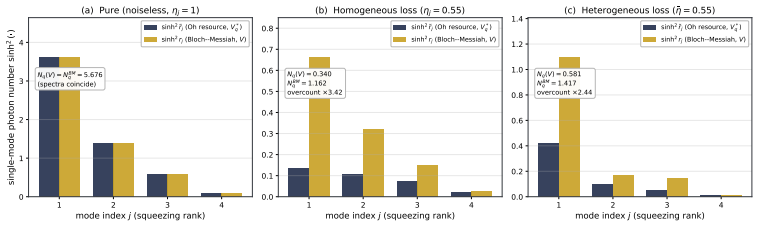
The quantum complexity resource contained in a mixed multimode Gaussian state provides universal quantitative characterization of its quantum advantage. The notion rests on convex optimization, multimode photon number statistics, the Hafnian Master Theorem, and #P-hard complexity. Pulsed OPAs can be engineered to maximize this resource and to support thousands of multipartite-entangled squeezed modes via nonlinear, spatio-temporally nonadiabatic generation inside the OPA together with optimized extraction; the resulting figure of merit is presented as more realistic than Bloch-Messiah supermodes for guiding multimode OPA design.
What carries the argument
The quantum complexity resource, obtained by convex optimization over multimode photon number statistics and evaluated via the Hafnian Master Theorem to capture #P-hard complexity.
If this is right
- Multimode OPAs can be optimized specifically to maximize the quantum complexity resource rather than traditional mode decompositions.
- The resource directly informs the generation of 3D cluster states suitable for one-way photonic quantum computing.
- Demonstration of quantum advantage becomes feasible through extraction of the resource from pulsed OPA output light.
- The measure supplies a quantitative target for engineering thousands of multipartite-entangled squeezed modes.
Where Pith is reading between the lines
- If the resource proves robust, it could serve as a common benchmark for comparing quantum advantage across different Gaussian-state sources beyond OPAs.
- The approach might extend to assessing advantage in continuous-variable systems where photon-number statistics are accessible but full state tomography is not.
- Experimental verification would require measuring multimode photon statistics at scale and checking correlation with known hard sampling tasks.
Load-bearing premise
The convex optimization over photon number statistics together with the Hafnian Master Theorem yields a measure that genuinely quantifies quantum advantage independent of the specific OPA model or fitting choices.
What would settle it
An experiment or calculation in which the computed quantum complexity resource fails to predict the observed sampling hardness or computational advantage in a concrete multimode Gaussian state prepared by an OPA.
Figures

read the original abstract
We introduce the notion and reveal remarkable properties of quantum complexity resource contained in a mixed multimode Gaussian state and providing universal quantitative characterization of its quantum advantage. The notion is based on convex optimization, multimode photon number statistics, Hafnian Master Theorem, and #P-hard complexity. We consider pulsed OPAs targeting maximal quantum complexity resource and thousands of multipartite-entangled squeezed modes of output light via nonlinear, spatio-temporally nonadiabatic generation inside OPA and optimized extraction out of OPA. We show that such figure of merit is more realistic than Bloch--Messiah supermodes and guides to multimode OPAs opening new paths to important applications in quantum information science such as generation of 3D cluster states for one-way photonic quantum computing and demonstration of quantum advantage.
Editorial analysis
A structured set of objections, weighed in public.
Referee Report
Summary. The manuscript introduces a 'quantum complexity resource' for mixed multimode Gaussian states, defined via convex optimization over multimode photon-number statistics combined with the Hafnian Master Theorem and #P-hard complexity concepts. This resource is claimed to provide a universal quantitative characterization of quantum advantage. The authors optimize pulsed OPAs (including nonlinear, spatio-temporally nonadiabatic evolution and extraction) to maximize the resource, generating thousands of multipartite-entangled squeezed modes, and argue that the resulting figure of merit is more realistic than Bloch-Messiah supermodes for applications such as 3D cluster states in one-way photonic quantum computing.
Significance. If the resource can be shown to be an intrinsic property of the Gaussian state (independent of the specific OPA model, pump profile, or fitting choices used to obtain the photon statistics), the work would offer a novel complexity-theoretic approach to quantifying quantum advantage in continuous-variable systems. The connection to Hafnian computations and #P-hardness is a distinctive element that could influence design of multimode squeezed-light sources.
major comments (3)
- [§3] §3 (definition of the quantum complexity resource): the resource is obtained by convex optimization over the multimode photon-number statistics of the state. The manuscript must demonstrate explicitly that the resulting scalar value remains invariant when the covariance matrix is held fixed while the underlying OPA Hamiltonian, pump profile, or truncation/fitting parameters are varied; otherwise the measure is not intrinsic to the state and cannot serve as a universal quantifier of quantum advantage.
- [§5] §5 (optimization and extraction results): the claim that the new figure of merit is 'more realistic' than Bloch-Messiah supermodes is central to the application section but is supported only by qualitative statements. A quantitative comparison (e.g., achievable cluster-state fidelity or computational overhead for a fixed number of modes) is required to substantiate superiority.
- [Abstract and §2] Abstract and §2 (Hafnian Master Theorem application): the manuscript invokes the Hafnian Master Theorem to link photon statistics to #P-hard complexity, yet does not provide a self-contained derivation or reference showing how the convex-optimization step preserves the hardness property for the mixed Gaussian case; this step is load-bearing for the universality claim.
minor comments (3)
- [§3] Notation for the convex-optimization functional is introduced without an explicit equation number in the main text; adding an equation label would improve traceability.
- [Abstract] The abstract states 'thousands of multipartite-entangled squeezed modes' without citing the specific figure or table that reports the mode count after optimization.
- A reference to prior work on Hafnians in Gaussian boson sampling should be added to contextualize the complexity argument.
Simulated Author's Rebuttal
We thank the referee for the careful and constructive review. The comments identify key areas where additional clarification and evidence would strengthen the manuscript. We address each major comment below and will revise accordingly.
read point-by-point responses
-
Referee: [§3] §3 (definition of the quantum complexity resource): the resource is obtained by convex optimization over the multimode photon-number statistics of the state. The manuscript must demonstrate explicitly that the resulting scalar value remains invariant when the covariance matrix is held fixed while the underlying OPA Hamiltonian, pump profile, or truncation/fitting parameters are varied; otherwise the measure is not intrinsic to the state and cannot serve as a universal quantifier of quantum advantage.
Authors: The resource is defined from the photon-number statistics of the Gaussian state, which are uniquely fixed by the covariance matrix. To explicitly confirm invariance, the revised manuscript will add numerical tests: we will generate the same covariance matrix via two distinct OPA Hamiltonians and pump profiles (plus varied truncation thresholds) and verify that the optimized resource scalar agrees to within numerical tolerance. This will establish that the measure depends only on the state. revision: yes
-
Referee: [§5] §5 (optimization and extraction results): the claim that the new figure of merit is 'more realistic' than Bloch-Messiah supermodes is central to the application section but is supported only by qualitative statements. A quantitative comparison (e.g., achievable cluster-state fidelity or computational overhead for a fixed number of modes) is required to substantiate superiority.
Authors: We agree a quantitative benchmark is needed. The revised §5 will include direct comparisons for a fixed mode count (e.g., 200 modes): we will report the achievable 3D cluster-state fidelity and the estimated number of two-mode gates or error-correction overhead when using the optimized resource versus the Bloch-Messiah decomposition, thereby substantiating the claim with concrete figures. revision: yes
-
Referee: [Abstract and §2] Abstract and §2 (Hafnian Master Theorem application): the manuscript invokes the Hafnian Master Theorem to link photon statistics to #P-hard complexity, yet does not provide a self-contained derivation or reference showing how the convex-optimization step preserves the hardness property for the mixed Gaussian case; this step is load-bearing for the universality claim.
Authors: We will expand §2 with a concise derivation: the convex program selects photon statistics whose Hafnian-based measure is maximized subject to Gaussian constraints; because the feasible set contains covariance matrices for which Hafnian evaluation is #P-hard, the optimization problem inherits the hardness. A short proof sketch referencing the Hafnian Master Theorem will be added, together with a note that the mixed-state case follows identically from the same combinatorial structure. revision: yes
Circularity Check
No significant circularity in derivation chain
full rationale
The provided abstract introduces a new notion of quantum complexity resource based on convex optimization over photon statistics, Hafnian Master Theorem and #P-hard complexity, then applies it to pulsed OPA models for maximization. No equations, definitions or derivation steps are exhibited that reduce the claimed resource to its own inputs or to model-specific fitting choices by construction. The universal characterization claim is presented as independent of the specific OPA Hamiltonian. Per hard rules, circularity requires explicit quotes showing reduction (e.g., Eq. X = Eq. Y or fitted parameter renamed as prediction); none are available here, so the finding is no significant circularity.
Axiom & Free-Parameter Ledger
invented entities (1)
-
quantum complexity resource
no independent evidence
Forward citations
Cited by 2 Pith papers
-
Quantum complexity resource in Gaussian boson sampling: Core structure of the semidefinite program
The quantum resource in Gaussian boson sampling is the unique pure Gaussian optimizer of an SDP on the covariance matrix, with closed-form solutions for passive-diagonalizable cases and equivalence to minimization ove...
-
Quantum-advantage resource of a two-mode Gaussian state: Analytical theory of convex optimization and a Galois no-go for the closed-form solution
First complete certificate-checked solution to quantum-advantage resource extraction from two-mode Gaussian states with Galois-theory proof of no closed-form expression.
Reference graph
Works this paper leans on
-
[1]
Serafini,Quantum Continuous Variables: A Primer of Theoretical Methods, 2nd ed.; CRC Press: Boca Raton, FL, USA, 2023
A. Serafini,Quantum Continuous Variables: A Primer of Theoretical Methods, 2nd ed.; CRC Press: Boca Raton, FL, USA, 2023
2023
-
[2]
R. W. Boyd,Nonlinear Optics, 4th ed.; Academic Press: London, UK, 2020
2020
-
[3]
Scaling and networking a modular photonic quantum computer,
H. A. Rad, T. Ainsworth, R. N. Alexander,et al., "Scaling and networking a modular photonic quantum computer," Nature638, 912–919 (2025)
2025
-
[4]
Toward large-scale fault-tolerant universal photonic quantum computing,
S. Takeda, A. Furusawa, "Toward large-scale fault-tolerant universal photonic quantum computing," APL Photonics 4, 060902 (2019)
2019
-
[5]
Programmabletime-multiplexedsqueezedlightsource,
H.Tomoda,T.Yoshida,T.Kashiwazaki,etal.,"Programmabletime-multiplexedsqueezedlightsource,"Opt.Express 31, 2161–2176 (2023)
2023
-
[6]
Quantum computational advantage using photons,
H.-S. Zhong, H. Wang, Y.-H. Deng,et al., "Quantum computational advantage using photons," Science (New York, N.Y.)370, 1460–1463 (2020)
2020
-
[7]
Boson Sampling from a Gaussian State,
A. P. Lund, A. Laing, S. Rahimi-Keshari,et al., "Boson Sampling from a Gaussian State," Phys. Rev. Lett.113, 100502 (2014)
2014
-
[8]
Gaussian boson sampling using threshold detectors,
N. Quesada, J. M. Arrazola, N. Killoran, "Gaussian boson sampling using threshold detectors," Phys. Rev. A98, 062322 (2018)
2018
-
[9]
Detailed study of Gaussian boson sampling,
R. Kruse, C. S. Hamilton,et al., "Detailed study of Gaussian boson sampling," Phys. Rev. A100, 032326 (2019)
2019
-
[10]
Experimental Gaussian Boson sampling,
H.-S. Zhong, L.-C. Peng, Y. Li,et al., "Experimental Gaussian Boson sampling," Sci. Bulletin64, 511–515 (2019)
2019
-
[11]
Universal bound on sampling bosons in linear optics and its computational implications,
M.-H. Yung, X. Gao, and J. Huh, "Universal bound on sampling bosons in linear optics and its computational implications," Natl. Sci. Rev.6, 719–729 (2019)
2019
-
[12]
Boson Sampling with 20 input photons and a 60-mode interferometer in a 1014-dimensional Hilbert space,
H. Wang, J. Qin, X. Dinget al., "Boson Sampling with 20 input photons and a 60-mode interferometer in a 1014-dimensional Hilbert space," Phys. Rev. Lett.123, 250503 (2019)
2019
-
[13]
Photonic implementation of boson sampling: a review,
D. J. Brod, E. F. Galvão, A. Crespi,et al., "Photonic implementation of boson sampling: a review," Advanced Photonics1, 034001 (2019)
2019
-
[14]
Phase-Programmable Gaussian Boson Sampling Using Stimulated Squeezed Light,
H.-S. Zhong, Y.-H. Deng, J. Qinet al., "Phase-Programmable Gaussian Boson Sampling Using Stimulated Squeezed Light," Phys. Rev. Lett.127, 180502 (2021)
2021
-
[15]
Quantum computational advantage via high-dimensional Gaussian boson sampling,
A. Deshpande, A. Mehta, T. Vincent,et al., "Quantum computational advantage via high-dimensional Gaussian boson sampling," Sci. Adv.8, eabi7894 (2022)
2022
-
[16]
TheboundaryforquantumadvantageinGaussianbosonsampling,
J.F.F.Bulmer,B.A.Bell,R.S.Chadwick,etal.,"TheboundaryforquantumadvantageinGaussianbosonsampling," Sci. Adv.8, eabl9236 (2022)
2022
-
[17]
Quantum computational advantage with a programmable photonic processor,
L. S. Madsen, F. Laudenbach, M. F. Askarani,et al., "Quantum computational advantage with a programmable photonic processor," Nature606, 75-81 (2022)
2022
-
[18]
Solving graph problems using Gaussian boson sampling,
Yu-H. Deng, Si-Q. Gong, Yi-C. Gu,et al., "Solving graph problems using Gaussian boson sampling," Phys. Rev. Lett.130, 190601 (2023)
2023
-
[19]
A universal programmable Gaussian boson sampler for drug discovery,
S. Yu, Z.-P. Zhong, Y. Fang,et al., "A universal programmable Gaussian boson sampler for drug discovery," Nature Comp. Sci.3, 839–848 (2023)
2023
-
[20]
ClassicalalgorithmforsimulatingexperimentalGaussianbosonsampling,
C.Oh, M.Liu, Y.Alexeev,etal., "ClassicalalgorithmforsimulatingexperimentalGaussianbosonsampling,"Nature Physics20, 1461–1468 (2024)
2024
-
[21]
Gaussian boson sampling with 1,024 squeezed states in 8,176 modes,
H.-L. Liu, H. Su1, Y.-H. Deng,et al., "Gaussian boson sampling with 1,024 squeezed states in 8,176 modes," Nature 653, 687–692 (2026)
2026
-
[22]
Practical limits on integrated squeezers,
D. J. Dean, T. Park, L. S.Madsen,et al., "Practical limits on integrated squeezers," npj Nanophotonics3, 31 (2026)
2026
-
[23]
Generation of 10-dB squeezed light from a broadband waveguide optical parametric amplifier with improved phase locking method,
K. Hirota, T. Kashiwazaki, G. Ha,et al., "Generation of 10-dB squeezed light from a broadband waveguide optical parametric amplifier with improved phase locking method," Opt. Express34, 7958–7966 (2026)
2026
-
[24]
Linear coupling of electromagnetic waves in inhomogeneous weakly-anisotropic media,
V. V. Zheleznyakov, V. V. Kocharovskii, Vl. V. Kocharovskii, "Linear coupling of electromagnetic waves in inhomogeneous weakly-anisotropic media," Sov. Phys. Usp.26, 877–905 (1983)
1983
-
[25]
Decomposing a pulsed optical parametric amplifier into independent squeezers,
A. I. Lvovsky, W. Wasilewski, K. Banaszek, "Decomposing a pulsed optical parametric amplifier into independent squeezers," J. Mod. Opt.54(5), 721–733 (2007)
2007
-
[26]
Dimensionality of the spatiotemporal entanglement of parametric down-conversion photon pairs,
A. Gatti, T. Corti, E. Brambilla, D. B. Horoshko, "Dimensionality of the spatiotemporal entanglement of parametric down-conversion photon pairs," Phys. Rev. A86, 053803 (2012)
2012
-
[27]
Bloch–Messiah reduction for twin beams of light,
B. Horoshko, L. La Volpe, F. Arzani,et al., "Bloch–Messiah reduction for twin beams of light," Phys. Rev. A100, 013837 (2019)
2019
-
[28]
Versatile engineering of multimode squeezed states by optimizing the pump spectral profile in spontaneous parametric down-conversion,
F. Arzani, C. Fabre, N. Treps, "Versatile engineering of multimode squeezed states by optimizing the pump spectral profile in spontaneous parametric down-conversion," Phys. Rev. A97, 033808 (2018)
2018
-
[29]
Properties of bright squeezed vacuum at increasing brightness,
P. R. Sharapova, G. Frascella, M. Riabinin,et al., "Properties of bright squeezed vacuum at increasing brightness," Phys. Rev. Res.2, 013371 (2020)
2020
-
[30]
Wigner function tomography via optical parametric amplification,
M. Kalash, M. V. Chekhova, "Wigner function tomography via optical parametric amplification," Optica10(9), 1142–1146 (2023)
2023
-
[31]
Variational Processing of Multimode Squeezed Light,
A. Karnieli, P.-A. Mor, C. Roques-Carmes,et al., "Variational Processing of Multimode Squeezed Light," Phys. Rev. X Quantum7, 020311 (2026)
2026
-
[32]
Spectral properties of high-gain parametric down-conversion,
K. Yu. Spasibko, T. Sh. Iskhakov, M. V. Chekhova, "Spectral properties of high-gain parametric down-conversion," Opt. Express20, 7507 (2012)
2012
-
[33]
Wavelength-multiplexed quantum networks with ultrafast frequency combs,
J. Roslund, R. M. de Araujo, S. Jiang, C. Fabre, N. Treps, "Wavelength-multiplexed quantum networks with ultrafast frequency combs," Nature Photonic8, 109–112 (2014)
2014
-
[34]
Multimode single-pass spatio-temporal squeezing,
L. La Volpe, S. De, T. Kouadou,et al., "Multimode single-pass spatio-temporal squeezing," Opt. Express28, 12385–12394 (2020)
2020
-
[35]
Quantum fluctuations spatial mode profiler,
C. Gabaldon, P. Barge, S. L.Cuozzo, I. Novikova,et al."Quantum fluctuations spatial mode profiler," AVS Quantum Sci.5, 025005 (2023)
2023
-
[36]
Spectrally shaped and pulse-by-pulse multiplexed multimode squeezed states of light,
T. Kouadou, F. Sansavini, M. Ansquer, J. Henaff, N. Treps, V. Parigi, "Spectrally shaped and pulse-by-pulse multiplexed multimode squeezed states of light," APL Photon.8, 086113 (2023)
2023
-
[37]
Multimodesqueezedstateforreconfigurablequantumnetworks at telecommunication wavelengths,
V.Roman-Rodriguez,D.Fainsin,G.L.Zanin,etal.,"Multimodesqueezedstateforreconfigurablequantumnetworks at telecommunication wavelengths," Phys. Rev. Res.6, 043113 (2024)
2024
-
[38]
F. Presutti, L. G. Wright, S.-Y. Ma,et al., "Highly multimode visible squeezed light with programmable spectral correlations through broadband up-conversion," arXiv:2401.06119v1 (2024)
-
[39]
Simultaneous measurement of multimode squeezing through multimode phase-sensitive amplification,
I. Barakat, M. Kalash, D. Scharwald, P. Sharapova, N. Lindlein, M. Chekhova, "Simultaneous measurement of multimode squeezing through multimode phase-sensitive amplification," Optica Quantum3(2), 36–44 (2025)
2025
-
[40]
Real-time monitoring of multimode squeezing,
M. Kalash, A. Sudharsanam, M. H. M. Passos, V. Parigi, M. Chekhova, "Real-time monitoring of multimode squeezing," Nature Commun.17, 3904 (2026)
2026
-
[41]
V. V. Kocharovsky, Vl. V. Kocharovsky, S. V. Tarasov, Atomic boson sampling in a Bose–Einstein-condensed gas, Phys. Rev. A106, 063312 (2022)
2022
-
[42]
Hybrid boson sampling,
V. V. Kocharovsky, "Hybrid boson sampling," Entropy26, 926 (2024)
2024
-
[43]
Boson sampling with self-generation of squeezing via interaction of photons and atoms,
S. V. Tarasov. Vl. V. Kocharovsky, "Boson sampling with self-generation of squeezing via interaction of photons and atoms," Phys. Rev. A113, 032615 (2026)
2026
-
[44]
Wigner Distribution Sets Universal Lower Bound for Quantum Advantage in Gaussian Boson Sampling,
V. V. Kocharovsky, K. Kalra, "Wigner Distribution Sets Universal Lower Bound for Quantum Advantage in Gaussian Boson Sampling," Entropy28, 188 (2026)
2026
-
[45]
The Hafnian Master Theorem,
V. V. Kocharovsky, Vl.V. Kocharovsky, S. V. Tarasov, "The Hafnian Master Theorem," Linear Algebra Appl.651, 144–161 (2022)
2022
-
[46]
Squeezing as an irreducible resource,
S. L. Braunstein, "Squeezing as an irreducible resource," Phys. Rev. A71, 055801 (2005)
2005
-
[47]
Reexamination of Bloch–Messiah reduction,
G. Cariolaro, G. Pierobon, "Reexamination of Bloch–Messiah reduction," Phys. Rev. A93, 062115 (2016)
2016
-
[48]
Vogel, D.-G
W. Vogel, D.-G. Welsch,Quantum Optics, 3rd ed.; Wiley-VCH Verlag GmbH: Berlin, Germany, 2006
2006
-
[49]
Towards the simplest model of quantum supremacy: Atomic boson sampling in a box trap,
V. V. Kocharovsky, Vl. V. Kocharovsky, W. D. Shannon, S. V. Tarasov, "Towards the simplest model of quantum supremacy: Atomic boson sampling in a box trap," Entropy25, 1584 (2023)
2023
-
[50]
PP is as hard as the polynomial-time hierarchy,
S. Toda, "PP is as hard as the polynomial-time hierarchy," SIAM J. Comput.20865–877 (1991)
1991
-
[51]
A complex analog of Toda’s theorem,
S. Basu, "A complex analog of Toda’s theorem," Found. Comput. Math.12, 327–362 (2012)
2012
-
[52]
Barvinok,Combinatorics and Complexity of Partition Functions, Algorithms and Combinatorics 30; Springer International Publishing AG: Cham, Switzerland, 2016
A. Barvinok,Combinatorics and Complexity of Partition Functions, Algorithms and Combinatorics 30; Springer International Publishing AG: Cham, Switzerland, 2016
2016
-
[53]
Bloch–Messiah decomposition and Magnus expansion for parametric down-conversion with monochromatic pump,
T. Lipfert, D. B. Horoshko, G. Patera, M. I. Kolobov, "Bloch–Messiah decomposition and Magnus expansion for parametric down-conversion with monochromatic pump," Phys. Rev. A98, 013815 (2018)
2018
-
[54]
Simulating lossy and partially distinguishable quantum optical circuits: theory, algorithms, and applications to experiment validation and state preparation,
J. F. F. Bulmer, J. Martínez-Cifuentes, B. A. Bell, N. Quesada, "Simulating lossy and partially distinguishable quantum optical circuits: theory, algorithms, and applications to experiment validation and state preparation," Adv. Photonics8, 016010 (2026)
2026
-
[55]
Boosting Gaussian boson sampling using optical parametric amplification networks,
Y. Zhao, X.-Ye Xu, C.-F. Li, G.-C. Guo, "Boosting Gaussian boson sampling using optical parametric amplification networks," Phys. Rev. A113, 062433 (2026)
2026
-
[56]
Multi-Qubit Bose–Einstein Condensate Trap for Atomic Boson Sampling,
V. V. Kocharovsky, Vl. V. Kocharovsky, W. D. Shannon, S. V. Tarasov, "Multi-Qubit Bose–Einstein Condensate Trap for Atomic Boson Sampling," Entropy24, 1771 (2022)
2022
-
[57]
V. V. Kocharovsky, Vl. V. Kocharovsky, and M. O. Scully, Condensation of N bosons. III. Analytical results for all higher moments of condensate fluctuations in interacting and ideal dilute Bose gases via the canonical ensemble quasiparticle formulation, Phys. Rev. A61, 053606 (2000)
2000
-
[58]
Achieving quantum supremacy with sparse and noisy commuting quantum computations,
M. J. Bremner, A. Montanaro, D. J. Shepherd, "Achieving quantum supremacy with sparse and noisy commuting quantum computations," Quantum1, 8 (2017)
2017
-
[59]
Quantum computing in the NISQ era and beyond,
J. Preskill, "Quantum computing in the NISQ era and beyond," Quantum2, 79 (2018)
2018
-
[60]
Characterizing quantum supremacy in near-term devices,
S. Boixo, S. V. Isakov, V. N. Smelyanskiy,et al., "Characterizing quantum supremacy in near-term devices," Nature Phys.14, 595–600 (2018)
2018
-
[61]
On the complexity and verification of quantum random circuit sampling,
A. Bouland, B. Fefferman, C. Nirkhe, U. Vazirani, "On the complexity and verification of quantum random circuit sampling," Nature Phys.15, 159–163 (2019)
2019
-
[62]
Quantum supremacy using a programmable superconducting processor,
F. Arute, K. Arya, R. Babbush,et al., "Quantum supremacy using a programmable superconducting processor," Nature574, 505–510 (2019)
2019
-
[63]
IBM releases first-ever 1,000-qubit quantum chip,
D. Castelvecchi, "IBM releases first-ever 1,000-qubit quantum chip," Nature624, 238 (2023)
2023
-
[64]
The computational complexity of linear optics,
S. Aaronson, A. Arkhipov, "The computational complexity of linear optics," Theory of Comp.9, 143–252 (2013)
2013
-
[65]
Quantum computational supremacy,
A. W. Harrow, A. Montanaro, "Quantum computational supremacy," Nature549, 203 (2017)
2017
-
[66]
Howmanyqubitsareneededforquantumcomputational supremacy?,
A.M.Dalzell,A.W.Harrow,D.E.Koh,andR.L.LaPlaca,"Howmanyqubitsareneededforquantumcomputational supremacy?," Quantum4, 264 (2020)
2020
-
[67]
The hardness of random quantum circuits,
R. Movassagh, "The hardness of random quantum circuits," Nature Physics19, 1719–1724 (2023)
2023
-
[68]
High-threshold fault-tolerant quantum computation with the Gottesman-Kitaev-Preskill qubit under noise in an optical setup,
K. Fukui, “High-threshold fault-tolerant quantum computation with the Gottesman-Kitaev-Preskill qubit under noise in an optical setup,” Phys. Rev. A107, 052414 (2023)
2023
-
[69]
High-Threshold Fault-Tolerant Quantum Computation with Analog Quantum Error Correction,
K. Fukui, A. Tomita, A. Okamoto, K. Fujii, "High-Threshold Fault-Tolerant Quantum Computation with Analog Quantum Error Correction," Phys. Rev. X8, 021054 (2018)
2018
discussion (0)
Sign in with ORCID, Apple, or X to comment. Anyone can read and Pith papers without signing in.