A Log-Uniform Initial Magnetic Field Distribution Explains Pulsar and Magnetar Populations through Magnetic Inclination Alignment
Pith reviewed 2026-06-26 20:16 UTC · model grok-4.3
The pith
A single continuous log-uniform initial magnetic field distribution accounts for both pulsars and magnetars once magnetic alignment effects on beaming are included.
A machine-rendered reading of the paper's core claim, the machinery that carries it, and where it could break.
Core claim
The gap in the observed magnetic field distribution can be naturally explained by the alignment of the magnetic inclination angle between the magnetic and spin axes. Based on coupled evolution of spin-down and magnetic inclination angle in the plasma-filled magnetosphere, the alignment timescale follows τ_α ∝ B^{-2}. Thus, strongly magnetized neutron stars including high-B pulsars and magnetars align more rapidly than pulsars with 10^{12} G, reducing their beaming fraction and thereby suppressing their observed numbers. However, magnetars are primarily identified through X-ray activity and are therefore relatively less affected by beaming. Taking into account both beaming fraction and lumino
What carries the argument
The alignment timescale τ_α ∝ B^{-2} arising from coupled spin-down and magnetic inclination evolution in the plasma-filled magnetosphere, which reduces the radio beaming fraction for high-B objects.
If this is right
- High-B neutron stars become under-represented in radio surveys due to rapid alignment.
- The observed populations can be unified under one initial magnetic field distribution.
- Log-uniform initial fields fit the data after beaming and luminosity corrections.
- Magnetar detection via X-rays bypasses the radio beaming suppression.
Where Pith is reading between the lines
- Future surveys selecting on X-ray properties alone should recover more high-B objects at radio wavelengths.
- This mechanism implies that the true birth rate of strong-field neutron stars is higher than radio counts suggest.
- Similar alignment physics might affect other observables like pulse profiles in young neutron stars.
Load-bearing premise
The alignment timescale scales inversely with the square of the magnetic field strength from the coupled evolution equations.
What would settle it
Direct measurements of magnetic inclination angles in a sample of high-B pulsars showing no faster alignment than in ordinary pulsars, or radio surveys finding the beaming fraction independent of B.
Figures
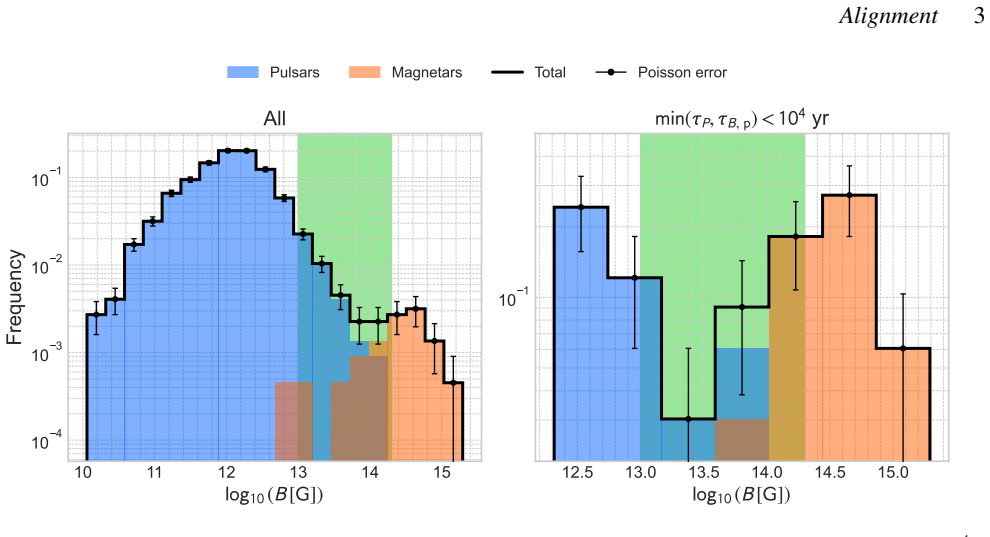
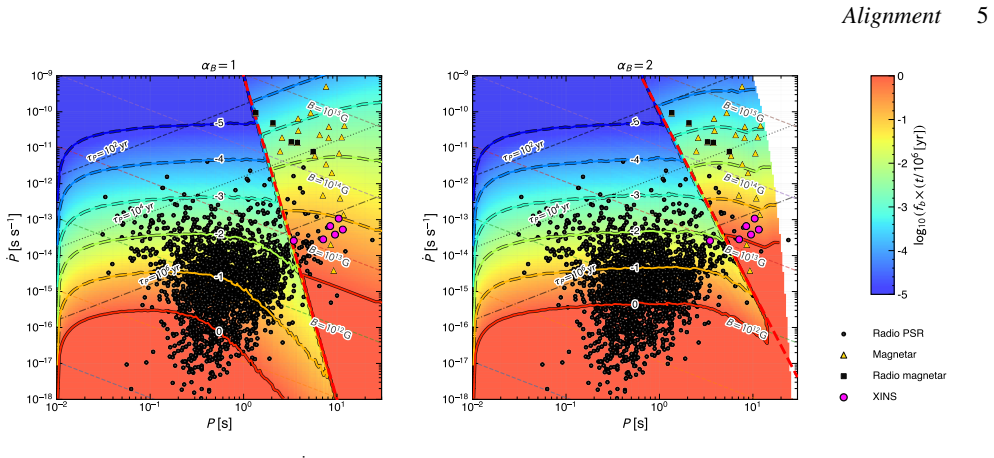
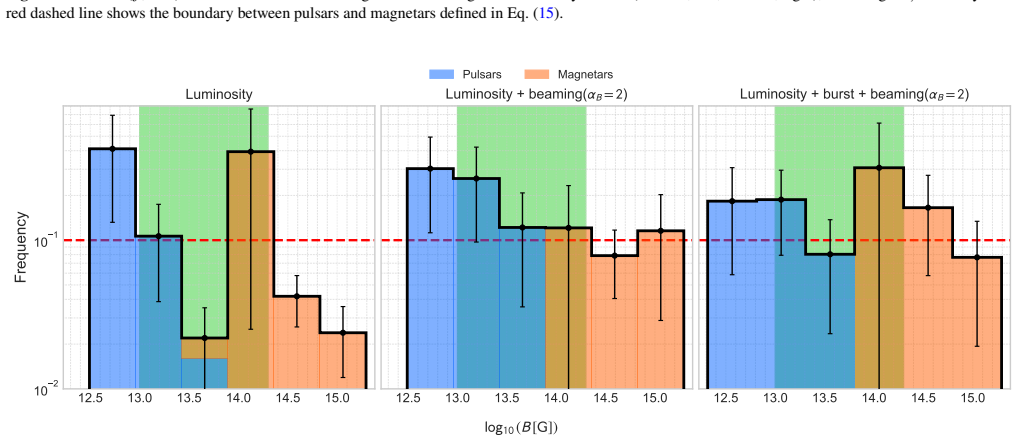
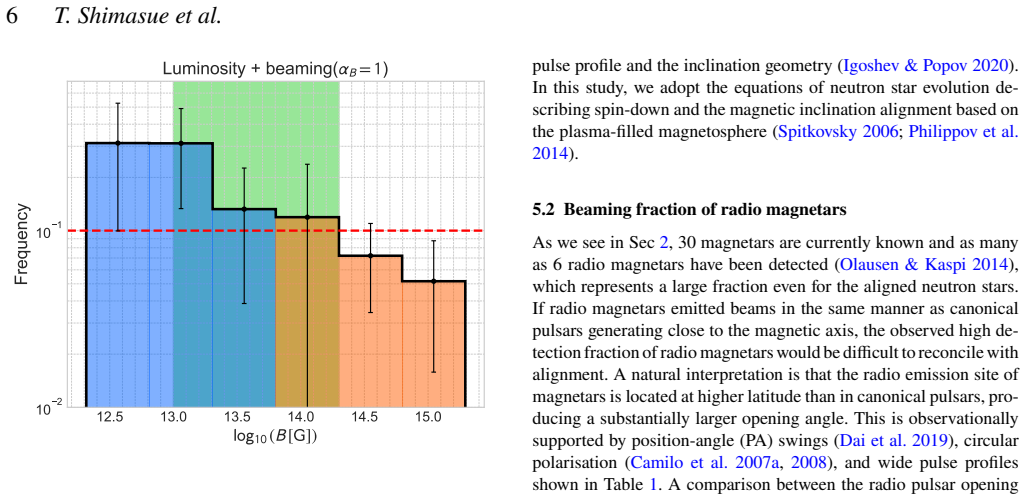
read the original abstract
The origin of the gap in the observed magnetic field distribution between pulsars and magnetars raises a challenge to understanding these populations within a unified framework. We analytically show that the gap can be naturally explained by the alignment of the magnetic inclination angle between the magnetic and spin axes. Based on coupled evolution of spin-down and magnetic inclination angle in the plasma-filled magnetosphere, the alignment timescale follows $\tau_\alpha \propto B^{-2}$. Thus, strongly magnetized neutron stars including high-$B$ pulsars and magnetars align more rapidly than pulsars with $10^{12}\,\mathrm{G}$, reducing their beaming fraction and thereby suppressing their observed numbers. However, magnetars are primarily identified through X-ray activity and are therefore relatively less affected by beaming. Taking into account both beaming fraction and luminosity corrections, we reconstruct the initial magnetic field distribution from the observed distribution. We show that pulsars and magnetars do not dictate intrinsically distinct initial distributions, but can instead be understood within a single continuous initial magnetic field distribution, such as a log-uniform distribution.
Editorial analysis
A structured set of objections, weighed in public.
Referee Report
Summary. The manuscript claims that the gap in the observed magnetic field distribution between pulsars and magnetars arises naturally from magnetic inclination alignment with timescale τ_α ∝ B^{-2} (derived from coupled spin-down and inclination evolution in the plasma-filled magnetosphere), which suppresses the beaming fraction of high-B objects, together with differential X-ray selection for magnetars. Applying beaming and luminosity corrections to invert the observed distribution yields a single continuous initial magnetic field distribution (e.g., log-uniform) that accounts for both populations without requiring intrinsically distinct birth distributions.
Significance. If the alignment scaling and reconstruction hold, the result would unify pulsar and magnetar populations under a single initial B distribution, reducing reliance on bimodal formation scenarios in neutron-star evolution models. The analytical derivation of τ_α ∝ B^{-2} from magnetospheric physics and the explicit treatment of selection effects constitute clear strengths that, if rigorously demonstrated, would make the work a useful contribution to the field.
major comments (2)
- [reconstruction procedure (following the alignment timescale)] The reconstruction of the initial magnetic field distribution (described after the statement of the τ_α scaling) proceeds by applying the alignment model and beaming/luminosity corrections to the observed distribution. Because the log-uniform form is recovered after these model-dependent corrections, the claim that this distribution 'explains' the gap risks circularity; a forward simulation assuming an a priori log-uniform initial B, evolving objects with the stated τ_α ∝ B^{-2} law, applying the same selection effects, and comparing the resulting synthetic populations to data would be required to establish predictive power rather than a post-hoc fit.
- [alignment timescale derivation] The central proportionality τ_α ∝ B^{-2} is presented as following directly from coupled spin-down and inclination evolution, yet the explicit steps, plasma assumptions, and torque model are not visible in the provided abstract. Because this scaling is load-bearing for both the suppression of high-B objects and the subsequent reconstruction, the full derivation (including any dependence on magnetospheric parameters) must be shown in the main text with sufficient detail to allow independent verification.
minor comments (1)
- The abstract would benefit from a quantitative statement of the goodness-of-fit between the reconstructed distribution and the proposed log-uniform form (e.g., a Kolmogorov-Smirnov statistic or parameter range).
Simulated Author's Rebuttal
We thank the referee for the detailed and constructive report. The comments highlight important points on demonstrating the robustness of our results. We respond to each major comment below and have revised the manuscript to address them.
read point-by-point responses
-
Referee: [reconstruction procedure (following the alignment timescale)] The reconstruction of the initial magnetic field distribution (described after the statement of the τ_α scaling) proceeds by applying the alignment model and beaming/luminosity corrections to the observed distribution. Because the log-uniform form is recovered after these model-dependent corrections, the claim that this distribution 'explains' the gap risks circularity; a forward simulation assuming an a priori log-uniform initial B, evolving objects with the stated τ_α ∝ B^{-2} law, applying the same selection effects, and comparing the resulting synthetic populations to data would be required to establish predictive power rather than a post-hoc fit.
Authors: The alignment timescale τ_α ∝ B^{-2} follows from an independent derivation based on magnetospheric torque balance and is not fitted to the observed gap. The reconstruction then inverts the observed distribution under this physics-based model plus selection effects to recover a continuous initial distribution. We agree, however, that a forward simulation would provide stronger evidence of predictive power. We have added such a simulation in the revised manuscript: we draw initial B from a log-uniform distribution, evolve each object under the coupled spin-down and alignment equations with the derived τ_α scaling, apply the same beaming and X-ray selection functions, and show that the resulting synthetic populations reproduce the observed gap and the relative numbers of pulsars and magnetars. revision: yes
-
Referee: [alignment timescale derivation] The central proportionality τ_α ∝ B^{-2} is presented as following directly from coupled spin-down and inclination evolution, yet the explicit steps, plasma assumptions, and torque model are not visible in the provided abstract. Because this scaling is load-bearing for both the suppression of high-B objects and the subsequent reconstruction, the full derivation (including any dependence on magnetospheric parameters) must be shown in the main text with sufficient detail to allow independent verification.
Authors: The derivation of τ_α ∝ B^{-2} is given in full in Section 2 of the manuscript, starting from the coupled differential equations for spin frequency and inclination angle under the plasma-filled magnetosphere model. We have now expanded this section with all algebraic steps, the explicit force-free plasma assumptions, the form of the magnetic torque, and the dependence on magnetospheric parameters (e.g., the pair multiplicity and the radius of the light cylinder). The revised text allows direct verification of the B^{-2} scaling. revision: yes
Circularity Check
No significant circularity identified
full rationale
The derivation begins from the stated physical model of coupled spin-down and inclination evolution yielding τ_α ∝ B^{-2}, applies this to compute B-dependent beaming and luminosity corrections, and reconstructs the initial B distribution from the observed one. The result that a single continuous (e.g., log-uniform) initial distribution suffices is an output of that reconstruction rather than an input or self-referential fit; no load-bearing step reduces by construction to the target claim, no self-citation chain is invoked for uniqueness, and the argument remains independent of the final functional form chosen for illustration.
Axiom & Free-Parameter Ledger
free parameters (1)
- parameters of the log-uniform initial distribution
axioms (2)
- domain assumption Alignment timescale τ_α ∝ B^{-2} from coupled spin-down and inclination evolution in plasma-filled magnetosphere
- domain assumption Beaming fraction and luminosity corrections differ systematically between radio-selected pulsars and X-ray-selected magnetars
Reference graph
Works this paper leans on
-
[10]
S., Gurevich A
Beskin V. S., Gurevich A. V., Istomin Y. N., 1993, Physics of the pulsar magnetosphere
1993
-
[20]
R., Burrows D., Campana S., Kennea J
Cummings J. R., Burrows D., Campana S., Kennea J. A., Krimm H. A., Palmer D. M., Sakamoto T., Zan S., 2011, The Astronomer's Telegram, https://ui.adsabs.harvard.edu/abs/2011ATel.3488....1C 3488, 1
2011
-
[24]
J., 1955, Annales d'Astrophysique, https://ui.adsabs.harvard.edu/abs/1955AnAp...18....1D 18, 1
Deutsch A. J., 1955, Annales d'Astrophysique, https://ui.adsabs.harvard.edu/abs/1955AnAp...18....1D 18, 1
1955
-
[72]
C., Goldwire Jr
Michel F. C., Goldwire Jr. H. C., 1970, , https://ui.adsabs.harvard.edu/abs/1970ApL.....5...21M 5, 21
1970
-
[82]
J., 1969, , https://ui.adsabs.harvard.edu/abs/1969ApL.....3..225R 3, 225
Radhakrishnan V., Cooke D. J., 1969, , https://ui.adsabs.harvard.edu/abs/1969ApL.....3..225R 3, 225
1969
-
[91]
Sherman M., Connor L., Ravi V., Law C., DSA-2000 Collaboration 2024, in American Astronomical Society Meeting Abstracts \#243. p. 261.04
2000
-
[112]
Time evolution of pulsar obliquity angle from 3D simulations of magnetospheres
Time evolution of pulsar obliquity angle from 3D simulations of magnetospheres. , keywords =. doi:10.1093/mnras/stu591 , archivePrefix =. 1311.1513 , primaryClass =
work page internal anchor Pith review Pith/arXiv arXiv doi:10.1093/mnras/stu591
-
[113]
Stripped-envelope supernova light curves argue for central engine activity. , keywords =. doi:10.1038/s41586-024-07262-x , archivePrefix =. 2404.10846 , primaryClass =
-
[114]
On the Evolution of Pulsar Beams. , keywords =. doi:10.1046/j.1365-8711.1998.01369.x , adsurl =
-
[115]
Toward an Empirical Theory of Pulsar Emission. VI. The Geometry of the Conal Emission Region. , keywords =. doi:10.1086/172361 , adsurl =
-
[116]
Multifrequency polarimetry of 300 radio pulsars. , keywords =. doi:10.1046/j.1365-8711.1998.02018.x , adsurl =
-
[117]
Time-dependent force-free pulsar magnetospheres: axisymmetric and oblique rotators
Time-dependent Force-free Pulsar Magnetospheres: Axisymmetric and Oblique Rotators. , keywords =. doi:10.1086/507518 , archivePrefix =. astro-ph/0603147 , primaryClass =
work page internal anchor Pith review Pith/arXiv arXiv doi:10.1086/507518
-
[118]
Magnetic Field Decay in Isolated Neutron Stars. , keywords =. doi:10.1086/171646 , adsurl =
-
[119]
Magnetar fraction in Core-Collapse Supernovae. arXiv e-prints , keywords =. doi:10.48550/arXiv.2601.16159 , archivePrefix =. 2601.16159 , primaryClass =
-
[120]
Grand Unification in Neutron Stars
Grand unification of neutron stars. Proceedings of the National Academy of Science , keywords =. doi:10.1073/pnas.1000812107 , archivePrefix =. 1005.0876 , primaryClass =
work page internal anchor Pith review Pith/arXiv arXiv doi:10.1073/pnas.1000812107
-
[121]
Supernova Light Curves Powered by Young Magnetars
Supernova Light Curves Powered by Young Magnetars. , keywords =. doi:10.1088/0004-637X/717/1/245 , archivePrefix =. 0911.0680 , primaryClass =
work page internal anchor Pith review Pith/arXiv arXiv doi:10.1088/0004-637x/717/1/245
-
[122]
Formation of Very Strongly Magnetized Neutron Stars: Implications for Gamma-Ray Bursts. , keywords =. doi:10.1086/186413 , adsurl =
-
[123]
Evidence for an abundant old population of Galactic ultra-long period magnetars and implications for fast radio bursts. , keywords =. doi:10.1093/mnras/stad208 , archivePrefix =. 2210.09323 , primaryClass =
-
[124]
Long Period Transients (LPTs): a comprehensive review. arXiv e-prints , keywords =. doi:10.48550/arXiv.2601.10393 , archivePrefix =. 2601.10393 , primaryClass =
-
[125]
A highly magnetized long-period radio transient exhibiting unusual emission features. Science Advances , keywords =. doi:10.1126/sciadv.adp6351 , archivePrefix =. 2501.10528 , primaryClass =
-
[126]
Beyond the Rotational Deathline: Radio Emission from Ultra-long Period Magnetars. , keywords =. doi:10.1093/mnras/stae1813 , archivePrefix =. 2406.04135 , primaryClass =
-
[127]
Millisecond pulsars with extremely strong magnetic fields as a cosmological source of -ray bursts. , keywords =. doi:10.1038/357472a0 , adsurl =
-
[128]
Magnetar Spindown, Hyper-Energetic Supernovae, and Gamma Ray Bursts
Magnetar Spin-Down, Hyperenergetic Supernovae, and Gamma-Ray Bursts. , keywords =. doi:10.1086/421969 , archivePrefix =. astro-ph/0401555 , primaryClass =
work page internal anchor Pith review Pith/arXiv arXiv doi:10.1086/421969
-
[129]
Millisecond Magnetar Birth Connects FRB 121102 to Superluminous Supernovae and Long-duration Gamma-Ray Bursts. , keywords =. doi:10.3847/1538-4357/aa633d , archivePrefix =. 1701.02370 , primaryClass =
work page internal anchor Pith review Pith/arXiv arXiv doi:10.3847/1538-4357/aa633d
-
[130]
A fast radio burst associated with a Galactic magnetar. , keywords =. doi:10.1038/s41586-020-2872-x , archivePrefix =. 2005.10828 , primaryClass =
-
[131]
Fast radio bursts at the dawn of the 2020s. , keywords =. doi:10.1007/s00159-022-00139-w , archivePrefix =. 2107.10113 , primaryClass =
-
[132]
The population of pulsars with interpulses and the implications for beam evolution. , keywords =. doi:10.1111/j.1365-2966.2008.13382.x , archivePrefix =. 0804.4318 , primaryClass =
-
[133]
Formation Rates and Evolution Histories of Magnetars
Formation rates and evolution histories of magnetars. , keywords =. doi:10.1093/mnras/stz1391 , archivePrefix =. 1903.06718 , primaryClass =
work page internal anchor Pith review Pith/arXiv arXiv doi:10.1093/mnras/stz1391 1903
-
[134]
Pulsar Population Synthesis with Magnetorotational Evolution: Constraining the Decay of the Magnetic Field. , keywords =. doi:10.3847/1538-4357/ad5af8 , archivePrefix =. 2408.14786 , primaryClass =
work page internal anchor Pith review Pith/arXiv arXiv doi:10.3847/1538-4357/ad5af8
-
[135]
The Galactic Population of Magnetars: A Simulation-based Inference Study. , keywords =. doi:10.3847/1538-4357/add0aa , archivePrefix =. 2503.11875 , primaryClass =
-
[136]
Statistics of interpulse radio pulsars - the key to solving the alignment/counter-alignment problem
Statistics of interpulse radio pulsars: the key to solving the alignment/counter-alignment problem. , keywords =. doi:10.1093/mnras/stw3139 , archivePrefix =. 1612.04820 , primaryClass =
work page internal anchor Pith review Pith/arXiv arXiv doi:10.1093/mnras/stw3139
-
[137]
Spin-Down of Pulsars by the Current - Comparison of Theory with Observations. , keywords =. doi:10.1007/BF00650179 , adsurl =
-
[138]
Astronomy Letters , keywords =
Data From FAST and MeerKAT Surveys As a Test of Radio Pulsar Physics. Astronomy Letters , keywords =. doi:10.1134/S1063773725700148 , archivePrefix =. 2506.12423 , primaryClass =
-
[139]
Physics of the pulsar magnetosphere
-
[140]
Structure and polarization of pulsar radio emission beams
-
[141]
Investigating the magnetic inclination angle distribution of $\gamma$-ray-loud radio pulsars
Investigating the magnetic inclination angle distribution of -ray-loud radio pulsars. , keywords =. doi:10.1093/mnras/stu2083 , archivePrefix =. 1410.3310 , primaryClass =
work page internal anchor Pith review Pith/arXiv arXiv doi:10.1093/mnras/stu2083
-
[142]
Constraints on viewing geometries from radio observations of -ray-loud pulsars using a novel method. , keywords =. doi:10.1093/mnras/stu2236 , archivePrefix =. 1410.3294 , primaryClass =
work page internal anchor Pith review Pith/arXiv arXiv doi:10.1093/mnras/stu2236
-
[143]
45 Years of Rotation of the Crab Pulsar
45 years of rotation of the Crab pulsar. , keywords =. doi:10.1093/mnras/stu2118 , archivePrefix =. 1410.0886 , primaryClass =
work page internal anchor Pith review Pith/arXiv arXiv doi:10.1093/mnras/stu2118
-
[144]
Electromagnetic Torques, Precession and Evolution of Magnetic Inclination of Pulsars
Electromagnetic torques, precession and evolution of magnetic inclination of pulsars. , keywords =. doi:10.1093/mnras/stv955 , archivePrefix =. 1503.01486 , primaryClass =
work page internal anchor Pith review Pith/arXiv arXiv doi:10.1093/mnras/stv955
-
[145]
Braking indices of young radio pulsars: theoretical perspective. , keywords =. doi:10.1093/mnras/staa3070 , archivePrefix =. 2008.11737 , primaryClass =
-
[146]
Nature Astronomy , year = 2024, month = may, volume =
A freely precessing magnetar following an X-ray outburst. Nature Astronomy , year = 2024, month = may, volume =. doi:10.1038/s41550-024-02226-7 , adsurl =
-
[147]
Transient pulsed radio emission from a magnetar
Transient pulsed radio emission from a magnetar. , keywords =. doi:10.1038/nature04986 , archivePrefix =. astro-ph/0605429 , primaryClass =
work page internal anchor Pith review Pith/arXiv arXiv doi:10.1038/nature04986
-
[148]
2007, MNRAS, 376, 1145, doi: 10.1111/j.1365-2966.2007.11495.x
Polarized radio emission from a magnetar. , keywords =. doi:10.1111/j.1365-2966.2007.11622.x , archivePrefix =. astro-ph/0702365 , primaryClass =
-
[149]
The magnetar 1E 1547.0-5408: radio spectrum, polarimetry, and timing
The Magnetar 1E 1547.0-5408: Radio Spectrum, Polarimetry, and Timing. , keywords =. doi:10.1086/587054 , archivePrefix =. 0802.0494 , primaryClass =
work page internal anchor Pith review Pith/arXiv arXiv doi:10.1086/587054
-
[150]
1E 1547.0-5408: a radio-emitting magnetar with a rotation period of 2 seconds
1E 1547.0-5408: A Radio-emitting Magnetar with a Rotation Period of 2 Seconds. , keywords =. doi:10.1086/521826 , archivePrefix =. 0708.0002 , primaryClass =
work page internal anchor Pith review Pith/arXiv arXiv doi:10.1086/521826
-
[151]
2012, MNRAS, 427, 1344, doi: 10.1111/j.1365-2966.2012.22008.x
Radio emission evolution, polarimetry and multifrequency single pulse analysis of the radio magnetar PSR J1622-4950. , keywords =. doi:10.1111/j.1365-2966.2012.20807.x , archivePrefix =. 1204.2045 , primaryClass =
-
[152]
Simultaneous multifrequency radio observations of the Galactic Centre magnetar SGR J1745-2900
Simultaneous multifrequency radio observations of the Galactic Centre magnetar SGR J1745-2900. , keywords =. doi:10.1093/mnrasl/slv063 , archivePrefix =. 1504.07241 , primaryClass =
work page internal anchor Pith review Pith/arXiv arXiv doi:10.1093/mnrasl/slv063
-
[153]
A strong magnetic field around the supermassive black hole at the centre of the Galaxy
A strong magnetic field around the supermassive black hole at the centre of the Galaxy. , keywords =. doi:10.1038/nature12499 , archivePrefix =. 1308.3147 , primaryClass =
work page internal anchor Pith review Pith/arXiv arXiv doi:10.1038/nature12499
-
[154]
Spectropolarimetric Properties of Swift J1818.0-1607: A 1.4 s Radio Magnetar. , keywords =. doi:10.3847/2041-8213/ab9898 , archivePrefix =. 2004.11522 , primaryClass =
-
[155]
The Inclination Angle and Evolution of the Braking Index of Pulsars with Plasma-filled Magnetosphere: Application to the High Braking Index of PSR J1640-4631. , keywords =. doi:10.3847/0004-637X/823/1/34 , archivePrefix =. 1603.01487 , primaryClass =
work page internal anchor Pith review Pith/arXiv arXiv doi:10.3847/0004-637x/823/1/34
-
[156]
Origin of Pulsed Radio Emission from Magnetars. , keywords =. doi:10.3847/2041-8213/ae2ade , archivePrefix =. 2509.13419 , primaryClass =
-
[157]
, year = 1969, month = jan, volume =
Magnetic Poles and the Polarization Structure of Pulsar Radiation. , year = 1969, month = jan, volume =
1969
-
[158]
Light-curve modelling constraints on the obliquities and aspect angles of the young Fermi pulsars
Light-curve modelling constraints on the obliquities and aspect angles of the young Fermi pulsars. , keywords =. doi:10.1051/0004-6361/201423815 , archivePrefix =. 1403.3849 , primaryClass =
work page internal anchor Pith review Pith/arXiv arXiv doi:10.1051/0004-6361/201423815
-
[159]
Studies on the Spin and Magnetic Inclination Evolution of Magnetars Swift J1834.9─0846 under Wind Braking. , keywords =. doi:10.3847/1538-4357/ae3bcf , archivePrefix =. 2602.06615 , primaryClass =
-
[160]
Revival of the Magnetar PSR J1622-4950: Observations with MeerKAT, Parkes, XMM-Newton, Swift, Chandra, and NuSTAR. , keywords =. doi:10.3847/1538-4357/aab35a , archivePrefix =. 1804.01933 , primaryClass =
work page internal anchor Pith review Pith/arXiv arXiv doi:10.3847/1538-4357/aab35a
-
[161]
The magnetar XTE J1810-197: variations in torque, radio flux density and pulse profile morphology
The Magnetar XTE J1810-197: Variations in Torque, Radio Flux Density, and Pulse Profile Morphology. , keywords =. doi:10.1086/518226 , archivePrefix =. astro-ph/0610685 , primaryClass =
work page internal anchor Pith review Pith/arXiv arXiv doi:10.1086/518226
-
[162]
The dynamic magnetosphere of Swift J1818.0-1607. , keywords =. doi:10.1093/mnras/staa3789 , archivePrefix =. 2011.12463 , primaryClass =
-
[163]
Evidence for a Multipolar Magnetic Field in SGR J1745-2900 from X-Ray Light-curve Analysis. , keywords =. doi:10.3847/1538-4357/ab65f4 , archivePrefix =. 1912.12336 , primaryClass =
-
[164]
Polarization Position Angle Swing and the Rotating Vector Model of Repeating Fast Radio Bursts. , keywords =. doi:10.3847/1538-4357/ade689 , archivePrefix =. 2504.00391 , primaryClass =
-
[165]
A Strong X-Ray Polarization Signal from the Magnetar 1RXS J170849.0-400910. , keywords =. doi:10.3847/2041-8213/acb703 , archivePrefix =. 2301.12919 , primaryClass =
-
[166]
The detection of polarized X-ray emission from the magnetar 1E 2259+586. , keywords =. doi:10.1093/mnras/stad3680 , archivePrefix =. 2311.03637 , primaryClass =
-
[167]
A radio pulsar phase from SGR J1935+2154 provides clues to the magnetar FRB mechanism. Science Advances , keywords =. doi:10.1126/sciadv.adf6198 , archivePrefix =. 2307.16124 , primaryClass =
-
[168]
Can Repeating and Nonrepeating Fast Radio Bursts Be Drawn from the Same Population?. , keywords =. doi:10.3847/1538-4357/ae0712 , archivePrefix =. 2506.09138 , primaryClass =
-
[169]
The Role of Magnetic and Rotation Axis Alignment in Driving Fast Radio Burst Phenomenology. , keywords =. doi:10.3847/1538-4357/adb8e6 , archivePrefix =. 2410.19043 , primaryClass =
-
[170]
INTEGRAL Discovery of a Burst with Associated Radio Emission from the Magnetar SGR 1935+2154. , keywords =. doi:10.3847/2041-8213/aba2cf , archivePrefix =. 2005.06335 , primaryClass =
-
[171]
NuSTAR Discovery of a Young, Energetic Pulsar Associated with the Luminous Gamma-Ray Source HESS J1640-465. , keywords =. doi:10.1088/0004-637X/788/2/155 , archivePrefix =. 1405.0465 , primaryClass =
work page internal anchor Pith review Pith/arXiv arXiv doi:10.1088/0004-637x/788/2/155
-
[172]
The McGill Magnetar Catalog. , keywords =. doi:10.1088/0067-0049/212/1/6 , archivePrefix =. 1309.4167 , primaryClass =
work page internal anchor Pith review Pith/arXiv arXiv doi:10.1088/0067-0049/212/1/6
-
[173]
A Radio-loud Magnetar in X-ray Quiescence
A Radio-loud Magnetar in X-ray Quiescence. , keywords =. doi:10.1088/2041-8205/721/1/L33 , archivePrefix =. 1007.1052 , primaryClass =
work page internal anchor Pith review Pith/arXiv arXiv doi:10.1088/2041-8205/721/1/l33 2041
-
[174]
Electron-positron flows around magnetars
Electron-Positron Flows around Magnetars. , keywords =. doi:10.1088/0004-637X/777/2/114 , archivePrefix =. 1209.4063 , primaryClass =
work page internal anchor Pith review Pith/arXiv arXiv doi:10.1088/0004-637x/777/2/114
-
[175]
, keywords =
Propagation effects in pulsar magnetospheres. , keywords =
-
[176]
2012, MNRAS, 427, 1344, doi: 10.1111/j.1365-2966.2012.22008.x
On the mean profiles of radio pulsars - I. Theory of propagation effects. , keywords =. doi:10.1111/j.1365-2966.2012.20988.x , archivePrefix =. 1107.3775 , primaryClass =
-
[177]
Extragalactic Magnetar Giant Flares: Population Implications, Rates, and Prospects for Gamma-Rays, Gravitational Waves, and Neutrinos. , keywords =. doi:10.3847/1538-4357/ada947 , archivePrefix =. 2411.16846 , primaryClass =
-
[178]
Wideband polarized radio emission from the newly revived magnetar XTE J1810$-$197
Wideband Polarized Radio Emission from the Newly Revived Magnetar XTE J1810-197. , keywords =. doi:10.3847/2041-8213/ab0e7a , archivePrefix =. 1902.04689 , primaryClass =
work page internal anchor Pith review Pith/arXiv arXiv doi:10.3847/2041-8213/ab0e7a 2041
-
[179]
Energetic Radiation from Rapidly Spinning Pulsars. I. Outer Magnetosphere Gaps. , keywords =. doi:10.1086/163829 , adsurl =
-
[180]
2004, MNRAS, 353, 1311, doi: 10.1111/j.1365-2966.2004.08157.x
A pulsar outer gap model with trans-field structure. , keywords =. doi:10.1111/j.1365-2966.2004.08270.x , archivePrefix =. astro-ph/0408044 , primaryClass =
-
[181]
The Third Fermi Large Area Telescope Catalog of Gamma-Ray Pulsars. , keywords =. doi:10.3847/1538-4357/acee67 , archivePrefix =. 2307.11132 , primaryClass =
-
[182]
The Second Fermi Large Area Telescope Catalog of Gamma-ray Pulsars
The Second Fermi Large Area Telescope Catalog of Gamma-Ray Pulsars. , keywords =. doi:10.1088/0067-0049/208/2/17 , archivePrefix =. 1305.4385 , primaryClass =
work page internal anchor Pith review Pith/arXiv arXiv doi:10.1088/0067-0049/208/2/17
-
[183]
Birth and Evolution of Isolated Radio Pulsars
Birth and Evolution of Isolated Radio Pulsars. , keywords =. doi:10.1086/501516 , archivePrefix =. astro-ph/0512585 , primaryClass =
work page internal anchor Pith review Pith/arXiv arXiv doi:10.1086/501516
-
[184]
Pulsar braking and the P-Pdot diagram
Pulsar braking and the P-dot\ P\ diagram. , keywords =. doi:10.1093/mnras/stx377 , archivePrefix =. 1702.03616 , primaryClass =
work page internal anchor Pith review Pith/arXiv arXiv doi:10.1093/mnras/stx377
-
[185]
Theory of pulsars: polar gaps, sparks, and coherent microwave radiation. , keywords =. doi:10.1086/153393 , adsurl =
discussion (0)
Sign in with ORCID, Apple, or X to comment. Anyone can read and Pith papers without signing in.