Re-Rooting-Based Fault-Tolerant One-to-All Broadcasting in Dense Eisenstein--Jacobi Networks
Pith reviewed 2026-06-26 19:38 UTC · model grok-4.3
The pith
For any two faulty nodes in dense Eisenstein--Jacobi networks, a common distance-diameter node exists as a valid re-rooted broadcast source.
A machine-rendered reading of the paper's core claim, the machinery that carries it, and where it could break.
Core claim
For any pair of faulty nodes in a dense Eisenstein--Jacobi network there exists a common distance-diameter node that can serve as a valid re-rooted source. The source-selection procedure requires linear time in the network diameter. Equivalently the selection cost is O(sqrt N) and the proposed method completes in at most twice the network diameter.
What carries the argument
Re-rooting the broadcast source to a common distance-diameter node from the faults, which positions the faulty nodes as leaves that do not forward messages.
If this is right
- Broadcasting completes in at most twice the network diameter for up to two faults.
- Source selection costs linear time in the diameter, or O(sqrt N) in the number of nodes.
- No redundant spanning trees, backup paths, or additional broadcast structures are required.
- The two-fault guarantee does not extend to arbitrary three-fault configurations.
Where Pith is reading between the lines
- The same re-rooting logic could apply to other vertex-symmetric degree-six networks with comparable diameter properties.
- Precomputing candidate re-root nodes from the algebraic coordinates might further reduce runtime selection cost.
- The approach could support reliable collective operations in on-chip networks with only a constant-factor time increase.
- Identifying algebraic conditions for common re-root nodes might allow controlled extension beyond two faults.
Load-bearing premise
The networks must satisfy the algebraic and geometric properties of dense Eisenstein--Jacobi graphs with degree six, vertex symmetry, diameter D and N=3t^2+3t+1 nodes, and node faults only prevent forwarding without altering connectivity in other ways.
What would settle it
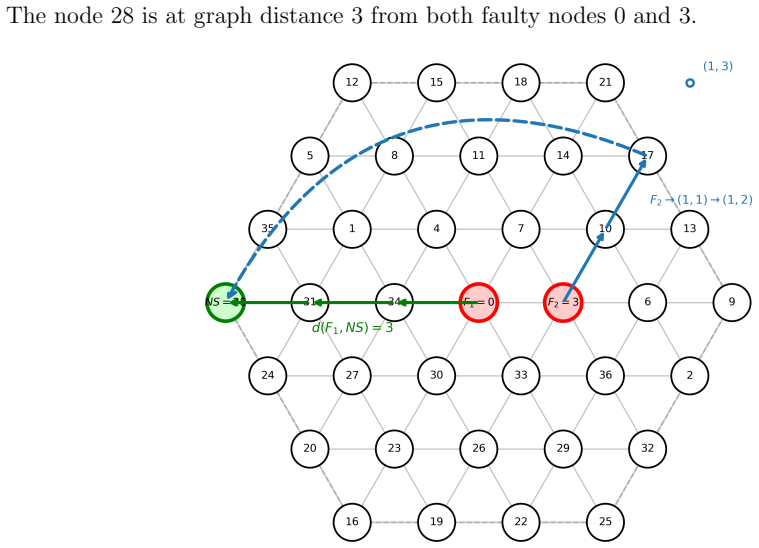
An explicit pair of faulty nodes with no common distance-diameter node would falsify the existence claim; the paper already supplies a concrete three-node counterexample showing where the two-fault guarantee stops.
Figures
read the original abstract
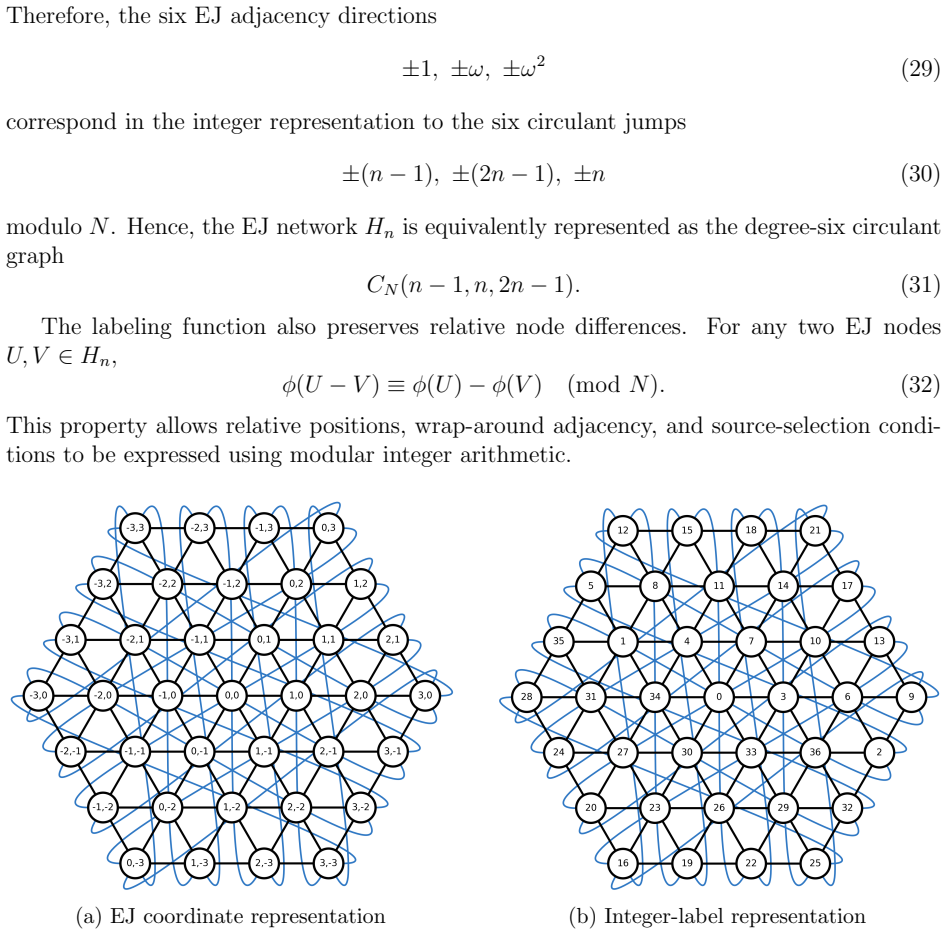
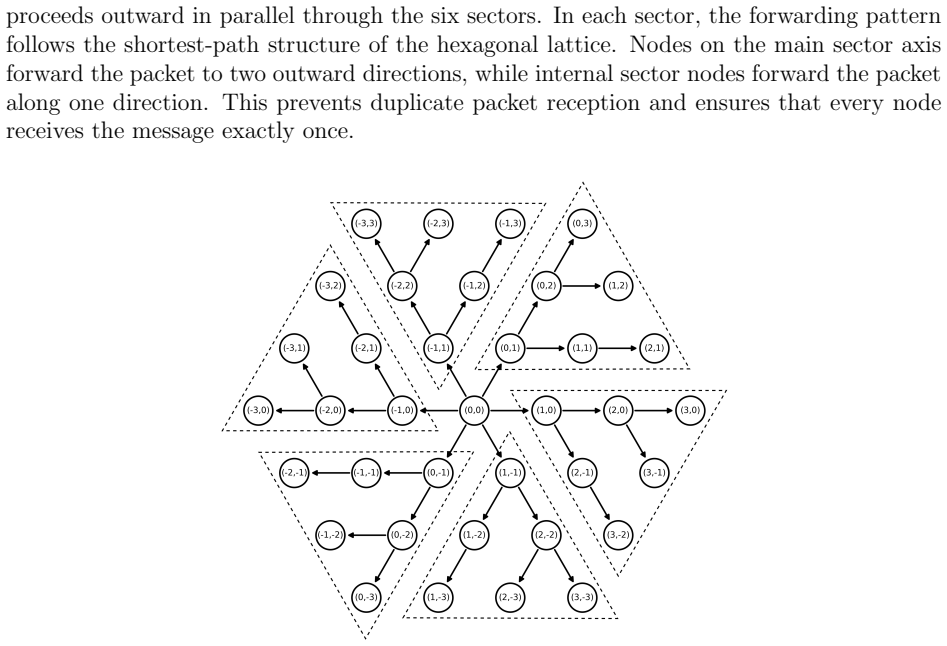
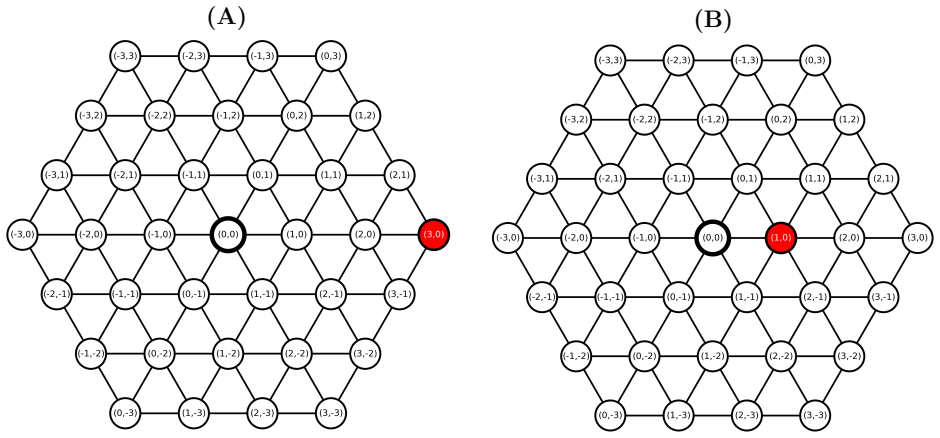
Dense Eisenstein--Jacobi networks are degree-six algebraic interconnection topologies with regular structure, vertex symmetry, small diameter, and efficient communication algorithms. These properties make them suitable for parallel and on-chip communication systems in which collective operations such as one-to-all broadcasting are frequent. Existing optimal broadcasting algorithms for dense hexagonal/Eisenstein--Jacobi networks assume fault-free operation. However, a faulty internal forwarding node may interrupt message propagation and prevent complete delivery. This paper proposes a lightweight re-rooting-based fault-tolerant broadcasting method for dense Eisenstein--Jacobi networks. The main idea is to relocate the effective broadcast source to a new source node such that each faulty node is located at graph distance equal to the network diameter from the new source. Consequently, faulty nodes become leaf-level nodes in the broadcast process and are not required to forward the message. We present source-selection algorithms for one- and two-node failures and prove that for any pair of faulty nodes in a dense Eisenstein--Jacobi network there exists a common distance-diameter node that can serve as a valid re-rooted source. The source-selection procedure requires linear time in the network diameter. Equivalently, since $N=3t^2+3t+1$, the selection cost is $O(\sqrt{N})$ in the number of nodes. Since the standard one-to-all broadcast completes in one diameter time and the relocation phase is also bounded by one diameter, the proposed method completes in at most twice the network diameter. We also show that the two-fault guarantee does not generally extend to arbitrary three-fault configurations by giving an explicit counterexample. The proposed approach improves broadcast reliability without constructing redundant spanning trees, backup paths, or additional broadcast structures.
Editorial analysis
A structured set of objections, weighed in public.
Referee Report
Summary. The paper proposes a re-rooting-based fault-tolerant one-to-all broadcasting scheme for dense Eisenstein-Jacobi networks (degree 6, vertex-transitive, N=3t²+3t+1, diameter D). The central claim is that for any two faulty nodes there exists a common re-rooted source at graph distance exactly D from both faults; this placement ensures the faults become leaves in any shortest-path broadcast tree. Explicit O(D) (equivalently O(√N)) source-selection algorithms are stated for one- and two-fault cases, yielding an overall broadcast latency of at most 2D. A counter-example is supplied showing the guarantee fails for some three-fault sets.
Significance. If the existence result and linear-time selection procedure hold, the method supplies a lightweight, structure-free way to tolerate up to two forwarding faults while preserving the optimal diameter bound of the underlying network family. The O(√N) selection cost and the explicit three-fault counter-example are concrete, falsifiable contributions that could be useful for on-chip or parallel-communication settings.
major comments (3)
- [Abstract / proof sections] The manuscript asserts the existence, for every pair of faults, of a common distance-D node that can serve as re-rooted source, yet supplies neither the algebraic derivation (using the Eisenstein-Jacobi coordinate representation or the known distance formula) nor the explicit construction of the selection algorithm. Without these steps the central claim cannot be verified.
- [Algorithm description] The O(D) time bound for source selection is stated but not accompanied by a complexity analysis or pseudocode that would allow confirmation that the procedure indeed runs in linear diameter time and correctly identifies a valid re-rooted source.
- [Counter-example section] The three-fault counter-example is mentioned but its explicit node coordinates or adjacency verification are not provided, preventing independent checking that the configuration indeed admits no common distance-D source.
minor comments (2)
- Notation for the network parameters (t, D, N) is introduced in the abstract but never related to the standard Eisenstein-Jacobi embedding or distance metric in the body.
- The fault model (forwarding blocked but connectivity otherwise unchanged) should be stated once in a dedicated paragraph rather than only implicitly.
Simulated Author's Rebuttal
We thank the referee for the thorough review and for identifying points where additional detail will strengthen the manuscript. We address each major comment below and will revise the paper to incorporate the requested derivations, analysis, pseudocode, and explicit counter-example data.
read point-by-point responses
-
Referee: [Abstract / proof sections] The manuscript asserts the existence, for every pair of faults, of a common distance-D node that can serve as re-rooted source, yet supplies neither the algebraic derivation (using the Eisenstein-Jacobi coordinate representation or the known distance formula) nor the explicit construction of the selection algorithm. Without these steps the central claim cannot be verified.
Authors: We agree that the submitted version did not contain a complete algebraic derivation of the existence result or the step-by-step construction of the re-rooted source. In the revised manuscript we will add a dedicated subsection that derives the common distance-D node from the Eisenstein-Jacobi integer representation and the known distance formula, followed by the explicit construction of the selection procedure for any pair of faults. revision: yes
-
Referee: [Algorithm description] The O(D) time bound for source selection is stated but not accompanied by a complexity analysis or pseudocode that would allow confirmation that the procedure indeed runs in linear diameter time and correctly identifies a valid re-rooted source.
Authors: The O(D) claim appears without supporting analysis or pseudocode in the current draft. The revision will include a complexity analysis establishing the linear-in-diameter bound together with pseudocode for both the one-fault and two-fault source-selection algorithms, allowing direct verification of correctness and runtime. revision: yes
-
Referee: [Counter-example section] The three-fault counter-example is mentioned but its explicit node coordinates or adjacency verification are not provided, preventing independent checking that the configuration indeed admits no common distance-D source.
Authors: We concur that the counter-example requires explicit coordinates and verification to be independently checkable. The revised manuscript will supply the concrete Eisenstein-Jacobi coordinates of the three faulty nodes, confirm their mutual distances, and demonstrate that no common distance-D node exists for that set. revision: yes
Circularity Check
No significant circularity identified
full rationale
The paper's claims consist of existence proofs for a common distance-diameter re-rooted source under any two faults, plus O(D) algorithms for source selection, all grounded in the algebraic and geometric properties of dense Eisenstein-Jacobi graphs (degree 6, vertex-transitive, N=3t²+3t+1). These rest on standard graph-distance arguments rather than any self-referential definitions, fitted parameters renamed as predictions, or load-bearing self-citations. The derivation chain is self-contained as a mathematical argument on network properties and does not reduce to its inputs by construction.
Axiom & Free-Parameter Ledger
axioms (2)
- domain assumption Dense Eisenstein-Jacobi networks are vertex-symmetric degree-6 graphs with diameter D and node count N=3t^2+3t+1.
- domain assumption Node failures only interrupt forwarding; the underlying graph remains connected for the purpose of distance calculations.
Reference graph
Works this paper leans on
-
[1]
The topology of Gaussian and Eisenstein–Jacobi interconnec- tion networks,
M. Flahive and B. Bose, “The topology of Gaussian and Eisenstein–Jacobi interconnec- tion networks,”IEEE Transactions on Parallel and Distributed Systems, vol. 21, no. 8, pp. 1132–1142, Aug. 2010
2010
-
[2]
Efficient communication algorithms in hexag- onal mesh interconnection networks,
B. Albader, B. Bose, and M. Flahive, “Efficient communication algorithms in hexag- onal mesh interconnection networks,”IEEE Transactions on Parallel and Distributed Systems, vol. 23, no. 1, pp. 69–77, Jan. 2012, doi: 10.1109/TPDS.2011.112
-
[3]
Addressing, routing, and broadcasting in hexagonal mesh multiprocessors,
M.-S. Chen, K. G. Shin, and D. D. Kandlur, “Addressing, routing, and broadcasting in hexagonal mesh multiprocessors,”IEEE Transactions on Computers, vol. 39, no. 1, pp. 10–18, Jan. 1990
1990
-
[4]
Reliable broadcast algorithms for HARTS,
D. D. Kandlur and K. G. Shin, “Reliable broadcast algorithms for HARTS,”ACM Transactions on Computer Systems, vol. 9, no. 4, pp. 374–398, Nov. 1991
1991
-
[5]
Performance analysis of virtual cut- through switching in HARTS: A hexagonal mesh multicomputer,
J. W. Dolter, P. Ramanathan, and K. G. Shin, “Performance analysis of virtual cut- through switching in HARTS: A hexagonal mesh multicomputer,”IEEE Transactions on Computers, vol. 40, no. 6, pp. 669–680, Jun. 1991
1991
-
[6]
Codes over Eisenstein–Jacobi integers,
K. Huber, “Codes over Eisenstein–Jacobi integers,” inFinite Fields: Theory, Applica- tions, and Algorithms. Providence, RI, USA: American Mathematical Society, 1994, pp. 165–179
1994
-
[7]
Modeling hexagonal net- works with the Eisenstein–Jacobi graphs,
C. Mart´ ınez, E. Stafford, R. Beivide, and E. M. Gabidulin, “Modeling hexagonal net- works with the Eisenstein–Jacobi graphs,”Problems of Information Transmission, vol. 44, no. 1, pp. 1–11, 2008
2008
-
[8]
Addressing and routing in hexagonal net- works with applications in location update and connection rerouting in mobile phone networks,
F. Garcia, I. Stojmenovic, and J. Zhang, “Addressing and routing in hexagonal net- works with applications in location update and connection rerouting in mobile phone networks,”IEEE Transactions on Parallel and Distributed Systems, vol. 13, no. 9, pp. 963–971, Sept. 2002
2002
-
[9]
Dense Gaussian networks: Suitable topologies for on-chip multiprocessors,
C. Mart´ ınez, E. Vallejo, R. Beivide, C. Izu, and M. Moret´ o, “Dense Gaussian networks: Suitable topologies for on-chip multiprocessors,”International Journal of Parallel Pro- gramming, vol. 34, no. 3, pp. 193–211, 2006
2006
-
[10]
Gaussian interconnection networks,
R. Beivide, C. Mart´ ınez, and E. Vallejo, “Gaussian interconnection networks,” inProc. Spanish Parallelism Conference, 2005
2005
-
[11]
Grama, A
A. Grama, A. Gupta, G. Karypis, and V. Kumar,Introduction to Parallel Computing, 2nd ed. Pearson, 2003. 29
2003
-
[12]
Kumar, A
V. Kumar, A. Grama, A. Gupta, and G. Karypis,Introduction to Parallel Computing: Design and Analysis of Algorithms. Redwood City, CA, USA: Benjamin-Cummings, 1994
1994
-
[13]
Duato, S
J. Duato, S. Yalamanchili, and L. Ni,Interconnection Networks: An Engineering Ap- proach. San Francisco, CA, USA: Morgan Kaufmann, 2002
2002
-
[14]
W. J. Dally and B. Towles,Principles and Practices of Interconnection Networks. San Francisco, CA, USA: Morgan Kaufmann, 2004
2004
-
[15]
Pasricha and N
S. Pasricha and N. Dutt,On-Chip Communication Architectures: System-on-Chip In- terconnect. San Francisco, CA, USA: Morgan Kaufmann, 2008
2008
-
[16]
Flich and D
J. Flich and D. Bertozzi,Designing Network-on-Chip Architectures in the Nanoscale Era. Boca Raton, FL, USA: CRC Press, 2010
2010
-
[17]
B. Cheng, D. Wang, and J. Fan, “Independent spanning trees in networks: A sur- vey,”ACM Computing Surveys, vol. 55, no. 14s, Article 335, pp. 1–29, 2023, doi: 10.1145/3591110
-
[18]
A parallel algo- rithm for constructing multiple independent spanning trees in bubble-sort networks,
S.-S. Kao, R. Klasing, L.-J. Hung, C.-W. Lee, and S.-Y. Hsieh, “A parallel algo- rithm for constructing multiple independent spanning trees in bubble-sort networks,” Journal of Parallel and Distributed Computing, vol. 181, Article 104731, 2023, doi: 10.1016/j.jpdc.2023.104731
-
[19]
Edge-independent spanning trees in folded crossed cubes,
H. Zhang, Y. Wang, J. Fan, and C. Shu, “Edge-independent spanning trees in folded crossed cubes,”Theoretical Computer Science, vol. 970, Article 114053, 2023, doi: 10.1016/j.tcs.2023.114053
-
[20]
K.-J. Pai, J.-S. Yang, G.-Y. Chen, and J.-M. Chang, “Configuring protection routing via completely independent spanning trees in dense Gaussian on-chip networks,”IEEE Transactions on Network Science and Engineering, vol. 9, no. 2, pp. 932–946, 2022, doi: 10.1109/TNSE.2022.3140329
-
[21]
X. Yu, J. Zhang, and Y. Liu, “Fault tolerant and quality of service aware routing algo- rithm based on priority technique for scalable network-on-chip architectures,”Scientific Reports, vol. 15, Article 39590, 2025, doi: 10.1038/s41598-025-20381-3
-
[22]
Adaptive and passage-based fault-tolerant routing methods for 3D mesh network-on-chip,
Y. Kurokawa, “Adaptive and passage-based fault-tolerant routing methods for 3D mesh network-on-chip,”Technologies, vol. 13, no. 5, Article 176, 2025, doi: 10.3390/technolo- gies13050176
-
[23]
A survey of machine learning for network-on-chips,
X. Zhang, H. Zhang, R. Shen, and S. Pasricha, “A survey of machine learning for network-on-chips,”Journal of Parallel and Distributed Computing, vol. 182, Article 104778, 2024, doi: 10.1016/j.jpdc.2023.104778
-
[24]
J. Samala, “Enhancing fault-tolerant application mapping in network-on-chip using transformer-based reinforcement learning,”The Journal of Supercomputing, 2025, doi: 10.1007/s10791-025-09704-0. 30
discussion (0)
Sign in with ORCID, Apple, or X to comment. Anyone can read and Pith papers without signing in.