REVIEW 3 minor 99 references
Enhancing the teleportation fidelity of a quantum network using purification
T0 review · 0 major / 3 minor · reviewed 2026-06-26 · grok-4.3
Pith's one-line read Entanglement purification over multiple paths substantially improves average maximum teleportation fidelity in quantum networks.
desk verdict Purification via multiple paths raises average max teleportation fidelity over single-path swapping across topologies, with the main addition being constrained algorithms for the metric. read the letter →
The pith
A machine-rendered reading of the paper's core claim, the machinery that carries it, and where it could break.
The reading
What carries the argument
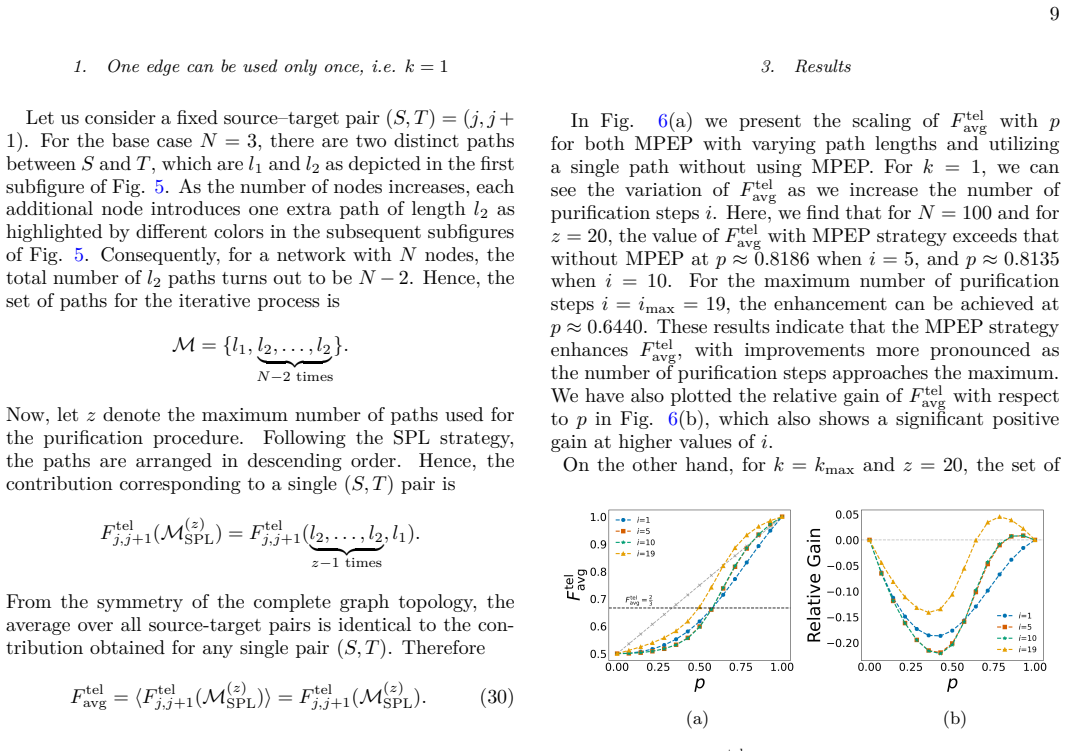
The average maximum teleportation fidelity metric, which averages the highest achievable teleportation fidelity over all source-target pairs under a given distribution scheme; it quantifies and compares network resourcefulness for the two protocols.
What would settle it
Direct computation or measurement showing that the average maximum teleportation fidelity remains the same or decreases when multi-path purification replaces single-path swapping in a tested network topology would falsify the central claim.
Extended reading notes
Core claim
The paper establishes that in quantum networks, entanglement purification strategies exploiting multiple paths between source and target nodes produce higher values of the average maximum teleportation fidelity metric than single-path entanglement swapping. This improvement holds across both regular and random topologies and demonstrates that purification-based schemes enhance the overall teleportation capability of the network.
Load-bearing premise
The recently described metric that averages the maximum teleportation fidelity between arbitrary source-target pairs accurately quantifies a network's resourcefulness for quantum communication.
Editorial extensions
If this is right
- The average maximum teleportation fidelity metric changes substantially depending on whether single-path swapping or multi-path purification is employed.
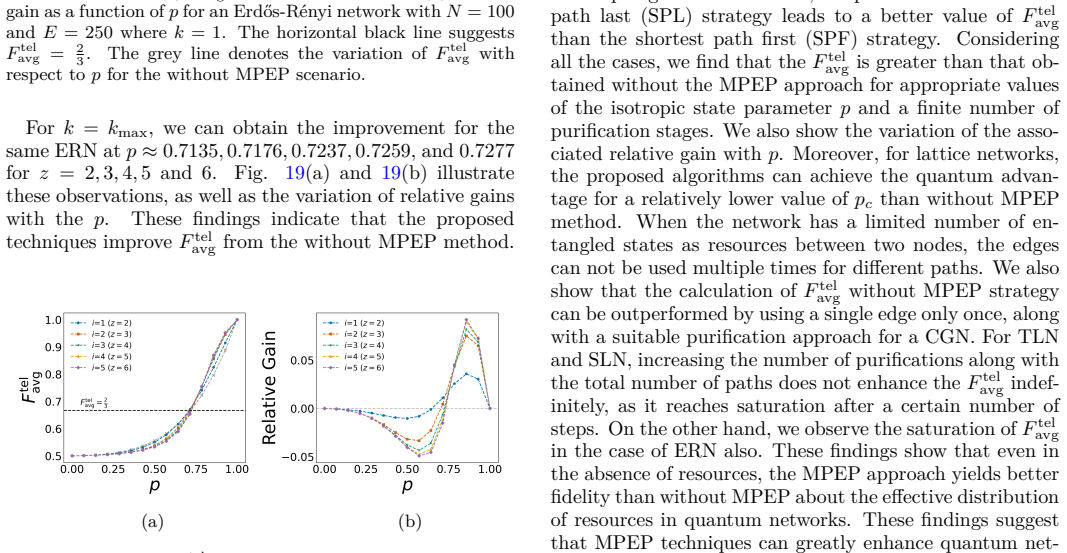
- Purification-based multi-path schemes raise the metric in both regular and random networks.
- Algorithms that respect edge-usage and path-ordering constraints can estimate the metric for both schemes.
- Multi-path purification improves teleportation capability relative to linear single-path repeater protocols.
Reading between the lines
- Network architectures that support many edge-disjoint paths between pairs would likely show larger gains under purification protocols.
- The same metric could be applied to compare hybrid schemes that mix swapping on some paths with purification on others.
- In the presence of realistic noise, the relative advantage of multi-path purification might increase because purification can mitigate errors across paths.
- Routing algorithms for future quantum networks could incorporate path multiplicity as a design criterion to maximize the fidelity metric.
Editorial analysis
A structured set of objections, weighed in public.
Referee Report
Summary. The manuscript analyzes quantum network resourcefulness, quantified via an average-maximum-teleportation-fidelity metric, under two entanglement-distribution protocols: single-path swapping versus multi-path purification. It compares performance across regular and random topologies, supplies algorithms that enforce edge-usage and path-ordering constraints, and concludes that purification yields substantial fidelity gains and therefore improves overall teleportation capability.
Significance. If the reported numerical comparisons hold, the work supplies concrete evidence that protocol choice materially affects network performance and that multi-path purification can deliver measurable improvements; the explicit algorithms for the metric under stated constraints constitute a reproducible contribution that future studies can build upon.
minor comments (3)
- Abstract states that purification 'substantially enhance[s]' fidelity yet supplies no representative numerical values or error bars; adding one or two key quantitative results (e.g., average fidelity improvement on a representative topology) would strengthen the abstract without altering length.
- The metric is taken from reference [1]; the manuscript should include a brief self-contained recap of its definition (including the precise averaging procedure over source-target pairs) so that readers need not consult the prior work to follow the algorithms in §3.
- Section 4 (or wherever the simulation results appear) should state the number of random-network realizations, the precise noise model parameters, and the convergence criterion used for the fidelity estimates; these details are required for reproducibility.
Simulated Author's Rebuttal
We thank the referee for their positive evaluation of the manuscript, including the assessment of its significance and the recommendation for minor revision. No specific major comments were listed in the report, so we have no points to address point-by-point at this stage. We will make the minor revisions necessary to prepare the manuscript for publication.
Circularity Check
No significant circularity detected
full rationale
The paper defines its central quantity (average maximum teleportation fidelity) by direct citation to an external reference [1] and then applies standard algorithmic comparisons of single-path swapping versus multi-path purification on given topologies. No equation or result inside the work is shown to reduce by construction to a fitted parameter, a self-referential definition, or a uniqueness claim imported from the same authors; the reported fidelity gains are obtained by explicit computation under the cited metric rather than by renaming or re-deriving the metric itself. The derivation chain therefore remains independent of the present paper's own inputs.
Assumptions & free parameters
assumptions (1)
- standard math Standard quantum mechanics and entanglement theory govern purification and swapping operations
Cite this review
Pith. "Pith review of Enhancing the teleportation fidelity of a quantum network using purification." pith.science (2026). https://pith.science/paper/AS33GBDJ
@misc{pith2026260618743,
  author       = {Pith},
  title        = {Pith review of: Enhancing the teleportation fidelity of a quantum network using purification},
  year         = {2026},
  howpublished = {\url{https://pith.science/paper/AS33GBDJ}},
  note         = {Machine review of arXiv:2606.18743}
}
read the original abstract
Complex quantum networks can support a diverse set of long-range entanglement distribution schemes ranging from linear repeater protocols to multipath entanglement purification strategies. As a result, a network's resourcefulness, that is its ability to facilitate quantum communication, depends on the deployed distribution scheme. In this work, we analyse and compare the resourcefulness of quantum networks across a broad range of network topologies, including both regular and random networks, under two distinct entanglement distribution schemes. The first relies on entanglement swapping along a single path connecting a source-target pair, while the second exploits entanglement purification using multiple paths between the same source and target nodes. The resourcefulness of the network is quantified using a recently described metric [1] that averages over the maximum teleportation fidelity between arbitrary source-target pairs in the network. We present algorithms for estimating this metric under constraints of edge-usage and ordering of paths. Our results not only demonstrate the sensitivity of the average maximum teleportation fidelity metric to the choice of entanglement distribution protocol, but also highlight the significant improvements enabled by network purification schemes. In particular, purification-based approaches can substantially enhance average teleportation fidelity, thereby improving the overall teleportation capability of quantum networks.
Figures


Figures from the paper (14 more)




Reference graph
Works this paper leans on
-
[1]
Findzmultiple, alternative and distinct network paths{R1,R 2,...,R z}betweenSandT
-
[2]
Establishzend-to-end states{ρST 1 ,ρST 2 ,...,ρST z }be- tweenSandTvia swapping at the intermediate nodes along each path
-
[3]
pathlr"and“path of lengthlr
Perform sequential EP with the states distributed in step 2 to obtain a high quality end-to-end state after (z−1)rounds of purifications. We now describe the EP protocol proposed by Deutsch et. al. [70] used for sequential purification of the entan- gled states distributed along multiple paths in the MPEP scheme discussed above. In this purification proto...
-
[4]
We first consider the nearest neighbour case, i.e., the (S,T)is(j,j+ 1)as shown in Fig
One edge can be used only once, i.e.k= 1 In the case of a ring network with nodeN, there are gen- erally two separate paths from the source (S) to the target (T), so the maximum number for purification is limited to one. We first consider the nearest neighbour case, i.e., the (S,T)is(j,j+ 1)as shown in Fig. 3. In this situation, there are two distinct pat...
-
[5]
k=k max We find that forN= 4, atp≈0.8966, the value of Ftel avg with MPEP strategy exceeds that without MPEP
One edge can be used maximum number of times i.e. k=k max We find that forN= 4, atp≈0.8966, the value of Ftel avg with MPEP strategy exceeds that without MPEP. For N >4, such an improvement is not observed for any value ofp. TheF tel avg and relative gain obtained via the MPEP strategy for different values ofpare shown in Fig. 4(a) and 4(b), respectively,...
-
[6]
The grey line denotes the variation ofFtel avg with respect topfor the without MPEP scenario. B. Complete Graph Network (CGN) Letkdenote the number of times an edge can be utilized. As in the previous case, we consider two cases based on how many paths one edge can be part of. FIG. 5. Purification procedure for anN-node complete graph network (CGN) fork= ...
-
[7]
For the base caseN= 3, there are two distinct paths betweenSandT, which arel 1 andl 2 as depicted in the first subfigure of Fig
One edge can be used only once, i.e.k= 1 Let us consider a fixed source–target pair(S,T) = (j,j+ 1). For the base caseN= 3, there are two distinct paths betweenSandT, which arel 1 andl 2 as depicted in the first subfigure of Fig. 5. As the number of nodes increases, each additional node introduces one extra path of lengthl2 as highlighted by different col...
-
[8]
k=k max If we consider a specified source-target pair(S,T) = (j,j+ 1)
One edge can be used maximum number of times i.e. k=k max If we consider a specified source-target pair(S,T) = (j,j+ 1). The shortest path connectingSandThas lengthl 1, while the longest path has lengthl N−1. Now, fork=k max and for a path of lengthlm, fixing the end- points atjandj+ 1, the total number of paths is given by N−2Pm−1= (N−2)! (N−m−1)!. Hence...
Show all 99 references
-
[9]
6(a) we present the scaling ofF tel avg withp for both MPEP with varying path lengths and utilizing a single path without using MPEP
Results In Fig. 6(a) we present the scaling ofF tel avg withp for both MPEP with varying path lengths and utilizing a single path without using MPEP. Fork= 1, we can see the variation ofF tel avg as we increase the number of purification stepsi. Here, we find that forN= 100and...
-
[10]
paths is the same as thek= 1case
The grey line denotes the variation ofF tel avg with respect topfor the without MPEP scenario. paths is the same as thek= 1case. Hence, the results remain the same as previous, as shown in Fig. 7(a). The same result is reflected in the case of relative gain as depicted in Fig....
-
[11]
The grey line denotes the variation ofFtel avg with respect topfor the without MPEP scenario. 10 For bothk= 1andk=k max, the MPEP protocol fails to achieve the quantum advantage threshold, i.e.Ftel avg = 2 3, at a value ofpc lower than that required for without MPEP scenario. ...
-
[12]
One edge can be used only once, i.e.k= 1 As we considered thek= 1case, the total number of paths and the corresponding pathlengths can be deter- mined in terms of the shortest lattice path (SLP) length lr. In the case of the TLN, there are four possible positions of a targetTw...
-
[13]
One edge can be used maximum number of times i.e. k=k max In this scenario, the longest path length for purification for a fixed source can extend up to2(n−1), i.e.O(n), making it extremely difficult to determine the number of paths analytically. Because many alternative inter...
-
[14]
We first focus on the casek= 1
Results We plotF tel avg as a function of visibilitypfor entangle- ment distribution using both MPEP and without MPEP scenarios on finite triangular lattices with equal numbers of rows and columns, i.e.,m=n. We first focus on the casek= 1. For(m,n) = (10,10)and a maximum numbe...
2019
-
[15]
Additionally, the maximum number of paths (zmax) is 4 here because one node has a degree of 4
One edge can be used only once, i.e.k= 1 As we considered thek= 1case, the number of distinct paths and the corresponding path lengths can be deter- mined in terms of the shortest lattice path (SLP) length lr. Additionally, the maximum number of paths (zmax) is 4 here because ...
-
[16]
One edge can be used maximum number of times i.e. k=k max It is quite challenging to calculate the number of unique paths analytically similar to the TLN, since the longest path length for purification for a fixed source can reach up to2(n−1), i.e.O(n). Consequently, obtaining...
-
[17]
First, we concentrate on thek= 1situation
Results On finite square lattices with equal numbers of rows and columns, i.e.,m=n, we plotF tel avg as a function of visibility pfor both MPEP and without MPEP scenarios. First, we concentrate on thek= 1situation. For(m,n) = (10,10) with the maximum number of purificationz= 4...
-
[18]
13 For thek=k max situation, we can also achieve the en- hancement for the same SLN atp≈0.2895,0.3332, and 0.8118fori= 1,5, and10, respectively
The grey line denotes the variation ofFtel avg with respect topfor the without MPEP scenario. 13 For thek=k max situation, we can also achieve the en- hancement for the same SLN atp≈0.2895,0.3332, and 0.8118fori= 1,5, and10, respectively. However, for i= 19, it immediately sho...
-
[19]
Similar to previous topologies, whenzincreases, the Ftel avg gradually approaches its saturation value, and after a given number ofz, wherei max =z−1
The grey line denotes the variation ofFtel avg with respect topfor the without MPEP scenario. Similar to previous topologies, whenzincreases, the Ftel avg gradually approaches its saturation value, and after a given number ofz, wherei max =z−1. For a SLN with (m,n) = (10,10)an...
-
[20]
Fork=k max, we can obtain the improvement for the same ERN atp≈0.7135,0.7176,0.7237,0.7259,and0.7277 forz= 2,3,4,5and6
The grey line denotes the variation ofF tel avg with respect topfor the without MPEP scenario. Fork=k max, we can obtain the improvement for the same ERN atp≈0.7135,0.7176,0.7237,0.7259,and0.7277 forz= 2,3,4,5and6. Fig. 19(a) and 19(b) illustrate these observations, as well as...
-
[21]
In the case of ERN, theF tel avg approaches saturation after a certain number ofz, wherei max =z−1, similar to the regular topologies
The grey line denotes the variation ofF tel avg with respect topfor the without MPEP scenario. In the case of ERN, theF tel avg approaches saturation after a certain number ofz, wherei max =z−1, similar to the regular topologies. Additionally, aszincreases, the paths with larg...
-
[22]
Mylavarapu, S
G. Mylavarapu, S. Ghosh, C. Hens, I. Chakrabarty, and S. Mitra, Teleportation fidelity of quantum repeater net- works, Phys. Rev. A112, 032618 (2025)
2025
-
[23]
Aspelmeyer, T
M. Aspelmeyer, T. Jennewein, M. Pfennigbauer, W. R. Leeb,andA.Zeilinger,Long-distancequantumcommunica- tion with entangled photons using satellites, IEEE Journal of Selected Topics in Quantum Electronics9, 1541 (2003)
2003
-
[24]
Bedington, J
R. Bedington, J. M. Arrazola, and A. Ling, Progress in satellite quantum key distribution, npj Quantum Informa- tion3, 30 (2017). 15
2017
-
[25]
Briegel, W
H.-J. Briegel, W. Dür, J. I. Cirac, and P. Zoller, Quantum repeaters: the role of imperfect local operations in quantum communication, Physical Review Letters81, 5932 (1998)
1998
-
[26]
L.-M. Duan, M. D. Lukin, J. I. Cirac, and P. Zoller, Long- distance quantum communication with atomic ensembles and linear optics, Nature414, 413 (2001)
2001
-
[27]
Gour and B
G. Gour and B. C. Sanders, Remote preparation and distri- bution of bipartite entangled states, Physical review letters 93, 260501 (2004)
2004
-
[28]
Sazim and I
S. Sazim and I. Chakrabarty, A study of teleportation and super dense coding capacity in remote entanglement distri- bution, The European Physical Journal D67, 174 (2013)
2013
-
[29]
C. H. Bennett, G. Brassard, C. Crépeau, R. Jozsa, A. Peres, and W. K. Wootters, Teleporting an unknown quantum state via dual classical and einstein-podolsky-rosen chan- nels, Physical review letters70, 1895 (1993)
1993
-
[30]
Chakrabarty, Teleportation via a mixture of a two qubit subsystem of a n-qubit w and ghz state, The European Physical Journal D57, 265 (2010)
I. Chakrabarty, Teleportation via a mixture of a two qubit subsystem of a n-qubit w and ghz state, The European Physical Journal D57, 265 (2010)
2010
-
[31]
Chakrabarty, N
I. Chakrabarty, N. Ganguly, and B. S. Choudhury, Dele- tion, bell’s inequality, teleportation, Quantum Information Processing10, 27 (2011)
2011
-
[32]
Adhikari, N
S. Adhikari, N. Ganguly, I. Chakrabarty, and B. Choud- hury, Quantum cloning, bell’s inequality and teleportation, Journal of Physics A: Mathematical and Theoretical41, 415302 (2008)
2008
-
[33]
Sohail, A. K. Pati, V. Aradhya, I. Chakrabarty, and S. Pa- tro, Teleportation of quantum coherence, Physical Review A108, 042620 (2023)
2023
-
[34]
Agrawal and A
P. Agrawal and A. K. Pati, Probabilistic quantum telepor- tation, Physics Letters A305, 12 (2002)
2002
-
[35]
Singh and I
P. Singh and I. Chakrabarty, Controlled state reconstruc- tion and quantum secret sharing, Physical Review A109, 032406 (2024)
2024
-
[36]
Adhikari, I
S. Adhikari, I. Chakrabarty, and P. Agrawal, Probabilistic secret sharing through noisy quantum channel, Quantum Info. Comput.12, 253–261 (2012)
2012
-
[37]
A. K. Pati, Minimum classical bit for remote preparation and measurement of a qubit, Physical Review A63, 014302 (2000)
2000
-
[38]
C. H. Bennett, P. Hayden, D. W. Leung, P. W. Shor, and A. Winter, Remote preparation of quantum states, IEEE Transactions on Information Theory51, 56 (2005)
2005
-
[39]
C. H. Bennett and S. J. Wiesner, Communication via one-and two-particle operators on einstein-podolsky-rosen states, Physical review letters69, 2881 (1992)
1992
-
[40]
Patro, I
S. Patro, I. Chakrabarty, and N. Ganguly, Non-negativity of conditional von neumann entropy and global unitary op- erations, Physical Review A96, 062102 (2017)
2017
-
[41]
Neumann, T
J. Neumann, T. V. Kondra, K. Hansenne, L. T. Wein- brenner, H. Kampermann, O. Gühne, D. Bruß, and N. Wyderka, No quantum advantage without classical com- munication: fundamental limitations of quantum networks, arXiv:2503.09473 [quant-ph] (2025)
2025
-
[42]
Bäuml, M
S. Bäuml, M. Christandl, K. Horodecki, and A. Winter, Limitations on quantum key repeaters, Nature communi- cations6, 6908 (2015)
2015
-
[43]
Das and G
S. Das and G. Siopsis, Practically secure quantum position verification, New Journal of Physics23, 063069 (2021)
2021
-
[44]
Albert and A.-L
R. Albert and A.-L. Barabási, Statistical mechanics of com- plex networks, Reviews of modern physics74, 47 (2002)
2002
-
[45]
D. J. Watts and S. H. Strogatz, Collective dynamics of ‘small-world’networks, Nature393, 440 (1998)
1998
-
[46]
Pastor-Satorras, C
R. Pastor-Satorras, C. Castellano, P. Van Mieghem, and A. Vespignani, Epidemic processes in complex networks, Reviews of modern physics87, 925 (2015)
2015
-
[47]
Boccaletti, G
S. Boccaletti, G. Bianconi, R. Criado, C. I. Del Ge- nio, J. Gómez-Gardenes, M. Romance, I. Sendina-Nadal, Z. Wang, and M. Zanin, The structure and dynamics of multilayer networks, Physics reports544, 1 (2014)
2014
-
[48]
P. Ji, J. Ye, Y. Mu, W. Lin, Y. Tian, C. Hens, M. Perc, Y. Tang, J. Sun, and J. Kurths, Signal propagation in com- plex networks, Physics reports1017, 1 (2023)
2023
-
[49]
C. Hens, U. Harush, S. Haber, R. Cohen, and B. Barzel, Spatiotemporal signal propagation in complex networks, Nature Physics15, 403 (2019)
2019
-
[50]
Ghavasieh and M
A. Ghavasieh and M. De Domenico, Diversity of informa- tion pathways drives sparsity in real-world networks, Na- ture Physics , 1 (2024)
2024
-
[51]
Meena, C
C. Meena, C. Hens, S. Acharyya, S. Haber, S. Boccaletti, and B. Barzel, Emergent stability in complex network dy- namics, Nature Physics19, 1033 (2023)
2023
-
[52]
Moore and T
S. Moore and T. Rogers, Predicting the speed of epidemics spreading in networks, Physical review letters124, 068301 (2020)
2020
-
[53]
S. K. Sharma, A. Mondal, A. Mondal, R. K. Upadhyay, and C. Hens, Emergence of bursting in a network of memory de- pendent excitable and spiking leech-heart neurons, Journal of The Royal Society Interface17, 20190859 (2020)
2020
-
[54]
Agrawal and B
P. Agrawal and B. Pradhan, Task-oriented maximally en- tangled states, Journal of Physics A: Mathematical and Theoretical43, 235302 (2010)
2010
-
[55]
Mylavarapu, I
G. Mylavarapu, I. Chakrabarty, K. Mukherjee, M. Huang, and J. Wu, Entanglement and Teleportation in a 1-D Net- work with Repeaters, arXiv:2306.01406 [quant-ph] (2023)
2023
-
[56]
Alimuddin, J
M. Alimuddin, J. Kim, A. Acín, and L. Zambrano, Entanglement-swapping measurements for deterministic entanglement distribution, arXiv:2601.08581 [quant-ph] (2026)
2026
-
[57]
Ghosal, J
A. Ghosal, J. Ghai, T. Saha, S. Ghosh, and M. Alimuddin, Repeater-based quantum communication protocol: Max- imizing teleportation fidelity with minimal entanglement, Phys. Rev. Lett.134, 160803 (2025)
2025
-
[58]
Maiti, G
S. Maiti, G. Avis, S. Kar, and S. Wehner, Requirements for teleportation in an intercity quantum network (2026), arXiv:2602.04869 [quant-ph]
2026
-
[59]
Horodecki, M
R. Horodecki, M. Horodecki, and P. Horodecki, Teleporta- tion, bell’s inequalities and inseparability, Physics Letters A222, 21 (1996)
1996
-
[60]
Ganguly, S
N. Ganguly, S. Adhikari, A. Majumdar, and J. Chatterjee, Entanglement witness operator for quantum teleportation, Physical Review Letters107, 270501 (2011)
2011
-
[61]
S. Roy, M. R. Miraj, C. Hens, G. Mylavarapu, S. Ghosh, and I. Chakrabarty, Teleportation fidelity of binary tree quantum repeater networks: S. roy et al., Quantum Infor- mation Processing25, 101 (2026)
2026
-
[62]
S. Bose, V. Vedral, and P. L. Knight, Multiparticle gener- alization of entanglement swapping, Physical Review A57, 822 (1998)
1998
-
[63]
S. Bose, V. Vedral, and P. L. Knight, Purification via entan- glement swapping and conserved entanglement, Phys. Rev. A60, 194 (1999)
1999
-
[64]
J.-W. Pan, D. Bouwmeester, H. Weinfurter, and A. Zeilinger, Experimental entanglement swapping: Entan- gling photons that never interacted, Phys. Rev. Lett.80, 3891 (1998)
1998
-
[65]
Guerra, T
H. Guerra, T. S. Sarubi, R. Chaves, and J. Maziero, En- tanglement distribution in quantum networks via swapping of partially entangled states, arXiv:2508.04536 [quant-ph] (2025)
2025
-
[66]
Lo, and I
K.Azuma, S.E.Economou, D.Elkouss, P.Hilaire, L.Jiang, H.-K. Lo, and I. Tzitrin, Quantum repeaters: From quan- tum networks to the quantum internet, Reviews of Modern 16 Physics95, 045006 (2023)
2023
-
[67]
Hartmann, B
L. Hartmann, B. Kraus, H.-J. Briegel, and W. Dür, Role of memory errors in quantum repeaters, Phys. Rev. A75, 032310 (2007)
2007
-
[68]
Rozpędek, K
F. Rozpędek, K. Goodenough, J. Ribeiro, N. Kalb, V. Caprara Vivoli, A. Reiserer, R. Hanson, S. Wehner, and D. Elkouss, Parameter regimes for a single sequential quan- tum repeater, Quantum Science & Technology3, 034002 (2018)
2018
-
[69]
Khatri, C
S. Khatri, C. T. Matyas, A. U. Siddiqui, and J. P. Dowl- ing, Practical figures of merit and thresholds for entangle- ment distribution in quantum networks, Phys. Rev. Res.1, 023032 (2019)
2019
-
[70]
Brand, T
S. Brand, T. Coopmans, and D. Elkouss, Efficient compu- tation of the waiting time and fidelity in quantum repeater chains, IEEE Journal on Selected Areas in Communications 38, 619 (2020)
2020
-
[71]
B. Li, T. Coopmans, and D. Elkouss, Efficient optimization of cutoffs in quantum repeater chains, IEEE Transactions on Quantum Engineering2, 1 (2021)
2021
-
[72]
Goodenough, T
K. Goodenough, T. Coopmans, and D. Towsley, On noise in swap ASAP repeater chains: exact analytics, distributions and tight approximations, Quantum9, 1744 (2025)
2025
-
[73]
Ferreira da Silva, A
F. Ferreira da Silva, A. Torres-Knoop, T. Coopmans, D. Maier, and S. Wehner, Optimizing entanglement gener- ation and distribution using genetic algorithms, Quantum Science & Technology6, 035007 (2021)
2021
-
[74]
G. Avis, F. Ferreira da Silva, T. Coopmans, A. Dahlberg, H. Jirovská, D. Maier, J. Rabbie, A. Torres-Knoop, and S. Wehner, Requirements for a processing-node quantum repeater on a real-world fiber grid, npj Quantum Informa- tion9, 100 (2023)
2023
-
[75]
L. J. Stephenson, D. P. Nadlinger, B. C. Nichol, S. An, P. Drmota, T. G. Ballance, K. Thirumalai, J. F. Goodwin, D. M. Lucas, and C. J. Ballance, High-rate, high-fidelity entanglement of qubits across an elementary quantum net- work, Phys. Rev. Lett.124, 110501 (2020)
2020
-
[76]
Krutyanskiy, M
V. Krutyanskiy, M. Meraner, J. Schupp, V. Krcmarsky, H. Hainzer, and B. P. Lanyon, Light-matter entanglement over 50km of optical fibre, npj Quantum Information5, 72 (2019)
2019
-
[77]
Krutyanskiy, M
V. Krutyanskiy, M. Galli, V. Krcmarsky, S. Baier, D. A. Fioretto, Y. Pu, A. Mazloom, P. Sekatski, M. Canteri, M. Teller, J. Schupp, J. Bate, M. Meraner, N. Sangouard, B.P.Lanyon,andT. E.Northup,Entanglementof trapped- ion qubits separated by 230 meters, Phys. Rev. Lett.130, 05...
2023
-
[78]
Krutyanskiy, M
V. Krutyanskiy, M. Canteri, M. Meraner, J. Bate, V. Kr- cmarsky, J. Schupp, N. Sangouard, and B. P. Lanyon, Telecom-wavelength quantum repeater node based on a trapped-ionprocessor,Phys.Rev.Lett.130,213601(2023)
2023
-
[79]
Schupp, V
J. Schupp, V. Krcmarsky, V. Krutyanskiy, M. Meraner, T. Northup, and B. Lanyon, Interface between trapped- ion qubits and traveling photons with close-to-optimal effi- ciency, PRX Quantum2, 020331 (2021)
2021
-
[80]
Bernien, B
H. Bernien, B. Hensen, W. Pfaff, G. Koolstra, M. S. Blok, L. Robledo, T. H. Taminiau, M. Markham, D. J. Twitchen, L. Childress, and R. Hanson, Heralded entanglement be- tween solid-state qubits separated by three metres, Nature 497, 86 (2013)
2013
-
[81]
P. C. Humphreys, N. Kalb, J. P. J. Morits, R. N. Schouten, R. F. L. Vermeulen, D. J. Twitchen, M. Markham, and R. Hanson, Deterministic delivery of remote entanglement on a quantum network, Nature558, 268 (2018)
2018
-
[82]
X. Liu, J. Hu, Z.-F. Li, X. Li, P.-Y. Li, P.-J. Liang, Z.-Q. Zhou, C.-F. Li, and G.-C. Guo, Heralded entanglement dis- tribution between two absorptive quantum memories, Na- ture594, 41 (2021)
2021
-
[83]
Lago-Rivera, S
D. Lago-Rivera, S. Grandi, J. V. Rakonjac, A. Seri, and H. de Riedmatten, Telecom-heralded entanglement between multimode solid-state quantum memories, Nature594, 37 (2021)
2021
-
[84]
Ruskuc, C.-J
A. Ruskuc, C.-J. Wu, E. Green, S. L. N. Hermans, W. Pa- jak, J. Choi, and A. Faraon, Multiplexed entanglement of multi-emitter quantum network nodes, Nature639, 54 (2025)
2025
-
[85]
C.-W. Chou, J. Laurat, H. Deng, K. S. Choi, H. de Ried- matten, D. Felinto, and H. J. Kimble, Functional quantum nodes for entanglement distribution over scalable quantum networks, Science316, 1316 (2007)
2007
-
[86]
Yuan, Y.-A
Z.-S. Yuan, Y.-A. Chen, B. Zhao, S. Chen, J. Schmied- mayer, and J.-W. Pan, Experimental demonstration of a bdcz quantum repeater node, Nature454, 1098 (2008)
2008
-
[87]
Y. Yu, F. Ma, X.-Y. Luo, B. Jing, P.-F. Sun, R.-Z. Fang, C.-W. Yang, H. Liu, M.-Y. Zheng, X.-P. Xie, W.-J. Zhang, L.-X. You, Z. Wang, T.-Y. Chen, Q. Zhang, X.-H. Bao, andJ.-W.Pan,Entanglementoftwoquantummemoriesvia fibres over dozens of kilometres, Nature578, 240 (2020)
2020
-
[88]
M. S. Mondal and S. Santra, Multipath entanglement pu- rification strategies for quantum networks, in2024 Interna- tional Conference on Quantum Communications, Network- ing, and Computing (QCNC)(2024) pp. 312–319
2024
-
[89]
Ferreira da Silva, G
F. Ferreira da Silva, G. Avis, J. A. Slater, and S. Wehner, Requirements for upgrading trusted nodes to a repeater chain over 900 km of optical fiber, Quantum Science and Technology9, 045041 (2024)
2024
-
[90]
M. S. Mondal, A. Zambare, and S. Santra, End-to-end en- tanglement of quantum network paths with multiparameter states, Phys. Rev. A112, 052610 (2025)
2025
-
[91]
Deutsch, A
D. Deutsch, A. Ekert, R. Jozsa, C. Macchiavello, S. Popescu, and A. Sanpera, Quantum privacy amplifica- tion and the security of quantum cryptography over noisy channels, Phys. Rev. Lett.77, 2818 (1996)
1996
-
[92]
M. Pant, D. Towsley, L. Tassiulas, L. Jiang, P. Basu, and D. Englund, Routing entanglement in the quantum inter- net, npj Quantum Information5, 25 (2019)
2019
-
[93]
Victora, S
M. Victora, S. Tserkis, S. Krastanov, A. S. de la Cerda, S. Willis, and P. Narang, Entanglement purification on quantum networks, Phys. Rev. Res.5, 033171 (2023)
2023
-
[94]
Sutcliffe and A
E. Sutcliffe and A. Beghelli, Multiuser entanglement distri- bution in quantum networks using multipath routing, IEEE Transactions on Quantum Engineering4, 1 (2023)
2023
-
[95]
Abane, M
A. Abane, M. Cubeddu, V. S. Mai, and A. Battou, Entan- glement routing in quantum networks: A comprehensive survey (2024), arXiv:2408.01234 [cs.ET]
2024
-
[96]
R. Bala, M. S. Mondal, and S. Santra, Statistical analysis of multipath entanglement purification in quantum networks, Phys. Rev. A112, 032601 (2025)
2025
-
[97]
Dür and H
W. Dür and H. J. Briegel, Entanglement purification and quantum error correction, Reports on Progress in Physics 70, 1381 (2007)
2007
-
[98]
Erdős and A
P. Erdős and A. Rényi, On random graphs i, Publicationes Mathematicae Debrecen6, 290 (1959)
1959
-
[99]
Horodecki, M
R. Horodecki, M. Horodecki, and P. Horodecki, Teleporta- tion, bell’s inequalities and inseparability, Physics Letters A222, 21 (1996). 17 Appendix A: Derivation of the formula of maximum teleportation fidelityFtel max Let’s begin with the representation of the stateρin the Be...
1996
Reviewed June 26, 2026 · model on record in the stance chip above.
Discussion (0). Continue with ORCID to comment.