Giant Nonequilibrium Fluctuations at a Reactive Surface
Pith reviewed 2026-06-26 19:14 UTC · model grok-4.3
The pith
Giant fluctuations in a gas induce matching fluctuations on a reactive surface over micrometer scales.
A machine-rendered reading of the paper's core claim, the machinery that carries it, and where it could break.
Core claim
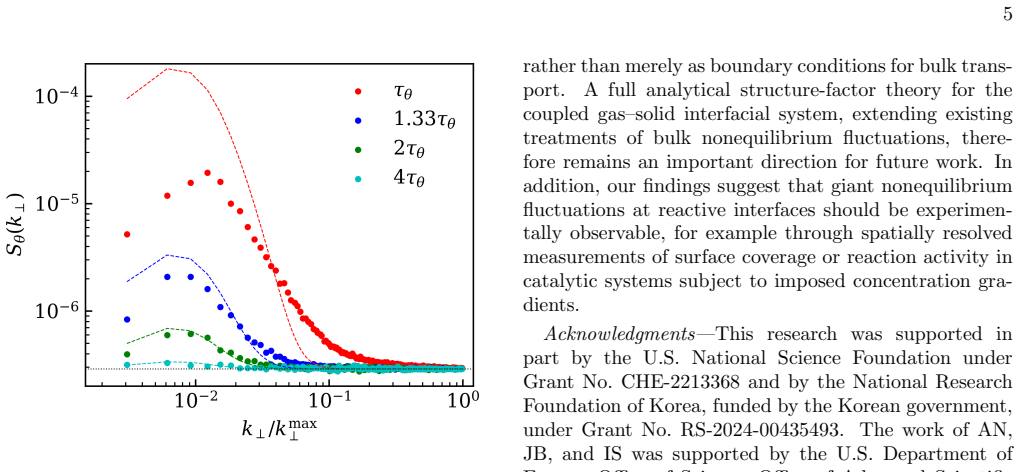
Numerical simulations of a minimal heterogeneous catalytic reactor demonstrate that giant fluctuations in a gas induce corresponding fluctuations on a reactive surface, with spatial correlations extending over micrometer scales. These fluctuations originate from the dependence of the adsorption rate on the reactant partial pressure, so that the surface-coverage structure factor mirrors that of the partial pressure, exhibiting similar enhancement and roll-off behavior across wave numbers.
What carries the argument
The dependence of adsorption rate on reactant partial pressure, which transmits gas fluctuations to the surface-coverage structure factor.
Load-bearing premise
The minimal heterogeneous catalytic reactor model accurately captures the essential gas-surface interaction physics, including the functional form of the adsorption rate dependence on partial pressure, without additional effects that would suppress or alter the fluctuation propagation.
What would settle it
An experiment that measures surface coverage in a catalytic reactor and finds no spatial correlations with gas partial pressure fluctuations or correlations that decay much faster than over micrometer scales.
Figures
read the original abstract
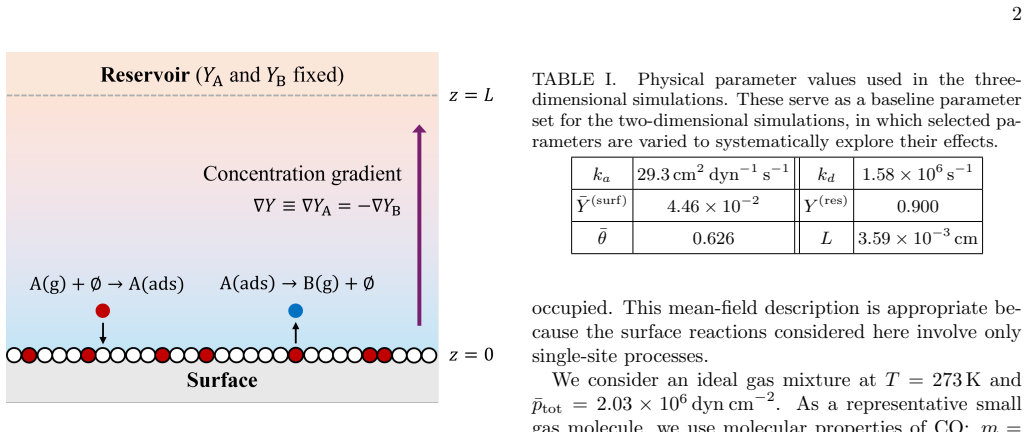
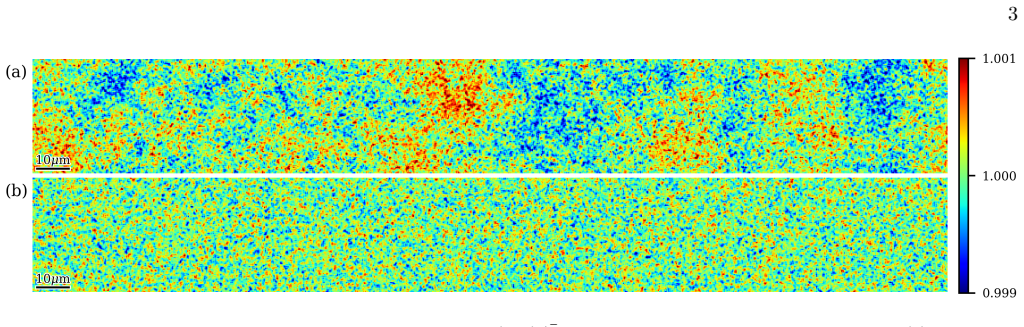
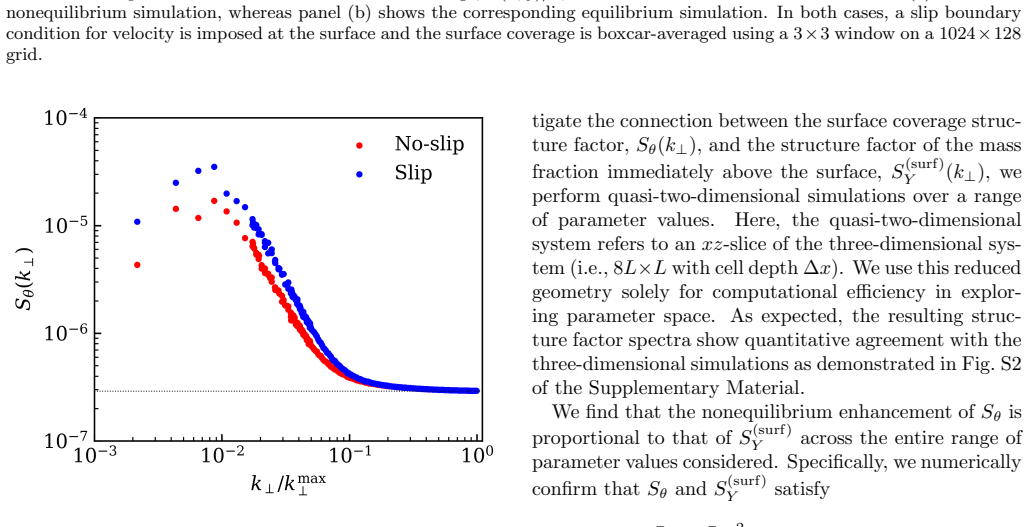
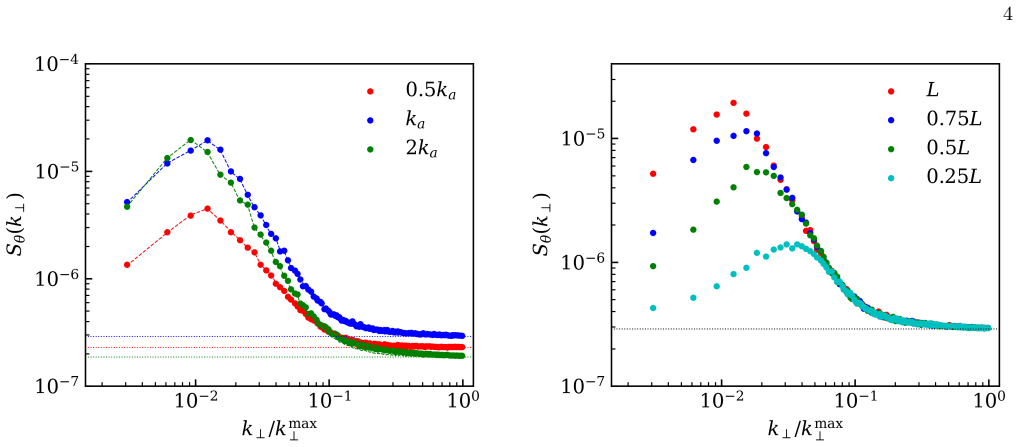
We investigate whether giant fluctuations in a gas can induce corresponding fluctuations on a reactive surface in contact with the gas. Numerical simulations of a minimal heterogeneous catalytic reactor demonstrate that such fluctuations indeed emerge on the surface, with spatial correlations extending over micrometer scales. These fluctuations originate from the dependence of the adsorption rate on the reactant partial pressure. As a result, the surface-coverage structure factor mirrors that of the partial pressure, exhibiting similar enhancement and roll-off behavior across wave numbers.
Editorial analysis
A structured set of objections, weighed in public.
Referee Report
Summary. The manuscript presents numerical simulations of a minimal heterogeneous catalytic reactor demonstrating that giant nonequilibrium fluctuations in a gas induce corresponding fluctuations on a reactive surface in contact with the gas. Spatial correlations extend over micrometer scales. These fluctuations originate from the dependence of the adsorption rate on the reactant partial pressure, such that the surface-coverage structure factor mirrors that of the partial pressure, with similar enhancement and roll-off behavior across wave numbers.
Significance. If the simulations are robust, the work provides a direct numerical demonstration, within an explicitly minimal model, of fluctuation transfer from gas-phase partial pressure to surface coverage via adsorption kinetics. This establishes a concrete mechanism for long-range spatial correlations on reactive surfaces driven by nonequilibrium gas fluctuations, which may be relevant for microscale catalysis where such effects could influence local reaction dynamics or noise characteristics. The scoping to a defined model and the mirroring structure-factor result constitute a clear, model-internal prediction.
minor comments (2)
- [Abstract] The abstract states the central result but provides no information on the specific model equations, rate laws, simulation parameters, grid resolution, or statistical sampling methods used to obtain the structure factors. Including these in the main text (e.g., a dedicated methods section) would allow readers to assess reproducibility and convergence.
- The manuscript should report error bars or uncertainty estimates on the structure-factor data, along with any convergence tests with respect to system size or simulation time, to confirm that the reported micrometer-scale correlations are not artifacts of finite sampling.
Simulated Author's Rebuttal
We thank the referee for the positive assessment of our manuscript and the recommendation for minor revision. No major comments were provided in the report.
Circularity Check
No significant circularity; result follows from direct numerical simulation of an explicitly defined model
full rationale
The paper's central claim is obtained via numerical simulation of a minimal heterogeneous catalytic reactor model, where gas partial-pressure fluctuations propagate to surface coverage through the stated adsorption-rate dependence. This produces the mirroring structure factor as a direct consequence of the implemented physics, without parameter fitting to the target fluctuation statistics, self-definitional reductions, or load-bearing self-citations. The derivation chain is self-contained against the model's own equations and boundary conditions.
Axiom & Free-Parameter Ledger
axioms (1)
- domain assumption Numerical simulation of the minimal heterogeneous catalytic reactor model is sufficient to demonstrate the fluctuation induction effect
Reference graph
Works this paper leans on
-
[1]
Vailati and M
A. Vailati and M. Giglio, Nature390, 262 (1997)
1997
-
[2]
Brogioli, A
D. Brogioli, A. Vailati, and M. Giglio, Phys. Rev. E61, R1 (2000)
2000
-
[3]
Vailati and M
A. Vailati and M. Giglio, Phys. Rev. E58, 4361 (1998)
1998
-
[4]
J. M. Ortiz de Z´ arate and J. V. Sengers,Hydrodynamic Fluctuations in Fluids and Fluid Mixtures(Elsevier Sci- ence, 2006)
2006
-
[5]
L. D. Landau and E. M. Lifschitz,Fluid Mechanics, 2nd ed. (Pergamon Press, 1987)
1987
-
[6]
A. L. Garcia, J. B. Bell, A. Nonaka, I. Srivastava, D. Ladiges, and C. Kim, SIAM Rev. To appear, arXiv:2406.12157
-
[7]
Donev, J
A. Donev, J. B. Bell, A. de la Fuente, and A. L. Garcia, Phys. Rev. Lett.106, 204501 (2011)
2011
-
[8]
C. J. Takacs, A. Vailati, R. Cerbino, S. Mazzoni, M. Giglio, and D. S. Cannell, Phys. Rev. Lett.106, 244502 (2011)
2011
-
[9]
J. M. Ortiz de Z´ arate, T. R. Kirkpatrick, and J. V. Sen- gers, Eur. Phys. J. E38, 99 (2015)
2015
-
[10]
Croccolo, J
F. Croccolo, J. M. Ortiz de Z´ arate, and J. V. Sengers, Eur. Phys. J. E39, 125 (2016)
2016
-
[11]
Vailati, H
A. Vailati, H. Bataller, M. M. Bou-Ali, M. Carpineti, R. Cerbino, F. Croccolo, S. U. Egelhaaf, F. Gi- avazzi, C. Giraudet, G. Guevara-Carrion, D. Horv´ ath, W. K¨ ohler, A. Mialdun, J. Porter, K. Schwarzenberger, V. Shevtsova, and A. D. Wit, npj Microgravity9, 1 (2023)
2023
-
[12]
C. Kim, A. Nonaka, J. B. Bell, A. L. Garcia, and A. Donev, J. Chem. Phys.149, 084113 (2018)
2018
-
[13]
H. T. Jung, H. Kim, A. L. Garcia, A. J. Nonaka, J. B. 6 Bell, I. Srivastava, and C. Kim, J. Chem. Phys.164, 094103 (2026)
2026
-
[14]
Srivastava, D
I. Srivastava, D. R. Ladiges, A. J. Nonaka, A. L. Garcia, and J. B. Bell, Phys. Rev. E107, 015305 (2023)
2023
-
[15]
J. M. Ortiz de Z´ arate and L. M. Redondo, Eur. Phys. J. B21, 135 (2001)
2001
-
[16]
FHDeX, https://github.com/AMReX-FHD/FHDeX.git
-
[17]
C. Kim, A. Nonaka, J. B. Bell, A. L. Garcia, and A. Donev, J. Chem. Phys.146, 124110 (2017). End Matter Numerical Structure Factors—In this work, we nu- merically compute two static structure factor spectra, Sθ(k⊥) andS (surf) Y (k⊥), characterizing the spatial cor- relations of fluctuations occurring at or near the reactive surface. These spectra are obt...
2017
-
[18]
(S15) into Eq
Dynamic Structure FactorS Y (ω,k⊥,z,z ′)and Static Structure FactorS Y (k⊥,z,z ′) Substituting Eq. (S15) into Eq. (S1) and using Eq. (S17), the dynamic structure factor SY (ω,k⊥,z,z ′) is given by SY (ω,k⊥,z,z ′) = (630L3)2⟨G(ω,k⊥)G∗(ω,k⊥)⟩/(2π)3 [ωL2(k2 ⊥L2 + 12)]2 + [ν(k4 ⊥L4 + 24k2 ⊥L2 + 504)]2|∇Y|2 × ∞∑ N=1 ∞∑ M=1 WN cos ( (2N−1)πz 2L ) iω+D ( (2N−1)2...
-
[19]
Bulk Structure FactorS (bulk) Y (k⊥) From the static structure factorS Y (k⊥,z,z ′), the scattering intensityS (bulk) Y (k⊥,k∥) can be computed as [1] S(bulk) Y (k⊥,k∥) = 1 L ∫ L 0 ∫ L 0 e−ik∥(z−z′)SY (k⊥,z,z ′)dzdz′ (S21) and, in the limitk ∥→0, we obtain S(bulk) Y (k⊥) =kBT|∇Y|2 ρD 40320k2 ⊥L6 π2 ∞∑ N=1 ∞∑ M=1 1 ((2N−1)2 + (2M−1)2)π2 + 8k2 ⊥L2 ×(−1)N+M ...
-
[20]
Cross-sectional Structure FactorS (zℓ) Y (k⊥) While the bulk structure factor corresponds to an average over the entire system, the cross-sectional structure factor requires resolving the intensity within individual slices 11 of thickness ∆z. From the static structure factorS Y (k⊥,z,z ′), the scattering intensity S(zℓ) Y (k⊥,k∥) can be computed as S(zℓ) ...
-
[21]
Hence, S(surf) Y ≈S(z1) Y,eq +S (z1) Y + ∆S (z1) Y .(S30)
Structure Factor Immediately above the Surface,S (surf) Y (k⊥) The structure factor immediately above the planez= 0, denoted byS (surf) Y (k⊥) in the main text, is obtained from the cross-sectional structure factor withℓ= 1. Hence, S(surf) Y ≈S(z1) Y,eq +S (z1) Y + ∆S (z1) Y .(S30)
-
[22]
J. M. Ortiz de Z´ arate and L. M. Redondo, Eur. Phys. J. B21, 135 (2001). 13 21
2001
discussion (0)
Sign in with ORCID, Apple, or X to comment. Anyone can read and Pith papers without signing in.