Implications of Adler-Finch-Skea solution on charged dark energy star satisfying Karmarkar Condition
Pith reviewed 2026-06-26 20:30 UTC · model grok-4.3
The pith
A charged strange star model with anisotropic dark energy based on the Adler-Finch-Skea solution satisfies the Karmarkar condition and remains singularity-free for Her X-1 parameters.
A machine-rendered reading of the paper's core claim, the machinery that carries it, and where it could break.
Core claim
The proposed interior solution for the charged dark energy star, constructed from the Adler-Finch-Skea metric ansatz and the Karmarkar condition with the stated equation of state, is free of singularities at the center and satisfies all the stability requirements needed for a physically realistic stellar model when matched to the observed mass and radius of Her X-1.
What carries the argument
Adler-Finch-Skea temporal metric component together with the radial metric component fixed by the Karmarkar condition, closed by the equation of state in which dark energy density is proportional to isotropic perfect-fluid density.
If this is right
- Metric functions, energy density, and both radial and tangential pressures remain finite and positive from center to boundary.
- The Darmois-Israel junction conditions are satisfied at the stellar surface for the chosen mass and radius of Her X-1.
- The model obeys the energy conditions and returns a mass-radius relation consistent with the observed values.
- Multiple stability criteria, including the adiabatic index and equilibrium of forces, are satisfied throughout the interior.
Where Pith is reading between the lines
- If the same proportionality between dark energy and matter densities applies to other observed compact objects, the construction could be repeated for additional candidates without altering the metric ansatz.
- The interior solution supplies a concrete density profile that could be compared against future X-ray or gravitational-wave constraints on strange-star interiors.
- The presence of charge and anisotropy in the model may influence the maximum mass limit, offering a testable extension once more precise mass-radius data become available.
Load-bearing premise
The equation of state assumes that the density of dark energy is proportional to the density of isotropic perfect fluid matter.
What would settle it
A direct computation of the central adiabatic index or the TOV force balance that yields a value below the stability threshold for the fitted constants of Her X-1 would falsify the stability claim.
Figures
read the original abstract
A possible approach for preventing compact astrophysical objects from gravitational collapse into singularities is the idea of dark energy. Since it is the cause of our universe's accelerated expansion, it has the greatest impact on the cosmos. As a result, it appears that dark energy can interact with any compact astrophysical stellar object [Phys. Rev. D 103, 084042 (2021)]. In this study, our primary objective is to develop a simpler model of a charged strange star coupled with anisotropic dark energy admitting the Adler-Finch-Skea solution [J. Math. Phys. 15, 727 (1974); Class. Quantum Grav. 6, 467 (1989)] within Einstein gravity. To develop this model, the Karmarkar condition was employed to determine the radial metric component, while Adler's methodology was used to choose the time-metric component. For this purpose, we explored a particular strange star, Her X-1, with observed values of mass $(0.85 \pm 0.15)M_{\odot}$ and radius $= 8.1_{-0.41}^{+0.41}$ km. In this context, we proceeded to model dark energy using the equation of state (EoS), such that the density of dark energy is proportional to the density of isotropic perfect fluid matter. The unknown constants in the metric were determined by smooth matching using the Darmois-Israel criterion. We conduct an in-depth examination of the stability and force equilibrium of our suggested star framework, as well as several physical characteristics of the model such as the metric function, pressure, density, mass-radius relation, and dark energy parameters. Thus, the physical consistency and stability of the present model are investigated. Therefore, following a comprehensive theoretical investigation, we discovered that our proposed model is singularity free and meets all the stability requirements to be a stable and physically realistic stellar model.
Editorial analysis
A structured set of objections, weighed in public.
Referee Report
Summary. The manuscript constructs a charged anisotropic dark energy star model in Einstein gravity by combining the Adler-Finch-Skea metric ansatz with the Karmarkar condition to fix the radial metric component. It adopts the equation of state ρ_de = k × ρ (dark energy density proportional to isotropic perfect fluid density) to close the system, determines integration constants by Darmois-Israel matching to the observed mass and radius of Her X-1, and reports that the resulting configuration is singularity-free while satisfying energy conditions, hydrostatic equilibrium, and stability criteria (sound-speed squared, adiabatic index).
Significance. If the proportionality assumption for dark energy holds, the work supplies a concrete, observationally anchored example of how dark energy can be embedded in compact-star interiors to support stability against collapse. The explicit use of Her X-1 parameters and the Adler-Finch-Skea + Karmarkar framework adds a calculable case to the literature on anisotropic charged stars, though the model's predictive reach remains tied to the specific EoS choice.
major comments (2)
- [Abstract and model construction] Abstract and model-construction paragraphs: the relation ρ_de = k × ρ is inserted directly to close the Einstein equations after the Karmarkar condition and Adler-Finch-Skea ansatz; no derivation from the field equations, no observational calibration of k, and no comparison with alternative dark-energy couplings are supplied. Because every subsequent expression for pressure, mass function, energy conditions, TOV equation, and stability indicators follows from this relation, its lack of independent justification is load-bearing for the central claim of a physically realistic stable model.
- [Abstract and stability analysis] Abstract and stability-analysis section: metric constants are fixed by matching to the observed mass (0.85 ± 0.15) M_⊙ and radius 8.1 km of Her X-1; stability indicators are then evaluated on the same fitted solution. This procedure converts the reported satisfaction of stability criteria into a consistency check on the input data rather than an independent test, weakening the claim that the model 'meets all the stability requirements'.
minor comments (1)
- [Abstract] Abstract: the quoted mass uncertainty is given but no propagation of that uncertainty into the stability indicators or the allowed range of k is shown.
Simulated Author's Rebuttal
We thank the referee for the careful reading and constructive comments. We address the two major points below, providing clarifications on the model assumptions and validation approach while proposing targeted revisions where they strengthen the manuscript without misrepresenting the work.
read point-by-point responses
-
Referee: [Abstract and model construction] Abstract and model-construction paragraphs: the relation ρ_de = k × ρ is inserted directly to close the Einstein equations after the Karmarkar condition and Adler-Finch-Skea ansatz; no derivation from the field equations, no observational calibration of k, and no comparison with alternative dark-energy couplings are supplied. Because every subsequent expression for pressure, mass function, energy conditions, TOV equation, and stability indicators follows from this relation, its lack of independent justification is load-bearing for the central claim of a physically realistic stable model.
Authors: The proportionality ρ_de = k ρ is introduced as a phenomenological closure relation, following similar assumptions in the literature on dark-energy compact objects where dark energy density is taken proportional to the matter density to permit analytic progress. It is not derived from the Einstein equations but is chosen to embed dark-energy effects while satisfying the Karmarkar condition and Adler-Finch-Skea ansatz. The constant k is fixed by demanding that all physical requirements (energy conditions, hydrostatic equilibrium, stability) hold for the Her X-1 parameters. We agree that an expanded discussion of the motivation for this EoS, the explored range of k, and brief comparisons to other dark-energy couplings (e.g., linear or quadratic forms) would improve transparency. We will add a short subsection on the rationale and limitations of the ansatz in the revised version. revision: partial
-
Referee: [Abstract and stability analysis] Abstract and stability-analysis section: metric constants are fixed by matching to the observed mass (0.85 ± 0.15) M_⊙ and radius 8.1 km of Her X-1; stability indicators are then evaluated on the same fitted solution. This procedure converts the reported satisfaction of stability criteria into a consistency check on the input data rather than an independent test, weakening the claim that the model 'meets all the stability requirements'.
Authors: Matching the integration constants to the observed mass and radius of Her X-1 is the standard procedure for constructing observationally anchored stellar models; the subsequent verification that the resulting configuration satisfies energy conditions, TOV balance, and stability criteria (sound-speed and adiabatic-index bounds) demonstrates that a physically viable solution exists within the adopted framework. While the check is performed on the fitted parameters, this is precisely how viability is established for specific compact objects in the literature. The manuscript does not present the stability results as an a-priori prediction independent of the data, but rather as evidence that the model is consistent with a known pulsar. We therefore maintain the original wording and do not plan further revision on this point. revision: no
Circularity Check
No significant circularity; model construction with explicit assumptions and post-fit checks
full rationale
The derivation begins with explicit inputs: the Adler-Finch-Skea ansatz for the temporal metric component, the Karmarkar condition to fix the radial component, and the proportionality assumption ρ_de = k × ρ to close the Einstein equations. Constants are then fixed by Darmois-Israel matching to the observed mass and radius of Her X-1. Subsequent checks (energy conditions, TOV equation, sound-speed squared, adiabatic index) are standard inequalities evaluated on the resulting explicit functions; none of these outputs are algebraically identical to the inputs by construction, nor are any 'predictions' obtained by refitting the same data. No self-citations appear in the load-bearing steps, and the EoS choice is stated as an assumption rather than derived or renamed from prior results. The paper therefore remains self-contained against external benchmarks.
Axiom & Free-Parameter Ledger
free parameters (1)
- metric integration constants
axioms (3)
- standard math Einstein field equations in four-dimensional spacetime
- domain assumption Karmarkar condition for class-one embedding
- domain assumption Darmois-Israel matching conditions at the stellar surface
Reference graph
Works this paper leans on
-
[1]
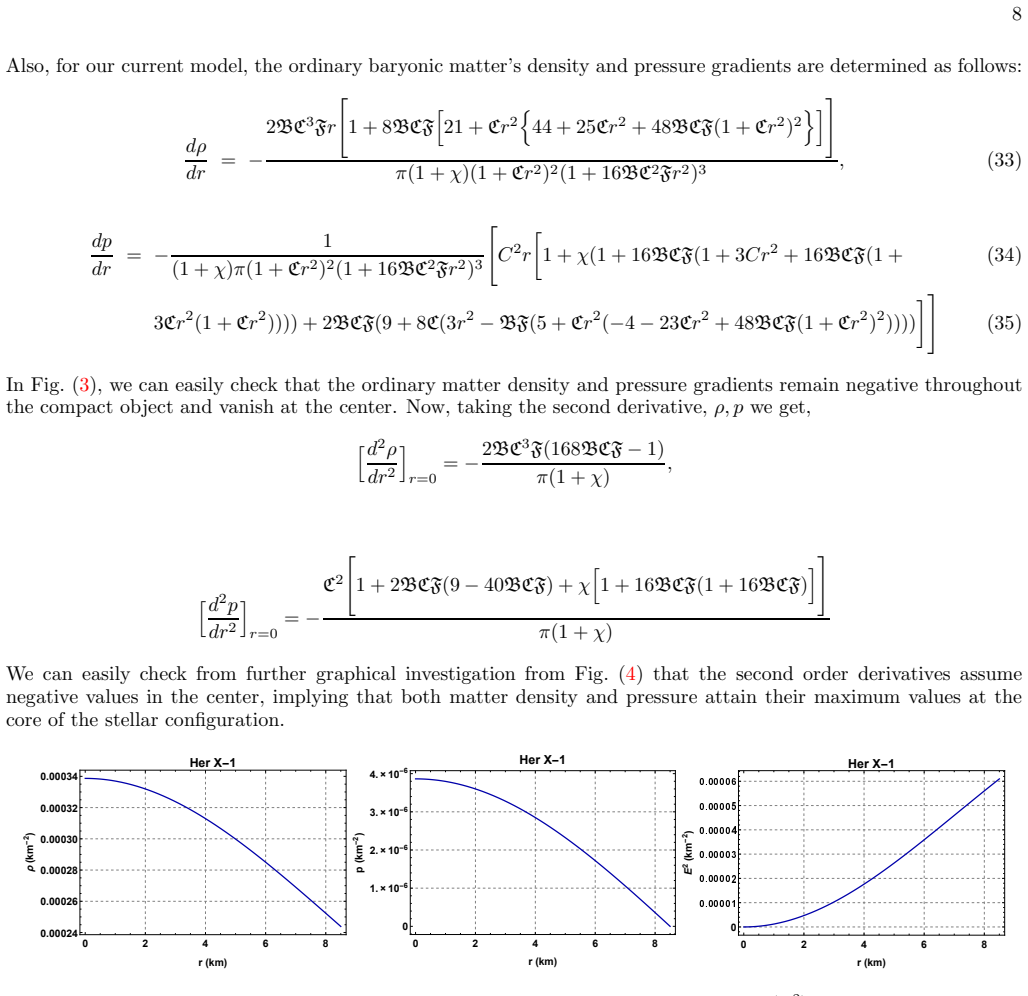
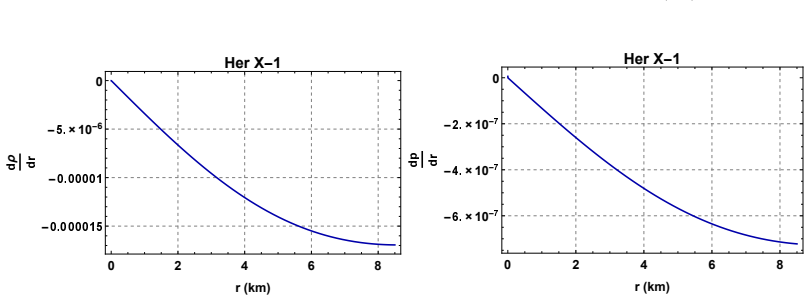
2: Profiles of baryonic matter-energy density, pressur e, and electric field intensity ( E2) with respect to ‘r’
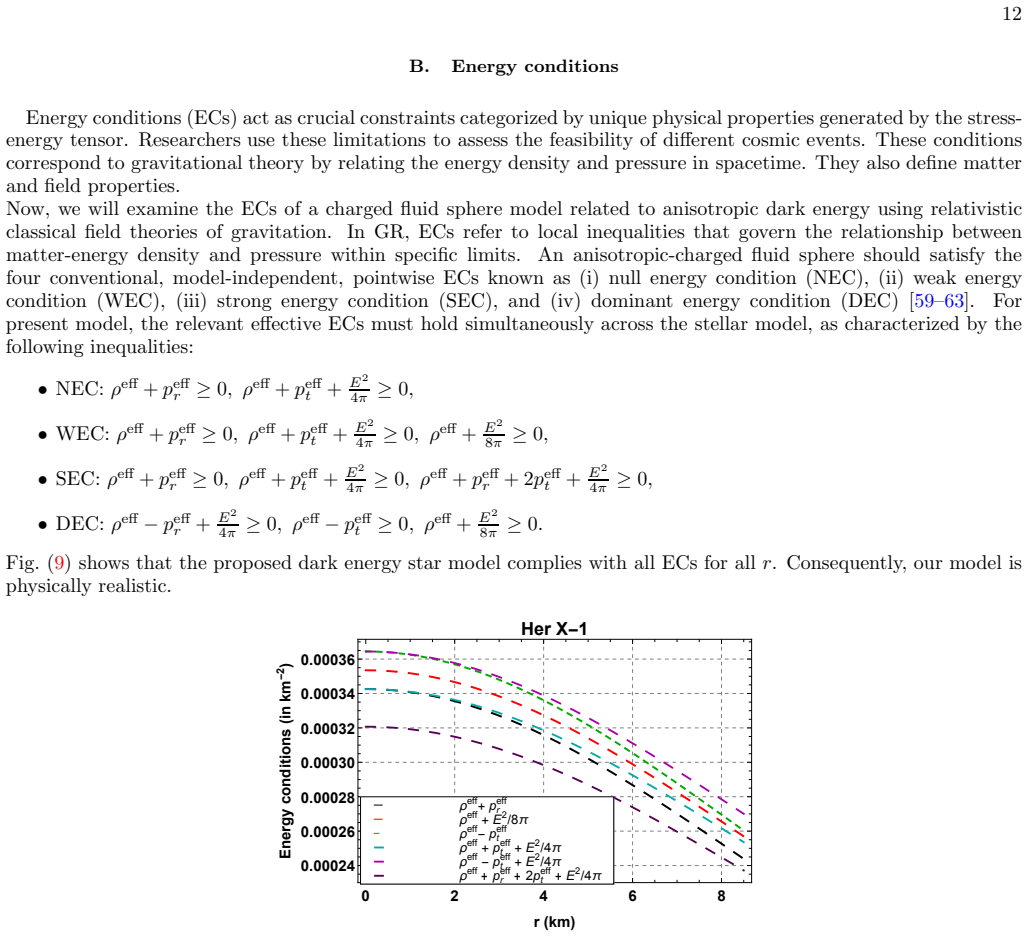
× 10-6 r (km) p (km-2) Her X-1 0 2 4 6 8 0 0 0 0 0 0 0 0 0 0 0 0 0 0 0 0 0 0 0 0 0 0 0 0 0 0 0 0 0 0 0 r (km) E2 (km-2) Her X-1 FIG. 2: Profiles of baryonic matter-energy density, pressur e, and electric field intensity ( E2) with respect to ‘r’. 0 2 4 6 8 - - - × 10-6 0 r (km) d ρ d Her X-1 0 2 4 6 8 - 6 × 10⁻⁷ - 4 × 10⁻⁷ - 2 × 10⁻⁷ 0 r (km) Her X-1 FIG. 3...
-
[2]
The dark energy density steadily dec lines within the stellar structure, with the maximum value occurring at the core
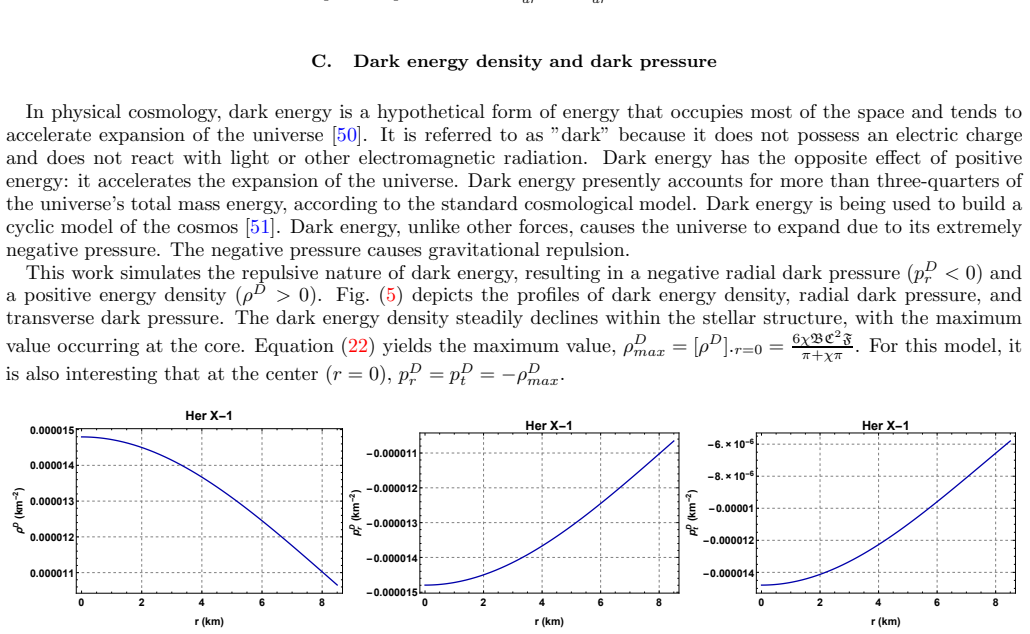
depicts the profiles of dark energy density, radial dark pressur e, and transverse dark pressure. The dark energy density steadily dec lines within the stellar structure, with the maximum value occurring at the core. Equation ( 22) yields the maximum value, ρD max = [ρD]. r=0 = 6χ BC2F π +χπ . For this model, it is also interesting that at the center ( r =...
2047
-
[3]
(46) 0 2 4 6 8 -2
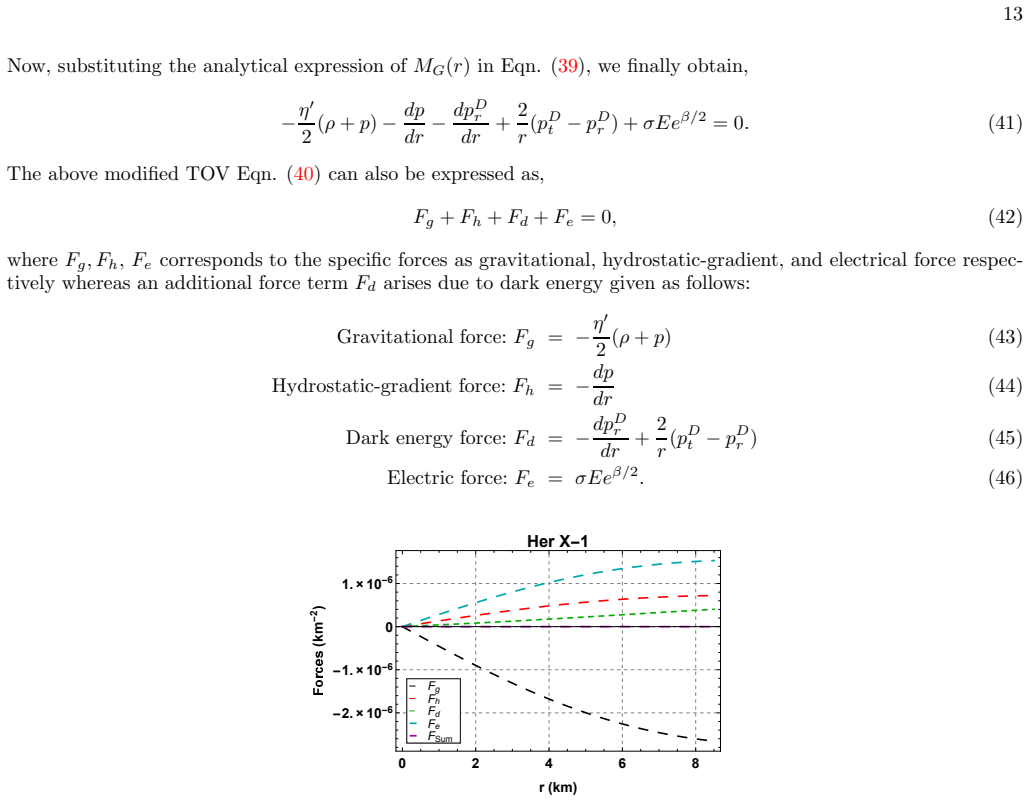
can also be expressed as, Fg + Fh + Fd + Fe = 0, (42) where Fg, F h, Fe corresponds to the specific forces as gravitational, hydrostatic -gradient, and electrical force respec- tively whereas an additional force term Fd arises due to dark energy given as follows: Gravitational force: Fg = − η′ 2 (ρ + p) (43) Hydrostatic-gradient force: Fh = − dp dr (44) Da...
-
[4]
× 10-6 r (km) F 5 8 9 : ; (km-2) Her X-1 FSum Fe Fd Fh Fg FIG. 10: Behavior of different forces, such as the gravitatio nal force Fg, hydrostatic gradient force Fh, dark energy force Fd and electric force Fe respectively versus radial coordinate r. Here FSum = Fg + Fh + Fd + Fe. We can visually verify the behavior of the generalized TOV equations u sing Fi...
-
[5]
F. S. N. Lobo, Class. Quant. Grav. 23, 1525 (2006), gr-qc/0508115
Pith/arXiv arXiv 2006
-
[6]
S. Perlmutter et al. (Supernova Cosmology Project), Ast rophys. J. 517, 565 (1999), astro-ph/9812133
Pith/arXiv arXiv 1999
-
[7]
Beltracchi and P
P. Beltracchi and P. Gondolo, Physical Review D 99, 044037 (2019)
2019
-
[8]
Chapline, eConf C041213, 0205 (2004), astro-ph/0503200
G. Chapline, eConf C041213, 0205 (2004), astro-ph/0503200
Pith/arXiv arXiv 2004
-
[9]
A. G. Riess, S. Casertano, W. Yuan, L. M. Macri, and D. Scol nic, Astrophys. J. 876, 85 (2019), 1903.07603
Pith/arXiv arXiv 2019
-
[10]
Sushkov, Physical Review D 71, 043520 (2005)
S. Sushkov, Physical Review D 71, 043520 (2005)
2005
-
[11]
R. Bibi, T. Feroze, and A. A. Siddiqui, Canadian Journal o f Physics 94, 758 (2016)
2016
-
[12]
C. Feng, B. Wang, E. Abdalla, and R. Su, Physics Letters B 665, 111 (2008)
2008
-
[13]
Karmarkar, in Proceedings of the Indian academy of sciences-section A (Springer, 1948), vol
K. Karmarkar, in Proceedings of the Indian academy of sciences-section A (Springer, 1948), vol. 27, pp. 56–60
1948
-
[14]
R. J. Adler, J. Math. Phys. 15, 727 (1974), [Erratum: J.Math.Phys. 17, 158 (1976)]
1974
-
[15]
M. R. Finch and J. E. F. Skea, Class. Quantum Grav. 6, 467 (1989)
1989
-
[16]
S. Ray, A. L. Espindola, M. Malheiro, J. P. Lemos, and V. T . Zanchin, Physical Review D 68, 084004 (2003)
2003
-
[17]
R. Chan, M. da Silva, and J. F. Villas da Rocha, General Re lativity and Gravitation 41, 1835 (2009)
2009
-
[18]
R. Chan, M. Da Silva, and J. F. Villas Da Rocha, Modern Phy sics Letters A 24, 1137 (2009)
2009
-
[19]
F. S. Lobo and A. V. Arellano, Classical and Quantum Grav ity 24, 1069 (2007)
2007
-
[20]
R. Chan, M. Da Silva, and P. Rocha, General Relativity an d Gravitation 43, 2223 (2011)
2011
-
[21]
Bertolami and J
O. Bertolami and J. Paramos, Physical Review D 72, 123512 (2005)
2005
-
[22]
Cattoen and T
C. Cattoen and T. Faber, Class. Quantum Gravity p. 4189 ( 2005)
2005
-
[23]
Gupta and S
Y. Gupta and S. K. Maurya, Astrophysics and Space Scienc e 331, 135 (2011)
2011
-
[24]
T. E. Kiess, Astrophysics and Space Science 339, 329 (2012)
2012
-
[25]
P. M. Takisa and S. Maharaj, General Relativity and Grav itation 45, 1951 (2013)
1951
-
[26]
Malaver, International Journal of Systems Science a nd Applied Mathematics 2, 93 (2017)
M. Malaver, International Journal of Systems Science a nd Applied Mathematics 2, 93 (2017)
2017
-
[27]
Malaver, World Scientific News 92, 327 (2018)
M. Malaver, World Scientific News 92, 327 (2018)
2018
-
[28]
J. M. Sunzu, S. D. Maharaj, and S. Ray, Astrophysics and S pace Science 354, 517 (2014)
2014
-
[29]
Nazar, A
H. Nazar, A. Majeed, G. Abbas, A. Ashraf, A. A. Ibraheem, and E. Davletov, Chin. J. Phys. 96, 1083 (2025)
2025
-
[30]
M. R. Shahzad, W. Habib, M. Amjad, A. Ashraf, A. H. Hakami , I. Boukhris, N. S. Alsaiari, and M. S. Al-Buriahi, Phys. Dark Univ. 49, 101964 (2025)
2025
-
[31]
Ditta, A
A. Ditta, A. Ashraf, S. K. Maurya, A. Ali, A. Alimova, and F. Atamurotov, Phys. Dark Universe 50, 102071 (2025)
2025
-
[32]
Mustafa, M
G. Mustafa, M. Zubair, S. Waheed, and X. Tiecheng, Eur. P hys. J. C 80, 26 (2020)
2020
-
[33]
G. Mustafa, M. F. Shamir, and X. Tie-Cheng, Phys. Rev. D 101, 104013 (2020), 2005.03997
arXiv 2020
-
[34]
C. R. Ghezzi, Astrophys. Space Sci. 333, 437 (2011), 0908.0779
Pith/arXiv arXiv 2011
-
[35]
Pandey and S
S. Pandey and S. Sharma, General Relativity and Gravita tion 14, 113 (1982)
1982
-
[36]
C. R. Ghezzi, Phys. Rev. D 72, 104017 (2005), gr-qc/0510106
Pith/arXiv arXiv 2005
-
[37]
W. Barreto, B. Rodriguez, L. Rosales, and O. Serrano, Ge n. Rel. Grav. 39, 23 (2007), [Erratum: Gen.Rel.Grav. 39, 537–538 (2007)], gr-qc/0611089
Pith/arXiv arXiv 2007
-
[38]
Das and N
K. Das and N. Ali, Astrophysics and Space Science 356, 57 (2015)
2015
-
[39]
Reissner, Annalen der Physik 355, 106 (1916)
H. Reissner, Annalen der Physik 355, 106 (1916)
1916
-
[40]
Nordstr¨ om, Koninklijke Nederlandse Akademie van W etenschappen Proceedings Series B Physical Sciences 20, 1238 (1918)
G. Nordstr¨ om, Koninklijke Nederlandse Akademie van W etenschappen Proceedings Series B Physical Sciences 20, 1238 (1918)
1918
-
[42]
V. Varela, F. Rahaman, S. Ray, K. Chakraborty, and M. Kal am, Phys. Rev. D 82, 044052 (2010), 1004.2165
Pith/arXiv arXiv 2010
-
[43]
M. K. Abubekerov, E. A. Antokhina, A. M. Cherepashchuk, and V. V. Shimanskii, Astron. Rep. 52, 379 (2008), 1201.5519
Pith/arXiv arXiv 2008
-
[44]
M. L. Rawls, J. A. Orosz, J. E. McClintock, M. A. P. Torres , C. D. Bailyn, and M. M. Buxton, Astrophys. J. 730, 25 (2011), 1101.2465
Pith/arXiv arXiv 2011
-
[45]
P. C. C. Freire et al., Mon. Not. Roy. Astron. Soc. 412, 2763 (2011), 1011.5809
Pith/arXiv arXiv 2011
-
[46]
T. Guver, F. Ozel, A. Cabrera-Lavers, and P. Wroblewski , Astrophys. J. 712, 964 (2010), 0811.3979
Pith/arXiv arXiv 2010
-
[47]
F. Ozel, T. Guver, and D. Psaltis, Astrophys. J. 693, 1775 (2009), 0810.1521
Pith/arXiv arXiv 2009
-
[48]
M. S. R. Delgaty and K. Lake, Comput. Phys. Commun. 115, 395 (1998), gr-qc/9809013
Pith/arXiv arXiv 1998
-
[49]
Pant, Astrophys
N. Pant, Astrophys. Space Sci. 331, 633 (2010)
2010
- [50]
-
[51]
Darmois, Paris France (1927)
G. Darmois, Paris France (1927)
1927
-
[52]
Israel, Nuovo Cim
W. Israel, Nuovo Cim. B 44S10, 1 (1966), [Erratum: Nuovo Cim.B 48, 463 (1967)]
1966
-
[53]
Chandrasekhar, Science 226, 497 (1984)
S. Chandrasekhar, Science 226, 497 (1984)
1984
-
[54]
P. J. E. Peebles and B. Ratra, Rev. Mod. Phys. 75, 559 (2003), astro-ph/0207347
Pith/arXiv arXiv 2003
-
[55]
L. Baum and P. H. Frampton, Phys. Rev. Lett. 98, 071301 (2007), hep-th/0610213. 17
Pith/arXiv arXiv 2007
-
[56]
H. A. Buchdahl, Physical Review 116, 1027 (1959)
1959
-
[57]
N. K. Glendenning, Compact stars: Nuclear physics, particle physics and gener al relativity (Springer Science & Business Media, 2012)
2012
-
[58]
P. S. Florides, Journal of Physics A: Mathematical and G eneral 16, 1419 (1983)
1983
-
[59]
Kumar and P
J. Kumar and P. Bharti, The European Physical Journal Pl us 137, 330 (2022)
2022
-
[60]
H. A. Buchdahl, Phys. Rev. 116, 1027 (1959)
1959
-
[61]
Herrera, Phys
L. Herrera, Phys. Lett. A 165, 206 (1992)
1992
-
[62]
H. Abreu, H. Hernandez, and L. A. Nunez, Class. Quant. Gr av. 24, 4631 (2007), 0706.3452
Pith/arXiv arXiv 2007
-
[63]
Bondi, Monthly Notices of the Royal Astronomical Soc iety 107, 410 (1947)
H. Bondi, Monthly Notices of the Royal Astronomical Soc iety 107, 410 (1947)
1947
-
[64]
Witten, Communications in Mathematical Physics 80, 381 (1981)
E. Witten, Communications in Mathematical Physics 80, 381 (1981)
1981
-
[65]
Visser, Science 276, 88 (1997)
M. Visser, Science 276, 88 (1997)
1997
-
[66]
H. Andreasson, Commun. Math. Phys. 288, 715 (2009), 0804.1882
Pith/arXiv arXiv 2009
-
[67]
N. M. Garcia, T. Harko, F. S. Lobo, and J. P. Mimoso, Physi cal Review D 83, 104032 (2011)
2011
-
[68]
Ponce de Leon, General relativity and gravitation 25, 1123 (1993)
J. Ponce de Leon, General relativity and gravitation 25, 1123 (1993)
1993
-
[69]
R. C. Tolman, Phys. Rev. 35, 875 (1930), URL https://link.aps.org/doi/10.1103/PhysRev.35.875
-
[70]
S. L. Shapiro and S. A. Teukolsky, Black holes, white dwarfs, and neutron stars: The physics of compact objects (John Wiley & Sons, 2008)
2008
-
[71]
Y. B. Zeldovich and I. D. Novikov, Chicago: University o f Chicago Press (1971)
1971
-
[72]
Y. B. Zel’dovich, I. D. Novikov, and J. Silk, Physics Tod ay 25, 63 (1972)
1972
-
[73]
L’DOVICH, Sov
Y. L’DOVICH, Sov. Phys. JETP 14, 1609 (1962)
1962
-
[74]
V. F. Shvartsman, Soviet Journal of Experimental and Th eoretical Physics 33, 475 (1971)
1971
discussion (0)
Sign in with ORCID, Apple, or X to comment. Anyone can read and Pith papers without signing in.