Online Distributional Prediction via Latent Cluster Geometry Under Drift and Corruption
Pith reviewed 2026-06-26 21:56 UTC · model grok-4.3
The pith
A restarted quasi-Bayesian predictor over latent cluster geometries attains sublinear cumulative Wasserstein regret under drift and corruption.
A machine-rendered reading of the paper's core claim, the machinery that carries it, and where it could break.
Core claim
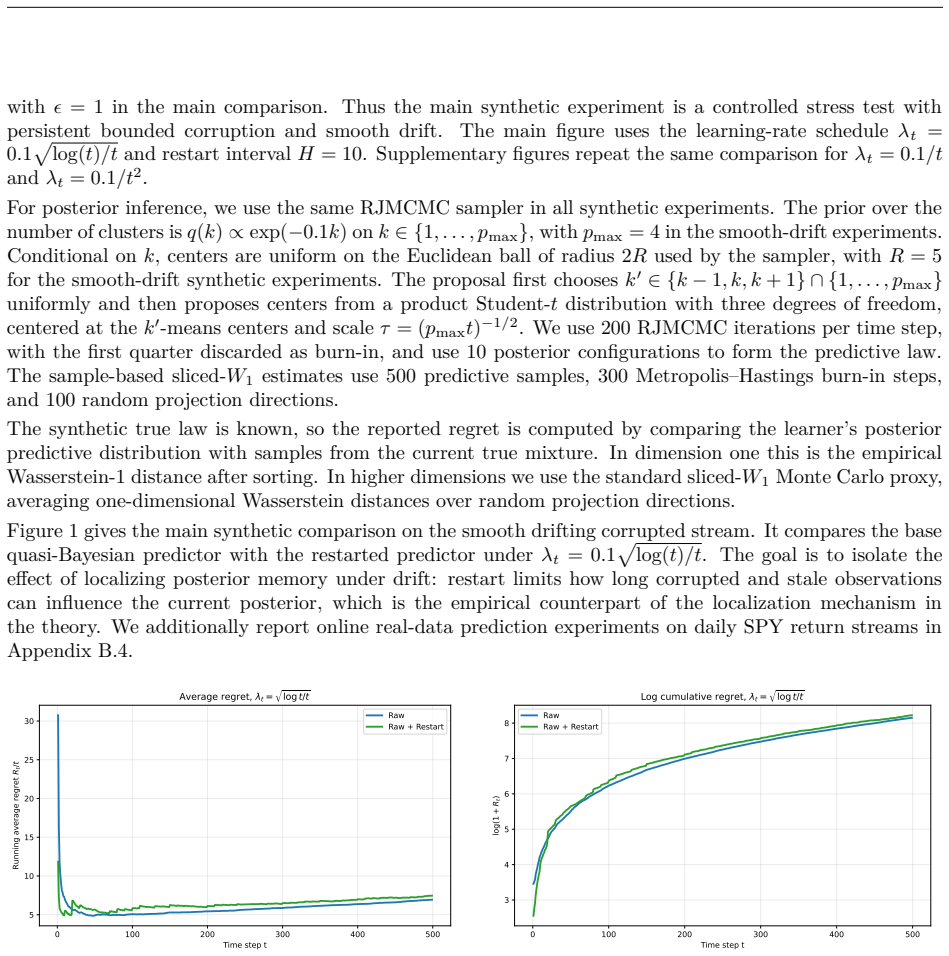
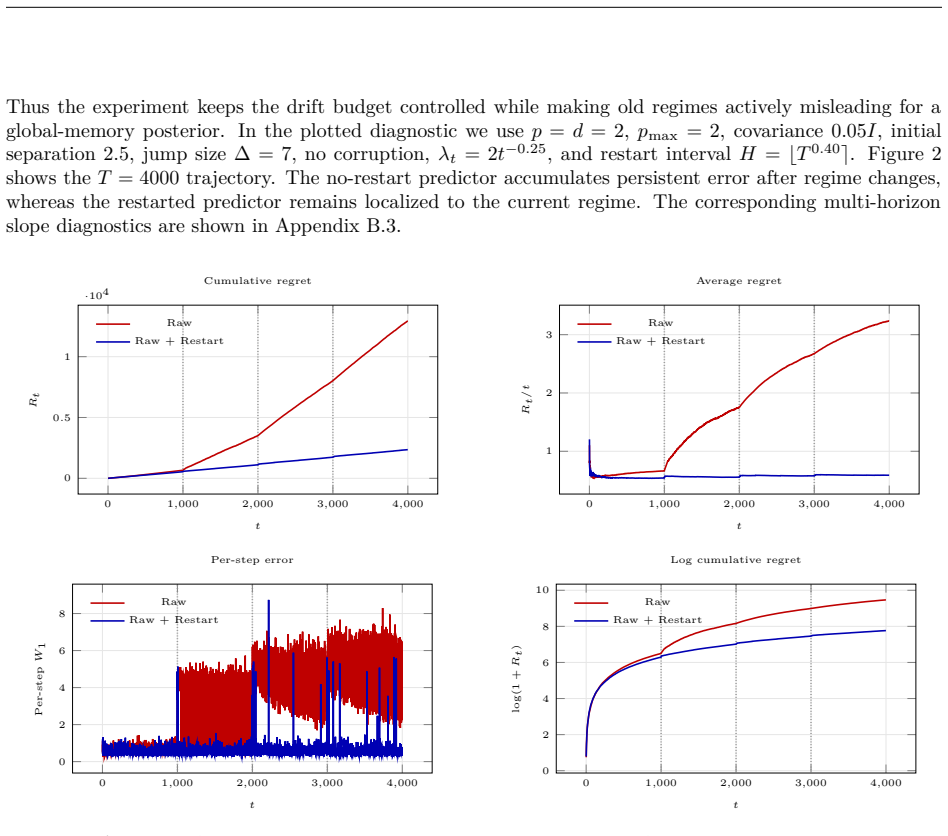
Under bounded support, stable latent geometry, predictive-map regularity, oracle realizability, localized restart windows, sublinear transport action A_T^OT = sum_{t=2}^T W_2^2(p_{t-1}^*, p_t^*), and sublinear corruption budget, the restarted predictor achieves sublinear cumulative Wasserstein regret. The analysis decomposes regret into a PAC-Bayesian term, a corruption-induced posterior perturbation, and the dynamic optimal-transport term; no parametric model of the stream, drift process, or corruption is required.
What carries the argument
latent cluster geometry: a variable-size configuration of centers that organizes probability mass and induces a predictive distribution, together with its Gibbs quasi-posterior updated online and sampled by reversible-jump MCMC
If this is right
- High-probability regret bounds decompose explicitly into PAC-Bayesian complexity, corruption perturbation, and dynamic optimal-transport cost.
- The same quasi-Bayesian update works without any parametric assumption on the data-generating process or the form of drift.
- Restart windows localize posterior memory, converting long-horizon drift into a controllable transport cost.
- Reversible-jump MCMC allows the latent configuration dimension to change over time while preserving the regret guarantee.
Where Pith is reading between the lines
- The framework could be tested on real non-stationary streams by monitoring posterior stability as a proxy for the stable-geometry assumption.
- If the dynamic-transport term can be estimated from data, the method supplies a practical diagnostic for when restarts should be triggered.
- The latent-center representation may transfer to other online tasks that require comparing or averaging entire distributions rather than point estimates.
Load-bearing premise
Stable latent geometry together with oracle realizability must hold so that the PAC-Bayesian and dynamic-transport terms produce sublinear regret.
What would settle it
Run the restarted algorithm on a stream where the true laws remain realizable inside a fixed stable latent geometry and measure whether cumulative Wasserstein regret stays sublinear; linear growth under these conditions would falsify the claim.
Figures
read the original abstract
Online learning in non-stationary streams is often formulated as tracking a point estimate, but many applications require predicting the full data-generating distribution. We study online distributional prediction under drift and adversarial corruption. Our approach represents each candidate law through a latent cluster geometry: a variable-size configuration of centers that organizes probability mass and induces a predictive distribution. A Gibbs quasi-posterior over these configurations yields an online predictor by posterior averaging, and the resulting variable-dimensional posterior can be sampled with reversible-jump MCMC. The method therefore avoids specifying a parametric streaming law while retaining a structured latent space for uncertainty, regularization, and comparison. We evaluate performance by cumulative Wasserstein-1 regret against the time-varying true law. The analysis separates two effects: corruption perturbs the loss-based posterior update, whereas drift makes long-horizon posterior memory stale. We address the latter with a restarted variant that temporally localizes the same quasi-Bayesian update. The resulting high-probability bounds decompose into a PAC-Bayesian complexity term, a corruption-sensitive posterior perturbation term, and a dynamic optimal-transport term driven by \(A_T^{\mathrm{OT}}=\sum_{t=2}^T W_2^2(p_{t-1}^*,p_t^*)\). Under bounded support, stable latent geometry, predictive-map regularity, oracle realizability, localized restart windows, sublinear transport action, and sublinear corruption budget, the restarted predictor achieves sublinear cumulative Wasserstein regret. These guarantees require no parametric model for the stream, drift mechanism, or corruption process.
Editorial analysis
A structured set of objections, weighed in public.
Referee Report
Summary. The manuscript proposes an online distributional prediction method that represents candidate laws via a latent cluster geometry (variable-size configuration of centers) and maintains a Gibbs quasi-posterior over configurations, sampled via reversible-jump MCMC. A restarted variant localizes the update to handle drift. The central claim is a high-probability sublinear cumulative Wasserstein-1 regret bound against the time-varying true law that decomposes into a PAC-Bayesian complexity term, a corruption-sensitive perturbation term, and a dynamic optimal-transport term A_T^OT = sum W_2^2(p_{t-1}^*, p_t^*), provided the stream satisfies bounded support, stable latent geometry, predictive-map regularity, oracle realizability, localized restart windows, sublinear transport action, and sublinear corruption budget. No parametric model of the stream, drift, or corruption is required.
Significance. If the stated assumptions can be verified or relaxed while preserving the decomposition, the result would advance non-stationary online learning by supplying the first high-probability Wasserstein regret guarantees for a non-parametric distributional predictor that retains a structured latent space for uncertainty and regularization. The explicit separation of corruption, drift, and complexity effects is a methodological strength.
major comments (2)
- [Abstract] Abstract (list of hypotheses): the sublinear regret claim for the restarted predictor is conditioned on 'stable latent geometry' together with 'oracle realizability'; these two conditions are load-bearing for both the PAC-Bayesian term and the dynamic-OT term to remain sublinear, yet the manuscript supplies neither a test nor a maintenance mechanism for either condition under the permitted drift.
- [Abstract] Abstract (dynamic term): A_T^OT is defined as the sum of squared Wasserstein distances between consecutive true laws and is asserted to be sublinear under the 'sublinear transport action' hypothesis; the manuscript does not demonstrate that this quantity is independent of the choice of restart windows or the latent-center configuration, raising a potential circularity for the overall bound.
minor comments (1)
- [Abstract] The abstract states that the variable-dimensional posterior 'can be sampled with reversible-jump MCMC' but does not indicate the form of the dimension-changing proposals or any mixing-time control; a brief remark on practical implementation would improve clarity.
Simulated Author's Rebuttal
We thank the referee for the thorough review and for highlighting these important points regarding the assumptions and the dynamic term in the abstract. We address each major comment below and indicate the revisions we will make.
read point-by-point responses
-
Referee: [Abstract] Abstract (list of hypotheses): the sublinear regret claim for the restarted predictor is conditioned on 'stable latent geometry' together with 'oracle realizability'; these two conditions are load-bearing for both the PAC-Bayesian term and the dynamic-OT term to remain sublinear, yet the manuscript supplies neither a test nor a maintenance mechanism for either condition under the permitted drift.
Authors: We agree that 'stable latent geometry' and 'oracle realizability' are load-bearing assumptions for the sublinear regret guarantee. The manuscript presents the result as conditional on these (along with the other listed hypotheses) and does not claim to provide tests or adaptive maintenance mechanisms, as the contribution is a theoretical regret decomposition under stated conditions. In the revision we will add a dedicated paragraph in the assumptions section (likely Section 3) discussing practical verification approaches, such as monitoring posterior stability of latent centers for geometry and using hold-out validation for realizability, while noting that these remain modeling assumptions rather than algorithmically enforced properties. revision: yes
-
Referee: [Abstract] Abstract (dynamic term): A_T^OT is defined as the sum of squared Wasserstein distances between consecutive true laws and is asserted to be sublinear under the 'sublinear transport action' hypothesis; the manuscript does not demonstrate that this quantity is independent of the choice of restart windows or the latent-center configuration, raising a potential circularity for the overall bound.
Authors: A_T^OT is defined strictly as a functional of the unknown true sequence {p_t^*} and therefore does not depend on the algorithm's restart windows, latent-center configurations, or any other design choice. The 'sublinear transport action' hypothesis is an assumption placed on the data-generating process itself. Consequently there is no circularity: the regret bound is expressed in terms of this stream property when the property holds. We will revise the abstract and the paragraph introducing the bound to state this independence explicitly. revision: yes
Circularity Check
No circularity: regret bounds are explicitly conditional on external assumptions about the data stream
full rationale
The paper states a conditional high-probability bound on cumulative Wasserstein regret that decomposes into PAC-Bayesian, corruption, and dynamic-OT terms, each controlled only when the listed hypotheses (stable latent geometry, oracle realizability, sublinear transport action A_T^OT = sum W_2^2(p_{t-1}^*,p_t^*), etc.) hold. These hypotheses are properties of the unknown sequence of true laws and the latent configuration space; they are not derived from or fitted by the restarted quasi-posterior algorithm. The dynamic term is defined directly from the true laws rather than being a fitted or renamed quantity produced by the method. No self-citation chains, self-definitional steps, or ansatzes smuggled via prior work appear in the derivation chain. The result is therefore a standard conditional guarantee rather than a tautology.
Axiom & Free-Parameter Ledger
Reference graph
Works this paper leans on
-
[1]
Cloud monitoring: A survey
Giuseppe Aceto, Alessio Botta, Walter De Donato, and Antonio Pescap \`e . Cloud monitoring: A survey. Computer Networks, 57 0 (9): 0 2093--2115, 2013
2093
-
[2]
Ashkan Aghdai, Fan Zhang, Nadun Dasanayake, Kang Xi, and H. Jonathan Chao. Traffic measurement and analysis in an organic enterprise data center. In 2013 IEEE 14th International Conference on High Performance Switching and Routing (HPSR), pp.\ 49--55, 2013. doi:10.1109/HPSR.2013.6602289
-
[4]
Optimal dynamic regret in exp-concave online learning
Dheeraj Baby and Yu-Xiang Wang. Optimal dynamic regret in exp-concave online learning. In Mikhail Belkin and Samory Kpotufe (eds.), Proceedings of Thirty Fourth Conference on Learning Theory, volume 134 of Proceedings of Machine Learning Research, pp.\ 359--409. PMLR, 15--19 Aug 2021. URL https://proceedings.mlr.press/v134/baby21a.html
2021
-
[5]
More is less: Signal processing and the data deluge
Richard Baraniuk. More is less: Signal processing and the data deluge. Science (New York, N.Y.), 331: 0 717--9, 02 2011. doi:10.1126/science.1197448
-
[6]
Numerische Mathematik , author =
Jean-David Benamou and Yann Brenier. A computational fluid mechanics solution to the monge--kantorovich mass transfer problem. Numerische Mathematik, 84 0 (3): 0 375--393, 2000. doi:10.1007/s002110050002
-
[7]
Non-stationary stochastic optimization
Omar Besbes, Yonatan Gur, and Assaf Zeevi. Non-stationary stochastic optimization. Operations research, 63 0 (5): 0 1227--1244, 2015
2015
-
[8]
Big Data Analytics for Cyber-Physical Systems: Machine Learning for the Internet of Things
Guido Dartmann, Houbing Song, and Anke Schmeink. Big Data Analytics for Cyber-Physical Systems: Machine Learning for the Internet of Things. Elsevier Science Publishers B. V., NLD, 1st edition, 2019. ISBN 0128166371
2019
-
[9]
Incremental learning of concept drift from streaming imbalanced data
Gregory Ditzler and Robi Polikar. Incremental learning of concept drift from streaming imbalanced data. IEEE Transactions on Knowledge and Data Engineering, 25 0 (10): 0 2283--2301, 2013. doi:10.1109/TKDE.2012.136
-
[10]
Stochastic optimization with heavy-tailed noise via accelerated gradient clipping
Eduard Gorbunov, Marina Danilova, and Alexander Gasnikov. Stochastic optimization with heavy-tailed noise via accelerated gradient clipping. In Proceedings of the 34th International Conference on Neural Information Processing Systems, NIPS '20, Red Hook, NY, USA, 2020. Curran Associates Inc. ISBN 9781713829546
2020
-
[11]
Introduction to online convex optimization, 2023
Elad Hazan. Introduction to online convex optimization, 2023. URL https://arxiv.org/abs/1909.05207
arXiv 2023
-
[12]
Automated detection of automated traffic
Cormac Herley. Automated detection of automated traffic. In 31st USENIX Security Symposium (USENIX Security 22), pp.\ 1615--1632, Boston, MA, August 2022. USENIX Association. ISBN 978-1-939133-31-1. URL https://www.usenix.org/conference/usenixsecurity22/presentation/herley
2022
-
[13]
Richard Jordan, David Kinderlehrer, and Felix Otto. The variational formulation of the fokker--planck equation. SIAM Journal on Mathematical Analysis, 29 0 (1): 0 1--17, 1998. doi:10.1137/S0036141096303359
-
[15]
A quasi-bayesian perspective to online clustering
Le Li, Benjamin Guedj, and S \'e bastien Loustau. A quasi-bayesian perspective to online clustering. Electronic Journal of Statistics, 12: 0 3071--3113, 2016. URL https://api.semanticscholar.org/CorpusID:88521244
2016
-
[17]
Hammad Mazhar and Zubair Shafiq
M. Hammad Mazhar and Zubair Shafiq. Real-time video quality of experience monitoring for https and quic. In IEEE INFOCOM 2018 - IEEE Conference on Computer Communications, pp.\ 1331--1339, 2018. doi:10.1109/INFOCOM.2018.8486321
-
[19]
Nazin, Arkadi S
Alexander V. Nazin, Arkadi S. Nemirovsky, A. Tsybakov, and Anatoli B. Juditsky. Algorithms of robust stochastic optimization based on mirror descent method. Automation and Remote Control, 80: 0 1607 -- 1627, 2019. URL https://api.semanticscholar.org/CorpusID:195820442
2019
-
[21]
Online robust non-stationary estimation
Abishek Sankararaman and Balakrishnan Narayanaswamy. Online robust non-stationary estimation. Advances in Neural Information Processing Systems, 36: 0 50506--50544, 2023
2023
-
[22]
FITNESS : ( F ine tune on new and similar samples) to detect anomalies in streams with drift and outliers
Abishek Sankararaman, Balakrishnan Narayanaswamy, Vikramank Y Singh, and Zhao Song. FITNESS : ( F ine tune on new and similar samples) to detect anomalies in streams with drift and outliers. In Kamalika Chaudhuri, Stefanie Jegelka, Le Song, Csaba Szepesvari, Gang Niu, and Sivan Sabato (eds.), Proceedings of the 39th International Conference on Machine Lea...
2022
-
[23]
Heavy-tailed streaming statistical estimation
Che-Ping Tsai, Adarsh Prasad, Sivaraman Balakrishnan, and Pradeep Ravikumar. Heavy-tailed streaming statistical estimation. In International Conference on Artificial Intelligence and Statistics, pp.\ 1251--1282. PMLR, 2022
2022
-
[24]
Robust online convex optimization in the presence of outliers
Tim van Erven, Sarah Sachs, Wouter M Koolen, and Wojciech Kotlowski. Robust online convex optimization in the presence of outliers. In Mikhail Belkin and Samory Kpotufe (eds.), Proceedings of Thirty Fourth Conference on Learning Theory, volume 134 of Proceedings of Machine Learning Research, pp.\ 4174--4194. PMLR, 15--19 Aug 2021. URL https://proceedings....
2021
-
[25]
Mirror descent strikes again: Optimal stochastic convex optimization under infinite noise variance
Nuri Mert Vural, Lu Yu, Krishna Balasubramanian, Stanislav Volgushev, and Murat A Erdogdu. Mirror descent strikes again: Optimal stochastic convex optimization under infinite noise variance. In Po-Ling Loh and Maxim Raginsky (eds.), Proceedings of Thirty Fifth Conference on Learning Theory, volume 178 of Proceedings of Machine Learning Research, pp.\ 65--...
2022
-
[26]
Zinkevich
Martin A. Zinkevich. Online convex programming and generalized infinitesimal gradient ascent. In International Conference on Machine Learning, 2003. URL https://api.semanticscholar.org/CorpusID:553962
2003
-
[27]
Algorithmic Learning Theory , pages=
Sequential change-point detection: Laplace concentration of scan statistics and non-asymptotic delay bounds , author=. Algorithmic Learning Theory , pages=. 2019 , organization=
2019
-
[28]
Electronic Journal of Statistics , year=
A Quasi-Bayesian Perspective to Online Clustering , author=. Electronic Journal of Statistics , year=
-
[29]
More Is Less: Signal Processing and the Data Deluge , volume =
Baraniuk, Richard , year =. More Is Less: Signal Processing and the Data Deluge , volume =. Science (New York, N.Y.) , doi =
-
[30]
Advances in Neural Information Processing Systems , volume=
Online robust non-stationary estimation , author=. Advances in Neural Information Processing Systems , volume=
-
[31]
2019 IFIP/IEEE Symposium on Integrated Network and Service Management (IM) , pages=
Traffic classification with machine learning in a live network , author=. 2019 IFIP/IEEE Symposium on Integrated Network and Service Management (IM) , pages=. 2019 , organization=
2019
-
[32]
Mantis: Reactive programmable switches , author=. Proceedings of the Annual conference of the ACM Special Interest Group on Data Communication on the applications, technologies, architectures, and protocols for computer communication , pages=
-
[33]
Proceedings of the 27th ACM International Conference on Architectural Support for Programming Languages and Operating Systems , pages=
Taurus: a data plane architecture for per-packet ML , author=. Proceedings of the 27th ACM International Conference on Architectural Support for Programming Languages and Operating Systems , pages=
-
[34]
A quasi-Bayesian perspective to online clustering , author=
-
[35]
IEEE INFOCOM 2018-IEEE Conference on Computer Communications , pages=
Real-time video quality of experience monitoring for https and quic , author=. IEEE INFOCOM 2018-IEEE Conference on Computer Communications , pages=. 2018 , organization=
2018
-
[36]
31st USENIX Security Symposium (USENIX Security 22) , year =
Cormac Herley , title =. 31st USENIX Security Symposium (USENIX Security 22) , year =
-
[37]
ArXiv , year=
Numerical Gaussian process Kalman filtering , author=. ArXiv , year=
-
[38]
ArXiv , year=
Online Identification of Time-Varying Systems Using Excitation Sets and Change Point Detection , author=. ArXiv , year=
-
[39]
2022 , editor =
Sankararaman, Abishek and Narayanaswamy, Balakrishnan and Singh, Vikramank Y and Song, Zhao , booktitle =. 2022 , editor =
2022
-
[40]
Ren, Hansheng and Xu, Bixiong and Wang, Yujing and Yi, Chao and Huang, Congrui and Kou, Xiaoyu and Xing, Tony and Yang, Mao and Tong, Jie and Zhang, Qi , title =. Proceedings of the 25th ACM SIGKDD International Conference on Knowledge Discovery & Data Mining , pages =. 2019 , isbn =. doi:10.1145/3292500.3330680 , abstract =
-
[41]
2018 , eprint=
Kitsune: An Ensemble of Autoencoders for Online Network Intrusion Detection , author=. 2018 , eprint=
2018
-
[42]
Proceedings of the 14th ACM International Conference on Web Search and Data Mining , pages =
Li, Jia and Di, Shimin and Shen, Yanyan and Chen, Lei , title =. Proceedings of the 14th ACM International Conference on Web Search and Data Mining , pages =. 2021 , isbn =. doi:10.1145/3437963.3441823 , abstract =
-
[43]
Incremental Learning of Concept Drift from Streaming Imbalanced Data , year=
Ditzler, Gregory and Polikar, Robi , journal=. Incremental Learning of Concept Drift from Streaming Imbalanced Data , year=
-
[44]
Proceedings of the ACM SIGCOMM 2013 Conference on SIGCOMM , pages =
Alizadeh, Mohammad and Yang, Shuang and Sharif, Milad and Katti, Sachin and McKeown, Nick and Prabhakar, Balaji and Shenker, Scott , title =. Proceedings of the ACM SIGCOMM 2013 Conference on SIGCOMM , pages =. 2013 , isbn =. doi:10.1145/2486001.2486031 , abstract =
-
[45]
Jonathan , booktitle=
Aghdai, Ashkan and Fan Zhang and Dasanayake, Nadun and Kang Xi and Chao, H. Jonathan , booktitle=. Traffic measurement and analysis in an organic enterprise data center , year=
-
[46]
Proceedings of Thirty Fourth Conference on Learning Theory , pages =
Robust Online Convex Optimization in the Presence of Outliers , author =. Proceedings of Thirty Fourth Conference on Learning Theory , pages =. 2021 , editor =
2021
-
[47]
Hammad and Shafiq, Zubair , booktitle=
Mazhar, M. Hammad and Shafiq, Zubair , booktitle=. Real-time Video Quality of Experience Monitoring for HTTPS and QUIC , year=
-
[48]
2019 , isbn =
Dartmann, Guido and Song, Houbing and Schmeink, Anke , title =. 2019 , isbn =
2019
-
[49]
Proceedings of the SIGCOMM'20 Poster and Demo Sessions , pages=
Real-time deep learning based traffic analytics , author=. Proceedings of the SIGCOMM'20 Poster and Demo Sessions , pages=
-
[50]
2019 IEEE 8th international conference on cloud networking (CloudNet) , pages=
Programmable event detection for in-band network telemetry , author=. 2019 IEEE 8th international conference on cloud networking (CloudNet) , pages=. 2019 , organization=
2019
-
[51]
Proceedings of the 25th ACM SIGKDD international conference on knowledge discovery & data mining , pages=
Time-series anomaly detection service at microsoft , author=. Proceedings of the 25th ACM SIGKDD international conference on knowledge discovery & data mining , pages=
-
[52]
31st USENIX Security Symposium (USENIX Security 22) , pages=
Automated detection of automated traffic , author=. 31st USENIX Security Symposium (USENIX Security 22) , pages=
-
[53]
Progress in Artificial Intelligence , volume=
Learning from streaming data with concept drift and imbalance: an overview , author=. Progress in Artificial Intelligence , volume=. 2012 , publisher=
2012
-
[54]
arXiv preprint arXiv:1802.09089 , year=
Kitsune: an ensemble of autoencoders for online network intrusion detection , author=. arXiv preprint arXiv:1802.09089 , year=
-
[55]
Proceedings of the 14th ACM international conference on web search and data mining , pages=
FluxEV: a fast and effective unsupervised framework for time-series anomaly detection , author=. Proceedings of the 14th ACM international conference on web search and data mining , pages=
-
[56]
International Conference on Machine Learning , pages=
Fitness:(fine tune on new and similar samples) to detect anomalies in streams with drift and outliers , author=. International Conference on Machine Learning , pages=. 2022 , organization=
2022
-
[57]
Computer Networks , volume=
Cloud monitoring: A survey , author=. Computer Networks , volume=. 2013 , publisher=
2013
-
[58]
Proceedings of the 23rd ACM SIGKDD international conference on knowledge discovery and data mining , pages=
Anomaly detection with robust deep autoencoders , author=. Proceedings of the 23rd ACM SIGKDD international conference on knowledge discovery and data mining , pages=
-
[59]
Operations research , volume=
Non-stationary stochastic optimization , author=. Operations research , volume=. 2015 , publisher=
2015
-
[60]
arXiv preprint arXiv:2303.12277 , year=
Stochastic nonsmooth convex optimization with heavy-tailed noises: High-probability bound, in-expectation rate and initial distance adaptation , author=. arXiv preprint arXiv:2303.12277 , year=
-
[61]
International Conference on Artificial Intelligence and Statistics , pages=
Heavy-tailed streaming statistical estimation , author=. International Conference on Artificial Intelligence and Statistics , pages=. 2022 , organization=
2022
-
[62]
The Thirteenth International Conference on Learning Representations , year=
Nonconvex Stochastic Optimization under Heavy-Tailed Noises: Optimal Convergence without Gradient Clipping , author=. The Thirteenth International Conference on Learning Representations , year=
-
[63]
International Conference on Machine Learning , pages=
Streaming algorithms for high-dimensional robust statistics , author=. International Conference on Machine Learning , pages=. 2022 , organization=
2022
-
[64]
ArXiv , year=
A Review of Changepoint Detection Models , author=. ArXiv , year=
-
[65]
The Annals of Statistics , year=
Online change-point detection for matrix-valued time series with latent two-way factor structure , author=. The Annals of Statistics , year=
-
[66]
Online robust non-stationary estimation , url =
Sankararaman, Abishek and Narayanaswamy, Balakrishnan , booktitle =. Online robust non-stationary estimation , url =
-
[67]
2023 , eprint=
Introduction to Online Convex Optimization , author=. 2023 , eprint=
2023
-
[68]
International Conference on Machine Learning , year=
Online Convex Programming and Generalized Infinitesimal Gradient Ascent , author=. International Conference on Machine Learning , year=
-
[69]
Proceedings of Thirty Fourth Conference on Learning Theory , pages =
Optimal Dynamic Regret in Exp-Concave Online Learning , author =. Proceedings of Thirty Fourth Conference on Learning Theory , pages =. 2021 , editor =
2021
-
[70]
Besbes, Omar and Gur, Yonatan and Zeevi, Assaf , title =. Oper. Res. , month = oct, pages =. 2015 , issue_date =
2015
-
[71]
2019 , eprint=
Recent Advances in Algorithmic High-Dimensional Robust Statistics , author=. 2019 , eprint=
2019
-
[72]
Foundations of Computational Mathematics , year=
Mean Estimation and Regression Under Heavy-Tailed Distributions: A Survey , author=. Foundations of Computational Mathematics , year=
-
[73]
Robust multivariate mean estimation: The optimality of trimmed mean , volume =
Lugosi, Gábor and Mendelson, Shahar , year =. Robust multivariate mean estimation: The optimality of trimmed mean , volume =. Annals of Statistics , doi =
-
[74]
arXiv: Statistics Theory , year=
Challenging the empirical mean and empirical variance: a deviation study , author=. arXiv: Statistics Theory , year=
-
[75]
Numerische Mathematik , volume=
A computational fluid mechanics solution to the Monge--Kantorovich mass transfer problem , author=. Numerische Mathematik , volume=. 2000 , doi=
2000
-
[76]
SIAM Journal on Mathematical Analysis , volume=
The variational formulation of the Fokker--Planck equation , author=. SIAM Journal on Mathematical Analysis , volume=. 1998 , doi=
1998
-
[77]
Proceedings of the 39th International Conference on Machine Learning , pages =
Streaming Algorithms for High-Dimensional Robust Statistics , author =. Proceedings of the 39th International Conference on Machine Learning , pages =. 2022 , editor =
2022
-
[78]
Online and Distribution-Free Robustness: Regression and Contextual Bandits with Huber Contamination , year=
Chen, Sitan and Koehler, Frederic and Moitra, Ankur and Yau, Morris , booktitle=. Online and Distribution-Free Robustness: Regression and Contextual Bandits with Huber Contamination , year=
-
[79]
Proceedings of the 34th International Conference on Neural Information Processing Systems , articleno =
Gorbunov, Eduard and Danilova, Marina and Gasnikov, Alexander , title =. Proceedings of the 34th International Conference on Neural Information Processing Systems , articleno =. 2020 , isbn =
2020
-
[80]
Automation and Remote Control , year=
Algorithms of Robust Stochastic Optimization Based on Mirror Descent Method , author=. Automation and Remote Control , year=
-
[81]
Proceedings of Thirty Fifth Conference on Learning Theory , pages =
Mirror Descent Strikes Again: Optimal Stochastic Convex Optimization under Infinite Noise Variance , author =. Proceedings of Thirty Fifth Conference on Learning Theory , pages =. 2022 , editor =
2022
-
[82]
ArXiv , year=
Stochastic Nonsmooth Convex Optimization with Heavy-Tailed Noises , author=. ArXiv , year=
-
[83]
Proceedings of the 34th International Conference on Neural Information Processing Systems , articleno =
Zhang, Jingzhao and Karimireddy, Sai Praneeth and Veit, Andreas and Kim, Seungyeon and Reddi, Sashank and Kumar, Sanjiv and Sra, Suvrit , title =. Proceedings of the 34th International Conference on Neural Information Processing Systems , articleno =. 2020 , isbn =
2020
-
[84]
International Conference on Learning Representations , year=
Why Gradient Clipping Accelerates Training: A Theoretical Justification for Adaptivity , author=. International Conference on Learning Representations , year=
-
[85]
Sliced and
Bonneel, Nicolas and Rabin, Julien and Peyr. Sliced and. Journal of Mathematical Imaging and Vision , volume=. 2015 , publisher=
2015
discussion (0)
Sign in with ORCID, Apple, or X to comment. Anyone can read and Pith papers without signing in.