Learned Radius Estimation for UDF-Based Point Cloud Reconstruction
Pith reviewed 2026-06-26 21:57 UTC · model grok-4.3
The pith
A neural selector learns a continuous per-query support radius to improve unsigned distance field surface reconstruction from point clouds.
A machine-rendered reading of the paper's core claim, the machinery that carries it, and where it could break.
Core claim
The paper shows that a learned per-query radius selector, trained on off-grid target radii from parabolic interpolation of cached UDF error curves, can be plugged into a frozen LoSF-UDF backbone to predict continuous support radii and thereby raise fine-scale reconstruction accuracy on point cloud data.
What carries the argument
The learned per-query radius selector: a neural network that takes a query point and local patch and outputs a single continuous radius value used as the support radius for the UDF evaluation.
If this is right
- Reconstruction accuracy improves on scenes with mixed curvature without changing the backbone model size.
- The method supports continuous rather than discrete radius choices at query time.
- Freezing the UDF backbone keeps training cost low while still adapting to heterogeneous geometry.
- The selector can be swapped into other local-patch UDF pipelines that use a support radius.
Where Pith is reading between the lines
- The same interpolation-based supervision could be tested on signed distance fields or other implicit representations.
- Integrating the selector with online adaptation might allow radius adjustment during live scanning sessions.
- Consumer devices that capture point clouds could ship the selector as a lightweight add-on to reduce manual parameter tuning.
Load-bearing premise
That the target radii obtained by parabolic interpolation of UDF error curves supply reliable and generalizable supervision for training the selector.
What would settle it
Measure reconstruction error on a held-out set of point clouds whose true per-point optimal radii are known from dense ground-truth surfaces; if the selector's predictions do not reduce error relative to the best fixed radius, the claim fails.
Figures
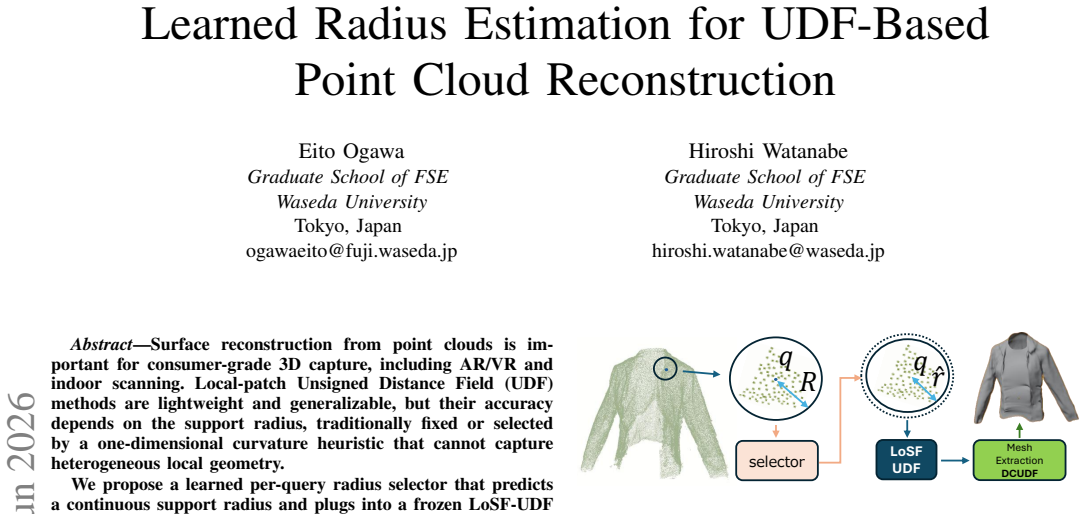

read the original abstract
Surface reconstruction from point clouds is important for consumer-grade 3D capture, including AR/VR and indoor scanning. Local-patch Unsigned Distance Field (UDF) methods are lightweight and generalizable, but their accuracy depends on the support radius, traditionally fixed or selected by a one-dimensional curvature heuristic that cannot capture heterogeneous local geometry. We propose a learned per-query radius selector that predicts a continuous support radius and plugs into a frozen LoSF-UDF backbone. The selector is trained using off-grid target radii obtained by parabolic interpolation of cached UDF error curves. Experiments show improved fine-scale reconstruction accuracy.
Editorial analysis
A structured set of objections, weighed in public.
Referee Report
Summary. The paper claims that a learned per-query radius selector, trained on off-grid target radii obtained by parabolic interpolation of cached UDF error curves, can be plugged into a frozen LoSF-UDF backbone to improve fine-scale surface reconstruction accuracy from point clouds compared to fixed or heuristic radius selection.
Significance. If the interpolated targets prove reliable and the selector generalizes, the approach could address a key limitation of local UDF methods by adapting support radii to heterogeneous geometry, with potential benefits for consumer 3D applications. The frozen-backbone design is a practical strength that avoids retraining the full model.
major comments (2)
- [Abstract] Abstract: the claim that 'experiments show improved fine-scale reconstruction accuracy' supplies no quantitative results, baselines, dataset details, or ablation studies, preventing verification of the central experimental claim.
- [Abstract] Training procedure (described in abstract): the off-grid targets are generated by parabolic interpolation of cached UDF error curves; the manuscript must show that these targets recover the true error-minimizing radius (e.g., via denser sampling validation or error-curve analysis) rather than curve-shape artifacts, as this supervision signal is load-bearing for the learned selector.
minor comments (1)
- [Abstract] LoSF-UDF acronym is used without expansion.
Simulated Author's Rebuttal
We thank the referee for the constructive comments on our manuscript. We address each major comment below and will incorporate revisions to strengthen the presentation of results and validation of the supervision signal.
read point-by-point responses
-
Referee: [Abstract] Abstract: the claim that 'experiments show improved fine-scale reconstruction accuracy' supplies no quantitative results, baselines, dataset details, or ablation studies, preventing verification of the central experimental claim.
Authors: We agree that the abstract lacks the necessary quantitative details to support the central claim. In the revised manuscript we will expand the abstract to report specific metrics (e.g., Chamfer distance and normal consistency improvements), name the datasets and baselines, and briefly reference the ablation studies that demonstrate the benefit of the learned selector. revision: yes
-
Referee: [Abstract] Training procedure (described in abstract): the off-grid targets are generated by parabolic interpolation of cached UDF error curves; the manuscript must show that these targets recover the true error-minimizing radius (e.g., via denser sampling validation or error-curve analysis) rather than curve-shape artifacts, as this supervision signal is load-bearing for the learned selector.
Authors: We acknowledge that explicit validation of the parabolic targets is required. The current manuscript does not contain a dedicated denser-sampling comparison or error-curve analysis; we will add such validation (including quantitative deviation statistics and example curves) in a new subsection of the experiments to confirm that the interpolated radii reliably approximate the true minima. revision: yes
Circularity Check
No significant circularity; derivation relies on external supervision targets
full rationale
The paper trains a learned radius selector on target radii obtained via parabolic interpolation of cached UDF error curves, which are computed independently of the selector itself. These targets serve as supervision for training, after which the selector is plugged into a frozen LoSF-UDF backbone. No equation or step reduces the output to a fitted quantity defined by the model, nor does any load-bearing claim rest on self-citation chains or imported uniqueness theorems. The approach is self-contained with externally derived signals, consistent with the reader's assessment of no circular reasoning.
Axiom & Free-Parameter Ledger
Reference graph
Works this paper leans on
-
[1]
Neural Unsigned Distance Fields for Implicit Function Learning,
J. Chibaneet al., “Neural Unsigned Distance Fields for Implicit Function Learning,” inAdv. Neural Inf. Process. Syst. (NeurIPS), 2020
2020
-
[2]
A Lightweight UDF Learning Framework for 3D Recon- struction Based on Local Shape Functions,
J. Huet al., “A Lightweight UDF Learning Framework for 3D Recon- struction Based on Local Shape Functions,” inProc. IEEE/CVF Conf. Comput. Vis. Pattern Recognit. (CVPR), 2025, pp. 1297–1307
2025
-
[3]
Accurate and Efficient Surface Reconstruction from Point Clouds via Geometry-Aware Local Adaptation,
E. Ogawaet al., “Accurate and Efficient Surface Reconstruction from Point Clouds via Geometry-Aware Local Adaptation,” inProc. IIEEJ Int. Conf. Image Electronics and Visual Computing (IEVC), 2026
2026
-
[4]
Robust Zero Level-Set Extraction from Unsigned Distance Fields Based on Double Covering,
F. Houet al., “Robust Zero Level-Set Extraction from Unsigned Distance Fields Based on Double Covering,”ACM Trans. Graph., vol. 42, no. 6, Art. 245, 2023
2023
-
[5]
ShapeNet: An Information-Rich 3D Model Repository
A. X. Changet al., “ShapeNet: An Information-Rich 3D Model Repos- itory,”arXiv:1512.03012, 2015
work page internal anchor Pith review Pith/arXiv arXiv 2015
-
[6]
Deep Fashion3D: A Dataset and Benchmark for 3D Garment Reconstruction from Single Images,
H. Zhuet al., “Deep Fashion3D: A Dataset and Benchmark for 3D Garment Reconstruction from Single Images,” inProc. Eur . Conf. Comput. Vis. (ECCV), 2020
2020
-
[7]
ScanNet: Richly-Annotated 3D Reconstructions of Indoor Scenes,
A. Daiet al., “ScanNet: Richly-Annotated 3D Reconstructions of Indoor Scenes,” inProc. IEEE Conf. Comput. Vis. Pattern Recognit. (CVPR), 2017, pp. 2432–2443
2017
discussion (0)
Sign in with ORCID, Apple, or X to comment. Anyone can read and Pith papers without signing in.