REVIEW 2 major objections 1 minor 35 references
Seed-Guided Semi-Supervised Clustering by A-Contrario Anomaly Detection
T0 review · 2 major / 1 minor · reviewed 2026-06-26 · grok-4.3
Pith's one-line read A semi-supervised clustering method grows seed groups by excluding anomalies defined against uniform randomness, reaching competitive results with 10-30 labels per cluster.
desk verdict The paper frames semi-supervised clustering as anomaly detection under a uniform null via a-contrario reasoning and claims low-seed performance, but that null looks mismatched to structured embeddings. read the letter →
The pith
A machine-rendered reading of the paper's core claim, the machinery that carries it, and where it could break.
The reading
What carries the argument
The Perception algorithm, which computes an expectation-based threshold E < 1 drawn from a-contrario reasoning to decide whether a point is an outlier relative to a uniform-randomness null hypothesis.
What would settle it
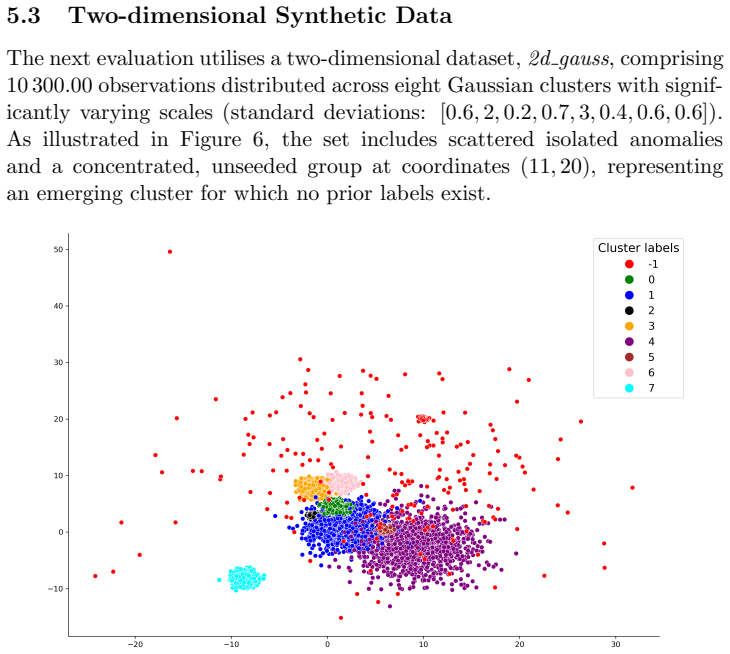
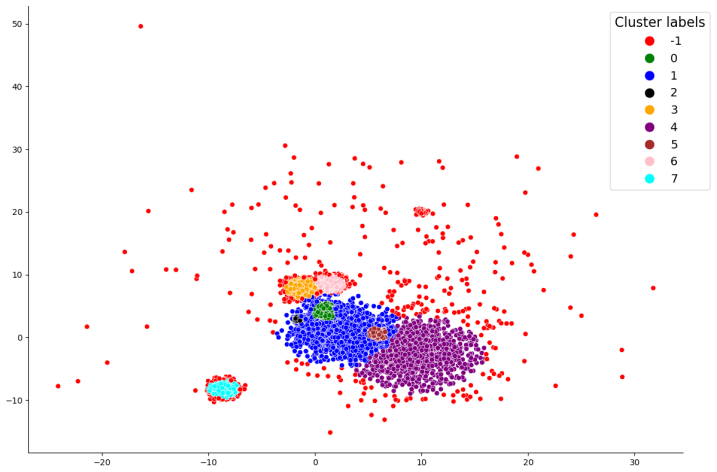
On a synthetic dataset whose outliers are drawn from a clearly non-uniform distribution while the seeded clusters remain compact, measure whether the E < 1 rule still excludes the correct points or begins to assign them incorrectly.
Extended reading notes
Core claim
Clustering is performed by iteratively admitting points that satisfy the a-contrario condition of not being anomalous relative to uniform randomness; the Perception algorithm supplies the E < 1 decision rule that requires no global density or distance parameters, allowing a small set of user seeds to initialise medians that are then expanded into robust clusters while fringe and noise points are left unassigned.
Load-bearing premise
The null hypothesis of uniform randomness is an appropriate model for defining anomalies within the data distribution being clustered.
Editorial extensions
If this is right
- With 10-30 seeds per cluster the method produces competitive or superior accuracy on standard image and text benchmarks under a low-tuning protocol.
- Runtime remains linear in both the number of observations and the feature dimension once the number of seeded clusters and iterations is held fixed.
- Fringe points, isolated noise, and points belonging to unseeded clusters are left unassigned by construction.
- The same pipeline applies without modification to raw data, linearly reduced embeddings, and neighbourhood-preserving embeddings.
Reading between the lines
- The uniform-randomness null may need replacement by a data-specific background model when clusters sit in highly structured manifolds.
- Because expansion decisions are local and expectation-based, the procedure could be adapted to an online setting where new points arrive sequentially.
- The duality between clustering and anomaly detection suggests the same machinery could be run in reverse to surface anomalies once clusters are known.
Editorial analysis
A structured set of objections, weighed in public.
Referee Report
Summary. The paper proposes a seed-guided semi-supervised clustering method based on a-contrario anomaly detection. Clusters are defined as maximal subsets containing no anomalies w.r.t. a uniform-randomness null hypothesis. The Perception algorithm uses an expectation-based threshold (E < 1) to admit points during iterative 'clustering-by-exclusion' expansion from seed-initialized medians. The central claim is that with 10-30 seeds per cluster the method achieves competitive or strong performance on synthetic and real (image/text embedding) benchmarks under low-tuning protocols while scaling linearly in observations and dimensionality (for fixed seeded clusters and iterations).
Significance. If the central construction holds, the approach supplies a statistically grounded, low-parameter alternative to standard semi-supervised clustering that naturally isolates noise and unknown clusters. The reported low-seed performance and linear scaling would be practically relevant for embedding-based tasks.
major comments (2)
- [Cluster definition and Perception algorithm (abstract and §3)] The uniform-randomness null underlying the Perception algorithm and the E < 1 threshold (central to the cluster definition and duality claim) is load-bearing for all performance results. In high-dimensional or manifold-structured embeddings the null typically fails to model local density or distance distributions, which risks systematic misclassification of inliers as anomalies and thereby undermines the claimed seed-guided expansion and noise isolation.
- [Evaluation section (synthetic and real-world benchmarks)] The experimental claims of 'competitive and often very strong performance' with 10-30 seeds rest on the appropriateness of the null; without explicit validation (e.g., comparison of anomaly scores against data-generating process on the image/text embeddings) the low-tuning benchmarking protocol cannot be taken as supporting the central claim.
minor comments (1)
- [Complexity analysis] The abstract states linear scalability 'with respect to both observations and dimensionality for a fixed number of seeded clusters and iterations'; this qualifier should appear in the main text when the complexity analysis is presented.
Simulated Author's Rebuttal
We thank the referee for the constructive comments on the statistical foundations of the Perception algorithm. We address each major point below and outline planned revisions.
read point-by-point responses
-
Referee: [Cluster definition and Perception algorithm (abstract and §3)] The uniform-randomness null underlying the Perception algorithm and the E < 1 threshold (central to the cluster definition and duality claim) is load-bearing for all performance results. In high-dimensional or manifold-structured embeddings the null typically fails to model local density or distance distributions, which risks systematic misclassification of inliers as anomalies and thereby undermines the claimed seed-guided expansion and noise isolation.
Authors: The a-contrario framework deliberately employs a simple uniform null to enable parameter-free detection via the E < 1 expectation threshold, which bounds false positives regardless of moderate model mismatch. While we recognize that high-dimensional embeddings may exhibit concentration effects not captured by the null, the seed-guided iterative expansion and empirical results on image/text embeddings demonstrate effective cluster formation and noise isolation. In revision we will augment §3 with explicit discussion of the null's limitations on manifolds and the robustness properties of the E < 1 criterion. revision: partial
-
Referee: [Evaluation section (synthetic and real-world benchmarks)] The experimental claims of 'competitive and often very strong performance' with 10-30 seeds rest on the appropriateness of the null; without explicit validation (e.g., comparison of anomaly scores against data-generating process on the image/text embeddings) the low-tuning benchmarking protocol cannot be taken as supporting the central claim.
Authors: On synthetic data the anomaly scores are directly evaluated against the known generative process, supporting the claimed behavior. For real embeddings we will add in the revised evaluation section a qualitative examination of flagged anomalies (e.g., their correspondence to known outliers or fringe points) together with quantitative checks on a subset of benchmarks. This will provide the requested validation while preserving the low-tuning protocol. revision: yes
Circularity Check
No significant circularity; derivation is self-contained from a-contrario definition
full rationale
The paper defines clusters as maximal subsets with no anomalies under a uniform-randomness null, using the Perception algorithm's E<1 expectation threshold as a first-principles rule derived from a-contrario reasoning and Gestalt principles. This construction does not reduce to fitted parameters or self-citations by definition. Performance claims are empirical evaluations on benchmarks, not derivations that loop back to inputs. No load-bearing self-citation chains, ansatz smuggling, or renaming of known results appear in the provided text. The uniform null is an explicit modeling choice (weakest assumption), not a circular fit.
Assumptions & free parameters
assumptions (1)
- domain assumption Null hypothesis of uniform randomness is suitable for modeling anomalies inside candidate clusters
Cite this review
Pith. "Pith review of Seed-Guided Semi-Supervised Clustering by A-Contrario Anomaly Detection." pith.science (2026). https://pith.science/paper/GXVKJJXE
@misc{pith2026260618833,
  author       = {Pith},
  title        = {Pith review of: Seed-Guided Semi-Supervised Clustering by A-Contrario Anomaly Detection},
  year         = {2026},
  howpublished = {\url{https://pith.science/paper/GXVKJJXE}},
  note         = {Machine review of arXiv:2606.18833}
}
abstract
This paper introduces a semi-supervised clustering framework grounded in the statistical duality between grouping principles and anomaly detection. We address the challenge of robust cluster definition in noisy environments -- a task where partitioning algorithms often over-assign outliers and density-based methods remain sensitive to heuristic global parameters. Drawing on \textit{a-contrario} statistical reasoning and Gestalt proximity principles, we define a cluster as a maximal subset of data points containing no anomalies relative to a null hypothesis of uniform randomness. Central to this approach is the Perception algorithm, which utilises a principled expectation-based threshold ($\mathbb{E} < 1$) to identify outliers without manual parameter tuning. By treating clustering as the dual of anomaly detection, we employ an iterative ``clustering-by-exclusion'' mechanism. The algorithm is seed-guided, leveraging minimal user-provided labels to initialise robust cluster medians and form initial groups, which are subsequently expanded by admitting non-anomalous points. This approach naturally isolates fringe points, isolated noise, and emerging unknown clusters. We evaluate the method on synthetic and real-world benchmarks, including image and text datasets represented through raw, linear-reduced, and neighbourhood-preserving embeddings. Results demonstrate that with as few as 10--30 seeds per cluster, the proposed method achieves competitive and often very strong performance under a practical low-tuning benchmarking protocol, while maintaining linear scalability with respect to both observations and dimensionality for a fixed number of seeded clusters and iterations.
Figures


Figures from the paper (15 more)







Reference graph
Works this paper leans on
-
[1]
Sugato Basu, Arindam Banerjee, and Raymond J. Mooney. Semi- supervised clustering by seeding. InICML, pages 27–34. Morgan Kauf- mann, 2002
2002
-
[2]
Sugato Basu, Arindam Banerjee, and Raymond J. Mooney. Active semi-supervision for pairwise constrained clustering.Proceedings of the tenth ACM SIGKDD international conference on Knowledge discovery and data mining, pages 333–342, 2004
2004
-
[3]
Lena G. M. Bauer, Collin Leiber, Christian B¨ ohm, and Clau- dia Plant. Extension of the dip-test repertoire: Efficient and differentiable p-value calculation for clustering. InProceed- ings of the 2023 SIAM International Conference on Data Min- ing (SDM), pages 109–117. Society for Industrial and Applied Mathematics, 2023. doi: 10.1137/1.9781611977653.ch...
-
[4]
k-means-: A unified approach to clustering and outlier detection
Sanjay Chawla and Aristides Gionis. k-means-: A unified approach to clustering and outlier detection. InSDM, pages 189–197. SIAM, 2013
2013
-
[5]
https://doi.org/10.1109/BIBM62325.2024.10821806
Qingsheng Chen, Mingjie Zhao, Yuzhu Ji, Xiaopeng Luo, Yiqun Zhang, and Yue Zhang. Mgod: Multi-granular outlier detection with 44 clustlier analysis. In2024 IEEE International Conference on Bioin- formatics and Biomedicine (BIBM), pages 3105–3110, 2024. doi: 10.1109/BIBM62325.2024.10821743
-
[6]
Springer Publish- ing Company, Incorporated, 1st edition, 2007
Agns Desolneux, Lionel Moisan, and Jean-Michel Morel.From Gestalt Theory to Image Analysis: A Probabilistic Approach. Springer Publish- ing Company, Incorporated, 1st edition, 2007. ISBN 0387726357
2007
-
[7]
Martin Ester, Hans-Peter Kriegel, J¨ org Sander, and Xiaowei Xu. A density-based algorithm for discovering clusters in large spatial databases with noise.Proceedings of the 2nd International Conference on Knowledge Discovery and Data Mining (KDD), pages 226–231, 1996
1996
-
[8]
Semi-supervised con- strained clustering: an in-depth overview, ranked taxonomy and future research directions.Artif
Germ´ an Gonz´ alez-Almagro, Daniel Peralta, Eli De Poorter, Jos´ e Ram´ on Cano, and Salvador Garc´ ıa. Semi-supervised con- strained clustering: an in-depth overview, ranked taxonomy and future research directions.Artif. Intell. Rev., 58(5):157, 2025
2025
Show all 35 references
-
[9]
Semi- supervised clustering under a compact-cluster assumption.IEEE Transactions on Knowledge and Data Engineering, 35(5):5244–5256, May 2023
Zhen Jiang, Yongzhao Zhan, Qirong Mao, and Yang Du. Semi- supervised clustering under a compact-cluster assumption.IEEE Transactions on Knowledge and Data Engineering, 35(5):5244–5256, May 2023. ISSN 1041-4347. doi: 10.1109/TKDE.2022.3145347. URL https://doi.org/10.1109/TKDE.2...
2023 doi
-
[10]
Unsuper- vised and semi-supervised clustering via density and distance-based label propagation and assignment.Information Systems, 136: 102639, 2025
Zhen Jiang, Bolin Niu, Jinxin Gua, and Yuping Xing. Unsuper- vised and semi-supervised clustering via density and distance-based label propagation and assignment.Information Systems, 136: 102639, 2025. ISSN 0306-4379. doi: 10.1016/j.is.2025.102639. URL https://www.sciencedirec...
2025 doi
-
[11]
Semi-supervised hierarchical clustering via low-density sepa- ration.Knowledge and Information Systems, 68(1), March
Zhen Jiang, Haolei Qin, Zeyu Feng, and Haizhen Guan. Semi-supervised hierarchical clustering via low-density sepa- ration.Knowledge and Information Systems, 68(1), March
-
[12]
doi: 10.1007/s10115-026-02717-1
ISSN 0219-1377. doi: 10.1007/s10115-026-02717-1. URL https://doi.org/10.1007/s10115-026-02717-1
-
[13]
Kamvar, Dan Klein, and Christopher D
Sepandar D. Kamvar, Dan Klein, and Christopher D. Manning. Spec- tral learning. InIJCAI, pages 561–566. Morgan Kaufmann, 2003
2003
-
[14]
Collin Leiber, Lena G. M. Bauer, Michael Neumayr, Claudia Plant, and Christian B¨ ohm. The DipEncoder: Enforcing multimodality in autoencoders. InProceedings of the 28th ACM SIGKDD Conference on Knowledge Discovery and Data Mining, KDD ’22, pages 846–856, New 45 York, NY, USA,...
2022 doi
-
[15]
Benchmarking deep clustering algorithms with clustpy
Collin Leiber, Lukas Miklautz, Claudia Plant, and Christian B¨ ohm. Benchmarking deep clustering algorithms with clustpy. In2023 IEEE International Conference on Data Mining Workshops (ICDMW), pages 625–632. IEEE, 2023. doi: 10.1109/ICDMW60847.2023.00087
2023 doi
-
[16]
Semi-supervised density-based clustering
Levi Lelis and J¨ org Sander. Semi-supervised density-based clustering. InICDM, pages 842–847. IEEE Computer Society, 2009
2009
-
[17]
Structured sparse subspace clustering: A unified optimization framework
Chun-Guang Li and Ren´ e Vidal. Structured sparse subspace clustering: A unified optimization framework. InProceedings of the IEEE Con- ference on Computer Vision and Pattern Recognition (CVPR), pages 277–286, 2015
2015
-
[18]
Weighted density for the win: Accurate subspace density clustering
Shuoyang Li, Yuantao Gu, and Wenwu Wang. Weighted density for the win: Accurate subspace density clustering. InICASSP 2025 - 2025 IEEE International Conference on Acoustics, Speech and Signal Pro- cessing (ICASSP), 2025. doi: 10.1109/ICASSP49660.2025.10890745
2025 doi
-
[19]
Clustering with outlier removal.IEEE Trans
Hongfu Liu, Jun Li, Yue Wu, and Yun Fu. Clustering with outlier removal.IEEE Trans. Knowl. Data Eng., 33(6):2369–2379, 2021
2021
-
[20]
Hierarchical reference sets for robust unsupervised detection of scat- tered and clustered outliers.IEEE Internet of Things Journal, 13(5): 9350–9364, 2026
Xiaopeng Luo, Xin Xu, Herschel Rabitz, Yiqun Zhang, Zexi Tan, Shenghong Cai, Zihua Yang, Sen Feng, Yuzhu Ji, and Haijun Zhang. Hierarchical reference sets for robust unsupervised detection of scat- tered and clustered outliers.IEEE Internet of Things Journal, 13(5): 9350–9364,...
2026 doi
-
[21]
MacQueen
J. MacQueen. Some methods for classification and analysis of multi- variate observations. InProceedings of the Fifth Berkeley Symposium on Mathematical Statistics and Probability, Volume 1: Statistics, pages 281–297, Berkeley, Calif., 1967. University of California Press
1967
-
[22]
Henry Holt and Co., Inc., USA, 1982
David Marr.Vision: A Computational Investigation into the Human Representation and Processing of Visual Information. Henry Holt and Co., Inc., USA, 1982. ISBN 0716715678
1982
-
[23]
Umap: Uniform manifold approximation and projection for dimension reduction.arXiv preprint arXiv:1802.03426, 2018
Leland McInnes, John Healy, and James Melville. Umap: Uniform manifold approximation and projection for dimension reduction.arXiv preprint arXiv:1802.03426, 2018. 46
2018 arXiv
-
[24]
Anomaly detection using principles of human per- ception, 2021
Nassir Mohammad. Anomaly detection using principles of human per- ception, 2021. URLhttps://arxiv.org/abs/2103.12323
2021
-
[25]
Pedregosa, G
F. Pedregosa, G. Varoquaux, A. Gramfort, V. Michel, B. Thirion, O. Grisel, M. Blondel, P. Prettenhofer, R. Weiss, V. Dubourg, J. Van- derplas, A. Passos, D. Cournapeau, M. Brucher, M. Perrot, and E. Duchesnay. Scikit-learn: Machine learning in Python.Journal of Machine Learnin...
2011
-
[26]
Fuzzy sets in pattern recognition: Methodology and methods.Pattern Recognition, 23(1-2):121–146, 1990
Witold Pedrycz. Fuzzy sets in pattern recognition: Methodology and methods.Pattern Recognition, 23(1-2):121–146, 1990. doi: 10.1016/0031-3203(90)90054-O
1990 doi
-
[27]
Deep clustering: A comprehensive survey.IEEE Transactions on Neural Networks and Learning Systems, 36(4):5858– 5878, 2025
Yazhou Ren et al. Deep clustering: A comprehensive survey.IEEE Transactions on Neural Networks and Learning Systems, 36(4):5858– 5878, 2025
2025
-
[28]
Computing gaussian mixture models with EM using equivalence constraints
Noam Shental, Aharon Bar-Hillel, Tomer Hertz, and Daphna Wein- shall. Computing gaussian mixture models with EM using equivalence constraints. InNIPS, pages 465–472. MIT Press, 2003
2003
-
[29]
Con- strained k-means clustering with background knowledge
Kiri Wagstaff, Claire Cardie, Seth Rogers, and Stefan Schr¨ odl. Con- strained k-means clustering with background knowledge. InICML, pages 577–584, 2001
2001
-
[30]
Hierarchical grouping to optimize an objective function
Joe H Ward Jr. Hierarchical grouping to optimize an objective function. Journal of the American Statistical Association, 58(301):236–244, 1963
1963
-
[31]
Girshick, and Ali Farhadi
Junyuan Xie, Ross B. Girshick, and Ali Farhadi. Unsupervised deep embedding for clustering analysis. InICML, volume 48 ofJMLR Work- shop and Conference Proceedings, pages 478–487. JMLR.org, 2016
2016
-
[32]
Sidiropoulos, and Mingyi Hong
Bo Yang, Xiao Fu, Nicholas D. Sidiropoulos, and Mingyi Hong. Towards k-means-friendly spaces: Simultaneous deep learning and clustering. In ICML, volume 70 ofProceedings of Machine Learning Research, pages 3861–3870. PMLR, 2017
2017
-
[33]
Lal, Jason Weston, and Bernhard Sch¨ olkopf
Dengyong Zhou, Olivier Bousquet, Thomas N. Lal, Jason Weston, and Bernhard Sch¨ olkopf. Learning with local and global consistency. In Advances in Neural Information Processing Systems, volume 16, pages 321–328, 2004. 47
2004
-
[34]
Learning from labeled and unla- beled data with label propagation
Xiaojin Zhu and Zoubin Ghahramani. Learning from labeled and unla- beled data with label propagation. Technical Report CMU-CALD-02- 107, Carnegie Mellon University, 2002
2002
-
[35]
SDENK: Unbiased subspace density-k- clustering.Neurocomputing, 567:131225, 2025
Rong Zou, Yunfan Zhang, Mingjie Zhao, Zexi Tan, Yiqun Zhang, and Yiu-Ming Cheung. SDENK: Unbiased subspace density-k- clustering.Neurocomputing, 567:131225, 2025. ISSN 0925-2312. doi: 10.1016/j.neucom.2025.131225. 48
2025 doi
Reviewed June 26, 2026 · model on record in the stance chip above.
Discussion (0). Continue with ORCID to comment.