First-Principles Study of Novel Lead-Free Double Perovskite b{eta}2SnGeX6 (b{eta} = K, Rb; X = Cl, Br, I) for thermomechanical, optoelectronic and outstanding thermoelectric applications
Pith reviewed 2026-06-26 20:16 UTC · model grok-4.3
The pith
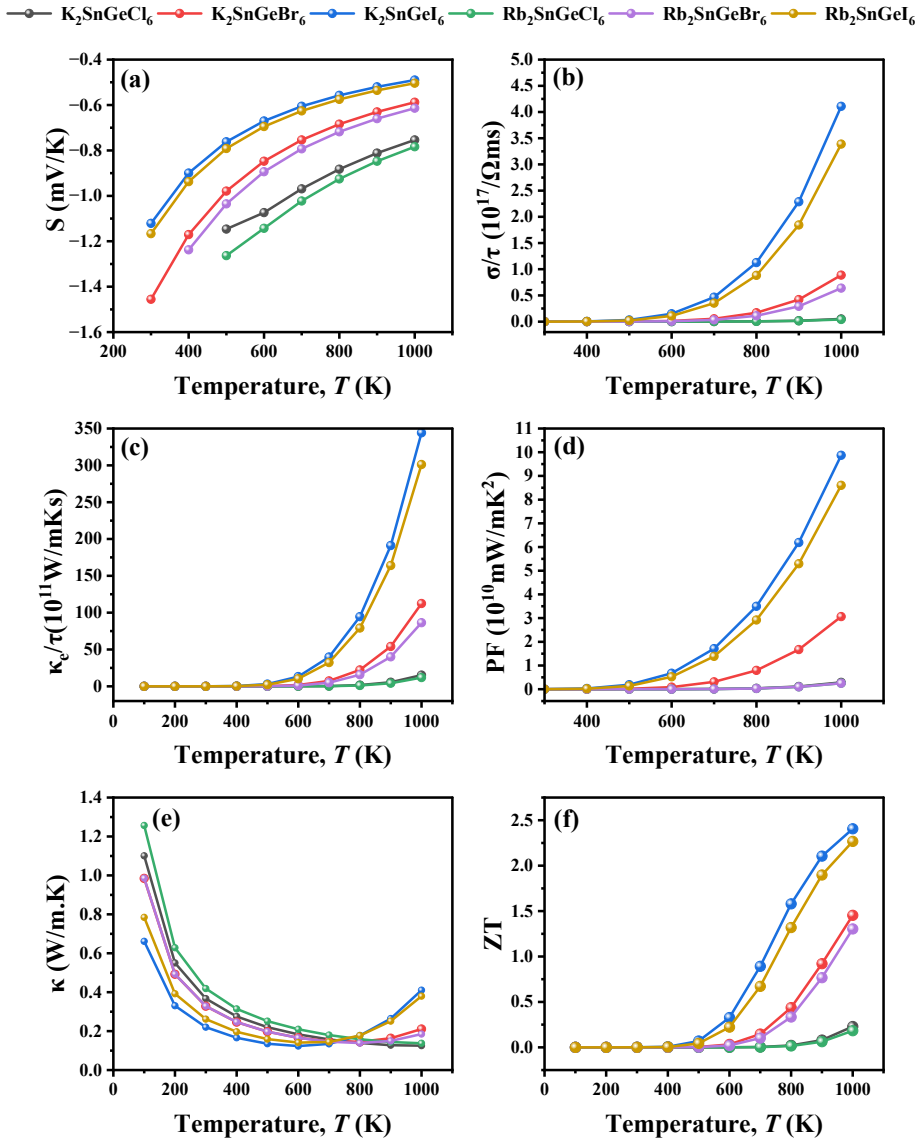
The iodide compounds in the lead-free double perovskite series β2SnGeX6 achieve a thermoelectric figure of merit of 2.4 at 1000 K.
A machine-rendered reading of the paper's core claim, the machinery that carries it, and where it could break.
Core claim
The central discovery is that the β2SnGeX6 family of double perovskites is thermodynamically stable, mechanically ductile, and electronically tunable, with the iodide members delivering outstanding thermoelectric performance through heavy-atom-induced lattice anharmonicity that reduces thermal conductivity enough to produce ZT = 2.4 in K2SnGeI6 at 1000 K.
What carries the argument
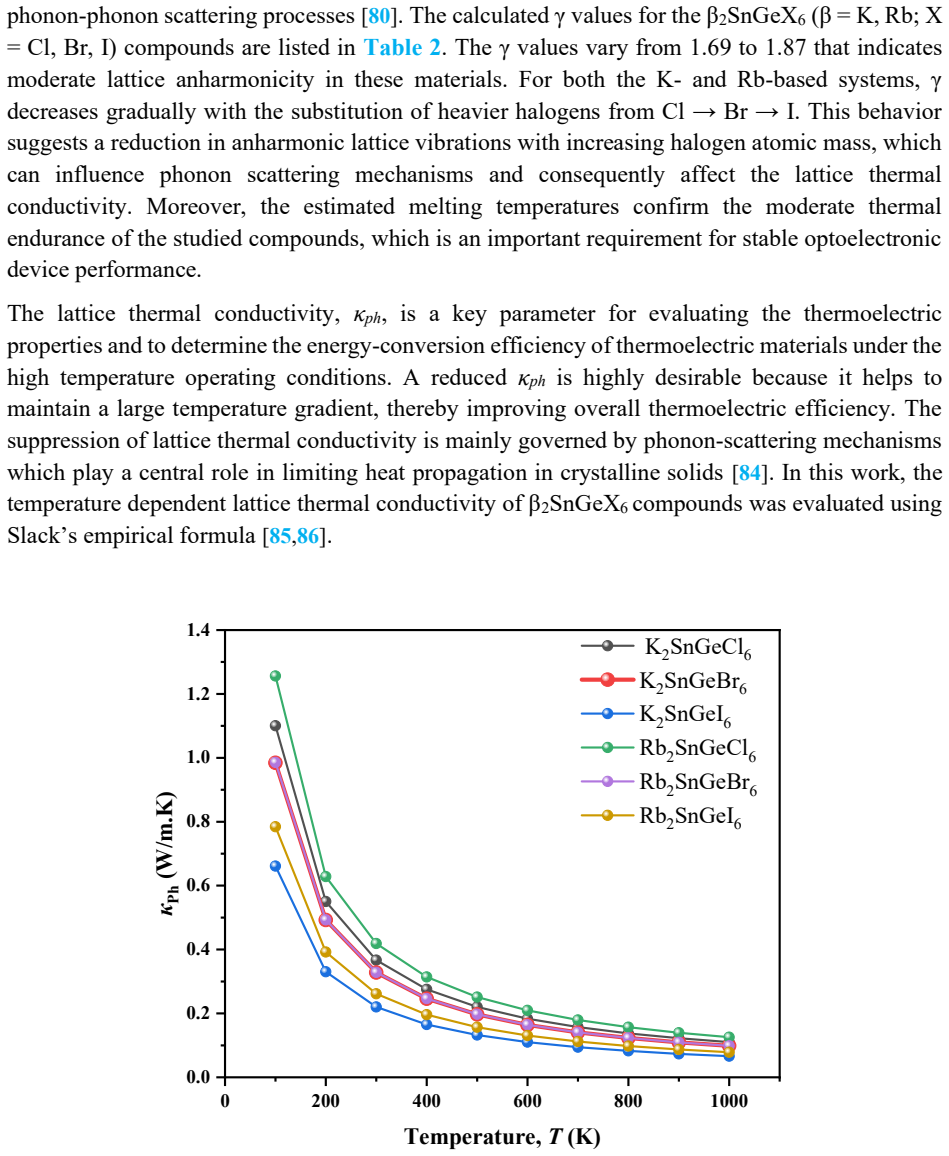
Lattice anharmonicity and high-temperature Umklapp phonon scattering from heavy constituent atoms that suppress lattice thermal conductivity while low carrier effective masses support electrical transport.
If this is right
- Chloride compounds suit single-junction solar cells due to wider bandgaps.
- Bromide and iodide analogs fit tandem cells and near-IR detectors.
- Ductility supports flexible device fabrication.
- Iodides enable efficient waste-heat recovery at high temperatures.
- The family provides a lead-free route to combined optoelectronic and thermoelectric functions.
Where Pith is reading between the lines
- Synthesis attempts could test if the predicted stability holds in real samples.
- Combining these materials in hybrid devices might yield higher overall efficiency than separate components.
- Extending the halogen series or substituting other heavy atoms could further optimize ZT.
- High-temperature measurements would be required to confirm the anharmonicity effect.
Load-bearing premise
Heavy atoms create sufficient lattice anharmonicity to cause intense Umklapp scattering that strongly lowers lattice thermal conductivity at elevated temperatures.
What would settle it
Direct measurement of lattice thermal conductivity much higher than calculated or ZT well below 2.4 at 1000 K for K2SnGeI6.
Figures
read the original abstract
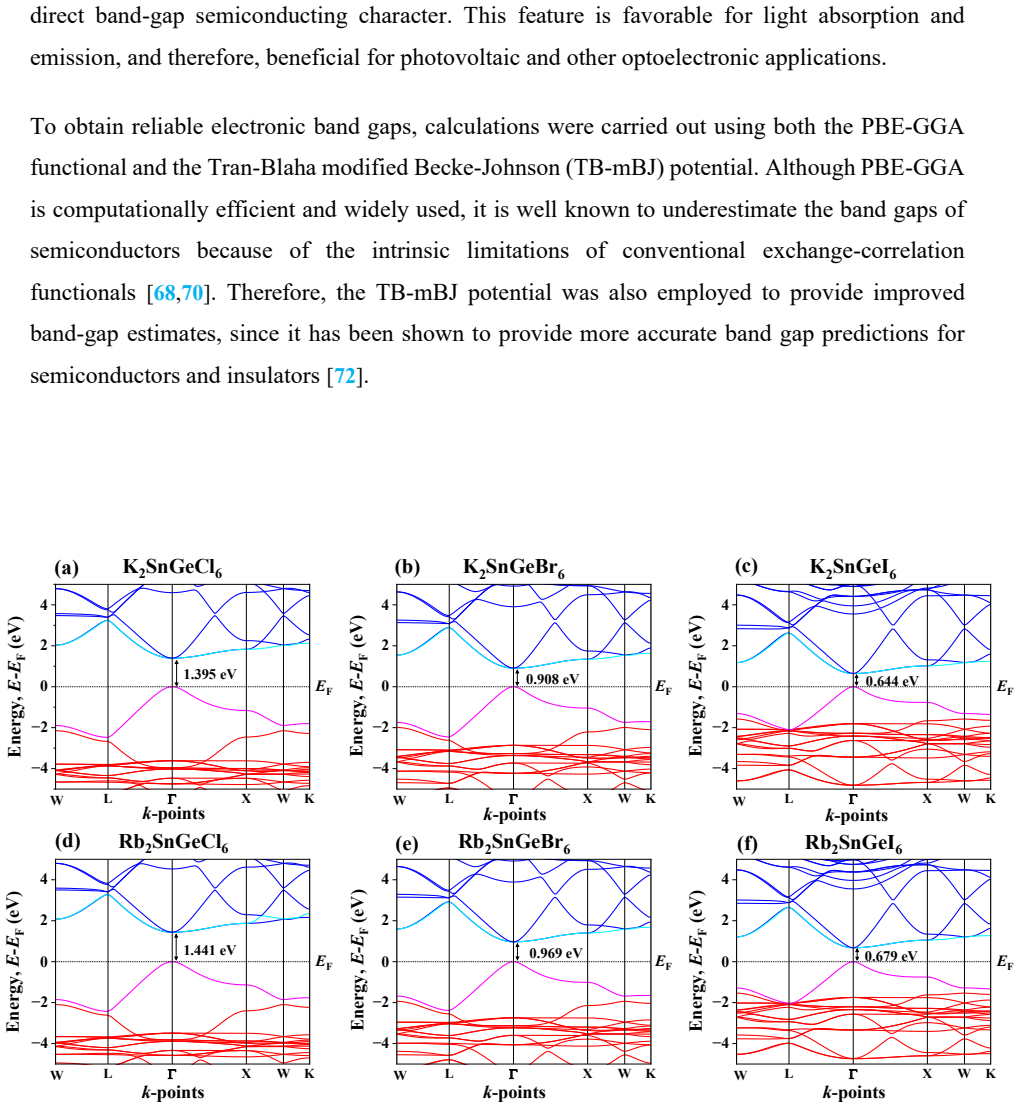
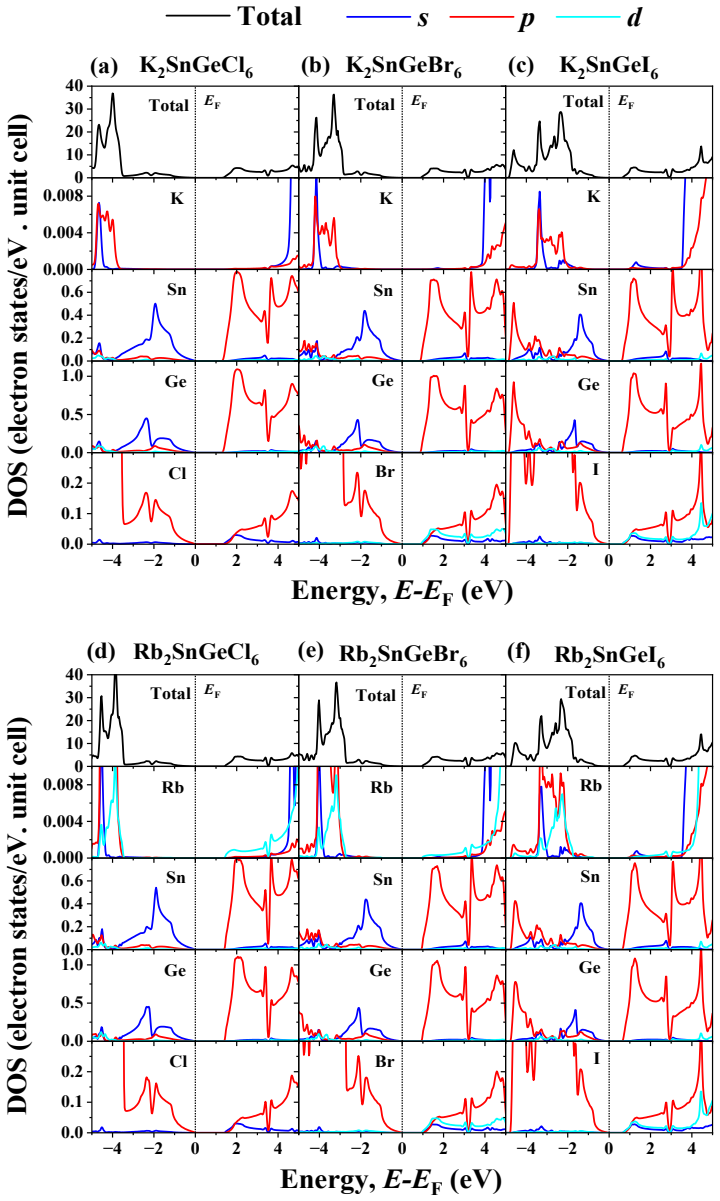
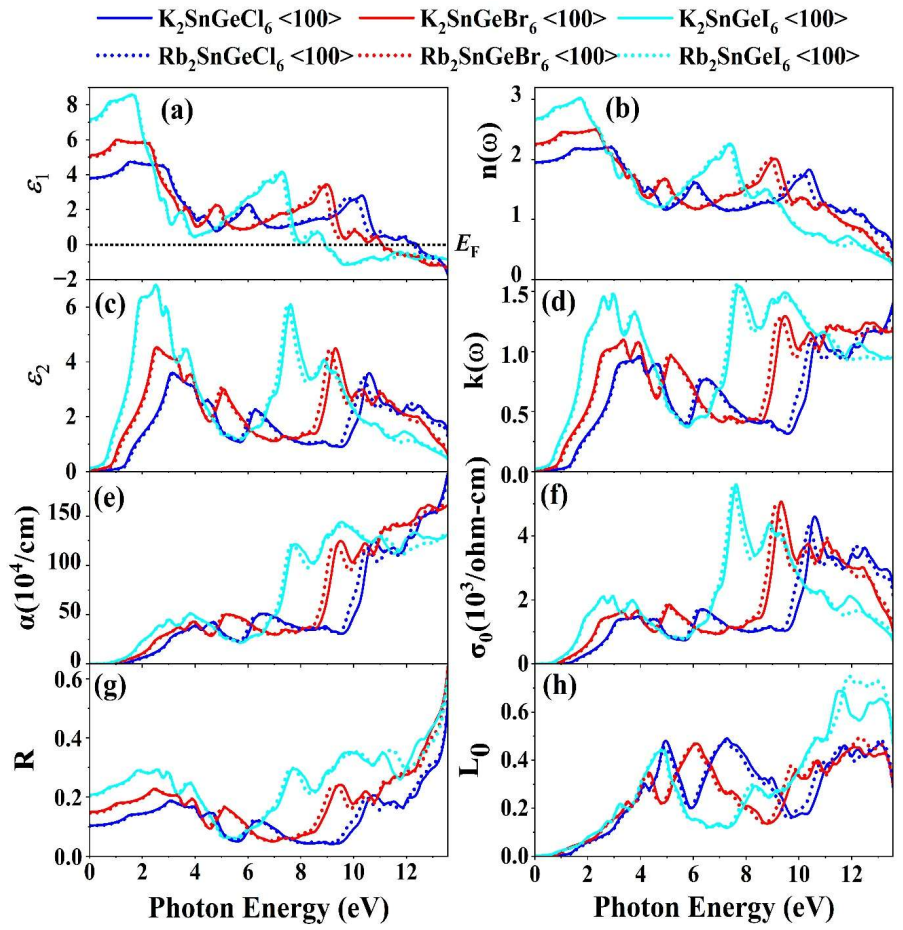
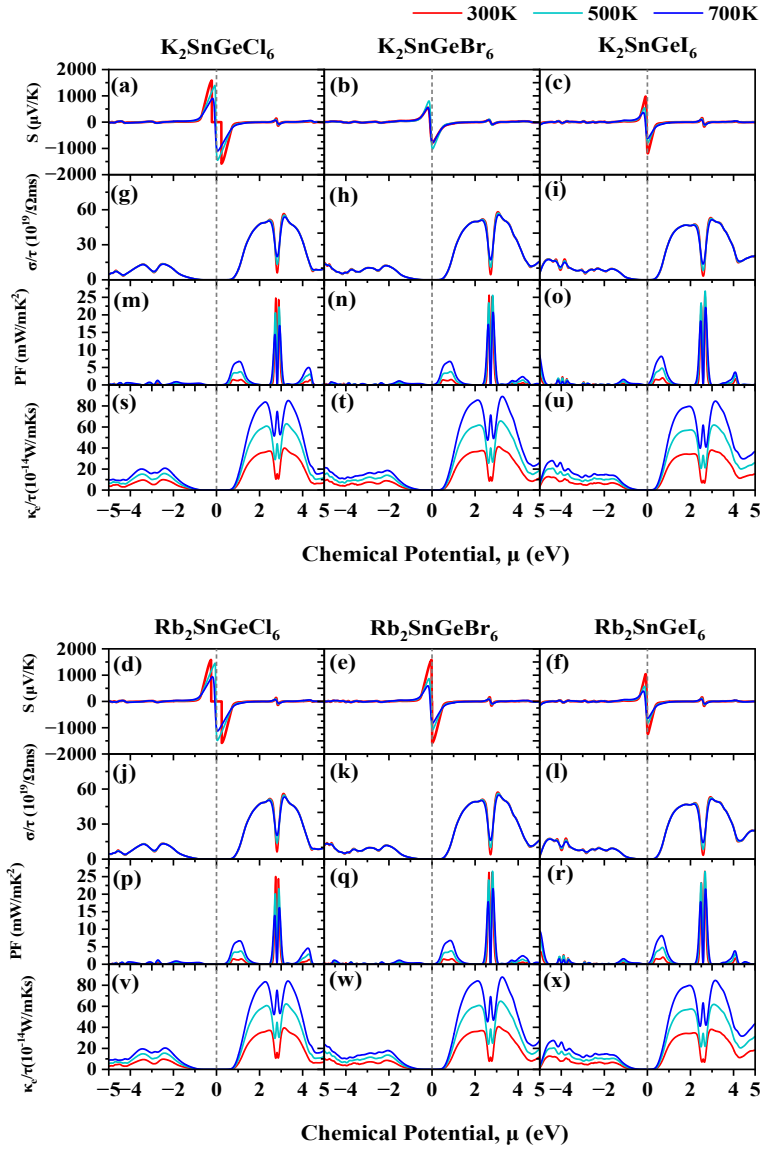
In this study, the structural, mechanical, electronic, optical, and thermoelectric properties of the novel lead-free halide double perovskite series beta2SnGeX6 (beta = K, Rb; X = Cl, Br, I) are systematically investigated using density functional theory (DFT). Calculated formation energies, Tolerance factors, and octahedral factors confirm that all six compounds exhibit robust thermodynamic stability within a highly symmetric cubic geometry. Mechanical analysis derived from elastic parameters characterizes the entire series as fundamentally ductile, ensuring high processing elasticity and resistance to micro-cracking during device manufacturing. Electronic band structures reveal direct bandgaps showing exceptional composition-dependent tunability from 1.44 eV down to 0.64 eV via progressive halogen substitution. The wide gap chloride variations are optimized for single-junction photovoltaic absorbers, while the narrower-gap bromide and iodide analogs show immense promise for tandem solar architectures and near-infrared photodetectors. Thermoelectrically, heavy constituent atoms introduce strong lattice anharmonicity and intense high-temperature Umklapp phonon scattering, significantly suppressing lattice thermal conductivity. Combined with low carrier effective masses that optimize electrical transport, the iodide compounds achieve higher power factors and outstanding dimensionless figures of merit (ZT = 2.4 for K2SnGeI6 at 1000 K). Ultimately, these lead-free double perovskite family emerges as an environmentally benign and versatile platform for next-generation green optoelectronics and solid-state waste-heat recovery.
Editorial analysis
A structured set of objections, weighed in public.
Referee Report
Summary. The manuscript reports a DFT-based investigation of the structural, mechanical, electronic, optical, and thermoelectric properties of the lead-free double perovskites β₂SnGeX₆ (β = K, Rb; X = Cl, Br, I). It finds all compounds thermodynamically stable in cubic geometry, mechanically ductile, with direct bandgaps tunable from 1.44 eV to 0.64 eV, and predicts high thermoelectric performance for the iodides, including ZT = 2.4 for K₂SnGeI₆ at 1000 K, attributed to suppressed lattice thermal conductivity from heavy-atom-induced anharmonicity and Umklapp scattering.
Significance. If the calculations are robust, the work identifies a family of lead-free, ductile perovskites with composition-tunable gaps suitable for photovoltaics and photodetectors, plus potentially high ZT values for waste-heat recovery. The mechanical ductility combined with thermoelectric predictions would strengthen the case for these materials in practical devices, provided the thermal transport results are quantitatively grounded.
major comments (1)
- [Abstract / Thermoelectric results] Abstract and thermoelectric results section: The headline claim of ZT = 2.4 for K₂SnGeI₆ at 1000 K (and similarly high values for other iodides) is presented as arising from 'strong lattice anharmonicity and intense high-temperature Umklapp phonon scattering' that 'significantly suppress[es] lattice thermal conductivity,' obtained from 'DFT phonon calculations.' Harmonic phonon dispersions (from DFPT or finite displacements) yield frequencies and velocities but do not furnish three-phonon scattering rates or κ_l. No mention is made of third-order interatomic force constants, phonon Boltzmann transport equation solution, or explicit numerical κ_l values. This step is load-bearing for the central thermoelectric application claim and must be clarified or supplemented with the actual computational protocol and results.
minor comments (1)
- [Abstract] Notation: The abstract uses 'beta2SnGeX6' and 'beta = K, Rb' while the title uses '\b{eta}2SnGeX6'; consistent use of K₂SnGeX₆ / Rb₂SnGeX₆ throughout would improve readability.
Simulated Author's Rebuttal
We thank the referee for the thorough review and for highlighting the need for greater clarity on the thermal transport methodology. The comment is well-taken and we will revise the manuscript accordingly.
read point-by-point responses
-
Referee: [Abstract / Thermoelectric results] Abstract and thermoelectric results section: The headline claim of ZT = 2.4 for K₂SnGeI₆ at 1000 K (and similarly high values for other iodides) is presented as arising from 'strong lattice anharmonicity and intense high-temperature Umklapp phonon scattering' that 'significantly suppress[es] lattice thermal conductivity,' obtained from 'DFT phonon calculations.' Harmonic phonon dispersions (from DFPT or finite displacements) yield frequencies and velocities but do not furnish three-phonon scattering rates or κ_l. No mention is made of third-order interatomic force constants, phonon Boltzmann transport equation solution, or explicit numerical κ_l values. This step is load-bearing for the central thermoelectric application claim and must be clarified or supplemented with the actual computational protocol and results.
Authors: We agree that the manuscript does not explicitly describe the anharmonic calculations. The lattice thermal conductivities were obtained by computing third-order interatomic force constants via the finite-displacement method, followed by solution of the phonon Boltzmann transport equation on dense q-grids. These steps capture the Umklapp scattering rates responsible for the low κ_l in the iodides. In the revised manuscript we will insert a new subsection (and supporting figures) that specifies the supercell sizes, interaction cutoffs, q-point sampling, and convergence tests for κ_l(T), together with the resulting numerical values. This will fully substantiate the reported ZT figures. revision: yes
Circularity Check
No significant circularity detected; derivation is self-contained DFT computation.
full rationale
The paper reports standard DFT calculations of formation energies, elastic constants, band structures, and thermoelectric quantities for the double perovskites. The ZT=2.4 value is stated as resulting from computed power factors combined with asserted suppression of lattice thermal conductivity due to anharmonicity and Umklapp scattering from heavy atoms, presented as following from DFT phonon work. No equations, self-citations, or parameter-fitting steps are quoted that reduce the final result to its inputs by construction. The load-bearing assumption about kappa_l magnitude is an inference from heavy-atom effects rather than a self-referential definition or renamed fit. This matches the default expectation of a non-circular first-principles study; concerns about whether harmonic phonons suffice for Umklapp rates fall under correctness rather than circularity per the rules.
Axiom & Free-Parameter Ledger
free parameters (1)
- DFT exchange-correlation functional and dispersion corrections
axioms (2)
- domain assumption Tolerance factor and octahedral factor reliably indicate thermodynamic stability and cubic symmetry for these halide double perovskites.
- domain assumption DFT phonon calculations with standard anharmonicity treatment accurately capture Umklapp scattering and lattice thermal conductivity at high temperature.
Reference graph
Works this paper leans on
-
[1]
M. Manzoor, D. Behera, R. Sharma, A.J.A. Moayad, A.A. Al-Kahtani, Y.A. Kumar, Comprehensive first principles to investigate optoelectronic and transport phenomenon of lead-free double perovskites Ba2AsBO6(B Nb, Ta) compounds, Heliyon, 10 (2024). https://doi.org/10.1016/j.heliyon.2024.e30109
-
[2]
Ayyaz, M
A. Ayyaz, M. Irfan, M.B. Shakir, H. Khan, R. Karmouch, H.A. Ibrahium, H. Albalawi, Q. Mahmood, First principles study of optoelectronic, thermoelectric, and mechanical features of double perovskites K2AgGaZ6(Z = Cl, Br) for energy harvesting perspectives, Optical and Quantum Electronics, 56 (2024)
2024
-
[3]
https://doi.org/10.1007/s11082-024-07321-7
-
[4]
S.G. Asadullayeva, N.A. Ismayilova, Q.Y. Eyyubov, Optical and electronic properties of defect chalcopyrite ZnGa2Se4: Experimental and theoretical investigations, Solid State Communications, 356 (2022) 114950. https://doi.org/10.1016/j.ssc.2022.114950
-
[5]
M. Younas, K. Harrabi, Performance enhancement of dye-sensitized solar cells via co-sensitization of ruthenium(II) based N749 dye and organic sensitizer RK1, Solar Energy, 203 (2020) 260–266. https://doi.org/10.1016/j.solener.2020.04.051
-
[7]
M. Younas, M. a. Gondal, U. Mehmood, K. Harrabi, Z. h. Yamani, F. a. Al-Sulaiman, Performance enhancement of dye-sensitized solar cells via cosensitization of ruthenizer Z907 and organic sensitizer SQ2, International Journal of Energy Research, 42 (2018) 3957–3965. https://doi.org/10.1002/er.4154. 31 | P a g e
-
[8]
Q. Mahmood, M. Younas, M.G.B. Ashiq, S.M. Ramay, A. Mahmood, H.M. Ghaithan, First principle study of lead-free double perovskites halides Rb2Pd(Cl/Br)6for solar cells and renewable energy devices: A quantum DFT, International Journal of Energy Research, 45 (2021) 14995–15004. https://doi.org/10.1002/er.6778
-
[9]
M.Q. Kareem, S.S. Alimardan, W.M. Mohammad, I.M. Khudhair, Tailoring ETL/HTL combinations for high-performance ITO/i-ZnO/ZnS/SnSe/SnTe solar cells: A simulation approach, Results in Surfaces and Interfaces, 18 (2025) 100411. https://doi.org/10.1016/j.rsurfi.2024.100411
-
[10]
M.Q. Kareem, S.A. Hassan, S.S. Alimardan, S.M. Shareef, M.M. Ameen, CHTS/Zn2P3-based solar cells with enhanced efficiency through ETL engineering: A numerical study, Journal of Physics and Chemistry of Solids, 188 (2024) 111931. https://doi.org/10.1016/j.jpcs.2024.111931
-
[11]
S. Dixit, Solar technologies and their implementations: A review, Materials Today: Proceedings, 28 (2020) 2137–2148. https://doi.org/10.1016/j.matpr.2020.04.134
-
[12]
M.K. Zoubir, B. Fadila, B. Keltoum, A. Ibrahim, B.L. Farah, Y. Al-Douri, A. Mohammed, Structural, electronic and thermodynamic investigation of Ag2GdSi, Ag2GdSn and Ag2GdPb Heusler alloys: First- principles calculations, Materials Testing, 63 (2021) 537–542. https://doi.org/10.1515/mt-2020-0088
-
[13]
M. Noman, Z. Khan, S.T. Jan, A comprehensive review on the advancements and challenges in perovskite solar cell technology, RSC Advances, 14 (2024) 5085–5131. https://doi.org/10.1039/D3RA07518D
-
[14]
L.M. Benhafsa, Y. Azzaz, N. Benseddik, N. Moulay, D. Bensaid, K. Bencherif, Optoelectronic and Photovoltaic Properties of Lead-Free Ba2AgBiX6 (X = I, Br and Cl) Double Perovskites: As a Sustainable Solar Cell Study Based on DFT and SCAPS-1D, Journal of Inorganic and Organometallic Polymers and Materials, (2025). https://doi.org/10.1007/s10904-025-04014-w
-
[15]
H. Akter, M.A. Ali, M.M. Hossain, M.M. Uddin, S.H. Naqib, Oxysulfide perovskites: reduction of the electronic band gap of RbTaO3 by sulfur substitution, Physica Scripta, 99 (2024) 045950. DOI 10.1088/1402-4896/ad31f3
-
[16]
Borhan Uddin, Mirza Humaun Kabir Rubel, Soukaina Bouhmaidi, Arpon Chakraborty, M
Md. Borhan Uddin, Mirza Humaun Kabir Rubel, Soukaina Bouhmaidi, Arpon Chakraborty, M. Khalid Hossain, Shakeel Ahmad, Md. Najmus Sakib, Mohammad Abdur Rashid, Larbi Setti, Shamsad Sharmin, S.H. Naqib, Md Abdul Mannan, Thallium-based iodo- perovskites TlMI3 (M = Ca, Sr) for optoelectronic and thermoelectric applications: A DFT investigation, J. Phys. Chem. ...
-
[17]
M. Biswas, S. Ghosh, J. Chowdhury, M.M. Ali, M.M. Mukter Hossain, S.H. Naqib, M.M. Uddin, An inclusive study of lead-free perovskite CsMI3 materials for photovoltaic and optoelectronic appliance explored by a first principles study, Materials Today Communications, 40 (2024) 109422. https://doi.org/10.1016/j.mtcomm.2024.109422
-
[18]
I.E. Yahiaoui, A. Lazreg, Z. Dridi, Y. Al-douri, B. Bouhafs, Gd impurities effect on Co2CrSi alloy: first-principle calculations, Bulletin of Materials Science, 41 (2018) 2. https://doi.org/10.1007/s12034-017- 1516-8
-
[19]
M.H. Benkabou, M. Harmel, A. Haddou, A. Yakoubi, N. Baki, R. Ahmed, Y. Al-Douri, S.V. Syrotyuk, H. Khachai, R. Khenata, C.H. Voon, M.R. Johan, Structural, electronic, optical and thermodynamic investigations of NaXF3 (X = Ca and Sr): First-principles calculations, Chinese Journal of Physics, 56 (2018) 131–144. https://doi.org/10.1016/j.cjph.2017.12.008
-
[20]
D.O. Obada, S.B. Akinpelu, S.A. Abolade, E. Okafor, A.M. Ukpong, S. Kumar R, A. Akande, Lead- Free Double Perovskites: A Review of the Structural, Optoelectronic, Mechanical, and Thermoelectric Properties Derived from First-Principles Calculations, and Materials Design Applicable for Pedagogical Purposes, Crystals, 14 (2024) 86. https://doi.org/10.3390/cr...
-
[21]
J. Zhu, H. Li, L. Zhong, P. Xiao, X. Xu, X. Yang, Z. Zhao, J. Li, Perovskite Oxides: Preparation, Characterizations, and Applications in Heterogeneous Catalysis, ACS Catalysis, 4 (2014) 2917–2940. https://doi.org/10.1021/cs500606g
-
[22]
W. Zhang, C. Chen, H. Shi, M. Yang, Y. Liu, P. Ji, H. Chen, R.X. Tan, E. Li, Curcumin is a biologically active copper chelator with antitumor activity, Phytomedicine, 23 (2016) 1–8. https://doi.org/10.1016/j.phymed.2015.11.005
-
[23]
W.-J. Yin, T. Shi, Y. Yan, Unique properties of halide perovskites as possible origins of the superior solar cell performance, Advanced materials (Deerfield Beach, Fla.), 26 (2014) 4653–4658. https://doi.org/10.1002/adma.201306281
-
[24]
J. Byun, H. Cho, C. Wolf, M. Jang, A. Sadhanala, R.H. Friend, H. Yang, T.-W. Lee, Efficient Visible Quasi-2D Perovskite Light-Emitting Diodes, Advanced Materials, 28 (2016) 7515–7520. https://doi.org/10.1002/adma.201601369
-
[25]
J. Li, L. Xu, T. Wang, J. Song, J. Chen, J. Xue, Y. Dong, B. Cai, Q. Shan, B. Han, H. Zeng, 50‐Fold EQE Improvement up to 6.27% of Solution‐Processed All‐Inorganic Perovskite CsPbBr3 QLEDs via Surface Ligand Density Control, Advanced Materials, 29 (2017) 1603885. https://doi.org/10.1002/adma.201603885
-
[26]
H. Zhu, Y. Fu, F. Meng, X. Wu, Z. Gong, Q. Ding, M.V. Gustafsson, M.T. Trinh, S. Jin, X.-Y. Zhu, Lead halide perovskite nanowire lasers with low lasing thresholds and high quality factors, Nature Materials, 14 (2015) 636–642. https://doi.org/10.1038/nmat4271
-
[27]
K.M. Wong, Characterization, modeling and physical mechanisms of different surface treatment methods at room temperature on the oxide and interfacial quality of the SiO2film using the spectroscopic scanning capacitance microscopy, Results in Physics, 7 (2017) 1308–1318. https://doi.org/10.1016/j.rinp.2017.03.035
-
[28]
P. Ramasamy, D.-H. Lim, B. Kim, S.-H. Lee, M.-S. Lee, J.-S. Lee, All-inorganic cesium lead halide perovskite nanocrystals for photodetector applications, Chemical Communications, 52 (2016) 2067–2070. https://doi.org/10.1039/C5CC08643D
-
[29]
R. Sharma, A. Sharma, S. Agarwal, M.S. Dhaka, Stability and efficiency issues, solutions and advancements in perovskite solar cells: A review, Solar Energy, 244 (2022) 516–535. https://doi.org/10.1016/j.solener.2022.08.001
-
[30]
A. Kojima, K. Teshima, Y. Shirai, T. Miyasaka, Organometal Halide Perovskites as Visible-Light Sensitizers for Photovoltaic Cells, Journal of the American Chemical Society, 131 (2009) 6050–6051. https://doi.org/10.1021/ja809598r
-
[31]
Z. Xiao, K.-Z. Du, W. Meng, J. Wang, D.B. Mitzi, Y. Yan, Intrinsic Instability of Cs2In(I)M(III)X6(M = Bi, Sb; X = Halogen) Double Perovskites: A Combined Density Functional Theory and Experimental Study, Journal of the American Chemical Society, 139 (2017) 6054–6057. https://doi.org/10.1021/jacs.7b02227
-
[32]
M.A. Green, A. Ho-Baillie, H.J. Snaith, The emergence of perovskite solar cells, Nature Photonics, 8 (2014) 506–514. https://doi.org/10.1038/nphoton.2014.134
-
[33]
M.M. Lee, J. Teuscher, T. Miyasaka, T.N. Murakami, H.J. Snaith, Efficient Hybrid Solar Cells Based on Meso-Superstructured Organometal Halide Perovskites, Science, 338 (2012) 643–647. https://doi.org/10.1126/science.1228604
-
[34]
H.-S. Kim, C.-R. Lee, J.-H. Im, K.-B. Lee, T. Moehl, A. Marchioro, S.-J. Moon, R. Humphry-Baker, J.-H. Yum, J.E. Moser, M. Grätzel, N.-G. Park, Lead Iodide Perovskite Sensitized All-Solid-State Submicron Thin Film Mesoscopic Solar Cell with Efficiency Exceeding, Scientific Reports, 2 (2012) 591. https://doi.org/10.1038/srep00591. 33 | P a g e
-
[35]
Md.N. Islam, J. Podder, Semiconductor to metallic transition in double halide perovskites Cs2AgBiCl6through induced pressure: A DFT simulation for optoelectronic and photovoltaic applications, Heliyon, 8 (2022) e10032. https://doi.org/10.1016/j.heliyon.2022.e10032
-
[36]
X. Liu, J. Gao, Q. Wang, Structural-property correlations of all-inorganic CsPbBr3 perovskites via synergetic controls by PbBr2, 2-mercapto-3-methyl-4-thiazoleacetic acid and water, Chemical Engineering Journal, 428 (2022) 131117. https://doi.org/10.1016/j.cej.2021.131117
-
[37]
J.S. Manser, M.I. Saidaminov, J.A. Christians, O.M. Bakr, P.V. Kamat, Making and Breaking of Lead Halide Perovskites, Accounts of Chemical Research, 49 (2016) 330–338. https://doi.org/10.1021/acs.accounts.5b00455
-
[38]
Md.H. Ali, M.J. Islam, A. Kumer, Md.S. Hossain, U. Chakma, D. Howlader, Md.T. Islam, T. Hossain, Investigation of Structural, Electronic and Optical Properties of Na2InAgCl6, K 2InAgCl6, and Rb2InAgCl6Lead-Free Halide Double Perovskites Regarding with Cs2InAgCl6 Perovskites Cell and a Comparative Study by DFT Functionals, Materials Research, 24 (2021) e20...
-
[39]
S. Zhao, W. Cai, H. Wang, Z. Zang, J. Chen, All‐Inorganic Lead‐Free Perovskite(‐Like) Single Crystals: Synthesis, Properties, and Applications, Small Methods, 5 (2021) 2001308. https://doi.org/10.1002/smtd.202001308
-
[40]
Y. Ogomi, A. Morita, S. Tsukamoto, T. Saitho, N. Fujikawa, Q. Shen, T. Toyoda, K. Yoshino, S.S. Pandey, T. Ma, S. Hayase, CH3NH3SnxPb (1– x ) I3 Perovskite Solar Cells Covering up to1060 nm, The Journal of Physical Chemistry Letters, 5 (2014) 1004–1011. https://doi.org/10.1021/jz5002117
-
[41]
F. Hao, C.C. Stoumpos, D.H. Cao, R.P.H. Chang, M.G. Kanatzidis, Lead-free solid-state organic– inorganic halide perovskite solar cells, Nature Photonics, 8 (2014) 489–494. https://doi.org/10.1038/nphoton.2014.82
-
[42]
P. Umari, E. Mosconi, F. De Angelis, Relativistic GW calculations on CH3NH3PbI3 and CH3NH3SnI3 Perovskites for Solar Cell Applications, Scientific Reports, 4 (2014) 4467. https://doi.org/10.1038/srep04467
-
[43]
C. Bernal, K. Yang, First-Principles Hybrid Functional Study of the Organic–Inorganic Perovskites CH3NH3SnBr3 and CH3NH3SnI3, The Journal of Physical Chemistry C, 118 (2014) 24383–24388. https://doi.org/10.1021/jp509358f
-
[44]
F. Ji, G. Boschloo, F. Wang, F. Gao, Challenges and Progress in Lead‐Free Halide Double Perovskite Solar Cells, Solar RRL, 7 (2023) 2201112. https://doi.org/10.1002/solr.202201112
-
[45]
R. Ullah, M.A. Ali, B.U. Haq, A. Khan, Q. Mahmood, G. Murtaza, Exploring electronic, structural, magnetic and thermoelectric properties of novel Ba2EuMoO6 double perovskite, Materials Science in Semiconductor Processing, 137 (2022) 106218. https://doi.org/10.1016/j.mssp.2021.106218
-
[46]
E.T. McClure, M.R. Ball, W. Windl, P.M. Woodward, Cs2AgBiX6 (X = Br, Cl): New Visible Light Absorbing, Lead-Free Halide Perovskite Semiconductors, Chemistry of Materials, 28 (2016) 1348–1354. https://doi.org/10.1021/acs.chemmater.5b04231
-
[47]
M. Roknuzzaman, C. Zhang, K. Ostrikov, A. Du, H. Wang, L. Wang, T. Tesfamichael, Electronic and optical properties of lead-free hybrid double perovskites for photovoltaic and optoelectronic applications, Scientific Reports, 9 (2019) 718. https://doi.org/10.1038/s41598-018-37132-2
-
[48]
G. Volonakis, A.A. Haghighirad, R.L. Milot, W.H. Sio, M.R. Filip, B. Wenger, M.B. Johnston, L.M. Herz, H.J. Snaith, F. Giustino, Cs2InAgCl6: A New Lead-Free Halide Double Perovskite with Direct Band Gap, The Journal of Physical Chemistry Letters, 8 (2017) 772–778. https://doi.org/10.1021/acs.jpclett.6b02682. 34 | P a g e
-
[49]
F. Wei, Z. Deng, S. Sun, N.T.P. Hartono, H.L. Seng, T. Buonassisi, P.D. Bristowe, A.K. Cheetham, Enhanced visible light absorption for lead-free double perovskite Cs2AgSbBr6, Chemical Communications, 55 (2019) 3721–3724. https://doi.org/10.1039/C9CC01134J
-
[50]
L.-Z. Lei, Z.-F. Shi, Y. Li, Z.-Z. Ma, F. Zhang, T.-T. Xu, Y.-T. Tian, D. Wu, X.-J. Li, G.-T. Du, High- efficiency and air-stable photodetectors based on lead-free double perovskite Cs2AgBiBr6thin films, Journal of Materials Chemistry C, 6 (2018) 7982–7988. https://doi.org/10.1039/C8TC02305K
-
[51]
Y. Zhou, Y. Zhao, Chemical stability and instability of inorganic halide perovskites, Energy & Environmental Science, 12 (2019) 1495–1511. https://doi.org/10.1039/C8EE03559H
-
[52]
E. Greul, M.L. Petrus, A. Binek, P. Docampo, T. Bein, Highly stable, phase pure Cs2AgBiBr6double perovskite thin films for optoelectronic applications, Journal of Materials Chemistry A, 5 (2017) 19972– 19981. https://doi.org/10.1039/C7TA06816F
-
[53]
X.-G. Zhao, D. Yang, Y. Sun, T. Li, L. Zhang, L. Yu, A. Zunger, Cu–In Halide Perovskite Solar Absorbers, Journal of the American Chemical Society, 139 (2017) 6718–6725. https://doi.org/10.1021/jacs.7b02120
-
[54]
S. Zhao, K. Yamamoto, S. Iikubo, S. Hayase, T. Ma, First-principles study of electronic and optical properties of lead-free double perovskites Cs2NaBX6 (B = Sb, Bi; X = Cl, Br, I), Journal of Physics and Chemistry of Solids, 117 (2018) 117–121. https://doi.org/10.1016/j.jpcs.2018.02.032
-
[55]
H. Shi, M.-H. Du, Discrete Electronic Bands in Semiconductors and Insulators: Potential High-Light- Yield Scintillators, Physical Review Applied, 3 (2015) 054005. https://doi.org/10.1103/PhysRevApplied.3.054005
-
[56]
A. Ayyaz, H.S. Albaqawi, F. Hedhili, Q. Mahmood, S.M. Al-Shomar, N.A. Al-Shammari, Optoelectronic and transport response of double perovskites Na2AuMX6 (M = Al, Ga, and X = Br, I) for energy harvesting: A DFT investigation, Materials Science and Engineering: B, 316 (2025) 118133. https://doi.org/10.1016/j.mseb.2025.118133
-
[57]
B. Lee, C.C. Stoumpos, N. Zhou, F. Hao, C. Malliakas, C.-Y. Yeh, T.J. Marks, M.G. Kanatzidis, R.P.H. Chang, Air-Stable Molecular Semiconducting Iodosalts for Solar Cell Applications: Cs2SnI6as a Hole Conductor, Journal of the American Chemical Society, 136 (2014) 15379–15385. https://doi.org/10.1021/ja508464w
-
[58]
A.E. Maughan, A.M. Ganose, M.M. Bordelon, E.M. Miller, D.O. Scanlon, J.R. Neilson, Defect Tolerance to Intolerance in the Vacancy-Ordered Double Perovskite Semiconductors Cs2SnI6 and Cs2TeI6, Journal of the American Chemical Society, 138 (2016) 8453–8464. https://doi.org/10.1021/jacs.6b03207
-
[59]
B. Saparov, J.-P. Sun, W. Meng, Z. Xiao, H.-S. Duan, O. Gunawan, D. Shin, I.G. Hill, Y. Yan, D.B. Mitzi, Thin-Film Deposition and Characterization of a Sn-Deficient Perovskite Derivative Cs2SnI6, Chemistry of Materials, 28 (2016) 2315–2322. https://doi.org/10.1021/acs.chemmater.6b00433
-
[60]
A.E. Maughan, A.M. Ganose, M.A. Almaker, D.O. Scanlon, J.R. Neilson, Tolerance Factor and Cooperative Tilting Effects in Vacancy-Ordered Double Perovskite Halides, Chemistry of Materials, 30 (2018) 3909–3919. https://doi.org/10.1021/acs.chemmater.8b01549
-
[61]
W. Werker, Die Krystallstruktur des Rb2SnJ6 und Cs2SnJ6, Recueil des Travaux Chimiques des Pays- Bas, 58 (1939) 257–258. https://doi.org/10.1002/recl.19390580309
-
[62]
Z. Khan, A. Manan, N.U. Khan, A.N. Khan, A. Khan, S. Joifullah, M. Al Yeamin, G. Liu, DFT-driven pressure-induced modulation in K2TIYCl6: unlocking pressure-responsive physical and photo-catalytic properties, Optical and Quantum Electronics, 57 (2025) 417. https://doi.org/10.1007/s11082-025-08342-6
-
[63]
A. Kaltzoglou, M. Antoniadou, D. Perganti, E. Siranidi, V. Raptis, K. Trohidou, V. Psycharis, A.G. Kontos, P. Falaras, Mixed-halide Cs2SnI3Br3perovskite as low resistance hole-transporting material in dye- 35 | P a g e sensitized solar cells, Electrochimica Acta, 184 (2015) 466–474. https://doi.org/10.1016/j.electacta.2015.10.030
-
[64]
A. Kaltzoglou, M. Antoniadou, A.G. Kontos, C.C. Stoumpos, D. Perganti, E. Siranidi, V. Raptis, K. Trohidou, V. Psycharis, M.G. Kanatzidis, P. Falaras, Optical-Vibrational Properties of the Cs2SnX6 (X = Cl, Br, I) Defect Perovskites and Hole-Transport Efficiency in Dye-Sensitized Solar Cells, The Journal of Physical Chemistry C, 120 (2016) 11777–11785. htt...
-
[65]
P.S. Chani, M. Gole, Y. Singh, M. Singh, Engineering optoelectronic properties of Cs2SnI6 using pressure, AIP Conference Proceedings, 3044 (2024) 050001. https://doi.org/10.1063/5.0209092
-
[66]
X.-X. Ma, Z.-S. Li, Influence of Sn/Ge Cation Exchange on Vacancy-Ordered Double Perovskite Cs2Sn(1−x)GexI6: A First-Principles Theoretical Study, physica status solidi (b), 256 (2019) 1800427. https://doi.org/10.1002/pssb.201800427
-
[67]
L. Dahane, H. Ez-Zahraouy, First-principles study of the structural, elastic, optoelectronic, thermoelectric, and photocatalytic properties of lead-free halide perovskite Cs2SnGeX6 for hydrogen production and photovoltaic applications, International Journal of Hydrogen Energy, 145 (2025) 589–600. https://doi.org/10.1016/j.ijhydene.2025.06.105
-
[68]
P. Hohenberg, W. Kohn, Inhomogeneous Electron Gas, Physical Review, 136 (1964) B864–B871. https://doi.org/10.1103/PhysRev.136.B864
-
[69]
W. Kohn, L.J. Sham, Self-Consistent Equations Including Exchange and Correlation Effects, Physical Review, 140 (1965) A1133–A1138. https://doi.org/10.1103/PhysRev.140.A1133
-
[70]
K. Schwarz, DFT calculations of solids with LAPW and WIEN2k, Journal of Solid State Chemistry, 176 (2003) 319–328. https://doi.org/10.1016/S0022-4596(03)00213-5
-
[71]
and Burke, Kieron and Ernzerhof, Matthias , year =
J.P. Perdew, K. Burke, M. Ernzerhof, Generalized Gradient Approximation Made Simple, Physical Review Letters, 77 (1996) 3865–3868. https://doi.org/10.1103/PhysRevLett.77.3865
-
[72]
F.D. Murnaghan, The Compressibility of Media under Extreme Pressures, Proceedings of the National Academy of Sciences, 30 (1944) 244–247. https://doi.org/10.1073/pnas.30.9.244
-
[73]
F. Tran, P. Blaha, Accurate Band Gaps of Semiconductors and Insulators with a Semilocal Exchange- Correlation Potential, Physical Review Letters, 102 (2009) 226401. https://doi.org/10.1103/PhysRevLett.102.226401
-
[74]
VESTA3 for three-dimensional visualization of crystal, volumetric and morphology data
K. Momma, F. Izumi, VESTA for three-dimensional visualization of crystal, volumetric and morphology data, Journal of Applied Crystallography, 44 (2011) 1272–1276. https://doi.org/10.1107/S0021889811038970
-
[75]
G.K.H. Madsen, D.J. Singh, BoltzTraP. A code for calculating band-structure dependent quantities, Computer Physics Communications, 175 (2006) 67–71. https://doi.org/10.1016/j.cpc.2006.03.007
-
[77]
Woodward, Octahedral Tilting in Perovskites
P.M. Woodward, Octahedral Tilting in Perovskites. I. Geometrical Considerations, Acta Crystallographica Section B: Structural Science, 53 (1997) 32–43. https://doi.org/10.1107/S0108768196010713
-
[78]
G. Kieslich, S. Sun, A. K. Cheetham, Solid-state principles applied to organic–inorganic perovskites: new tricks for an old dog, Chemical Science, 5 (2014) 4712–4715. https://doi.org/10.1039/C4SC02211D. 36 | P a g e
-
[79]
R.D. Shannon, Revised effective ionic radii and systematic studies of interatomic distances in halides and chalcogenides, Acta Crystallographica Section A: Crystal Physics, Diffraction, Theoretical and General Crystallography, 32 (1976) 751–767. https://doi.org/10.1107/S0567739476001551
-
[80]
M. Born, K. Huang, Dynamical Theory Of Crystal Lattices. Oxford University PressNew York, NY,
-
[81]
https://doi.org/10.1093/oso/9780192670083.001.0001
-
[82]
S.F. Pugh, XCII. Relations between the elastic moduli and the plastic properties of polycrystalline pure metals, The London, Edinburgh, and Dublin Philosophical Magazine and Journal of Science, 45 (1954) 823–843. https://doi.org/10.1080/14786440808520496
discussion (0)
Sign in with ORCID, Apple, or X to comment. Anyone can read and Pith papers without signing in.