Self-Aligned Metallic-Semiconducting Phosphorus Nanoarrays Driven by Facet Engineering
Pith reviewed 2026-06-26 20:14 UTC · model grok-4.3
The pith
Curved copper surfaces stabilize metallic blue phosphorene on (111) terraces and a new semiconducting skewed-square phosphorus phase on (513) facets, forming self-aligned nanoarrays of alternating terraces.
A machine-rendered reading of the paper's core claim, the machinery that carries it, and where it could break.
Core claim
On curved Cu surfaces, hexagonal blue phosphorene forms on Cu(111) terraces while a skewed-square phosphorus phase forms on Cu(513) facets; the competition between these phases produces self-aligned nanoarrays of alternating metallic and semiconducting phosphorus terraces.
What carries the argument
Crystal-facet engineering on curved Cu surfaces, which selects metallic blue phosphorene on (111) terraces versus a semiconducting skewed-square phase on (513) facets through substrate termination.
If this is right
- A single preparation step produces both metallic and semiconducting 2D phosphorus regions on the same substrate.
- Local phase competition creates self-aligned nanoarrays without additional patterning steps.
- High-index facets become viable templates for stabilizing emergent 2D phosphorus phases.
- The approach enables engineering of nanostructures with tailored metal-semiconductor transitions.
Where Pith is reading between the lines
- The method could extend to other 2D materials to produce hybrid metallic-semiconducting arrays on curved metal surfaces.
- The nanoarrays might serve as building blocks for devices that require periodic modulation of electronic properties along a surface.
- Systematic variation of the curvature radius could control the relative area of each phase and thus tune the overall transition.
Load-bearing premise
The combined microscopy, spectroscopy, and calculations correctly identify the skewed-square phase on (513) facets and confirm its distinct semiconducting character separate from metallic blue phosphorene.
What would settle it
Scanning tunneling spectroscopy measurements showing no bandgap on the phase formed on (513) facets, or structural data inconsistent with the skewed-square model, would falsify the claim of a distinct semiconducting phase.
Figures
read the original abstract
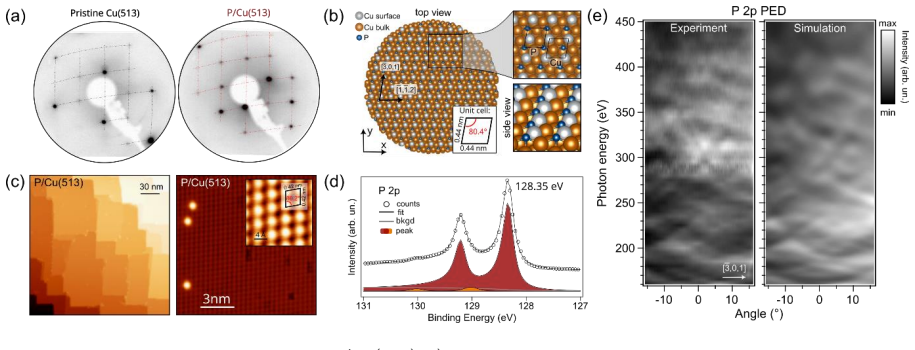
Two-dimensional (2D) materials often require specific substrate terminations for epitaxial stabilization, yet the search for suitable templates has largely focused on low-index metal surfaces, which may not provide the optimal conditions for the growth of new phases. Here, we show that crystal-facet engineering on curved Cu surfaces enables the stabilization, within a single preparation step, of two distinct 2D phosphorus phases with different electronic properties. Hexagonal blue phosphorene forms on Cu(111) terraces, whereas a previously unreported skewed-square phosphorus phase is stabilized on Cu(513) facets. By combining complementary microscopy and spectroscopy techniques with theoretical calculations, we determine the structural and electronic properties of this new phase, which displays semiconducting character, in contrast to the metallic behavior of blue phosphorene. The coexistence of these two competing phases gives rise to a metal-to-semiconducting transition of the 2D phosphorus layer over the substrate. Locally, the competition between the two phases gives rise to self-aligned nanoarrays of alternating metallic and semiconducting phosphorus terraces. These results establish crystal-facet engineering as a practical route for discovering and stabilizing emergent 2D material phases on high-index substrates, while also enabling the engineering of nanostructures with tailored electronic properties through a simple and scalable growth process.
Editorial analysis
A structured set of objections, weighed in public.
Referee Report
Summary. The manuscript demonstrates that crystal-facet engineering on curved Cu surfaces stabilizes two competing 2D phosphorus phases in a single growth step: metallic hexagonal blue phosphorene on Cu(111) terraces and a previously unreported skewed-square phosphorus phase on Cu(513) facets. Complementary microscopy, spectroscopy, and DFT calculations are used to assign structures and electronic characters; the phase coexistence produces a metal-to-semiconducting transition across the substrate and self-aligned alternating metallic/semiconducting nanoarrays.
Significance. If the structural assignments and electronic distinction hold, the work provides a practical, scalable route to engineer hybrid 2D nanostructures with spatially modulated properties directly on high-index metal facets, extending beyond conventional low-index templates.
major comments (2)
- [electronic properties / DFT section (likely §4 or equivalent)] The central claim that the skewed-square phase is distinctly semiconducting (while blue phosphorene is metallic) rests on the joint microscopy/spectroscopy + DFT identification. The electronic distinction is load-bearing for the reported metal-to-semiconducting transition and nanoarray formation; however, the DFT gap assignment for the new phase appears to be performed without explicit substrate-hybridization corrections or functional benchmarking, and no direct experimental gap measurement (e.g., STS dI/dV or ARPES) is reported to cross-validate the semiconducting character against possible substrate-induced metallization.
- [structural characterization (likely §3)] The structural assignment of the skewed-square phase to Cu(513) facets and its distinction from blue phosphorene relies on microscopy and spectroscopy; the manuscript must demonstrate that the observed terrace periodicity and local electronic contrast unambiguously map to the two phases rather than substrate reconstruction or mixed domains.
minor comments (2)
- [methods / experimental section] Figure captions should explicitly state the substrate temperature, phosphorus flux, and annealing conditions used for the single-step growth to allow reproducibility.
- [throughout] Notation for the new phase (e.g., lattice parameters of the skewed-square structure) should be defined consistently between text, figures, and supplementary information.
Simulated Author's Rebuttal
We thank the referee for the constructive and detailed comments, which have helped clarify key aspects of our work. We address each major comment below and indicate the revisions made to the manuscript.
read point-by-point responses
-
Referee: The central claim that the skewed-square phase is distinctly semiconducting (while blue phosphorene is metallic) rests on the joint microscopy/spectroscopy + DFT identification. The electronic distinction is load-bearing for the reported metal-to-semiconducting transition and nanoarray formation; however, the DFT gap assignment for the new phase appears to be performed without explicit substrate-hybridization corrections or functional benchmarking, and no direct experimental gap measurement (e.g., STS dI/dV or ARPES) is reported to cross-validate the semiconducting character against possible substrate-induced metallization.
Authors: We agree that explicit substrate-hybridization corrections and functional benchmarking would strengthen the DFT results. In the revised manuscript we have added calculations using PBE, HSE06, and optB88-vdW functionals, together with explicit Cu(513) slab models that include interface hybridization; these confirm a finite gap for the skewed-square phase. We have inserted the new data and discussion into the electronic-properties section. However, we do not have STS or ARPES spectra for the high-index facets and cannot acquire them within the present revision. revision: partial
-
Referee: The structural assignment of the skewed-square phase to Cu(513) facets and its distinction from blue phosphorene relies on microscopy and spectroscopy; the manuscript must demonstrate that the observed terrace periodicity and local electronic contrast unambiguously map to the two phases rather than substrate reconstruction or mixed domains.
Authors: We have revised §3 to include additional STM line profiles, FFT analysis of the observed periodicities, and direct comparison with DFT-relaxed structures on Cu(513). These show that the measured lattice constants and contrast match the skewed-square phosphorus phase and are inconsistent with known Cu reconstructions. Multi-sample statistics and facet-correlated phase separation are now presented to exclude mixed-domain interpretations. revision: yes
- Direct experimental band-gap measurement (STS dI/dV or ARPES) on the skewed-square phase to independently confirm its semiconducting character.
Circularity Check
No significant circularity; experimental and computational results are independent of self-referential inputs.
full rationale
The paper reports experimental stabilization of two phosphorus phases on different Cu facets via microscopy/spectroscopy, with DFT used to assign structure and electronic character (metallic vs. semiconducting). No equations, fitted parameters, or derivations appear that reduce a claimed prediction to an input by construction. No self-citation chains are invoked to justify uniqueness or ansatzes. The central claim of phase coexistence and nanoarray formation rests on direct observation and standard computational characterization rather than any self-definitional or fitted-input loop, making the derivation self-contained against external benchmarks.
Axiom & Free-Parameter Ledger
Reference graph
Works this paper leans on
-
[1]
Characterization of the P/Cu(513) system. Phosphorous deposition on a curved Cu crystal that exposes (111) vicinal surfaces , referred here to as c-Cu(645), allowed us to reveal the coexistence of two stable and competing P phases: the so-called blue-P growing on the Cu(111) surface and a skewed- square P structure growing on Cu(513) terraces. For the sak...
-
[2]
P-induced faceting on a curved Cu substrate. Having fully characterized the structural and electronic properties of the Skewed-P phase, we now investigate its role as one of the two competing P phases that stabilize on the vicinal Cu(111) surfaces. To do so, we used a curved Cu crystal, referred to here as c- Cu(645), which exposes fully-kinked (111) vici...
-
[3]
Y. C. Lin et al., Recent Advances in 2D Material Theory, Synthesis, Properties, and Applications, ACS Nano 17, 9694 (2023)
2023
-
[4]
J. Dong, L. Zhang, X. Dai, and F. Ding, The epitaxy of 2D materials growth, Nature Communications 2020 11:1 11, 5862 (2020)
2020
-
[5]
Si and T
N. Si and T. Niu, Epitaxial growth of elemental 2D materials: What can we learn from the periodic table?, Nano Today 30, 100805 (2020)
2020
-
[6]
C. Liu, T. Liu, Z. Zhang, Z. Sun, G. Zhang, E. Wang, and K. Liu, Understanding epitaxial growth of two-dimensional materials and their homostructures, Nature Nanotechnology 2024 19:7 19, 907 (2024)
2024
-
[7]
Zhang, P
L. Zhang, P. Peng, and F. Ding, Epitaxial Growth of 2D Materials on High-Index Substrate Surfaces, Adv. Funct. Mater. 31, 2100503 (2021)
2021
-
[8]
Ronci, G
F. Ronci, G. Serrano, P. Gori, A. Cricenti, and S. Colonna, Silicon-induced faceting at the Ag(110) surface, Phys. Rev. B Condens. Matter Mater. Phys. 89, 115437 (2014)
2014
-
[9]
Schiller, M
F. Schiller, M. Corso, J. Cordón, F. J. G. De Abajo, and J. E. Ortega, Interplay between electronic states and structure during Au faceting, New J. Phys. 10, (2008)
2008
-
[10]
M. Ilyn, A. Magaña, A. L. Walter, J. Lobo-Checa, D. G. De Oteyza, F. Schiller, and J. E. Ortega, Step-doubling at Vicinal Ni(111) Surfaces Investigated with a Curved Crystal, Journal of Physical Chemistry C 121, 3880 (2017)
2017
-
[11]
J. E. Ortega, G. Vasseur, I. Piquero-Zulaica, S. Matencio, M. A. Valbuena, J. E. Rault, F. Schiller, M. Corso, A. Mugarza, and J. Lobo-Checa, Structure and electronic states of vicinal Ag(111) surfaces with densely kinked steps, New J. Phys. 20, (2018)
2018
-
[12]
J. E. Ortega, M. Corso, Z. M. Abd-El-Fattah, E. A. Goiri, and F. Schiller, Interplay between structure and electronic states in step arrays explored with curved surfaces, Phys. Rev. B Condens. Matter Mater. Phys. 83, (2011)
2011
-
[13]
Corso, F
M. Corso, F. Schiller, L. Fernndez, J. Cordón, and J. E. Ortega, Electronic states in faceted Au(111) studied with curved crystal surfaces, Journal of Physics: Condensed Matter 21, 353001 (2009)
2009
-
[14]
Fernandez, A
L. Fernandez, A. A. Makarova, C. Laubschat, D. V. Vyalikh, D. Y. Usachov, J. E. Ortega, and F. Schiller, Boron nitride monolayer growth on vicinal Ni(1 1 1) surfaces systematically studied with a curved crystal, 2d Mater. 6, 025013 (2019)
2019
-
[15]
Ali et al., Atomically-Precise Texturing of Hexagonal Boron Nitride Nanostripes, Advanced Science 8, 2101455 (2021)
K. Ali et al., Atomically-Precise Texturing of Hexagonal Boron Nitride Nanostripes, Advanced Science 8, 2101455 (2021)
2021
-
[16]
Vondráček, D
M. Vondráček, D. Kalita, M. Kučera, L. Fekete, J. Kopeček, J. Lančok, J. Coraux, V. Bouchiat, and J. Honolka, Nanofaceting as a stamp for periodic graphene charge carrier modulations, Scientific Reports 2016 6:1 6, 23663 (2016)
2016
-
[17]
V. Tran, R. Soklaski, Y. Liang, and L. Yang, Layer-controlled band gap and anisotropic excitons in few-layer black phosphorus, Phys. Rev. B 89, 235319 (2014)
2014
-
[18]
Castellanos-Gomez, Black Phosphorus: Narrow Gap, Wide Applications, Journal of Physical Chemistry Letters 6, 4280 (2015)
A. Castellanos-Gomez, Black Phosphorus: Narrow Gap, Wide Applications, Journal of Physical Chemistry Letters 6, 4280 (2015)
2015
-
[19]
L. Kou, C. Chen, and S. C. Smith, Phosphorene: Fabrication, Properties, and Applications, Journal of Physical Chemistry Letters 6, 2794 (2015)
2015
-
[20]
L. Li, Y. Yu, G. J. Ye, Q. Ge, X. Ou, H. Wu, D. Feng, X. H. Chen, and Y. Zhang, Black phosphorus field-effect transistors, Nature Nanotechnology 2014 9:5 9, 372 (2014)
2014
-
[21]
F. Xia, H. Wang, and Y. Jia, Rediscovering black phosphorus as an anisotropic layered material for optoelectronics and electronics, Nat. Commun. 5, (2014)
2014
-
[22]
Carvalho, M
A. Carvalho, M. Wang, X. Zhu, A. S. Rodin, H. Su, and A. H. Castro Neto, Phosphorene: from theory to applications, Nature Reviews Materials 2016 1:11 1, 1 (2016)
2016
-
[23]
H. Liu, A. T. Neal, Z. Zhu, Z. Luo, X. Xu, D. Tománek, and P. D. Ye, Phosphorene: An unexplored 2D semiconductor with a high hole mobility, ACS Nano 8, 4033 (2014)
2014
-
[24]
Batmunkh, M
M. Batmunkh, M. Bat-Erdene, and J. G. Shapter, Phosphorene and Phosphorene-Based Materials – Prospects for Future Applications, Advanced Materials 28, 8586 (2016)
2016
-
[25]
Zhang, X
J. Zhang, X. Dong, S. Xu, Y. Xia, W. Ho, H. Xu, and M. Xie, Metal-phosphorus network on Pt(111), 2d Mater. 9, (2022)
2022
-
[26]
Heikkinen, H
O. Heikkinen, H. Pinto, G. Sinha, S. K. Hämäläinen, J. Sainio, S. Öberg, P. R. Briddon, A. S. Foster, and J. Lahtinen, Characterization of a Hexagonal Phosphorus Adlayer on Platinum (111), Journal of Physical Chemistry C 119, 12291 (2015)
2015
-
[27]
Heikkinen, A
O. Heikkinen, A. Riihimäki, J. Sainio, and J. Lahtinen, Phosphorus adlayers on Platinum (110), Surf. Sci. 664, 216 (2017)
2017
-
[28]
J. L. Zhang et al., Phosphorus Nanostripe Arrays on Cu(110): A Case Study to Understand the Substrate Effect on the Phosphorus thin Film Growth, Adv. Mater. Interfaces 4, 1601167 (2017)
2017
-
[29]
Bassotti, L
M. Bassotti, L. Floreano, L. Schio, S. Salaverria, D. G. de Oteyza, G. Giorgi, F. Schiller, and A. Verdini, Suppressing Metal–Molecule Charge Transfer With a Phosphorus Interlayer, Adv. Mater. Interfaces 13, e00969 (2026)
2026
-
[30]
Del Puppo et al., Blue phosphorene on Au(111): theoretical, spectroscopic and diffraction analysis reveal the role of single Au adatoms, Nanoscale Adv
S. Del Puppo et al., Blue phosphorene on Au(111): theoretical, spectroscopic and diffraction analysis reveal the role of single Au adatoms, Nanoscale Adv. 6, 3582 (2024)
2024
-
[31]
Kaddar et al., Dirac Fermions in Blue Phosphorene Monolayer, Adv
Y. Kaddar et al., Dirac Fermions in Blue Phosphorene Monolayer, Adv. Funct. Mater. 33, 2213664 (2023)
2023
-
[32]
Y. H. Song, M. U. Muzaffar, Q. Wang, Y. Wang, Y. Jia, P. Cui, W. Zhang, X. Sen Wang, and Z. Zhang, Realization of large-area ultraflat chiral blue phosphorene, Nat. Commun. 15, (2024)
2024
-
[33]
Y. H. Song et al., Hierarchical Phosphorene Growth Pathway Mediated by Competing P–Cu and P–P Interactions, Nano Lett. 25, 17237 (2025)
2025
-
[34]
J. L. Zhang et al., Synthesis of Monolayer Blue Phosphorus Enabled by Silicon Intercalation, ACS Nano 14, 3687 (2020)
2020
-
[35]
Zhang, H
W. Zhang, H. Enriquez, Y. Tong, A. J. Mayne, A. Bendounan, A. Smogunov, Y. J. Dappe, A. Kara, G. Dujardin, and H. Oughaddou, Flat epitaxial quasi-1D phosphorene chains, Nature Communications 2021 12:1 12, 1 (2021)
2021
-
[36]
L. Ding, P. Shao, Y. Yin, and F. Ding, Synthesis of 2D Phosphorene: Current Status and Challenges, Adv. Funct. Mater. 34, 2316612 (2024)
2024
-
[37]
Y. Wang, C. Hua, S. Sun, J. Gou, S. Duan, A. T. S. Wee, M. Zhou, Y. L. Huang, and W. Chen, Evolution of Low-Dimensional Phosphorus Allotropes on Ag(111), Chemistry of Materials 34, 10651 (2022)
2022
-
[38]
J. Lu, X. Zhang, D. Liu, N. Yang, H. Huang, S. Jin, J. Wang, P. K. Chu, and X. F. Yu, Modulation of Phosphorene for Optimal Hydrogen Evolution Reaction, ACS Appl. Mater. Interfaces 11, 37787 (2019)
2019
-
[39]
Zhang, X
W. Zhang, X. Zhang, L. K. Ono, Y. Qi, and H. Oughaddou, Recent Advances in Phosphorene: Structure, Synthesis, and Properties, Small 20, 2303115 (2024)
2024
-
[40]
Jones, M
G. Jones, M. J. Gladys, J. Ottal, S. J. Jenkins, and G. Held, Surface geometry of Cu{531}, Phys. Rev. B 79, 165420 (2009)
2009
-
[41]
Despont, D
L. Despont, D. Naumović, F. Clerc, C. Koitzsch, M. G. Garnier, F. J. Garcia De Abajo, M. A. Van Hove, and P. Aebi, X-ray photoelectron diffraction study of Cu(1 1 1): Multiple scattering investigation, Surf. Sci. 600, 380 (2006)
2006
-
[42]
Haverkamp, S
R. Haverkamp, S. Neppl, and A. Föhlisch, Near-Isotropic Local Attosecond Charge Transfer within the Anisotropic Puckered Layers of Black Phosphorus, J. Phys. Chem. Lett. 14, 8765 (2023)
2023
-
[43]
Hüfner, Photoelectron Spectroscopy, (2003)
S. Hüfner, Photoelectron Spectroscopy, (2003)
2003
-
[44]
García-Martínez, E
F. García-Martínez, E. Turco, F. Schiller, and J. E. Ortega, CO and O2 Interaction with Kinked Pt Surfaces, ACS Catal. 14, 6319 (2024)
2024
-
[45]
Garcia-Martinez, F
F. Garcia-Martinez, F. Schiller, S. Blomberg, M. Shipilin, L. R. Merte, J. Gustafson, E. Lundgren, and J. E. Ortega, CO Chemisorption on Vicinal Rh(111) Surfaces Studied with a Curved Crystal, The Journal of Physical Chemistry C 124, 9305 (2020)
2020
-
[46]
Diller, F
K. Diller, F. Klappenberger, M. Marschall, K. Hermann, A. Nefedov, C. Wöll, and J. V. Barth, Self-metalation of 2H-tetraphenylporphyrin on Cu(111): An x-ray spectroscopy study, Journal of Chemical Physics 136, 14705 (2012)
2012
-
[47]
Sala et al., Black or red phosphorus yields the same blue phosphorus film, Nanoscale 14, 16256 (2022)
A. Sala et al., Black or red phosphorus yields the same blue phosphorus film, Nanoscale 14, 16256 (2022)
2022
-
[48]
Koepernik and H
K. Koepernik and H. Eschrig, Full-potential nonorthogonal local-orbital minimum-basis band- structure scheme, Phys. Rev. B 59, 1743 (1999)
1999
-
[49]
Http://Www.Fplo.De/, (unpublished)
-
[50]
Fang et al., Valence transition and termination-dependent surface states in the topological Kondo semimetal YbPtBi, Phys
Y. Fang et al., Valence transition and termination-dependent surface states in the topological Kondo semimetal YbPtBi, Phys. Rev. B 108, 125110 (2023)
2023
-
[51]
F. J. García de Abajo, M. A. Van Hove, and C. S. Fadley, Multiple scattering of electrons in solids and molecules: A cluster-model approach, Phys. Rev. B 63, 075404 (2001). SUPPLEMENTARY INFORMATION Self-Aligned Metallic–Semiconducting Phosphorus Nanoarrays Driven by Facet Engineering M. Bassotti,a,* M. Tallarida,b J. Dai,b S. Salaverria,c P. Angulo-Portu...
2001
discussion (0)
Sign in with ORCID, Apple, or X to comment. Anyone can read and Pith papers without signing in.