Testing of a 15-Positioner Module Based on the MPS Design for Stage-5 Telescopes
Pith reviewed 2026-06-26 19:32 UTC · model grok-4.3
The pith
A prototype 15-positioner module meets the performance targets for Stage-5 telescopes.
A machine-rendered reading of the paper's core claim, the machinery that carries it, and where it could break.
Core claim
The paper establishes that the measured metrics, including positioning repeatability, datum repeatability, backlash, non-linearity, and angular tilt, of the 15-positioner module are compared directly with the nominal performance targets defined for Stage-5 telescope systems.
What carries the argument
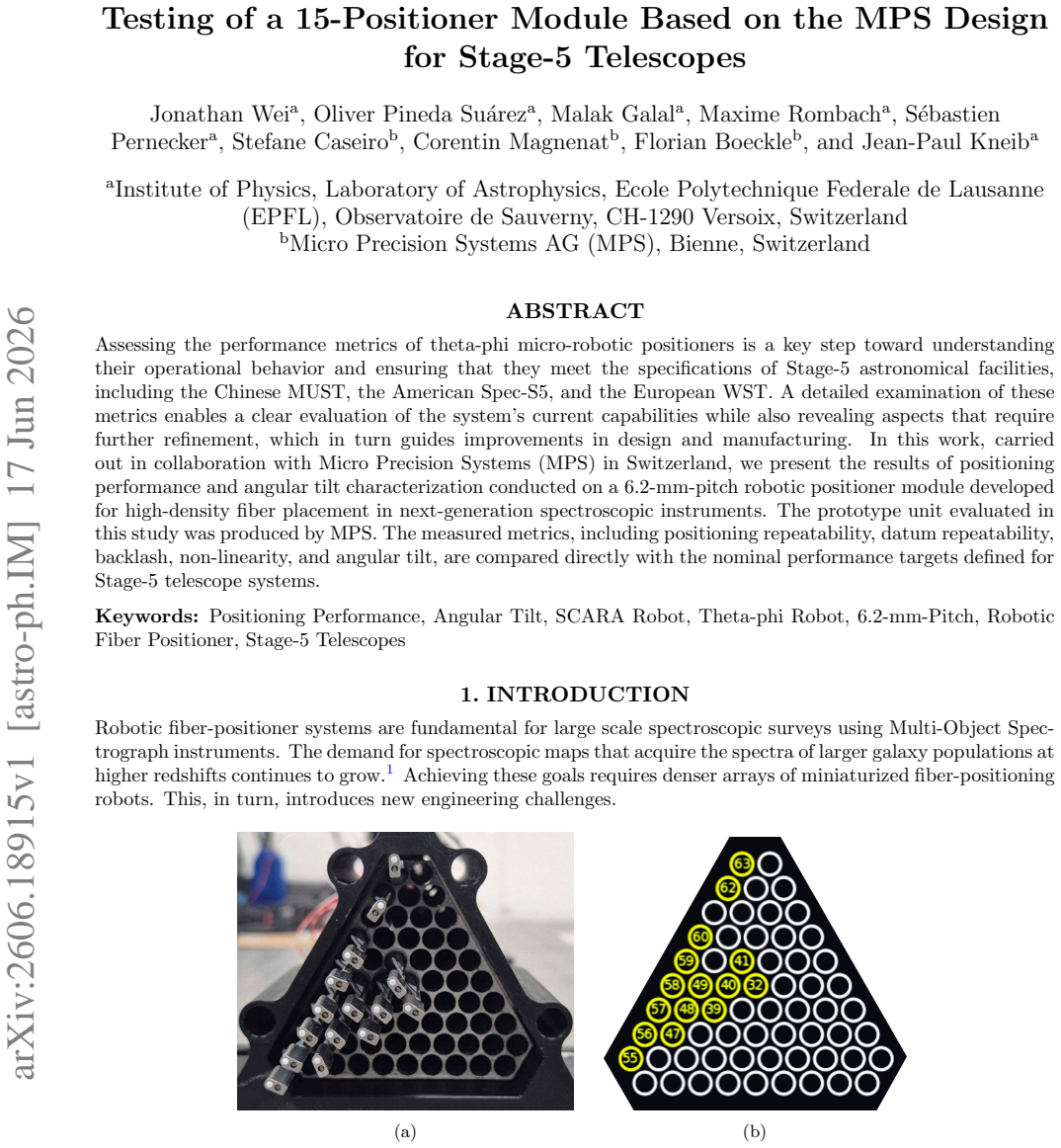
The 15-positioner module using theta-phi micro-robotic positioners at 6.2 mm pitch for high-density fiber placement.
If this is right
- The module's performance supports the operational requirements for high-density fiber placement in spectroscopic instruments.
- Areas for design and manufacturing refinement are identified through the metric evaluation.
- The approach enables assessment of capabilities for facilities planning Stage-5 telescopes.
Where Pith is reading between the lines
- Additional modules should be tested to confirm consistency across units.
- Real-world conditions in telescopes may reveal performance differences not seen in lab tests.
- The results could inform similar positioner designs for other astronomical applications.
Load-bearing premise
The performance metrics from one prototype under test conditions represent the reliability needed for full-scale deployment in Stage-5 facilities.
What would settle it
Finding that the metrics on additional prototypes or in telescope operation exceed the nominal targets would show the design does not yet meet requirements.
Figures
read the original abstract
Assessing the performance metrics of theta-phi micro-robotic positioners is a key step toward understanding their operational behavior and ensuring that they meet the specifications of Stage-5 astronomical facilities, including the Chinese MUST, the American Spec-S5, and the European WST. A detailed examination of these metrics enables a clear evaluation of the system's current capabilities while also revealing aspects that require further refinement, which in turn guides improvements in design and manufacturing. In this work, carried out in collaboration with Micro Precision Systems (MPS) in Switzerland, we present the results of positioning performance and angular tilt characterization conducted on a 6.2-mm-pitch robotic positioner module developed for high-density fiber placement in next-generation spectroscopic instruments. The prototype unit evaluated in this study was produced by MPS. The measured metrics, including positioning repeatability, datum repeatability, backlash, non-linearity, and angular tilt, are compared directly with the nominal performance targets defined for Stage-5 telescope systems.
Editorial analysis
A structured set of objections, weighed in public.
Referee Report
Summary. The manuscript reports performance testing of a 15-positioner robotic module (6.2 mm pitch) developed in collaboration with MPS for high-density fiber placement in Stage-5 spectroscopic facilities (MUST, Spec-S5, WST). It describes measurements of positioning repeatability, datum repeatability, backlash, non-linearity, and angular tilt on a single prototype unit and states that these metrics are compared directly to the nominal performance targets defined for those telescopes.
Significance. If the measured values meet the Stage-5 targets, the work would supply concrete engineering data on a compact theta-phi positioner design that could inform fiber-positioner arrays for next-generation instruments. The explicit comparison to facility requirements and the MPS collaboration are positive elements; however, the single-unit scope restricts the strength of any claim about readiness for large-scale deployment.
major comments (1)
- [Abstract] Abstract (paragraph on prototype evaluation): the central claim that the measured metrics support operational use in Stage-5 systems rests on results from a single 15-positioner prototype. No data on unit-to-unit variation, mechanical coupling across the module, or environmental effects (thermal, vibration) are referenced, so the direct numerical comparison cannot establish representativeness for arrays of thousands of units.
Simulated Author's Rebuttal
We thank the referee for their review and for highlighting the scope limitations of the prototype testing. We address the major comment below and have revised the manuscript accordingly.
read point-by-point responses
-
Referee: [Abstract] Abstract (paragraph on prototype evaluation): the central claim that the measured metrics support operational use in Stage-5 systems rests on results from a single 15-positioner prototype. No data on unit-to-unit variation, mechanical coupling across the module, or environmental effects (thermal, vibration) are referenced, so the direct numerical comparison cannot establish representativeness for arrays of thousands of units.
Authors: We agree that the evaluation is limited to a single prototype unit and that this restricts any inference about unit-to-unit variation, inter-positioner coupling, or environmental robustness. The manuscript reports performance data from this prototype and compares the measured values directly to the Stage-5 targets; it does not claim that the design is ready for large-scale deployment. To address the concern we have revised the abstract to state explicitly that the results are from a single prototype and that additional testing on multiple units and under varied conditions would be required to assess production readiness. revision: yes
Circularity Check
No circularity: direct experimental comparison to external targets
full rationale
The paper reports laboratory measurements of positioning repeatability, datum repeatability, backlash, non-linearity, and angular tilt on a single 15-positioner MPS prototype module, then compares those measured values directly against pre-existing nominal performance targets defined for Stage-5 facilities (MUST, Spec-S5, WST). No equations, fitted parameters, predictions, or derivations appear in the abstract or described content. No self-citations are invoked to justify uniqueness or to close a logical loop. The central claim is therefore an empirical benchmark against independent specifications rather than a self-referential construction.
Axiom & Free-Parameter Ledger
Reference graph
Works this paper leans on
-
[1]
2024 , eprint=
WST -- Widefield Spectroscopic Telescope: Motivation, science drivers and top-level requirements for a new dedicated facility , author=. 2024 , eprint=
2024
-
[2]
2025 , eprint=
MUltiplexed Survey Telescope: Perspectives for Large-Scale Structure Cosmology in the Era of Stage-V Spectroscopic Survey , author=. 2025 , eprint=
2025
-
[3]
The Multi-Object, Fiber-Fed Spectrographs for SDSS and the Baryon Oscillation Spectroscopic Survey
The Multi-object, Fiber-fed Spectrographs for the Sloan Digital Sky Survey and the Baryon Oscillation Spectroscopic Survey. The Astronomical Journal , keywords =. 2013 , month =. doi:10.1088/0004-6256/146/2/32 , archivePrefix =. 1208.2233 , primaryClass =
work page internal anchor Pith review Pith/arXiv arXiv doi:10.1088/0004-6256/146/2/32 2013
-
[4]
Flaugher, Brenna and Bebek, Chris and. The. 2014 , institution =
2014
-
[5]
2025 , eprint=
Prototyping of 6.2-mm-Pitch Fiber Positioner Modules for Stage-V Telescope Instrumentation , author=. 2025 , eprint=
2025
-
[6]
Journal of Astronomical Telescopes, Instruments, and Systems , number =
Luzius Kronig and Philipp H. Journal of Astronomical Telescopes, Instruments, and Systems , number =. 2020 , doi =
2020
-
[7]
25,000 optical fiber positioning robots for next-generation cosmology. arXiv e-prints , keywords =. doi:10.48550/arXiv.2212.07908 , archivePrefix =. 2212.07908 , primaryClass =
-
[8]
Prototyping of 6.2-mm-Pitch Fiber Positioner Modules for Stage-V Telescope Instrumentation
Prototyping of 6.2-mm-Pitch Fiber Positioner Modules for Stage-V Telescope Instrumentation. arXiv e-prints , keywords =. doi:10.48550/arXiv.2508.19711 , archivePrefix =. 2508.19711 , primaryClass =
work page internal anchor Pith review Pith/arXiv arXiv doi:10.48550/arxiv.2508.19711
-
[9]
Precision
Kronig, Luzius Gregor , year =. Precision
-
[10]
Advances in Optical and Mechanical Technologies for Telescopes and Instrumentation VII, Proc
Pineda Su\'arez, Oliver and Wei, Jonathan and Galal, Malak and Daniilidis, Melina and Rombach, Maxime and Pernecker, S\'ebastien and Kneib, Jean-Paul , title =. Advances in Optical and Mechanical Technologies for Telescopes and Instrumentation VII, Proc. SPIE 14154 , year =
-
[11]
Advances in Optical and Mechanical Technologies for Telescopes and Instrumentation VII, Proc
Rombach, Maxime and Galal, Malak and Wei, Jonathan and Caseiro, Stefane and Magnenat, Corentin and Kneib, Jean-Paul , title =. Advances in Optical and Mechanical Technologies for Telescopes and Instrumentation VII, Proc. SPIE 14154 , year =
-
[12]
Advances in Optical and Mechanical Technologies for Telescopes and Instrumentation VII, Proc
W\"uthrich, Johannes and Yamani, Banan and Fazan, Andrin and Lebrun, L\'eonard and MacBride, Sean and Andrade-Oliveira, Felipe and Soares-Santos, Marcelle and Zhao, Guandi , title =. Advances in Optical and Mechanical Technologies for Telescopes and Instrumentation VII, Proc. SPIE 14154 , year =
-
[13]
Advances in Optical and Mechanical Technologies for Telescopes and Instrumentation VII, Proc
Lebrun, L\'eonard and W\"uthrich, Johannes and Fazan, Andrin and MacBride, Sean and Andrade-Oliveira, Felipe and Soares-Santos, Marcelle , title =. Advances in Optical and Mechanical Technologies for Telescopes and Instrumentation VII, Proc. SPIE 14154 , year =
-
[14]
2024 , eprint=
The Wide-field Spectroscopic Telescope (WST) Science White Paper , author=. 2024 , eprint=
2024
-
[15]
Ground-based and Airborne Instrumentation for Astronomy X , editor =
Maxime Rombach and Xiangyu Xu and Ricardo Araujo and Markus Thurneysen and Stefane Caseiro and Corentin Magnenat and Joseph Silber and Malak Galal and David Schlegel and Jean-Paul Kneib , title =. Ground-based and Airborne Instrumentation for Astronomy X , editor =. 2024 , doi =
2024
discussion (0)
Sign in with ORCID, Apple, or X to comment. Anyone can read and Pith papers without signing in.