Measurement-enabled online quantum processing with amplitude encoding
Pith reviewed 2026-06-26 20:22 UTC · model grok-4.3
The pith
Mid-circuit measurements and resets implement amplitude encoding for online quantum reservoir computing.
A machine-rendered reading of the paper's core claim, the machinery that carries it, and where it could break.
Core claim
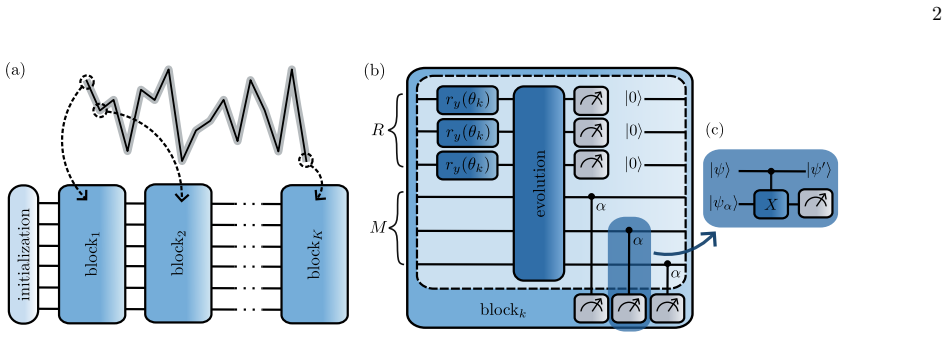
The protocol combines mid-circuit measurement and reset operations to implement the partial-trace dynamics underlying amplitude encoding, while an indirect measurement scheme provides access to reservoir observables without interrupting temporal processing. In contrast to other approaches, the method preserves online operation, avoids input buffering, and keeps the runtime linear in the number of time steps.
What carries the argument
Mid-circuit measurement and reset operations that realize partial-trace dynamics for amplitude encoding, paired with an indirect measurement scheme for accessing reservoir observables.
If this is right
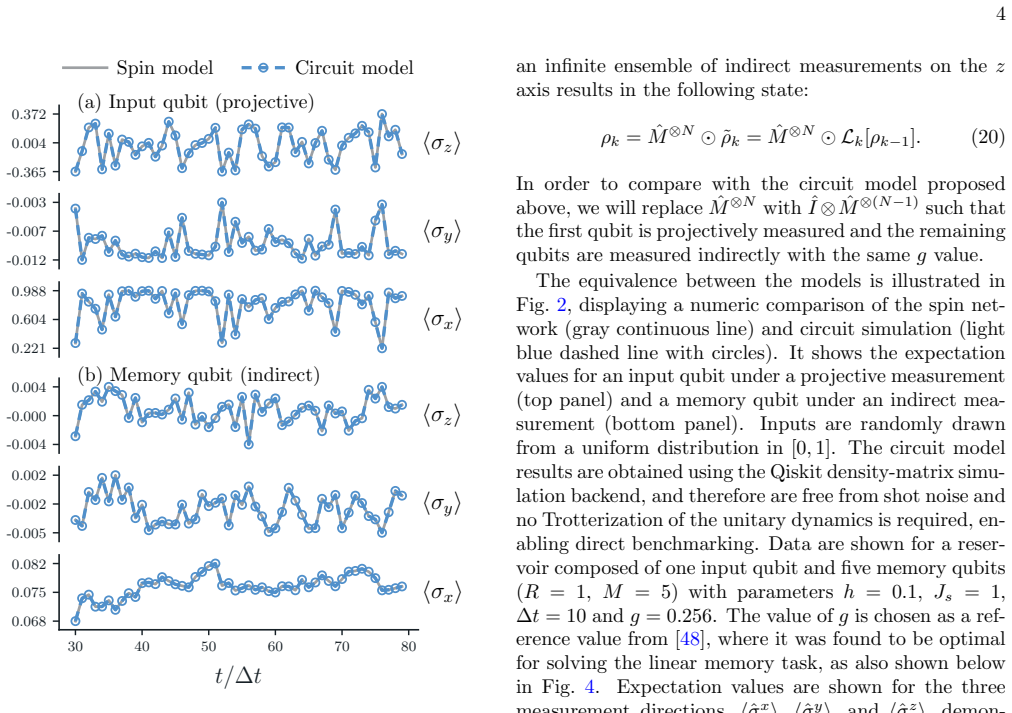
- Reservoir dynamics can be monitored through both direct measurements of the input qubits and indirect measurements of the memory qubits.
- The full system can be observed while isolating the internal evolution of the reservoir.
- The approach provides a practical route toward scalable hardware implementations of amplitude-encoded quantum reservoir computing.
- Systematic experimental studies of complex quantum reservoirs become feasible.
Where Pith is reading between the lines
- The same mid-circuit technique might apply to other online quantum machine learning models that rely on partial traces.
- If hardware fidelity improves, the linear runtime could support longer temporal sequences than buffering-based methods.
- Comparing direct versus indirect measurement accuracy on noisy hardware would test whether the indirect scheme truly isolates internal evolution.
Load-bearing premise
Mid-circuit measurement and reset operations on current quantum hardware can be performed with fidelity high enough to preserve the intended partial-trace reservoir dynamics.
What would settle it
An experiment in which reservoir performance on benchmark tasks degrades nonlinearly with added time steps due to accumulated errors from mid-circuit operations would show the dynamics are not preserved.
Figures
read the original abstract
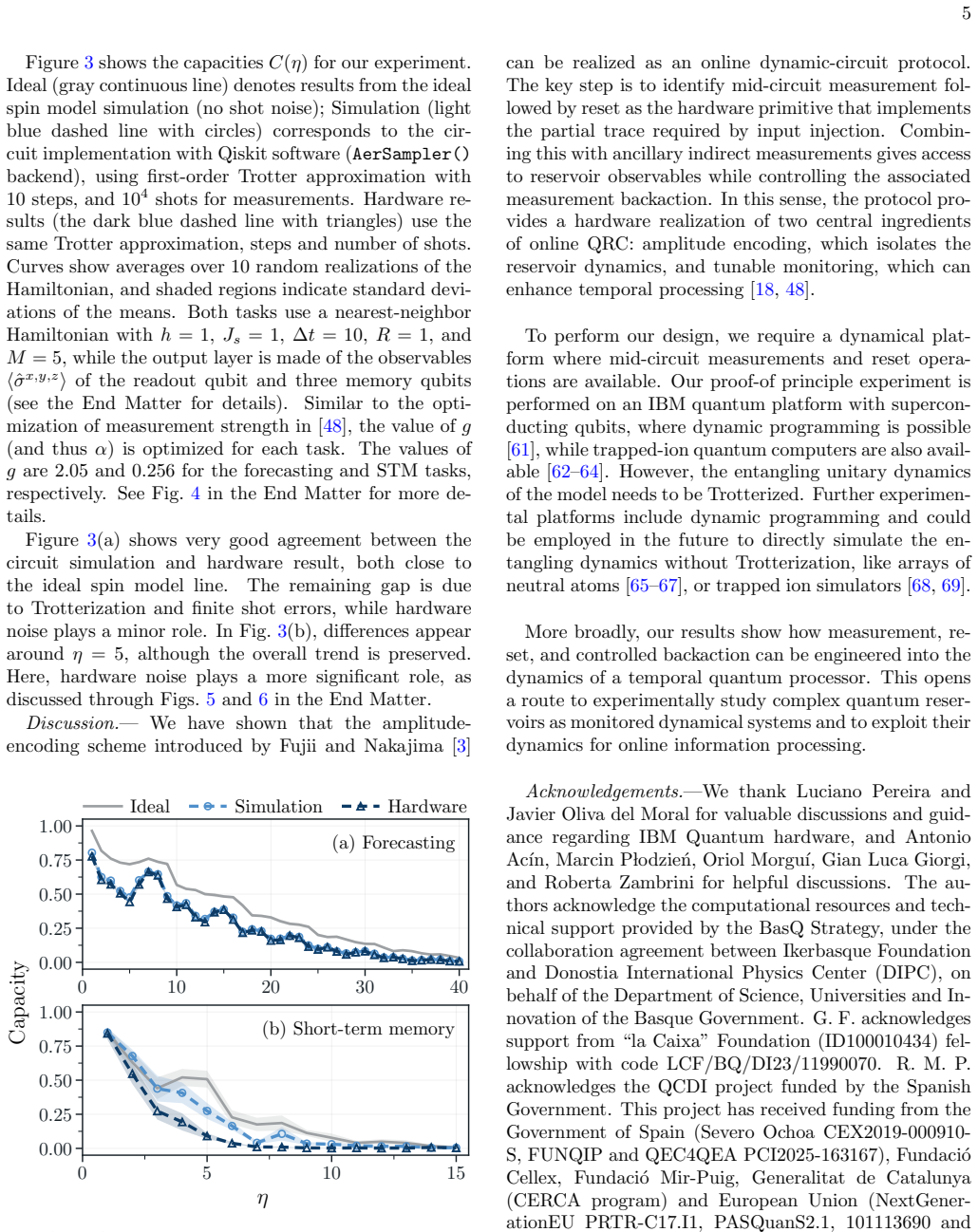
We introduce a quantum reservoir computing online protocol that realizes amplitude encoding on quantum hardware. Our scheme combines mid-circuit measurement and reset operations to implement the partial-trace dynamics underlying amplitude encoding, while an indirect measurement scheme provides access to reservoir observables without interrupting temporal processing. In contrast to other approaches, our method preserves online operation, avoids input buffering, and keeps the runtime linear in the number of time steps. We present the theoretical formulation of the protocol and a proof-of-principle implementation on quantum hardware, and we evaluate its performance on two standard benchmark tasks. Our results show that the reservoir dynamics can be monitored through both direct measurements of the input qubits and indirect measurements of the memory qubits, enabling observation of the full system while isolating the internal evolution of the reservoir. This work provides a practical route toward scalable hardware implementations of amplitude-encoded quantum reservoir computing and opens the door to systematic experimental studies of complex quantum reservoirs.
Editorial analysis
A structured set of objections, weighed in public.
Referee Report
Summary. The manuscript introduces an online quantum reservoir computing protocol that realizes amplitude encoding via mid-circuit measurements and resets to implement the required partial-trace dynamics. An indirect measurement scheme is used to access reservoir observables without interrupting temporal processing. The approach is claimed to preserve online operation, avoid input buffering, and achieve runtime linear in the number of time steps. The paper provides a theoretical formulation, a proof-of-principle demonstration on quantum hardware, and performance evaluation on two standard benchmark tasks, with results indicating that reservoir dynamics can be monitored via both direct input-qubit measurements and indirect memory-qubit measurements.
Significance. If the experimental results hold, the work supplies a practical route to scalable amplitude-encoded quantum reservoir computing on near-term hardware. The explicit experimental validation on quantum hardware, combined with the linear-runtime online protocol, constitutes a falsifiable test of the central construction and strengthens the case for hardware-feasible quantum reservoirs.
minor comments (2)
- The abstract refers to 'two standard benchmark tasks' without naming them; these should be identified explicitly in the abstract or introduction to allow readers to assess the scope of the evaluation immediately.
- Figure captions and axis labels in the hardware-results section should include error bars or uncertainty quantification to make the comparison between direct and indirect measurements fully interpretable.
Simulated Author's Rebuttal
We thank the referee for the positive summary, the assessment of significance, and the recommendation of minor revision. No major comments are listed in the report, so we have no specific points requiring rebuttal or clarification at this stage. We will incorporate any minor suggestions during revision.
Circularity Check
No circularity: protocol is a direct construction
full rationale
The paper introduces a new quantum reservoir computing protocol that combines mid-circuit measurement and reset to realize partial-trace dynamics for amplitude encoding, plus an indirect measurement scheme. No load-bearing equations, fitted parameters, or predictions are described that reduce by construction to the inputs; the runtime linearity and online operation follow directly from the stated operations without self-referential definitions or self-citation chains. The derivation is self-contained as an explicit hardware construction.
Axiom & Free-Parameter Ledger
axioms (1)
- standard math Standard postulates of quantum mechanics, including the effect of projective measurement and partial trace on density operators
Reference graph
Works this paper leans on
-
[1]
Ghosh, K
S. Ghosh, K. Nakajima, T. Krisnanda, K. Fujii, and T. C. H. Liew, Quantum neuromorphic computing with reservoir computing networks, Adv. Quantum Technol. 4, 2100053 (2021)
2021
-
[2]
Mujal, R
P. Mujal, R. Mart´ ınez-Pe˜ na, J. Nokkala, J. Garc´ ıa-Beni, G. L. Giorgi, M. C. Soriano, and R. Zambrini, Oppor- tunities in quantum reservoir computing and extreme learning machines, Adv. Quantum Technol.4, 2100027 (2021)
2021
-
[3]
Fujii and K
K. Fujii and K. Nakajima, Harnessing disordered- ensemble quantum dynamics for machine learning, Phys. Rev. Appl.8, 024030 (2017)
2017
-
[4]
Nakajima, K
K. Nakajima, K. Fujii, M. Negoro, K. Mitarai, and M. Kitagawa, Boosting computational power through spatial multiplexing in quantum reservoir computing, Phys. Rev. Appl.11, 034021 (2019)
2019
-
[5]
Chen and H
J. Chen and H. I. Nurdin, Learning nonlinear input– output maps with dissipative quantum systems, Quan- tum Inf. Process.18, 1 (2019)
2019
-
[6]
Kutvonen, K
A. Kutvonen, K. Fujii, and T. Sagawa, Optimizing a quantum reservoir computer for time series prediction, Sci. Rep.10, 1 (2020)
2020
-
[7]
Q. H. Tran and K. Nakajima, Higher-order quantum reservoir computing, arXiv:2006.08999 (2020)
arXiv 2006
-
[8]
Mart´ ınez-Pe˜ na, J
R. Mart´ ınez-Pe˜ na, J. Nokkala, G. L. Giorgi, R. Zambrini, and M. C. Soriano, Information processing capacity of spin-based quantum reservoir computing systems, Cogn. Comput. , 1 (2020)
2020
-
[9]
Mart´ ınez-Pe˜ na, G
R. Mart´ ınez-Pe˜ na, G. L. Giorgi, J. Nokkala, M. C. So- riano, and R. Zambrini, Dynamical phase transitions in quantum reservoir computing, Phys. Rev. Lett.127, 100502 (2021)
2021
-
[10]
Nokkala, R
J. Nokkala, R. Mart´ ınez-Pe˜ na, G. L. Giorgi, V. Pa- rigi, M. C. Soriano, and R. Zambrini, Gaussian states of continuous-variable quantum systems provide univer- sal and versatile reservoir computing, Commun. Phys.4, 1 (2021)
2021
-
[11]
Nokkala, R
J. Nokkala, R. Mart´ ınez-Pe˜ na, R. Zambrini, and M. C. Soriano, High-performance reservoir computing with fluctuations in linear networks, IEEE Trans. Neural Netw. Learn. Syst.33, 2664 (2022)
2022
-
[12]
Mujal, J
P. Mujal, J. Nokkala, R. Mart´ ınez-Pe˜ na, G. L. Giorgi, M. C. Soriano, and R. Zambrini, Analytical evidence of nonlinearity in qubits and continuous-variable quan- tum reservoir computing, J. Phys.: Complex.2, 045008 (2021)
2021
-
[13]
W. Xia, J. Zou, X. Qiu, and X. Li, The reservoir learn- ing power across quantum many-body localization tran- sition, Front. Phys.17, 1 (2022)
2022
-
[14]
Mujal, Quantum reservoir computing for speckle dis- order potentials, Condens
P. Mujal, Quantum reservoir computing for speckle dis- order potentials, Condens. Matter7, 17 (2022)
2022
-
[15]
Vintskevich and D
S. Vintskevich and D. Grigoriev, Computing with two quantum reservoirs connected via optimized two-qubit nonselective measurements, inQuantum 2.0(Optica Publishing Group, 2022) pp. QW2A–48
2022
-
[16]
W. Xia, J. Zou, X. Qiu, F. Chen, B. Zhu, C. Li, D.-L. Deng, and X. Li, Configured quantum reservoir comput- ing for multi-task machine learning, Sci. Bull.68, 2321 (2023)
2023
-
[17]
Llodr` a, C
G. Llodr` a, C. Charalambous, G. L. Giorgi, and R. Zam- brini, Benchmarking the role of particle statistics in quantum reservoir computing, Adv. Quantum Technol. 6, 2200100 (2023)
2023
-
[18]
Mujal, R
P. Mujal, R. Mart´ ınez-Pe˜ na, G. L. Giorgi, M. C. Soriano, and R. Zambrini, Time-series quantum reservoir comput- ing with weak and projective measurements, Npj Quan- tum Inf.9, 16 (2023)
2023
-
[19]
G¨ otting, F
N. G¨ otting, F. Lohof, and C. Gies, Exploring quantum- ness in quantum reservoir computing, Phys. Rev. A108, 052427 (2023)
2023
-
[20]
Mlika, S
Z. Mlika, S. Cherkaoui, J. F. Laprade, and S. Corbeil- Letourneau, User trajectory prediction in mobile wire- less networks using quantum reservoir computing, IET Quantum Commun.4, 125 (2023)
2023
-
[21]
Garc´ ıa-Beni, G
J. Garc´ ıa-Beni, G. L. Giorgi, M. C. Soriano, and R. Zam- brini, Scalable photonic platform for real-time quantum reservoir computing, Phys. Rev. Appl.20, 014051 (2023)
2023
-
[22]
L. Domingo, M. Grande, G. Carlo, F. Borondo, and J. Borondo, Optimal quantum reservoir computing for market forecasting: An application to fight food price crises, arXiv:2401.03347 (2023)
arXiv 2023
-
[23]
Kobayashi and Y
K. Kobayashi and Y. Motome, Quantum reservoir prob- ing: An inverse paradigm of quantum reservoir comput- ing for exploring quantum many-body physics, SciPost Phys.18, 198 (2025)
2025
-
[24]
Nokkala, G
J. Nokkala, G. L. Giorgi, and R. Zambrini, Retriev- ing past quantum features with deep hybrid classical- quantum reservoir computing, Mach. Learn.: Sci. Tech- nol.5, 035022 (2024)
2024
-
[25]
Garc´ ıa-Beni, G
J. Garc´ ıa-Beni, G. Luca Giorgi, M. C. Soriano, and R. Zambrini, Squeezing as a resource for time series pro- cessing in quantum reservoir computing, Opt. Express 32, 6733 (2024)
2024
-
[26]
Palacios, R
A. Palacios, R. Mart´ ınez-Pe˜ na, M. C. Soriano, G. L. Giorgi, and R. Zambrini, Role of coherence in many- body quantum reservoir computing, Commun. Phys.7, 369 (2024)
2024
-
[27]
ˇCindrak, B
S. ˇCindrak, B. Donvil, K. L¨ udge, and L. Jaurigue, En- hancing the performance of quantum reservoir comput- ing and solving the time-complexity problem by artificial memory restriction, Phys. Rev. Res.6, 013051 (2024)
2024
-
[28]
S. Kobayashi, Q. H. Tran, and K. Nakajima, Coherence influx is indispensable for quantum reservoir computing, arXiv:2409.12693 (2024)
arXiv 2024
-
[29]
Kobayashi, Q
S. Kobayashi, Q. H. Tran, and K. Nakajima, Extend- ing echo state property for quantum reservoir computing, Phys. Rev. E110, 024207 (2024)
2024
-
[30]
Llodr` a, P
G. Llodr` a, P. Mujal, R. Zambrini, and G. L. Giorgi, Quantum reservoir computing in atomic lattices, Chaos Solitons Fractals195, 116289 (2025)
2025
-
[31]
Hahto and J
M. Hahto and J. Nokkala, Smarter usage of measure- ment statistics can greatly improve continuous variable quantum reservoir computing, New J. Phys.27, 094510 (2025)
2025
-
[32]
M. N. Ivaki, A. Lazarides, and T. Ala-Nissila, Quantum reservoir computing on random regular graphs, Phys. Rev. A112, 012622 (2025)
2025
-
[33]
ˇCindrak, L
S. ˇCindrak, L. Jaurigue, and K. L¨ udge, Engineering quantum reservoirs through krylov complexity, expressiv- ity, and observability, Phys. Rev. Res.7, 043190 (2025)
2025
-
[34]
ˇCindrak, K
S. ˇCindrak, K. L¨ udge, and L. Jaurigue, From krylov com- plexity to observability: Capturing phase space dimen- 7 sion with applications in quantum reservoir computing, Phys. Rev. Res.7, L042039 (2025)
2025
-
[35]
Sch¨ utte, N
N.-E. Sch¨ utte, N. G¨ otting, H. M¨ untinga, C. Gies, and M. List, Expressive limits of quantum reservoir comput- ing, inQuantum Computing, Communication, and Sim- ulation V(SPIE, 2025) p. PC133910M
2025
-
[36]
Steinegger and C
J. Steinegger and C. R¨ ath, Predicting three-dimensional chaotic systems with four qubit quantum systems, Sci. Rep.15, 6201 (2025)
2025
-
[37]
Y. Kora and C. Simon, Statistical noise enhances quan- tumness benefits in spin-network quantum reservoir com- puting, arXiv:2504.17837 (2025)
Pith/arXiv arXiv 2025
- [38]
-
[39]
Kobayashi and Y
K. Kobayashi and Y. Motome, Quantum reservoir prob- ing of quantum phase transitions, Nat. Commun.16, 3871 (2025)
2025
-
[40]
Kobayashi and Y
K. Kobayashi and Y. Motome, Edge of many-body quan- tum chaos in quantum reservoir computing, Phys. Rev. Lett.136, 040602 (2026)
2026
- [41]
- [42]
- [43]
-
[44]
Jain and R
V. Jain and R. Maulik, Higher order quantum reser- voir computing for non-intrusive reduced-order models, inAIAA SCITECH 2026 Forum(2026) p. 1419
2026
-
[45]
M. Kawanabe, S. Cindrak, K. Luedge, J.-i. Shirakashi, T. Shibuya, and H. Imai, Efficient time-series prediction on nisq devices via time-delayed quantum extreme learn- ing machine, arXiv:2602.21544 (2026)
Pith/arXiv arXiv 2026
-
[46]
S. ˇCindrak, L. Giebeler, N. G¨ otting, C. Gies, and K. L¨ udge, Memory-nonlinearity trade-off across quan- tum reservoir computing frameworks, arXiv:2603.21371 (2026)
arXiv 2026
-
[47]
P. Sun, L. Wang, L.-J. Kong, Y. Sun, and X. Zhang, Correlated optical reservoir computing, Laser Photonics Rev. , e01823 (2026)
2026
-
[48]
Franceschetto, M
G. Franceschetto, M. P lodzie´ n, M. Lewenstein, A. Ac´ ın, and P. Mujal, Harnessing quantum backaction for time- series processing, Phys. Rev. X16, 021002 (2026)
2026
-
[49]
F. Hu, S. A. Khan, N. T. Bronn, G. Angelatos, G. E. Rowlands, G. J. Ribeill, and H. E. T¨ ureci, Overcoming the coherence time barrier in quantum machine learning on temporal data, Nat. Commun.15, 7491 (2024)
2024
-
[50]
W. Hamhoum, S. Cherkaoui, J.-F. Laprade, O. Ahmed, and S. Wang, Multivariate time series forecasting with gate-based quantum reservoir computing on nisq hard- ware, arXiv:2510.13634 (2025)
arXiv 2025
-
[51]
J. Chen, H. I. Nurdin, and N. Yamamoto, Temporal in- formation processing on noisy quantum computers, Phys. Rev. Appl.14, 024065 (2020)
2020
- [52]
-
[53]
E. Ricci, F. Monzani, L. Nigro, and E. Prati, Quantum reservoir computing induced by controllable damping, Npj Quantum Inf. 10.1038/s41534-026-01229-8 (2026)
-
[54]
Negoro, K
M. Negoro, K. Mitarai, K. Nakajima, and K. Fujii, To- ward nmr quantum reservoir computing, inReservoir computing: theory, physical implementations, and appli- cations(Springer, 2021) pp. 451–458
2021
-
[55]
Sannia, R
A. Sannia, R. Mart´ ınez-Pe˜ na, M. C. Soriano, G. L. Giorgi, and R. Zambrini, Dissipation as a resource for quantum reservoir computing, Quantum8, 1291 (2024)
2024
-
[56]
M. Polch´ e, V. Puram, A. Lal, W. Golletz, J. ´E. Arrow, V. Sahgal, K. Ghosh, G. Cortiana, and C. O’Meara, Hybrid quantum-classical machine learning algorithms for multi-output time-series forecasting at utility scale, arXiv:2605.24252 (2026)
Pith/arXiv arXiv 2026
-
[57]
H¨ ubner, N
U. H¨ ubner, N. B. Abraham, and C. O. Weiss, Dimen- sions and entropies of chaotic intensity pulsations in a single-mode far-infrared nh3 laser, Phys. Rev. A40, 6354 (1989)
1989
-
[58]
Weigend and N
A. Weigend and N. Gershenfeld, Results of the time series prediction competition at the santa fe institute, inIEEE International Conference on Neural Networks(1993) pp. 1786–1793 vol.3
1993
-
[59]
Jaeger,Short Term Memory in Echo State Networks, Tech
H. Jaeger,Short Term Memory in Echo State Networks, Tech. Rep. GMD Report 152 (GMD Forschungszentrum Informationstechnik GmbH, 2002). [60]https://github.com/GiacomoFrn/online_FN_qrc
2002
-
[60]
A. D. C´ orcoles, M. Takita, K. Inoue, S. Lekuch, Z. K. Minev, J. M. Chow, and J. M. Gambetta, Exploiting dynamic quantum circuits in a quantum algorithm with superconducting qubits, Phys. Rev. Lett.127, 100501 (2021)
2021
-
[61]
J. M. Pino, J. M. Dreiling, C. Figgatt, J. P. Gaebler, S. A. Moses, M. Allman, C. Baldwin, M. Foss-Feig, D. Hayes, K. Mayer,et al., Demonstration of the trapped-ion quan- tum ccd computer architecture, Nature592, 209 (2021)
2021
-
[62]
DeCross, E
M. DeCross, E. Chertkov, M. Kohagen, and M. Foss-Feig, Qubit-reuse compilation with mid-circuit measurement and reset, Phys. Rev. X13, 041057 (2023)
2023
-
[63]
Y. Yu, K. Yan, D. Biswas, V. N. Zhang, B. Harraz, C. Noel, C. Monroe, and A. Kozhanov, In situ mid- circuit qubit measurement and reset in a single-species trapped-ion quantum computing system, Phys. Rev. Res. 7, 043355 (2025)
2025
-
[64]
T. M. Graham, L. Phuttitarn, R. Chinnarasu, Y. Song, C. Poole, K. Jooya, J. Scott, A. Scott, P. Eichler, and M. Saffman, Midcircuit measurements on a single-species neutral alkali atom quantum processor, Phys. Rev. X13, 041051 (2023)
2023
-
[65]
J. W. Lis, A. Senoo, W. F. McGrew, F. R¨ onchen, A. Jenkins, and A. M. Kaufman, Midcircuit operations using the omg architecture in neutral atom arrays, Phys. Rev. X13, 041035 (2023)
2023
-
[66]
Norcia, W
M. Norcia, W. Cairncross, K. Barnes, P. Battaglino, A. Brown, M. Brown, K. Cassella, C.-A. Chen, R. Coxe, D. Crow,et al., Midcircuit qubit measurement and rear- rangement in a yb 171 atomic array, Phys. Rev. X13, 041034 (2023)
2023
-
[67]
Motlakunta, N
S. Motlakunta, N. Kotibhaskar, C.-Y. Shih, A. Vogliano, D. McLaren, L. Hahn, J. Zhu, R. Habl¨ utzel, and R. Islam, Preserving a qubit during state-destroying operations on an adjacent qubit at a few micrometers distance, Nat. 8 Commun.15, 6575 (2024)
2024
-
[68]
Foss-Feig, G
M. Foss-Feig, G. Pagano, A. C. Potter, and N. Y. Yao, Progress in trapped-ion quantum simulation, Annu. Rev. Condens. Matter Phys.16, 145–172 (2025)
2025
-
[69]
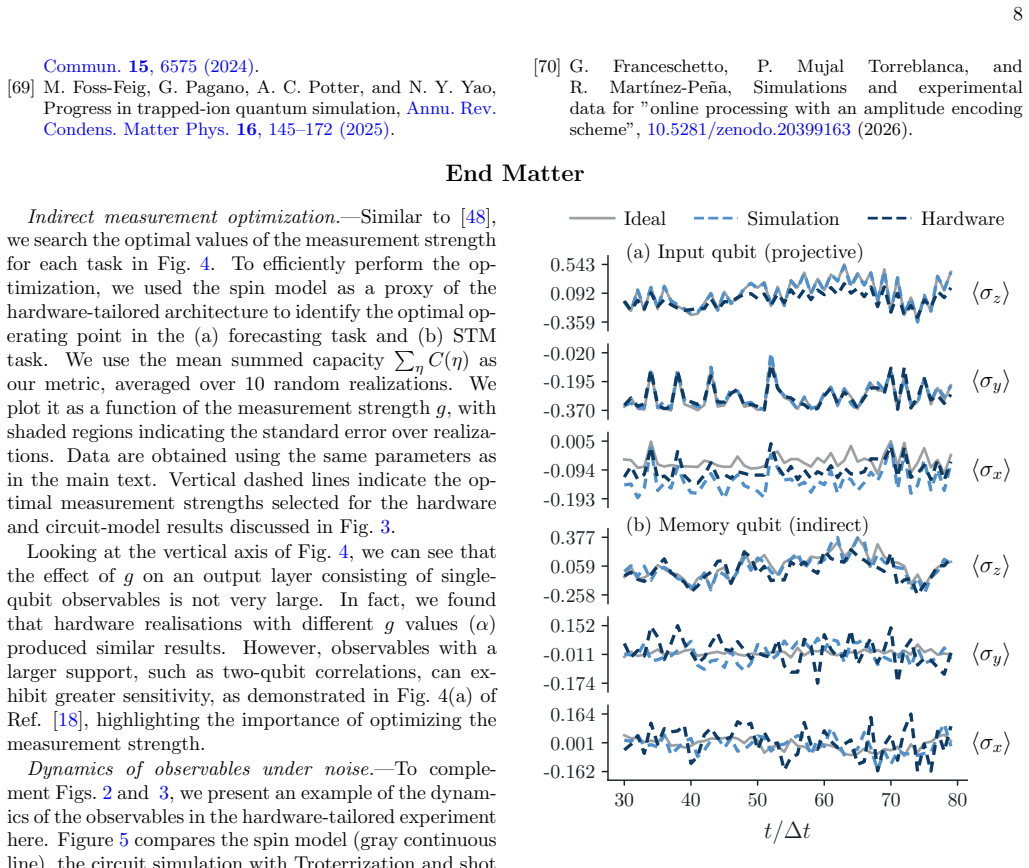
G. Franceschetto, P. Mujal Torreblanca, and R. Mart´ ınez-Pe˜ na, Simulations and experimental data for ”online processing with an amplitude encoding scheme”, 10.5281/zenodo.20399163 (2026). End Matter Indirect measurement optimization.—Similar to [48], we search the optimal values of the measurement strength for each task in Fig. 4. To efficiently perfor...
discussion (0)
Sign in with ORCID, Apple, or X to comment. Anyone can read and Pith papers without signing in.