DIPHINE: Diffusion-based Φ-ID Neural Estimator
Pith reviewed 2026-06-26 21:26 UTC · model grok-4.3
The pith
DIPHINE uses one score-based diffusion model to estimate all mutual information terms for ΦID and recovers the sixteen atoms via Möbius inversion.
A machine-rendered reading of the paper's core claim, the machinery that carries it, and where it could break.
Core claim
DIPHINE is the first neural estimator that leverages score-based diffusion models to jointly estimate all the mutual information terms required by ΦID from a single amortized network, recovering the sixteen atoms through Möbius inversion. It provides a theoretical analysis of error propagation through the inversion, showing that the Jacobian of the mapping from mutual informations to atoms is integer-valued and that the synergy-to-synergy atom is provably the hardest to estimate. The method demonstrates accurate recovery of ground-truth atoms on synthetic benchmarks, superior performance compared to established mutual information estimators, and the ability to extract physiologically interpr
What carries the argument
A single score-based diffusion model that jointly estimates the mutual information terms needed by ΦID, followed by Möbius inversion to recover the sixteen atoms.
If this is right
- Accurate recovery of ground-truth atoms on synthetic benchmarks for continuous non-Gaussian data.
- Superior performance relative to established mutual information estimators.
- Extraction of physiologically interpretable information-dynamic structure from real data without distributional assumptions.
- Error propagation through the inversion is governed by an integer-valued Jacobian.
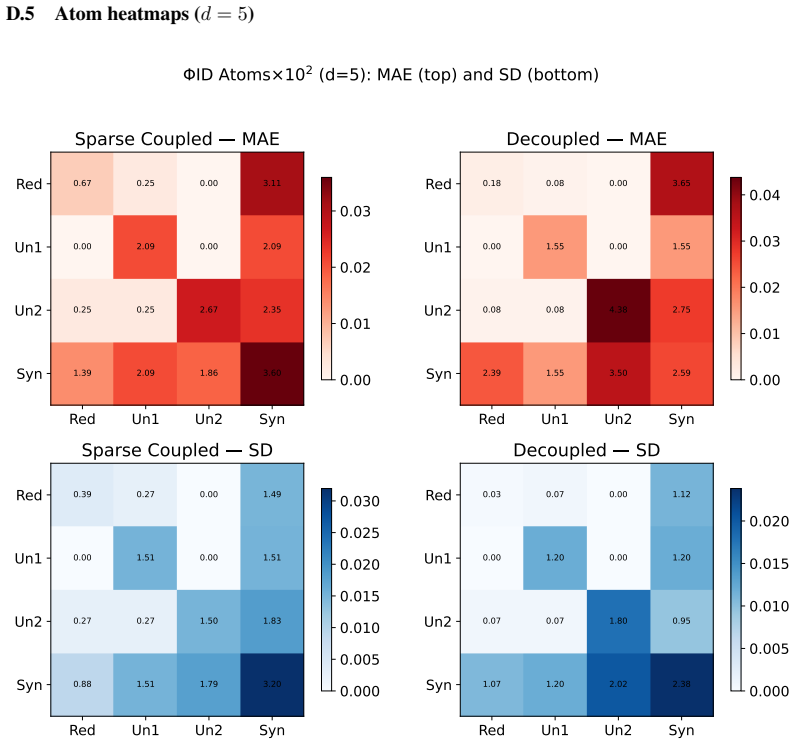
- The synergy-to-synergy atom is provably the hardest to estimate.
Where Pith is reading between the lines
- The amortized single-network design may scale to higher-dimensional systems where separate estimators would become prohibitive.
- The integer Jacobian property could be used to design targeted regularization that protects the most sensitive atoms during training.
- The same diffusion-plus-inversion pipeline might be applied to other information decompositions that rely on Möbius inversion over lattices.
- Real-data applications could be extended by testing whether the extracted atoms remain stable under controlled perturbations of the observed time series.
Load-bearing premise
A single score-based diffusion model produces sufficiently accurate estimates of all required mutual-information terms for continuous non-Gaussian data so that Möbius inversion yields reliable atoms.
What would settle it
A synthetic continuous non-Gaussian process with independently computed ground-truth ΦID atoms on which DIPHINE's recovered atoms deviate beyond the error bounds predicted by the integer Jacobian analysis.
Figures
read the original abstract
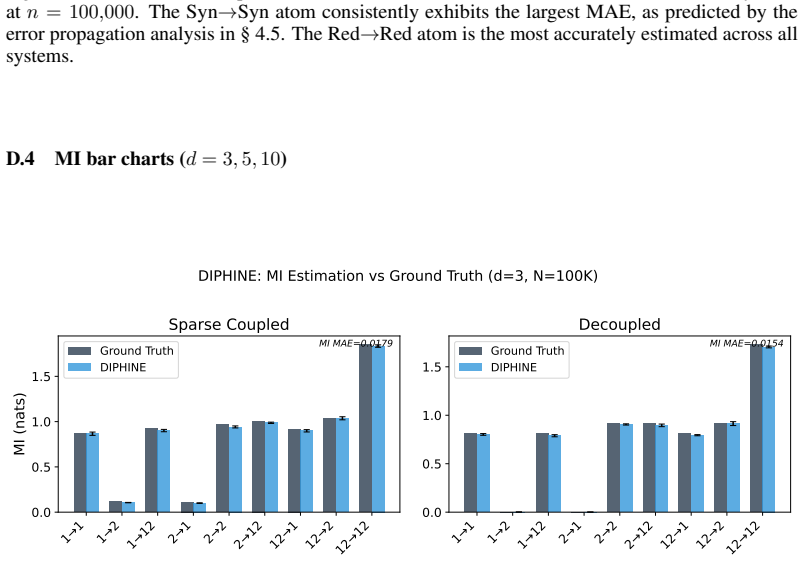
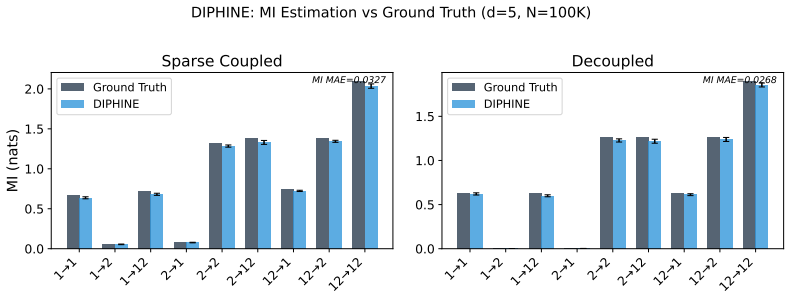
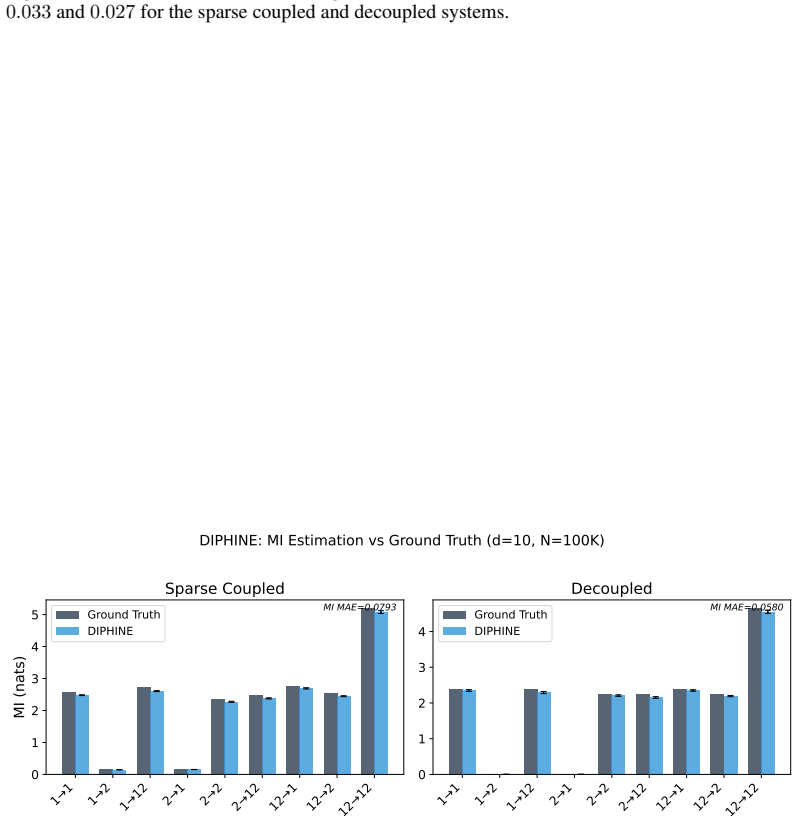
Uncovering the true informational architecture of real-world complex systems requires disentangling how their components uniquely store, redundantly share, and synergistically integrate information over time. Integrated Information Decomposition ($\Phi$ID) is a framework for decomposing the information dynamics of multivariate systems into sixteen non-overlapping atoms that characterize redundant, unique, and synergistic modes of information storage, transfer, and integration. Existing methods to compute $\Phi$ID are restricted to Gaussian or discrete systems, preventing its application to continuous non-Gaussian dynamical systems. We address this limitation by proposing DIPHINE (Diffusion-based $\Phi$-ID Neural Estimator), the first neural estimator that leverages score-based diffusion models to jointly estimate all the mutual information terms required by $\Phi$ID from a single amortized network, recovering the sixteen atoms through M\"obius inversion. We provide a theoretical analysis of error propagation through the inversion, showing that the Jacobian of the mapping from mutual informations to atoms is integer-valued and that the synergy-to-synergy atom is provably the hardest to estimate. We demonstrate accurate recovery of ground-truth atoms on synthetic benchmarks, superior performance compared to established mutual information estimators, and the ability to extract physiologically interpretable information-dynamic structure on an application involving real data without any distributional assumptions.
Editorial analysis
A structured set of objections, weighed in public.
Referee Report
Summary. The paper proposes DIPHINE, the first neural estimator that uses a single amortized score-based diffusion model to jointly estimate all mutual-information terms required by ΦID, then recovers the sixteen atoms via Möbius inversion. It supplies a theoretical analysis of error propagation through the integer-valued Jacobian (highlighting the synergy-to-synergy atom as hardest) and reports accurate recovery on synthetic benchmarks, superior performance versus existing MI estimators, and interpretable results on real physiological data without distributional assumptions.
Significance. If the central claim holds, the work would remove the Gaussian/discrete restriction that has limited ΦID to date, enabling its use on continuous non-Gaussian dynamical systems; the amortized single-network design and explicit error-propagation analysis are genuine strengths that could make the method practically usable.
major comments (2)
- [Abstract / method description] The central claim that one diffusion-based MI estimator produces errors small enough and sufficiently uncorrelated for stable Möbius inversion to sixteen atoms rests on unverified experimental assertions; the abstract states accurate recovery and a theoretical analysis but supplies no quantitative error bars, dataset sizes, or ablation results on per-term MI accuracy (reader’s soundness note).
- [Theoretical analysis section] The theoretical error-propagation claim is stated but not shown in sufficient detail to confirm that the integer Jacobian does not amplify bias or variance into uninterpretable atoms for continuous non-Gaussian data; the paper identifies the synergy-to-synergy atom as hardest yet does not demonstrate that the diffusion estimator keeps its error below the threshold needed for reliable recovery.
minor comments (2)
- [Abstract] The abstract asserts “superior performance compared to established mutual information estimators” without naming the baselines, metrics, or dataset characteristics used for that comparison.
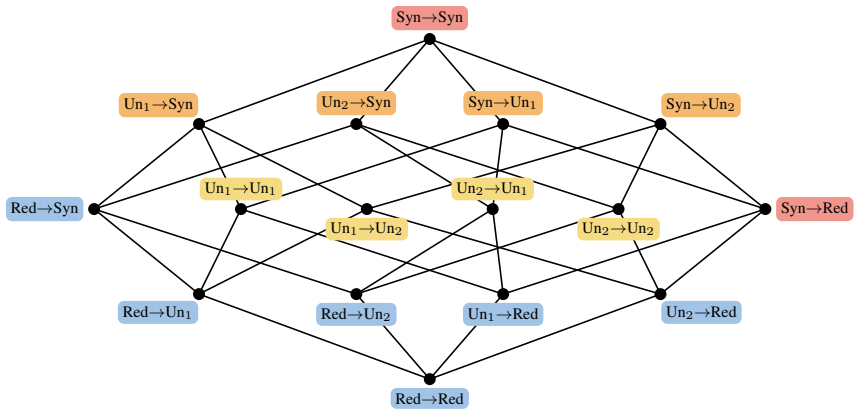
- [Introduction / method] Notation for the sixteen ΦID atoms and the precise mapping from the estimated MI terms to those atoms should be introduced earlier and with an explicit table or diagram to aid reproducibility.
Simulated Author's Rebuttal
We thank the referee for the constructive comments. We address each major point below and will revise the manuscript accordingly to provide additional quantitative details and expanded theoretical exposition.
read point-by-point responses
-
Referee: [Abstract / method description] The central claim that one diffusion-based MI estimator produces errors small enough and sufficiently uncorrelated for stable Möbius inversion to sixteen atoms rests on unverified experimental assertions; the abstract states accurate recovery and a theoretical analysis but supplies no quantitative error bars, dataset sizes, or ablation results on per-term MI accuracy (reader’s soundness note).
Authors: We agree that the abstract would benefit from explicit quantitative support. In the revision we will augment the abstract with key numerical results (mean absolute errors with standard deviations across the 16 atoms, dataset sizes for the synthetic benchmarks, and a reference to the per-term MI ablation studies). These metrics and ablations already appear in Sections 4–5; the change is therefore limited to improved visibility in the abstract and method overview. revision: yes
-
Referee: [Theoretical analysis section] The theoretical error-propagation claim is stated but not shown in sufficient detail to confirm that the integer Jacobian does not amplify bias or variance into uninterpretable atoms for continuous non-Gaussian data; the paper identifies the synergy-to-synergy atom as hardest yet does not demonstrate that the diffusion estimator keeps its error below the threshold needed for reliable recovery.
Authors: We acknowledge that the current theoretical section derives the integer Jacobian and identifies the synergy-to-synergy atom via its maximal coefficients, but does not supply explicit numerical verification of error thresholds under the diffusion estimator’s bias/variance profile. We will expand the section with (i) a short derivation of worst-case amplification bounds and (ii) Monte-Carlo simulations that inject realistic diffusion-model errors into the MI vector and track atom recovery error, confirming that the observed per-term errors remain below the stability threshold for all sixteen atoms on continuous non-Gaussian data. revision: yes
Circularity Check
No circularity detected; derivation is self-contained new pipeline
full rationale
The paper presents DIPHINE as a novel combination of score-based diffusion models for amortized joint estimation of the mutual information terms in the ΦID decomposition, followed by standard Möbius inversion to recover the 16 atoms. The abstract and claims describe this as a new estimation pipeline with an independent theoretical analysis of error propagation (integer Jacobian, hardest atom identified). No equations or steps reduce any claimed result to a fitted parameter renamed as prediction, a self-citation chain, or a definitional tautology. The method is grounded in external techniques (diffusion models, Möbius inversion) without load-bearing self-referential reductions. This is the normal case of an independent methodological contribution.
Axiom & Free-Parameter Ledger
axioms (1)
- standard math Möbius inversion correctly recovers the 16 ΦID atoms from the estimated mutual-information terms
Reference graph
Works this paper leans on
-
[2]
, journal=
Barrett, Adam B. , journal=. Exploration of synergistic and redundant information sharing in static and dynamical. 2015 , publisher=
2015
-
[3]
Mediano, Pedro A. M. and Rosas, Fernando E. and Luppi, Andrea I. and Carhart-Harris, Robin L. and Bor, Daniel and Seth, Anil K. and Barrett, Adam B. , journal=. Toward a unified taxonomy of information dynamics via. 2025 , publisher=
2025
-
[4]
Entropy , volume=
Quantifying unique information , author=. Entropy , volume=. 2014 , publisher=
2014
-
[5]
Entropy , volume=
Measuring multivariate redundant information with pointwise common change in surprisal , author=. Entropy , volume=. 2017 , publisher=
2017
-
[6]
On extractable shared information
Extractable shared information , author=. arXiv preprint arXiv:1701.07805 , year=
work page internal anchor Pith review Pith/arXiv arXiv
-
[7]
2012 , publisher=
Enumerative Combinatorics , author=. 2012 , publisher=
2012
-
[8]
, author=
Estimation of non-normalized statistical models by score matching. , author=. Journal of Machine Learning Research , volume=
-
[12]
Neural computation , volume=
A connection between score matching and denoising autoencoders , author=. Neural computation , volume=. 2011 , publisher=
2011
-
[13]
2018 , organization=
Belghazi, Mohamed Ishmael and Barber, Aristide and Drber, Stephan and Ozair, Sherjil and Pineau, Joelle and Courville, Aaron and Bengio, Yoshua , booktitle=. 2018 , organization=
2018
-
[14]
IEEE Transactions on Information Theory , volume=
Estimating divergence functionals and the likelihood ratio by convex risk minimization , author=. IEEE Transactions on Information Theory , volume=. 2010 , publisher=
2010
-
[16]
Physical Review E , volume=
Estimating mutual information , author=. Physical Review E , volume=. 2004 , publisher=
2004
-
[17]
American Journal of Physiology -- Regulatory, Integrative and Comparative Physiology , volume=
Age-related alterations in the fractal scaling of cardiac interbeat interval dynamics , author=. American Journal of Physiology -- Regulatory, Integrative and Comparative Physiology , volume=. 1996 , publisher=
1996
-
[18]
and Amaral, Luis A
Goldberger, Ary L. and Amaral, Luis A. N. and Glass, Leon and Hausdorff, Jeffrey M. and Ivanov, Plamen Ch. and Mark, Roger G. and Mietus, Joseph E. and Moody, George B. and Peng, Chung-Kang and Stanley, H. Eugene , journal=. 2000 , publisher=
2000
-
[19]
Entropy , volume=
Transfer information energy: A quantitative indicator of information transfer between time series , author=. Entropy , volume=. 2018 , publisher=
2018
-
[20]
International Conference on Artificial Intelligence and Statistics , pages=
Formal limitations on the measurement of mutual information , author=. International Conference on Artificial Intelligence and Statistics , pages=. 2020 , organization=
2020
-
[21]
Advances in Neural Information Processing Systems , volume=
Estimating the unique information of continuous variables , author=. Advances in Neural Information Processing Systems , volume=
-
[22]
Partial Information Decomposition via Normalizing Flows in Latent
Zhao, Fei and Duan, Shujian and Qu, Huimin , booktitle=. Partial Information Decomposition via Normalizing Flows in Latent
-
[23]
Advances in Neural Information Processing Systems , volume=
Mutual Information Estimation via Normalizing Flows , author=. Advances in Neural Information Processing Systems , volume=
-
[24]
Kholkin, Sergei and Butakov, Ivan and Burnaev, Evgeny and Gushchin, Nikita and Korotin, Alexander , journal=
-
[25]
International Conference on Artificial Intelligence and Statistics , year=
Galeano Mu. International Conference on Artificial Intelligence and Statistics , year=
-
[26]
and Rizzo, Maria L
Székely, Gábor J. and Rizzo, Maria L. and Bakirov, Nail K. , title =. Annals of Statistics , year =
-
[28]
Measuring Statistical Dependence with Hilbert-Schmidt Norms , booktitle =
Gretton, Arthur and Bousquet, Olivier and Smola, Alex and Sch. Measuring Statistical Dependence with Hilbert-Schmidt Norms , booktitle =. 2005 , pages =
2005
-
[29]
Journal of computational neuroscience , volume=
Transfer entropy—a model-free measure of effective connectivity for the neurosciences , author=. Journal of computational neuroscience , volume=. 2011 , publisher=
2011
-
[30]
Journal of Hydrology , volume=
A copula-based joint deficit index for droughts , author=. Journal of Hydrology , volume=. 2010 , publisher=
2010
-
[31]
International economic review , volume=
Modelling asymmetric exchange rate dependence , author=. International economic review , volume=. 2006 , publisher=
2006
-
[32]
, title =
Kullback, Solomon and Leibler, Richard A. , title =. The Annals of Mathematical Statistics , year =
-
[33]
Physical review letters , volume=
Measuring information transfer , author=. Physical review letters , volume=. 2000 , publisher=
2000
-
[34]
Information Sciences , volume =
Local measures of information storage in complex distributed computation , author =. Information Sciences , volume =. 2012 , publisher =
2012
-
[35]
, title =
Seth, Anil K. , title =. Network: Computation in Neural Systems , volume =. 2005 , publisher =
2005
-
[36]
Proceedings of the National Academy of Sciences , volume=
Unified framework for information integration based on information geometry , author=. Proceedings of the National Academy of Sciences , volume=. 2016 , publisher=
2016
-
[37]
2023 , cdate=
Xianghao Kong and Rob Brekelmans and Greg Ver Steeg , title=. 2023 , cdate=
2023
-
[38]
Trends in Cognitive Sciences , volume=
Information decomposition and the informational architecture of the brain , author=. Trends in Cognitive Sciences , volume=. 2024 , publisher=
2024
-
[39]
and Mediano, Pedro A
Luppi, Andrea I. and Mediano, Pedro A. M. and Rosas, Fernando E. and Allanson, Judith and Pickard, John D. and Carhart-Harris, Robin L. and Williams, Guy B. and Craig, Michael M. and Finoia, Paola and Owen, Adrian M. and Naci, Lorina and Menon, David K. and Bor, Daniel and Stamatakis, Emmanuel A. , journal=. A synergistic workspace for human consciousness...
2024
-
[40]
Information Sciences , volume=
Local measures of information storage in complex distributed computation , author=. Information Sciences , volume=. 2012 , publisher=
2012
-
[41]
Jansma, Abel and Mediano, Pedro AM and Rosas, Fernando E , journal=. Fast M. 2025 , publisher=
2025
-
[43]
A. B. Barrett. Exploration of synergistic and redundant information sharing in static and dynamical G aussian systems. Physical Review E, 91 0 (5): 0 052802, 2015
2015
-
[44]
M. I. Belghazi, A. Barber, S. Drber, S. Ozair, J. Pineau, A. Courville, and Y. Bengio. MINE : Mutual information neural estimation. In International Conference on Machine Learning, pages 531--540. PMLR, 2018
2018
-
[45]
Bertschinger, J
N. Bertschinger, J. Rauh, E. Olbrich, J. Jost, and N. Ay. Quantifying unique information. Entropy, 16 0 (4): 0 2161--2183, 2014
2014
-
[46]
M. Bounoua, G. Franzese, and P. Michiardi. S omega i: Score-based o-information estimation. arXiv preprint arXiv:2402.05667, 2024
-
[47]
Butakov, A
I. Butakov, A. Tolmachev, S. Malanchuk, A. Neopryatnaya, and A. Frolov. Mutual information estimation via normalizing flows. In Advances in Neural Information Processing Systems, volume 37, pages 3027--3057, 2024
2024
-
[48]
Ca t aron and R
A. Ca t aron and R. Andonie. Transfer information energy: A quantitative indicator of information transfer between time series. Entropy, 20 0 (5): 0 323, 2018
2018
-
[49]
G. Franzese, M. Bounoua, and P. Michiardi. Minde: Mutual information neural diffusion estimation. arXiv preprint arXiv:2310.09031, 2023
-
[50]
S. P. Galeano Mu \ n oz, M. Bounoua, G. Franzese, P. Michiardi, and M. Filippone. TENDE : Transfer entropy neural diffusion estimation. In International Conference on Artificial Intelligence and Statistics. PMLR, 2026
2026
-
[51]
A. L. Goldberger, L. A. N. Amaral, L. Glass, J. M. Hausdorff, P. C. Ivanov, R. G. Mark, J. E. Mietus, G. B. Moody, C.-K. Peng, and H. E. Stanley. PhysioBank, PhysioToolkit, and PhysioNet : Components of a new research resource for complex physiologic signals. Circulation, 101 0 (23): 0 e215--e220, 2000
2000
-
[52]
Gretton, O
A. Gretton, O. Bousquet, A. Smola, and B. Sch \"o lkopf. Measuring statistical dependence with hilbert-schmidt norms. In Algorithmic Learning Theory, pages 63--77. Springer Berlin Heidelberg, 2005
2005
-
[53]
Hyv \"a rinen
A. Hyv \"a rinen. Estimation of non-normalized statistical models by score matching. Journal of Machine Learning Research, 6 0 (4), 2005
2005
-
[54]
R. A. A. Ince. Measuring multivariate redundant information with pointwise common change in surprisal. Entropy, 19 0 (7): 0 318, 2017
2017
-
[55]
Iyengar, C.-K
N. Iyengar, C.-K. Peng, R. Morin, A. L. Goldberger, and L. A. Lipsitz. Age-related alterations in the fractal scaling of cardiac interbeat interval dynamics. American Journal of Physiology -- Regulatory, Integrative and Comparative Physiology, 271 0 (4): 0 R1078--R1084, 1996
1996
-
[56]
Kao and R
S.-C. Kao and R. S. Govindaraju. A copula-based joint deficit index for droughts. Journal of Hydrology, 380 0 (1-2): 0 121--134, 2010
2010
-
[57]
S. Kholkin, I. Butakov, E. Burnaev, N. Gushchin, and A. Korotin. InfoBridge : Mutual information estimation via bridge matching. arXiv preprint arXiv:2502.01383, 2025
-
[58]
X. Kong, R. Brekelmans, and G. V. Steeg. Information-theoretic diffusion. In ICLR, 2023
2023
-
[59]
Kraskov, H
A. Kraskov, H. St \"o gbauer, and P. Grassberger. Estimating mutual information. Physical Review E, 69 0 (6): 0 066138, 2004
2004
-
[60]
Kullback and R
S. Kullback and R. A. Leibler. On information and sufficiency. The Annals of Mathematical Statistics, 22 0 (1): 0 79--86, 1951
1951
- [61]
-
[62]
J. T. Lizier, M. Prokopenko, and A. Y. Zomaya. Local measures of information storage in complex distributed computation. Information Sciences, 208: 0 39--54, 2012
2012
-
[63]
A. I. Luppi, P. A. M. Mediano, F. E. Rosas, J. Allanson, J. D. Pickard, R. L. Carhart-Harris, G. B. Williams, M. M. Craig, P. Finoia, A. M. Owen, L. Naci, D. K. Menon, D. Bor, and E. A. Stamatakis. A synergistic workspace for human consciousness revealed by I ntegrated I nformation D ecomposition. eLife, 12: 0 e88173, 2024 a
2024
-
[64]
A. I. Luppi, F. E. Rosas, P. A. M. Mediano, D. K. Menon, and E. A. Stamatakis. Information decomposition and the informational architecture of the brain. Trends in Cognitive Sciences, 28 0 (4): 0 352--368, 2024 b
2024
-
[65]
McAllester and K
D. McAllester and K. Stratos. Formal limitations on the measurement of mutual information. In International Conference on Artificial Intelligence and Statistics, pages 875--884. PMLR, 2020
2020
-
[66]
P. A. M. Mediano, F. E. Rosas, A. I. Luppi, R. L. Carhart-Harris, D. Bor, A. K. Seth, and A. B. Barrett. Toward a unified taxonomy of information dynamics via I ntegrated I nformation D ecomposition. Proceedings of the National Academy of Sciences, 122 0 (39): 0 e2423297122, 2025
2025
-
[67]
Nguyen, M
X. Nguyen, M. J. Wainwright, and M. I. Jordan. Estimating divergence functionals and the likelihood ratio by convex risk minimization. IEEE Transactions on Information Theory, 56 0 (11): 0 5847--5861, 2010
2010
-
[68]
Oizumi, N
M. Oizumi, N. Tsuchiya, and S.-i. Amari. Unified framework for information integration based on information geometry. Proceedings of the National Academy of Sciences, 113 0 (51): 0 14817--14822, 2016
2016
-
[69]
A. v. d. Oord, Y. Li, and O. Vinyals. Representation learning with contrastive predictive coding. arXiv preprint arXiv:1807.03748, 2018
work page internal anchor Pith review Pith/arXiv arXiv 2018
-
[70]
Pakman, A
A. Pakman, A. Nejatbakhsh, D. Gilboa, A. Makkeh, L. Mazzucato, M. Wibral, and E. Schneidman. Estimating the unique information of continuous variables. In Advances in Neural Information Processing Systems, volume 34, pages 20295--20307, 2021
2021
-
[71]
A. J. Patton. Modelling asymmetric exchange rate dependence. International economic review, 47 0 (2): 0 527--556, 2006
2006
-
[72]
Schreiber
T. Schreiber. Measuring information transfer. Physical review letters, 85 0 (2): 0 461, 2000
2000
-
[73]
A. K. Seth. Causal connectivity of evolved neural networks during behavior. Network: Computation in Neural Systems, 16 0 (1): 0 35--54, 2005
2005
-
[74]
Y. Song, J. Sohl-Dickstein, D. P. Kingma, A. Kumar, S. Ermon, and B. Poole. Score-based generative modeling through stochastic differential equations. arXiv preprint arXiv:2011.13456, 2020
work page internal anchor Pith review Pith/arXiv arXiv 2011
-
[75]
R. P. Stanley. Enumerative Combinatorics, volume 1. Cambridge University Press, 2 edition, 2012
2012
-
[76]
G. J. Székely, M. L. Rizzo, and N. K. Bakirov. Measuring and testing dependence by correlation of distances. Annals of Statistics, 35 0 (6): 0 2769--2794, 2007
2007
-
[77]
Vicente, M
R. Vicente, M. Wibral, M. Lindner, and G. Pipa. Transfer entropy—a model-free measure of effective connectivity for the neurosciences. Journal of computational neuroscience, 30 0 (1): 0 45--67, 2011
2011
-
[78]
P. Vincent. A connection between score matching and denoising autoencoders. Neural computation, 23 0 (7): 0 1661--1674, 2011
2011
-
[79]
P. L. Williams and R. D. Beer. Nonnegative decomposition of multivariate information. arXiv preprint arXiv:1004.2515, 2010
work page internal anchor Pith review Pith/arXiv arXiv 2010
- [80]
-
[81]
F. Zhao, S. Duan, and H. Qu. Partial information decomposition via normalizing flows in latent G aussian distributions. In International Conference on Learning Representations, 2025
2025
discussion (0)
Sign in with ORCID, Apple, or X to comment. Anyone can read and Pith papers without signing in.