Ultra-precise Multi-fiber Optical Connectors for Astronomy
Pith reviewed 2026-06-26 19:18 UTC · model grok-4.3
The pith
Femtosecond-laser 3D-printed multi-fiber connectors reach 0.95 percent insertion loss for astronomy.
A machine-rendered reading of the paper's core claim, the machinery that carries it, and where it could break.
Core claim
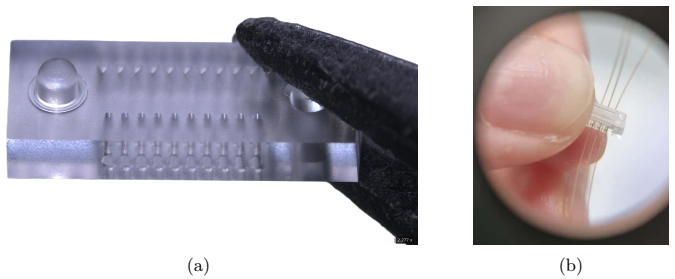
Connectors fabricated using femtosecond-laser 3-D printing achieve sub-micron ferrule tolerances. Preliminary metrology shows excellent hole alignment and roundness. Initial throughput tests for three simultaneously connected fibers show losses as low as 0.95 percent (0.04 dB).
What carries the argument
Femtosecond-laser 3D printing process that produces ferrules with sub-micron tolerances for simultaneous multi-fiber connections.
Load-bearing premise
The femtosecond-laser 3D printing process can consistently deliver and maintain the claimed sub-micron ferrule tolerances under real observatory conditions.
What would settle it
Metrology or throughput measurements on multiple connectors under observatory temperature, humidity, and vibration conditions that show average hole misalignment above one micron or insertion losses above 1 percent.
Figures



read the original abstract
The increasing sensitivity of modern astronomical instruments requires optical fiber connections with high crossmating stability and insertion loss as low as 1% (0.05 dB). Conventional connectors, though suitable for telecommunications, introduce excess attenuation, Fresnel reflections, and alignment instabilities that degrade throughput and calibration accuracy in astronomy. This work presents the design and characterization of ultra-low-loss optical multi-fiber connectors developed for astronomical use. Fabricated using femtosecond-laser 3-D printing, they achieve sub-micron ferrule tolerances. Preliminary metrology shows excellent hole alignment and roundness, and initial throughput tests for three simultaneously connected fibers show losses as low as 0.95% (0.04 dB). Further throughput and FRD characterization to be implemented to assess efficiency, stability, and repeatability under observatory conditions.
Editorial analysis
A structured set of objections, weighed in public.
Referee Report
Summary. The manuscript presents the design of ultra-precise multi-fiber optical connectors for astronomical instruments, fabricated via femtosecond-laser 3D printing to achieve sub-micron ferrule tolerances. It reports preliminary metrology results on hole alignment and roundness together with initial throughput measurements showing losses as low as 0.95% (0.04 dB) for three simultaneously connected fibers, while noting that full throughput, FRD, stability, and repeatability testing under observatory conditions remains future work.
Significance. If the sub-micron tolerances and low insertion losses can be maintained under real observatory conditions, the connectors would address a recognized limitation of commercial telecom connectors in astronomy by reducing excess attenuation and alignment instabilities, thereby improving throughput and calibration accuracy in high-sensitivity instruments. The approach of using 3D printing for custom, high-precision ferrules is a practical contribution to astronomical instrumentation.
major comments (1)
- Abstract: the central performance claim of losses as low as 0.95% (0.04 dB) rests on initial throughput tests whose methods, sample size, number of trials, error bars, and test conditions are not described; this information is required to assess whether the result supports the stated sub-micron tolerance and low-loss assertions.
Simulated Author's Rebuttal
We thank the referee for the constructive comment on our manuscript. We agree that the abstract's performance claim requires supporting details on the throughput test methodology and will revise the manuscript to address this.
read point-by-point responses
-
Referee: Abstract: the central performance claim of losses as low as 0.95% (0.04 dB) rests on initial throughput tests whose methods, sample size, number of trials, error bars, and test conditions are not described; this information is required to assess whether the result supports the stated sub-micron tolerance and low-loss assertions.
Authors: We acknowledge that the abstract does not provide sufficient methodological detail on the initial throughput measurements. These were preliminary laboratory tests performed on three simultaneously connected fibers using a basic setup consisting of a stabilized light source, power meter, and reference measurements, under ambient conditions without environmental control. However, we agree the current description is inadequate for evaluation. In the revised manuscript we will expand the abstract (and add a short methods paragraph in the main text) to specify the test conditions, sample size (three fibers), number of connection trials, any available repeatability data, and error estimates. We will also retain the existing qualification that these are initial results and that full FRD, stability, and observatory-condition testing remains future work. This revision will allow readers to properly assess the preliminary claims relative to the sub-micron metrology results. revision: yes
Circularity Check
No significant circularity identified
full rationale
The paper is an experimental design, fabrication, and metrology report. It describes femtosecond-laser 3D printing of connectors, reports direct measurements of hole alignment/roundness, and gives initial throughput loss values from physical tests. No equations, derivations, fitted parameters, model predictions, or self-citation chains appear in the text. All reported results are empirical observations rather than outputs derived from prior results within the paper. This is the most common honest finding for purely experimental instrumentation papers.
Axiom & Free-Parameter Ledger
Reference graph
Works this paper leans on
-
[1]
Zhao, C., Huang, S., He, M., et al., “Multiplexed survey telescope: Perspectives for large-scale structure cosmology in the era of stage-v spectroscopic survey,” (2024). arXiv:2411.07970 [astro-ph]
work page internal anchor Pith review Pith/arXiv arXiv 2024
-
[2]
Besuner, R., Dey, A., Drlica-Wagner, A., et al., “The spectroscopic stage-5 experiment,” (2025). arXiv:2503.07923 [astro-ph]
-
[3]
Mainieri, V., Anderson, R. I., Brinchmann, J., et al., “The wide-field spectroscopic telescope (wst) science white paper,” (2024). arXiv:2403.05398 [astro-ph]
-
[4]
The multi-object, fiber-fed spectrographs for the sloan digital sky survey and the baryon oscillation spectroscopic survey,
Smee, S. A., Gunn, J. E., Uomoto, A., et al., “The multi-object, fiber-fed spectrographs for the sloan digital sky survey and the baryon oscillation spectroscopic survey,”The Astronomical Journal146(2), 32 (2013)
2013
-
[5]
The apache point observatory galactic evolution experiment (apogee) spectrographs,
Wilson, J., Hearty, F., Skrutskie, M., et al., “The apache point observatory galactic evolution experiment (apogee) spectrographs,”Publications of the Astronomical Society of the Pacific131(999), 055001 (2019)
2019
-
[6]
Overview of the desi legacy imaging surveys,
Dey, A., Schlegel, D. J., Lang, D., et al., “Overview of the desi legacy imaging surveys,”The Astronomical Journal157(5), 168 (2019)
2019
-
[7]
Overview of the fiber system for the dark energy spectroscopic instrument,
Poppett, C., Tyas, L., Aguilar, J., et al., “Overview of the fiber system for the dark energy spectroscopic instrument,”The Astronomical Journal168(6), 245 (2024)
2024
-
[8]
Optimizing fibre connectors for high throughput and low frd for next-generation multi-fibre astronomical instruments,
Sathi, Z. M., Wang, A., and Bryant, J., “Optimizing fibre connectors for high throughput and low frd for next-generation multi-fibre astronomical instruments,” in [Advances in Optical and Mechanical Technologies for Telescopes and Instrumentation VI],13100, 750–757, SPIE (2024)
2024
-
[9]
Fiber optic throughput performance evaluation in multi-fiber termi- nation connectors,
Farr, E., Tuttle, S., Wilson, J., et al., “Fiber optic throughput performance evaluation in multi-fiber termi- nation connectors,” in [Ground-based and Airborne Instrumentation for Astronomy IX],12184, 2299–2308, SPIE (2022)
2022
-
[10]
Super low-loss, super high-density multi-fiber optical connectors,
Suematsu, K., Shinoda, M., Shigenaga, T., et al., “Super low-loss, super high-density multi-fiber optical connectors,”Furukawa Rev23, 53–8 (2003)
2003
discussion (0)
Sign in with ORCID, Apple, or X to comment. Anyone can read and Pith papers without signing in.