Comparative Study of Hollow-Core and Standard Optical Fibers for Astronomy
Pith reviewed 2026-06-26 19:16 UTC · model grok-4.3
The pith
Inhibited-coupling hollow-core fibers reduce blue-visible light loss compared to standard fibers in astronomical spectrographs.
A machine-rendered reading of the paper's core claim, the machinery that carries it, and where it could break.
Core claim
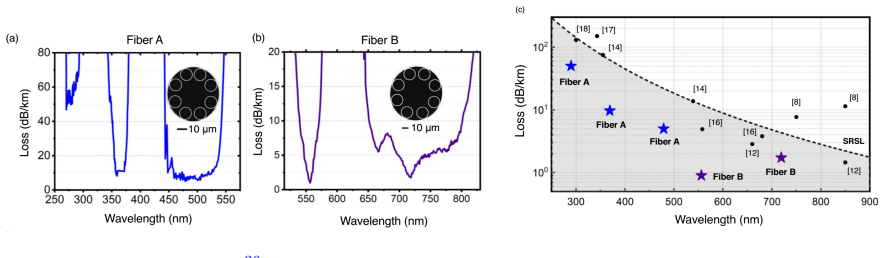
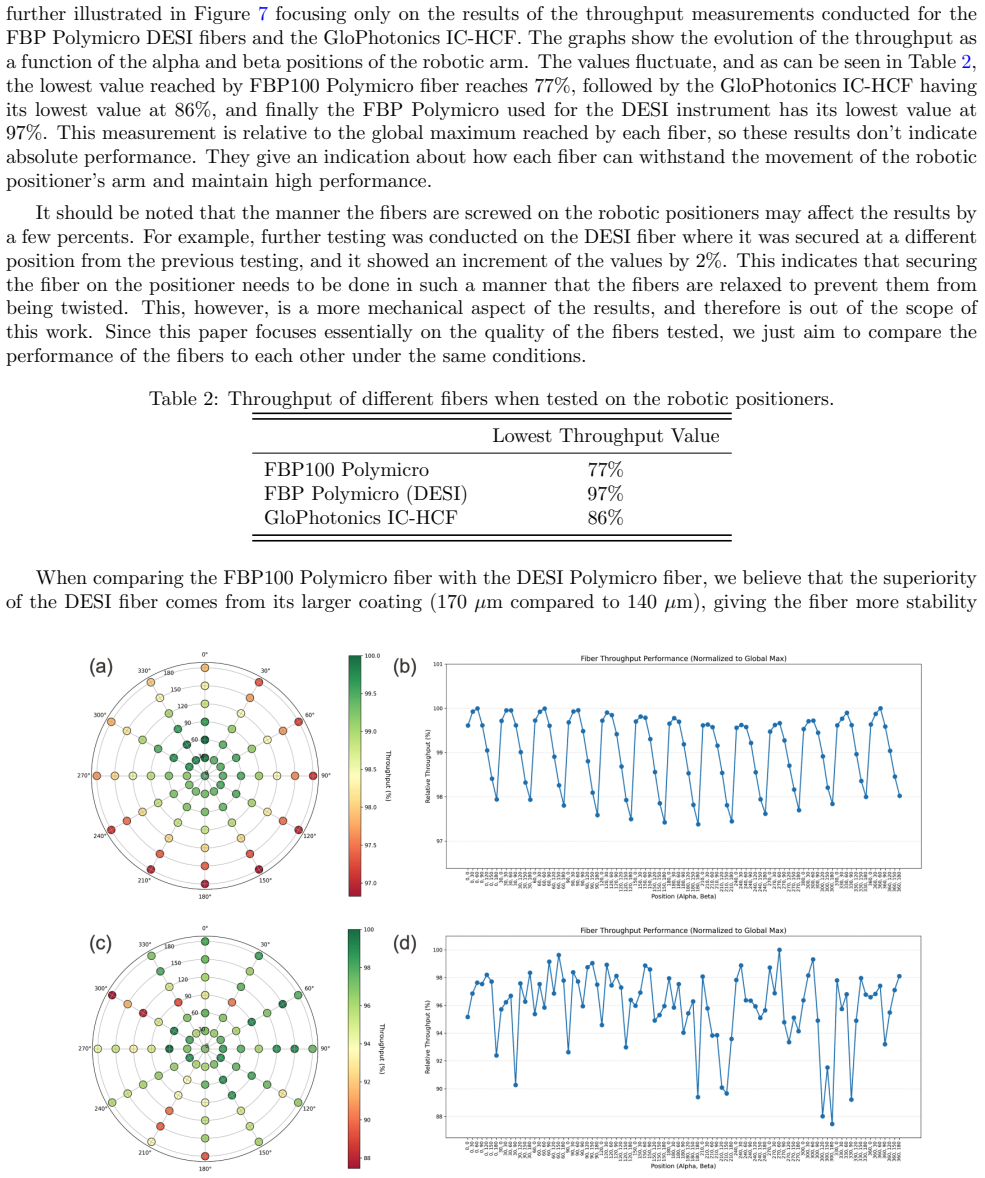
IC-HCFs guide light predominantly in air rather than through silica, yielding significantly lower attenuation across the visible band than standard multi-mode fibers; comparative tests in robotic fiber-positioner prototypes confirm reduced throughput loss under bending, twisting, and pinching, directly quantifying the advantage for blue-sensitive spectroscopy.
What carries the argument
Inhibited-coupling hollow-core fibers (IC-HCFs) that confine light in an air core with reduced surface roughness.
If this is right
- Higher blue throughput directly increases signal-to-noise for faint-object spectroscopy in the visible.
- Robotic positioner systems for next-generation facilities can adopt IC-HCFs without major redesign if the measured mechanical robustness holds.
- Survey depth or speed in blue-sensitive programs improves without requiring larger telescopes or better detectors.
- The air-guided mechanism avoids the material absorption that limits conventional fibers below ~450 nm.
Where Pith is reading between the lines
- Adoption would allow existing fiber positioner hardware to deliver deeper blue surveys on current telescopes.
- Long-term connector and splicing reliability for hollow-core fibers remains untested in the paper and would need separate validation before full deployment.
- The same low-loss property could benefit other blue-light applications such as high-resolution spectroscopy of exoplanet atmospheres.
Load-bearing premise
Throughput losses measured on fiber-positioner prototypes under mechanical stress match the losses that will occur once the fibers are installed in operational astronomical instruments.
What would settle it
Side-by-side measurement of end-to-end throughput in the 400-500 nm band on an actual telescope spectrograph using an IC-HCF link versus a standard fiber link under normal survey observing conditions.
Figures
read the original abstract
Efficient light transmission in the blue-visible regime remains a major limitation for fiber-fed astronomical spectrographs, where low photon flux and the intrinsic attenuation of conventional silica fibers reduce survey sensitivity and depth. Inhibited-coupling hollow-core fibers (IC-HCFs) with reduced surface roughness offer a promising alternative, providing guidance predominantly in air and enabling significantly lower loss across the visible spectrum. In this study, we present a comparative evaluation of IC-HCFs against standard multi-mode fibers used in current astronomical instrumentation. We assess the throughput loss that occurs due to bending, twisting, or pinching of the optical fibers when moved using one of the robotic fiber-positioner prototypes designed for next-generation telescopes. These measurements quantify the performance gains offered by IC-HCFs for blue-sensitive spectroscopy and assess their suitability for integration into future survey facilities.
Editorial analysis
A structured set of objections, weighed in public.
Referee Report
Summary. The manuscript reports a comparative experimental study of inhibited-coupling hollow-core fibers (IC-HCFs) versus standard multi-mode fibers for astronomical spectrographs. It claims that IC-HCFs with reduced surface roughness enable guidance predominantly in air and deliver significantly lower throughput loss across the visible spectrum, particularly for blue-sensitive applications. The evaluation focuses on loss induced by bending, twisting, or pinching during motion in robotic fiber-positioner prototypes intended for next-generation telescopes, with the goal of quantifying performance gains and assessing integration suitability.
Significance. If the quantitative measurements were to demonstrate a clear, reproducible advantage in the blue-visible regime under representative conditions, the work would be relevant to fiber-fed instrumentation for large surveys, where attenuation currently limits sensitivity. The experimental focus on positioner-induced stresses addresses a practical integration question, though the manuscript as presented supplies no data to evaluate whether that advantage materializes.
major comments (2)
- [Abstract] Abstract: the central claim that IC-HCFs provide 'significantly lower loss across the visible spectrum' and 'performance gains' is asserted without any numerical throughput values, error bars, sample sizes, wavelength-dependent plots, or measurement protocols. This absence prevents assessment of whether the prototype data support the stated conclusion.
- [Methods/Results] Methods/Results (prototype testing description): the throughput-loss measurements are performed on short segments in a robotic-positioner prototype under controlled bending/twisting/pinching. No discussion or data address whether these conditions capture the additional loss channels expected in full deployments (tens-of-meter runs, repeated thermal cycling, telescope vibration spectra, and spectrograph coupling), which the skeptic note identifies as potentially dominant for IC-HCFs.
minor comments (2)
- [Abstract/Introduction] The abstract and introduction would benefit from explicit definition of the fiber types compared (core diameter, NA, manufacturer) and the exact wavelength range tested.
- [Figures] Figure captions (if present) should include the number of trials, fiber lengths, and bend radii used in each test condition.
Simulated Author's Rebuttal
We thank the referee for the careful review and constructive comments. We address each major point below and indicate the revisions made to the manuscript.
read point-by-point responses
-
Referee: [Abstract] Abstract: the central claim that IC-HCFs provide 'significantly lower loss across the visible spectrum' and 'performance gains' is asserted without any numerical throughput values, error bars, sample sizes, wavelength-dependent plots, or measurement protocols. This absence prevents assessment of whether the prototype data support the stated conclusion.
Authors: We agree that the abstract would be strengthened by the inclusion of quantitative results. In the revised version we have added representative throughput-loss values (with uncertainties and sample sizes) at key blue-visible wavelengths together with a concise statement of the measurement protocol, allowing readers to evaluate the claims directly. revision: yes
-
Referee: [Methods/Results] Methods/Results (prototype testing description): the throughput-loss measurements are performed on short segments in a robotic-positioner prototype under controlled bending/twisting/pinching. No discussion or data address whether these conditions capture the additional loss channels expected in full deployments (tens-of-meter runs, repeated thermal cycling, telescope vibration spectra, and spectrograph coupling), which the skeptic note identifies as potentially dominant for IC-HCFs.
Authors: Our experimental design deliberately isolates the mechanical stresses produced by the positioner, which constitute a previously unquantified loss channel for robotic fiber systems. We have added an explicit limitations paragraph in the Discussion that acknowledges the absence of data on long fiber runs, thermal cycling, and vibration spectra, and we note that these factors remain important topics for future work. The present study therefore provides a differential comparison under representative positioner motion rather than a complete end-to-end deployment assessment. revision: partial
Circularity Check
No circularity: direct experimental comparison with no derivations or fitted predictions
full rationale
The paper is a comparative experimental study measuring throughput loss in fiber prototypes under bending/twisting/pinching. No equations, derivations, predictions, or self-citation chains are present that could reduce to inputs by construction. Central claims rest on empirical data, not on any load-bearing theoretical step that loops back to itself. This matches the default expectation of a non-circular experimental report.
Axiom & Free-Parameter Ledger
Reference graph
Works this paper leans on
-
[1]
Zhao, C., Huang, S., He, M., Montero-Camacho, P., Liu, Y., Renard, P., Tang, Y., Verdier, A., Xu, W., Yang, X., et al., “Multiplexed survey telescope: perspectives for large-scale structure cosmology in the era of stage-v spectroscopic survey,”arXiv preprint arXiv:2411.07970(2024)
Pith/arXiv arXiv 2024
-
[2]
The spectroscopic stage-5 experiment,
Besuner, R., Dey, A., Drlica-Wagner, A., Ebina, H., Moroni, G. F., Ferraro, S., Forero-Romero, J., Honscheid, K., Jelinsky, P., Lang, D., et al., “The spectroscopic stage-5 experiment,”arXiv preprint arXiv:2503.07923(2025)
arXiv 2025
-
[3]
The wide-field spectroscopic telescope (wst) science white paper,
Mainieri, V., Anderson, R. I., Brinchmann, J., Cimatti, A., Ellis, R. S., Hill, V., Kneib, J.-P., McLeod, A. F., Opitom, C., Roth, M. M., et al., “The wide-field spectroscopic telescope (wst) science white paper,” arXiv preprint arXiv:2403.05398(2024)
arXiv 2024
-
[4]
Disentangling loss mechanisms to bridge inhibited-coupling and anti-resonant models in hollow-core fibers,
Melli, F., Rosa, L., Vasko, K., Benabid, F., and Vincetti, L., “Disentangling loss mechanisms to bridge inhibited-coupling and anti-resonant models in hollow-core fibers,”Journal of Lightwave Technology44(11), 4714–4724 (2026)
2026
-
[5]
40 km, 0.052 db/km and 83 km, 0.076 db/km in interstitial-tube-assisted hollow-core fibre,
Gao, S., Chen, H., Xiong, Y., Sun, Y., Ding, W., and Wang, Y., “40 km, 0.052 db/km and 83 km, 0.076 db/km in interstitial-tube-assisted hollow-core fibre,” in [2025 European Conference on Optical Communi- cations (ECOC)], 1–4, IEEE (2025)
2025
-
[6]
Kilowatt-average-power single-mode laser light transmission over kilometre-scale hollow-core fibre,
Mulvad, H., Abokhamis Mousavi, S., Zuba, V., Xu, L., Sakr, H., Bradley, T., Hayes, J., Jasion, G., Numkam Fokoua, E., Taranta, A., et al., “Kilowatt-average-power single-mode laser light transmission over kilometre-scale hollow-core fibre,”Nature Photonics16(6), 448–453 (2022)
2022
-
[7]
Study of backward brillouin scattering in gas-filled anti-resonant fibers,
Galal, M., Zhang, L., Gao, S., Wang, Y., and Th´ evenaz, L., “Study of backward brillouin scattering in gas-filled anti-resonant fibers,”APL Photonics8(8) (2023)
2023
-
[8]
Exceptional polarization purity in antiresonant hollow-core optical fibres,
Taranta, A., Numkam Fokoua, E., Abokhamis Mousavi, S., Hayes, J., Bradley, T., Jasion, G., and Poletti, F., “Exceptional polarization purity in antiresonant hollow-core optical fibres,”Nature Photonics14(8), 504–510 (2020)
2020
-
[9]
Nonlinearity-free coherent transmission in hollow-core antiresonant fiber,
Liu, Z., Karanov, B., Galdino, L., Hayes, J. R., Lavery, D., Clark, K., Shi, K., Elson, D. J., Thomsen, B. C., Petrovich, M. N., et al., “Nonlinearity-free coherent transmission in hollow-core antiresonant fiber,”Journal of Lightwave Technology37(3), 909–916 (2018)
2018
-
[10]
Prototyping of 6.2-mm-Pitch Fiber Positioner Modules for Stage-V Telescope Instrumentation,
Galal, M., Rombach, M., Wei, J., Pineda Su´ arez, O., Ara´ ujo, R., Pernecker, S., Bault, A., Silber, J. H., Wenner, N., Besuner, R., Kirkby, D., Van Shourt, W., et al., “Prototyping of 6.2-mm-Pitch Fiber Positioner Modules for Stage-V Telescope Instrumentation,”arXiv e-prints, arXiv:2508.19711 (Aug. 2025)
Pith/arXiv arXiv 2025
-
[11]
Apogee observing,
SDSS-IV Collaboration, “Apogee observing,” (2025). Accessed: 2025-10-23
2025
-
[12]
Focal plane systems,
SDSS-IV Collaboration, “Focal plane systems,” (2025). Accessed: 2025-10-23
2025
-
[13]
The sloan digital sky survey: Technical summary,
York, D. G., Adelman, J., Anderson Jr, J. E., Anderson, S. F., Annis, J., Bahcall, N. A., Bakken, J., Barkhouser, R., Bastian, S., Berman, E., et al., “The sloan digital sky survey: Technical summary,”The Astronomical Journal120(3), 1579 (2000)
2000
-
[14]
Measuring the matter density using baryon oscillations in the sdss,
Percival, W. J., Nichol, R. C., Eisenstein, D. J., Weinberg, D. H., Fukugita, M., Pope, A. C., Schneider, D. P., Szalay, A. S., Vogeley, M. S., Zehavi, I., et al., “Measuring the matter density using baryon oscillations in the sdss,”The Astrophysical Journal657(1), 51 (2007)
2007
-
[15]
The desi experiment, a whitepaper for snowmass 2013,
Levi, M., Bebek, C., Beers, T., Blum, R., Cahn, R., Eisenstein, D., Flaugher, B., Honscheid, K., Kron, R., Lahav, O., et al., “The desi experiment, a whitepaper for snowmass 2013,”arXiv preprint arXiv:1308.0847 (2013)
Pith/arXiv arXiv 2013
-
[16]
The desi experiment part i: science, targeting, and survey design,
Aghamousa, A., Aguilar, J., Ahlen, S., Alam, S., Allen, L. E., Prieto, C. A., Annis, J., Bailey, S., Balland, C., Ballester, O., et al., “The desi experiment part i: science, targeting, and survey design,”arXiv preprint arXiv:1611.00036(2016)
Pith/arXiv arXiv 2016
-
[17]
Desi 2024: Constraints on physics-focused aspects of dark energy using desi dr1 bao data,
Lodha, K., Shafieloo, A., Calderon, R., Linder, E., Sohn, W., Cervantes-Cota, J., De Mattia, A., Garc´ ıa- Bellido, J., Ishak, M., Matthewson, W., et al., “Desi 2024: Constraints on physics-focused aspects of dark energy using desi dr1 bao data,”Physical Review D111(2), 023532 (2025)
2024
-
[18]
Euclid. i. overview of the euclid mission,
Mellier, Y., Abdurro´ uf, A., Barroso, J. A., Ach´ ucarro, A., Adamek, J., Adam, R., Addison, G., Aghanim, N., Aguena, M., Ajani, V., et al., “Euclid. i. overview of the euclid mission,”Astronomy & Astrophysics (2024)
2024
-
[19]
4most: 4-metre multi-object spectroscopic telescope,
De Jong, R. S., Bellido-Tirado, O., Chiappini, C., Depagne, ´E., Haynes, R., Johl, D., Schnurr, O., Schwope, A., Walcher, J., Dionies, F., et al., “4most: 4-metre multi-object spectroscopic telescope,” in [Ground-based and airborne instrumentation for astronomy IV],8446, 252–266, SPIE (2012)
2012
-
[20]
25,000 optical fiber positioning robots for next-generation cosmology,
Silber, J. H., Schlegel, D. J., Araujo, R., Baltay, C., Besuner, R. W., Farr, E., Guy, J., Kneib, J.-P., Poppett, C., Mandeville, T. A., Schubnell, M., Thurneysen, M., and Tuttle, S., “25,000 optical fiber positioning robots for next-generation cosmology,”arXiv e-prints, arXiv:2212.07908 (Dec. 2022)
arXiv 2022
-
[21]
Investigations on assembly and coverage for modular focal planes of multiplexed telescopes,
Rombach, M., Xu, X., Araujo, R., Thurneysen, M., Caseiro, S., Magnenat, C., Silber, J., Galal, M., Schlegel, D., and Kneib, J.-P., “Investigations on assembly and coverage for modular focal planes of multiplexed telescopes,” in [Ground-based and Airborne Instrumentation for Astronomy X],13096, 2885–2900, SPIE (2024)
2024
-
[22]
Silica/silica optical fiber fbp,
Laser Components, “Silica/silica optical fiber fbp,” (2021). Accessed: 2025-10-23
2021
-
[23]
Overview of the fiber system for the dark energy spectroscopic instrument,
Poppett, C., Tyas, L., Aguilar, J., Bebek, C., Bramall, D., Claybaugh, T., Edelstein, J., Fagrelius, P., Heet- derks, H., Jelinsky, P., et al., “Overview of the fiber system for the dark energy spectroscopic instrument,” The Astronomical Journal168(6), 245 (2024)
2024
-
[24]
Hexabundles: imaging fiber arrays for low-light astronomical applications,
Bland-Hawthorn, J., Bryant, J., Robertson, G., Gillingham, P., O’Byrne, J., Cecil, G., Haynes, R., Croom, S., Ellis, S., Maack, M., et al., “Hexabundles: imaging fiber arrays for low-light astronomical applications,” Optics Express19(3), 2649–2661 (2011)
2011
-
[25]
Focal ratio degradation in lightly fused hexabundles,
Bryant, J., Fogarty, L., Lawrence, J., and Croom, S., “Focal ratio degradation in lightly fused hexabundles,” Monthly Notices of the Royal Astronomical Society438(1), 869–877 (2014)
2014
-
[26]
Astronomical applications of multi-core fiber technology,
Jovanovic, N., Harris, R. J., and Cvetojevic, N., “Astronomical applications of multi-core fiber technology,” IEEE Journal of Selected Topics in Quantum Electronics26(4), 1–9 (2020)
2020
-
[27]
Poppett, C.,A new approach to Highly Multiplexed Spectroscopy, PhD thesis, Durham University (2011)
2011
-
[28]
Transmission and bend loss in far ultraviolet hollow-core fibers for compact fiber-fed, multi-object spectrographs and reflectometers,
Dewitt, D., Vorobiev, D., Livingston, T., Fleming, B., Farr, E., Birks, T. A., Winter, B., Harrington, K., and Wadsworth, W., “Transmission and bend loss in far ultraviolet hollow-core fibers for compact fiber-fed, multi-object spectrographs and reflectometers,” in [UV, X-Ray, and Gamma-Ray Space Instrumentation for Astronomy XXIII],12678, 237–245, SPIE (2023)
2023
-
[29]
Hollow-core optical fibers for ultravi- olet instrumentation (Conference Presentation),
Vorobiev, D., Fleming, B., DeWitt, D., Farr, E., and Livingston, T., “Hollow-core optical fibers for ultravi- olet instrumentation (Conference Presentation),” in [Advances in Optical and Mechanical Technologies for Telescopes and Instrumentation VI], Navarro, R. and Jedamzik, R., eds.,13100, 131002I, International Society for Optics and Photonics, SPIE (2024)
2024
-
[30]
2023 astrophotonics roadmap: pathways to realizing multi-functional integrated astrophotonic instruments,
Jovanovic, N., Gatkine, P., Anugu, N., Amezcua-Correa, R., Thakur, R. B., Beichman, C., Bender, C. F., Berger, J.-P., Bigioli, A., Bland-Hawthorn, J., et al., “2023 astrophotonics roadmap: pathways to realizing multi-functional integrated astrophotonic instruments,”Journal of Physics: Photonics5(4), 042501 (2023)
2023
-
[31]
Ultimate low loss of hollow-core photonic crystal fibres,
Roberts, P., Couny, F., Sabert, H., Mangan, B., Williams, D., Farr, L., Mason, M., Tomlinson, A., Birks, T., Knight, J., et al., “Ultimate low loss of hollow-core photonic crystal fibres,”Optics express13(1), 236–244 (2005)
2005
-
[32]
Nested antiresonant nodeless hollow core fiber,
Poletti, F., “Nested antiresonant nodeless hollow core fiber,”Optics express22(20), 23807–23828 (2014)
2014
-
[33]
Hollow core nanf with 0.28 db/km attenuation in the c and l bands,
Jasion, G. T., Bradley, T. D., Harrington, K., Sakr, H., Chen, Y., Fokoua, E. N., Davidson, I. A., Taranta, A., Hayes, J. R., Richardson, D. J., et al., “Hollow core nanf with 0.28 db/km attenuation in the c and l bands,” in [Optical Fiber Communication Conference], Th4B–4, Optica Publishing Group (2020)
2020
-
[34]
0.174 db/km hollow core double nested antiresonant nodeless fiber (dnanf),
Jasion, G. T., Sakr, H., Hayes, J. R., Sandoghchi, S. R., Hooper, L., Fokoua, E. N., Saljoghei, A., Mulvad, H. C., Alonso, M., Taranta, A., et al., “0.174 db/km hollow core double nested antiresonant nodeless fiber (dnanf),” in [2022 Optical Fiber Communications Conference and Exhibition (OFC)], 1–3, IEEE (2022)
2022
-
[35]
Broadband optical fibre with an attenuation lower than 0.1 decibel per kilometre,
Petrovich, M., Numkam Fokoua, E., Chen, Y., Sakr, H., Adamu, A. I., Hassan, R., Wu, D., Fatobene Ando, R., Papadimopoulos, A., Sandoghchi, S. R., et al., “Broadband optical fibre with an attenuation lower than 0.1 decibel per kilometre,”Nature Photonics, 1–6 (2025)
2025
-
[36]
Hollow-core fibers with reduced surface roughness and ultralow loss in the short-wavelength range,
Os´ orio, J. H., Amrani, F., Delahaye, F., Dhaybi, A., Vasko, K., Melli, F., Giovanardi, F., Vandembroucq, D., Tessier, G., Vincetti, L., et al., “Hollow-core fibers with reduced surface roughness and ultralow loss in the short-wavelength range,”Nature Communications14(1), 1146 (2023)
2023
-
[37]
Hollow core optical fibres with comparable attenuation to silica fibres between 600 and 1100 nm,
Sakr, H., Chen, Y., Jasion, G. T., Bradley, T. D., Hayes, J. R., Mulvad, H. C. H., Davidson, I. A., Numkam Fokoua, E., and Poletti, F., “Hollow core optical fibres with comparable attenuation to silica fibres between 600 and 1100 nm,”Nature communications11(1), 6030 (2020)
2020
-
[38]
Bending losses in multi-mode fibers with low numerical aperture,
Huang, M., Poppett, C., Kupke, R., Bundy, K., Westfall, K. B., MacDonald, N., and Dillon, D., “Bending losses in multi-mode fibers with low numerical aperture,” in [Ground-based and Airborne Instrumentation for Astronomy VIII],11447, 1969–1974, SPIE (2020)
1969
discussion (0)
Sign in with ORCID, Apple, or X to comment. Anyone can read and Pith papers without signing in.