INDEQS: Informed Neural controlled Differential EQuationS
Pith reviewed 2026-06-26 21:02 UTC · model grok-4.3
The pith
Separating inner and outer graph mixing in NCDEs improves forecasting accuracy when a directed graph is known ahead of time.
A machine-rendered reading of the paper's core claim, the machinery that carries it, and where it could break.
Core claim
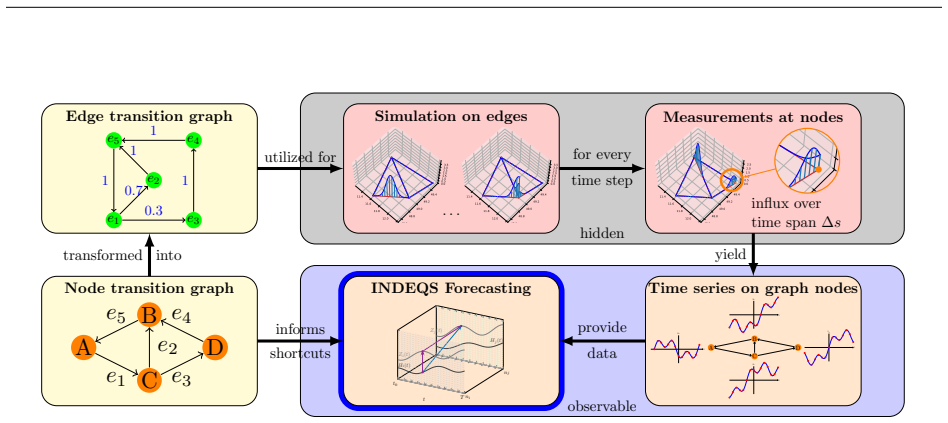
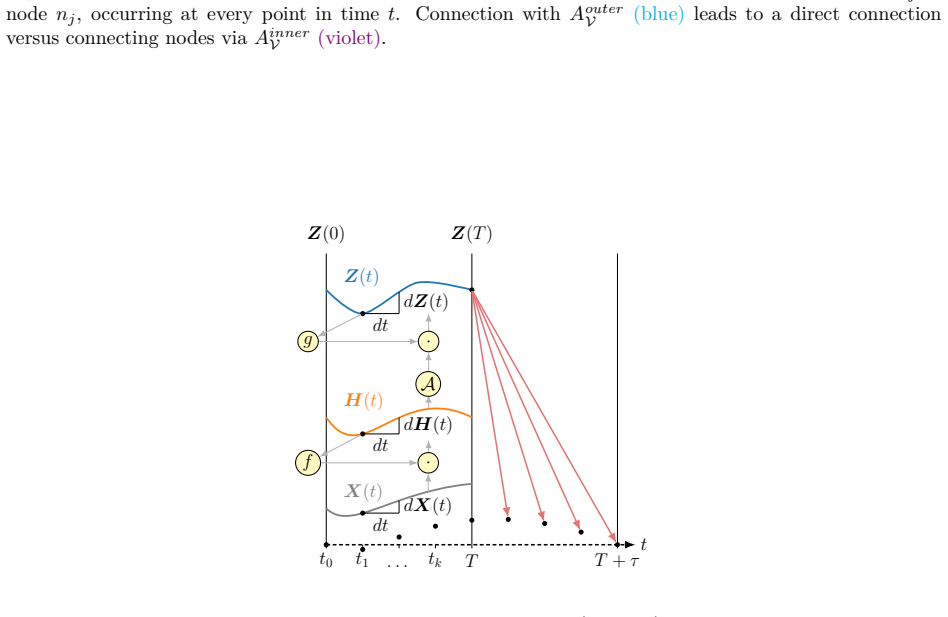
INDEQS extends the NCDE framework by inserting a known directed graph at two architecturally separate positions: inner mixing that propagates hidden states across nodes according to the adjacency, and outer mixing that modulates the interaction between the learned vector field and the control path. The method supplies a lightweight graph-constrained variant that enforces the known edges and a more expressive variant that augments them with adaptive graph convolutions learned from data. On a continuous advection simulation that generates synthetic spatio-temporal series with known ground-truth flow, as well as on hydrological river networks and the PeMS08 traffic dataset, outer informedness y
What carries the argument
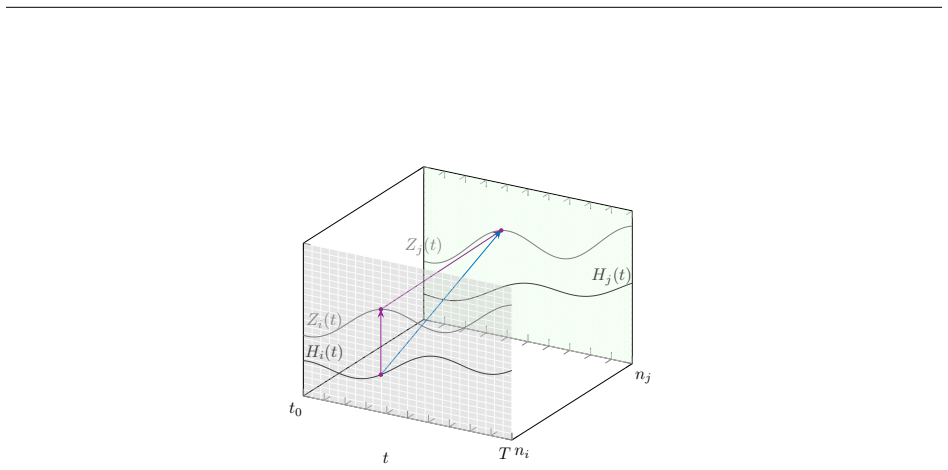
Separation of inner mixing (hidden-state propagation across graph nodes) from outer mixing (vector-field-to-control interaction), allowing the known directed adjacency to be injected at either or both locations.
If this is right
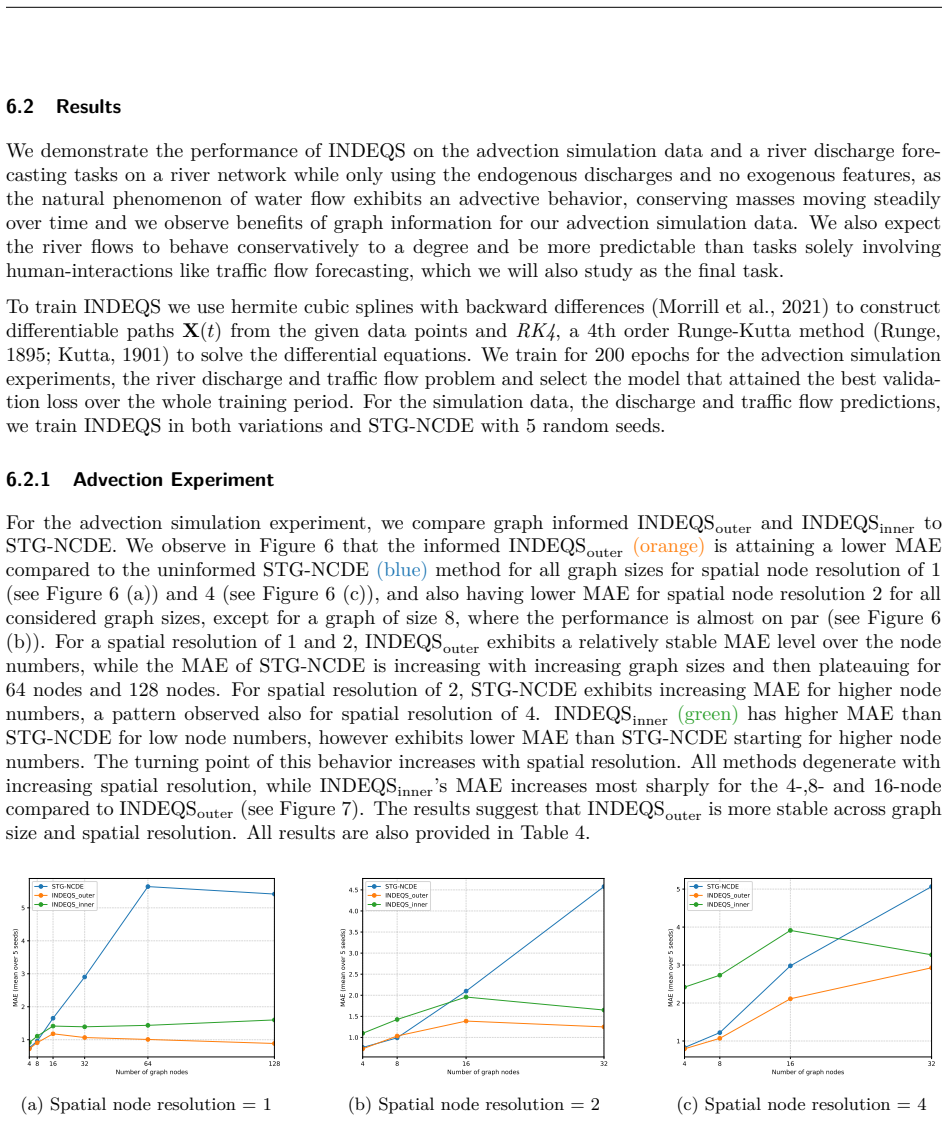
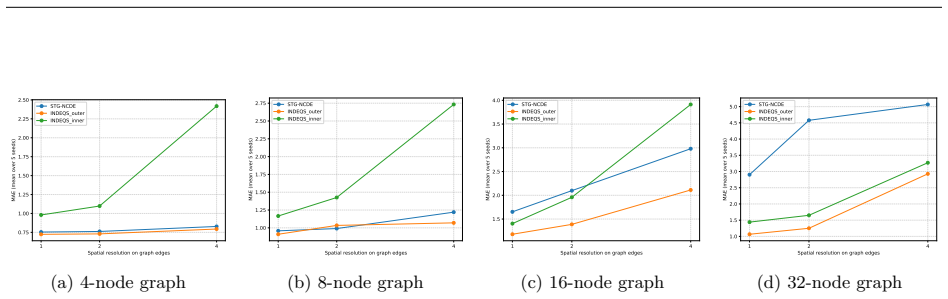
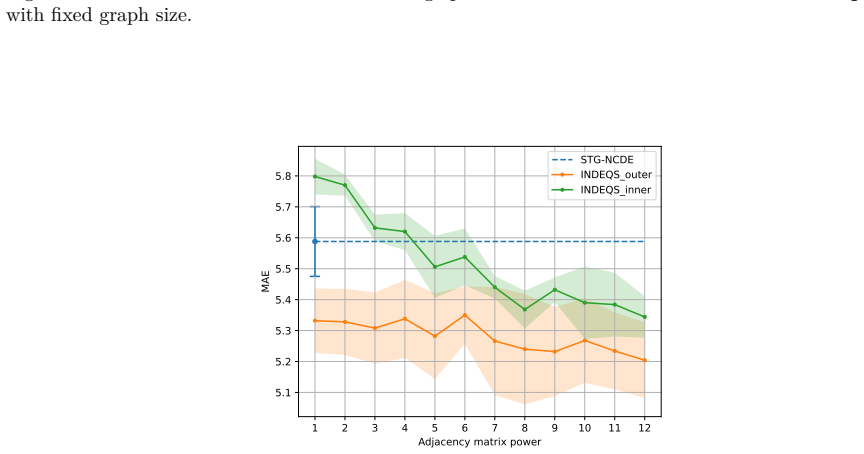
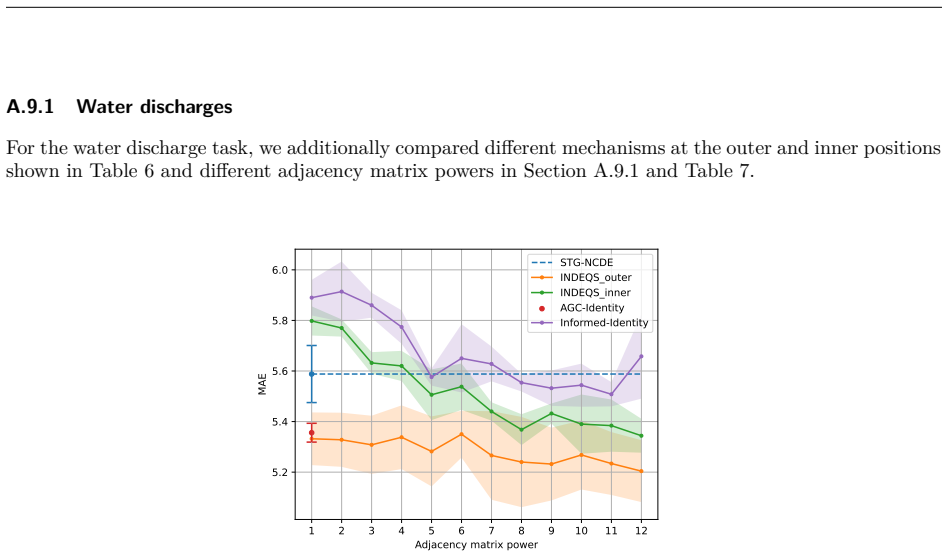
- Outer informedness lowers mean absolute error relative to an uninformed NCDE of comparable size, with larger gains on bigger graphs.
- Inner informedness supplies a parameter-efficient option when the supplied adjacency must be followed exactly.
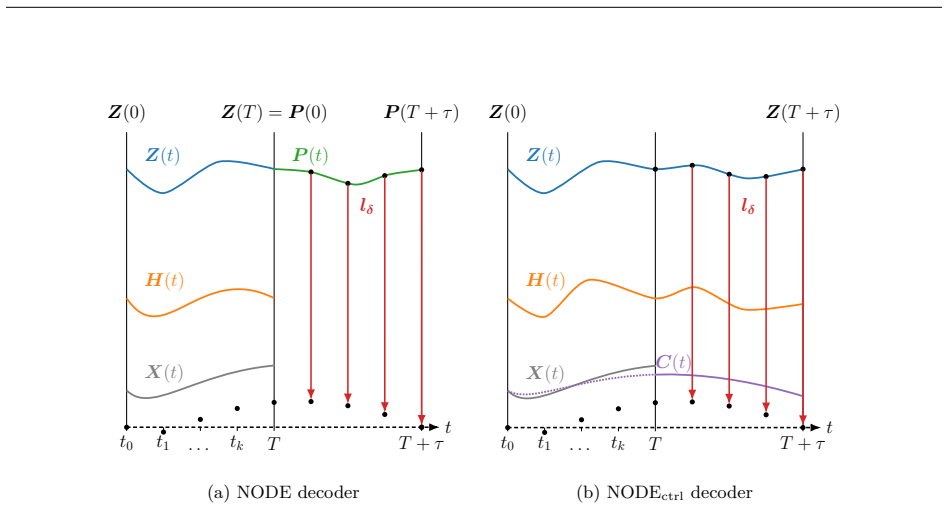
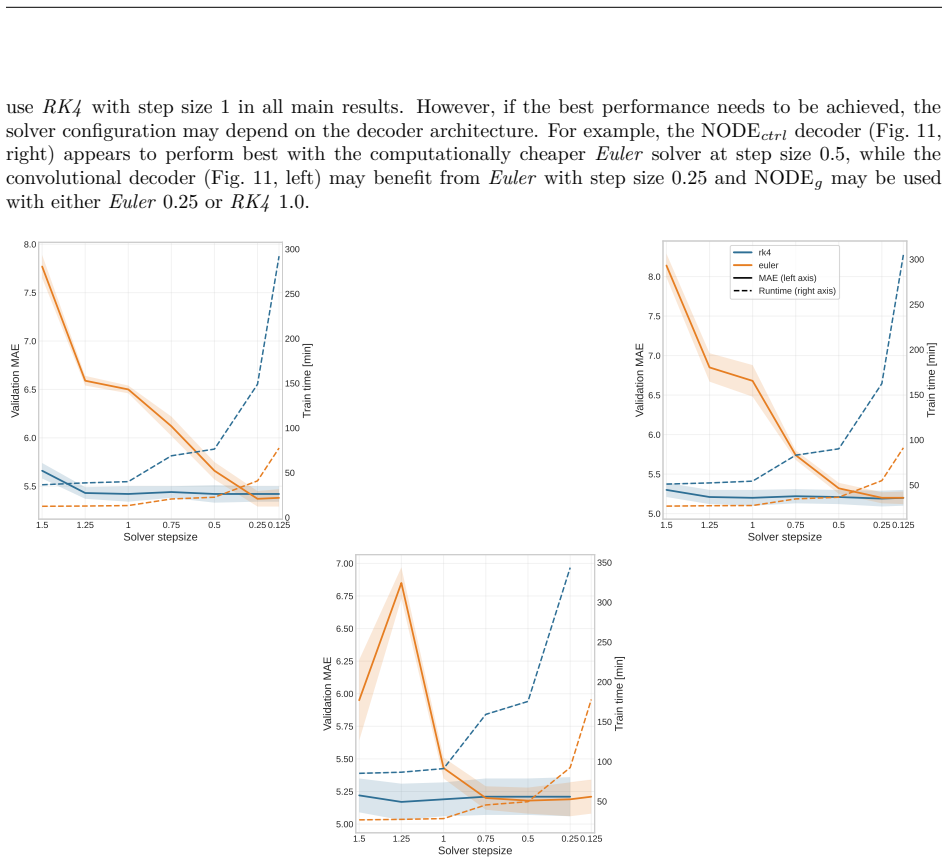
- Continuous-time decoders produce higher accuracy and greater temporal flexibility than discrete convolutional decoders on real hydrological and traffic tasks.
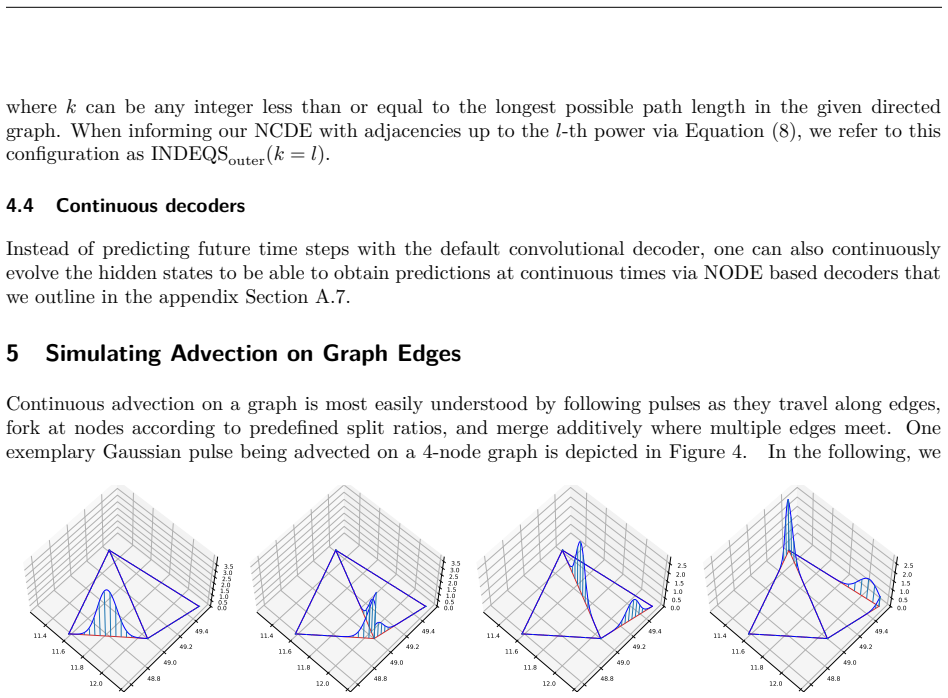
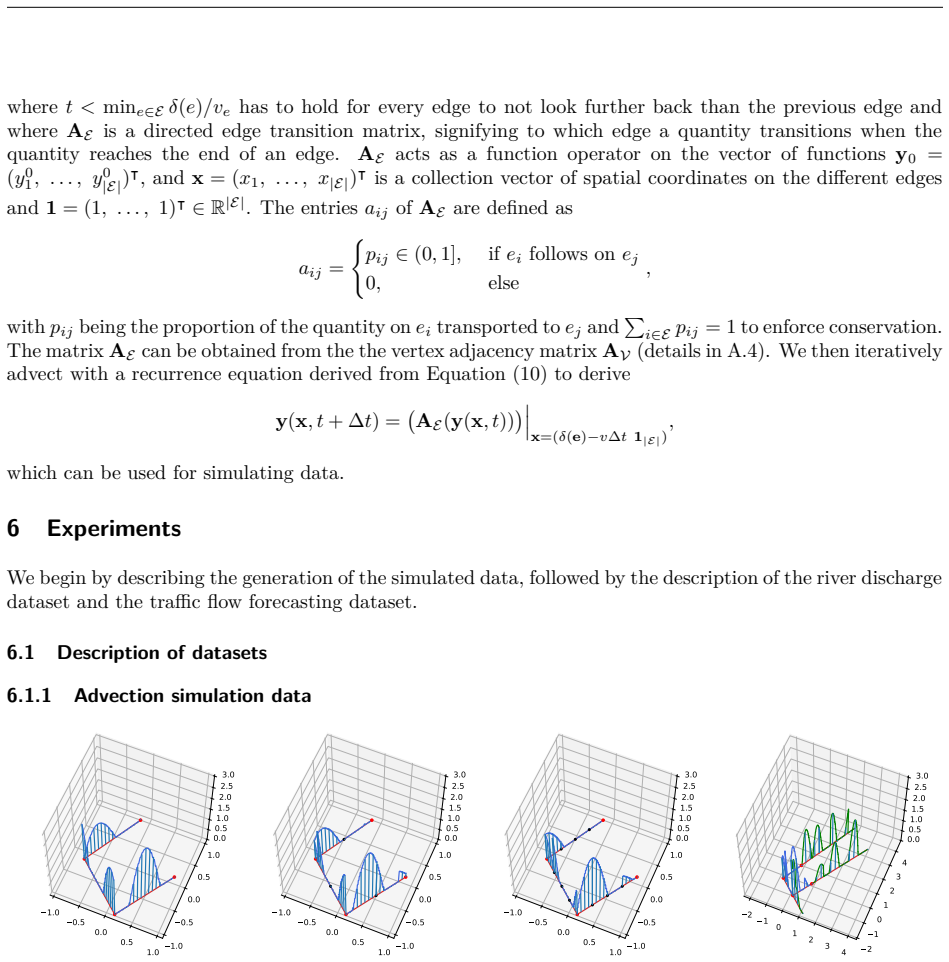
- The continuous advection simulation on directed graphs supplies a controlled testbed with known ground-truth flow for studying graph-informed continuous models.
Where Pith is reading between the lines
- The inner/outer split could be tested on other known-topology domains such as power-grid load or epidemic spread on contact networks.
- Replacing the adaptive graph convolutions with alternative graph-learning layers would isolate whether the benefit comes from the informed positions or from the extra parameters.
- The advection simulator could be extended to include stochastic forcing or time-varying edges to probe robustness of the informedness gains.
Load-bearing premise
A directed graph structure is known in advance and placing the graph information at the inner-versus-outer mixing split is a structurally useful insertion point.
What would settle it
An uninformed NCDE with the same parameter budget achieves equal or lower MAE than the outer-informed INDEQS variant on the PeMS08 traffic dataset or on the largest advection graphs.
Figures
read the original abstract
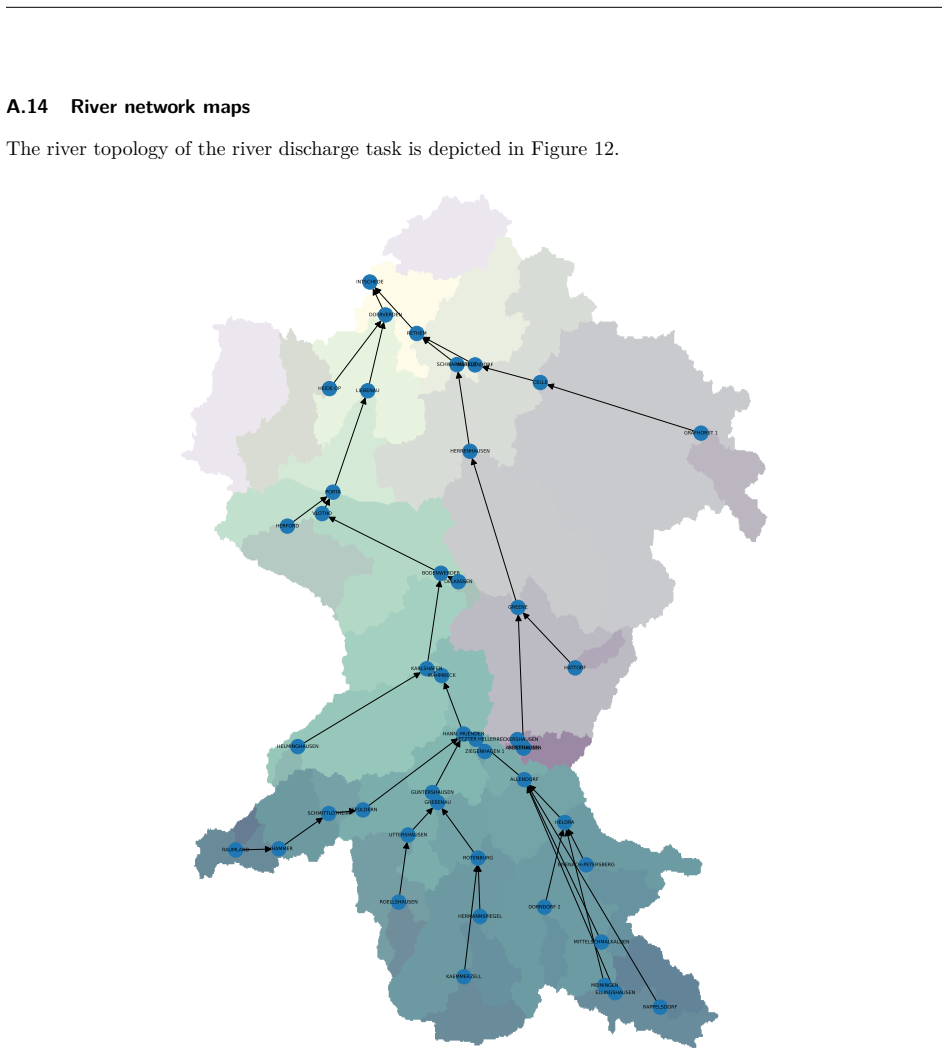
Neural Controlled Differential Equations (NCDE) provide a powerful continuous-time framework for forecasting time series, but standard graph-based extensions typically learn spatial structure purely from data, even in settings where a directed graph structure is known a priori. We introduce Informed Neural controlled Differential EQuationS (INDEQS), a graph-based NCDE forecasting method that incorporates prior knowledge of a directed graph at distinct architectural positions. INDEQS separates inner mixing of hidden states across graph nodes from outer mixing between vector field and control, and offers both a lightweight graph-constrained variant and a more expressive variant, learning additional graph connections from data via adaptive graph convolutions. To systematically study when graph informedness is beneficial in forecasting, we devise a continuous advection simulation on directed graphs, yielding synthetic spatio-temporal datasets with known ground-truth flow structure. We then evaluate INDEQS on two real-world tasks: river discharge forecasting on a hydrological network and traffic flow prediction on PeMS08. Across these synthetic and real-world benchmarks, outer informedness consistently improves mean absolute error over an uninformed NCDE with comparable parameter count, particularly on larger graphs, while inner informedness offers a more parameter-efficient alternative when strict adherence to a known adjacency is desired. A comparison of discrete convolutional and continuous-time decoders further shows that continuous decoders yield better accuracy and greater temporal flexibility on real-world tasks. An implementation of INDEQS and the advection simulation is available at https://github.com/Mitchi1/indeqs.
Editorial analysis
A structured set of objections, weighed in public.
Referee Report
Summary. The paper proposes INDEQS, an extension of Neural Controlled Differential Equations (NCDEs) for spatio-temporal forecasting that injects a priori directed graph structure at two distinct positions: inner mixing of hidden states across nodes and outer mixing between the vector field and control path. It introduces a lightweight graph-constrained variant and an expressive variant using adaptive graph convolutions to learn additional edges. A new synthetic continuous advection simulation on directed graphs is presented to generate datasets with known ground-truth flow. Evaluations on river discharge forecasting and PeMS08 traffic prediction claim that outer informedness yields consistent MAE gains over an uninformed NCDE with matched parameter count (especially on larger graphs), while inner informedness is more parameter-efficient when strict adherence to the known adjacency is required. A decoder comparison shows continuous-time decoders outperform discrete convolutional ones on real tasks. Code and the advection simulator are released.
Significance. If the reported MAE improvements hold under fair hyperparameter matching and are specifically attributable to the inner/outer injection points rather than graph information in general, the work offers a practical way to incorporate known directed graph priors into continuous-time models. The synthetic advection generator and open implementation are clear strengths that support reproducibility and further investigation of graph-informed NCDEs.
major comments (2)
- [Method description and Experiments] The central architectural claim is that separating inner hidden-state mixing from outer vector-field/control mixing provides a structurally useful insertion point for known directed adjacency (as opposed to other positions). However, the experiments section reports comparisons only against an uninformed NCDE baseline and does not include ablations that inject the identical adjacency matrix at alternative locations (e.g., initial hidden-state projection, control-path preprocessing, or decoder). Without these controls it is impossible to determine whether the observed MAE reductions on the advection, river, and traffic benchmarks arise from the inner/outer split specifically or from the mere presence of graph information. This directly affects the load-bearing claim that the proposed separation is the advantageous design choice.
- [Experiments] The abstract and experimental claims state that outer informedness 'consistently improves mean absolute error' and that gains are 'particularly on larger graphs,' yet no tables or text report statistical significance tests, standard deviations across random seeds, or explicit confirmation that all baselines received equivalent hyperparameter tuning and training budgets. Given that the soundness assessment notes uncertainty about baseline fairness, these details are required to substantiate the empirical contribution.
minor comments (1)
- [Method] Notation for the inner and outer mixing operators should be introduced with explicit equations early in the method section to avoid ambiguity when the two variants are later compared.
Simulated Author's Rebuttal
Thank you for the opportunity to respond to the referee's comments. We address each major comment below and indicate the revisions we will make to the manuscript.
read point-by-point responses
-
Referee: [Method description and Experiments] The central architectural claim is that separating inner hidden-state mixing from outer vector-field/control mixing provides a structurally useful insertion point for known directed adjacency (as opposed to other positions). However, the experiments section reports comparisons only against an uninformed NCDE baseline and does not include ablations that inject the identical adjacency matrix at alternative locations (e.g., initial hidden-state projection, control-path preprocessing, or decoder). Without these controls it is impossible to determine whether the observed MAE reductions on the advection, river, and traffic benchmarks arise from the inner/outer split specifically or from the mere presence of graph information. This directly affects the load-bearing claim that the proposed separation is the advantageous design choice.
Authors: We recognize that the referee's point is valid and that additional ablations would more conclusively attribute the gains to the specific inner/outer positions rather than graph information in general. Our experiments were designed to compare the proposed INDEQS variants against the standard uninformed NCDE with matched parameter counts, demonstrating the benefit of informedness at these positions. The separation is theoretically motivated by the NCDE formulation, where the vector field and hidden state dynamics are distinct. To strengthen the manuscript, we will add a new subsection with ablations injecting the graph at alternative locations (initial hidden state and decoder) on the synthetic advection dataset, as this is computationally feasible. This will be included in the revised version. revision: yes
-
Referee: [Experiments] The abstract and experimental claims state that outer informedness 'consistently improves mean absolute error' and that gains are 'particularly on larger graphs,' yet no tables or text report statistical significance tests, standard deviations across random seeds, or explicit confirmation that all baselines received equivalent hyperparameter tuning and training budgets. Given that the soundness assessment notes uncertainty about baseline fairness, these details are required to substantiate the empirical contribution.
Authors: We agree that reporting statistical details is important for substantiating the claims. In the current manuscript, we focused on mean performance but did not include variance or significance tests. We will revise the experimental section to report mean and standard deviation over at least 5 random seeds for all methods, include p-values from statistical tests where appropriate, and add a paragraph detailing the hyperparameter tuning procedure and training budgets to confirm fairness. These additions will be made in the revised manuscript. revision: yes
Circularity Check
No circularity: architectural proposal evaluated empirically without self-referential derivations
full rationale
The paper proposes INDEQS as a graph-informed extension of NCDE by separating inner hidden-state mixing from outer vector-field/control mixing and injecting a known directed adjacency at those positions. Claims of improved MAE are supported solely by direct empirical comparisons on a custom advection simulation plus river/traffic benchmarks, using standard train/test splits and parameter-matched baselines. No equations, uniqueness theorems, or ansatzes are introduced that reduce any result to a fitted quantity defined by the same model or to a self-citation chain. The method is presented as an architectural choice whose value is tested externally rather than derived by construction from its own inputs.
Axiom & Free-Parameter Ledger
Reference graph
Works this paper leans on
-
[1]
Tanyu, Derick Nganyu and Ning, Jianfeng and Freudenberg, Tom and Heilenkötter, Nick and Rademacher, Andreas and Iben, Uwe and Maass, Peter , month = may, year =. Deep
-
[2]
Gaussian
Härkönen, Marc and Lange-Hegermann, Markus and Raiţă, Bogdan , month = jul, year =. Gaussian
-
[3]
Anumasa, Srinivas and Gunapati, Geetakrishnasai and Srijith, P. K. , month = dec, year =. Continuous
-
[4]
On neural differential equations , volume =
Kidger, P , editor =. On neural differential equations , volume =. , pages =. 2021 , series =
2021
-
[5]
Ali, Ameen and Schnake, Thomas and Eberle, Oliver and Montavon, Grégoire and Müller, Klaus-Robert and Wolf, Lior , month = jun, year =
-
[6]
Universal approximation property of invertible neural networks , url =
Ishikawa, Isao and Teshima, Takeshi and Tojo, Koichi and Oono, Kenta and Ikeda, Masahiro and Sugiyama, Masashi , month = apr, year =. Universal approximation property of invertible neural networks , url =
-
[7]
Training
Krämer, Andreas and Köhler, Jonas and Noé, Frank , month = nov, year =. Training
-
[8]
Stochastic
Wu, Hao and Köhler, Jonas and Noé, Frank , month = oct, year =. Stochastic
-
[9]
Spectral
Bruna, Joan and Zaremba, Wojciech and Szlam, Arthur and LeCun, Yann , month = may, year =. Spectral
-
[11]
and Neumann, David and Samek, Wojciech and Müller, Klaus-Robert and Lapuschkin, Sebastian , month = jun, year =
Anders, Christopher J. and Neumann, David and Samek, Wojciech and Müller, Klaus-Robert and Lapuschkin, Sebastian , month = jun, year =. Software for
-
[12]
Köhler, Jonas and Krämer, Andreas and Noé, Frank , month = nov, year =. Smooth
-
[13]
Kipf and Max Welling , booktitle=
Thomas N. Kipf and Max Welling , booktitle=. 2017 , url=
2017
-
[14]
Thomas N. Kipf and Max Welling , year=. 1609.02907 , archivePrefix=
-
[15]
and Kumar, Abhishek and Ermon, Stefano and Poole, Ben , month = feb, year =
Song, Yang and Sohl-Dickstein, Jascha and Kingma, Diederik P. and Kumar, Abhishek and Ermon, Stefano and Poole, Ben , month = feb, year =. Score-
-
[16]
Recurrent. Scientific Reports , author =. 2018 , keywords =. doi:10.1038/s41598-018-24271-9 , abstract =
-
[17]
Raissi, Maziar and Perdikaris, Paris and Karniadakis, George Em , month = nov, year =. Physics
-
[18]
and Nakajima, Shinichi and Kessel, Pan , month = jun, year =
Vaitl, Lorenz and Nicoli, Kim A. and Nakajima, Shinichi and Kessel, Pan , month = jun, year =. Path-
-
[19]
Gao, Jianfei and Ribeiro, Bruno , month = mar, year =. On the
-
[20]
Shrikumar, Avanti and Greenside, Peyton and Shcherbina, Anna and Kundaje, Anshul , month = apr, year =. Not
-
[21]
Zubov, Kirill and McCarthy, Zoe and Ma, Yingbo and Calisto, Francesco and Pagliarino, Valerio and Azeglio, Simone and Bottero, Luca and Luján, Emmanuel and Sulzer, Valentin and Bharambe, Ashutosh and Vinchhi, Nand and Balakrishnan, Kaushik and Upadhyay, Devesh and Rackauckas, Chris , month = jul, year =
-
[22]
Morrill, James and Kidger, Patrick and Yang, Lingyi and Lyons, Terry , month = jun, year =. Neural
-
[23]
Kidger, Patrick and Morrill, James and Foster, James and Lyons, Terry , booktitle =
-
[24]
and Tancik, Matthew and Barron, Jonathan T
Mildenhall, Ben and Srinivasan, Pratul P. and Tancik, Matthew and Barron, Jonathan T. and Ramamoorthi, Ravi and Ng, Ren , month = aug, year =
-
[25]
Lahat, Dana and Adali, Tülay and Jutten, Christian , year =. Multimodal. doi:10.1109/JPROC.2015.2460697 , journal =
-
[26]
Multi-. Sensors , author =. 2022 , keywords =. doi:10.3390/s22103697 , abstract =
-
[27]
IEEE Transactions on Intelligent Transportation Systems , author =
Modeling and. IEEE Transactions on Intelligent Transportation Systems , author =. 2014 , keywords =. doi:10.1109/TITS.2013.2278614 , urldate =
-
[28]
Digital Signal Processing , author =
Methods for interpreting and understanding deep neural networks , volume =. Digital Signal Processing , author =. 2018 , keywords =. doi:10.1016/j.dsp.2017.10.011 , language =
-
[29]
Papamakarios, George and Pavlakou, Theo and Murray, Iain , month = jun, year =. Masked
-
[30]
Linear algebra with transformers , url =
Charton, François , month = nov, year =. Linear algebra with transformers , url =
-
[31]
Journal of Computational Physics , author =
Learning. Journal of Computational Physics , author =. 2021 , keywords =. doi:10.1016/j.jcp.2020.110072 , abstract =
-
[32]
Rubanova, Yulia and Chen, Ricky T. Q. and Duvenaud, David , month = jul, year =. Latent
-
[33]
Rubanova, Yulia and Chen, Ricky T. Q. and Duvenaud, David K , booktitle =
-
[34]
Langevin
Srinivasan, Vignesh and Müller, Klaus-Robert and Samek, Wojciech and Nakajima, Shinichi , month = aug, year =. Langevin
-
[35]
Lagrangian
Cranmer, Miles and Greydanus, Sam and Hoyer, Stephan and Battaglia, Peter and Spergel, David and Ho, Shirley , month = jul, year =. Lagrangian
-
[36]
and Ying, Rex and Leskovec, Jure , month = sep, year =
Hamilton, William L. and Ying, Rex and Leskovec, Jure , month = sep, year =. Inductive
-
[37]
Hopfield
Ramsauer, Hubert and Schäfl, Bernhard and Lehner, Johannes and Seidl, Philipp and Widrich, Michael and Adler, Thomas and Gruber, Lukas and Holzleitner, Markus and Pavlović, Milena and Sandve, Geir Kjetil and Greiff, Victor and Kreil, David and Kopp, Michael and Klambauer, Günter and Brandstetter, Johannes and Hochreiter, Sepp , month = apr, year =. Hopfield
-
[38]
Gu, Albert and Dao, Tri and Ermon, Stefano and Rudra, Atri and Re, Christopher , month = oct, year =
-
[39]
Machine Learning: Science and Technology , author =
High-fidelity molecular dynamics trajectory reconstruction with bi-directional neural networks , volume =. Machine Learning: Science and Technology , author =. 2022 , keywords =. doi:10.1088/2632-2153/ac6ec6 , abstract =
-
[40]
Salinas, David and Bohlke-Schneider, Michael and Callot, Laurent and Medico, Roberto and Gasthaus, Jan , month = oct, year =. High-
-
[41]
Raissi, Maziar and Yazdani, Alireza and Karniadakis, George Em , month = aug, year =. Hidden
-
[42]
, month = jun, year =
Liu, Zibo and Shojaee, Parshin and Reddy, Chandan K. , month = jun, year =. Graph-based
-
[43]
Poli, Michael and Massaroli, Stefano and Park, Junyoung and Yamashita, Atsushi and Asama, Hajime and Park, Jinkyoo , booktitle =. Graph. 2021 , maintitle =
2021
-
[44]
Michael Poli and Stefano Massaroli and Junyoung Park and Atsushi Yamashita and Hajime Asama and Jinkyoo Park , year=. 1911.07532 , archivePrefix=
arXiv 1911
-
[45]
Zhou, Jie and Cui, Ganqu and Hu, Shengding and Zhang, Zhengyan and Yang, Cheng and Liu, Zhiyuan and Wang, Lifeng and Li, Changcheng and Sun, Maosong , month = oct, year =. Graph
-
[46]
ISPRS International Journal of Geo-Information , author =
Graph. ISPRS International Journal of Geo-Information , author =. 2023 , pages =. doi:10.3390/ijgi12030100 , abstract =
-
[47]
Jeongwhan Choi AND Hwangyong Choi AND Jeehyun Hwang AND Noseong Park , booktitle=
-
[48]
Proceedings of the AAAI Conference on Artificial Intelligence , author=. 2022 , month=. doi:10.1609/aaai.v36i6.20587 , abstractNote=
-
[49]
, month = sep, year =
Chamberlain, Benjamin Paul and Rowbottom, James and Gorinova, Maria and Webb, Stefan and Rossi, Emanuele and Bronstein, Michael M. , month = sep, year =
-
[50]
2021 , editor =
Chamberlain, Ben and Rowbottom, James and Gorinova, Maria I and Bronstein, Michael and Webb, Stefan and Rossi, Emanuele , booktitle =. 2021 , editor =
2021
-
[51]
Machine Learning: Science and Technology , author =
Gradients should stay on path: better estimators of the reverse- and forward. Machine Learning: Science and Technology , author =. 2022 , keywords =. doi:10.1088/2632-2153/ac9455 , abstract =
-
[52]
and Bruna, Joan and Cohen, Taco and Veličković, Petar , month = may, year =
Bronstein, Michael M. and Bruna, Joan and Cohen, Taco and Veličković, Petar , month = may, year =. Geometric
-
[53]
Pattern Recognition , author =
Explaining. Pattern Recognition , author =. 2017 , keywords =. doi:10.1016/j.patcog.2016.11.008 , abstract =
-
[54]
Enhancing the
Li, Shiyang and Jin, Xiaoyong and Xuan, Yao and Zhou, Xiyou and Chen, Wenhu and Wang, Yu-Xiang and Yan, Xifeng , month = jan, year =. Enhancing the
-
[55]
Dissipative
Zhong, Yaofeng Desmond and Dey, Biswadip and Chakraborty, Amit , month = apr, year =. Dissipative
-
[56]
Discovering
Cranmer, Miles and Sanchez-Gonzalez, Alvaro and Battaglia, Peter and Xu, Rui and Cranmer, Kyle and Spergel, David and Ho, Shirley , month = nov, year =. Discovering
-
[57]
Aziznejad, Shayan and Unser, Michael , month = may, year =. Deep. doi:10.1109/ICASSP.2019.8682547 , urldate =
-
[58]
Continuous
Deng, Zhiwei and Nawhal, Megha and Meng, Lili and Mori, Greg , month = sep, year =. Continuous
-
[59]
Combining
Gu, Albert and Johnson, Isys and Goel, Karan and Saab, Khaled and Dao, Tri and Rudra, Atri and Ré, Christopher , month = oct, year =. Combining
-
[60]
Zhou, Zhaorun and Shi, Zhenghao and Guo, Mingtao and Feng, Yaning and Zhao, Minghua , month = may, year =
-
[61]
Axiomatic
Sundararajan, Mukund and Taly, Ankur and Yan, Qiqi , month = jun, year =. Axiomatic
-
[62]
Augmented
Dupont, Emilien and Doucet, Arnaud and Teh, Yee Whye , month = oct, year =. Augmented
-
[63]
Augmented
Dupont, Emilien and Doucet, Arnaud and Teh, Yee Whye , booktitle =. Augmented
-
[64]
and Kaiser, Lukasz and Polosukhin, Illia , month = dec, year =
Vaswani, Ashish and Shazeer, Noam and Parmar, Niki and Uszkoreit, Jakob and Jones, Llion and Gomez, Aidan N. and Kaiser, Lukasz and Polosukhin, Illia , month = dec, year =. Attention
-
[65]
Attention based spatial-temporal graph convolutional networks for traffic flow forecasting,
Attention. Proceedings of the AAAI Conference on Artificial Intelligence , author =. 2019 , keywords =. doi:10.1609/aaai.v33i01.3301922 , abstract =
-
[66]
and Reisinger, Christoph and Wang, Sheng , month = aug, year =
Cohen, Samuel N. and Reisinger, Christoph and Wang, Sheng , month = aug, year =. Arbitrage-free neural-
-
[67]
A. Neural Computation , author =. 2020 , keywords =. doi:10.1162/neco_a_01273 , abstract =
-
[68]
Sixt, Leon and Landgraf, Tim , month = nov, year =. A
-
[69]
Chevyrev, Ilya and Kormilitzin, Andrey , month = mar, year =. A
-
[70]
Chen, Ricky T. Q. and Rubanova, Yulia and Bettencourt, Jesse and Duvenaud, David K , booktitle =
-
[71]
Universal
Rackauckas, Christopher and Ma, Yingbo and Martensen, Julius and Warner, Collin and Zubov, Kirill and Supekar, Rohit and Skinner, Dominic and Ramadhan, Ali and Edelman, Alan , month = nov, year =. Universal
-
[72]
, volume =
Estimation of non-normalized statistical models by score matching. , volume =. Journal of Machine Learning Research , author =. 2005 , file =
2005
-
[73]
Physics-informed neural networks:. Journal of Computational Physics , author =. 2019 , keywords =. doi:https://doi.org/10.1016/j.jcp.2018.10.045 , abstract =
-
[74]
Differential equations driven by rough paths , publisher =
Lyons, Terry J and Caruana, Michael and Lévy, Thierry , year =. Differential equations driven by rough paths , publisher =
-
[75]
Introduction to
Samek, Wojciech , file =. Introduction to
-
[76]
Ma, Yao and Tang, Jiliang , keywords =. Book
-
[77]
Raissi, Maziar , month = jan, year =. Deep
-
[78]
Hoidn, Oliver and Mishra, Aashwin Ananda and Mehta, Apurva , month = oct, year =. Physics
-
[79]
Review of. Frontiers in Genetics , author =. 2019 , keywords =. doi:10.3389/fgene.2019.00524 , urldate =
-
[80]
Causal discovery for time series from multiple datasets with latent contexts , url =
Günther, Wiebke and Ninad, Urmi and Runge, Jakob , month = jun, year =. Causal discovery for time series from multiple datasets with latent contexts , url =
-
[81]
Quantifying the. Journal of Climate , author =. 2014 , keywords =. doi:10.1175/JCLI-D-13-00159.1 , abstract =
discussion (0)
Sign in with ORCID, Apple, or X to comment. Anyone can read and Pith papers without signing in.