Multi-Thermal CME Detection with ALMANAC
Pith reviewed 2026-06-26 19:23 UTC · model grok-4.3
The pith
Multi-thermal ALMANAC detects low-coronal CME origins with clearer separation and more consistent onset times than single-channel or coronagraph methods.
A machine-rendered reading of the paper's core claim, the machinery that carries it, and where it could break.
Core claim
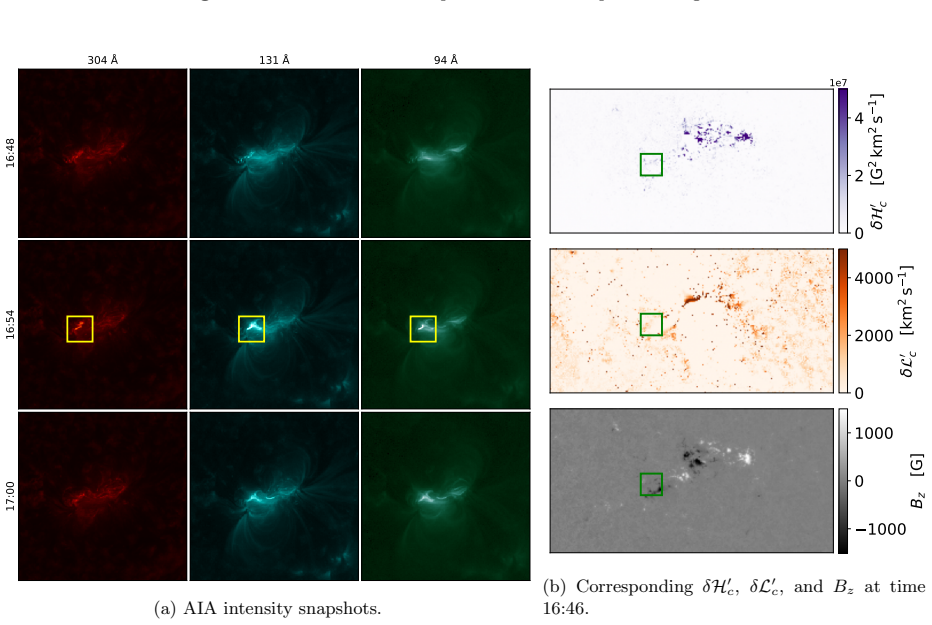
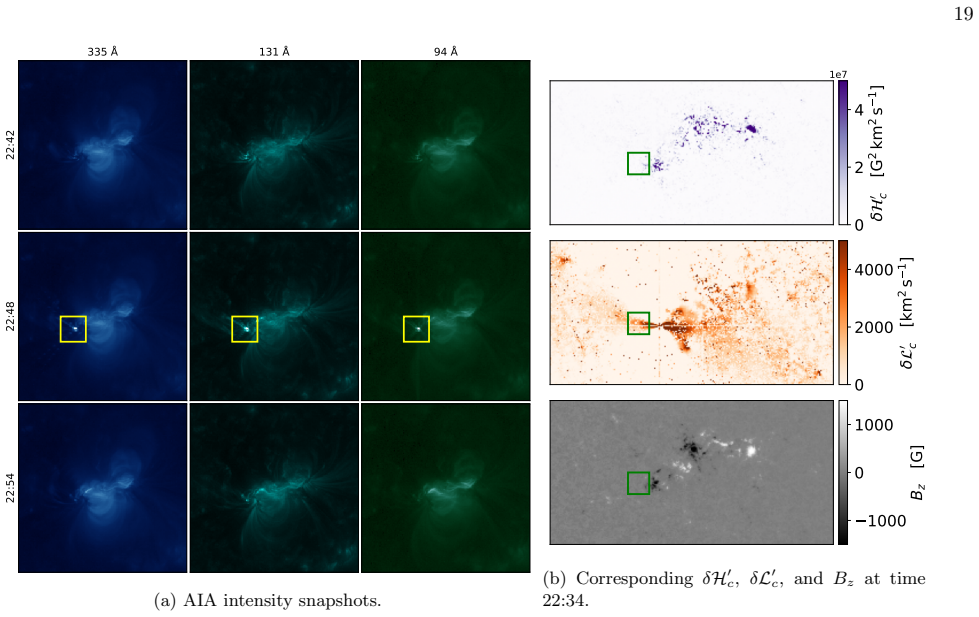
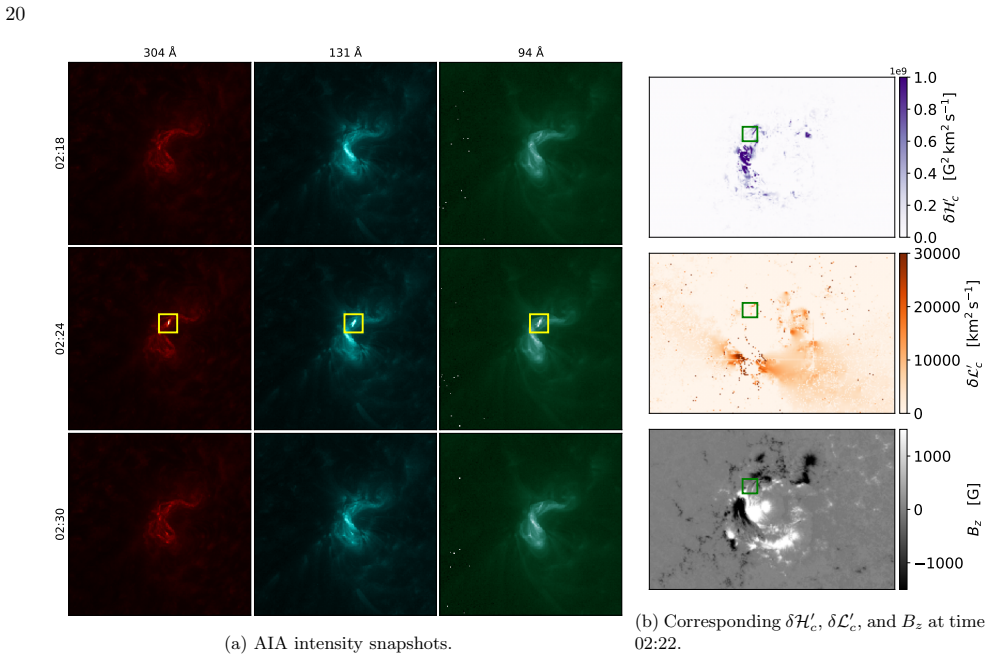
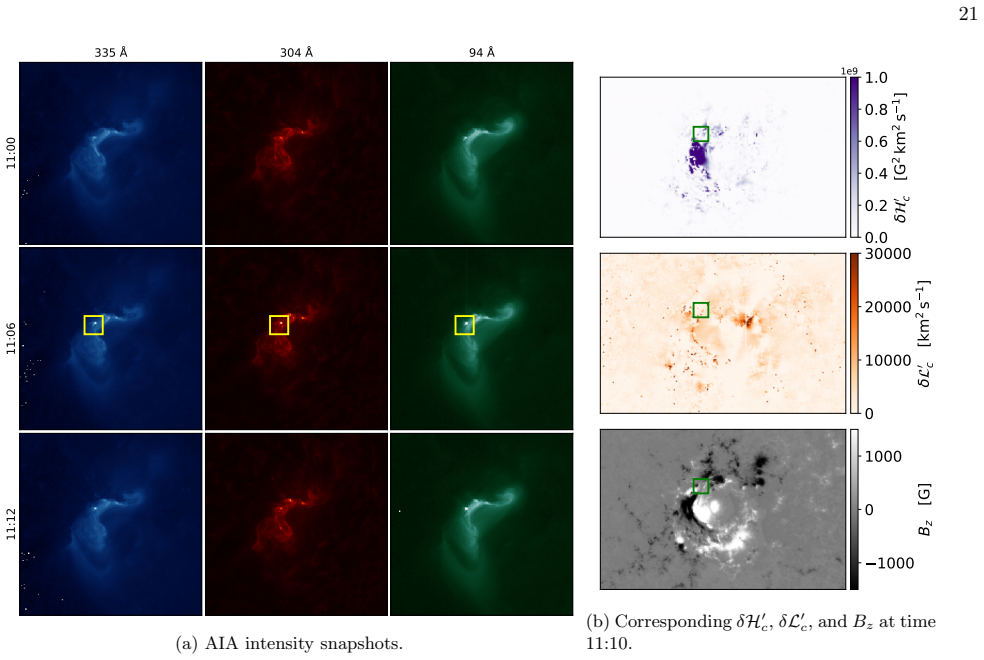
Extending ALMANAC to a multi-thermal EUV framework with complementary channel responses and spatiotemporal clustering produces detections that separate eruptions more cleanly, localise onsets more consistently relative to coronagraph timings, and capture precursor activity missed by white-light catalogues; when run alongside ARTop these signatures often precede magnetic helicity changes and X-class activity.
What carries the argument
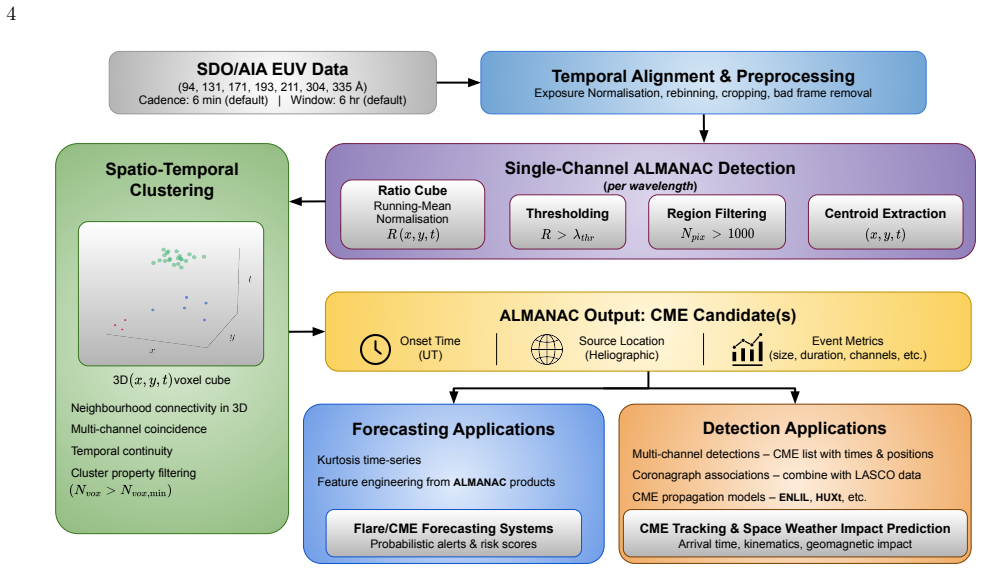
Multi-thermal ALMANAC algorithm that merges detections across EUV channels via spatiotemporal clustering to reduce bifurcation while preserving parallel-computing performance.
Load-bearing premise
Complementary temperature responses from multiple EUV channels reduce projection effects and wavelength ambiguities without introducing new selection biases or post-hoc tuning that would erase the reported gains in onset consistency.
What would settle it
A new sample of halo or non-halo CMEs where multi-thermal ALMANAC onset times show larger scatter against independent low-coronal markers than single-channel ALMANAC or CDAW estimates would falsify the claimed improvement.
Figures
read the original abstract
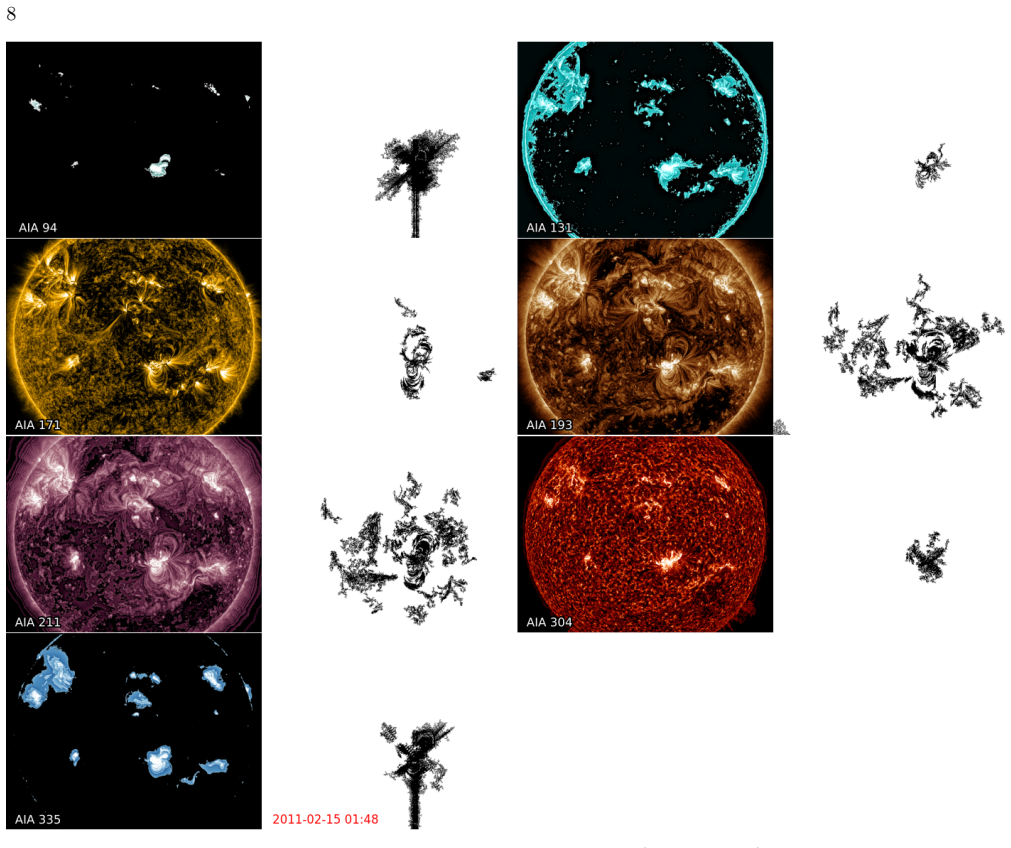
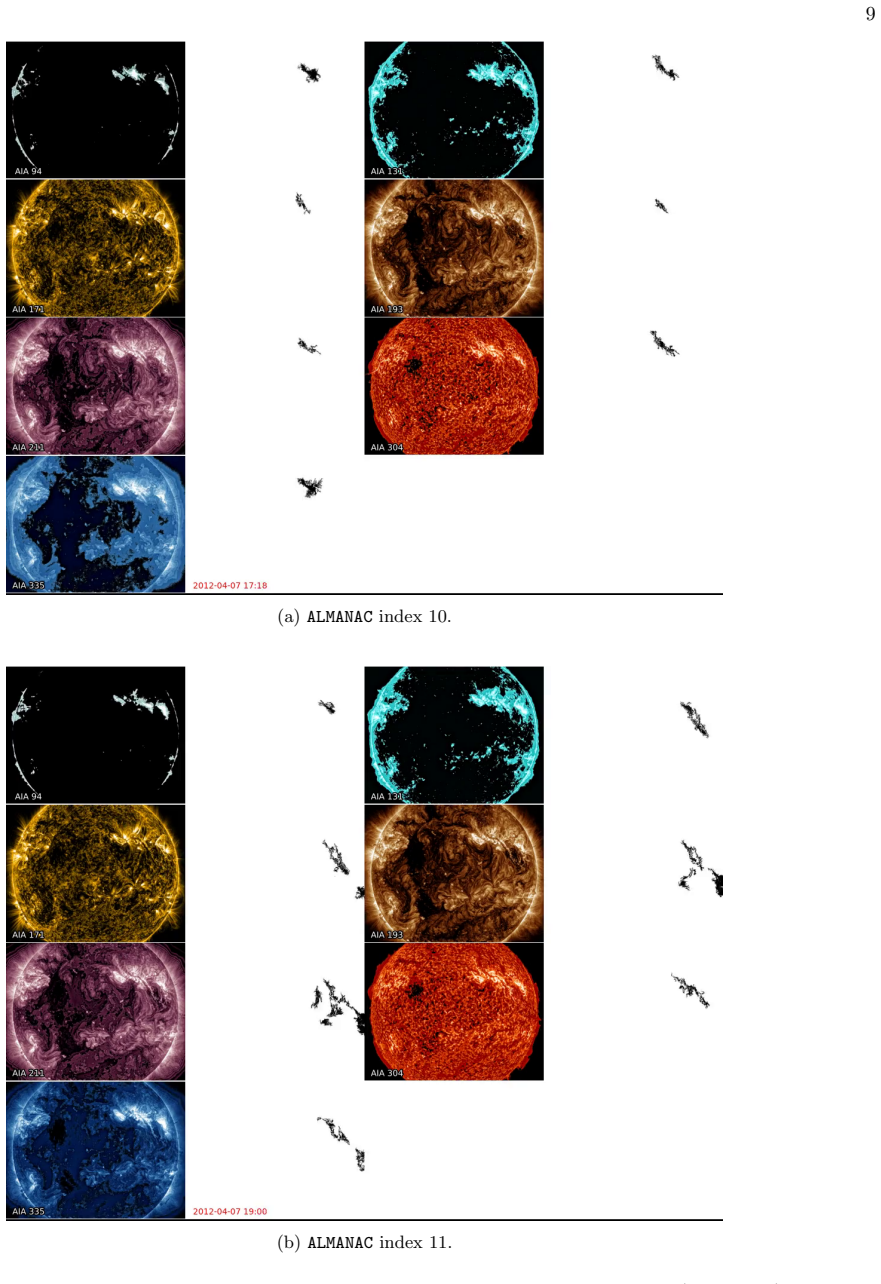
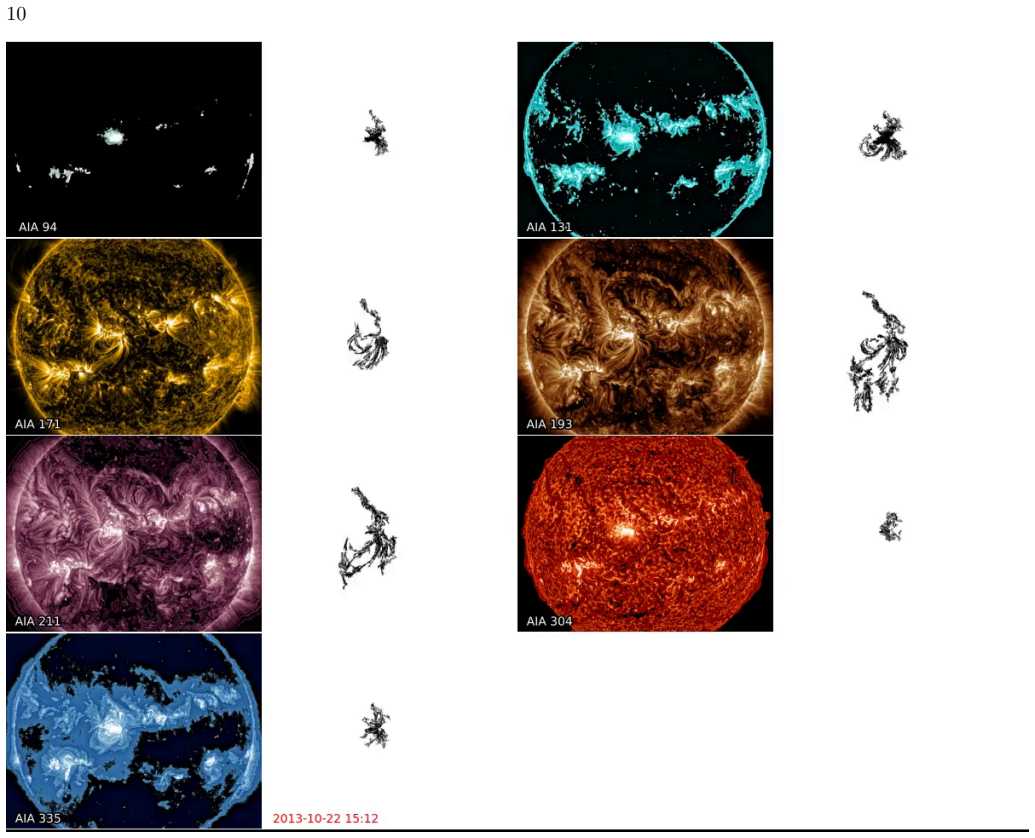
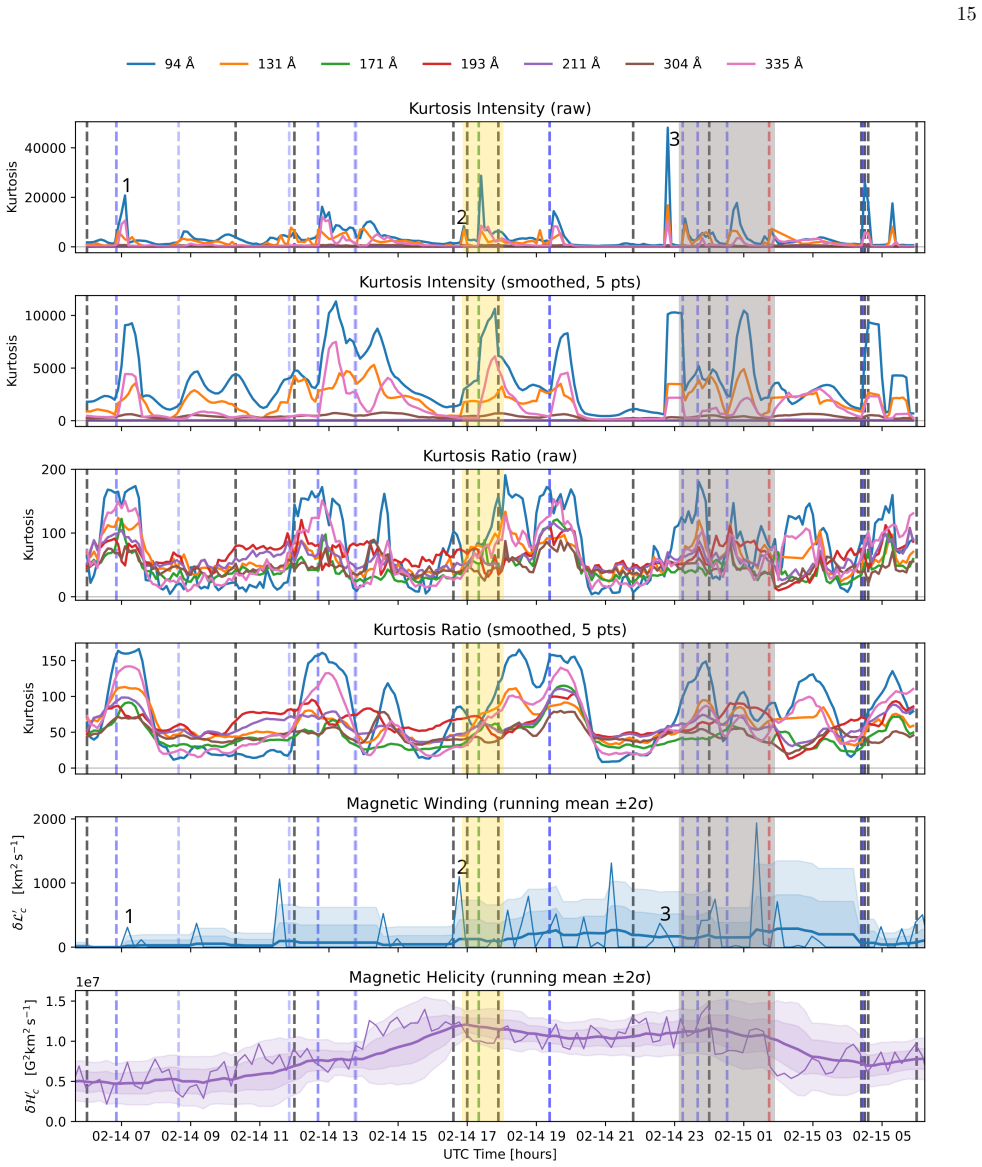
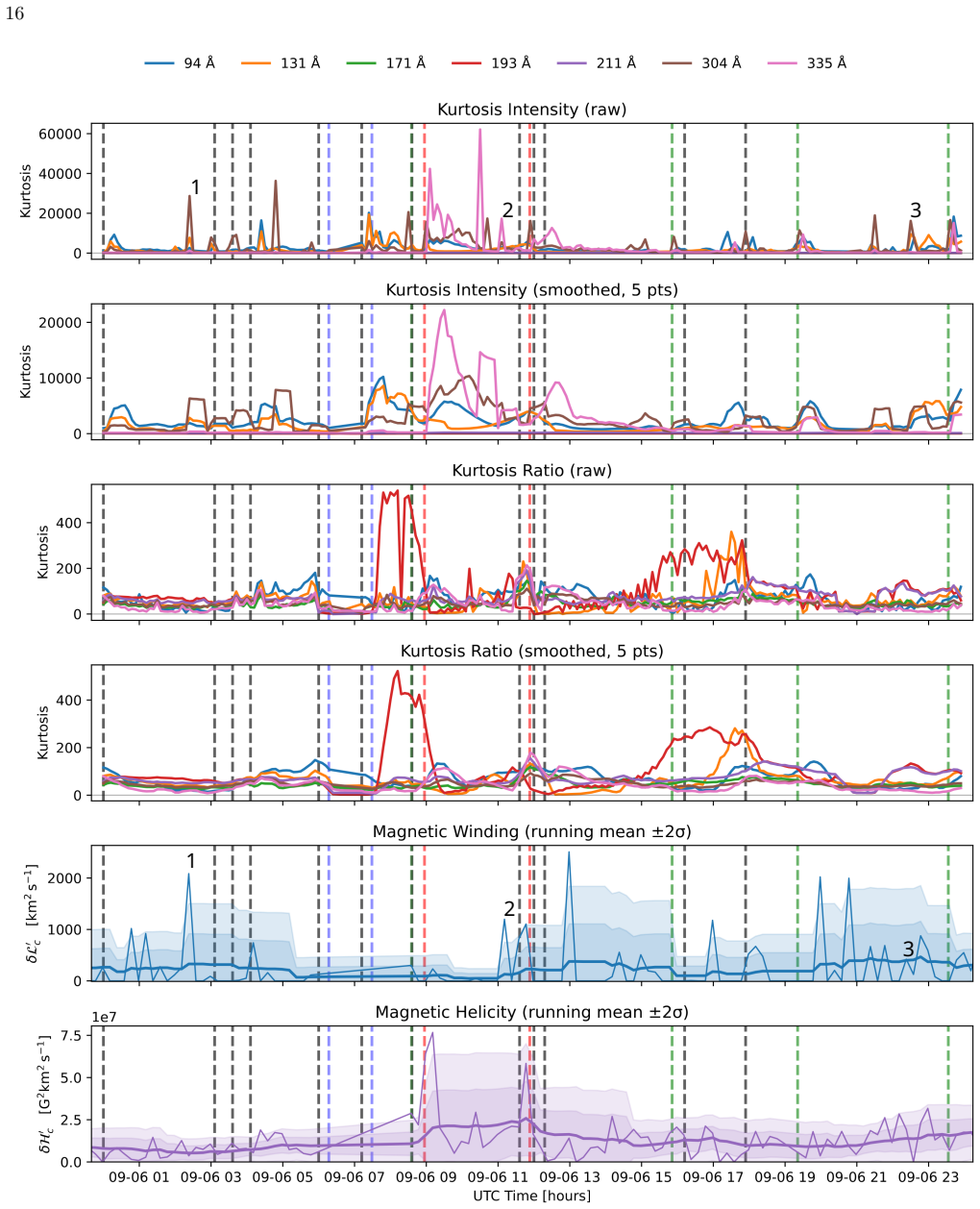
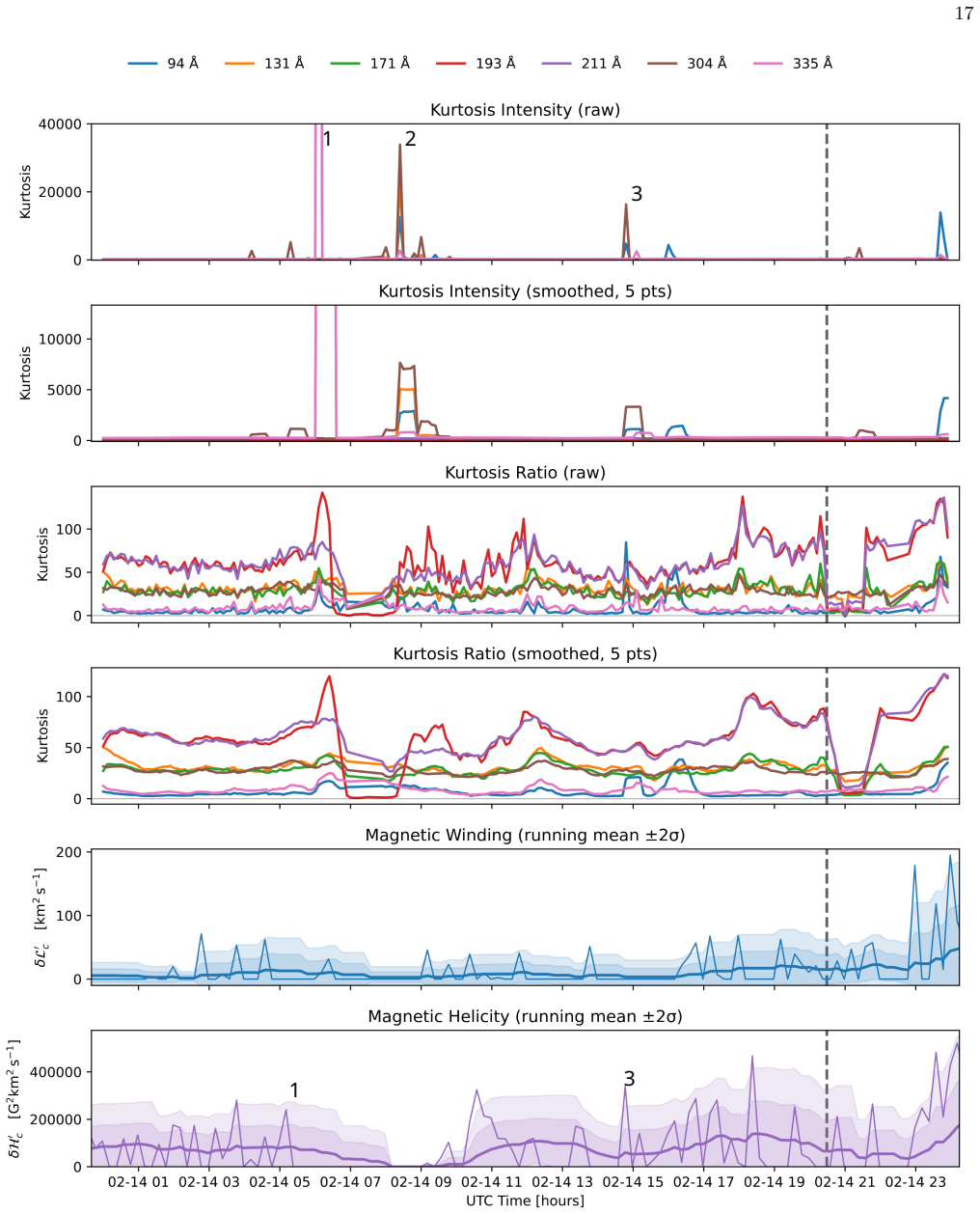
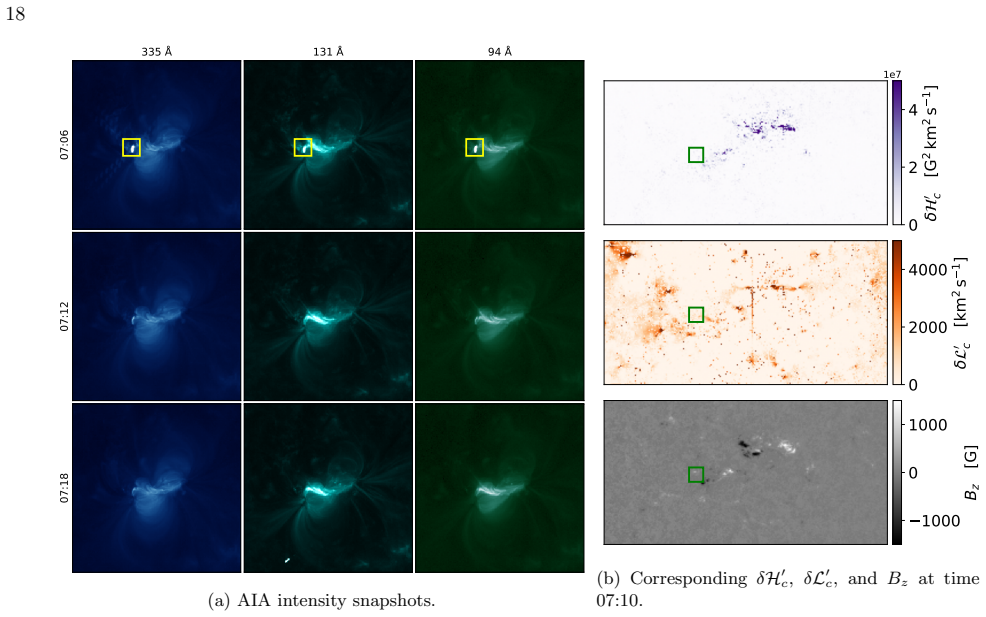
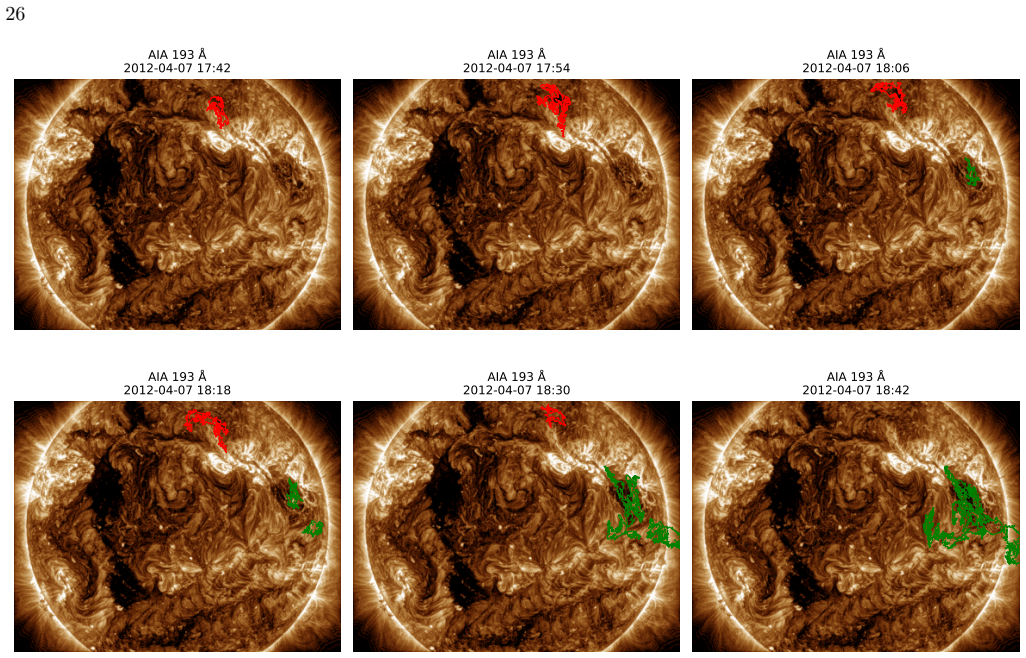
Reliable identification of low-coronal CME origins remains a key limitation in space weather forecasting with coronagraphs not directly resolving low-coronal signatures. We present a re-engineered multi-thermal implementation of the ALMANAC algorithm, designed to detect eruptive signatures in EUV observations. The framework extends the method to a multi-wavelength system, improving robustness against projection effects, instrumental artifacts, and wavelength-dependent ambiguities via complementary temperature responses. A spatiotemporal clustering scheme merges detections across channels, reducing event bifurcation and improving coherence while maintaining NRT performance through parallel computing. Benchmarking against 20 halo CMEs from CDAW shows improved interpretability and operational usability, with clearer separation of eruptions and more consistent onset localisation relative to coronagraph estimates. The main benefits arise from improved event discrimination, reduced fragmentation, and more interpretable source region identification. ALMANAC shows sensitivity to precursor low-coronal activity not always captured in white-light catalogues, highlighting its advantages for early warning detection. When coupled with the ARTop framework, it enables co-analysis of coronal intensity variability and photospheric magnetic evolution. In this context, kurtosis time-series from multi-wavelength EUV data exhibit recurrent pre-eruptive spikes that frequently align with enhancements in magnetic winding and helicity injection. Across multiple regions, these signatures often precede solar activity, including potential discrimination of X-class flares, while remaining suppressed during magnetically quiet intervals. Overall, integrating coronal diagnostics with photospheric topology offers a pathway toward improved eruption forecasting and space weather prediction.
Editorial analysis
A structured set of objections, weighed in public.
Referee Report
Summary. The paper presents a re-engineered multi-thermal version of the ALMANAC algorithm for detecting eruptive signatures in multi-wavelength EUV observations. It extends the method with complementary temperature responses across channels and a spatiotemporal clustering scheme to merge detections, aiming to reduce projection effects, fragmentation, and wavelength-dependent ambiguities while preserving near-real-time performance. Benchmarking is reported against 20 halo CMEs from the CDAW catalogue, claiming improved interpretability, clearer event separation, and more consistent onset localisation relative to coronagraph estimates. The work also couples ALMANAC with the ARTop framework to examine pre-eruptive kurtosis spikes in EUV data alongside photospheric magnetic evolution, suggesting utility for eruption forecasting.
Significance. If the reported gains in coherence and localisation are shown to be robust and not artifacts of event selection or hyperparameter tuning, the approach could meaningfully advance low-coronal CME source identification for space weather applications by leveraging multi-thermal EUV data to complement white-light observations. The integration with ARTop for joint coronal-photospheric analysis is a positive step toward multi-diagnostic forecasting, though its predictive value remains to be quantified.
major comments (3)
- [Abstract] Abstract: the claim of 'more consistent onset localisation relative to coronagraph estimates' is presented without any quantitative metric (e.g., mean temporal offset, RMS residual, or Kolmogorov-Smirnov test against CDAW times) or error bars; this absence makes it impossible to evaluate whether the improvement exceeds the scatter already present in single-channel or white-light catalogues.
- [Abstract] Abstract / benchmarking description: no comparison is shown to the single-thermal ALMANAC implementation on the identical set of 20 halo CMEs; without this control it cannot be established that the multi-thermal clustering step, rather than other algorithmic changes, produces the reported reduction in bifurcation and improved coherence.
- [Abstract] Abstract: the 20-event benchmark set is introduced without stating selection criteria, independence from algorithm tuning, or exclusion rules; if the events or clustering hyperparameters were chosen or adjusted with reference to CDAW onsets, the apparent gain in localisation consistency could be circular.
minor comments (1)
- [Abstract] The abstract states that ALMANAC 'shows sensitivity to precursor low-coronal activity not always captured in white-light catalogues' but provides no example events or false-positive rate to support this operational advantage.
Simulated Author's Rebuttal
We thank the referee for the constructive feedback on our manuscript. We address each major comment point by point below and outline the revisions we will make to strengthen the presentation of our results.
read point-by-point responses
-
Referee: [Abstract] Abstract: the claim of 'more consistent onset localisation relative to coronagraph estimates' is presented without any quantitative metric (e.g., mean temporal offset, RMS residual, or Kolmogorov-Smirnov test against CDAW times) or error bars; this absence makes it impossible to evaluate whether the improvement exceeds the scatter already present in single-channel or white-light catalogues.
Authors: We agree that the abstract would benefit from explicit quantitative support for the localisation claim. In the revised manuscript we will add the mean temporal offset, RMS residual, and associated uncertainties between ALMANAC onsets and CDAW times directly in the abstract, together with a brief statement of the statistical comparison performed. revision: yes
-
Referee: [Abstract] Abstract / benchmarking description: no comparison is shown to the single-thermal ALMANAC implementation on the identical set of 20 halo CMEs; without this control it cannot be established that the multi-thermal clustering step, rather than other algorithmic changes, produces the reported reduction in bifurcation and improved coherence.
Authors: The single-thermal version was described in earlier work, but we accept that a direct head-to-head evaluation on the same 20 events is necessary to isolate the contribution of the multi-thermal clustering. We will add this comparison (including metrics for fragmentation and coherence) to the revised manuscript. revision: yes
-
Referee: [Abstract] Abstract: the 20-event benchmark set is introduced without stating selection criteria, independence from algorithm tuning, or exclusion rules; if the events or clustering hyperparameters were chosen or adjusted with reference to CDAW onsets, the apparent gain in localisation consistency could be circular.
Authors: The 20 halo CMEs were selected as all events in the CDAW catalogue during a defined observing window that possessed simultaneous multi-channel EUV coverage; no tuning of clustering hyperparameters was performed against CDAW onset times. We will insert an explicit description of these selection criteria and the independence from CDAW timing into the revised abstract and methods section. revision: yes
Circularity Check
No circularity: claims rest on external benchmarking and algorithmic description
full rationale
The abstract and description present ALMANAC as a re-engineered multi-thermal detection framework whose central claims (improved coherence via spatiotemporal clustering, better onset localisation relative to CDAW) are evaluated by direct comparison to an independent external catalogue of 20 halo CMEs. No equations, fitted parameters, or self-citations are shown that would make the reported improvements equivalent to the inputs by construction. The derivation chain is therefore self-contained against external benchmarks, consistent with the default expectation that most papers exhibit no significant circularity.
Axiom & Free-Parameter Ledger
Reference graph
Works this paper leans on
-
[1]
RAS Techniques and Instruments , volume =
Alielden, K and MacTaggart, D and Ming, Q and Prior, C and Raphaldini, B , title = ". RAS Techniques and Instruments , volume =. 2023 , month =. doi:10.1093/rasti/rzad029 , url =
-
[2]
Automated Detection of coronaL MAss Ejecta origiNs for Space Weather AppliCations (ALMANAC). Space Weather , keywords =. doi:10.1029/2022SW003253 , archivePrefix =. 2211.04405 , primaryClass =
-
[3]
MNRAS , volume =
Photospheric Signatures of CME Onset. MNRAS , volume =
-
[4]
Frontiers in Physics , volume =
Barnard, Luke and Owens, Mathew , title =. Frontiers in Physics , volume =. 2022 , doi =
2022
-
[5]
Barnes, Graham and Leka, K. D. and Schrijver, Carolus J. and Colak, T. , title =. The Astrophysical Journal , volume =. 2016 , doi =
2016
-
[6]
and Prommer, E
Berghmans, D. and Prommer, E. and Stegen, K. and Clette, F. , title =. Advances in Space Research , volume =. 2006 , doi =
2006
-
[7]
Shaun and Higgins, Paul A
Bloomfield, D. Shaun and Higgins, Paul A. and McAteer, R. T. James and Gallagher, Peter T. , title =. The Astrophysical Journal Letters , volume =. 2012 , doi =
2012
-
[8]
and Couvidat, Sebastien , title =
Bobra, Monica G. and Couvidat, Sebastien , title =. The Astrophysical Journal , volume =. 2015 , doi =
2015
-
[9]
Nature communications , volume =
Early-warning signals for Dansgaard-Oeschger events in a high-resolution ice core record , author =. Nature communications , volume =. 2018 , publisher =
2018
-
[10]
Magnetic Winding as an Indicator of Flare Activity in Solar Active Regions. , keywords =. 2022 , month = mar, volume =. doi:10.3847/1538-4357/ac4df9 , adsurl =
-
[11]
Solar Flare Forecast: A Comparative Analysis of Machine Learning Algorithms for Solar Flare Class Prediction. arXiv e-prints , keywords =. doi:10.48550/arXiv.2505.03385 , archivePrefix =. 2505.03385 , primaryClass =
-
[12]
Brueckner, G. E. and Howard, R. A. and Koomen, M. J. and Korendyke, C. M. and Michels, D. J. and Moses, J. D. and Socker, D. G. and Dere, K. P. and Lamy, P. L. and Llebaria, A. and Bout, M. V. and Schwenn, R. and Simnett, G. M. and Bedford, D. K. and Eyles, C. J. , title =. Solar Physics , volume =. 1995 , doi =
1995
-
[13]
Byrne, J. P. and Morgan, H. and Habbal, S. R. and Gallagher, P. T. , title =. The Astrophysical Journal , volume =. 2012 , doi =
2012
-
[14]
Scientific reports , volume=
Detecting early-warning signals for sudden deterioration of complex diseases by dynamical network biomarkers , author=. Scientific reports , volume=. 2012 , publisher=
2012
-
[15]
Alobaid, Khalid A. and Abduallah, Yasser and Wang, Jason T. L. and Wang, Haimin and Jiang, Haodi and Xu, Yan and Yurchyshyn, Vasyl and Zhang, Hongyang and Cavus, Huseyin and Jing, Ju , TITLE=. Frontiers in Astronomy and Space Sciences , VOLUME=. 2022 , URL=. doi:10.3389/fspas.2022.1013345 , ISSN=
-
[16]
Nature ecology & evolution , volume=
Ecosystem tipping points in an evolving world , author=. Nature ecology & evolution , volume=. 2019 , publisher=
2019
-
[17]
and Fleck, B
Domingo, V. and Fleck, B. and Poland, A. I. , title =. Solar Physics , volume =. 1995 , doi =
1995
-
[18]
and Benvenuto, Federico and Bloomfield, D
Florios, Kostas and Kontogiannis, Ioannis and Park, Sung-Hong and Guerra, Juan A. and Benvenuto, Federico and Bloomfield, D. Shaun , title =. Solar Physics , volume =. 2018 , doi =
2018
-
[19]
and Yashiro, S
Gopalswamy, N. and Yashiro, S. and Michalek, G. and Stenborg, G. and Vourlidas, A. and Freeland, S. and Howard, R. , title =. Earth, Moon, and Planets , volume =. 2009 , doi =
2009
-
[20]
and Yashiro, S
Gopalswamy, N. and Yashiro, S. and Michalek, G. and Xie, H. and Makela, P. and Vourlidas, A. and Howard, R. A. , title =. Sun and Geosphere , volume =
-
[21]
Space Weather , volume =
Gandhi, Harshita and Patel, Ritesh and Pant, Vaibhav and Majumdar, Satabdwa and Pal, Sanchita and Banerjee, Dipankar and Morgan, Huw , title =. Space Weather , volume =. 2024 , doi =
2024
-
[22]
Journal of Geophysical Research: Machine Learning and Computation , volume =
Gandhi, Harshita and Morgan, Huw and Thomas, Cory , title =. Journal of Geophysical Research: Machine Learning and Computation , volume =. 2025 , doi =
2025
-
[23]
Design and Ground Calibration of the Helioseismic and Magnetic Imager (HMI) Instrument on the Solar Dynamics Observatory (SDO). , keywords =. doi:10.1007/s11207-011-9842-2 , adsurl =
-
[24]
The Helioseismic and Magnetic Imager (HMI) Vector Magnetic Field Pipeline: Overview and Performance
The Helioseismic and Magnetic Imager (HMI) Vector Magnetic Field Pipeline: Overview and Performance. , keywords =. doi:10.1007/s11207-014-0516-8 , archivePrefix =. 1404.1881 , primaryClass =
work page internal anchor Pith review Pith/arXiv arXiv doi:10.1007/s11207-014-0516-8
-
[25]
and Glauert, Sarah A
Horne, Richard B. and Glauert, Sarah A. and Meredith, Nigel P. and Boscher, Daniel and Maget, Valerie and Heynderickx, Daniel and Pitchford, David , title =. Space Weather , volume =. 2013 , doi =
2013
-
[26]
and Harrison, Richard A
Howard, Timothy A. and Harrison, Richard A. , title =. Solar Physics , volume =. 2013 , doi =
2013
-
[27]
Leka, K. D. and Barnes, G. , title =. The Astrophysical Journal , volume =. 2003 , doi =
2003
-
[28]
International Journal of Electrical Power & Energy Systems , volume =
Johnson, Michael and Gorospe, George and Landry, Jonathan and Schuster, Anja , title =. International Journal of Electrical Power & Energy Systems , volume =. 2016 , doi =
2016
-
[29]
Space Science Reviews , volume =
Klein, Karl-Ludwig and Dalla, Silvia , title =. Space Science Reviews , volume =. 2017 , doi =
2017
-
[30]
Lemen, J. R. and Title, A. M. and Akin, D. J. and others , title =. Solar Physics , volume =. 2012 , doi =
2012
-
[31]
Liu, Xin and Liu, Jiajia and Song, Shuhua and Jiang, Ye and Huang, Xin and Xu, Zhanpeng and Erde\'lyi, Robertus and Wang, Yimin , title =. 2026 , month =. doi:10.3847/1538-4365/ae3d07 , url =
-
[32]
, title =
MacTaggart, David and Prior, Christopher and Raphaldini, Breno and Romano, Paolo and Guglielmino, Salvo L. , title =. Nature Communications , volume =. 2021 , doi =
2021
-
[33]
Mays, M. L. and Taktakishvili, A. and Pulkkinen, A. and MacNeice, P. J. and Rast. Ensemble modeling of CMEs using the WSA--ENLIL+Cone model , journal =. 2015 , doi =
2015
-
[34]
, title =
McIntosh, Patrick S. , title =. Solar Physics , volume =. 1990 , doi =
1990
-
[35]
and Habbal, S
Morgan, H. and Habbal, S. R. , title =. The Astrophysical Journal , volume =. 2006 , doi =
2006
-
[36]
and Druckm
Morgan, H. and Druckm. Multi-scale Gaussian normalization for solar image processing , journal =. 2014 , volume =
2014
-
[37]
The Astrophysical Journal , volume =
Nishizuka, Naoto and Sugiura, Kengo and Kubo, Yuki and Den, Mitsuru and Ishii, Masaya , title =. The Astrophysical Journal , volume =. 2018 , doi =
2018
-
[38]
and Sugiura, K
Nishizuka, N. and Sugiura, K. and Kubo, Y. and Den, M. and Watari, S. and Ishii, M. , title =. The Astrophysical Journal , volume =. 2017 , doi =
2017
-
[39]
Earth, Planets and Space , keywords =
Operational solar flare prediction model using Deep Flare Net. Earth, Planets and Space , keywords =. doi:10.1186/s40623-021-01381-9 , archivePrefix =. 2112.00977 , primaryClass =
-
[40]
Advances in Space Research , volume =
Odstrcil, Dusan , title =. Advances in Space Research , volume =. 2003 , doi =
2003
-
[41]
and Zhang, J
Olmedo, O. and Zhang, J. and Wechsler, H. and Poland, A. and Borne, K. , title =. Solar Physics , volume =. 2008 , doi =
2008
-
[42]
and Lang, Matthew and Barnard, Luke and Lockwood, Mike and Davis, Christopher J
Owens, Mathew J. and Lang, Matthew and Barnard, Luke and Lockwood, Mike and Davis, Christopher J. and Steinvall, Olof , title =. Solar Physics , volume =. 2020 , doi =
2020
-
[43]
Towards Interpretable Solar Flare Prediction with Attention-based Deep Neural Networks. 2023 IEEE Sixth International Conference on Artificial Intelligence and Knowledge Engineering , year = 2023, month = sep, pages =. doi:10.1109/AIKE59827.2023.00021 , archivePrefix =. 2309.04558 , primaryClass =
-
[44]
Dean and Thompson, B
Pesnell, W. Dean and Thompson, B. J. and Chamberlin, P. C. , title =. Solar Physics , volume =. 2012 , doi =
2012
-
[45]
Time-dependent data-driven coronal simulations of AR 12673 from emergence to eruption. , keywords =. doi:10.1051/0004-6361/201935535 , adsurl =
-
[46]
Journal of Plasma Physics , volume =
Prior, Christopher and MacTaggart, David , title =. Journal of Plasma Physics , volume =. 2019 , doi =
2019
-
[47]
Proceedings of the Royal Society A , volume =
Prior, Christopher and MacTaggart, David , title =. Proceedings of the Royal Society A , volume =. 2020 , doi =
2020
-
[48]
Proceedings of the Royal Society A , volume=
Magnetic winding: what is it and what is it good for? , author=. Proceedings of the Royal Society A , volume=. 2020 , publisher=
2020
-
[49]
and MacTaggart, David , title =
Raphaldini, Breno and Prior, Christopher B. and MacTaggart, David , title =. The Astrophysical Journal , volume =. 2022 , doi =
2022
-
[50]
The Astrophysical Journal , volume=
Deciphering the Pre--solar-storm Features of the 2017 September Storm From Global and Local Dynamics , author=. The Astrophysical Journal , volume=. 2023 , publisher=
2017
-
[51]
and Verronen, Pekka and Singer, Howard and G
Riley, Pete and Baker, Daniel and Liu, Ying D. and Verronen, Pekka and Singer, Howard and G. Extreme Space Weather Events: From Cradle to Grave , journal =. 2018 , doi =
2018
-
[52]
and Berghmans, D
Robbrecht, E. and Berghmans, D. , title =. Astronomy & Astrophysics , volume =. 2004 , doi =
2004
-
[53]
and Berghmans, D
Robbrecht, E. and Berghmans, D. and Van der Linden, R. A. M. , title =. The Astrophysical Journal , volume =. 2009 , doi =
2009
-
[54]
Living Reviews in Solar Physics , volume =
Schwenn, Rainer , title =. Living Reviews in Solar Physics , volume =. 2006 , doi =
2006
-
[55]
European Journal of Operational Research , volume=
Developing an early warning system to predict currency crises , author=. European Journal of Operational Research , volume=. 2014 , publisher=
2014
-
[56]
P. W. Schuck , title =. 2008 , month =. doi:10.1086/589434 , url =
-
[57]
2023 , doi =
The SunPy Project: An Interoperable Ecosystem for Solar Data Analysis , journal =. 2023 , doi =
2023
-
[58]
Living Reviews in Solar Physics , volume =
Temmer, Manuela , title =. Living Reviews in Solar Physics , volume =. 2021 , doi =
2021
-
[59]
Living Reviews in Solar Physics , volume =
Toriumi, Shin and Wang, Haimin , title =. Living Reviews in Solar Physics , volume =. 2019 , doi =
2019
-
[60]
The Astrophysical Journal Supplement Series , volume =
Wang, Pengyu and Zhang, Yan and Feng, Li and Yuan, Hanqing and Gan, Yuan and Li, Shuting and Lu, Lei and Ying, Beili and Gan, Weiqun and Li, Hui , title =. The Astrophysical Journal Supplement Series , volume =. 2019 , doi =
2019
-
[61]
Investigating the Efficacy of Topologically Derived Time Series for Flare Forecasting. I. Data Set Preparation. , keywords =. doi:10.3847/1538-4357/ada600 , archivePrefix =. 2412.04335 , primaryClass =
-
[62]
Investigating the Efficacy of Topologically Derived Time Series for Flare Forecasting. II. XGBoost Model. , keywords =. doi:10.3847/1538-4357/ae3f26 , archivePrefix =. 2512.14840 , primaryClass =
-
[63]
Yashiro, Seiji and Gopalswamy, Nat and Michalek, Grzegorz and St. Cyr, O. C. and Plunkett, Steven P. and Rich, N. B. and Howard, Richard A. , title =. Journal of Geophysical Research , volume =. 2004 , doi =
2004
-
[64]
Annales Geophysicae , year = 2008, month = oct, volume =
A comparison of coronal mass ejections identified by manual and automatic methods. Annales Geophysicae , year = 2008, month = oct, volume =. doi:10.5194/angeo-26-3103-2008 , adsurl =
discussion (0)
Sign in with ORCID, Apple, or X to comment. Anyone can read and Pith papers without signing in.