REVIEW 2 minor 1 cited by
Markovian actions are Anosov-like
T0 review · 0 major / 2 minor · reviewed 2026-06-26 · grok-4.3
Pith's one-line read Group actions on the plane preserving transverse singular foliations and a strong Markovian family are Anosov-like.
desk verdict The paper proves that a strong Markovian family plus preserved transverse singular foliations forces a plane group action to be Anosov-like, via direct construction from the rectangles. read the letter →
The pith
A machine-rendered reading of the paper's core claim, the machinery that carries it, and where it could break.
The reading
What carries the argument
The strong Markovian family, a collection of rectangles that serves as an analogue of a Markov partition and forces the action to satisfy the Anosov-like properties.
What would settle it
An explicit group action on the plane that preserves a pair of transverse singular foliations and admits a strong Markovian family yet fails to be Anosov-like, for instance by lacking infinitely many elements with fixed points.
Extended reading notes
Core claim
Any group action on the plane that preserves a pair of transverse singular foliations as well as a strong Markovian family is Anosov-like. In particular, the existence of a strong Markovian family constrains the invariant bifoliation and endows the action with characteristic features of hyperbolic dynamics such as the existence of infinitely many elements with fixed points.
Load-bearing premise
The definitions of Anosov-like action, transverse singular foliation, and strong Markovian family are such that the Markovian condition alone implies the Anosov-like property without further restrictions on the group or the foliations.
Editorial extensions
If this is right
- The action satisfies all defining properties of Anosov-like actions.
- The invariant bifoliation must obey the constraints imposed by the Markovian family.
- The group contains infinitely many elements that possess fixed points.
- The action exhibits the characteristic dynamical features associated with hyperbolic behavior.
Reading between the lines
- If strong Markovian families can be constructed for additional classes of actions, more examples might be shown to be Anosov-like by the same argument.
- Verification of the Markovian condition could become a practical test for hyperbolicity-like properties in foliation-preserving actions.
- The result might extend to actions on other surfaces or with different types of invariant structures.
Editorial analysis
A structured set of objections, weighed in public.
Referee Report
Summary. The paper proves that any group action on the plane preserving a pair of transverse singular foliations together with a strong Markovian family (a collection of rectangles analogous to a Markov partition) is Anosov-like. In particular, the Markovian condition constrains the bifoliation and implies hyperbolic features such as the existence of infinitely many group elements with fixed points. The argument constructs local product structures from the Markov rectangles and shows that the Markov condition propagates to global hyperbolicity-like behavior.
Significance. If the derivation holds, the result supplies a self-contained characterization linking Markovian families directly to Anosov-like properties without additional hypotheses on the group or foliations. This strengthens the framework introduced by Barthelmé–Frankel–Mann by showing that the Markovian condition alone suffices to recover the key dynamical consequences, including fixed-point behavior.
minor comments (2)
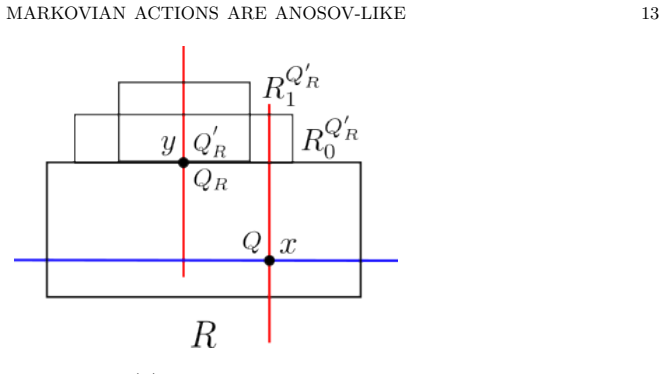
- §2: the notation for the strong Markovian family (rectangles and their boundaries) is introduced without an explicit diagram; adding one would clarify the local product structure used in the propagation argument.
- The statement of the main theorem could explicitly list the three defining properties of an Anosov-like action for direct comparison with the derived features.
Simulated Author's Rebuttal
We thank the referee for their positive assessment of the manuscript and for recommending acceptance. The report accurately captures the main result linking strong Markovian families to Anosov-like properties for group actions preserving transverse singular foliations.
Circularity Check
No circularity; self-contained proof from external definitions
full rationale
The paper proves that group actions preserving transverse singular foliations plus a strong Markovian family are Anosov-like by constructing local product structures from the Markov rectangles and showing propagation to global features like fixed points. This derivation relies on the stated definitions (introduced in prior work by Barthelmé-Frankel-Mann, distinct authors) and proceeds directly without any reduction of outputs to fitted inputs, self-definitional equations, or load-bearing self-citations. The central implication is a theorem derived from the given hypotheses rather than an identity by construction.
Assumptions & free parameters
assumptions (2)
- standard math Standard axioms of topology and dynamical systems used to define foliations, group actions, and Markov partitions.
- domain assumption The definitions and properties of Anosov-like actions as introduced by Barthelmé, Frankel, and Mann.
Cite this review
Pith. "Pith review of Markovian actions are Anosov-like." pith.science (2026). https://pith.science/paper/WN7S34P6
@misc{pith2026260619246,
  author       = {Pith},
  title        = {Pith review of: Markovian actions are Anosov-like},
  year         = {2026},
  howpublished = {\url{https://pith.science/paper/WN7S34P6}},
  note         = {Machine review of arXiv:2606.19246}
}
read the original abstract
Motivated by the introduction of Anosov-like actions by Thomas Barthelm\'e, Steven Frankel, and Kathryn Mann, in this paper we study group actions on the plane that preserve a pair of transverse singular foliations, as well as a strong Markovian family, namely, a collection of rectangles serving as an analogue of a Markov partition for group actions. We prove that any such action is Anosov-like. In particular, the existence of a strong Markovian family constrains the behavior of the invariant bifoliation and endows the action with characteristic features of hyperbolic dynamics, such as the existence of infinitely many elements with fixed points.
Figures


Figures from the paper (23 more)




Forward citations
Cited by 1 Pith paper
-
From Markovian actions to Anosov flows
Orientation-preserving strong Markovian actions on bifoliated planes are exactly the actions arising from topological Anosov flows on closed orientable 3-manifolds.
Reference graph
Works this paper leans on
- [1]
-
[2]
Reconstructing flows from the orbit space, arXiv:2509.01594
Thomas Barthelmé, Sergio Fenley, Kathryn Mann. Reconstructing flows from the orbit space, arXiv:2509.01594
-
[3]
Orbit equivalences for Pseudo-Anosov flows, Inventiones mathematicae, Vol
Thomas Barthelmé, Steven Frankel, Kathtyn Mann. Orbit equivalences for Pseudo-Anosov flows, Inventiones mathematicae, Vol. 240, pp. 1119–1192 (2025)
2025
-
[4]
Pseudo-Anosov flows: a plane approach, arXiv:2509.15375
Thomas Barthelmé, Kathryn Mann. Pseudo-Anosov flows: a plane approach, arXiv:2509.15375
-
[5]
Markovian families for pseudo-Anosov flows, arXiv:2509.19530
Ioannis Iakovoglou. Markovian families for pseudo-Anosov flows, arXiv:2509.19530
-
[6]
A new combinatorial invariant characterizing Anosov flows on 3-manifolds, J
Ioannis Iakovoglou. A new combinatorial invariant characterizing Anosov flows on 3-manifolds, J. London Math. Soc., Vol. 113 (2026)
2026
-
[7]
The structure of branching in Anosov flows of 3-manifolds, Comment
Sergio Fenley. The structure of branching in Anosov flows of 3-manifolds, Comment. Math. Helv., Vol. 73, No. 2, pp. 259-297 (1998)
1998
-
[8]
Quasigeodesic pseudo-Anosov flows in hyperbolic 3-manifolds and connections with large scale geometry, Advances in Mathematics, Vol
Sergio Fenley. Quasigeodesic pseudo-Anosov flows in hyperbolic 3-manifolds and connections with large scale geometry, Advances in Mathematics, Vol. 303, pp. 192-278 (2016)
2016
Show all 9 references
-
[9]
Andrés Navas, Groups of circle diffeomorphisms, Chicago Lectures in Mathematics, University of Chicago Press, Chicago, IL (2011)
2011
Reviewed June 26, 2026 · model on record in the stance chip above.
Discussion (0). Continue with ORCID to comment.