Spin point group symmetry and classification of non-relativistic spin splitting in non-collinear magnetic structures: Identification of high-order spin splitting types (l=5,7, and 9)
Pith reviewed 2026-06-26 19:57 UTC · model grok-4.3
The pith
Spin point groups permit non-relativistic spin splitting up to order 9 in non-collinear magnetic structures, except when time reversal and inversion combine.
A machine-rendered reading of the paper's core claim, the machinery that carries it, and where it could break.
Core claim
Spin point groups, written as direct products of a nontrivial crystallographic part and a spin-only group that is either trivial or augmented by time reversal, control the allowed monomials in the power expansion of electron wave-vector components. Except for the groups containing the combined time-reversal and inversion operation 1', every listed coplanar and non-coplanar spin point group permits spin splitting at some order, with the lowest-order terms ranging from l=0 to l=9 except l=8. Explicit expressions are given for the l=5, 7 and 9 spin textures that occur in selected noncentrosymmetric groups, and one material example is supplied.
What carries the argument
The spin point group (SpPG) formed as the direct product of a crystallographic symmetry part and a spin-only part (with or without time reversal), which restricts the symmetry-allowed monomials in the spin-splitting expansion of crystal momentum.
If this is right
- Spin splitting is forbidden only when the spin point group includes the combined time-reversal and inversion operation 1'.
- Non-collinear structures allow spin-splitting orders higher than the l<=6 limit that applies to collinear magnets.
- The l=5, 7 and 9 spin textures appear exclusively in noncentrosymmetric spin point groups.
- The functional form of each high-order splitting is fixed once the spin point group is known.
- LaMnAu5 realizes the l=5 spin-splitting texture.
Where Pith is reading between the lines
- The tabulated spin point groups could be used to screen candidate materials for desired momentum-dependent spin textures.
- Higher-order splitting may produce more intricate spin-momentum locking patterns detectable in angle-resolved photoemission.
- The same symmetry classification might be applied to other momentum-dependent quantities such as orbital texture or nonlinear transport.
Load-bearing premise
That every relevant magnetic structure corresponds to one of the enumerated spin point groups written as a direct product and that the symmetry extraction correctly identifies all allowed splitting terms.
What would settle it
An experimental band-structure measurement that finds spin splitting in a structure whose spin point group contains the 1' operation, or finds no splitting at any order up to l=9 in a structure whose group lacks 1'.
Figures
read the original abstract
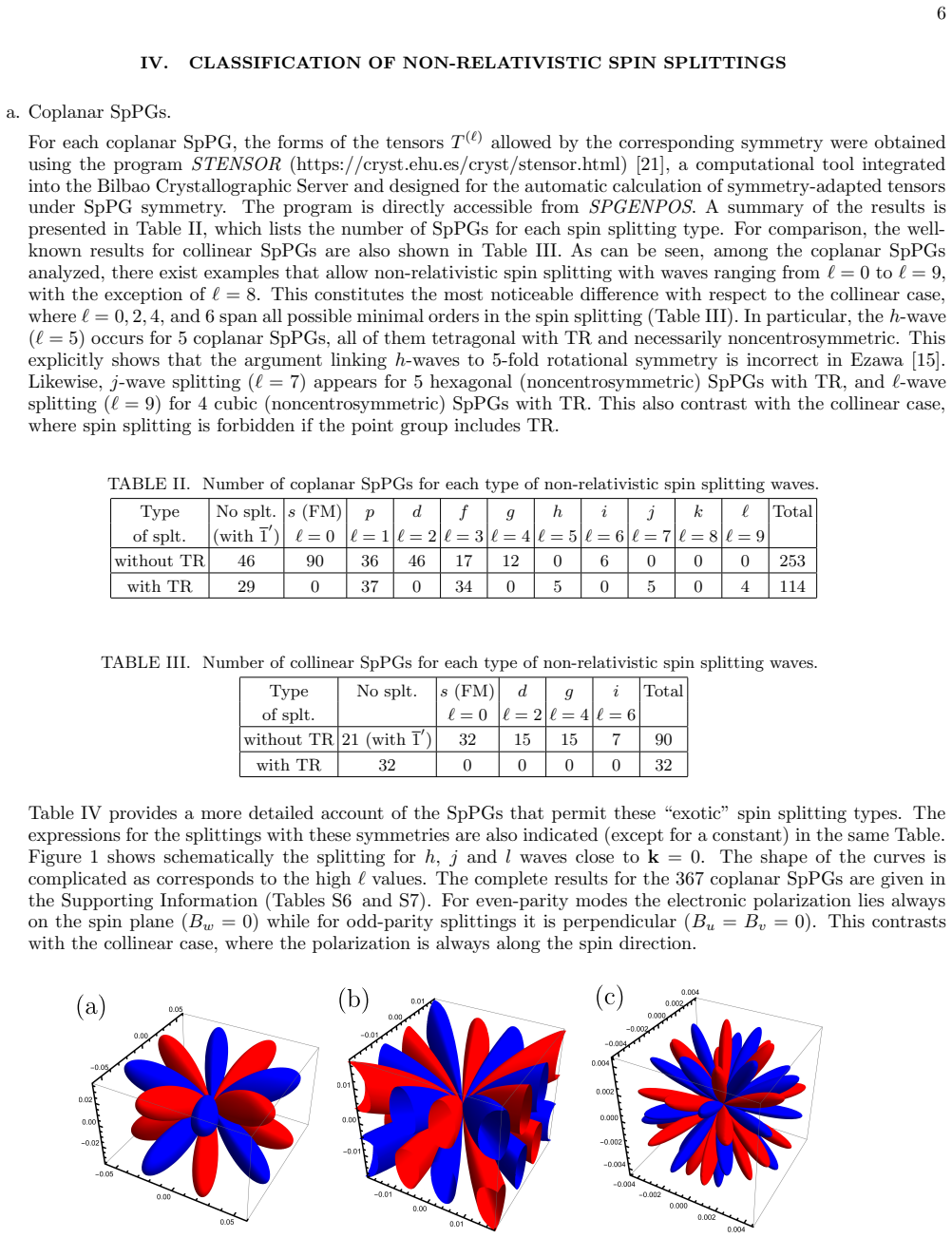
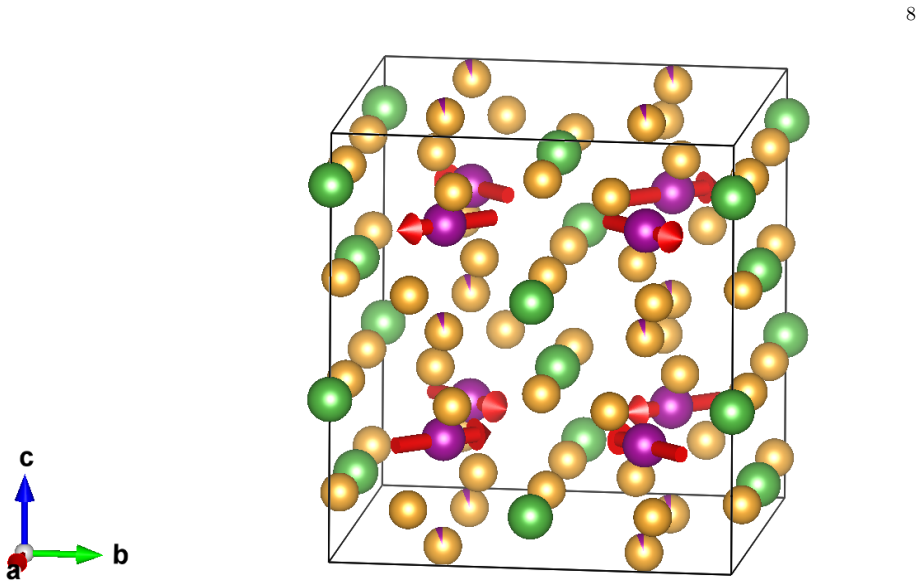
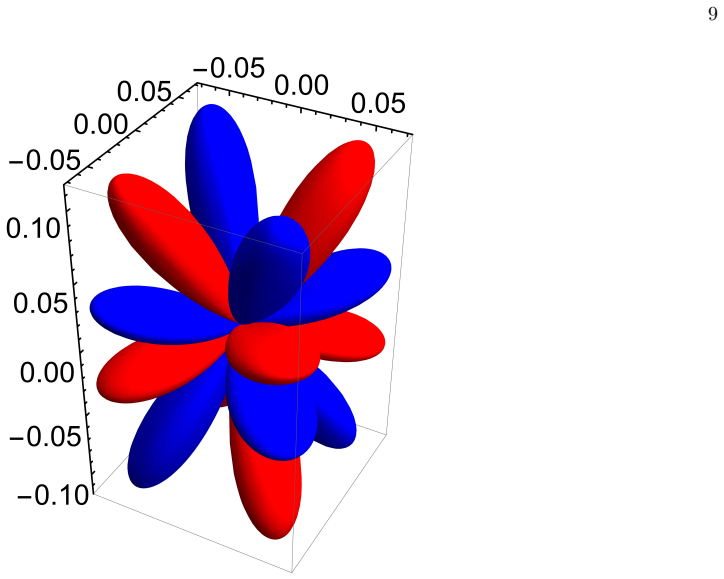
A comprehensive study of the possible types of non-relativistic spin splitting of electronic bands in coplanar and non-coplanar magnetic structures is presented on the basis of spin-group theory. First, we tabulate all non-equivalent spin point groups (SpPGs) which can be expressed as a direct product of a nontrivial part and a spin-only group limited to be the intrinsic (trivial) one, or augmented by the time-reversal (TR) operation. This tabulation, which includes the listing of symmetry operations for 1249 nonequivalent SpPGs, is now available as an online database SPGENPOS in the Bilbao Crystallographic Server (BCS). This extends previous enumerations, in which the possible presence of TR in the magnetic point group was not taken into account, thus overlooking the full SpPG symmetry associated with the numerous magnetic structures which have a magnetic space group of type IV. For each of the listed coplanar and non-coplanar SpPGs, the spin-splitting that is symmetry allowed is analyzed in detail using the program STENSOR also in the BCS. Except for the SpPGs that include the operation 1', i.e., the combined operation of TR and space inversion, all other coplanar and non-coplanar SpPGs allow spin splitting at some order in a power expansion of the electron wave vector components. We find that, depending on the SpPG, spin-splitting terms can appear with the lowest-order monomials ranging from l=0 to 9, with the exception of l=8. This contrasts with the collinear case, where the lowest order is not higher than l=6, and where TR forbids any spin splitting. For the newly identified spin textures with powers l=5, 7, and 9, which are possible in some noncentrosymmetric SpPGs, the functional form of the spin splitting in terms of the components of the crystal momentum is given. One example of a real material, LaMnAu5, showing l=5 spin splitting is identified.
Editorial analysis
A structured set of objections, weighed in public.
Referee Report
Summary. The paper claims to provide a comprehensive tabulation of all 1249 non-equivalent spin point groups (SpPGs) expressible as direct products of a nontrivial crystallographic part and a spin-only group limited to {1} or {1,1'}, now available as the SPGENPOS database on the Bilbao Crystallographic Server. For each listed coplanar and non-coplanar SpPG, the STENSOR program is used to enumerate symmetry-allowed non-relativistic spin-splitting terms in a power expansion of the electron wave vector; the result is that all such SpPGs except those containing the 1' operation permit splitting, with lowest-order monomials ranging from l=0 to 9 (excluding l=8). Explicit functional forms are supplied for the newly identified l=5, 7, and 9 textures possible in certain noncentrosymmetric SpPGs, together with the concrete material example LaMnAu5 realizing l=5 splitting.
Significance. If the enumerated results hold, the work supplies a publicly accessible database and analysis pipeline that systematically extends prior spin-group classifications by incorporating time-reversal symmetry for type-IV magnetic space groups. The identification of allowed spin-splitting orders up to l=9 (absent in collinear cases) together with explicit monomial forms for l=5,7,9 furnishes concrete, falsifiable predictions for band-structure calculations in non-collinear magnets. The machine-readable SPGENPOS database and STENSOR implementation constitute verifiable, reusable assets that materially advance the practical application of spin-group theory in materials discovery.
minor comments (2)
- [Abstract] Abstract: the parenthetical remark on the contrast with the collinear case (lowest order ≤ l=6 and TR-forbidden) would be clearer if it explicitly referenced the relevant prior literature on collinear spin splitting.
- [Introduction / Methods] The manuscript states that the 1249 SpPGs are those 'which can be expressed as a direct product'; a short dedicated paragraph in the methods or introduction reiterating that non-factorizable SpPGs lie outside the present scope would prevent any misreading of the completeness claim.
Simulated Author's Rebuttal
We thank the referee for the positive assessment of our work and the recommendation to accept the manuscript. No major comments were raised.
Circularity Check
No circularity: classification obtained by explicit enumeration over a stated subset of direct-product SpPGs
full rationale
The paper's central result is a tabulation of 1249 nonequivalent direct-product SpPGs (crystallographic part × {1} or {1,1'}) followed by STENSOR extraction of allowed spin-splitting monomials up to order 9. This is a direct, parameter-free enumeration from the chosen group definitions and the listed symmetry operations; no fitted inputs are relabeled as predictions, no self-citation supplies a uniqueness theorem that forces the outcome, and the restriction to factorizable groups is stated explicitly rather than smuggled in. The derivation therefore remains self-contained against external benchmarks and does not reduce to its inputs by construction.
Axiom & Free-Parameter Ledger
axioms (1)
- standard math Spin point groups form closed groups under composition of their operations
Reference graph
Works this paper leans on
-
[1]
Momentum-dependent spin splitting by collinear antiferromagnetic ordering,
Satoru Hayami, Yuki Yanagi, and Hiroaki Kusunose, “Momentum-dependent spin splitting by collinear antiferromagnetic ordering,” Journal of the Physical Society of Japan 88, 123702 (2019)
2019
-
[2]
Lin-Ding Yuan, Zhi Wang, Jun-Wei Luo, Emmanuel I Rashba, and Alex Zunger, Phys. Rev. B. 102, 014422 (2020)
2020
-
[3]
Igor I Mazin, Klaus Koepernik, Michelle D Johannes, Rafael Gonz´ alez-Hern´ andez, and LiborˇSmejkal, Proc. Natl. Acad. Sci. U. S. A. 118, e2108924118 (2021)
2021
-
[4]
Libor ˇSmejkal, Jairo Sinova, and Tomas Jungwirth, Phys. Rev. X. 12, 031042 (2022)
2022
-
[5]
Libor ˇSmejkal, Jairo Sinova, and Tomas Jungwirth, Phys. Rev. X. 12, 040501 (2022)
2022
-
[6]
Igor Mazin, Phys. Rev. X. 12, 040002 (2022)
2022
-
[7]
J Krempask´ y, LˇSmejkal, S W D’Souza, M Hajlaoui, G Springholz, K Uhl´ ıˇ rov´ a, F Alarab, P C Constantinou, V Strocov, D Usanov, W R Pudelko, R Gonz´ alez-Hern´ andez, A Birk Hellenes, Z Jansa, H Reichlov´ a, ZˇSob´ aˇ n, R D Gonzalez Betan- court, P Wadley, J Sinova, D Kriegner, J Min´ ar, J H Dil, and T Jungwirth, Nature 626, 517–522 (2024)
2024
-
[8]
Sayantika Bhowal and Nicola A Spaldin, Phys. Rev. X. 14, 011019 (2024)
2024
-
[9]
Efficient electrical spin splitter based on nonrelativistic collinear antiferromagnetism,
Rafael Gonz´ alez-Hern´ andez, LiborˇSmejkal, Karel V´ yborn´ y, Yuta Yahagi, Jairo Sinova, Tom´ a ˇ s Jungwirth, and Jakub ˇZelezn´ y, “Efficient electrical spin splitter based on nonrelativistic collinear antiferromagnetism,” Phys. Rev. Lett. 126, 127701 (2021)
2021
-
[10]
Efficient spin seebeck and spin nernst effects of magnons in altermagnets,
Qirui Cui, Bowen Zeng, Ping Cui, Tao Yu, and Hongxin Yang, “Efficient spin seebeck and spin nernst effects of magnons in altermagnets,” Phys. Rev. B 108, L180401 (2023)
2023
-
[11]
Electrical 180 ° switching of n´ eel vector in spin-splitting antiferromagnet,
Lei Han, Xizhi Fu, Rui Peng, Xingkai Cheng, Jiankun Dai, Liangyang Liu, Yidian Li, Yichi Zhang, Wenxuan Zhu, Hua Bai, Yongjian Zhou, Shixuan Liang, Chong Chen, Qian Wang, Xianzhe Chen, Luyi Yang, Yang Zhang, Cheng Song, Junwei Liu, and Feng Pan, “Electrical 180 ° switching of n´ eel vector in spin-splitting antiferromagnet,” Science Advances 10, eadn0479 (2024)
2024
-
[12]
Anna Birk Hellenes, Tom´ aˇ s Jungwirth, Rodrigo Jaeschke-Ubiergo, Atasi Chakraborty, Jairo Sinova, and Libor ˇSmejkal, “P-wave magnets,” (2024), arXiv:2309.01607 [cond-mat.mes-hall]
Pith/arXiv arXiv 2024
-
[13]
Jan Priessnitz, Anna Birk Hellenes, Riccardo Comin, and Libor ˇSmejkal, “Ferroelectric p-wave magnets,” (2026), arXiv:2603.19107 [cond-mat.mtrl-sci]
arXiv 2026
-
[14]
Odd-parity magnetism driven by antiferromagnetic exchange,
Yue Yu, Magnus B. Lyngby, Tatsuya Shishidou, Merc` e Roig, Andreas Kreisel, Michael Weinert, Brian M. Andersen, and Daniel F. Agterberg, “Odd-parity magnetism driven by antiferromagnetic exchange,” Phys. Rev. Lett. 135, 046701 (2025)
2025
-
[15]
Third-order and fifth-order nonlinear spin-current generation in g-wave and i-wave altermagnets and perfectly nonreciprocal spin current in f-wave magnets,
Motohiko Ezawa, “Third-order and fifth-order nonlinear spin-current generation in g-wave and i-wave altermagnets and perfectly nonreciprocal spin current in f-wave magnets,” Phys. Rev. B 111, 125420 (2025)
2025
-
[16]
Odd-parity magnetism in fe-based superconductors with coplanar magnetic order,
Reuel Dsouza, Andreas Kreisel, Brian M. Andersen, Daniel F. Agterberg, and Morten H. Christensen, “Odd-parity magnetism in fe-based superconductors with coplanar magnetic order,” Phys. Rev. B 113, 144509 (2026)
2026
-
[17]
Xiaobing Chen, Jun Ren, Yanzhou Zhu, Yutong Yu, Ao Zhang, Pengfei Liu, Jiayu Li, Yuntian Liu, Caiheng Li, and Qihang Liu, Phys. Rev. X. 14, 031038 (2024)
2024
-
[18]
Yi Jiang, Ziyin Song, Tiannian Zhu, Zhong Fang, Hongming Weng, Zheng-Xin Liu, Jian Yang, and Chen Fang, Phys. Rev. X. 14, 031039 (2024)
2024
-
[19]
Zhenyu Xiao, Jianzhou Zhao, Yanqi Li, Ryuichi Shindou, and Zhi-Da Song, Phys. Rev. X. 14, 031037 (2024)
2024
-
[20]
Crystal tensor properties of magnetic materials with and without spin–orbit coupling. application of spin point groups as approximate symmetries,
Jesus Etxebarria, J. Manuel Perez-Mato, Emre S. Tasci, and Luis Elcoro, “Crystal tensor properties of magnetic materials with and without spin–orbit coupling. application of spin point groups as approximate symmetries,” Acta Cryst. A 81, 317–338 (2025)
2025
-
[21]
Automatic calculation of symmetry-adapted tensors under spin-group symmetry: STENSOR, a new tool of the Bilbao Crystallographic Server,
Luis Elcoro, Jesus Etxebarria, J. Manuel Perez-Mato, and Emre S. Tasci, “Automatic calculation of symmetry-adapted tensors under spin-group symmetry: STENSOR, a new tool of the Bilbao Crystallographic Server,” Journal of Applied Crystallography 59, 640–647 (2026)
2026
-
[22]
Spin point groups,
D B Litvin, “Spin point groups,” Acta Crystallogr. A 33, 279–287 (1977)
1977
-
[23]
Algorithm for spin symmetry operation search,
Kohei Shinohara, Atsushi Togo, Hikaru Watanabe, Takuya Nomoto, Isao Tanaka, and Ryotaro Arita, “Algorithm for spin symmetry operation search,” Acta Crystallographica Section A 80, 94–103 (2024)
2024
-
[24]
Pengfei Liu, Jiayu Li, Jingzhi Han, Xiangang Wan, and Qihang Liu, Phys. Rev. X. 12, 021016 (2022)
2022
-
[25]
The crystallographic spin point groups and their representations,
Hana Schiff, Alberto Corticelli, Afonso Guerreiro, Judit Romh´ anyi, and Paul McClarty, “The crystallographic spin point groups and their representations,” SciPost Phys. 18, 109 (2025). 67
2025
-
[26]
MAGNDATA: towards a database of magnetic structures. i. the commensurate case,
Samuel V Gallego, J Manuel Perez-Mato, Luis Elcoro, Emre S Tasci, Robert M Hanson, Koichi Momma, Mois I Aroyo, and Gotzon Madariaga, “ MAGNDATA: towards a database of magnetic structures. i. the commensurate case,” J. Appl. Crystallogr. 49, 1750–1776 (2016)
2016
-
[27]
Paolo G Radaelli, Phys. Rev. B. 110, 214428 (2024)
2024
-
[28]
Yuntian Liu, Xiaobing Chen, Yutong Yu, Jes´ us Etxebarria, J Manuel Perez-Mato, and Qihang Liu, Nature 652, 869–873 (2026)
2026
-
[29]
Mater.36, 3546–3554 (2024)
Stefanie Siebeneichler, Alexander Ovchinnikov, Denis Sheptyakov, and Anja-Verena Mudring, Chem. Mater.36, 3546–3554 (2024)
2024
-
[30]
Yutong Yu, Xiaobing Chen, Yanzhou Zhu, Yuhui Li, Renzheng Xiong, Jiayu Li, Yuntian Liu, and Qihang Liu, “Iden- tifying oriented spin space groups and related physical properties using an online platform findspingroup,” (2026), arXiv:2604.21397 [cond-mat.mtrl-sci]
Pith/arXiv arXiv 2026
discussion (0)
Sign in with ORCID, Apple, or X to comment. Anyone can read and Pith papers without signing in.