NeuMesh++: Towards Versatile and Efficient Volumetric Editing with Disentangled Neural Mesh-based Implicit Field
Pith reviewed 2026-06-26 21:20 UTC · model grok-4.3
The pith
A mesh-based representation encodes neural radiance fields with separate geometry, texture and semantic codes on vertices to support multiple editing operations.
A machine-rendered reading of the paper's core claim, the machinery that carries it, and where it could break.
Core claim
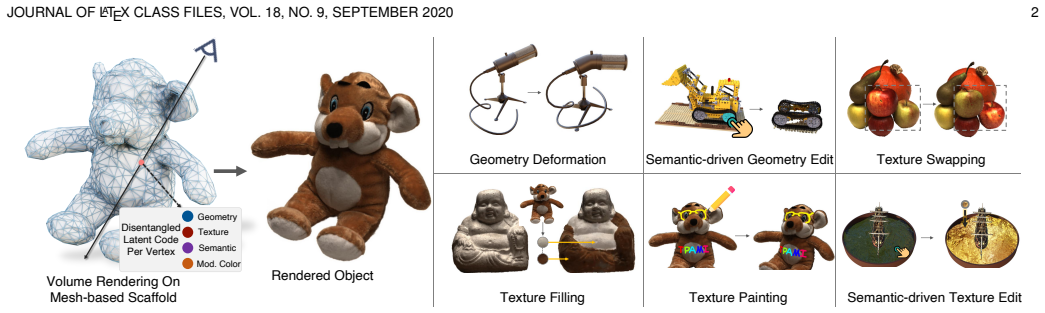
We present a novel mesh-based representation by encoding the neural radiance field with disentangled geometry, texture, and semantic codes on mesh vertices, which empowers a set of efficient and comprehensive editing functionalities, including mesh-guided geometry editing, designated texture editing with texture swapping, filling and painting operations, and semantic-guided editing. The work develops local space parameterization to enhance rendering quality and training stability, a learnable modification color on vertices to improve texture editing fidelity, a spatial-aware optimization strategy for precise texture edits, and semantic-aided region selection to reduce annotation effort.
What carries the argument
Disentangled geometry, texture and semantic codes placed on mesh vertices, which carry independent editing operations while preserving the underlying implicit field.
If this is right
- Mesh-guided geometry editing can be applied directly while keeping rendering quality intact.
- Texture swapping, filling and painting become feasible on designated regions with improved fidelity.
- Semantic-guided editing reduces the need for manual annotation of implicit fields.
- The representation maintains high quality on both real and synthetic data across the listed edit types.
Where Pith is reading between the lines
- The vertex-level disentanglement may make it simpler to combine edits from multiple independent sources than entangled field representations allow.
- The local parameterization step could transfer to other mesh-based implicit models to improve their training stability.
- Adding further vertex attributes such as material or lighting codes would be a direct next step for broader editing control.
Load-bearing premise
The local space parameterization, learnable modification color, spatial-aware optimization and semantic-aided region selection will deliver high-fidelity edits and stable training without artifacts or post-hoc fixes.
What would settle it
Apply the texture painting operation to a held-out real scene and check whether novel-view renderings of the painted region show seams, color drift or loss of detail relative to the intended edit.
Figures





read the original abstract
Recently neural implicit rendering techniques have evolved rapidly and demonstrated significant advantages in novel view synthesis and 3D scene reconstruction. However, existing neural rendering methods for editing purposes offer limited functionalities, e.g., rigid transformation and category-specific editing. In this paper, we present a novel mesh-based representation by encoding the neural radiance field with disentangled geometry, texture, and semantic codes on mesh vertices, which empowers a set of efficient and comprehensive editing functionalities, including mesh-guided geometry editing, designated texture editing with texture swapping, filling and painting operations, and semantic-guided editing. To this end, we develop several techniques including a novel local space parameterization to enhance rendering quality and training stability, a learnable modification color on vertex to improve the fidelity of texture editing, a spatial-aware optimization strategy to realize precise texture editing, and a semantic-aided region selection to ease the laborious annotation of implicit field editing. Extensive experiments and editing examples on both real and synthetic datasets demonstrate the superiority of our method on representation quality and editing ability. Project page: https://zju3dv.github.io/neumeshplusplus/
Editorial analysis
A structured set of objections, weighed in public.
Referee Report
Summary. The paper proposes NeuMesh++, a mesh-based implicit representation that encodes neural radiance fields using disentangled geometry, texture, and semantic codes attached to mesh vertices. This enables a range of editing operations: mesh-guided geometry editing, designated texture editing (swapping, filling, painting), and semantic-guided editing. Supporting components include local space parameterization, learnable modification color on vertices, spatial-aware optimization, and semantic-aided region selection. The authors assert that these yield high-fidelity edits and superior representation quality, validated by extensive experiments on real and synthetic datasets.
Significance. If the empirical claims hold with proper quantitative support, the work could provide a practical bridge between explicit mesh control and implicit field flexibility, expanding editing capabilities beyond rigid transforms or category-specific methods in neural rendering.
major comments (1)
- Abstract: the central claim of superiority 'via extensive experiments' is asserted without any quantitative results, baselines, error bars, ablation tables, or method implementation details, so the load-bearing empirical support for the editing functionalities cannot be assessed from the provided text.
Simulated Author's Rebuttal
We thank the referee for the detailed review and the opportunity to clarify our work. We address the single major comment below.
read point-by-point responses
-
Referee: [—] Abstract: the central claim of superiority 'via extensive experiments' is asserted without any quantitative results, baselines, error bars, ablation tables, or method implementation details, so the load-bearing empirical support for the editing functionalities cannot be assessed from the provided text.
Authors: We acknowledge that the abstract, as a concise summary, does not include specific quantitative numbers, baselines, or ablation details. These elements are presented in full in the Experiments section of the manuscript, including quantitative comparisons on representation quality (e.g., PSNR/SSIM metrics), editing fidelity, ablation studies, and implementation specifics. However, to improve accessibility of the central claim from the abstract alone, we will revise the abstract to incorporate one or two key quantitative highlights demonstrating the reported superiority. revision: yes
Circularity Check
No significant circularity detected
full rationale
The paper presents a novel mesh-based implicit representation with disentangled vertex codes plus four supporting techniques (local space parameterization, learnable modification color, spatial-aware optimization, semantic-aided selection). Central claims rest on empirical results from experiments on real and synthetic datasets rather than any derivation chain. No equations, fitted parameters renamed as predictions, self-definitional loops, or load-bearing self-citations appear in the provided text. The method is self-contained via external empirical validation.
Axiom & Free-Parameter Ledger
Reference graph
Works this paper leans on
-
[1]
Real-Time Rendering
Tomas Akenine-Moller, Eric Haines, and Naty Hoffman. Real-Time Rendering. AK Peters/crc Press, 2019
2019
-
[2]
Geneavatar: Generic expression-aware volumetric head avatar editing from a single image
Chong Bao, Yinda Zhang, Yuan Li, Xiyu Zhang, Bangbang Yang, Hujun Bao, Marc Pollefeys, Guofeng Zhang, and Zhaopeng Cui. Geneavatar: Generic expression-aware volumetric head avatar editing from a single image. In Proceedings of the IEEE/CVF Conference on Computer Vision and Pattern Recognition, pages 8952–8963, 2024
2024
-
[3]
Mip-nerf 360: Unbounded anti-aliased neural radiance fields
Jonathan T Barron, Ben Mildenhall, Dor Verbin, Pratul P Srinivasan, and Peter Hedman. Mip-nerf 360: Unbounded anti-aliased neural radiance fields. InProceedings of the IEEE/CVF conference on computer vision and pattern recogni- tion, pages 5470–5479, 2022
2022
-
[4]
Blender. Blender. https://www.blender.org/, 2023. Ac- cessed: 2023-12
2023
-
[5]
NeRD: Neural Reflectance Decomposition from Image Collections
Mark Boss, Raphael Braun, Varun Jampani, Jonathan T Barron, Ce Liu, and Hendrik Lensch. NeRD: Neural Reflectance Decomposition from Image Collections. In Proceedings of the IEEE/CVF International Conference on Com- puter Vision, pages 12684–12694, 2021
2021
-
[6]
Emerging properties in self-supervised vision transform- ers
Mathilde Caron, Hugo Touvron, Ishan Misra, Herv ´e J´egou, Julien Mairal, Piotr Bojanowski, and Armand Joulin. Emerging properties in self-supervised vision transform- ers. InProceedings of the International Conference on Computer Vision (ICCV), 2021
2021
-
[7]
Sofgan: A portrait image generator with dynamic styling.ACM Transactions on Graphics (TOG), 41(1):1–26, 2022
Anpei Chen, Ruiyang Liu, Ling Xie, Zhang Chen, Hao Su, and Jingyi Yu. Sofgan: A portrait image generator with dynamic styling.ACM Transactions on Graphics (TOG), 41(1):1–26, 2022
2022
-
[8]
Mvsnerf: Fast generalizable radiance field reconstruction from multi- view stereo
Anpei Chen, Zexiang Xu, Fuqiang Zhao, Xiaoshuai Zhang, Fanbo Xiang, Jingyi Yu, and Hao Su. Mvsnerf: Fast generalizable radiance field reconstruction from multi- view stereo. InProceedings of the IEEE/CVF International Conference on Computer Vision, pages 14124–14133, 2021
2021
-
[9]
Neural Volume Render- ing: NeRF And Beyond.arXiv preprint arXiv:2101.05204, 2020
Frank Dellaert and Lin Yen-Chen. Neural Volume Render- ing: NeRF And Beyond.arXiv preprint arXiv:2101.05204, 2020
-
[10]
Deformed Im- plicit Field: Modeling 3D Shapes with Learned Dense Correspondence
Yu Deng, Jiaolong Yang, and Xin Tong. Deformed Im- plicit Field: Modeling 3D Shapes with Learned Dense Correspondence. InProceedings of the IEEE/CVF Conference on Computer Vision and Pattern Recognition, pages 10286– 10296, 2021
2021
-
[11]
A density-based algorithm for discovering clusters in large spatial databases with noise
Martin Ester, Hans-Peter Kriegel, J ¨org Sander, Xiaowei Xu, et al. A density-based algorithm for discovering clusters in large spatial databases with noise. Inkdd, volume 96, pages 226–231, 1996
1996
-
[12]
Unified implicit neural styl- ization
Zhiwen Fan, Yifan Jiang, Peihao Wang, Xinyu Gong, Dejia Xu, and Zhangyang Wang. Unified implicit neural styl- ization. InEuropean Conference on Computer Vision, pages 636–654. Springer, 2022
2022
-
[13]
Deferred Neural Lighting: Free-Viewpoint Relighting from Unstructured Photographs.ACM Transac- tions on Graphics (TOG), 39(6):1–15, 2020
Duan Gao, Guojun Chen, Yue Dong, Pieter Peers, Kun Xu, and Xin Tong. Deferred Neural Lighting: Free-Viewpoint Relighting from Unstructured Photographs.ACM Transac- tions on Graphics (TOG), 39(6):1–15, 2020
2020
-
[14]
A Papier-m ˆach´e Approach to Learning 3D Surface Generation
Thibault Groueix, Matthew Fisher, Vladimir G Kim, Bryan C Russell, and Mathieu Aubry. A Papier-m ˆach´e Approach to Learning 3D Surface Generation. InProceed- ings of the IEEE Conference on Computer Vision and Pattern Recognition, pages 216–224, 2018
2018
-
[15]
Object-Centric Neural Scene Rendering
Michelle Guo, Alireza Fathi, Jiajun Wu, and Thomas Funkhouser. Object-Centric Neural Scene Rendering. arXiv preprint arXiv:2012.08503, 2020
-
[16]
Vmesh: Hybrid volume-mesh representation for efficient view synthesis
Yuan-Chen Guo, Yan-Pei Cao, Chen Wang, Yu He, Ying Shan, Xiaohu Qie, and Song-Hai Zhang. Vmesh: Hybrid volume-mesh representation for efficient view synthesis. arXiv preprint arXiv:2303.16184, 2023
-
[17]
Baking neural radiance fields for real-time view synthesis
Peter Hedman, Pratul P Srinivasan, Ben Mildenhall, Jonathan T Barron, and Paul Debevec. Baking neural radiance fields for real-time view synthesis. InProceedings of the IEEE/CVF International Conference on Computer Vision, pages 5875–5884, 2021
2021
-
[18]
Hoetzlein
Rama C. Hoetzlein. Fast fixed-radius nearest neighbors: Interactive million-particle fluids, 2014. GPU Technology Conference
2014
-
[19]
Kinectfusion: real-time 3D reconstruction and interaction using a moving depth camera
Shahram Izadi, David Kim, Otmar Hilliges, David Molyneaux, Richard Newcombe, Pushmeet Kohli, Jamie Shotton, Steve Hodges, Dustin Freeman, Andrew Davi- son, et al. Kinectfusion: real-time 3D reconstruction and interaction using a moving depth camera. InProceedings of the 24th annual ACM symposium on User interface software and technology, pages 559–568, 2011
2011
-
[20]
Large Scale Multi-view Stereopsis Evaluation
Rasmus Jensen, Anders Dahl, George Vogiatzis, Engil Tola, and Henrik Aanæs. Large Scale Multi-view Stereopsis Evaluation. In2014 IEEE Conference on Computer Vision and Pattern Recognition, pages 406–413. IEEE, 2014
2014
-
[21]
CoNeRF: Controllable Neural Radiance Fields
Kacper Kania, Kwang Moo Yi, Marek Kowalski, Tomasz Trzci´nski, and Andrea Tagliasacchi. CoNeRF: Controllable Neural Radiance Fields. InProceedings of the IEEE/CVF Conference on Computer Vision and Pattern Recognition, pages 18623–18632, 2022
2022
-
[22]
Forsyth, and Derek Hoiem
Kevin Karsch, Varsha Hedau, David A. Forsyth, and Derek Hoiem. Rendering Synthetic Objects into Legacy Pho- tographs.ACM Trans. Graph., 30(6):157, 2011
2011
-
[23]
Kazhdan, Matthew Bolitho, and Hugues Hoppe
Michael M. Kazhdan, Matthew Bolitho, and Hugues Hoppe. Poisson Surface Reconstruction. InProceedings of Eurographics Symposium on Geometry Processing, pages 61– 70, 2006
2006
-
[24]
3d gaussian splatting for real-time radiance field rendering.ACM Transactions on Graphics (ToG), 42(4):1–14, 2023
Bernhard Kerbl, Georgios Kopanas, Thomas Leimk ¨uhler, and George Drettakis. 3d gaussian splatting for real-time radiance field rendering.ACM Transactions on Graphics (ToG), 42(4):1–14, 2023
2023
-
[25]
Lerf: Language em- bedded radiance fields
Justin Kerr, Chung Min Kim, Ken Goldberg, Angjoo Kanazawa, and Matthew Tancik. Lerf: Language em- bedded radiance fields. InProceedings of the IEEE/CVF International Conference on Computer Vision, pages 19729– 19739, 2023
2023
-
[26]
3D Object Manipulation in a Single Photograph JOURNAL OF LATEX CLASS FILES, VOL
Natasha Kholgade, Tomas Simon, Alexei Efros, and Yaser Sheikh. 3D Object Manipulation in a Single Photograph JOURNAL OF LATEX CLASS FILES, VOL. 18, NO. 9, SEPTEMBER 2020 16 Using Stock 3D Models.ACM Transactions on Graphics (TOG), 33(4):1–12, 2014
2020
-
[27]
Garfield: Group anything with radiance fields
Chung Min Kim, Mingxuan Wu, Justin Kerr, Ken Gold- berg, Matthew Tancik, and Angjoo Kanazawa. Garfield: Group anything with radiance fields. InProceedings of the IEEE/CVF Conference on Computer Vision and Pattern Recognition, pages 21530–21539, 2024
2024
-
[28]
Alexander Kirillov, Eric Mintun, Nikhila Ravi, Hanzi Mao, Chloe Rolland, Laura Gustafson, Tete Xiao, Spencer White- head, Alexander C Berg, Wan-Yen Lo, et al. Segment anything.arXiv preprint arXiv:2304.02643, 2023
work page internal anchor Pith review Pith/arXiv arXiv 2023
-
[29]
Decomposing nerf for editing via feature field dis- tillation.Advances in Neural Information Processing Systems, 35:23311–23330, 2022
Sosuke Kobayashi, Eiichi Matsumoto, and Vincent Sitz- mann. Decomposing nerf for editing via feature field dis- tillation.Advances in Neural Information Processing Systems, 35:23311–23330, 2022
2022
-
[30]
Adanerf: Adaptive sampling for real-time rendering of neural radiance fields
Andreas Kurz, Thomas Neff, Zhaoyang Lv, Michael Zollh¨ofer, and Markus Steinberger. Adanerf: Adaptive sampling for real-time rendering of neural radiance fields. InEuropean Conference on Computer Vision, pages 254–270. Springer, 2022
2022
-
[31]
Nerfacc: Efficient sampling accelerates nerfs
Ruilong Li, Hang Gao, Matthew Tancik, and Angjoo Kanazawa. Nerfacc: Efficient sampling accelerates nerfs. arXiv preprint arXiv:2305.04966, 2023
-
[32]
Neuralangelo: High-fidelity neural surface reconstruction
Zhaoshuo Li, Thomas M ¨uller, Alex Evans, Russell H Tay- lor, Mathias Unberath, Ming-Yu Liu, and Chen-Hsuan Lin. Neuralangelo: High-fidelity neural surface reconstruction. InProceedings of the IEEE/CVF Conference on Computer Vi- sion and Pattern Recognition, pages 8456–8465, 2023
2023
-
[33]
Stylerf: Zero-shot 3d style transfer of neural radiance fields
Kunhao Liu, Fangneng Zhan, Yiwen Chen, Jiahui Zhang, Yingchen Yu, Abdulmotaleb El Saddik, Shijian Lu, and Eric P Xing. Stylerf: Zero-shot 3d style transfer of neural radiance fields. InProceedings of the IEEE/CVF Conference on Computer Vision and Pattern Recognition, pages 8338–8348, 2023
2023
-
[34]
Neural Sparse Voxel Fields.Advances in Neural Information Processing Systems, 33:15651–15663, 2020
Lingjie Liu, Jiatao Gu, Kyaw Zaw Lin, Tat-Seng Chua, and Christian Theobalt. Neural Sparse Voxel Fields.Advances in Neural Information Processing Systems, 33:15651–15663, 2020
2020
-
[35]
Neu- ral Actor: Neural Free-view Synthesis of Human Actors with Pose Control.ACM Transactions on Graphics (TOG), 40(6):1–16, 2021
Lingjie Liu, Marc Habermann, Viktor Rudnev, Kri- pasindhu Sarkar, Jiatao Gu, and Christian Theobalt. Neu- ral Actor: Neural Free-view Synthesis of Human Actors with Pose Control.ACM Transactions on Graphics (TOG), 40(6):1–16, 2021
2021
-
[36]
Soft Rasterizer: A Differentiable Renderer for Image-based 3D Reasoning.The IEEE International Conference on Computer Vision (ICCV), Oct 2019
Shichen Liu, Tianye Li, Weikai Chen, and Hao Li. Soft Rasterizer: A Differentiable Renderer for Image-based 3D Reasoning.The IEEE International Conference on Computer Vision (ICCV), Oct 2019
2019
-
[37]
Editing Con- ditional Radiance Fields
Steven Liu, Xiuming Zhang, Zhoutong Zhang, Richard Zhang, Jun-Yan Zhu, and Bryan Russell. Editing Con- ditional Radiance Fields. InProceedings of the IEEE/CVF International Conference on Computer Vision, pages 5773– 5783, 2021
2021
-
[38]
Marching Cubes: A High Resolution 3D Surface Construction Algorithm
William E Lorensen and Harvey E Cline. Marching Cubes: A High Resolution 3D Surface Construction Algorithm. ACM SIGGRAPH Computer Graphics, 21(4):163–169, 1987
1987
-
[39]
NIID-Net: Adapting Surface Normal Knowledge for Intrinsic Image Decompo- sition in Indoor Scenes.IEEE Transactions on Visualization and Computer Graphics, 26(12):3434–3445, 2020
Jundan Luo, Zhaoyang Huang, Yijin Li, Xiaowei Zhou, Guofeng Zhang, and Hujun Bao. NIID-Net: Adapting Surface Normal Knowledge for Intrinsic Image Decompo- sition in Indoor Scenes.IEEE Transactions on Visualization and Computer Graphics, 26(12):3434–3445, 2020
2020
-
[40]
NeRF: Representing Scenes as Neural Radiance Fields for View Synthesis
Ben Mildenhall, Pratul P Srinivasan, Matthew Tancik, Jonathan T Barron, Ravi Ramamoorthi, and Ren Ng. NeRF: Representing Scenes as Neural Radiance Fields for View Synthesis. InEuropean Conference on Computer Vision, pages 405–421. Springer, 2020
2020
-
[41]
Instant Neural Graphics Primitives with a Multiresolution Hash Encoding.ACM Trans
Thomas M ¨uller, Alex Evans, Christoph Schied, and Alexander Keller. Instant Neural Graphics Primitives with a Multiresolution Hash Encoding.ACM Trans. Graph., 41(4):102:1–102:15, July 2022
2022
-
[42]
Atlas: End-to-End 3D Scene Reconstruction from Posed Images
Zak Murez, Tarrence van As, James Bartolozzi, Ayan Sinha, Vijay Badrinarayanan, and Andrew Rabinovich. Atlas: End-to-End 3D Scene Reconstruction from Posed Images. InEuropean Conference on Computer Vision, pages 414–431. Springer, 2020
2020
-
[43]
Donerf: Towards real-time rendering of compact neural radiance fields us- ing depth oracle networks
Thomas Neff, Pascal Stadlbauer, Mathias Parger, Andreas Kurz, Joerg H Mueller, Chakravarty R Alla Chaitanya, An- ton Kaplanyan, and Markus Steinberger. Donerf: Towards real-time rendering of compact neural radiance fields us- ing depth oracle networks. InComputer Graphics Forum, volume 40, pages 45–59. Wiley Online Library, 2021
2021
-
[44]
Giraffe: Repre- senting Scenes as Compositional Generative Neural Fea- ture Fields
Michael Niemeyer and Andreas Geiger. Giraffe: Repre- senting Scenes as Compositional Generative Neural Fea- ture Fields. InProceedings of the IEEE/CVF Conference on Computer Vision and Pattern Recognition, pages 11453– 11464, 2021
2021
-
[45]
Texture Fields: Learn- ing Texture Representations in Function Space
Michael Oechsle, Lars Mescheder, Michael Niemeyer, Thilo Strauss, and Andreas Geiger. Texture Fields: Learn- ing Texture Representations in Function Space. InProceed- ings of the IEEE/CVF International Conference on Computer Vision, pages 4531–4540, 2019
2019
-
[46]
UNISURF: Unifying Neural Implicit Surfaces and Radi- ance Fields for Multi-View Reconstruction
Michael Oechsle, Songyou Peng, and Andreas Geiger. UNISURF: Unifying Neural Implicit Surfaces and Radi- ance Fields for Multi-View Reconstruction. InInternational Conference on Computer Vision (ICCV), 2021
2021
-
[47]
Neural Point Light Fields.arXiv preprint arXiv:2112.01473, 2021
Julian Ost, Issam Laradji, Alejandro Newell, Yuval Bahat, and Felix Heide. Neural Point Light Fields.arXiv preprint arXiv:2112.01473, 2021
-
[48]
Lo- cally stylized neural radiance fields
Hong-Wing Pang, Binh-Son Hua, and Sai-Kit Yeung. Lo- cally stylized neural radiance fields. InProceedings of the IEEE/CVF International Conference on Computer Vision, pages 307–316, 2023
2023
-
[49]
Nerfies: Deformable Neural Radiance Fields
Keunhong Park, Utkarsh Sinha, Jonathan T Barron, Sofien Bouaziz, Dan B Goldman, Steven M Seitz, and Ricardo Martin-Brualla. Nerfies: Deformable Neural Radiance Fields. InProceedings of the IEEE/CVF International Con- ference on Computer Vision, pages 5865–5874, 2021
2021
-
[50]
Barron, Sofien Bouaziz, Dan B Goldman, Ricardo Martin-Brualla, and Steven M
Keunhong Park, Utkarsh Sinha, Peter Hedman, Jonathan T. Barron, Sofien Bouaziz, Dan B Goldman, Ricardo Martin-Brualla, and Steven M. Seitz. HyperNeRF: A Higher-Dimensional Representation for Topologically Varying Neural Radiance Fields.ACM Trans. Graph., 40(6), dec 2021
2021
-
[51]
Neural body: Implicit Neural Representations with Structured Latent Codes for Novel View Synthesis of Dynamic Humans
Sida Peng, Yuanqing Zhang, Yinghao Xu, Qianqian Wang, Qing Shuai, Hujun Bao, and Xiaowei Zhou. Neural body: Implicit Neural Representations with Structured Latent Codes for Novel View Synthesis of Dynamic Humans. In Proceedings of the IEEE/CVF Conference on Computer Vision and Pattern Recognition, pages 9054–9063, 2021
2021
-
[52]
Pois- son Image Editing.ACM Trans
Patrick P ´erez, Michel Gangnet, and Andrew Blake. Pois- son Image Editing.ACM Trans. Graph., 22(3):313–318, 2003
2003
-
[53]
Marie-Julie Rakotosaona, Fabian Manhardt, Diego Martin Arroyo, Michael Niemeyer, Abhijit Kundu, and Federico Tombari. Nerfmeshing: Distilling neural radiance fields into geometrically-accurate 3d meshes.arXiv preprint arXiv:2303.09431, 2023
-
[54]
KiloNeRF: Speeding up Neural Radiance Fields with Thousands of Tiny MLPs
Christian Reiser, Songyou Peng, Yiyi Liao, and An- dreas Geiger. KiloNeRF: Speeding up Neural Radiance Fields with Thousands of Tiny MLPs. InProceedings of the IEEE/CVF International Conference on Computer Vision, pages 14335–14345, 2021
2021
-
[55]
Neural Voxel Renderer: Learning an Accurate and Controllable Render- ing Tool
Konstantinos Rematas and Vittorio Ferrari. Neural Voxel Renderer: Learning an Accurate and Controllable Render- ing Tool. InProceedings of the IEEE/CVF Conference on Computer Vision and Pattern Recognition, pages 5417–5427, 2020
2020
-
[56]
Free View Synthesis
Gernot Riegler and Vladlen Koltun. Free View Synthesis. InEuropean Conference on Computer Vision, pages 623–640. Springer, 2020
2020
-
[57]
Stable View Synthe- sis
Gernot Riegler and Vladlen Koltun. Stable View Synthe- sis. InProceedings of the IEEE/CVF Conference on Computer Vision and Pattern Recognition, pages 12216–12225, 2021
2021
-
[58]
Sara Fridovich-Keil and Alex Yu, Matthew Tancik, Qin- JOURNAL OF LATEX CLASS FILES, VOL. 18, NO. 9, SEPTEMBER 2020 17 hong Chen, Benjamin Recht, and Angjoo Kanazawa. Plenoxels: Radiance Fields without Neural Networks. In CVPR, 2022
2020
-
[59]
Sch ¨onberger and Jan-Michael Frahm
Johannes L. Sch ¨onberger and Jan-Michael Frahm. Structure-from-Motion Revisited. InProceedings of IEEE Conference on Computer Vision and Pattern Recognition, pages 4104–4113. IEEE Computer Society, 2016
2016
-
[60]
GRAF: Generative Radiance Fields for 3D-Aware Image Synthesis.Advances in Neural Information Processing Systems, 33:20154–20166, 2020
Katja Schwarz, Yiyi Liao, Michael Niemeyer, and Andreas Geiger. GRAF: Generative Radiance Fields for 3D-Aware Image Synthesis.Advances in Neural Information Processing Systems, 33:20154–20166, 2020
2020
-
[61]
Ad- versarial Scene Editing: Automatic Object Removal from Weak Supervision.Advances in Neural Information Process- ing Systems, 31, 2018
Rakshith R Shetty, Mario Fritz, and Bernt Schiele. Ad- versarial Scene Editing: Automatic Object Removal from Weak Supervision.Advances in Neural Information Process- ing Systems, 31, 2018
2018
-
[62]
Very Deep Convolutional Networks for Large-Scale Image Recognition
Karen Simonyan and Andrew Zisserman. Very deep convolutional networks for large-scale image recognition. arXiv preprint arXiv:1409.1556, 2014
work page internal anchor Pith review Pith/arXiv arXiv 2014
-
[63]
As-rigid-as-possible Surface Modeling
Olga Sorkine and Marc Alexa. As-rigid-as-possible Surface Modeling. InSymposium on Geometry Processing, volume 4, pages 109–116, 2007
2007
-
[64]
NeRV: Neural Reflectance and Visibility Fields for Relight- ing and View Synthesis
Pratul P Srinivasan, Boyang Deng, Xiuming Zhang, Matthew Tancik, Ben Mildenhall, and Jonathan T Barron. NeRV: Neural Reflectance and Visibility Fields for Relight- ing and View Synthesis. InProceedings of the IEEE/CVF Conference on Computer Vision and Pattern Recognition, pages 7495–7504, 2021
2021
-
[65]
Direct voxel grid optimization: Super-fast convergence for radi- ance fields reconstruction
Cheng Sun, Min Sun, and Hwann-Tzong Chen. Direct voxel grid optimization: Super-fast convergence for radi- ance fields reconstruction. InProceedings of the IEEE/CVF Conference on Computer Vision and Pattern Recognition, pages 5459–5469, 2022
2022
-
[66]
FENeRF: Face Editing in Neural Radiance Fields
Jingxiang Sun, Xuan Wang, Yong Zhang, Xiaoyu Li, Qi Zhang, Yebin Liu, and Jue Wang. FENeRF: Face Editing in Neural Radiance Fields. InProceedings of the IEEE/CVF Conference on Computer Vision and Pattern Recognition, pages 7672–7682, 2022
2022
-
[67]
NeuralRecon: Real-time Coherent 3D Reconstruction from Monocular Video
Jiaming Sun, Yiming Xie, Linghao Chen, Xiaowei Zhou, and Hujun Bao. NeuralRecon: Real-time Coherent 3D Reconstruction from Monocular Video. InProceedings of the IEEE/CVF Conference on Computer Vision and Pattern Recognition, pages 15598–15607, 2021
2021
-
[68]
Block-NeRF: Scalable Large Scene Neural View Synthesis
Matthew Tancik, Vincent Casser, Xinchen Yan, Sabeek Pradhan, Ben Mildenhall, Pratul P Srinivasan, Jonathan T Barron, and Henrik Kretzschmar. Block-NeRF: Scalable Large Scene Neural View Synthesis. InProceedings of the IEEE/CVF Conference on Computer Vision and Pattern Recognition, pages 8248–8258, 2022
2022
-
[69]
Jiaxiang Tang, Hang Zhou, Xiaokang Chen, Tianshu Hu, Errui Ding, Jingdong Wang, and Gang Zeng. Delicate textured mesh recovery from nerf via adaptive surface refinement.arXiv preprint arXiv:2303.02091, 2023
-
[70]
De- ferred Neural Rendering: Image Synthesis Using Neural Textures.ACM Transactions on Graphics (TOG), 38(4):1–12, 2019
Justus Thies, Michael Zollh ¨ofer, and Matthias Nießner. De- ferred Neural Rendering: Image Synthesis Using Neural Textures.ACM Transactions on Graphics (TOG), 38(4):1–12, 2019
2019
-
[71]
Least-Squares Estimation of Transforma- tion Parameters Between Two Point Patterns.IEEE Transac- tions on Pattern Analysis & Machine Intelligence, 13(04):376– 380, 1991
Shinji Umeyama. Least-Squares Estimation of Transforma- tion Parameters Between Two Point Patterns.IEEE Transac- tions on Pattern Analysis & Machine Intelligence, 13(04):376– 380, 1991
1991
-
[72]
Let there be color! Large-Scale Texturing of 3D Reconstruc- tions
Michael Waechter, Nils Moehrle, and Michael Goesele. Let there be color! Large-Scale Texturing of 3D Reconstruc- tions. InEuropean Conference on Computer Vision, pages 836–850. Springer, 2014
2014
-
[73]
Clip-nerf: Text-and-image driven manip- ulation of neural radiance fields
Can Wang, Menglei Chai, Mingming He, Dongdong Chen, and Jing Liao. Clip-nerf: Text-and-image driven manip- ulation of neural radiance fields. InProceedings of the IEEE/CVF Conference on Computer Vision and Pattern Recog- nition, pages 3835–3844, 2022
2022
-
[74]
NeuS: Learning Neu- ral Implicit Surfaces by Volume Rendering for Multi-view Reconstruction.NeurIPS, 2021
Peng Wang, Lingjie Liu, Yuan Liu, Christian Theobalt, Taku Komura, and Wenping Wang. NeuS: Learning Neu- ral Implicit Surfaces by Volume Rendering for Multi-view Reconstruction.NeurIPS, 2021
2021
-
[75]
IBRNet: Learning Multi-view Image-based Rendering
Qianqian Wang, Zhicheng Wang, Kyle Genova, Pratul P Srinivasan, Howard Zhou, Jonathan T Barron, Ricardo Martin-Brualla, Noah Snavely, and Thomas Funkhouser. IBRNet: Learning Multi-view Image-based Rendering. In Proceedings of the IEEE/CVF Conference on Computer Vision and Pattern Recognition, pages 4690–4699, 2021
2021
-
[76]
Unsupervised Texture Transfer from Images to Model Collections.ACM Trans
Tuanfeng Y Wang, Hao Su, Qixing Huang, Jingwei Huang, Leonidas J Guibas, and Niloy J Mitra. Unsupervised Texture Transfer from Images to Model Collections.ACM Trans. Graph., 35(6):177–1, 2016
2016
-
[77]
SGPN: Similarity Group Proposal Network for 3D Point Cloud Instance Segmentation
Weiyue Wang, Ronald Yu, Qiangui Huang, and Ulrich Neumann. SGPN: Similarity Group Proposal Network for 3D Point Cloud Instance Segmentation. InProceedings of the IEEE Conference on Computer Vision and Pattern Recognition, pages 2569–2578, 2018
2018
-
[78]
Xinyue Wei, Fanbo Xiang, Sai Bi, Anpei Chen, Kalyan Sunkavalli, Zexiang Xu, and Hao Su. Neumanifold: Neural watertight manifold reconstruction with efficient and high-quality rendering support.arXiv preprint arXiv:2305.17134, 2023
-
[79]
NeuTex: Neural Texture Mapping for Volumetric Neural Rendering
Fanbo Xiang, Zexiang Xu, Milos Hasan, Yannick Hold- Geoffroy, Kalyan Sunkavalli, and Hao Su. NeuTex: Neural Texture Mapping for Volumetric Neural Rendering. In Proceedings of the IEEE/CVF Conference on Computer Vision and Pattern Recognition, pages 7119–7128, 2021
2021
-
[80]
CityNeRF: Building NeRF at City Scale.arXiv preprint arXiv:2112.05504, 2021
Yuanbo Xiangli, Linning Xu, Xingang Pan, Nanxuan Zhao, Anyi Rao, Christian Theobalt, Bo Dai, and Dahua Lin. CityNeRF: Building NeRF at City Scale.arXiv preprint arXiv:2112.05504, 2021
discussion (0)
Sign in with ORCID, Apple, or X to comment. Anyone can read and Pith papers without signing in.