Simulating Robotic Locomotion in Sand: Resistive Force Theory in an Open-Source Physics Engine
Reviewed by Pith T0 review T1 audit T2 compute T3 formal T4 reserved 2026-06-26 20:43 UTCgrok-4.3pith:YUJYJKV5record.jsonopen to challenge →

The pith
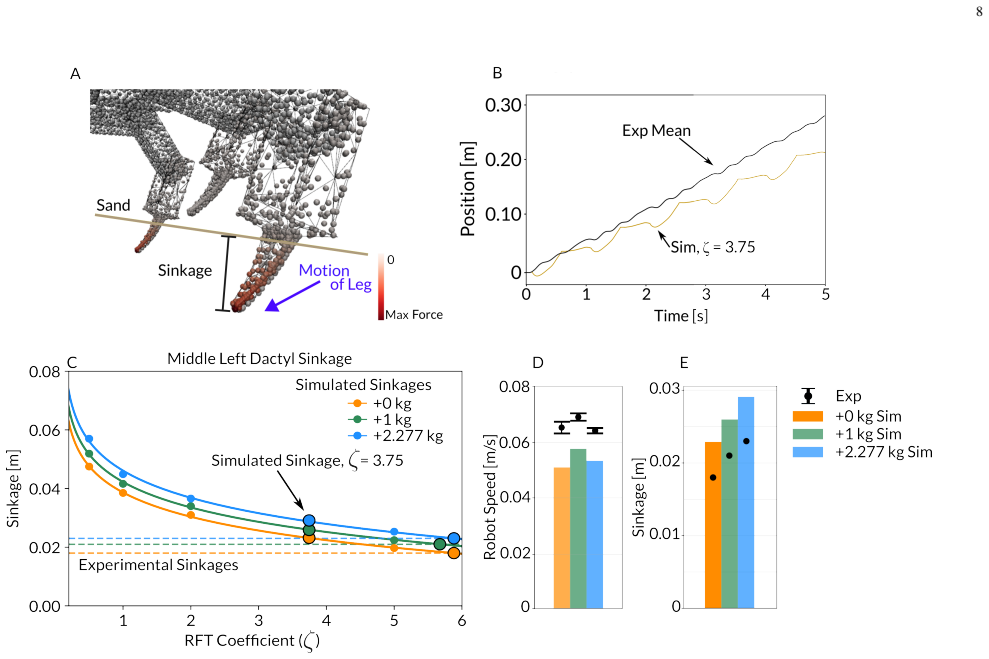
Implementation of 3D resistive force theory in MuJoCo predicts hexapod robot walking distance and foot sinkage in sand within 20 percent of experiments.
A machine-rendered reading of the paper's core claim, the machinery that carries it, and where it could break.
Core claim
We implement 3D Granular Resistive Force Theory in MuJoCo. The resulting simulations preserve key trends due to end effector shape, speed, and loading. Our implementation predicts walking distance and foot sinkage of a 12-Degree of Freedom hexapod robot within 20% of experiments in sand.
What carries the argument
3D Granular Resistive Force Theory (3D RFT) integrated with MuJoCo's standard dynamics calculations, which approximates ground reaction forces to simulate a stable substrate for walking robots.
If this is right
- The simulations preserve trends due to end effector shape, speed, and loading.
- The open-source tool can help develop new and improved robot designs to traverse granular media substrates.
- Resistive force approximations provide a stable substrate for a freely walking robot when integrated with standard dynamics.
- Key performance metrics like walking distance and foot sinkage can be predicted accurately enough for practical use.
Where Pith is reading between the lines
- This approach may reduce the need for expensive physical prototyping when designing robots for sandy or granular environments.
- Similar integrations could be tested in other physics engines to increase accessibility for researchers.
- Extending the model to other types of granular media or more complex robot gaits could be a next step.
- The 20% accuracy level might suffice for initial design iterations but may require refinement for precise control tasks.
Load-bearing premise
Resistive force approximations are sufficient, when integrated with standard dynamics calculations, to provide a stable substrate for a freely walking robot.
What would settle it
Running the implemented simulation on the 12-DoF hexapod and comparing the predicted walking distance and foot sinkage to physical experiments in sand; a discrepancy larger than 20% would falsify the prediction accuracy claim.
Figures



read the original abstract
Recent advancements in Resistive Force Theory (RFT) enable approximation of ground reaction forces for locomotion in sand without the computational expense of modeling interactions with individual grains. However, these tools have been absent in 3D physics engines commonly used for robot simulation. We explore if resistive force approximations are sufficient, when integrated with standard dynamics calculations, to provide a stable substrate for a freely walking robot. To determine this, we implement 3D Granular Resistive Force Theory (3D RFT) in a physics simulation engine, MuJoCo. We verify simulations in multiple scenarios to demonstrate that key trends due to end effector shape, speed, and loading are preserved. Our implementation predicts walking distance and foot sinkage of a 12-Degree of Freedom hexapod robot within 20\% of experiments in sand. While RFT has inherent approximations, the open source tool described here has potential to help develop new and improved robot designs to traverse granular media substrates.
Editorial analysis
A structured set of objections, weighed in public.
Referee Report
Summary. The paper implements 3D Granular Resistive Force Theory (3D RFT) inside the MuJoCo physics engine to approximate ground-reaction forces during locomotion in sand. It reports that the implementation preserves qualitative trends with end-effector shape, speed and loading, and that a 12-DOF hexapod simulation reproduces experimental walking distance and foot sinkage to within 20%. The central claim is that resistive-force approximations, once inserted into a standard dynamics solver, supply a sufficiently stable substrate for free walking.
Significance. An open-source RFT module in a widely used engine would lower the barrier to simulating granular locomotion and could accelerate design iteration for robots that traverse sand or regolith. The work supplies reproducible code, which is a concrete strength.
major comments (3)
- [Hexapod locomotion results] Hexapod results paragraph: the statement that distance and sinkage lie 'within 20% of experiments' supplies neither error bars, the number of trials, nor any description of how RFT parameters were chosen or cross-validated; without these the quantitative claim cannot be assessed.
- [Verification scenarios] Verification section: preservation of trends with shape, speed and load is asserted but no quantitative metric (e.g., relative error, statistical test) or comparison against a null model is given, leaving the claim that RFT integration yields a 'stable substrate' unsupported by the reported data.
- [Discussion and limitations] Discussion: the manuscript does not examine whether resistive-force vectors remain accurate under stance-phase acceleration, lateral slip, or multi-foot loading sequences that differ from the validation set; such mismatches could accumulate into instability while still keeping scalar distance/sinkage within 20%.
minor comments (2)
- [Abstract] Abstract: the phrase 'key trends due to end effector shape, speed, and loading' is never defined; a short enumeration of the trends would improve clarity.
- [Figures] Figure captions: several plots lack axis units or legend entries for the experimental versus simulated curves.
Simulated Author's Rebuttal
Thank you for the opportunity to respond to the referee's report on our manuscript. We address each major comment point by point below.
read point-by-point responses
-
Referee: [Hexapod locomotion results] Hexapod results paragraph: the statement that distance and sinkage lie 'within 20% of experiments' supplies neither error bars, the number of trials, nor any description of how RFT parameters were chosen or cross-validated; without these the quantitative claim cannot be assessed.
Authors: We agree with the referee that these details are necessary for assessing the claim. The revised manuscript will include error bars from repeated trials (n=5), specify the number of trials performed, and describe the RFT parameter selection and cross-validation process based on single-leg experiments. This addresses the concern directly. revision: yes
-
Referee: [Verification scenarios] Verification section: preservation of trends with shape, speed and load is asserted but no quantitative metric (e.g., relative error, statistical test) or comparison against a null model is given, leaving the claim that RFT integration yields a 'stable substrate' unsupported by the reported data.
Authors: The verification section shows preservation of trends via comparative plots. To better support the stability claim, we will add quantitative relative error metrics for the trends and include a comparison to the default contact model in MuJoCo as a null baseline in the revised manuscript. revision: yes
-
Referee: [Discussion and limitations] Discussion: the manuscript does not examine whether resistive-force vectors remain accurate under stance-phase acceleration, lateral slip, or multi-foot loading sequences that differ from the validation set; such mismatches could accumulate into instability while still keeping scalar distance/sinkage within 20%.
Authors: We acknowledge this limitation in the current validation. The discussion will be expanded to explicitly discuss these conditions as potential sources of error accumulation, while maintaining that the 20% agreement holds for the tested steady locomotion. This will clarify the scope without overclaiming. revision: yes
Circularity Check
No significant circularity; validation uses independent physical experiments
full rationale
The paper implements 3D RFT inside MuJoCo and reports that simulated hexapod walking distance and foot sinkage match separate physical experiments within 20%. The abstract and reader's summary indicate direct comparison to external data rather than fitting any parameter to the same trajectories later presented as predictions. No equations, self-citations, or ansatzes are shown that would make the reported accuracy tautological by construction. The derivation chain therefore remains self-contained against external benchmarks.
Axiom & Free-Parameter Ledger
Reference graph
Works this paper leans on
-
[1]
Creating a Mixed Reality (Physical) Sandbox,
A. Devanga, V . K. Ramesh, and R. Bockmon, “Creating a Mixed Reality (Physical) Sandbox,” in2025 11th International Conference on Virtual Reality (ICVR), pp. 322–329, July 2025
2025
-
[2]
Regulating Fintech in the EU: the Case for a Guided Sandbox,
W.-G. Ringe and C. Ruof, “Regulating Fintech in the EU: the Case for a Guided Sandbox,”European Journal of Risk Regulation, vol. 11, pp. 604–629, Sept. 2020
2020
-
[3]
An Android Application Sandbox system for suspicious software detec- tion,
T. Bl ¨asing, L. Batyuk, A.-D. Schmidt, S. A. Camtepe, and S. Albayrak, “An Android Application Sandbox system for suspicious software detec- tion,” in2010 5th International Conference on Malicious and Unwanted Software, pp. 55–62, Oct. 2010
2010
-
[4]
A New Concept of Digital Twin Supporting Optimization and Resilience of Factories of the Future,
A. B ´ecue, E. Maia, L. Feeken, P. Borchers, and I. Prac ¸a, “A New Concept of Digital Twin Supporting Optimization and Resilience of Factories of the Future,”Applied Sciences, vol. 10, p. 4482, Jan. 2020
2020
-
[5]
Modeling and simulation in intelligent manufacturing,
L. Zhang, L. Zhou, L. Ren, and Y . Laili, “Modeling and simulation in intelligent manufacturing,”Computers in Industry, vol. 112, p. 103123, Nov. 2019
2019
-
[6]
Efficient statistical validation with edge cases to evaluate Highly Automated Vehicles,
D. Karunakaran, S. Worrall, and E. Nebot, “Efficient statistical validation with edge cases to evaluate Highly Automated Vehicles,” in2020 IEEE 23rd International Conference on Intelligent Transportation Systems (ITSC), pp. 1–8, Sept. 2020
2020
-
[7]
Design and Implementa- tion of a Suburban Signal Traffic Control and Management System in the Field of Informatics,
V . L. Sivakumar, P. S. Perumal, and A. Raju, “Design and Implementa- tion of a Suburban Signal Traffic Control and Management System in the Field of Informatics,” in2023 7th International Conference on I-SMAC (IoT in Social, Mobile, Analytics and Cloud) (I-SMAC), pp. 1047–1054, Oct. 2023
2023
-
[8]
Pedipulate: En- abling Manipulation Skills using a Quadruped Robot’s Leg,
P. Arm, M. Mittal, H. Kolvenbach, and M. Hutter, “Pedipulate: En- abling Manipulation Skills using a Quadruped Robot’s Leg,” in2024 IEEE International Conference on Robotics and Automation (ICRA), pp. 5717–5723, May 2024
2024
-
[9]
Perceptive Au- tonomous Stair Climbing for Quadrupedal Robots,
S. Qi, W. Lin, Z. Hong, H. Chen, and W. Zhang, “Perceptive Au- tonomous Stair Climbing for Quadrupedal Robots,” in2021 IEEE/RSJ International Conference on Intelligent Robots and Systems (IROS), pp. 2313–2320, Sept. 2021
2021
-
[10]
Variability in Real-World Activity Patterns of Heavy-Duty Vehicles by V ocation,
G. Scora, K. Boriboonsomsin, T. D. Durbin, K. Johnson, S. Yoon, J. Collins, and Z. Dai, “Variability in Real-World Activity Patterns of Heavy-Duty Vehicles by V ocation,”Transportation Research Record, vol. 2673, pp. 51–61, Sept. 2019
2019
-
[11]
Per- formance of an agricultural tractor fitted with rubber tracks,
G. Molari, L. Bellentani, A. Guarnieri, M. Walker, and E. Sedoni, “Per- formance of an agricultural tractor fitted with rubber tracks,”Biosystems Engineering, vol. 111, pp. 57–63, Jan. 2012
2012
-
[12]
Dominant design and evolution of technological trajectories: The case of tank technology, 1915–1998,
J. Kim, J. Yoon, and J.-D. Lee, “Dominant design and evolution of technological trajectories: The case of tank technology, 1915–1998,” Journal of Evolutionary Economics, vol. 31, pp. 661–676, Apr. 2021
1915
-
[13]
The Atacama Desert in Northern Chile as an Analog Model of Mars,
A. Azua-Bustos, C. Gonz ´alez-Silva, and A. G. Fair ´en, “The Atacama Desert in Northern Chile as an Analog Model of Mars,”Frontiers in Astronomy and Space Sciences, vol. 8, Jan. 2022
2022
-
[14]
NASA Glenn Research Center mTRAX Planetary Exploration Laboratories Capabilities Overview,
E. T. Rezich and A. Schepelmann, “NASA Glenn Research Center mTRAX Planetary Exploration Laboratories Capabilities Overview,” vol. 2595, p. 8024, June 2021. ADS Bibcode: 2021LPICo2595.8024R
-
[15]
Bipedial Locomotion Up Sandy Slopes: Systematic Experiments Using Zero Moment Point Methods,
J. R. Gosyne, C. M. Hubicki, X. Xiong, A. D. Ames, and D. I. Goldman, “Bipedial Locomotion Up Sandy Slopes: Systematic Experiments Using Zero Moment Point Methods,” in2018 IEEE-RAS 18th International Conference on Humanoid Robots (Humanoids), pp. 994–1001, Nov. 2018
2018
-
[16]
Traversing Steep and Granular Martian Analog Slopes with a Dynamic Quadrupedal Robot,
H. Kolvenbach, P. Arm, E. Hampp, A. Dietsche, V . Bickel, B. Sun, C. Meyer, and M. Hutter, “Traversing Steep and Granular Martian Analog Slopes with a Dynamic Quadrupedal Robot,”Field Robotics, vol. 2, pp. 910–939, May 2022
2022
-
[17]
Intruder friction effects on granular impact dynamics,
H. Zheng, D. Wang, D. Z. Chen, M. Wang, and R. P. Behringer, “Intruder friction effects on granular impact dynamics,”Physical Review E, vol. 98, p. 032904, Sept. 2018
2018
-
[18]
Mole crab- inspired vertical self-burrowing,
L. K. Treers, B. McInroe, R. J. Full, and H. S. Stuart, “Mole crab- inspired vertical self-burrowing,”Frontiers in Robotics and AI, vol. 9, Oct. 2022
2022
-
[19]
Controlling subterranean forces enables a fast, steerable, burrowing soft robot,
N. D. Naclerio, A. Karsai, M. Murray-Cooper, Y . Ozkan-Aydin, E. Ay- din, D. I. Goldman, and E. W. Hawkes, “Controlling subterranean forces enables a fast, steerable, burrowing soft robot,”Science Robotics, vol. 6, p. eabe2922, June 2021. 11
2021
-
[20]
An Experimental Investigation of Digging Via Localized Fluidization, Tested With RoboClam: A Robot Inspired by Atlantic Razor Clams,
M. Isava and A. G. Winter V , “An Experimental Investigation of Digging Via Localized Fluidization, Tested With RoboClam: A Robot Inspired by Atlantic Razor Clams,”Journal of Mechanical Design, vol. 138, Sept. 2016
2016
-
[21]
Using a Small Hexapod Robot to Pick up Large Cylinders for Munitions Response,
Y . Gong, M. Pan, and K. A. Daltorio, “Using a Small Hexapod Robot to Pick up Large Cylinders for Munitions Response,”Journal of Field Robotics, vol. 42, no. 5, pp. 1679–1695, 2025. eprint: https://onlinelibrary.wiley.com/doi/pdf/10.1002/rob.22482
-
[22]
A bio-inspired helically driven self-burrowing robot,
H. Bagheri, D. Stockwell, B. Bethke, N. K. Okwae, D. Aukes, J. Tao, and H. Marvi, “A bio-inspired helically driven self-burrowing robot,” Acta Geotechnica, vol. 19, pp. 1435–1448, Mar. 2024
2024
-
[23]
SBOR: a minimalistic soft self-burrowing-out robot inspired by razor clams,
J. J. Tao, S. Huang, and Y . Tang, “SBOR: a minimalistic soft self-burrowing-out robot inspired by razor clams,”Bioinspiration & Biomimetics, vol. 15, p. 055003, July 2020
2020
-
[24]
CRABOT: A Biomimetic Burrowing Robot Designed for Underground Chemical Source Location,
R. A. Russell, “CRABOT: A Biomimetic Burrowing Robot Designed for Underground Chemical Source Location,” Advanced Robotics, vol. 25, pp. 119–134, Jan. 2011. eprint: https://doi.org/10.1163/016918610X538516
-
[25]
Steerable Burrowing Robot: Design, Modeling and Experiments,
M. Barenboim and A. Degani, “Steerable Burrowing Robot: Design, Modeling and Experiments,” in2020 IEEE International Conference on Robotics and Automation (ICRA), pp. 829–835, May 2020
2020
-
[26]
Mole-inspired robot burrowing with forelimbs for planetary soil exploration,
T. Zhang, H. Wei, H. Zheng, Z. Liang, H. Yang, Y . Zhang, H. Zhu, Y . Guan, X. Ding, K. Wang, and K. Xu, “Mole-Inspired Robot Burrowing with Forelimbs for Planetary Soil Exploration,”Advanced Intelligent Systems, vol. 6, no. 6, p. 2300392, 2024. eprint: https://advanced.onlinelibrary.wiley.com/doi/pdf/10.1002/aisy.202300392
-
[27]
Coordination between the legs and tail during digging and swimming in sand crabs,
Z. Faulkes and D. H. Paul, “Coordination between the legs and tail during digging and swimming in sand crabs,”Journal of Comparative Physiology A, vol. 180, pp. 161–169, Jan. 1997
1997
-
[28]
Maladen, Y
R. Maladen, Y . Ding, P. Umbanhowar, A. Kamor, and D. Goldman, Biophysically inspired development of a sand-swimming robot. June 2010
2010
-
[29]
Vehicle with traveling wave thrust module apparatuses, methods and systems,
B. P. Filardo, D. S. Zimmerman, and M. I. Weaker, “Vehicle with traveling wave thrust module apparatuses, methods and systems,” Oct. 2023
2023
-
[30]
Ad- dressing Foot Geometry Trade-Offs to Achieve Amphibious Surf Zone Transitions with a Crab Robot,
N. Graf, J. Grezmak, N. Carmichael, Y . Gong, and K. Daltorio, “Ad- dressing Foot Geometry Trade-Offs to Achieve Amphibious Surf Zone Transitions with a Crab Robot,” inWalking Robots into Real World (K. Berns, M. O. Tokhi, A. Roennau, M. F. Silva, and R. Dillmann, eds.), (Cham), pp. 95–106, Springer Nature Switzerland, 2024
2024
-
[31]
Comparing open-source DEM frameworks for simulations of common bulk processes,
M. Dosta, D. Andre, V . Angelidakis, R. A. Caulk, M. A. Celigueta, B. Chareyre, J. F. Dietiker, J. Girardot, N. Govender, C. Hubert, R. Kobyłka, A. F. Moura, V . Skorych, D. K. Weatherley, and T. Wein- hart, “Comparing open-source DEM frameworks for simulations of common bulk processes,”Computer Physics Communications, vol. 296, p. 109066, Mar. 2024
2024
-
[32]
A Comprehensive Review of Coverage Path Planning in Robotics Using Classical and Heuristic Algorithms,
C. S. Tan, R. Mohd-Mokhtar, and M. R. Arshad, “A Comprehensive Review of Coverage Path Planning in Robotics Using Classical and Heuristic Algorithms,”IEEE Access, vol. 9, pp. 119310–119342, 2021
2021
-
[33]
Deep Learning in Robotics: Survey on Model Structures and Training Strategies,
A. I. K ´aroly, P. Galambos, J. Kuti, and I. J. Rudas, “Deep Learning in Robotics: Survey on Model Structures and Training Strategies,” IEEE Transactions on Systems, Man, and Cybernetics: Systems, vol. 51, pp. 266–279, Jan. 2021
2021
-
[34]
Real-Time Neural MPC: Deep Learning Model Predictive Control for Quadrotors and Agile Robotic Platforms,
T. Salzmann, E. Kaufmann, J. Arrizabalaga, M. Pavone, D. Scaramuzza, and M. Ryll, “Real-Time Neural MPC: Deep Learning Model Predictive Control for Quadrotors and Agile Robotic Platforms,”IEEE Robotics and Automation Letters, vol. 8, pp. 2397–2404, Apr. 2023
2023
-
[35]
The effectiveness of resistive force theory in granular locomotiona),
T. Zhang and D. I. Goldman, “The effectiveness of resistive force theory in granular locomotiona),”Physics of Fluids, vol. 26, p. 101308, Oct. 2014
2014
-
[36]
Continuum modelling and simulation of granular flows through their many phases
S. Dunatunga and K. Kamrin, “Continuum modelling and simulation of granular flows through their many phases,”Journal of Fluid Mechanics, vol. 779, pp. 483–513, Sept. 2015. arXiv:1411.5447 [cond-mat]
work page internal anchor Pith review Pith/arXiv arXiv 2015
-
[37]
The Propulsion of Sea-Urchin Sperma- tozoa,
J. Gray and G. J. Hancock, “The Propulsion of Sea-Urchin Sperma- tozoa,”Journal of Experimental Biology, vol. 32, pp. 802–814, Dec. 1955
1955
-
[38]
Contact Modeling and Manipulation,
I. Kao, K. M. Lynch, and J. W. Burdick, “Contact Modeling and Manipulation,” inSpringer Handbook of Robotics(B. Siciliano and O. Khatib, eds.), pp. 931–954, Cham: Springer International Publishing, 2016
2016
-
[39]
A Terradynamics of Legged Locomotion on Granular Media,
C. Li, T. Zhang, and D. I. Goldman, “A Terradynamics of Legged Locomotion on Granular Media,”Science, vol. 339, pp. 1408–1412, Mar. 2013
2013
-
[40]
Modeling of the interaction of rigid wheels with dry granular media,
S. Agarwal, C. Senatore, T. Zhang, M. Kingsbury, K. Iagnemma, D. I. Goldman, and K. Kamrin, “Modeling of the interaction of rigid wheels with dry granular media,”Journal of Terramechanics, vol. 85, pp. 1–14, Oct. 2019
2019
-
[41]
Modeling wheeled locomotion in granular media using 3D-RFT and sand deformation,
Q. Yu, C. Pavlov, W. Kim, and A. M. Johnson, “Modeling wheeled locomotion in granular media using 3D-RFT and sand deformation,” Journal of Terramechanics, vol. 115, p. 100987, Oct. 2024
2024
-
[42]
Compliant Fins for Locomotion in Granular Media,
D. Li, S. Huang, Y . Tang, H. Marvi, J. Tao, and D. M. Aukes, “Compliant Fins for Locomotion in Granular Media,”IEEE Robotics and Automation Letters, vol. 6, pp. 5984–5991, July 2021
2021
-
[43]
Undulatory Swimming in Sand: Subsurface Locomotion of the Sandfish Lizard,
R. D. Maladen, Y . Ding, C. Li, and D. I. Goldman, “Undulatory Swimming in Sand: Subsurface Locomotion of the Sandfish Lizard,” Science, vol. 325, pp. 314–318, July 2009
2009
-
[44]
Granular Resistive Force Theory Implementation for Three-Dimensional Trajectories,
L. K. Treers, C. Cao, and H. S. Stuart, “Granular Resistive Force Theory Implementation for Three-Dimensional Trajectories,”IEEE Robotics and Automation Letters, vol. 6, pp. 1887–1894, Apr. 2021
2021
-
[45]
Mechanistic framework for reduced-order models in soft materials: Application to three-dimensional granular intrusion,
S. Agarwal, D. I. Goldman, and K. Kamrin, “Mechanistic framework for reduced-order models in soft materials: Application to three-dimensional granular intrusion,”Proceedings of the National Academy of Sciences, vol. 120, p. e2214017120, Jan. 2023
2023
-
[46]
A Dynamic Resistive Force Model for Designing Mobile Robot in Granular Media,
L. Huang, J. Zhu, Y . Yuan, and Y . Yin, “A Dynamic Resistive Force Model for Designing Mobile Robot in Granular Media,”IEEE Robotics and Automation Letters, vol. 7, pp. 5357–5364, Apr. 2022
2022
-
[47]
The “Shadow Effect
C.-H. Ko and M. Elimelech, “The “Shadow Effect” in Colloid Transport and Deposition Dynamics in Granular Porous Media: Measurements and Mechanisms,”Environmental Science & Technology, vol. 34, pp. 3681– 3689, Sept. 2000
2000
-
[48]
Extending granular resistive force theory to cohesive powder-scale media,
D. Kerimoglu, E. Marteau, D. Soto, and D. I. Goldman, “Extending granular resistive force theory to cohesive powder-scale media,”Journal of Terramechanics, vol. 120, p. 101058, Oct. 2025
2025
-
[49]
Simulation tools for model-based robotics: Comparison of Bullet, Havok, MuJoCo, ODE and PhysX,
T. Erez, Y . Tassa, and E. Todorov, “Simulation tools for model-based robotics: Comparison of Bullet, Havok, MuJoCo, ODE and PhysX,” in2015 IEEE International Conference on Robotics and Automation (ICRA), pp. 4397–4404, May 2015
2015
-
[50]
Benchmarking the Sim-to-Real Gap in Cloth Manipulation,
D. Blanco-Mulero, O. Barbany, G. Alcan, A. Colom ´e, C. Torras, and V . Kyrki, “Benchmarking the Sim-to-Real Gap in Cloth Manipulation,” IEEE Robotics and Automation Letters, vol. 9, pp. 2981–2988, Mar. 2024
2024
-
[51]
Crab-Like Hexapod Feet for Amphibious Walking in Sand and Waves,
N. M. Graf, A. M. Behr, and K. A. Daltorio, “Crab-Like Hexapod Feet for Amphibious Walking in Sand and Waves,” inBiomimetic and Biohybrid Systems(U. Martinez-Hernandez, V . V ouloutsi, A. Mura, M. Mangan, M. Asada, T. J. Prescott, and P. F. Verschure, eds.), (Cham), pp. 158–170, Springer International Publishing, 2019
2019
-
[52]
Terrain Classification Based on Sensed Leg Compliance for Amphibious Crab Robot,
J. Grezmak, N. Graf, A. Behr, and K. Daltorio, “Terrain Classification Based on Sensed Leg Compliance for Amphibious Crab Robot,”IEEE Sensors Journal, vol. 21, pp. 23308–23316, Oct. 2021
2021
-
[53]
Intrusion rheology in grains and other flowable materials,
H. Askari and K. Kamrin, “Intrusion rheology in grains and other flowable materials,”Nature Materials, vol. 15, pp. 1274–1279, Dec. 2016
2016
-
[54]
A. C. Smit, E. Schat, and E. Ceulemans, “The Exponentially Weighted Moving Average Procedure for Detecting Changes in Intensive Lon- gitudinal Data in Psychological Research in Real-Time: A Tutorial Showcasing Potential Applications,”Assessment, vol. 30, pp. 1354– 1368, July 2023
2023
-
[55]
A framework for identifying the onset of landslide acceleration based on the expo- nential moving average (EMA),
J.-z. Wang, N.-p. Ju, Y .-b. Tie, Y .-j. Bai, and H. Ge, “A framework for identifying the onset of landslide acceleration based on the expo- nential moving average (EMA),”Journal of Mountain Science, vol. 20, pp. 1639–1649, June 2023
2023
-
[56]
A Simple Risk-Adjusted Exponen- tially Weighted Moving Average,
O. Grigg and D. Spiegelhalter, “A Simple Risk-Adjusted Exponen- tially Weighted Moving Average,”Journal of the American Sta- tistical Association, vol. 102, pp. 140–152, Mar. 2007. eprint: https://doi.org/10.1198/016214506000001121
-
[57]
Double Exponential Smooth- ing for predictive vision based target tracking of a wheeled mobile robot,
F. Gu ´erin, S. G. Fabri, and M. K. Bugeja, “Double Exponential Smooth- ing for predictive vision based target tracking of a wheeled mobile robot,” in52nd IEEE Conference on Decision and Control, pp. 3535– 3540, Dec. 2013
2013
-
[58]
Design and performance evaluation of an exponentially weighted moving average–based adaptive control for piezo-driven motion platform,
Y . Ting, T. V . Nguyen, and J.-C. Chen, “Design and performance evaluation of an exponentially weighted moving average–based adaptive control for piezo-driven motion platform,”Advances in Mechanical Engineering, vol. 10, p. 1687814018767194, June 2018
2018
-
[59]
Walk- Burrow-Tug: Legged Anchoring Analysis Using RFT-Based Granu- lar Limit Surfaces,
T. M. Huh, C. Cao, J. Aderibigbe, D. Moon, and H. S. Stuart, “Walk- Burrow-Tug: Legged Anchoring Analysis Using RFT-Based Granu- lar Limit Surfaces,”IEEE Robotics and Automation Letters, vol. 8, pp. 3796–3803, June 2023
2023
-
[60]
Gazebo Fluids: SPH-based simulation of fluid interaction with articulated rigid body dynamics,
E. Angelidis, J. Bender, J. Arreguit, L. Gleim, W. Wang, C. Axenie, A. Knoll, and A. Ijspeert, “Gazebo Fluids: SPH-based simulation of fluid interaction with articulated rigid body dynamics,” in2022 IEEE/RSJ International Conference on Intelligent Robots and Systems (IROS), pp. 11238–11245, Oct. 2022
2022
-
[61]
Open3D: A Modern Library for 3D Data Processing
Q.-Y . Zhou, J. Park, and V . Koltun, “Open3D: A Modern Library for 3D Data Processing,” Jan. 2018. arXiv:1801.09847 [cs]. 12
work page internal anchor Pith review Pith/arXiv arXiv 2018
-
[62]
Surprising simplicity in the modeling of dynamic granular intrusion,
S. Agarwal, A. Karsai, D. I. Goldman, and K. Kamrin, “Surprising simplicity in the modeling of dynamic granular intrusion,” Jan. 2021. arXiv:2005.10976 [cond-mat]
-
[63]
Probing with Each Step: How a Walking Crab-like Robot Classifies Buried Cylinders in Sand with Hall-Effect Sensors,
J. Grezmak and K. A. Daltorio, “Probing with Each Step: How a Walking Crab-like Robot Classifies Buried Cylinders in Sand with Hall-Effect Sensors,”Sensors, vol. 24, p. 1579, Jan. 2024
2024
-
[64]
Built upon sand: Theoretical ideas inspired by granular flows,
L. P. Kadanoff, “Built upon sand: Theoretical ideas inspired by granular flows,”Reviews of Modern Physics, vol. 71, pp. 435–444, Jan. 1999
1999
-
[65]
MuJoCo: A physics engine for model-based control,
E. Todorov, T. Erez, and Y . Tassa, “MuJoCo: A physics engine for model-based control,” in2012 IEEE/RSJ International Conference on Intelligent Robots and Systems, pp. 5026–5033, Oct. 2012
2012
-
[66]
Get a grip: inward dactyl motions improve efficiency of sideways-walking gait for an amphibious crab-like robot,
N. M. Graf, J. E. Grezmak, and K. A. Daltorio, “Get a grip: inward dactyl motions improve efficiency of sideways-walking gait for an amphibious crab-like robot,”Bioinspiration & Biomimetics, vol. 17, p. 066008, Oct. 2022
2022
-
[67]
Virtual Model of a Robotic Arm Digital Twin with MuJoCo,
B. Perez Inturias, J. P. G. Marques de Oliveira, and M. Becerra Var- gas, “Virtual Model of a Robotic Arm Digital Twin with MuJoCo,” inRobotics, Computer Vision and Intelligent Systems(J. Filipe and J. R ¨oning, eds.), (Cham), pp. 457–469, Springer Nature Switzerland, 2024
2024
-
[68]
K. Zakka, B. Tabanpour, Q. Liao, M. Haiderbhai, S. Holt, J. Y . Luo, A. Allshire, E. Frey, K. Sreenath, L. A. Kahrs, C. Sferrazza, Y . Tassa, and P. Abbeel, “MuJoCo Playground,” Feb. 2025. arXiv:2502.08844 [cs]
work page Pith review arXiv 2025
-
[69]
Advances in Modeling Dense Granular Media,
K. Kamrin, K. M. Hill, D. I. Goldman, and J. E. Andrade, “Advances in Modeling Dense Granular Media,”Annual Review of Fluid Mechanics, vol. 56, pp. 215–240, Jan. 2024
2024
-
[70]
Q. Zhang, E. Deal, J. T. Perron, J. G. Venditti, S. J. Bena- vides, M. Rushlow, and K. Kamrin, “Fluid-Driven Transport of Round Sediment Particles: From Discrete Simulations to Con- tinuum Modeling,”Journal of Geophysical Research: Earth Sur- face, vol. 127, no. 7, p. e2021JF006504, 2022. eprint: https://agupubs.onlinelibrary.wiley.com/doi/pdf/10.1029/202...
-
[71]
A general fluid–sediment mixture model and constitutive theory validated in many flow regimes,
A. S. Baumgarten and K. Kamrin, “A general fluid–sediment mixture model and constitutive theory validated in many flow regimes,”Journal of Fluid Mechanics, vol. 861, pp. 721–764, Feb. 2019
2019
-
[72]
Particle Motions in a Gas-Fluidized Bed of Sand,
N. Menon and D. J. Durian, “Particle Motions in a Gas-Fluidized Bed of Sand,”Physical Review Letters, vol. 79, pp. 3407–3410, Nov. 1997
1997
-
[73]
Calibration of granular material param- eters for DEM modelling and numerical verification by blade–granular material interaction,
C. J. Coetzee and D. N. J. Els, “Calibration of granular material param- eters for DEM modelling and numerical verification by blade–granular material interaction,”Journal of Terramechanics, vol. 46, pp. 15–26, Feb. 2009
2009
-
[74]
A novel framework for calibrating DEM parameters: A case study of sand and soil-rock mixture,
Y . Hu and Y . Lu, “A novel framework for calibrating DEM parameters: A case study of sand and soil-rock mixture,”Computers and Geotechnics, vol. 174, p. 106619, Oct. 2024
2024
-
[75]
Blaze-DEMGPU: Modular high performance DEM framework for the GPU architecture,
N. Govender, D. N. Wilke, and S. Kok, “Blaze-DEMGPU: Modular high performance DEM framework for the GPU architecture,”SoftwareX, vol. 5, pp. 62–66, Jan. 2016
2016
-
[76]
Mole-inspired Forepaw Design and Optimization Based on Resistive Force Theory,
T. Zhang, Z. Liang, H. Zheng, Z. Chen, K. Zheng, R. Xu, J. Liu, H. Zhu, Y . Guan, K. Xu, and X. Ding, “Mole-inspired Forepaw Design and Optimization Based on Resistive Force Theory,”Journal of Bionic Engineering, vol. 22, pp. 171–180, Jan. 2025
2025
-
[77]
Learning to enhance multi-legged robot on rugged landscapes,
J. He, B. Chong, Z. Xu, S. Ha, and D. I. Goldman, “Learning to enhance multi-legged robot on rugged landscapes,” Sept. 2024. arXiv:2409.09473 [cs]
-
[78]
Open- Source Reinforcement Learning Environments Implemented in MuJoCo with Franka Manipulator,
Z. Xu, Y . Li, X. Yang, Z. Zhao, L. Zhuang, and J. Zhao, “Open- Source Reinforcement Learning Environments Implemented in MuJoCo with Franka Manipulator,” in2024 IEEE International Conference on Advanced Intelligent Mechatronics (AIM), pp. 709–714, July 2024
2024
-
[79]
Neuromechanical Simulation with NEURON and MuJoCo,
C. Fietkiewicz, L. Tran, R. McDougal, C. Jackson, R. D. Quinn, H. J. Chiel, and P. J. Thomas, “Neuromechanical Simulation with NEURON and MuJoCo,” June 2025. Pages: 2025.06.17.660217 Section: New Results
2025
discussion (0)
Sign in with ORCID, Apple, or X to comment. Anyone can read and Pith papers without signing in.