Advances in Scientific Machine Learning for Coupled Fluid Flow and Transport
Pith reviewed 2026-06-26 20:51 UTC · model grok-4.3
The pith
Scientific machine learning builds fast surrogate models for coupled fluid flow and transport within tested regimes.
A machine-rendered reading of the paper's core claim, the machinery that carries it, and where it could break.
Core claim
The chapter demonstrates that SciML methods, including PINNs for surrogate modeling of turbidity currents and β-VAEs for disentangled nonlinear modes from thermal flows, enable fast and accurate approximations of coupled incompressible Navier-Stokes and scalar transport equations, substantially lowering computational costs relative to traditional full-order simulations when applied inside the specific data regimes considered.
What carries the argument
Physics-Informed Neural Networks (PINNs) and β-Variational Autoencoders (β-VAEs) combined with adaptive mesh refinement/coarsening and scientific data compression, used to construct reduced-order surrogates of the Navier-Stokes and transport system.
If this is right
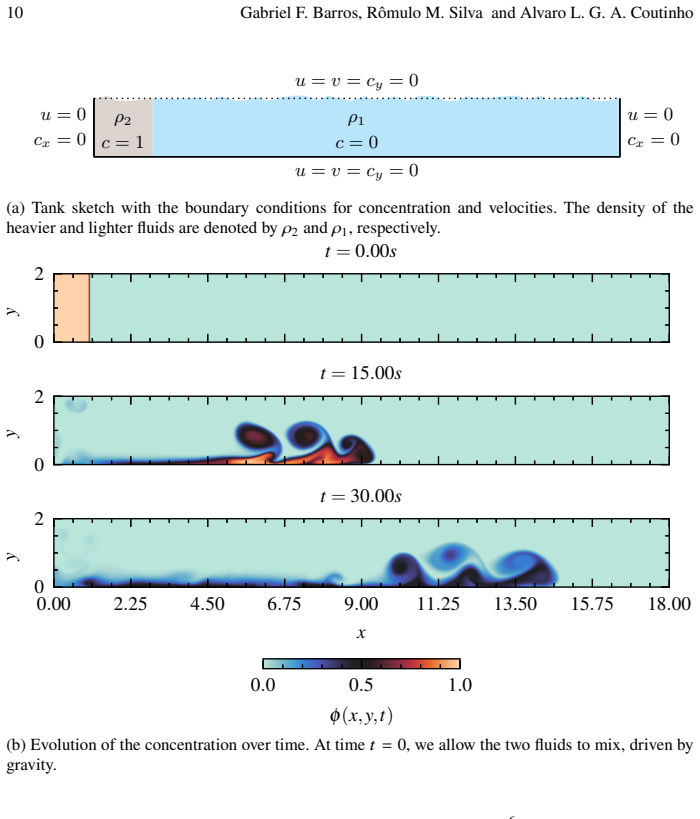
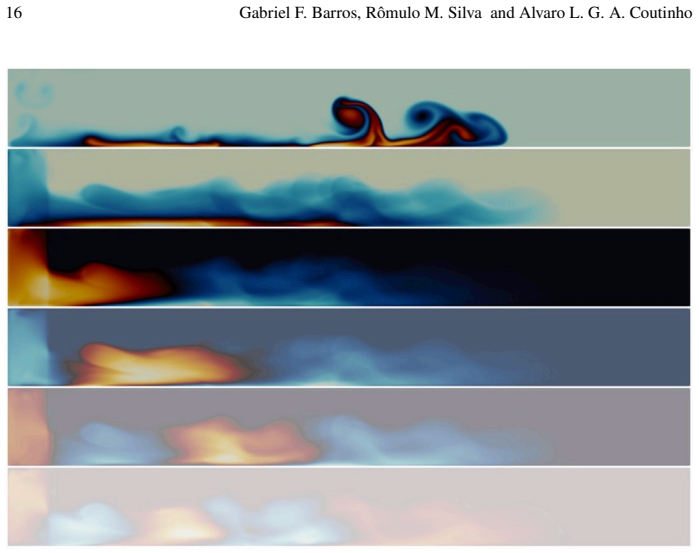
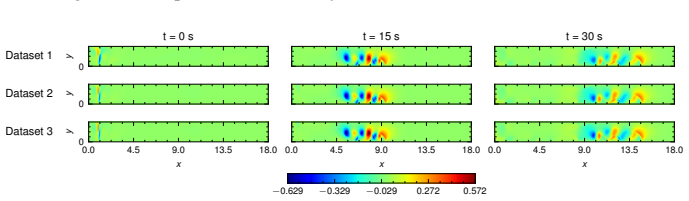
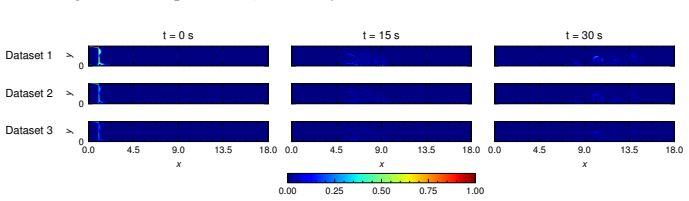
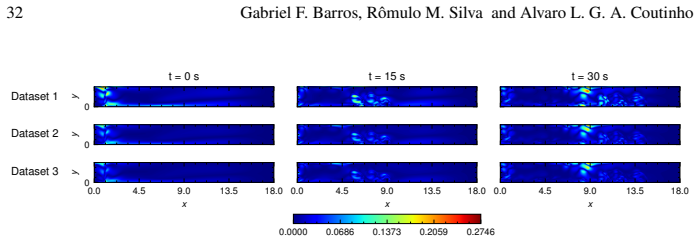
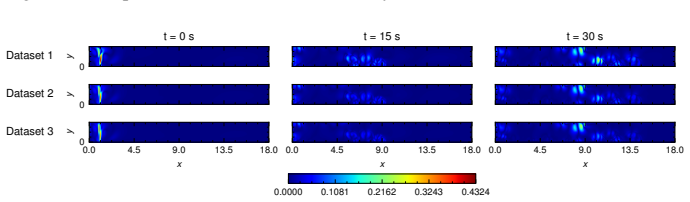
- PINN surrogates can reproduce lock-exchange turbidity current dynamics at reduced cost.
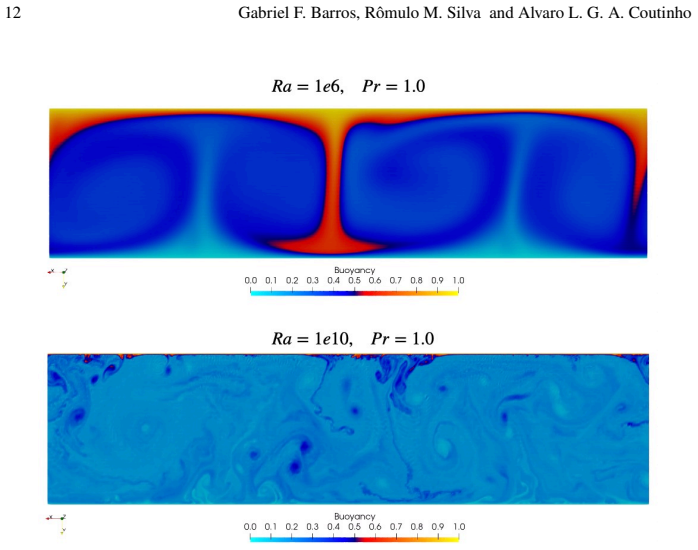
- β-VAEs can extract disentangled nonlinear modes from Rayleigh-Bénard convection simulations.
- The combined SciML and HPC workflow lowers computational expense for coupled flow-transport problems relative to full-order models.
- Accuracy holds for the nonlinear coupling and multiscale features present in the studied benchmarks.
Where Pith is reading between the lines
- Real-time prediction capability is stated to depend strongly on the concrete problem and data regime.
- Uncertainty quantification for these surrogates is identified as an active research direction rather than a delivered capability.
- The same surrogate-construction pattern could be tested on other coupled transport problems that share the same governing equations.
Load-bearing premise
The surrogate models remain accurate and useful only inside the specific data regimes and modeling assumptions considered in the two example problems.
What would settle it
Compare PINN surrogate predictions for turbidity currents against full-order Navier-Stokes solutions on parameter values lying outside the training ranges used in the lock-exchange benchmarks.
Figures
read the original abstract
This chapter reviews recent advances in Scientific Machine Learning (SciML) for modeling coupled fluid flow and transport phenomena governed by the incompressible Navier-Stokes and scalar transport equations. Such systems, found in applications like turbidity currents and thermal convection, feature strong nonlinear coupling and multiscale behavior that make high-fidelity simulations computationally expensive. To address this, the chapter surveys state-of-the-art SciML methods for building efficient surrogate models, including linear reduced-order techniques based on Singular Value Decomposition (such as Dynamic Mode Decomposition) and nonlinear neural network approaches like Physics-Informed Neural Networks (PINNs) and $\beta$-Variational Autoencoders ($\beta$-VAEs). It first covers the authors' work combining these models with High Performance Computing strategies, including Adaptive Mesh Refinement/Coarsening (AMR/C) and scientific floating-point data compression. It then presents two new contributions: surrogate modeling of turbidity currents via PINNs, and the extraction of disentangled nonlinear modes from thermal flows using $\beta$-VAEs. Governing equations and representative benchmarks, including lock-exchange flows and Rayleigh-B\'enard convection, illustrate these methodologies. The chapter is intentionally long, covering both the mathematical and physical foundations of coupled fluid flow and the computational aspects of state-of-the-art modeling. Overall, it demonstrates how SciML enables fast, accurate approximations of complex coupled systems within the specific data regimes and modeling assumptions considered, while substantially reducing computational cost relative to full-order simulations. Broader capabilities such as real-time prediction and uncertainty quantification remain active research directions whose feasibility depends strongly on the problem at hand.
Editorial analysis
A structured set of objections, weighed in public.
Referee Report
Summary. This chapter reviews SciML methods (DMD, PINNs, β-VAEs) for surrogate modeling of incompressible Navier-Stokes plus scalar transport problems, with applications to turbidity currents and Rayleigh-Bénard convection. It integrates these with HPC techniques (AMR/C, data compression) and presents two new contributions: a PINN surrogate for lock-exchange turbidity currents and a β-VAE for disentangled nonlinear mode extraction in thermal convection. The central claim is that the resulting surrogates deliver fast, accurate approximations inside the specific data regimes and modeling assumptions considered, while substantially lowering cost relative to full-order simulations; broader capabilities such as real-time prediction and UQ are noted as problem-dependent.
Significance. If the quantitative validations and cost comparisons for the two new contributions hold, the chapter would supply a useful, self-contained survey of SciML techniques for strongly coupled multiscale fluid-transport systems together with concrete HPC integrations. The explicit scoping to considered regimes avoids over-claiming generality.
major comments (1)
- [Abstract] Abstract: the statements that the PINN and β-VAE surrogates are 'fast and accurate' and 'substantially reducing computational cost' are presented without any quantitative error metrics, validation protocols, baseline comparisons, or timing data. Because these two new contributions are the primary novel elements, the absence of such evidence is load-bearing for the central claim.
Simulated Author's Rebuttal
We thank the referee for their thoughtful review and for highlighting the need to strengthen the abstract's presentation of our new contributions. We address the single major comment below and will revise the manuscript accordingly.
read point-by-point responses
-
Referee: [Abstract] Abstract: the statements that the PINN and β-VAE surrogates are 'fast and accurate' and 'substantially reducing computational cost' are presented without any quantitative error metrics, validation protocols, baseline comparisons, or timing data. Because these two new contributions are the primary novel elements, the absence of such evidence is load-bearing for the central claim.
Authors: We agree that the abstract should include quantitative support for the claims regarding the PINN turbidity-current surrogate and the β-VAE mode extraction. The body of the manuscript (Sections 4.2 and 5.3) already reports relative L2 errors, validation against high-fidelity AMR/C simulations, and wall-clock timing comparisons demonstrating order-of-magnitude speedups within the considered regimes. We will revise the abstract to incorporate concise quantitative statements (e.g., typical error levels and observed speedups) together with a brief reference to the validation protocols, while preserving the existing scoping language that limits generality claims. revision: yes
Circularity Check
Minor self-citations in review context; no load-bearing circularity
full rationale
This is a review chapter surveying SciML methods for fluid flow and transport, with two scoped example applications (PINN surrogate for turbidity currents; β-VAE for Rayleigh-Bénard). The central claim is explicitly limited to accuracy and cost reduction 'within the specific data regimes and modeling assumptions considered,' and flags that broader capabilities 'depend strongly on the problem at hand.' No derivation reduces by construction to fitted inputs, no uniqueness theorem is imported from self-citation, and self-citations to prior author work are not load-bearing for the scoped demonstration. The paper is self-contained against external benchmarks within its stated scope.
Axiom & Free-Parameter Ledger
Reference graph
Works this paper leans on
-
[1]
Research in Engineering Design31(3), 275–298 (2020)
Alizadeh, R., Allen, J.K., Mistree, F.: Managing computational complexity using surrogate models: a critical review. Research in Engineering Design31(3), 275–298 (2020). DOI 10.1007/s00163- 020-00336-7
-
[2]
Proceedings of the Royal Society of London
Allen, C.M.: Numerical simulation of contaminant dispersion in estuary flows. Proceedings of the Royal Society of London. A. Mathematical and Physical Sciences381(1780), 179–194 (1982)
1982
-
[3]
Nat Methods15(6), 399–400 (2018)
Altman, N., Krzywinski, M.: The curse (s) of dimensionality. Nat Methods15(6), 399–400 (2018)
2018
-
[4]
In: High Performance Computing in Science and Engineering´ 16: Transac- tions of the High Performance Computing Center, Stuttgart (HLRS) 2016, pp
Axtmann, G., Rist, U.: Scalability of openfoam with large eddy simulations and dns on high- performance systems. In: High Performance Computing in Science and Engineering´ 16: Transac- tions of the High Performance Computing Center, Stuttgart (HLRS) 2016, pp. 413–424. Springer (2017)
2016
-
[5]
Physics of fluids17(10) (2005)
Bae, J.H., Yoo, J.Y., Choi, H.: Direct numerical simulation of turbulent supercritical flows with heat transfer. Physics of fluids17(10) (2005)
2005
-
[6]
Dissertation, Federal University of Rio de Janeiro (COPPE/UFRJ), Rio de Janeiro, Brazil (2023)
Barros, G.F.: Contributions to the application of snapshot-based data-driven methods in computa- tional science and engineering. Dissertation, Federal University of Rio de Janeiro (COPPE/UFRJ), Rio de Janeiro, Brazil (2023). Awarded the 2024 ABMEC Best Doctoral Thesis Prize
2023
-
[7]
CILAMCE 2020 - Proceedings of the XLI Ibero-Latin-American Congress on Computational Methods in Engineering (2020)
Barros, G.F., C ˆortes, A.M.A., Coutinho, A.L.: Dynamic mode decomposition for density-driven gravity current simulations. CILAMCE 2020 - Proceedings of the XLI Ibero-Latin-American Congress on Computational Methods in Engineering (2020)
2020
-
[8]
Engineering with Computers40(1), 455–476 (2024)
Barros, G.F., Grave, M., Camata, J.J., Coutinho, A.L.: Enhancing dynamic mode decomposition workflow with in situ visualization and data compression. Engineering with Computers40(1), 455–476 (2024). DOI 10.1007/s00366-023-01805-y Advances in Scientific Machine Learning for Coupled Fluid Flow and Transport 47
-
[9]
Engineering with Computers38(5), 4241–4268 (2022)
Barros, G.F., Grave, M., Viguerie, A., Reali, A., Coutinho, A.L.: Dynamic mode decomposition in adaptive mesh refinement and coarsening simulations. Engineering with Computers38(5), 4241–4268 (2022). DOI 10.1007/s00366-021-01485-6
-
[10]
Bischof, R., Kraus, M.A.: Multi-objective loss balancing for physics-informed deep learn- ing. Computer Methods in Applied Mechanics and Engineering439, 117914 (2025). DOI 10.1016/j.cma.2025.117914
-
[11]
In: Proceedings of the 20th SIGNLL conference on computational natural language learning, pp
Bowman, S., Vilnis, L., Vinyals, O., Dai, A., Jozefowicz, R., Bengio, S.: Generating sentences from a continuous space. In: Proceedings of the 20th SIGNLL conference on computational natural language learning, pp. 10–21 (2016)
2016
-
[12]
arXiv preprint arXiv:1804.03599 (2018)
Burgess, C.P., Higgins, I., Pal, A., Matthey, L., Watters, N., Desjardins, G., Lerchner, A.: Understanding disentangling in𝛽-V AE. arXiv preprint arXiv:1804.03599 (2018). URL https://arxiv.org/abs/1804.03599
Pith/arXiv arXiv 2018
-
[13]
The International Journal of High Performance Computing Applications33(6), 1201–1220 (2019)
Cappello, F., Di, S., Li, S., Liang, X., Gok, A.M., Tao, D., Yoon, C.H., Wu, X.C., Alexeev, Y., Chong, F.T.: Use cases of lossy compression for floating-point data in scientific data sets. The International Journal of High Performance Computing Applications33(6), 1201–1220 (2019)
2019
-
[14]
CRC Press (1997)
Carey, G.F.: Computational Grids: Generations, Adaptation & Solution Strategies. CRC Press (1997)
1997
-
[15]
Journal of Fluid Mechanics204, 1–30 (1989)
Castaing, B., Gunaratne, G., Heslot, F., Kadanoff, L., Libchaber, A., Thomae, S., Wu, X.Z., Zaleski, S., Zanetti, G.: Scaling of hard thermal turbulence in rayleigh-b´enard convection. Journal of Fluid Mechanics204, 1–30 (1989). DOI 10.1017/S0022112089001643
-
[16]
arXiv preprint arXiv:2603.05225 (2026)
Chen, D., Cong, J., Mirhoseini, A., Kozyrakis, C., Mitra, S., Xiong, J., Young, C., Anandkumar, A., Littman, M., Kirschen, A., Shao, S., Leef, S., Shanbhag, N., Milojicic, D., Schulte, M., Cauwenberghs, G., Chow, J.M., Dao, T., Gopalakrishnan, K., Ho, R., Kim, H., Olukotun, K., Pan, D.Z., Ren, M., Roth, D., Singh, A., Sun, Y., Wang, Y., LeCun, Y., Puri, R...
arXiv 2035
-
[17]
Engineering Applications of Computational Fluid Mechanics18(1), 2407005 (2024)
Chen, X., Wang, Z., Deng, L., Yan, J., Gong, C., Yang, B., Wang, Q., Zhang, Q., Yang, L., Pang, Y., Liu, J.: Towards a new paradigm in intelligence-driven computational fluid dynamics simulations. Engineering Applications of Computational Fluid Mechanics18(1), 2407005 (2024). DOI 10.1080/19942060.2024.2407005
-
[18]
arXiv preprint arXiv:1711.02257 (2017)
Chen, Z., Badrinarayanan, V., Lee, C.Y., Rabinovich, A.: Gradnorm: Gradient normalization for adaptive loss balancing in deep multitask networks. arXiv preprint arXiv:1711.02257 (2017). URL https://arxiv.org/abs/1711.02257
Pith/arXiv arXiv 2017
-
[19]
In: Stochastic processes and functional analysis, pp
Chipman, J.S.: “proofs” and proofs of the eckart–young theorem. In: Stochastic processes and functional analysis, pp. 71–83. CRC Press (2020)
2020
-
[20]
arXiv preprint arXiv:2505.22904 (2025)
Choi, Y., Cheung, S.W., Kim, Y., Tsai, P.H., Diaz, A.N., Zanardi, I., Chung, S.W., Copeland, D.M., Kendrick, C., Anderson, W., Iliescu, T., Heinkenschloss, M.: Defining foundation models for computational science: A call for clarity and rigor. arXiv preprint arXiv:2505.22904 (2025). URL https://arxiv.org/abs/2505.22904
arXiv 2025
-
[21]
In: Variational Methods for Machine Learning with Applications to Deep Networks
Cinelli, L.P., Marins, M.A., da Silva, E.A.B., Netto, S.L.: Variational methods for machine learn- ing with applications to deep networks. In: Variational Methods for Machine Learning with Applications to Deep Networks. Springer (2021). DOI 10.1007/978-3-030-70679-1
-
[22]
Colbrook, M.J.: Chapter 4 - the multiverse of dynamic mode decomposition algorithms. In: S. Mishra, A. Townsend (eds.) Numerical Analysis Meets Machine Learning,Handbook of Nu- merical Analysis, vol. 25, pp. 127–230. Elsevier (2024). DOI 10.1016/bs.hna.2024.05.004
-
[23]
Scientific Reports14(1), 3826 (2024)
Coscia, D., Demo, N., Rozza, G.: Generative adversarial reduced order modelling. Scientific Reports14(1), 3826 (2024). DOI 10.1038/s41598-024-54067-z
-
[24]
Scientific machine learning through physics-informed neural networks: Where we are and what’s next
Cuomo, S., Cola, V.S.D., Giampaolo, F., Rozza, G., Raissi, M., Piccialli, F.: Scientific machine learning through physics–informed neural networks: Where we are and what’s next. Journal of Scientific Computing92(3) (2022). DOI 10.1007/s10915-022-01939-z
-
[25]
Applied Thermal Engineering112, 841–854 (2017)
Dbouk, T.: A review about the engineering design of optimal heat transfer systems using topology optimization. Applied Thermal Engineering112, 841–854 (2017)
2017
-
[26]
Chemical engineering science81, 329–344 (2012) 48 Gabriel F
Deen, N.G., Kriebitzsch, S.H., van der Hoef, M.A., Kuipers, J.: Direct numerical simulation of flow and heat transfer in dense fluid–particle systems. Chemical engineering science81, 329–344 (2012) 48 Gabriel F. Barros, R ˆomulo M. Silva and Alvaro L. G. A. Coutinho
2012
-
[27]
SIAM Journal on Numerical Analysis52(5), 2415–2439 (2014)
Deteix, J., Jendoubi, A., Yakoubi, D.: A coupled prediction scheme for solving the navier–stokes and convection-diffusion equations. SIAM Journal on Numerical Analysis52(5), 2415–2439 (2014). DOI 10.1137/130942516
-
[28]
ACM computing surveys57(11), 1–38 (2025)
Di, S., Liu, J., Zhao, K., Liang, X., Underwood, R., Zhang, Z., Shah, M., Huang, Y., Huang, J., Yu, X., et al.: A survey on error-bounded lossy compression for scientific datasets. ACM computing surveys57(11), 1–38 (2025)
2025
-
[29]
Expert Systems with Applications202, 117038 (2022)
Eivazi, H., Le Clainche, S., Hoyas, S., Vinuesa, R.: Towards extraction of orthogonal and parsi- monious non-linear modes from turbulent flows. Expert Systems with Applications202, 117038 (2022). DOI 10.1016/j.eswa.2022.117038
-
[30]
Gavish, M., Donoho, D.L.: The optimal hard threshold for singular values is 4/ √
-
[31]
IEEE Trans- actions on Information Theory60(8), 5040–5053 (2014). DOI 10.1109/TIT.2014.2323359
-
[32]
International Journal for Numerical Methods in Fluids73(8), 729–749 (2013)
Guerra, G.M., Zio, S., Camata, J.J., Rochinha, F.A., Elias, R.N., Paraizo, P.L., Coutinho, A.L.: Numerical simulation of particle-laden flows by the residual-based variational multiscale method. International Journal for Numerical Methods in Fluids73(8), 729–749 (2013)
2013
-
[33]
SIAM (2018)
Heath, M.T.: Scientific computing: an introductory survey, revised second edition. SIAM (2018)
2018
-
[34]
arXiv preprint arXiv:1912.12355 (2019)
Heydari, A.A., Thompson, C.A., Mehmood, A.: Softadapt: Techniques for adaptive loss weighting of neural networks with multi-part loss functions. arXiv preprint arXiv:1912.12355 (2019). URL https://arxiv.org/abs/1912.12355
arXiv 1912
-
[35]
Springer Berlin Heidelberg (2009)
Jiji, L.M.: Heat Convection. Springer Berlin Heidelberg (2009). DOI 10.1007/978-3-642-02971-4
-
[36]
Jin, X., Cai, S., Li, H., Karniadakis, G.E.: Nsfnets (navier-stokes flow nets): Physics-informed neural networks for the incompressible navier-stokes equations. Journal of Computational Physics 426, 109951 (2021). DOI 10.1016/j.jcp.2020.109951
-
[37]
Nature Reviews Physics3(6), 422–440 (2021)
Karniadakis, G.E., Kevrekidis, I.G., Lu, L., Perdikaris, P., Wang, S., Yang, L.: Physics-informed machine learning. Nature Reviews Physics3(6), 422–440 (2021)
2021
-
[38]
Kingma, D.P., Salimans, T., Welling, M.: Variational dropout and the local reparameterization trick. In: C. Cortes, N. Lawrence, D. Lee, M. Sugiyama, R. Garnett (eds.) Advances in Neural Information Processing Systems, vol. 28. Curran Associates, Inc. (2015)
2015
-
[39]
Kingma, D.P., Welling, M.: Auto-encoding variational bayes. In: 2nd International Confer- ence on Learning Representations, ICLR 2014 - Conference Track Proceedings (2014). DOI 10.61603/ceas.v2i1.33
-
[40]
Foundations and Trends® in Machine Learning12(4), 307–392 (2019)
Kingma, D.P., Welling, M.: An introduction to variational autoencoders. Foundations and Trends® in Machine Learning12(4), 307–392 (2019)
2019
-
[41]
Journal of Machine Learning Research24, 1–97 (2023)
Kovachki, N., Zongyi Li, N., Burigede Liu, C., Azizzadenesheli, K., Kaushik Bhattacharya, N., Stuart, A., Anandkumar, A., Editor, C., Rosasco, L., Li, Z., Liu, B., Bhattacharya, K.: Neural Operator: Learning Maps Between Function Spaces With Applications to PDEs. Journal of Machine Learning Research24, 1–97 (2023)
2023
-
[42]
Visual Informatics5(3), 15–27 (2021)
Krake, T., Reinhardt, S., Hlawatsch, M., Eberhardt, B., Weiskopf, D.: Visualization and selection of dynamic mode decomposition components for unsteady flow. Visual Informatics5(3), 15–27 (2021). DOI 10.1016/j.visinf.2021.06.003
-
[43]
Journal of scientific computing3(1), 25–43 (1988)
Leonard, A.D., Hill, J.C.: Direct numerical simulation of turbulent flows with chemical reaction. Journal of scientific computing3(1), 25–43 (1988)
1988
-
[44]
In: ICLR 2021 - 9th International Conference on Learning Representations (2021)
Li, Z., Kovachki, N., Azizzadenesheli, K., Liu, B., Bhattacharya, K., Stuart, A., Anandkumar, A.: Fourier Neural Operator for Parametric Partial Differential Equations. In: ICLR 2021 - 9th International Conference on Learning Representations (2021)
2021
-
[45]
IEEE transactions on visualization and computer graphics20(12), 2674–2683 (2014)
Lindstrom, P.: Fixed-rate compressed floating-point arrays. IEEE transactions on visualization and computer graphics20(12), 2674–2683 (2014)
2014
-
[46]
Computational Mechanics46(4), 545–557 (2010)
Lins, E.F., Elias, R.N., Rochinha, F.A., Coutinho, A.L.: Residual-based variational multiscale simulation of free surface flows. Computational Mechanics46(4), 545–557 (2010)
2010
-
[47]
Lecture notes in computational science and engineering (2012)
Logg, A., Mardal, K.A., Wells, G.: Automated solution of differential equations by the finite element method: the fenics book. Lecture notes in computational science and engineering (2012)
2012
-
[48]
Lu, L., Jin, P., Pang, G., Zhang, Z., Karniadakis, G.E.: Learning nonlinear operators via DeepONet based on the universal approximation theorem of operators. Nature Machine Intelligence (2021). DOI 10.1038/s42256-021-00302-5
-
[49]
SIAM Journal on Scientific Computing43(6), B1105–B1132 (2021)
Lu, L., Pestourie, R., Yao, W., Wang, Z., Verdugo, F., Johnson, S.G.: Physics-informed neural networks with hard constraints for inverse design. SIAM Journal on Scientific Computing43(6), B1105–B1132 (2021). DOI 10.1137/21m1397908 Advances in Scientific Machine Learning for Coupled Fluid Flow and Transport 49
-
[50]
In: Atmospheric Turbulence and Radio Wave Propagation, edited by A
Lumley, J.L.: The structure of inhomogeneous turbulence. In: Atmospheric Turbulence and Radio Wave Propagation, edited by A. M. Yaglom and V. I. Tatarski (Nauka, Moscow), pp. 166–178 (1967)
1967
-
[51]
SSRN Electronic Journal (2022)
McClenny, L., Braga-Neto, U.: Self-adaptive physics-informed neural networks. SSRN Electronic Journal (2022). DOI 10.2139/ssrn.4086448
-
[52]
Annual Review of Fluid Mechanics 42(Volume 42, 2010), 135–156 (2010)
Meiburg, E., Kneller, B.: Turbidity currents and their deposits. Annual Review of Fluid Mechanics 42(Volume 42, 2010), 135–156 (2010). DOI 10.1146/annurev-fluid-121108-145618
-
[53]
Journal of Fluid Mechanics545, 339–372 (2005)
Necker, F., Hartel, C., Kleiser, L., Meiburg, E.: Mixing and dissipation in particle-driven gravity currents. Journal of Fluid Mechanics545, 339–372 (2005). DOI 10.1017/S0022112005006932
-
[54]
International Journal of Multiphase Flow28(2), 279–300 (2002)
Necker, F., H ¨artel, C., Kleiser, L., Meiburg, E.: High-resolution simulations of particle-driven gravity currents. International Journal of Multiphase Flow28(2), 279–300 (2002). DOI 10.1016/S0301-9322(01)00065-9
-
[55]
Advances in Neural Information Processing Systems37, 44989–45037 (2024)
Ohana, R., McCabe, M., Meyer, L., Morel, R., Agocs, F., Beneitez, M., Berger, M., Burkhart, B., Dalziel, S., Fielding, D., et al.: The well: a large-scale collection of diverse physics simulations for machine learning. Advances in Neural Information Processing Systems37, 44989–45037 (2024)
2024
-
[56]
Proceedings in Applied Mathematics and Mechanics24(4), e202400210 (2024)
Padula, G., Girfoglio, M., Rozza, G.: A brief review of reduced order models using intrusive and non-intrusive techniques. Proceedings in Applied Mathematics and Mechanics24(4), e202400210 (2024). DOI 10.1002/pamm.202400210
-
[57]
Advances in environmental research3(1), 45–69 (2014)
Patil, S., Chore, H.: Contaminant transport through porous media: An overview of experimental and numerical studies. Advances in environmental research3(1), 45–69 (2014)
2014
-
[58]
Computer Methods in Applied Mechanics and Engineering306, 196–215 (2016)
Peherstorfer, B., Willcox, K.: Data-driven operator inference for nonintrusive projection-based model reduction. Computer Methods in Applied Mechanics and Engineering306, 196–215 (2016). DOI 10.1016/j.cma.2016.03.025
-
[59]
Peherstorfer, B., Willcox, K., Gunzburger, M.: Survey of multifidelity methods in uncertainty propagation, inference, and optimization. In: SIAM Review (2018). DOI 10.1137/16M1082469
-
[60]
Journal of Computational Physics477, 111902 (2023)
Psaros, A.F., Meng, X., Zou, Z., Guo, L., Karniadakis, G.E.: Uncertainty quantification in scientific machine learning: Methods, metrics, and comparisons. Journal of Computational Physics477, 111902 (2023). DOI 10.1016/j.jcp.2022.111902
-
[61]
Springer (2015)
Quarteroni, A., Manzoni, A., Negri, F.: Reduced basis methods for partial differential equations: an introduction. Springer (2015)
2015
-
[62]
Journal of Computational Physics378, 686–707 (2019)
Raissi, M., Perdikaris, P., Karniadakis, G.E.: Physics-informed neural networks: A deep learn- ing framework for solving forward and inverse problems involving nonlinear partial differential equations. Journal of Computational Physics378, 686–707 (2019)
2019
-
[63]
arXiv preprint arXiv:2301.00942 (2023)
Ray, D., Pinti, O., Oberai, A.A.: Deep learning and computational physics (lecture notes). arXiv preprint arXiv:2301.00942 (2023). URL https://arxiv.org/abs/2301.00942
arXiv 2023
-
[64]
arXiv preprint arXiv:1810.00597 (2018)
Rezende, D.J., Viola, F.: Taming vaes. arXiv preprint arXiv:1810.00597 (2018). URL https://arxiv.org/abs/1810.00597
Pith/arXiv arXiv 2018
-
[65]
In: Proceedings of the international conference for high performance computing, networking, storage and analysis, pp
Rudi, J., Malossi, A.C.I., Isaac, T., Stadler, G., Gurnis, M., Staar, P.W., Ineichen, Y., Bekas, C., Curioni, A., Ghattas, O.: An extreme-scale implicit solver for complex pdes: Highly heterogeneous flow in earth’s mantle. In: Proceedings of the international conference for high performance computing, networking, storage and analysis, pp. 1–12 (2015)
2015
-
[66]
Journal of Mathematical Imaging and Vision62(3), 352–364 (2020)
Ruthotto, L., Haber, E.: Deep neural networks motivated by partial differential equations. Journal of Mathematical Imaging and Vision62(3), 352–364 (2020)
2020
-
[67]
Journal of Fluid Mechanics656, 5–28 (2010)
Schmid, P.J.: Dynamic mode decomposition of numerical and experimental data. Journal of Fluid Mechanics656, 5–28 (2010). DOI 10.1017/S0022112010001217
-
[68]
In: Annual Review of Fluid Mechanics, vol
Schmid, P.J.: Dynamic Mode Decomposition and Its Variants. In: Annual Review of Fluid Mechanics, vol. 54, pp. 225–254 (2021). DOI 10.1146/annurev-fluid-030121-015835
-
[69]
Dissertation, Federal University of Rio de Janeiro (COPPE/UFRJ), Rio de Janeiro, Brazil (2023)
Silva, R.M.: Advances in physics-informed neural networks for parameter estimation and re- construction of multiphase fluid flows. Dissertation, Federal University of Rio de Janeiro (COPPE/UFRJ), Rio de Janeiro, Brazil (2023)
2023
-
[70]
Nature Communications15(1) (2024)
Solera-Rico, A., Sanmiguel Vila, C., G ´omez-L´opez, M., Wang, Y., Almashjary, A., Dawson, S.T., Vinuesa, R.:𝛽-Variational autoencoders and transformers for reduced-order modelling of fluid flows. Nature Communications15(1) (2024). DOI 10.1038/s41467-024-45578-4
-
[71]
Proceedings Of The Royal Society A-Mathematical Physical And Engineering Sciences (2026) 50 Gabriel F
Sreekumar, A., Komis, G., Barman, S., Astolfi, A., Chronopoulos, D.: From snapshots to manifolds: A practical roadmap for interpolatory reduced-order-modeling. Proceedings Of The Royal Society A-Mathematical Physical And Engineering Sciences (2026) 50 Gabriel F. Barros, R ˆomulo M. Silva and Alvaro L. G. A. Coutinho
2026
-
[72]
AIAA Journal55(12), 4013–4041 (2017)
Taira, K., Brunton, S.L., Dawson, S.T., Rowley, C.W., Colonius, T., McKeon, B.J., Schmidt, O.T., Gordeyev, S., Theofilis, V., Ukeiley, L.S.: Modal analysis of fluid flows: An overview. AIAA Journal55(12), 4013–4041 (2017). DOI 10.2514/1.J056060
-
[73]
International Journal for numerical methods in fluids47(3), 201–231 (2005)
Valli, A., Carey, G., Coutinho, A.: Control strategies for timestep selection in finite element simu- lation of incompressible flows and coupled reaction–convection–diffusion processes. International Journal for numerical methods in fluids47(3), 201–231 (2005)
2005
-
[74]
Communications in Numerical Methods in Engineering 24(12), 1941–1952 (2008)
Valli, A.M.P., Carey, G.F., Coutinho, A.L.G.A.: On decoupled time step/subcycling and iteration strategies for multiphysics problems. Communications in Numerical Methods in Engineering 24(12), 1941–1952 (2008). DOI 10.1002/cnm.1085
-
[75]
Finite Elements in Analysis and Design248(2025)
Velho, R.M., C ˆortes, A.M., Barros, G.F., Rochinha, F.A., Coutinho, A.L.: Advances in data-driven reduced order models using two-stage dimension reduction for coupled viscous flow and transport. Finite Elements in Analysis and Design248(2025). DOI 10.1016/j.finel.2025.104355
-
[76]
Symmetry14(6), 1219 (2022)
Wang, C., Qiang, X., Xu, M., Wu, T.: Recent advances in surrogate modeling methods for uncer- tainty quantification and propagation. Symmetry14(6), 1219 (2022)
2022
-
[77]
Computer Methods in Applied Mechanics and Engineering403, 115671 (2023)
Wu, C., Zhu, M., Tan, Q., Kartha, Y., Lu, L.: A comprehensive study of non-adaptive and residual- based adaptive sampling for physics-informed neural networks. Computer Methods in Applied Mechanics and Engineering403, 115671 (2023). DOI 10.1016/j.cma.2022.115671
-
[78]
Applied Ocean Research39, 53–71 (2013)
Xing, Y., Ai, C., Jin, S.: A three-dimensional hydrodynamic and salinity transport model of estuarine circulation with an application to a macrotidal estuary. Applied Ocean Research39, 53–71 (2013). DOI 10.1016/j.apor.2012.10.003
-
[79]
In: The Fourteenth International Conference on Learning Represen- tations (2026)
Zandieh, A., Daliri, M., Hadian, M., Mirrokni, V.: Turboquant: Online vector quantization with near-optimal distortion rate. In: The Fourteenth International Conference on Learning Represen- tations (2026)
2026
-
[80]
Measurement Science and Technology36(1), 012003 (2025)
Zhao, X., Sun, Y., Li, Y., Jia, N., Xu, J.: Applications of machine learning in real-time control systems: a review. Measurement Science and Technology36(1), 012003 (2025)
2025
discussion (0)
Sign in with ORCID, Apple, or X to comment. Anyone can read and Pith papers without signing in.