Emergency hub placement with a neutral-atom quantum computer
Pith reviewed 2026-06-26 20:17 UTC · model grok-4.3
The pith
Neutral-atom quantum computers sample independent sets that yield near-optimal dominating sets for emergency hub placement.
A machine-rendered reading of the paper's core claim, the machinery that carries it, and where it could break.
Core claim
Neutral-atom devices operating in analog mode can already be used to tackle graph optimization problems for real-world applications, because quantum-generated independent-set samples, despite hardware noise, enable near-optimal solutions of the minimum dominating set placement problem after classical refinement.
What carries the argument
Hybrid quantum-classical framework that uses neutral-atom quantum computers as independent set samplers to generate candidate dominating sets from small maximal independent sets and complements of large independent sets, followed by classical refinement.
If this is right
- Quantum-generated samples, despite hardware noise, enable near-optimal solutions of the placement problem.
- Neutral-atom devices operating in analog mode can already be used to tackle graph optimization problems for real-world applications.
- The hybrid method solves instances of up to 100 nodes on the Fresnel processor.
- Both small maximal independent sets and complements of large independent sets supply useful candidates for refinement.
Where Pith is reading between the lines
- The same sampling-plus-refinement pattern could apply to related covering problems such as minimum vertex cover or set cover in logistics.
- Higher-fidelity hardware might reduce reliance on the classical post-processing step.
- Testing the framework on time-dependent or larger dynamic graphs would reveal how sample diversity scales with problem size.
Load-bearing premise
Independent-set samples produced by the noisy neutral-atom hardware remain sufficiently diverse and high-quality to yield near-optimal dominating sets after the classical refinement step on the tested instances.
What would settle it
On the same instances, a purely classical method such as greedy selection or random independent-set sampling followed by the identical refinement step produces solutions of equal or better quality.
Figures

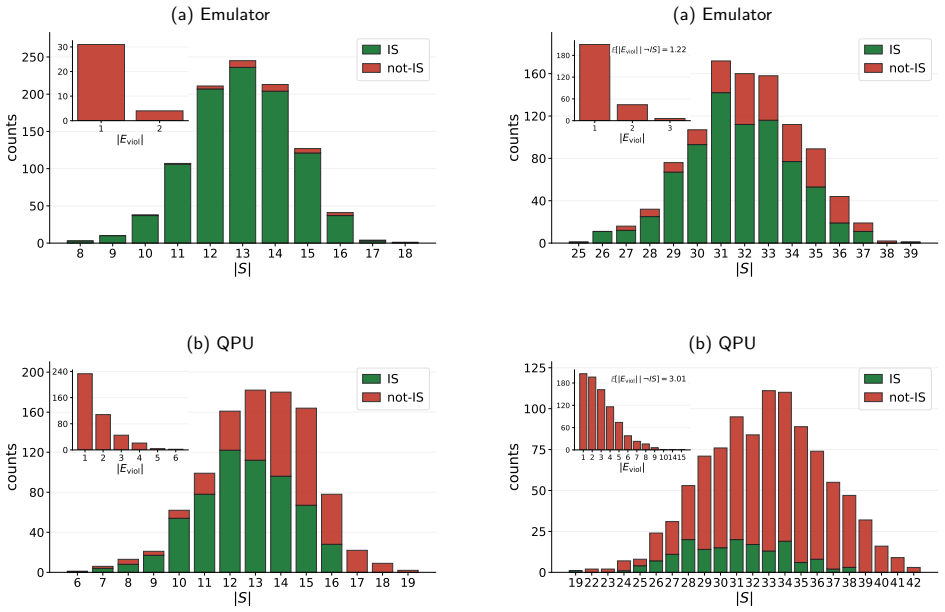
read the original abstract
We study the problem of emergency operation center placement in disaster response, where a minimal number of hubs must be selected to ensure timely coverage of all affected locations. This task can be formulated as a minimum dominating set problem on a graph encoding reachability within a target response time. We propose a hybrid quantum-classical approximation framework that leverages neutral-atom quantum computers as independent set samplers. Candidate dominating sets are constructed from both small maximal independent sets and complements of large independent sets, and are subsequently refined via a lightweight classical procedure. We benchmark the approach on synthetic instances and realistic case studies, and implement it on the Fresnel quantum processor by Pasqal, solving instances of up to 100 nodes. Our results show that quantum-generated samples, despite hardware noise, enable near-optimal solutions of the placement problem. Overall, our results demonstrate that neutral-atom devices operating in analog mode can already be used to tackle graph optimization problems for real-world applications.
Editorial analysis
A structured set of objections, weighed in public.
Referee Report
Summary. The paper formulates emergency hub placement as a minimum dominating set problem on a reachability graph and proposes a hybrid quantum-classical solver that uses a neutral-atom device (Pasqal Fresnel) in analog mode to sample independent sets. Candidate dominating sets are built from small maximal independent sets and complements of large independent sets, then refined by a lightweight classical procedure. The approach is tested on synthetic graphs and realistic instances up to 100 nodes; the abstract asserts that the quantum samples yield near-optimal solutions despite hardware noise and that analog neutral-atom hardware is already usable for real-world graph optimization.
Significance. If the central empirical claim holds with adequate quantitative support, the work would provide concrete evidence that current-generation analog neutral-atom processors can supply useful samples for a practically relevant combinatorial problem, thereby strengthening the case for near-term hybrid quantum-classical pipelines in disaster-response logistics.
major comments (2)
- [Abstract] Abstract: the claim that 'quantum-generated samples, despite hardware noise, enable near-optimal solutions' is presented without any reported metrics on independent-set validity rates, sample-size distributions, diversity relative to classical samplers, or direct comparison of final dominating-set quality against purely classical baselines; this quantitative gap is load-bearing for the attribution of performance to the quantum sampler rather than the classical refinement step.
- [Results] Results (implementation on Fresnel): no error analysis, acceptance-rate statistics, or ablation isolating the contribution of the quantum samples versus the classical post-processing is supplied for the 100-node instances, leaving the weakest assumption—that the noisy samples remain sufficiently diverse and high-quality—unsupported by the data shown.
minor comments (2)
- [Methods] Notation for the construction of dominating-set candidates from maximal independent sets and their complements should be made explicit with a short pseudocode block or equation set.
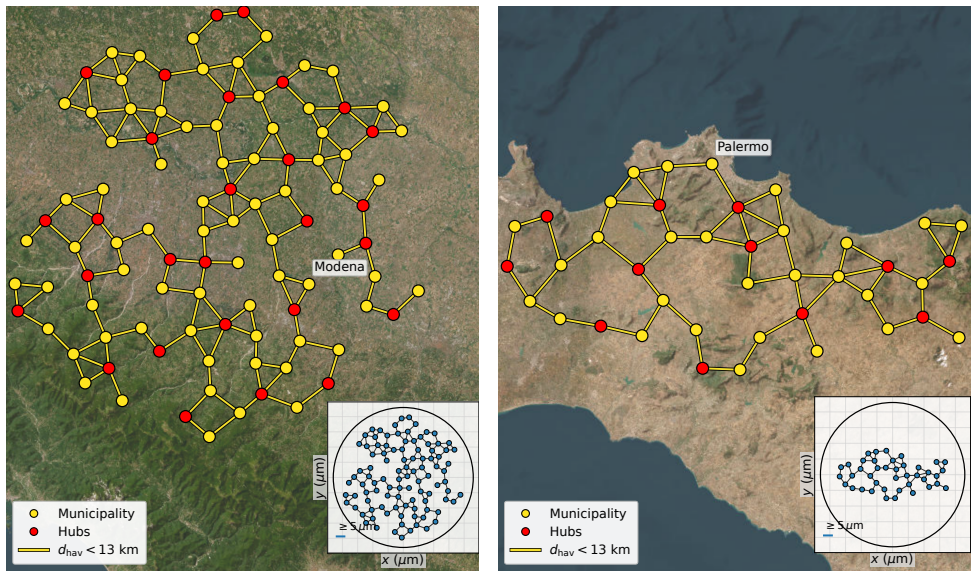
- [Figures] Figure captions for the realistic case-study graphs should include the number of nodes, edge density, and target response-time threshold used to build the reachability graph.
Simulated Author's Rebuttal
We thank the referee for the constructive comments, which highlight important aspects of quantitative validation. We address each major comment below and will revise the manuscript accordingly to strengthen the empirical support for our claims.
read point-by-point responses
-
Referee: [Abstract] Abstract: the claim that 'quantum-generated samples, despite hardware noise, enable near-optimal solutions' is presented without any reported metrics on independent-set validity rates, sample-size distributions, diversity relative to classical samplers, or direct comparison of final dominating-set quality against purely classical baselines; this quantitative gap is load-bearing for the attribution of performance to the quantum sampler rather than the classical refinement step.
Authors: We agree that the abstract's claim would benefit from explicit supporting metrics. In the revised version we will add a concise statement summarizing independent-set validity rates observed on the device, sample diversity, and a direct comparison of final dominating-set quality obtained with and without the quantum-generated candidates (i.e., using only the classical refinement step on random or greedy seeds). This will make the attribution to the quantum sampler explicit while remaining within the abstract's length constraints. revision: yes
-
Referee: [Results] Results (implementation on Fresnel): no error analysis, acceptance-rate statistics, or ablation isolating the contribution of the quantum samples versus the classical post-processing is supplied for the 100-node instances, leaving the weakest assumption—that the noisy samples remain sufficiently diverse and high-quality—unsupported by the data shown.
Authors: We acknowledge that the current Results section lacks a dedicated error analysis, acceptance-rate statistics, and an ablation study for the 100-node instances. We will add these elements—either in the main text or as a supplementary section—reporting device-level acceptance rates, an error breakdown for the largest graphs, and an ablation that compares the hybrid pipeline against the classical post-processing applied to purely classical independent-set samples of comparable size. This will directly address the concern that the observed performance may be driven solely by the refinement step. revision: yes
Circularity Check
No circularity: quantum samples function as external input to classical post-processing on external benchmarks
full rationale
The derivation chain treats neutral-atom analog-mode output as an independent sampler whose samples feed a separate classical refinement step; performance is evaluated on synthetic and realistic instances that are not generated by the method itself. No equation reduces a claimed prediction to a fitted parameter by construction, no uniqueness theorem is imported from prior self-work, and no ansatz is smuggled via self-citation. The framework is therefore self-contained against external benchmarks rather than internally tautological.
Axiom & Free-Parameter Ledger
Reference graph
Works this paper leans on
-
[1]
Understanding quantum tech- nologies 2025
Olivier Ezratty. “Understanding quantum tech- nologies 2025” (2025). arXiv:2111.15352
-
[2]
Quantum computing optimization: An in- troduction
Alejandro Giraldo-Quintero, Daniel Sierra- Sosa, Ibrahim Imam, and Adel S. Elmaghraby. “Quantum computing optimization: An in- troduction”. IEEE Access14, 63363– 63393 (2026)
2026
-
[3]
Challenges and opportuni- ties in quantum optimization
Amira Abbas, Andris Ambainis, Brandon Au- gustino, Andreas Bärtschi, Harry Buhrman, Carleton Coffrin, Giorgio Cortiana, Vedran Dunjko, Daniel J. Egger, Bruce G. Elmegreen, Nicola Franco, Filippo Fratini, Bryce Fuller, Julien Gacon, Constantin Gonciulea, Sander Gribling, Swati Gupta, Stuart Hadfield, Raoul Heese, Gerhard Kircher, Thomas Kleinert, Thorsten ...
2024
-
[4]
Quantum computers
T. D. Ladd, F. Jelezko, R. Laflamme, Y . Naka- mura, C. Monroe, and J. L. O’Brien. “Quantum computers”. Nature464, 45–53 (2010)
2010
-
[5]
An elementary review on basic principles and developments of qubits for quantum comput- ing
Eunmi Chae, Joonhee Choi, and Junki Kim. “An elementary review on basic principles and developments of qubits for quantum comput- ing”. Nano Convergence11, 11 (2024)
2024
-
[6]
Quantum computation and quantum informa- tion: 10th anniversary edition
Michael A. Nielsen and Isaac L. Chuang. “Quantum computation and quantum informa- tion: 10th anniversary edition”. Cambridge University Press. (2010)
2010
-
[7]
Adia- batic quantum computation
Tameem Albash and Daniel A. Lidar. “Adia- batic quantum computation”. Reviews of Mod- ern Physics90(2018)
2018
-
[8]
Quantum annealing for industry applications: introduction and re- view
Sheir Yarkoni, Elena Raponi, Thomas Bäck, and Sebastian Schmitt. “Quantum annealing for industry applications: introduction and re- view”. Reports on Progress in Physics85, 104001 (2022)
2022
-
[9]
Neutral atom quantum computing hardware: performance and end-user per- spective
Karen Wintersperger, Florian Dommert, Thomas Ehmer, Andrey Hoursanov, Johannes Klepsch, Wolfgang Mauerer, Georg Reuber, Thomas Strohm, Ming Yin, and Sebastian Luber. “Neutral atom quantum computing hardware: performance and end-user per- spective”. EPJ Quantum Technology10, 32 (2023)
2023
-
[10]
Quantum computing with neutral atoms
Tommaso Macrì. “Quantum computing with neutral atoms”. Pages 25–31. Springer Nature Switzerland. Cham (2026)
2026
-
[11]
Logical quantum processor based on reconfigurable atom arrays
Dolev Bluvstein, Simon J. Evered, Alexan- dra A. Geim, Sophie H. Li, Hengyun Zhou, Tom Manovitz, Sepehr Ebadi, Madelyn Cain, Marcin Kalinowski, Dominik Hangleiter, J. Pablo Bonilla Ataides, Nishad Maskara, Iris Cong, Xun Gao, Pedro Sales Rodriguez, Thomas Karolyshyn, Giulia Semeghini, Michael J. Gul- lans, Markus Greiner, Vladan Vuleti ´c, and Mikhail D. ...
2024
-
[12]
Quantum computing with neutral atoms
Loïc Henriet, Lucas Beguin, Adrien Signoles, Thierry Lahaye, Antoine Browaeys, Georges- Olivier Reymond, and Christophe Jurczak. “Quantum computing with neutral atoms”. Quantum4, 327 (2020)
2020
-
[13]
Many- body physics with individually controlled Ry- dberg atoms
Antoine Browaeys and Thierry Lahaye. “Many- body physics with individually controlled Ry- dberg atoms”. Nature Physics16, 132– 142 (2020)
2020
-
[14]
Controlling quantum many-body dynamics in driven rydberg atom arrays
D. Bluvstein, A. Omran, H. Levine, A. Keesling, G. Semeghini, S. Ebadi, T. T. Wang, A. A. Michailidis, N. Maskara, W. W. Ho, S. Choi, M. Serbyn, M. Greiner, V . Vuleti´c, and M. D. Lukin. “Controlling quantum many-body dynamics in driven rydberg atom arrays”. Science371, 1355–1359 (2021)
2021
-
[15]
Dipole blockade and quantum information processing in mesoscopic atomic ensembles
M. D. Lukin, M. Fleischhauer, R. Cote, L. M. Duan, D. Jaksch, J. I. Cirac, and P. Zoller. “Dipole blockade and quantum information processing in mesoscopic atomic ensembles”. Phys. Rev. Lett.87, 037901 (2001)
2001
-
[16]
Observation of Rydberg blockade between two atoms
E. Urban, T. A. Johnson, T. Henage, L. Isen- hower, D. D. Yavuz, T. G. Walker, and M. Saffman. “Observation of Rydberg blockade between two atoms”. Nature Physics5, 110– 114 (2009). 12
2009
-
[17]
Quantum information with rydberg atoms
M. Saffman, T. G. Walker, and K. Mølmer. “Quantum information with rydberg atoms”. Rev. Mod. Phys.82, 2313–2363 (2010)
2010
-
[19]
Quantum optimization of maximum indepen- dent set using rydberg atom arrays
S. Ebadi, A. Keesling, M. Cain, T. T. Wang, H. Levine, D. Bluvstein, G. Semeghini, A. Om- ran, J.-G. Liu, R. Samajdar, X.-Z. Luo, B. Nash, X. Gao, B. Barak, E. Farhi, S. Sachdev, N. Gemelke, L. Zhou, S. Choi, H. Pichler, S.-T. Wang, M. Greiner, V . Vuleti´c, and M. D. Lukin. “Quantum optimization of maximum indepen- dent set using rydberg atom arrays”. Sc...
2022
-
[20]
Solving the independent domination problem by the quan- tum approximate optimization algorithm
Haoqian Pan and Changhong Lu. “Solving the independent domination problem by the quan- tum approximate optimization algorithm”. En- tropy26(2024)
2024
-
[21]
Auxiliary-qubit-free quan- tum approximate optimization algorithm for the minimum dominating set problem
Guanghui Li, Xiaohui Ni, Junjian Su, Sujuan Qin, Fenzhuo Guo, Bingjie Xu, Wei Huang, and Fei Gao. “Auxiliary-qubit-free quan- tum approximate optimization algorithm for the minimum dominating set problem”. Chinese Physics B35, 050304 (2026)
2026
-
[22]
A Quantum Approximate Optimization Algorithm
Edward Farhi, Jeffrey Goldstone, and Sam Gut- mann. “A quantum approximate optimization algorithm” (2014). arXiv:1411.4028
work page internal anchor Pith review Pith/arXiv arXiv 2014
-
[23]
Simple heuristics for unit disk graphs
M. V . Marathe, H. Breu, H. B. Hunt III, S. S. Ravi, and D. J. Rosenkrantz. “Simple heuristics for unit disk graphs”. Networks25, 59–68 (1995). arXiv:https://onlinelibrary.wiley.com/doi/pdf/10.1002/net.3230250205
-
[24]
Fundamentals of domination in graphs
Teresa W. Haynes, Stephen T. Hedetniemi, and Peter J. Slater. “Fundamentals of domination in graphs” (1998)
1998
-
[25]
In- dependent domination in graphs: A survey and recent results
Wayne Goddard and Michael A. Henning. “In- dependent domination in graphs: A survey and recent results”. Discrete Mathematics313, 839– 854 (2013)
2013
-
[26]
Independent domination of graphs with bounded maximum degree
Eun-Kyung Cho, Jinha Kim, Minki Kim, and Sang il Oum. “Independent domination of graphs with bounded maximum degree”. Jour- nal of Combinatorial Theory, Series B158, 341–352 (2023)
2023
-
[27]
Help from the sky: Leveraging uavs for disaster manage- ment
Milan Erdelj, Enrico Natalizio, Kaushik R. Chowdhury, and Ian F. Akyildiz. “Help from the sky: Leveraging uavs for disaster manage- ment”. IEEE Pervasive Computing16, 24– 32 (2017)
2017
-
[28]
The use of unmanned aerial vehicles for disaster management
Ged F. Griffin. “The use of unmanned aerial vehicles for disaster management”. Geomatica 68, 264–280 (2014)
2014
-
[29]
Applications of drone in disaster management: A scoping review
Sharifah Mastura Syed Mohd Daud, Mohd Yus- miaidil Putera Mohd Yusof, Chong Chin Heo, Lay See Khoo, Mansharan Kaur Chainchel Singh, Mohd Shah Mahmood, and Hapizah Nawawi. “Applications of drone in disaster management: A scoping review”. Science & Justice62, 30–42 (2022)
2022
-
[30]
Com- puters and intractability; a guide to the theory of np-completeness
Michael R. Garey and David S. Johnson. “Com- puters and intractability; a guide to the theory of np-completeness”. W. H. Freeman & Co. USA (1990)
1990
-
[31]
Reducibility among com- binatorial problems
Richard M. Karp. “Reducibility among com- binatorial problems”. Pages 85–103. Springer US. Boston, MA (1972)
1972
-
[32]
Combina- torial optimization: Theory and algorithms
B. H. Korte and Jens Vygen. “Combina- torial optimization: Theory and algorithms”. Springer-Verlag. New York, NY (2012)
2012
-
[33]
A measure & conquer ap- proach for the analysis of exact algorithms
Fedor V . Fomin, Fabrizio Grandoni, and Di- eter Kratsch. “A measure & conquer ap- proach for the analysis of exact algorithms”. J. ACM56(2009)
2009
-
[34]
Mdsa: A dy- namic and greedy approach to solve the min- imum dominating set problem
Fatih Okumu¸ s and ¸ Seyda Karcı. “Mdsa: A dy- namic and greedy approach to solve the min- imum dominating set problem”. Applied Sci- ences14(2024)
2024
-
[35]
A fast local search algorithm for minimum weight dominating set problem on massive graphs
Yiyuan Wang, Shaowei Cai, Jiejiang Chen, and Minghao Yin. “A fast local search algorithm for minimum weight dominating set problem on massive graphs”. In Proceedings of the Twenty- Seventh International Joint Conference on Arti- ficial Intelligence, IJCAI-18. Pages 1514–1522. International Joint Conferences on Artificial In- telligence Organization (2018)
2018
-
[36]
An efficient local search algorithm with large neighborhoods for the maximum weighted independent set problem
K. Haraguchi, H. Hashimoto, J. Itoyanagi, and M. Yagiura. “An efficient local search algorithm with large neighborhoods for the maximum weighted independent set problem” (2019)
2019
-
[37]
An iterated greedy al- gorithm for finding the minimum dominating 13 set in graphs
A. Casado, S. Bermudo, A.D. López-Sánchez, and J. Sánchez-Oro. “An iterated greedy al- gorithm for finding the minimum dominating 13 set in graphs”. Mathematics and Computers in Simulation207, 41–58 (2023)
2023
-
[38]
A dual-mode local search algorithm for solving the minimum dominating set problem
Enqiang Zhu, Yu Zhang, Shengzhi Wang, Dar- ren Strash, and Chanjuan Liu. “A dual-mode local search algorithm for solving the minimum dominating set problem”. Knowledge-Based Systems298, 111950 (2024)
2024
-
[39]
Numds: An efficient local search algorithm for minimum dominating set problem
Rui Sun, Zhaohui Liu, Yiyuan Wang, Han Xiao, Jiangnan Li, and Jiejiang Chen. “Numds: An efficient local search algorithm for minimum dominating set problem”. In James Kwok, editor, Proceedings of the Thirty-Fourth Inter- national Joint Conference on Artificial Intelli- gence, IJCAI-25. Pages 8966–8976. Inter- national Joint Conferences on Artificial Intel...
2025
-
[40]
Application of graph domination to defend medical information net- works against cyber threats
Angel Dharmakkan. “Application of graph domination to defend medical information net- works against cyber threats”. Journal of Ambi- ent Intelligence and Humanized Computing13, 3765–3770 (2022)
2022
-
[41]
Applied graph theory to security: A qual- itative placement of security solutions within iot networks
Tanguy Godquin, Morgan Barbier, Chrystel Gaber, Jean-Luc Grimault, and Jean-Marie Le Bars. “Applied graph theory to security: A qual- itative placement of security solutions within iot networks”. Journal of Information Security and Applications55, 102640 (2020)
2020
-
[42]
A new algorithm for finding a dominating set in wireless sensor and iot networks based on the wait-before-starting concept
Madani Bezoui, Ahcene Bounceur, Reinhardt Euler, Farid Lalem, and Laouid Abdelkader. “A new algorithm for finding a dominating set in wireless sensor and iot networks based on the wait-before-starting concept”. In 2017 IEEE SENSORS. Pages 1–3. (2017)
2017
-
[43]
Causes and impacts of flood events in emilia-romagna (italy) in may 2023
Letizia Cremonini, Pierluigi Randi, Massim- iliano Fazzini, Marianna Nardino, Federica Rossi, and Teodoro Georgiadis. “Causes and impacts of flood events in emilia-romagna (italy) in may 2023”. Land13, 1800 (2024)
2023
-
[44]
geojson-italy: Geojson and topo- json boundaries for italian municipalities (de- rived from istat administrative limits)
openpolis. “geojson-italy: Geojson and topo- json boundaries for italian municipalities (de- rived from istat administrative limits)”. GitHub repository (2023)
2023
-
[45]
Exploring network structure, dynamics, and function using networkx
Aric Hagberg, Pieter Swart, and Daniel Chult. “Exploring network structure, dynamics, and function using networkx”. Proceedings of the 7th Python in Science Conference (2008)
2008
-
[46]
Quantum Optimization for Maximum Independent Set Using Rydberg Atom Arrays
Hannes Pichler, Sheng-Tao Wang, Leo Zhou, Soonwon Choi, and Mikhail D. Lukin. “Quantum optimization for maximum indepen- dent set using rydberg atom arrays” (2018). arXiv:1808.10816
work page internal anchor Pith review Pith/arXiv arXiv 2018
-
[47]
Pierre Cazals, Aymeric François, Loïc Hen- riet, Lucas Leclerc, Malory Marin, Yassine Naghmouchi, Wesley da Silva Coelho, Flo- rian Sikora, Vittorio Vitale, Rémi Watrig- ant, Monique Witt Garzillo, and Constantin Dalyac. “Identifying hard native instances for the maximum independent set problem on neutral atoms quantum processors” (2025). arXiv:2502.04291
-
[48]
Quantum compilation toolkit for rydberg atom arrays with implications for prob- lem hardness and quantum speedups
Martin J. A. Schuetz, Ruben S. Andrist, Grant Salton, Romina Yalovetzky, Rudy Ray- mond, Yue Sun, Atithi Acharya, Shouvanik Chakrabarti, Marco Pistoia, and Helmut G. Katzgraber. “Quantum compilation toolkit for rydberg atom arrays with implications for prob- lem hardness and quantum speedups”. Phys. Rev. Res.7, 033107 (2025)
2025
-
[49]
Graph algorithms with neutral atom quantum proces- sors
Constantin Dalyac, Lucas Leclerc, Louis Vig- noli, Mehdi Djellabi, Wesley da Silva Coelho, Bruno Ximenez, Alexandre Dareau, Davide Dreon, Vincent E. Elfving, Adrien Signoles, Louis-Paul Henry, and Loïc Henriet. “Graph algorithms with neutral atom quantum proces- sors”. The European Physical Journal A60, 177 (2024)
2024
-
[50]
Industry applications of neutral-atom quantum comput- ing solving independent set problems
Jonathan Wurtz, Pedro L. S. Lopes, Christoph Gorgulla, Nathan Gemelke, Alexander Keesling, and Shengtao Wang. “Industry applications of neutral-atom quantum comput- ing solving independent set problems” (2022). arXiv:2205.08500
-
[51]
Benchmarking neutral atom-based quantum processors at scale
Andrea B. Rava, Kristel Michielsen, and J. A. Montanez-Barrera. “Benchmarking neutral atom-based quantum processors at scale” (2025). arXiv:2511.22967
-
[52]
Unit disk graph recognition is np-hard
Heinz Breu and David G. Kirkpatrick. “Unit disk graph recognition is np-hard”. Computa- tional Geometry9, 3–24 (1998)
1998
-
[53]
Neural-powered unit disk graph embedding: qubits connectivity for some qubo problems
Chiara Vercellino, Paolo Viviani, Giacomo Vitali, Alberto Scionti, Andrea Scarabosio, Olivier Terzo, Edoardo Giusto, and Bartolomeo Montrucchio. “Neural-powered unit disk graph embedding: qubits connectivity for some qubo problems”. In 2022 IEEE International Confer- ence on Quantum Computing and Engineering (QCE). Pages 186–196. (2022). 14
2022
-
[54]
Approximate combina- torial optimization with rydberg atoms: The barrier of interpretability
Christian de Correc, Thomas Ayral, and Corentin Bertrand. “Approximate combina- torial optimization with rydberg atoms: The barrier of interpretability”. Physical Review A112(2025)
2025
-
[55]
Pulser: An open-source package for the design of pulse se- quences in programmable neutral-atom arrays
Henrique Silvério, Sebastián Grijalva, Con- stantin Dalyac, Lucas Leclerc, Peter J. Kar- alekas, Nathan Shammah, Mourad Beji, Louis- Paul Henry, and Loïc Henriet. “Pulser: An open-source package for the design of pulse se- quences in programmable neutral-atom arrays”. Quantum6, 629 (2022)
2022
-
[56]
Ibm ilog cplex 12.7 user’s manual
IBM ILOG CPLEX Division. “Ibm ilog cplex 12.7 user’s manual”. IBM Corporation. Incline Village, NV . (2017). 15
2017
discussion (0)
Sign in with ORCID, Apple, or X to comment. Anyone can read and Pith papers without signing in.