REVIEW 3 major objections 2 minor 2 cited by
Machine-learned prediction of carbon interstitial clusters in diamond
T0 review · 3 major / 2 minor · reviewed 2026-06-26 · grok-4.3
Pith's one-line read MACE machine-learning potential matches DFT for carbon interstitials in diamond and enables discovery of new clusters whose metastability follows kinetic pathways.
desk verdict MACE beats the other two potentials on known interstitial data and the MD turns up new clusters, but those new structures still need DFT checks to make the discovery claim stick. read the letter →
The pith
A machine-rendered reading of the paper's core claim, the machinery that carries it, and where it could break.
The reading
What carries the argument
The equivariant MACE machine-learning interatomic potential, validated on DFT energies, forces and barriers, then used to drive annealing molecular-dynamics trajectories that explore interstitial configurational space.
What would settle it
Direct DFT calculation of an interstitial cluster whose energy is lower than any structure found by the MACE annealing trajectories, or confirmation that MACE misorders a ground-state energy relative to DFT, would falsify the claim that the landscape has been reliably charted.
Extended reading notes
Core claim
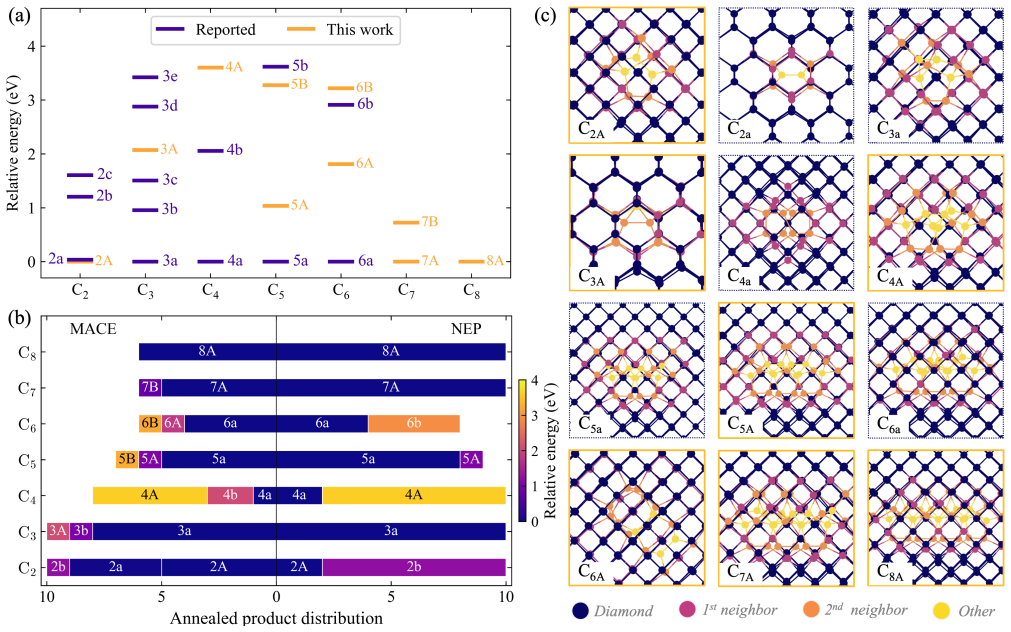
An active-learning procedure yields a dataset that trains the equivariant MACE potential to reproduce DFT reference energetics and migration barriers for carbon interstitials in diamond; subsequent annealing molecular-dynamics trajectories then locate new di-, tri-, tetra-, penta-, hexa- and octa-interstitial configurations, some of which introduce in-gap states, establishing that observed metastability is controlled by kinetically accessible pathways rather than thermodynamic ordering.
Load-bearing premise
The active-learning dataset and trained potentials are assumed complete enough that molecular-dynamics trajectories locate all relevant new minima and paths without missing lower-energy structures or introducing artifacts outside the training distribution.
Editorial extensions
If this is right
- A series of previously unreported carbon interstitial clusters ranging from di- to octa-interstitials are identified.
- Several of the new clusters introduce in-gap states that may function as colour centres.
- Metastability of the clusters is governed by kinetically accessible migration pathways rather than by energetic ordering alone.
- The validated workflow accelerates mapping of interstitial defects relevant to quantum-technology applications.
Reading between the lines
- The same active-learning-plus-annealing protocol could be applied to interstitial defects in other wide-bandgap host materials used for quantum devices.
- Because stability is set by accessible kinetics, processing conditions such as temperature ramps or irradiation dose rates could be tuned to favour particular clusters.
- In-gap states from these clusters may either enhance or compete with the optically active defects already targeted in diamond-based quantum sensors.
Editorial analysis
A structured set of objections, weighed in public.
Referee Report
Summary. The paper constructs an active-learning dataset focused on carbon interstitials in diamond and benchmarks three ML interatomic potentials (GAP, NEP, MACE) against DFT reference data for energies, forces, and migration barriers. MACE is shown to best reproduce relative stabilities. Annealing MD simulations with the validated potentials are then used to identify previously unreported di- to octa-interstitial clusters, several of which introduce in-gap states, with the conclusion that metastability is controlled by kinetic accessibility rather than ground-state energetics.
Significance. If the transferability of the potentials to unseen cluster configurations holds, the work would provide a practical route to mapping the configurational landscape of self-interstitial defects in diamond, directly relevant to identifying candidate colour centres for quantum technologies. The explicit comparison of three potentials and the emphasis on kinetic pathways are useful contributions.
major comments (3)
- [MD results section] § on MD discovery and validation: the central claim that annealing MD uncovers previously unreported clusters whose metastability is kinetically governed rests on the potentials remaining accurate outside the active-learning distribution. No DFT single-point calculations or additional benchmarks are reported for the newly discovered di- to octa-interstitial configurations, leaving open the possibility that spurious minima or incorrect relative energies are being reported.
- [Benchmarking section] Benchmarking section: performance metrics (energies, forces, barriers) are shown only for configurations that appear to lie within or near the active-learning dataset. No explicit out-of-distribution test set (e.g., larger clusters or topologically distinct arrangements) is used to quantify extrapolation error before the MD trajectories are interpreted as physical discoveries.
- [Methods / active learning] Active-learning protocol: the paper does not state pre-specified convergence criteria or data-exclusion rules for the active-learning loop; without these, it is difficult to assess whether the dataset is demonstrably complete for the larger clusters later explored by MD.
minor comments (2)
- [Figure captions] Figure captions for the MD trajectories should explicitly state the simulation cell size, temperature schedule, and number of independent runs to allow reproducibility assessment.
- [Introduction / results] Notation for interstitial cluster sizes (di-, tri-, octa-) should be defined once in the main text rather than only in figure legends.
Simulated Author's Rebuttal
We thank the referee for their constructive and detailed comments. These have helped us identify areas where additional clarification and validation will strengthen the manuscript. We address each major comment below and will incorporate the suggested improvements in the revised version.
read point-by-point responses
-
Referee: [MD results section] § on MD discovery and validation: the central claim that annealing MD uncovers previously unreported clusters whose metastability is kinetically governed rests on the potentials remaining accurate outside the active-learning distribution. No DFT single-point calculations or additional benchmarks are reported for the newly discovered di- to octa-interstitial configurations, leaving open the possibility that spurious minima or incorrect relative energies are being reported.
Authors: We agree that direct DFT validation on the newly discovered clusters would provide stronger support for the physical interpretation of the MD results. The active-learning procedure was constructed to sample a wide variety of interstitial environments, and MACE's demonstrated accuracy on migration barriers and relative stabilities within the benchmark set gives us confidence in its extrapolation. In the revised manuscript we will add DFT single-point calculations on a representative subset of the new di- to octa-interstitial configurations to quantify any residual extrapolation error. revision: yes
-
Referee: [Benchmarking section] Benchmarking section: performance metrics (energies, forces, barriers) are shown only for configurations that appear to lie within or near the active-learning dataset. No explicit out-of-distribution test set (e.g., larger clusters or topologically distinct arrangements) is used to quantify extrapolation error before the MD trajectories are interpreted as physical discoveries.
Authors: The reported test metrics were obtained on configurations held out from the active-learning iterations, which already span a range of cluster sizes and topologies. We nevertheless recognise the benefit of an explicit out-of-distribution evaluation. We will include a dedicated OOD test set of larger interstitial clusters and topologically distinct arrangements that were never seen during training or validation, together with the corresponding error statistics, to better characterise extrapolation behaviour before the MD results are presented. revision: yes
-
Referee: [Methods / active learning] Active-learning protocol: the paper does not state pre-specified convergence criteria or data-exclusion rules for the active-learning loop; without these, it is difficult to assess whether the dataset is demonstrably complete for the larger clusters later explored by MD.
Authors: We will revise the Methods section to provide the explicit convergence criteria used in the active-learning loop (including force and energy error thresholds that trigger new DFT calculations) and the precise rules governing data inclusion and exclusion. This will allow readers to evaluate the completeness of the dataset with respect to the cluster sizes subsequently explored by MD. revision: yes
Circularity Check
No significant circularity: new clusters are MD outputs on fitted potential, not redefinitions of training targets
full rationale
The paper constructs an active-learning dataset from DFT, fits MLIPs (GAP/NEP/MACE), validates them on energies/forces/barriers for reference interstitial configurations, and then runs annealing MD to locate additional minima. The headline result (previously unreported di- to octa-interstitial clusters and their kinetic metastability) is an output of the dynamics on the learned surface rather than a statistical re-expression of the fitted data points. No equation or claim reduces a prediction to an input by construction, no self-citation is invoked as a uniqueness theorem, and no ansatz is smuggled via prior work. The transferability concern raised by the skeptic is a correctness/robustness issue, not a circularity reduction.
Assumptions & free parameters
Cite this review
Pith. "Pith review of Machine-learned prediction of carbon interstitial clusters in diamond." pith.science (2026). https://pith.science/paper/2NN672YK
@misc{pith2026260619600,
  author       = {Pith},
  title        = {Pith review of: Machine-learned prediction of carbon interstitial clusters in diamond},
  year         = {2026},
  howpublished = {\url{https://pith.science/paper/2NN672YK}},
  note         = {Machine review of arXiv:2606.19600}
}
read the original abstract
Diamond hosts optically active point defects central to quantum technologies, yet the carbon self-interstitials introduced during growth and irradiation compete with them and form new defects whose configurational landscape is poorly charted, as subtle energy differences govern the competing minima and pathways. Here we build an interstitial-focused dataset by active learning and benchmark three machine-learning interatomic potentials -- GAP, NEP and the equivariant MACE -- against density functional theory for energies, forces and migration barriers. MACE reproduces the reference energetics and relative stabilities, whereas the others can misorder the ground states. Annealing molecular dynamics with the validated potentials uncovers a series of previously unreported carbon interstitial clusters, from di- to octa-interstitials -- several introducing in-gap states of interest as colour centres -- and shows that their metastability is governed by kinetically accessible pathways rather than energetic ordering. These results chart the interstitial defect landscape and accelerate defect discovery for quantum technologies.
Figures

Forward citations
Cited by 2 Pith papers
-
Dislocation-loop formation is a first-order phase transition
Dislocation-loop formation in diamond is a first-order phase transition driven ~98% by bond-energy reorganisation, modeled via Ginzburg-Landau theory with order parameter loop area and coefficients from ML atomistic s...
-
Dislocation-loop formation is a first-order phase transition
Carbon interstitials in diamond undergo a first-order phase transition to a prismatic ½⟨110⟩ dislocation loop, described by a Ginzburg–Landau free energy parameterized from atomistic simulation.
Reference graph
Works this paper leans on
-
[1]
& Tian, Y
Nie, A., Zhao, Z., Xu, B. & Tian, Y . Microstructure engineering in diamond-based materials.Nat. Mater.24, 1172–1185 (2025)
2025
-
[2]
& Neu, E
Aharonovich, I. & Neu, E. Diamond nanophotonics.Adv. Opt. Mater.2, 911–928 (2014)
2014
-
[3]
Yang, N.et al.Conductive diamond: synthesis, properties, and electrochemical applications.Chem. Soc. Rev.48, 157–204 (2019)
2019
-
[4]
T., Strong, H
Bundy, F., Hall, H. T., Strong, H. & Wentorfjun, R. Man-made diamonds.Nature176, 51–55 (1955)
1955
-
[5]
Balmer, R.et al.Chemical vapour deposition synthetic diamond: materials, technology and applications.J. Phys. Condens. Matter21, 364221 (2009)
2009
-
[6]
Németh, P.et al.Complex nanostructures in diamond. Nat. Mater.19, 1126–1131 (2020)
2020
-
[7]
A., Yu, G., Cao, J., He, S
Rakha, S. A., Yu, G., Cao, J., He, S. & Zhou, X. Influence of CH4 on the morphology of nanocrystalline diamond films deposited by ar rich microwave plasma.J. Appl. Phys.107(2010)
2010
-
[8]
J.et al.Nitrogen incorporated ultrananocrystalline diamond microstructures from bias-enhanced microwave N 2/CH4-plasma chemical vapor deposition.Plasma Process
Sankaran, K. J.et al.Nitrogen incorporated ultrananocrystalline diamond microstructures from bias-enhanced microwave N 2/CH4-plasma chemical vapor deposition.Plasma Process. Polym.13, 419–428 (2016)
2016
Show all 56 references
-
[9]
J.et al.Origin of conductive nanocrystalline diamond nanoneedles for optoelectronic applications
Sankaran, K. J.et al.Origin of conductive nanocrystalline diamond nanoneedles for optoelectronic applications. ACS Appl. Mater. & Interfaces11, 25388–25398 (2019)
2019
-
[10]
& Meijer, J
Pezzagna, S. & Meijer, J. Quantum computer based on color centers in diamond.Appl. Phys. Rev.8(2021)
2021
-
[11]
& Wrachtrup, J
Atatüre, M., Englund, D., Vamivakas, N., Lee, S.-Y . & Wrachtrup, J. Material platforms for spin-based photonic quantum technologies.Nat. Rev. Mater.3, 38–51 (2018)
2018
-
[12]
Aharonovich, I., Greentree, A. D. & Prawer, S. Diamond photonics.Nat. Photonics5, 397–405 (2011)
2011
-
[13]
& Gali, A
Pershin, A., Tárkányi, A., Verkhovlyuk, V ., Ivády, V . & Gali, A. A coherence-protection scheme for quantum sensors based on ultra-shallow single nitrogen-vacancy centers in diamond.Nat. Commun.16, 9797 (2025)
2025
-
[14]
N.et al.Nitrogen in diamond.Chem
Ashfold, M. N.et al.Nitrogen in diamond.Chem. Rev. 120, 5745–5794 (2020)
2020
-
[15]
Bézard, M.et al.Giant quantum electrodynamic effects on single SiV color centers in nanosized diamonds.ACS nano18, 6406–6412 (2024)
2024
-
[16]
B: Condens
Iakoubovskii, K.et al.Annealing of vacancies and interstitials in diamond.Phys. B: Condens. Matter340, 67–75 (2003)
2003
-
[17]
& Kertesz, M
Slepetz, B. & Kertesz, M. Divacancies in diamond: a stepwise formation mechanism.Phys. Chem. Chem. Phys. 16, 1515–1521 (2014)
2014
-
[18]
& Des.115422 (2026)
Dickmann, M.et al.Defect evolution in nitrogen-implanted CVD diamond during thermal annealing: The formation of NV centers and vacancy clusters.Mater. & Des.115422 (2026)
2026
-
[19]
Hunt, D.et al.Identification of the neutral carbon< 100>-split interstitial in diamond.Phys. Rev. B61, 3863 (2000)
2000
-
[20]
& Fisher, D
Kiflawi, I., Collins, A., Iakoubovskii, K. & Fisher, D. Electron irradiation and the formation of vacancy–interstitial pairs in diamond.J. Phys. Condens. Matter19, 046216 (2007)
2007
-
[21]
Naydenov, B.et al.Engineering single photon emitters by ion implantation in diamond.Appl. Phys. Lett.95 (2009)
2009
-
[22]
Foglszinger, J.et al.TR12 centers in diamond as a room temperature atomic scale vector magnetometer.npj Quantum Inf.8, 65 (2022)
2022
-
[23]
Foglszinger, J.et al.Discovery of ST2 centers in natural and CVD diamond.npj Quantum Inf.12, 42 (2026)
2026
-
[24]
G., Hashemi, A
Cherati, N. G., Hashemi, A. & Gali, Á. From mono-to hexa-interstitials: Computational insights into carbon defects in diamond.Phys. Rev. Res.8, 023088 (2026)
2026
-
[25]
J., Tutein, A
Stuart, S. J., Tutein, A. B. & Harrison, J. A. A reactive potential for hydrocarbons with intermolecular interactions.The J. Chem. Phys.112, 6472–6486 (2000)
2000
-
[26]
L., Gasparotto, P., Csányi, G
Rowe, P., Deringer, V . L., Gasparotto, P., Csányi, G. & Michaelides, A. An accurate and transferable machine learning potential for carbon.The J. Chem. Phys.153 (2020)
2020
-
[27]
Wang, Y ., Fan, Z., Qian, P., Caro, M. A. & Ala-Nissila, T. Density dependence of thermal conductivity in nanoporous and amorphous carbon with machine-learned molecular dynamics.Phys. Rev. B111, 094205 (2025)
2025
-
[28]
& Kohn, W
Hohenberg, P. & Kohn, W. Inhomogeneous electron gas. Phys. Rev.136, B864 (1964)
1964
-
[29]
Chen, G., Prentice, J. C. & Smith, J. M. Simulating the dynamics of NV− formation in diamond in the presence of carbon self-interstitials.npj Comput. Mater.11, 157 (2025). 8/9
2025
-
[30]
& Gali, A
Deák, P., Udvarhelyi, P., Thiering, G. & Gali, A. The kinetics of carbon pair formation in silicon prohibits reaching thermal equilibrium.Nat. Commun.14, 361 (2023)
2023
-
[31]
P., Payne, M
Bartók, A. P., Payne, M. C., Kondor, R. & Csányi, G. Gaussian approximation potentials: The accuracy of quantum mechanics, without the electrons.Phys. Rev. Lett.104, 136403 (2010)
2010
-
[32]
P., Kondor, R
Bartók, A. P., Kondor, R. & Csányi, G. On representing chemical environments.Phys. Rev. B87, 184115 (2013)
2013
-
[33]
Fan, Z.et al.Neuroevolution machine learning potentials: Combining high accuracy and low cost in atomistic simulations and application to heat transport.Phys. Rev. B104, 104309 (2021)
2021
-
[34]
GPUMD 4.0: a high-performance molecular dynamics package for versatile materials simulations with machine-learned potentials.Mater
Xu, K.et al. GPUMD 4.0: a high-performance molecular dynamics package for versatile materials simulations with machine-learned potentials.Mater. Genome Eng. Adv.3, e70028 (2025)
2025
-
[35]
P., Simm, G., Ortner, C
Batatia, I., Kovacs, D. P., Simm, G., Ortner, C. & Csányi, G. MACE: Higher order equivariant message passing neural networks for fast and accurate force fields.Adv. Neural Inf. Process. Syst.35, 11423–11436 (2022)
2022
-
[36]
P., Batatia, I., Arany, E
Kovács, D. P., Batatia, I., Arany, E. S. & Csanyi, G. Evaluation of the MACE force field architecture: from medicinal chemistry to materials science.The J. Chem. Phys.159(2023)
2023
-
[37]
Mater.11, 9 (2025)
Deng, B.et al.Systematic softening in universal machine learning interatomic potentials.npj Comput. Mater.11, 9 (2025)
2025
-
[38]
Fan, Z.et al.Combining linear-scaling quantum transport and machine-learning molecular dynamics to study thermal and electronic transports in complex materials.J. Phys. Condens. Matter36, 245901 (2024)
2024
-
[39]
GPUMD: a package for constructing accurate machine-learned potentials and performing highly efficient atomistic simulations.The J
Fan, Z.et al. GPUMD: a package for constructing accurate machine-learned potentials and performing highly efficient atomistic simulations.The J. Chem. Phys. 157(2022)
2022
-
[40]
P.et al.Python materials genomics (pymatgen): a robust, open-source python library for materials analysis
Ong, S. P.et al.Python materials genomics (pymatgen): a robust, open-source python library for materials analysis. Comput. Mater. Sci.68, 314–319 (2013)
2013
-
[41]
& Scuseria, G
Heyd, J. & Scuseria, G. E. Efficient hybrid density functional calculations in solids: assessment of the Heyd–Scuseria–Ernzerhof screened coulomb hybrid functional.The J. Chem. Phys.121, 1187–1192 (2004)
2004
-
[42]
R.et al.Exploiting chemistry and molecular systems for quantum information science.Nat
Wasielewski, M. R.et al.Exploiting chemistry and molecular systems for quantum information science.Nat. Rev. Chem.4, 490–504 (2020)
2020
-
[43]
The structure and mechanism of formation of platelets in natural type Ia diamond.Proc
Humble, P. The structure and mechanism of formation of platelets in natural type Ia diamond.Proc. Royal Soc. London. A. Math. Phys. Sci.381, 65–81 (1982)
1982
-
[44]
Twitchen, D.et al.Electron-paramagnetic-resonance measurements on the di-< 001>-split interstitial center (R1) in diamond.Phys. Rev. B54, 6988 (1996)
1996
-
[45]
& Anthony, T
Twitchen, D., Newton, M., Baker, J., Banholzer, W. & Anthony, T. Optical spin polarization in the di-< 001>-split interstitial (R1) centre in diamond.Diam. Relat. Mater.8, 1101–1106 (1999)
1999
-
[46]
Liu, Y ., He, X. & Mo, Y . Discrepancies and error evaluation metrics for machine learning interatomic potentials.npj Comput. Mater.9, 174 (2023)
2023
-
[47]
Ab initio simulations of materials using V ASP: density-functional theory and beyond.J
Hafner, J. Ab initio simulations of materials using V ASP: density-functional theory and beyond.J. Comput. Chem. 29, 2044–2078 (2008)
-
[48]
P., Burke, K
Perdew, J. P., Burke, K. & Ernzerhof, M. Generalized gradient approximation made simple.Phys. Rev. Lett.77, 3865 (1996)
1996
-
[49]
Kermode, J. R. f90wrap: an automated tool for constructing deep Python interfaces to modern Fortran codes.J. Phys. Condens. Matter .32, 305901 (2020)
2020
-
[50]
Caro, M. A. Optimizing many-body atomic descriptors for enhanced computational performance of machine learning based interatomic potentials.Phys. Rev. B100, 024112 (2019)
2019
-
[51]
H.et al.The atomic simulation environment—a python library for working with atoms
Larsen, A. H.et al.The atomic simulation environment—a python library for working with atoms. J. Phys. Condens. Matter29, 273002 (2017)
2017
-
[52]
A., Caro, M
Marchant, G. A., Caro, M. A., Karasulu, B. & Pártay, L. B. Exploring the configuration space of elemental carbon with empirical and machine learned interatomic potentials.npj Comput. Mater.9, 131 (2023)
2023
-
[53]
Luo, K.et al.Coherent interfaces govern direct transformation from graphite to diamond.Nature607, 486–491 (2022)
2022
-
[54]
P.et al.LAMMPS-a flexible simulation tool for particle-based materials modeling at the atomic, meso, and continuum scales.Comput
Thompson, A. P.et al.LAMMPS-a flexible simulation tool for particle-based materials modeling at the atomic, meso, and continuum scales.Comput. Phys. Commun. 271, 108171 (2022)
2022
-
[55]
Visualization and analysis of atomistic simulation data with ovito–the open visualization tool
Stukowski, A. Visualization and analysis of atomistic simulation data with ovito–the open visualization tool. Model. Simul. Mater. Sci. Eng.18, 015012 (2010)
2010
-
[56]
& Shao, J.-L
Wu, Y .-C. & Shao, J.-L. Mdapy: a flexible and efficient analysis software for molecular dynamics simulations. Comput. Phys. Commun.290, 108764 (2023). 9/9
2023
Reviewed June 26, 2026 · model on record in the stance chip above.
Discussion (0). Sign in to comment.