Sensitivity of the photon-induced processes to the proton radius
Pith reviewed 2026-06-26 19:48 UTC · model grok-4.3
The pith
Dilepton production in proton collisions shows non-trivial sensitivity to the proton radius through dipole form factor fits to ATLAS and CMS data.
A machine-rendered reading of the paper's core claim, the machinery that carries it, and where it could break.
Core claim
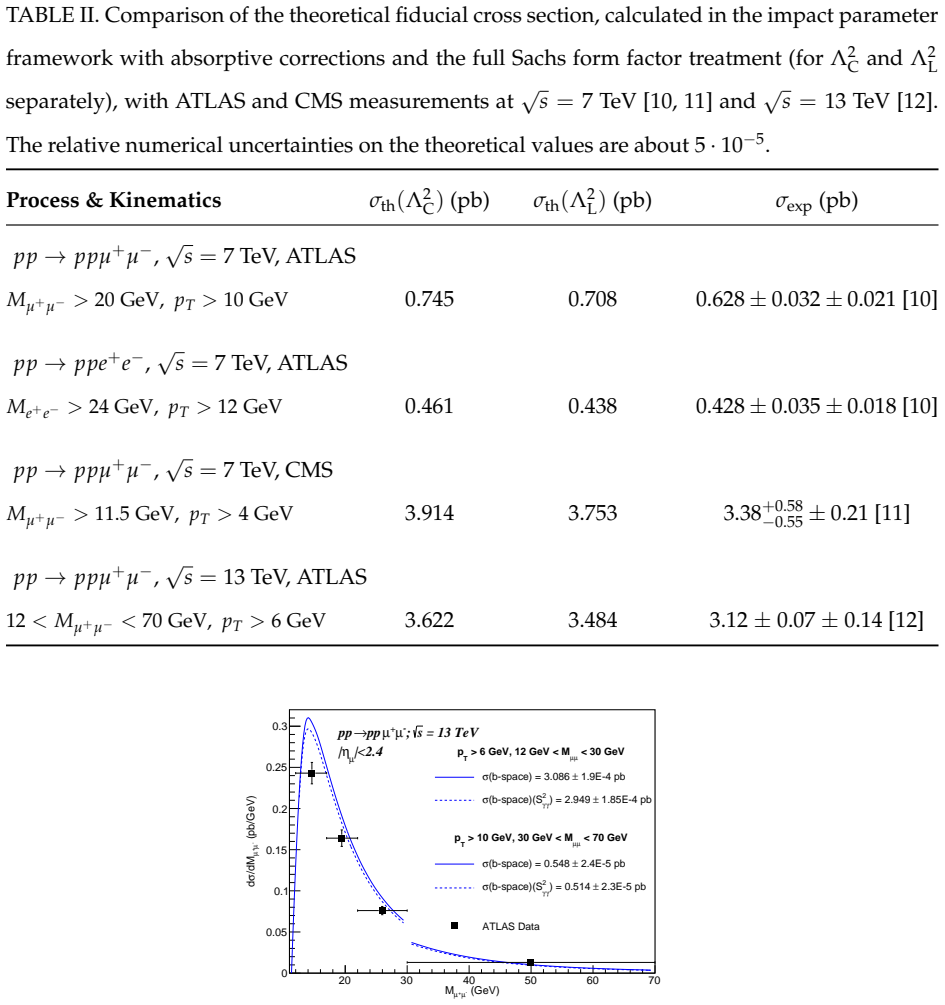
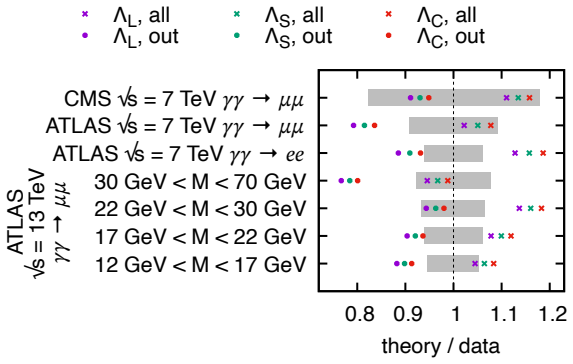
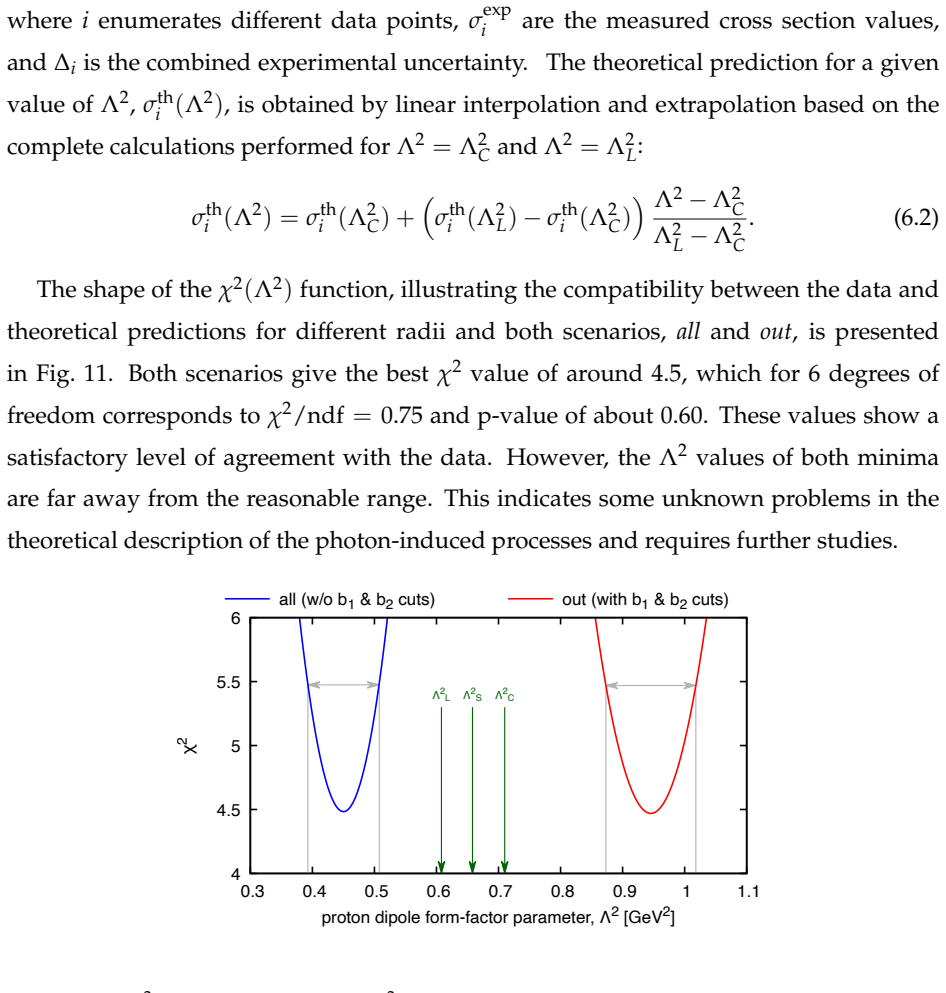
Using a dipole form factor model, the exclusive dilepton production cross section in proton-proton collisions exhibits sensitivity to the proton radius, with the greatest effect at large dilepton invariant masses and forward or backward rapidities. Fitting the current ATLAS and CMS data yields Λ² = 0.465 ± 0.056 GeV², corresponding to an effective radius rp = 1.002 ± 0.038 fm.
What carries the argument
The dipole form factor model with parameter Λ, which parametrizes the proton electromagnetic structure and controls the photon-induced dilepton amplitude.
If this is right
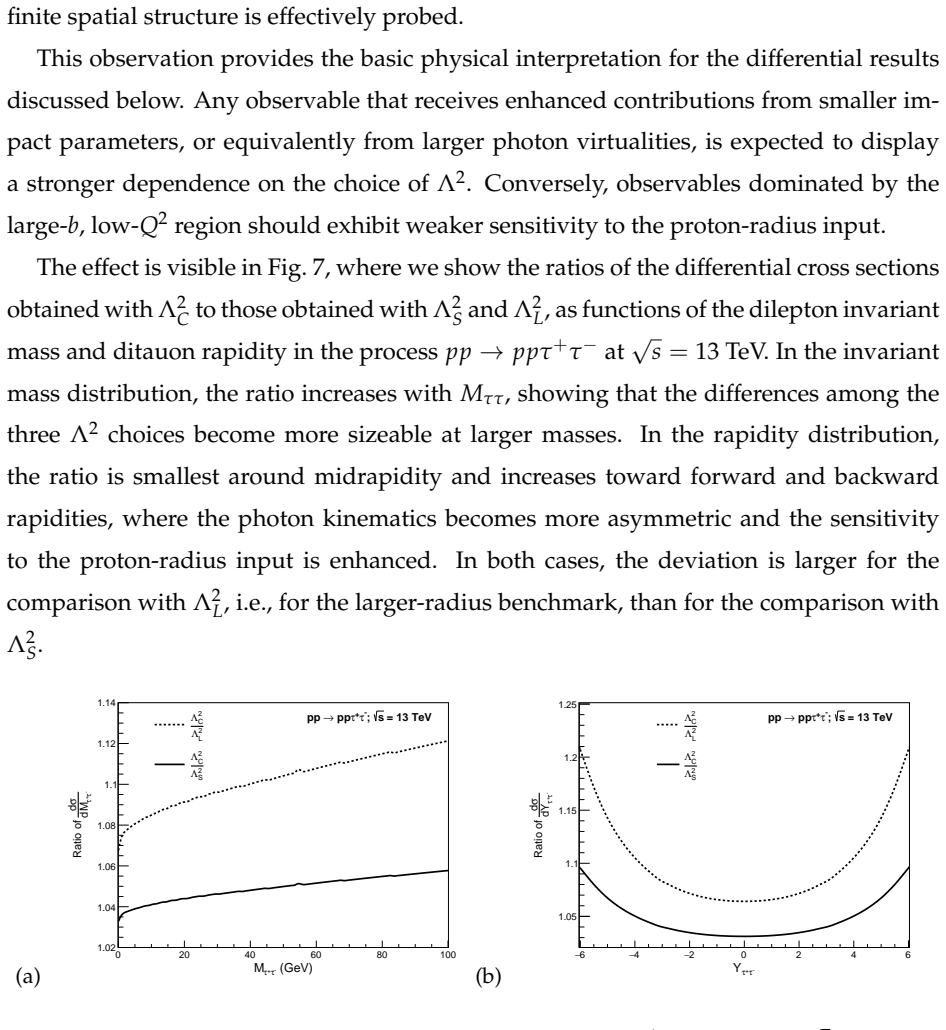
- The sensitivity peaks in the high-mass and forward-rapidity regions of phase space.
- Current LHC data already provide a non-zero constraint on the effective radius within the model.
- The extracted value lies outside the range of the two PDG test scenarios considered.
- Higher-precision data in the sensitive kinematic bins would tighten the radius constraint further.
Where Pith is reading between the lines
- Future runs with larger integrated luminosity could turn this into a competitive radius measurement.
- The same form-factor approach might be applied to other photon-induced final states at the LHC.
- Discrepancies between this effective radius and low-energy determinations could point to missing higher-order effects in the model.
Load-bearing premise
The single-parameter dipole form factor accurately captures the main dependence of the dilepton cross section on the proton radius across the measured kinematic range.
What would settle it
A new measurement of the dilepton cross section at high invariant mass and forward rapidity that falls well outside the band predicted by the fitted radius value of 1.002 fm would show the extracted sensitivity does not hold.
Figures
read the original abstract
We study the exclusive production of dileptons in proton--proton collisions as a probe of the proton radius. Using a dipole form factor model, we compare the conventional choice of $\Lambda^2=0.71$~GeV$^2$ with PDG test scenarios corresponding to $r_p=0.8751$~fm and $r_p=0.84087$~fm. The sensitivity is greatest at large dilepton invariant masses and forward/backward rapidity. Fitting to the current ATLAS and CMS data within the adopted model gives $\Lambda^2 = 0.465 \pm 0.056~\mathrm{GeV}^2$, corresponding to an effective radius $r_p = 1.002 \pm 0.038~\mathrm{fm}$, which indicates non-trivial sensitivity on the proton radius scale, but is not yet a definitive solution to the proton radius puzzle.
Editorial analysis
A structured set of objections, weighed in public.
Referee Report
Summary. The manuscript studies exclusive dilepton production in proton-proton collisions as a probe of the proton radius. Using a single-parameter dipole form factor F(Q²) = Λ²/(Λ² + Q²), it compares the conventional Λ² = 0.71 GeV² against PDG scenarios for rp = 0.8751 fm and rp = 0.84087 fm. The sensitivity is stated to be largest at high dilepton invariant mass and forward/backward rapidity. A fit to existing ATLAS and CMS data within this model yields Λ² = 0.465 ± 0.056 GeV², corresponding to an effective radius rp = 1.002 ± 0.038 fm, which the authors interpret as evidence of non-trivial sensitivity on the proton-radius scale while noting that current data do not yet resolve the proton-radius puzzle.
Significance. If the dipole model isolates the dominant radius dependence, the work provides a concrete numerical benchmark showing that LHC photon-induced dilepton data can constrain rp at the ~4% level. The explicit fit result with uncertainty and the identification of the most sensitive kinematic regions constitute a useful starting point for future dedicated measurements. The modest conclusion that the result is not yet definitive is appropriately cautious.
major comments (2)
- [Abstract] Abstract (fit result): The reported effective radius rp = 1.002 ± 0.038 fm is obtained by fitting the single free parameter Λ² directly to the ATLAS and CMS data whose sensitivity is being claimed. This makes the demonstration of sensitivity dependent on the untested assumption that the dipole form factor captures all relevant Q² dependence across the probed kinematics; without explicit robustness checks against alternative parametrizations or NLO effects, the extracted value cannot be cleanly attributed to the proton radius.
- [Abstract] Abstract (PDG comparison): The fit yields a value outside both tested PDG radii (0.8751 fm and 0.84087 fm), yet the significance of this discrepancy rests on the validity of the single-parameter dipole model. The manuscript provides no quantitative assessment of how changes in form-factor shape or unmodeled contributions would shift the extracted Λ², which is load-bearing for interpreting the result as a probe of rp rather than a model artifact.
minor comments (1)
- The abstract would benefit from a brief statement of the kinematic cuts, background treatment, and exact data sets entering the fit to improve reproducibility.
Simulated Author's Rebuttal
We thank the referee for the positive evaluation of the work's significance and for the constructive comments on the abstract. We respond point by point below, indicating planned revisions where appropriate.
read point-by-point responses
-
Referee: [Abstract] Abstract (fit result): The reported effective radius rp = 1.002 ± 0.038 fm is obtained by fitting the single free parameter Λ² directly to the ATLAS and CMS data whose sensitivity is being claimed. This makes the demonstration of sensitivity dependent on the untested assumption that the dipole form factor captures all relevant Q² dependence across the probed kinematics; without explicit robustness checks against alternative parametrizations or NLO effects, the extracted value cannot be cleanly attributed to the proton radius.
Authors: We agree that the extracted effective radius is obtained within the single-parameter dipole model and that the demonstration of sensitivity therefore rests on this assumption. The manuscript already qualifies the result as being 'within the adopted model' and states that it does not resolve the proton-radius puzzle. The primary aim is to show that existing data exhibit non-trivial sensitivity to the radius parameter at the few-percent level when analyzed in this standard framework. We will revise the abstract and add a short paragraph in the conclusions to further stress the model dependence and the desirability of future checks with alternative parametrizations. revision: partial
-
Referee: [Abstract] Abstract (PDG comparison): The fit yields a value outside both tested PDG radii (0.8751 fm and 0.84087 fm), yet the significance of this discrepancy rests on the validity of the single-parameter dipole model. The manuscript provides no quantitative assessment of how changes in form-factor shape or unmodeled contributions would shift the extracted Λ², which is load-bearing for interpreting the result as a probe of rp rather than a model artifact.
Authors: The fact that the fitted value lies outside the two PDG scenarios is presented only as an illustration that the data can distinguish between different radius choices inside the dipole model, not as a claim that the true radius differs from the PDG values. We explicitly caution that current data are not yet definitive. We will revise the abstract to make this model-specific interpretation even clearer and to note that shifts from alternative form-factor shapes or higher-order effects are not quantified here. revision: yes
Circularity Check
No circularity: explicit fit of dipole parameter to external ATLAS/CMS data
full rationale
The paper adopts the standard dipole form factor F(Q²) = Λ²/(Λ² + Q²) and performs a direct fit of Λ² to existing ATLAS and CMS dilepton data, reporting the resulting effective rp via the conventional conversion rp = √(12/Λ²). This is presented as a model-dependent extraction demonstrating sensitivity, not as a first-principles derivation or prediction. No self-citations, uniqueness theorems, or ansatzes from prior author work are invoked. The output is the fitted value itself, with no reduction of a claimed independent result to the input data by construction. The analysis remains self-contained against the external datasets.
Axiom & Free-Parameter Ledger
free parameters (1)
- Λ² =
0.465 ± 0.056 GeV²
axioms (1)
- domain assumption The proton electromagnetic form factor is adequately described by the dipole model F(Q²) = 1/(1 + Q²/Λ²)².
Reference graph
Works this paper leans on
-
[1]
The determination using electron results in alargerproton size, described by radiusr L =0.8751±0.0061 fm
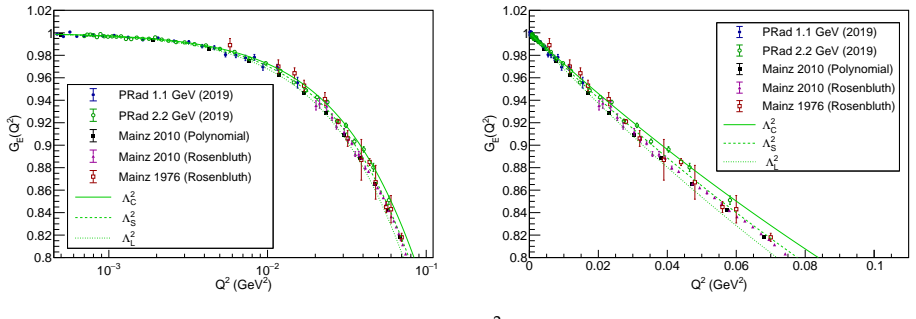
[19]. The determination using electron results in alargerproton size, described by radiusr L =0.8751±0.0061 fm. The determination based on muonic hydrogen gives a smallerproton, with radiusr S =0.84087±0.00026 fm. The proton electromagnetic structure is not purely electric. It is described by the Sachs electric and magnetic form factors,G E(Q2)andG M(Q2),...
2019
-
[2]
and the EIC [32] offer a complementary window into the low-Q2 limit and the valid- 21 ity of the photon flux modeling. Future progress requires not only higher statistics, but a refined theoretical treatment of unitarization to transform exclusive dilepton production into a precision probe of proton structure. ACKNOWLEDGEMENTS This work was partially supp...
2021
-
[3]
Gao and M
H. Gao and M. Vanderhaeghen. The proton charge radius.Rev. Mod. Phys., 94:015002, Jan
-
[4]
URL:https://link.aps.org/doi/10.1103/RevModPhys.94.015002,doi:10.1103/ RevModPhys.94.015002
-
[5]
Carl E. Carlson. The Proton Radius Puzzle.Prog. Part. Nucl. Phys., 82:59–77, 2015.arXiv: 1502.05314,doi:10.1016/j.ppnp.2015.01.002
work page internal anchor Pith review Pith/arXiv arXiv doi:10.1016/j.ppnp.2015.01.002 2015
-
[6]
The size of the proton.nature, 466(7303):213–216, 2010.doi:10.1038/nature09250
Randolf Pohl, Aldo Antognini, François Nez, Fernando D Amaro, François Biraben, João MR Cardoso, Daniel S Covita, Andreas Dax, Satish Dhawan, Luis MP Fernandes, et al. The size of the proton.nature, 466(7303):213–216, 2010.doi:10.1038/nature09250
-
[7]
URLhttps://www.science.org/doi/abs/ 10.1126/science.1230016
Aldo Antognini et al. Proton Structure from the Measurement of 2S−2PTransition Frequen- cies of Muonic Hydrogen.Science, 339:417–420, 2013.doi:10.1126/science.1230016
-
[8]
V . M. Budnev, I. F. Ginzburg, G. V . Meledin, and V . G. Serbo. The Two photon particle production mechanism. Physical problems. Applications. Equivalent photon approximation. Phys. Rept., 15:181–281, 1975.doi:10.1016/0370-1573(75)90009-5
-
[9]
Mateusz Dyndal and Laurent Schoeffel. The role of finite-size effects on the spectrum of equivalent photons in proton–proton collisions at the LHC.Phys. Lett. B, 741:66–70, 2015. arXiv:1410.2983,doi:10.1016/j.physletb.2014.12.019
work page internal anchor Pith review Pith/arXiv arXiv doi:10.1016/j.physletb.2014.12.019 2015
-
[10]
R. G. Sachs. High-Energy Behavior of Nucleon Electromagnetic Form Factors.Phys. Rev., 126:2256–2260, 1962.doi:10.1103/PhysRev.126.2256
-
[11]
J. C. Bernauer et al. High-precision determination of the electric and magnetic form factors of the proton.Phys. Rev. Lett., 105:242001, 2010.arXiv:1007.5076,doi:10.1103/PhysRevLett. 105.242001. 22
work page internal anchor Pith review Pith/arXiv arXiv doi:10.1103/physrevlett 2010
-
[12]
C. F. Perdrisat, V . Punjabi, and M. Vanderhaeghen. Nucleon Electromagnetic Form Fac- tors.Prog. Part. Nucl. Phys., 59:694–764, 2007.arXiv:hep-ph/0612014,doi:10.1016/j.ppnp. 2007.05.001
work page internal anchor Pith review Pith/arXiv arXiv doi:10.1016/j.ppnp 2007
-
[13]
Georges Aad et al. Measurement of exclusiveγγ→ℓ +ℓ− production in proton-proton collisions at √s=7 TeV with the ATLAS detector.Phys. Lett. B, 749:242–261, 2015.arXiv: 1506.07098,doi:10.1016/j.physletb.2015.07.069
work page internal anchor Pith review Pith/arXiv arXiv doi:10.1016/j.physletb.2015.07.069 2015
-
[14]
Serguei Chatrchyan et al. Exclusive photon-photon production of muon pairs in proton- proton collisions at √s=7 TeV.JHEP, 01:052, 2012.arXiv:1111.5536,doi:10.1007/ JHEP01(2012)052
Pith/arXiv arXiv 2012
-
[15]
Morad Aaboud et al. Measurement of the exclusiveγγ→µ +µ− process in proton-proton collisions at √s=13 TeV with the ATLAS detector.Phys. Lett. B, 777:303–323, 2018.arXiv: 1708.04053,doi:10.1016/j.physletb.2017.12.043
work page internal anchor Pith review Pith/arXiv arXiv doi:10.1016/j.physletb.2017.12.043 2018
-
[16]
Multi-modal contrastive learning of urban space representations from POI data
Georges Aad et al. Electroweak, QCD and flavour physics studies with ATLAS data from Run 2 of the LHC.Phys. Rept., 1116:57–126, 2025.arXiv:2404.06829,doi:10.1016/j. physrep.2024.12.003
work page doi:10.1016/j 2025
-
[17]
Agnieszka Ogrodnik. BSM physics using photon-photon fusion processes in UPC in Pb+Pb collisions with the ATLAS detector.PoS, HardProbes2023:067, 2024.doi:10.22323/1.438. 0067
-
[18]
Laurent Thomas. Searches for BSM physics in dilepton, multilepton, and lepton+MET final states at CMS.PoS, DIS2016:111, 2016.doi:10.22323/1.265.0111
-
[19]
Jan C Bernauer, P Achenbach, C Ayerbe Gayoso, R Böhm, Damir Bosnar, L Debenjak, MO Distler, L Doria, A Esser, H Fonvieille, et al. High-precision determination of the elec- tric and magnetic form factors of the proton.Physical Review Letters, 105(24):242001, 2010. doi:10.1103/PhysRevLett.105.242001
-
[20]
W. Xiong et al. A small proton charge radius from an electron–proton scattering experiment. Nature, 575(7781):147–150, 2019.doi:10.1038/s41586-019-1721-2
-
[21]
J. C. Bernauer et al. Electric and magnetic form factors of the proton.Phys. Rev. C, 90(1):015206, 2014.arXiv:1307.6227,doi:10.1103/PhysRevC.90.015206
work page internal anchor Pith review Pith/arXiv arXiv doi:10.1103/physrevc.90.015206 2014
-
[22]
Masaharu Tanabashi, K Hagiwara, K Hikasa, Katsumasa Nakamura, Y Sumino, F Takahashi, J Tanaka, K Agashe, Giulio Aielli, Claude Amsler, et al. Review of particle physics: particle data groups.Physical Review D, 98(3):1–1898, 2018.doi:10.1103/PhysRevD.98.030001. 23
-
[23]
Francis Halzen and Alan D. Martin. Quarks and leptons: An introductory course in modern particle physics. 1984. URL:https://api.semanticscholar.org/CorpusID:122066102
1984
-
[24]
Bernauer.Measurement of the elastic electron-proton cross section and separation of the electric and magnetic form factor in the Q 2 range from 0.004 to 1 (GeV/c) 2
Jan C. Bernauer.Measurement of the elastic electron-proton cross section and separation of the electric and magnetic form factor in the Q 2 range from 0.004 to 1 (GeV/c) 2. PhD thesis, Mainz U., Inst. Kernphys., 2010
2010
-
[25]
G. Hohler, E. Pietarinen, I. Sabba Stefanescu, F. Borkowski, G. G. Simon, V . H. Walther, and R. D. Wendling. Analysis of Electromagnetic Nucleon Form-Factors.Nucl. Phys. B, 114:505– 534, 1976.doi:10.1016/0550-3213(76)90449-1
-
[26]
M. Klusek-Gawenda and A. Szczurek. Exclusive muon-pair productions in ultrarelativistic heavy-ion collisions – realistic nucleus charge form factor and differential distributions.Phys. Rev. C, 82:014904, 2010.arXiv:1004.5521,doi:10.1103/PhysRevC.82.014904
work page internal anchor Pith review Pith/arXiv arXiv doi:10.1103/physrevc.82.014904 2010
-
[27]
E. J. Williams. Nature of the high-energy particles of penetrating radiation and status of ionization and radiation formulae.Phys. Rev., 45:729–730, 1934.doi:10.1103/PhysRev.45. 729
-
[28]
Vysotskii and Evgeny Zhemchugov
Mikhail I. Vysotskii and Evgeny Zhemchugov. Equivalent photons in proton and ion—ion collisions at the LHC.Phys. Usp., 62(9):910–919, 2019.arXiv:1806.07238,doi:10.3367/ UFNe.2018.07.038389
arXiv 2019
-
[29]
S. I. Godunov, E. K. Karkaryan, V . A. Novikov, A. N. Rozanov, M. I. Vysotsky, and E. V . Zhemchugov. Weak interaction corrections to muon pair production via the photon fusion at the LHC.Phys. Rev. D, 108(9):093006, 2023.arXiv:2308.01169,doi:10.1103/PhysRevD. 108.093006
-
[30]
G. Peter Lepage. A New Algorithm for Adaptive Multidimensional Integration.J. Comput. Phys., 27:192, 1978.doi:10.1016/0021-9991(78)90004-9
-
[31]
Georges Aad et al. Measurement of the total cross section from elastic scattering in pp collisions at √s=7 TeV with the ATLAS detector.Nucl. Phys. B, 889:486–548, 2014. arXiv:1408.5778,doi:10.1016/j.nuclphysb.2014.10.019
work page internal anchor Pith review Pith/arXiv arXiv doi:10.1016/j.nuclphysb.2014.10.019 2014
-
[32]
Georges Aad et al. Measurement of the total cross section andρ-parameter from elastic scattering in pp collisions at √s=13 TeV with the ATLAS detector.Eur. Phys. J. C, 83(5):441, 2023.arXiv:2207.12246,doi:10.1140/epjc/s10052-023-11436-8
-
[33]
A. Abada et al. FCC-hh: The Hadron Collider: Future Circular Collider Conceptual Design Report Volume 3.Eur. Phys. J. ST, 228(4):755–1107, 2019.doi:10.1140/epjst/ 24 e2019-900087-0
-
[34]
Ya-Ping Xie and V . P . Gonçalves. Exclusive dilepton production in photon-induced interac- tions at RHIC.Eur. Phys. J. C, 83(6):528, 2023.doi:10.1140/epjc/s10052-023-11720-7
-
[35]
Chwastowski, Krzysztof Piotrzkowski, and Mariusz Przybycien
Janusz J. Chwastowski, Krzysztof Piotrzkowski, and Mariusz Przybycien. Exclusive lepton pair production at the electron–ion collider.Eur. Phys. J. C, 82(9):846, 2022.arXiv:2206. 02466,doi:10.1140/epjc/s10052-022-10820-0. 25
discussion (0)
Sign in with ORCID, Apple, or X to comment. Anyone can read and Pith papers without signing in.