Charge-state control of carbon-related optical absorption in AlN
Pith reviewed 2026-06-26 19:42 UTC · model grok-4.3
The pith
Neutral substitutional carbon on nitrogen sites produces the 2-4 eV optical absorption band in AlN.
A machine-rendered reading of the paper's core claim, the machinery that carries it, and where it could break.
Core claim
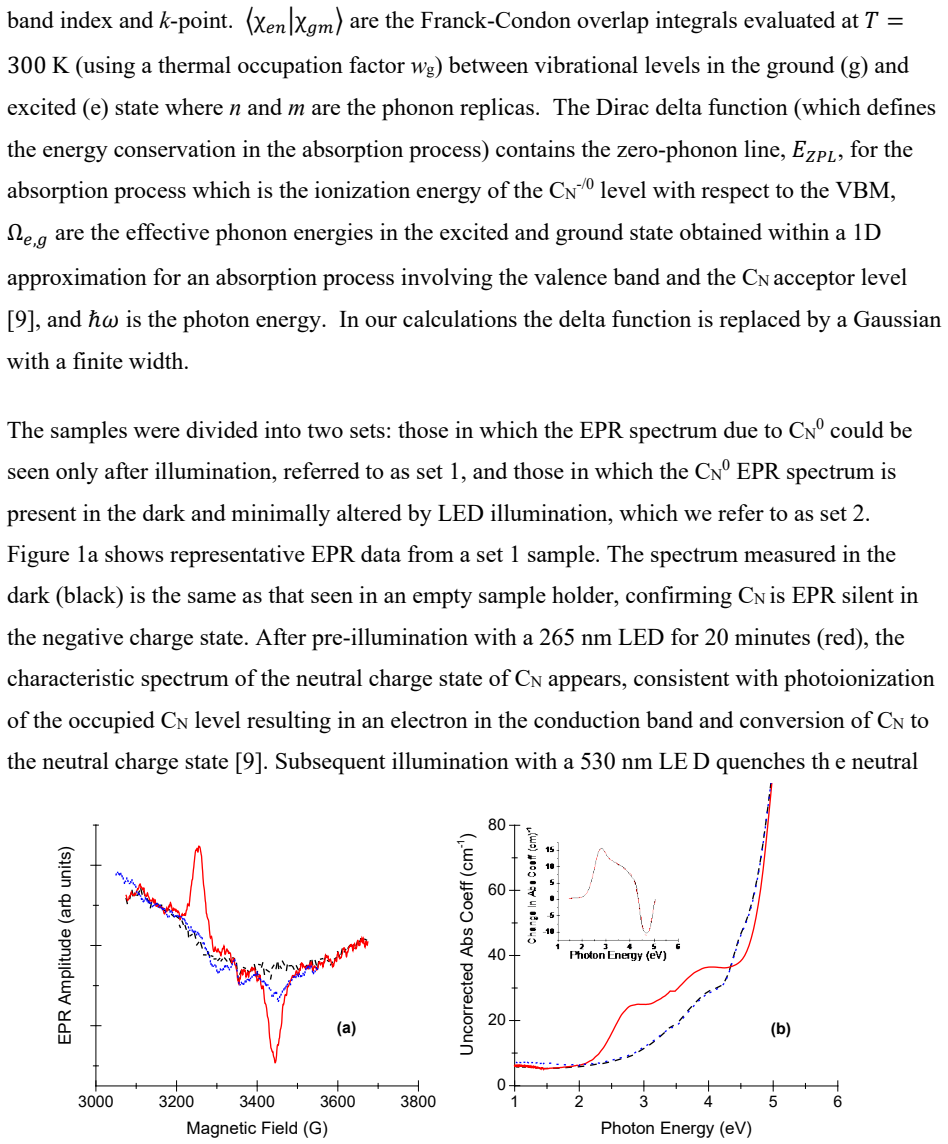
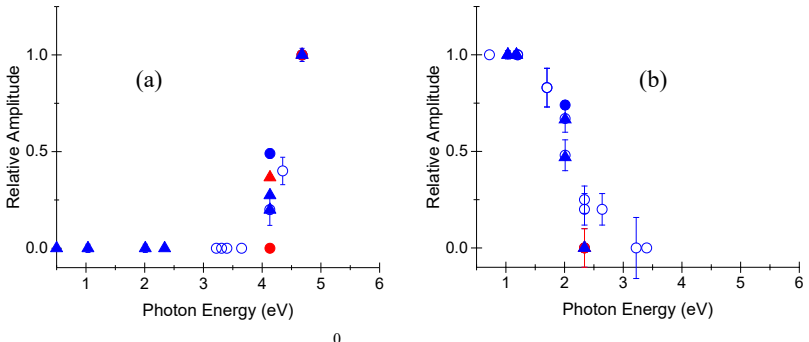
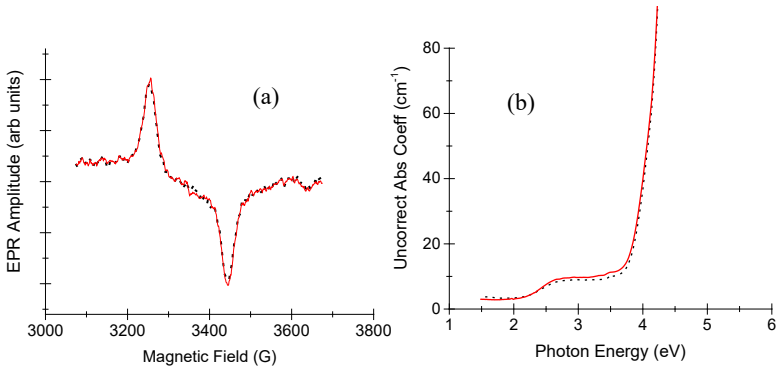
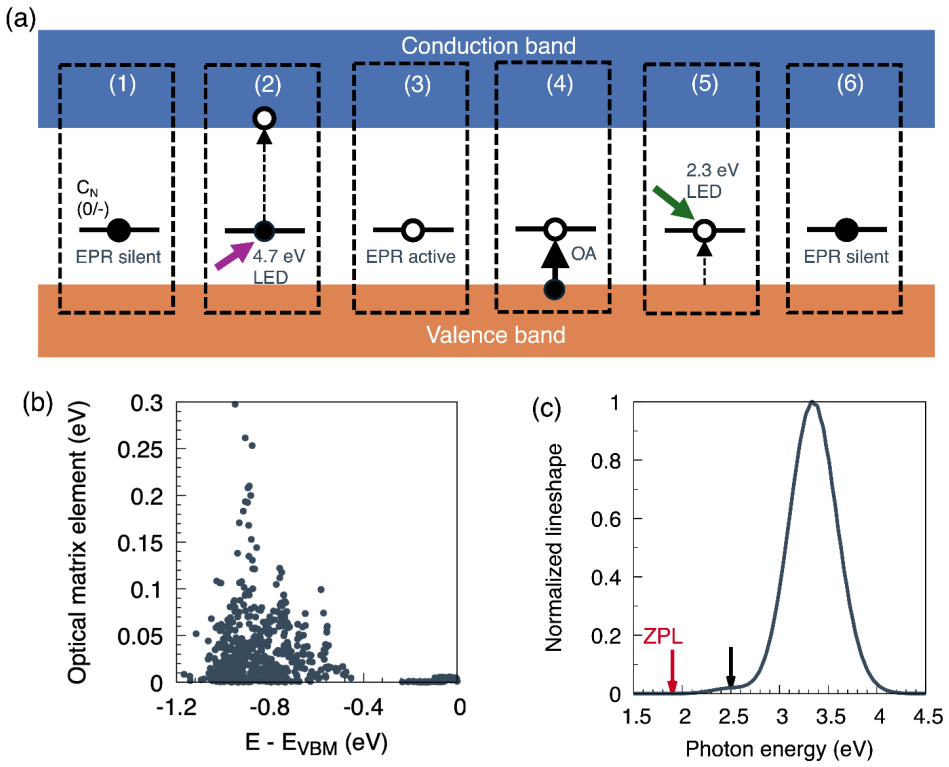
The central claim is that the absorption band between 2 eV and 4 eV in AlN arises from the neutral charge state of substitutional carbon on the nitrogen site. This is established by correlating the absorption intensity with photo-EPR signals that manipulate the carbon charge state on the same samples and by hybrid functional calculations showing a matching optical transition near 3.3 eV that incorporates valence band dispersion and the energy dependence of the optical matrix elements.
What carries the argument
Combined photo-induced electron paramagnetic resonance (photo-EPR) control of charge state and hybrid functional calculations of the absorption spectrum for the neutral substitutional carbon defect on the nitrogen site (C_N), including valence band dispersion and energy-dependent matrix elements.
If this is right
- The intensity of the absorption band can be directly modulated by photo-induced changes in the neutral fraction of C_N.
- A distinct peak near 3.3 eV in the absorption spectrum corresponds to transitions between the valence band and the C_N level.
- The calculations must include valence band dispersion and energy-dependent matrix elements to achieve quantitative agreement with experiment.
- No other defects contribute significantly to absorption in this energy range under the conditions studied.
Where Pith is reading between the lines
- The same combined photo-EPR and line-shape calculation method could be applied to assign defect origins for absorption bands in related wide-bandgap nitrides.
- Reducing unintentional carbon incorporation during growth may lower sub-bandgap optical losses in AlN-based ultraviolet devices.
- Because the transition involves the valence band, the presence of neutral C_N could influence hole transport or p-type behavior in carbon-containing AlN.
Load-bearing premise
Photo-EPR selectively controls only the charge state of C_N and no other defects contribute appreciably to absorption in the same 2-4 eV energy window.
What would settle it
If the 2-4 eV absorption band persists after photo-EPR has converted all detectable C_N to non-neutral charge states, or if the band appears in samples with no carbon detected by EPR.
Figures
read the original abstract
Sub-bandgap optical absorption in AlN between 2 eV and 4 eV is widely observed, but its microscopic origin remains contested. Using photo-induced electron paramagnetic resonance (photo-EPR) and optical absorption spectroscopy on the same samples, we demonstrate a correlation between this absorption band and the neutral charge state of substitutional carbon on the nitrogen site (C$_N$). Hybrid functional calculations of the optical absorption spectra show that a transition involving C$_N$ and the valence band occurs near 3.3 eV, which agrees well with a peak identified within the measured optical absorption between 2 eV and 4 eV. This conclusion requires the combined ability to manipulate the charge state of carbon using photo-EPR and to use first-principles calculations of the absorption line shape that account for the dispersion of the valence band and the energy dependence of the optical matrix elements.
Editorial analysis
A structured set of objections, weighed in public.
Referee Report
Summary. The manuscript claims that the widely observed sub-bandgap optical absorption in AlN (2–4 eV) arises from the neutral charge state of substitutional carbon on the nitrogen site (C_N). This is supported by correlating photo-EPR measurements (which manipulate the C_N charge state) with optical absorption spectra on the same samples, together with hybrid-functional calculations showing a C_N-to-valence-band optical transition near 3.3 eV whose line shape matches a peak in the measured absorption. The abstract emphasizes that this identification requires both photo-EPR charge-state control and first-principles absorption spectra that incorporate valence-band dispersion and energy-dependent matrix elements.
Significance. If the central identification holds, the result would resolve a contested defect assignment in AlN, a key material for UV optoelectronics, and demonstrate a general methodology combining photo-EPR with computed optical line shapes. The explicit accounting for valence-band dispersion and matrix-element energy dependence in the calculations is a methodological strength that goes beyond simple transition-energy matching.
major comments (2)
- [Abstract] Abstract: The central claim equates the 2–4 eV absorption band with C_N^0 on the basis of photo-EPR correlation and the calculated 3.3 eV transition. This identification is load-bearing only if the illumination conditions affect solely the C_N charge state and if no other defects contribute appreciably in the same window. The manuscript does not report EPR surveys of other known centers or absorption spectra on carbon-free reference samples to exclude such contributions, leaving the correlation compatible with multi-defect or coincidental origins.
- [Abstract] Abstract (final paragraph): The text states that the conclusion 'requires the combined ability to manipulate the charge state of carbon using photo-EPR and to use first-principles calculations of the absorption line shape.' No explicit controls or data are presented to verify that the photo-EPR conditions achieve selective control of C_N without affecting other carbon-related or unrelated defects, which directly undermines the uniqueness of the assignment.
minor comments (1)
- [Abstract] The abstract mentions 'a peak identified within the measured optical absorption' but does not specify how the peak position, width, or intensity were extracted from the raw spectra or how error bars were determined.
Simulated Author's Rebuttal
We thank the referee for the thorough review and constructive feedback on our manuscript. We address the major comments point-by-point below, focusing on the strength of the evidence and proposed revisions to clarify the claims.
read point-by-point responses
-
Referee: [Abstract] Abstract: The central claim equates the 2–4 eV absorption band with C_N^0 on the basis of photo-EPR correlation and the calculated 3.3 eV transition. This identification is load-bearing only if the illumination conditions affect solely the C_N charge state and if no other defects contribute appreciably in the same window. The manuscript does not report EPR surveys of other known centers or absorption spectra on carbon-free reference samples to exclude such contributions, leaving the correlation compatible with multi-defect or coincidental origins.
Authors: We agree that the identification would be strengthened by EPR surveys of other centers and absorption data on carbon-free samples. Our evidence rests on the direct, quantitative correlation between the intensity of the C_N^0 EPR signal and the 2–4 eV absorption under illumination energies chosen to match the known photoionization thresholds of C_N (distinct from many other AlN defects per prior literature). The hybrid-functional absorption spectrum, computed with valence-band dispersion and energy-dependent matrix elements, reproduces both the position (~3.3 eV) and the asymmetric line shape of the observed peak. We will add a discussion paragraph noting the correlative nature of the assignment and the limitations of the current data set, while emphasizing that the combined photo-EPR + line-shape calculation approach provides stronger support than transition-energy matching alone. revision: partial
-
Referee: [Abstract] Abstract (final paragraph): The text states that the conclusion 'requires the combined ability to manipulate the charge state of carbon using photo-EPR and to use first-principles calculations of the absorption line shape.' No explicit controls or data are presented to verify that the photo-EPR conditions achieve selective control of C_N without affecting other carbon-related or unrelated defects, which directly undermines the uniqueness of the assignment.
Authors: The abstract underscores that both techniques are necessary for the reported conclusion. The illumination conditions are selected from established C_N photo-thresholds, which differ from those of other known defects. We acknowledge that the manuscript does not include explicit controls demonstrating zero effect on every possible other defect. To address this concern, we will revise the final abstract paragraph to state that the assignment is supported by the observed correlation and the matching calculated line shape, while noting that exhaustive verification of selectivity would require additional reference experiments. revision: yes
Circularity Check
No circularity: independent experiment and first-principles calculation
full rationale
The derivation rests on two independent elements: (1) direct experimental correlation between the 2-4 eV absorption band and the neutral C_N charge state obtained by performing photo-EPR and optical absorption on identical samples, and (2) hybrid-functional calculations that compute the C_N-to-valence-band optical transition energy and lineshape from first principles, yielding ~3.3 eV without any fitting to the measured peak. No self-citation is invoked to establish uniqueness or to supply an ansatz; the calculated spectrum is not a renamed fit, and the experimental identification does not reduce to a parameter that was itself derived from the target absorption data. The paper therefore contains no self-definitional, fitted-input-called-prediction, or self-citation-load-bearing steps.
Axiom & Free-Parameter Ledger
axioms (2)
- domain assumption Hybrid functional calculations that include valence band dispersion and energy-dependent optical matrix elements accurately reproduce the absorption line shape of C_N.
- domain assumption Photo-EPR selectively manipulates the charge state of C_N without significant interference from other defects in the measured absorption.
Reference graph
Works this paper leans on
-
[1]
The fraction of nonlocal Hartree-Fock exchange is set to 0.33, which reproduces experimental band gaps and lattice parameters of AlN
with a plane-wave energy cutoff of 500 eV. The fraction of nonlocal Hartree-Fock exchange is set to 0.33, which reproduces experimental band gaps and lattice parameters of AlN. Wavefunctions and energies for carbon substituting on the nitrogen site in AlN are taken from our previous study using the results from 288-atom supercells [9]. To resolve individu...
-
[2]
III-nitride-based monolithic integration: From electronics to photonics
Yijian Song, Rui He, Junxue Ran, Junxi Wang, Jinmin Li, Tongbo Wei, “III-nitride-based monolithic integration: From electronics to photonics”, Appl. Phys. Rev. 12, 021301 (2025)
2025
-
[3]
From atomic-scale understanding to wafer-scale growth: Delta-doped AlN/GaN/AlN XHEMTs on single-crystal AlN by molecular beam epitaxy
Yu-Hsin Chen, Keisuke Shinohara, Jimy Encomendero, Naomi Pieczulewski, Kasey Hogan, James Grandusky, David A. Muller, Huili Grace Xing, Debdeep Jena, “From atomic-scale understanding to wafer-scale growth: Delta-doped AlN/GaN/AlN XHEMTs on single-crystal AlN by molecular beam epitaxy”, APL Mater. 13, 121103 (2025)
2025
-
[4]
Review—Status and Challenges in Hetero -epitaxial Growth Approach for Large Diameter AlN Single Crystalline Substrates
R. Sumathi, “Review—Status and Challenges in Hetero -epitaxial Growth Approach for Large Diameter AlN Single Crystalline Substrates” ECS Journal of Solid State Science and Technol. 10 035001 (2021)
2021
-
[5]
The emergence and prospects of deep- ultraviolet light-emitting diode technologies
M. Kneissl, T. Seong, J. Han, H. Amano, “The emergence and prospects of deep- ultraviolet light-emitting diode technologies”, Nature Photonics 13, 233 (2019)
2019
-
[6]
Single-Photon Emission from Point Defects in Aluminum Nitride Films
Yongzhou Xue, Hui Wang, Nan Xie, Qian Yang, Fujun Xu, Bo Shen, Jun-jie Shi, Desheng Jiang, Xiuming Dou, Tongjun Yu, and Bao-quan Sun, “Single-Photon Emission from Point Defects in Aluminum Nitride Films”, J. Phys. Chem. Lett. 11, 2689 (2020)
2020
-
[7]
On the preparation, optical properties and electrical behaviour of aluminium nitride
G.A. Cox, D.O. Cummins, K. Kawabe, R.H. Tredgold, “On the preparation, optical properties and electrical behaviour of aluminium nitride”, J. Phys Chem. Solids 28, 543 (167)
-
[8]
AlN Single Crystals
G. Slack and T Mcnelly, “AlN Single Crystals” Journal of Crystal Growth 42 560 (1977)
1977
-
[9]
Point defect content and optical transitions in bulk aluminum nitride crystals
M. Bickermann, B. Epelbaum, O. Filip, P. Heimann, S. Nagata, A. Winnacker, “Point defect content and optical transitions in bulk aluminum nitride crystals”, Phys. Status Solidi B 246, 1181 (2009). 12
2009
-
[10]
Direct evidence for carbon incorporation on the nitrogen site in AlN
Darshana Wickramaratne, Mackenzie Siford, Md Shafiqul Islam Mollik, John L. Lyons, and M. E. Zvanut, “Direct evidence for carbon incorporation on the nitrogen site in AlN”, Phys. Rev. Materials 8, 094602 (2024)
2024
-
[11]
On the origin of the 265 nm absorption band in AlN bulk crystals
Ramo´n Collazo, Jinqiao Xie, Benjamin E. Gaddy, Zachary Bryan, Ronny Kirste,Marc Hoffmann, Rafael Dalmau, Baxter Moody, Yoshinao Kumagai, Toru Nagashima, Yuki Kubota, Toru Kinoshita, Akinori Koukitu, Douglas L. Irving, and Zlatko Sitar, “On the origin of the 265 nm absorption band in AlN bulk crystals”, Appl. Phys. Lett. 100, 191914 (2012)
2012
-
[12]
Photochromism and influence of point defect charge states on optical absorption in aluminum nitride (AlN)
Ivan Gamov, Carsten Hartmann, Thomas Straubinger, and Matthias Bickermann, “Photochromism and influence of point defect charge states on optical absorption in aluminum nitride (AlN)”, J. Appl. Phys. 129, 113103 (2021)
2021
-
[13]
Thermal conductivity of single-crystalline AlN
Robert Rounds, Biplab Sarkar, Andrew Klump, Carsten Hartmann, Toru Nagashima, Ronny Kirste, Alexander Franke, Matthias Bickermann, Yoshinao Kumagai, Zlatko Sitar, and Ramón Collazo, “Thermal conductivity of single-crystalline AlN”, Applied Physics Express 11, 071001 (2018)
2018
-
[14]
The origin of 2.78 eV emission and yellow coloration in bulk AlN substrates
A Sedhain, L. Du, J. Edgar, J. Lin, H. Jiang, “The origin of 2.78 eV emission and yellow coloration in bulk AlN substrates”, Appl. Phys. Lett. 95, 262104 (2009)
2009
-
[15]
Origins of optical absorption and emission lines in AlN
Qimin Yan, Anderson Janotti, Matthias Scheffler, and Chris G. Van de Walle, “Origins of optical absorption and emission lines in AlN”, Appl Phys. Lett. 105, 111104 (2014)
2014
-
[16]
Identification of the V Al-ON defect complex in AlN single crystals
J.-M. Maki, I. Makkonen, F. Tuomisto, A. Karjalainen, S. Suihkonen, J. Raisanen, T. Yu. Chemekova, and Yu. N. Makarov, “Identification of the V Al-ON defect complex in AlN single crystals” Phys. Rev. B 84, 081204(R) (2011)
2011
-
[17]
On compensation in Si-doped AlN
Joshua S. Harris, Jonathon N. Baker, Benjamin E. Gaddy, Isaac Bryan, Zachary Bryan, Kelsey J. Mirrielees, Pramod Reddy, Ramon Collazo, Zlatko Sitar, and Douglas L. Irving, “On compensation in Si-doped AlN”, Appl. Phys. Lett. 112, 152101 (2018)
2018
-
[18]
Below bandgap photoluminescence of an AlN crystal: Co-existence of two different charging states of a defect center
Qin Zhou, Zhaofu Zhang, and Baikui Li, Hui Li, Sergii Golovynskyi, Xi Tang, Honglei Wu, Jiannong Wang, and Baikui Li, “Below bandgap photoluminescence of an AlN crystal: Co-existence of two different charging states of a defect center”, APL Mater. 8, 081107 (2020)
2020
-
[19]
Powell, Physics of solid state laser materials (Springer-Verlag New York Berlin Heidelberg, 1998)
Richard C. Powell, Physics of solid state laser materials (Springer-Verlag New York Berlin Heidelberg, 1998). 13
1998
-
[20]
Self-Consistent Equations Including Exchange and Correlation Effects
W. Kohn and L. J. Sham, “Self-Consistent Equations Including Exchange and Correlation Effects”, Phys. Rev. 140, A1133 (1965)
1965
-
[21]
Projector augmented-wave method
P. E. Blochl, “Projector augmented-wave method”, Phys. Rev. B 50, 17953 (1994)
1994
-
[22]
Efficient iterative schemes for ab initio total-energy calculations using a plane-wave basis set
G. Kresse and J. Furthmuller, “Efficient iterative schemes for ab initio total-energy calculations using a plane-wave basis set”, Phys. Rev. B 54, 11169 (1996); G. Kresse and J. Hafner, “Ab initio molecular-dynamics simulation of the liquid-metal–amorphous- semiconductor transition in germanium”, Phys. Rev. B 49, 14251 (1994)
1996
-
[23]
Hybrid functionals based on a screened Coulomb potential
J. Heyd, G. Scuseria, and M. Ernzerhof, “Hybrid functionals based on a screened Coulomb potential”, J. Chem. Phys. 118, 8207 (2003); J. Heyd, G. E. Scuseria, and M. Ernzerhof, “Erratum: “Hybrid functionals based on a screened Coulomb potential”, J. Chem. Phys. 124, 219906 (2006)
2003
-
[24]
Effects of carbon on the electrical and optical properties of InN, GaN, and AlN
J. L. Lyons, A. Janotti, and C. G. Van de Walle, “Effects of carbon on the electrical and optical properties of InN, GaN, and AlN”, Phys. Rev. B 89, 035204 (2014)
2014
discussion (0)
Sign in with ORCID, Apple, or X to comment. Anyone can read and Pith papers without signing in.