PiMiX 2.0: AI-enhanced Data Fusion for Radiographic Imaging and Tomography
Pith reviewed 2026-06-26 15:44 UTC · model grok-4.3
The pith
PiMiX 2.0 integrates AI agents with multi-modal radiographic imaging and tomography for accelerated physics-informed analysis.
A machine-rendered reading of the paper's core claim, the machinery that carries it, and where it could break.
Core claim
PiMiX 2.0 is an artificial-intelligence (AI)-enhanced data-fusion and analysis framework that integrates multi-experiment multi-modal radiographic imaging and tomography (RadIT) with physics-informed reasoning and agentic AI workflows. The framework supports automated data ingestion, multimodal image processing from one or more experiments, three-dimensional (3D) and time-resolved three-dimensional (4D) reconstruction, and physics-aware interpretation of experimental observations. By coupling RadIT instrumentation and measurements with geometry, physics, computation, and statistical inference, PiMiX 2.0 aims to accelerate RadIT data processing, knowledge extraction, improve reproducibility,
What carries the argument
PiMiX agents that perform physics-informed reasoning and agentic AI workflows to couple RadIT instrumentation with geometry, physics, computation, and statistical inference.
If this is right
- Automated ingestion and processing of multi-modal data from multiple experiments
- Support for 3D and 4D tomographic reconstructions
- Scalable operation from desktop systems to high-performance computing
- Enhanced reproducibility through integrated physics-aware analysis
- Application to experiments in plasmas, fusion, and manufacturing
Where Pith is reading between the lines
- If successful, similar agentic frameworks could be adapted for other multi-modal scientific imaging techniques
- Direct benchmarks against non-AI methods on identical datasets would quantify the claimed accelerations
- The desktop scalability might enable broader adoption among experimental physicists without HPC access
- Potential extension to real-time feedback loops in dynamic experiments
Load-bearing premise
The coupling of RadIT instrumentation and measurements with geometry, physics, computation, and statistical inference through AI agents will accelerate data processing and improve reproducibility.
What would settle it
A side-by-side comparison on a standard RadIT dataset where PiMiX 2.0 shows no reduction in processing time or no increase in reproducibility compared to manual or non-agentic methods.
Figures

read the original abstract
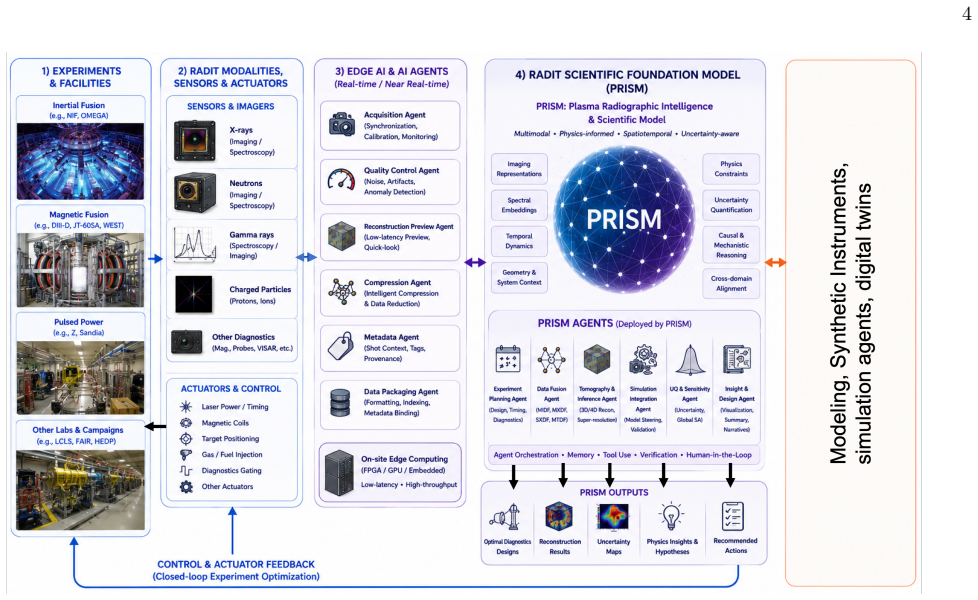
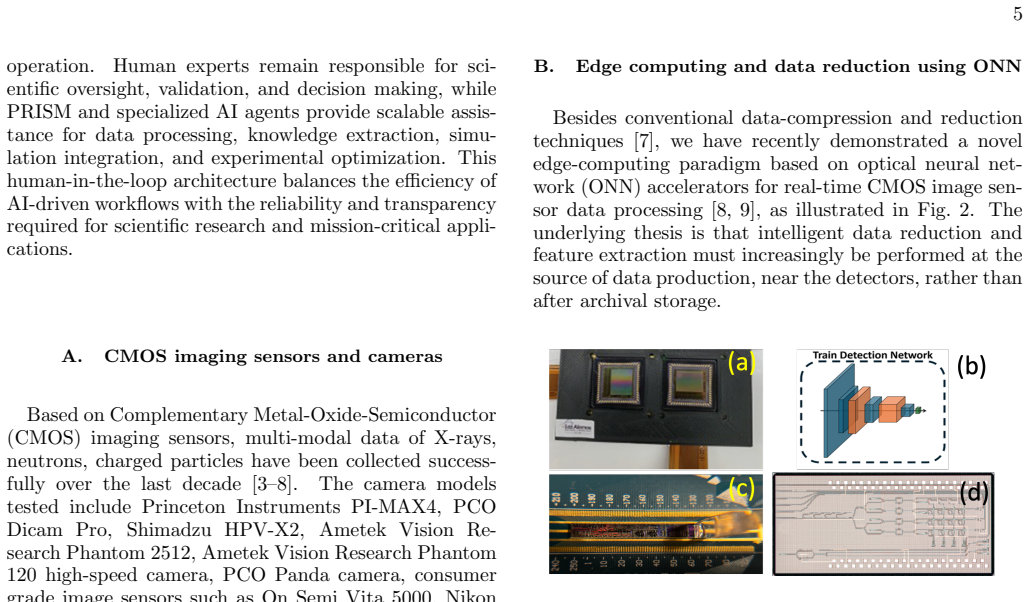
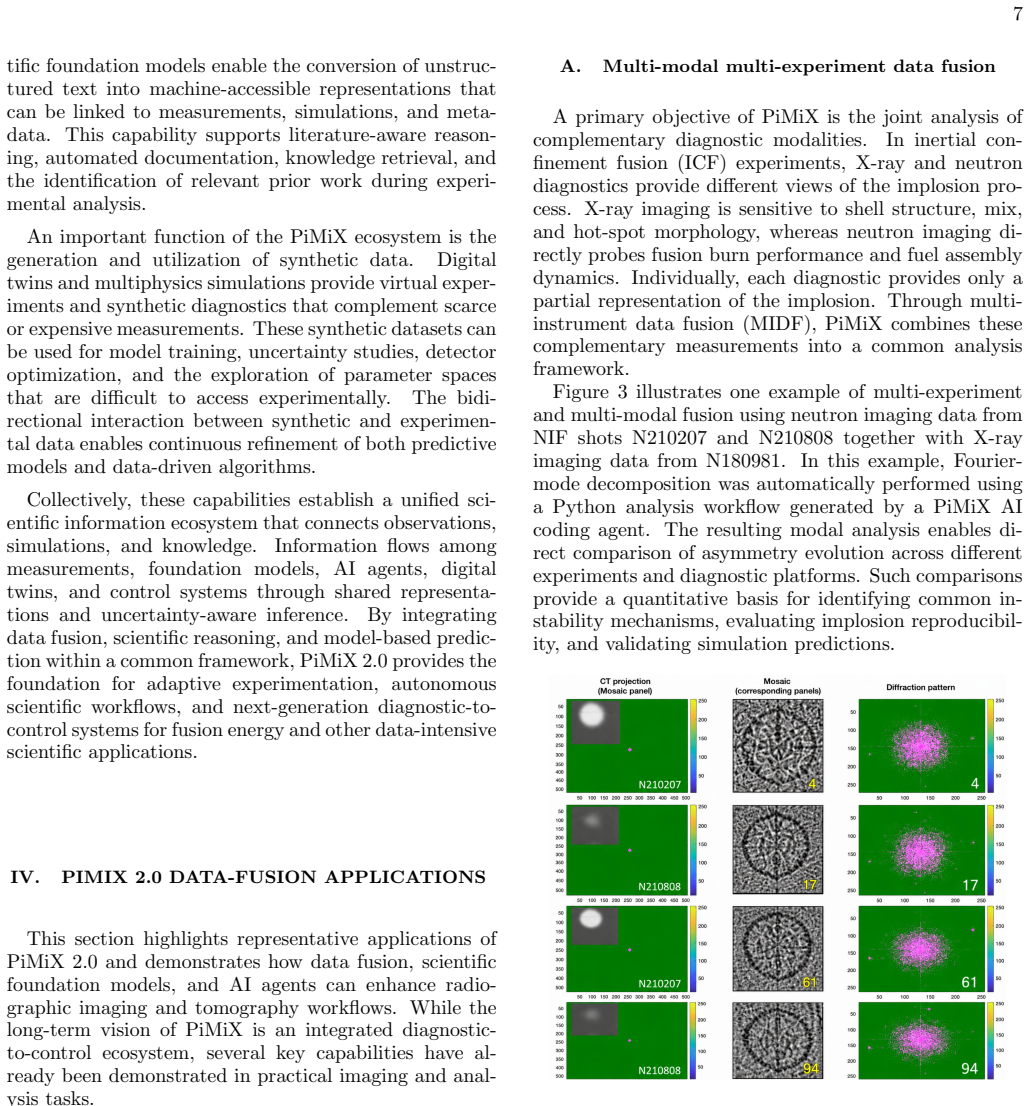
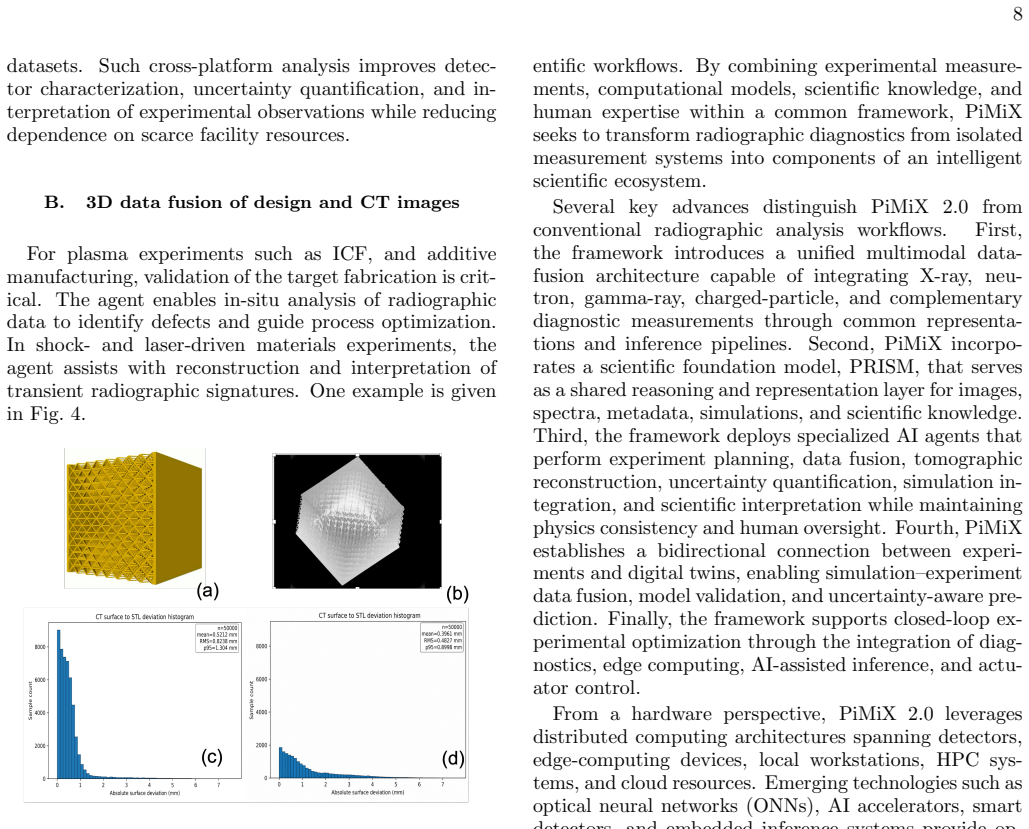
Extending earlier work in Physics-informed Meta-instrument for eXperiments (PiMiX) [1], PiMiX~2.0 is an artificial-intelligence (AI)-enhanced data-fusion and analysis framework that integrates multi-experiment multi-modal radiographic imaging and tomography (RadIT) with physics-informed reasoning and agentic AI workflows. The framework supports automated data ingestion, multimodal image processing from one or more experiments, three-dimensional (3D) and time-resolved three-dimensional (4D) reconstruction, and physics-aware interpretation of experimental observations. The PiMiX agents are designed for deployment on desktop and laptop systems commonly used in experimental workflows, while remaining scalable to high-performance computing environments for computationally intensive tasks. By coupling RadIT instrumentation and measurements with geometry, physics, computation, and statistical inference, PiMiX 2.0 aims to accelerate RadIT data processing, knowledge extraction, improve reproducibility, and enable more integrated analysis and workflows in high-temperature plasmas, nuclear fusion, advanced manufacturing, other static and dynamic experiments.
Editorial analysis
A structured set of objections, weighed in public.
Referee Report
Summary. The manuscript presents PiMiX 2.0 as an AI-enhanced data-fusion and analysis framework extending prior PiMiX work. It integrates multi-experiment, multi-modal radiographic imaging and tomography (RadIT) with physics-informed reasoning and agentic AI workflows to support automated ingestion, multimodal processing, 3D/4D reconstruction, and physics-aware interpretation. The framework is described as deployable on desktop/laptop systems and scalable to HPC, with the goal of coupling instrumentation, geometry, physics, computation, and statistical inference to accelerate processing, knowledge extraction, and reproducibility in high-temperature plasmas, nuclear fusion, advanced manufacturing, and related experiments.
Significance. If the described framework were implemented with demonstrated quantitative gains in processing speed and reproducibility on real RadIT datasets, it could offer a meaningful contribution to integrated, physics-aware analysis pipelines in experimental physics and imaging. The emphasis on agentic AI workflows and desktop-scale deployment addresses practical needs in experimental facilities. However, the manuscript contains no implementations, benchmarks, or results, so these potential benefits remain hypothetical.
major comments (2)
- [Abstract] Abstract (final sentence): The claims that PiMiX 2.0 'aims to accelerate RadIT data processing, knowledge extraction, improve reproducibility, and enable more integrated analysis' are presented without any supporting benchmarks, timing comparisons, reproducibility metrics, ablation studies, or case studies on RadIT data. This leaves the central performance assertions as untested design goals rather than demonstrated outcomes.
- [Abstract] Abstract and framework description: No derivations, quantitative predictions, error analyses, or validation protocols are provided to substantiate how the coupling of RadIT measurements with geometry/physics/inference via AI agents will achieve the stated improvements; the manuscript functions as a high-level outline whose success depends on future implementation.
Simulated Author's Rebuttal
We thank the referee for the constructive review. The manuscript is a conceptual framework proposal extending prior PiMiX work, without implementations or benchmarks, and we agree the performance assertions remain design goals. We will revise to clarify scope and add plans for future validation.
read point-by-point responses
-
Referee: [Abstract] Abstract (final sentence): The claims that PiMiX 2.0 'aims to accelerate RadIT data processing, knowledge extraction, improve reproducibility, and enable more integrated analysis' are presented without any supporting benchmarks, timing comparisons, reproducibility metrics, ablation studies, or case studies on RadIT data. This leaves the central performance assertions as untested design goals rather than demonstrated outcomes.
Authors: We agree the benefits are presented as design goals rather than demonstrated results. The manuscript functions as a high-level framework description, consistent with proposal-style papers in the field. We will revise the abstract to explicitly frame these as intended outcomes pending implementation and testing on RadIT datasets. revision: yes
-
Referee: [Abstract] Abstract and framework description: No derivations, quantitative predictions, error analyses, or validation protocols are provided to substantiate how the coupling of RadIT measurements with geometry/physics/inference via AI agents will achieve the stated improvements; the manuscript functions as a high-level outline whose success depends on future implementation.
Authors: The manuscript is a high-level outline of the proposed architecture and agentic workflows. No derivations or validations are included at this stage because the focus is on describing the integration approach. We will add a section outlining planned validation protocols, quantitative benchmarks, and error analyses to be pursued in follow-on work. revision: yes
Circularity Check
No circularity: high-level framework proposal with no derivations or self-referential predictions
full rationale
The manuscript is a conceptual description of an AI framework (PiMiX 2.0) that extends prior work via citation [1] but contains no equations, quantitative predictions, fitted parameters, or claimed derivations. All performance assertions use language of intent ('aims to accelerate...') rather than demonstrated results. The single self-citation is not load-bearing because no central claim reduces to it; the paper is self-contained as an outline of future workflows. No steps match any enumerated circularity pattern.
Axiom & Free-Parameter Ledger
Reference graph
Works this paper leans on
-
[1]
Physics-informed Meta-instrument for eX- periments (PiMiX) with applications to fusion energy,
Z. Wang, S. Lin, M. Teng-Levy, P. Chu, B. T. Wolfe, C.- S. Wong, C. S. Campbell, X. Yue, L. Zhang, D. Aberle, M. Alvarado Alvarez, D. Broughton, R. T. Chen, B. Cheng, F. Chu, E. R. Fossum, M. A. Foster, C. Huang, V. Kilic, K. Krushelnick, W. Li, E. Loomis, T. Schmidt Jr., S. K. Sjue, C. Tomkins, D. A. Yarotski, and R. Zhu, “Physics-informed Meta-instrumen...
arXiv 2024
-
[2]
Wang, ”Radiographic imaging and tomography,” Appl
Z. Wang, ”Radiographic imaging and tomography,” Appl. Opt. 61, RDS1-RDS4 (2022)
2022
-
[4]
K. O. Plaud-Ramos, M. S. Freeman, W. Wei, E. Guardincerri, J. D. Bacon, J. Cowan, J. M. Durham, D. Huang, J. Gao, M. A. Hoffbauer, D. J. Morley, C. L. Morris, D. C. Poulson, Zhehui Wang, Rev. Sci. Instrum. 87(11): 11E706 (2016).https://doi.org/10.1063/1. 4960168
work page doi:10.1063/1 2016
-
[5]
Z. Wang, K. Anagnost, C. W. Barnes, D. M. Dattel- baum, E. R. Fossum, E. Lee, J. Liu, J. J. Ma, W. Z. Meijer, W. Nie, C. M. Sweeney, A. C. Therrien, H. Tsai, X. Yue; Billion-pixel x-ray camera (BiPC-X). Rev. Sci. Instrum.92(4): 043708 (2021).https://doi.org/10. 1063/5.0043013
2021
-
[6]
Z. Wang, A. F. T. Leong, A. Dragone, A. E. Gleason, R. Ballabriga, C. Campbell, M. Campbell, S. J. Clark, C. Da Vi` a, D. M. Dattelbaum, M. Demarteau, L. Fabris, K. Fezzaa, E. R. Fossum, S. M. Gruner, T. C. Hufnagel, X. Ju, K. Li, X. Llopart, B. Luki´ c, A. Rack, J. Strehlow, A. C. Therrien, J. Thom-Levy, F. Wang, T. Xiao, M. Xu, and X. Yue, Nucl. Instrum...
2023
-
[7]
S. Lin, S. Ning, H. Zhu, T. Zhou, C. L. Mor- ris, S. Clayton, M. J. Cherukara, R. T. Chen and Z. Wang (2024) Front. Phys. 12:1334298. doi: 10.3389/fphy.2024.1334298
-
[8]
S. Lin, H. Zhu, et al. Sci Rep15, 45464 (2025).https: //doi.org/10.1038/s41598-025-29482-5
-
[9]
Pan, and Ray T
Shupeng Ning, Hanqing Zhu, Chenghao Feng, Jiaqi Gu, David Z. Pan, and Ray T. Chen,Optica12, 1079-1089 (2025)
2025
-
[10]
S. Lin, J.K. Baldwin, M. Blatnik, S.M. Clayton, C. Cude- Woods, S.A. Currie, B. Filippone, E.M. Fries, P. Gel- tenbort, A.T. Holley, W. Li, C.-Y. Liu, M. Makela, C.L. Morris, R. Musedinovic, C. O’Shaughnessy, R.W. Pat- tie, D.J. Salvat, A. Saunders, E.I. Sharapov, M. Singh, X. Sun, Z. Tang, W. Uhrich, W. Wei, B. Wolfe, A.R. Young, Z. Wang, Nuclear Instrum...
work page doi:10.1016/j 2023
-
[11]
Zirui Gao, Seher Karakuzu, Dmitri Gavrilov, Daniel Al- lan, Adam Thompson, Denis Leshchev, Hanfei Yan, SC Workshops ’25: Proceedings of the SC ’25 Workshops of the International Conference for High Performance Com- puting, Networking, Storage and Analysis, 2362 - 2368, https://doi.org/10.1145/3731599.3767593
-
[12]
2015 Multi- mode quasi-periodic pulsations in a solar flare.Astron
Ma, P. X., Cruz, L., Farah, W., Siemion, A., Gajjar, V., Croft, S., Czech, D., Thompson, A., Burdick, C., Manos, M., and Pollak, A. W., “A deployed real-time end-to-end deep learning algorithm for fast radio burst detection,” Astron. Astrophys.702, A181 (2025), doi:10.1051/0004- 6361/202555217
discussion (0)
Sign in with ORCID, Apple, or X to comment. Anyone can read and Pith papers without signing in.