Upper Limits on Planet-Induced GHz Radio Emission from Inactive M Dwarfs
Pith reviewed 2026-06-26 16:11 UTC · model grok-4.3
The pith
Non-detections of GHz radio emission from M dwarfs with close-in planets constrain the exoplanets' magnetic fields to be weak or absent under modeled wind conditions.
A machine-rendered reading of the paper's core claim, the machinery that carries it, and where it could break.
Core claim
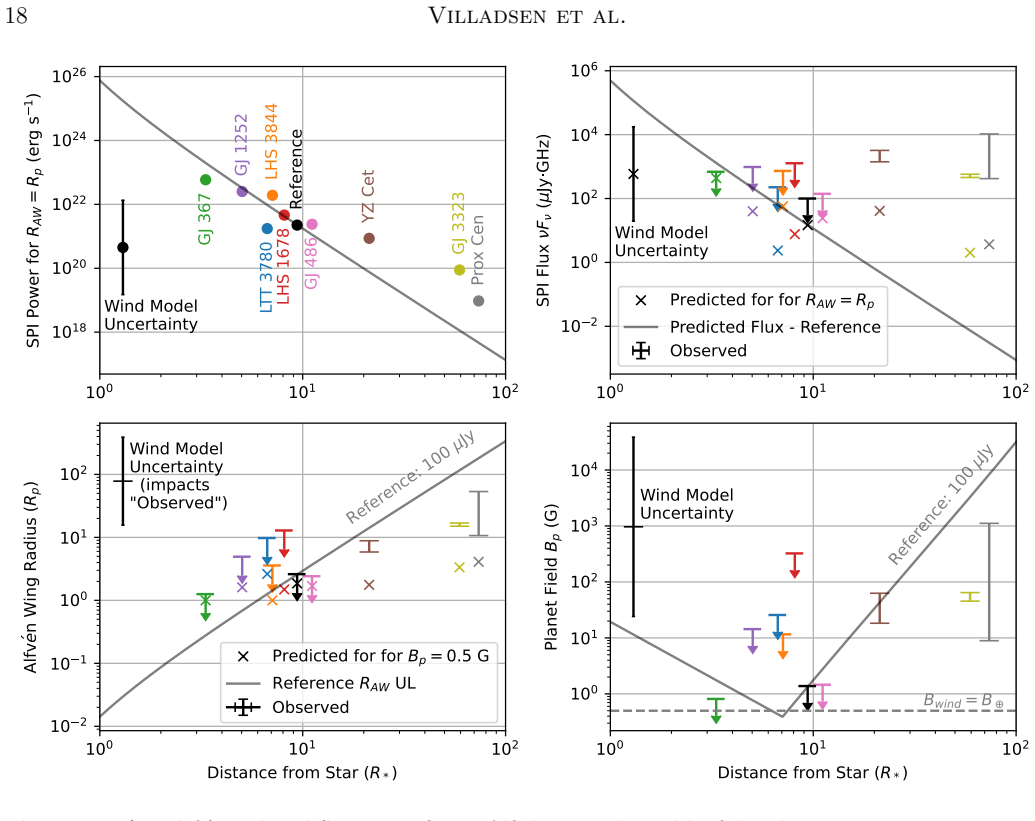
The central claim is that the absence of detectable planet-induced radio emission at GHz frequencies from these systems allows constraints on exoplanet magnetic fields via the sub-Alfvénic interaction model, specifically for GJ 367 b yielding a field upper limit of 0.8 G and no extended magnetosphere, although this depends on stellar wind parameters derived from rotation periods. The detections of quiescent emission in two stars indicate ongoing magnetic activity despite their ages and low variability.
What carries the argument
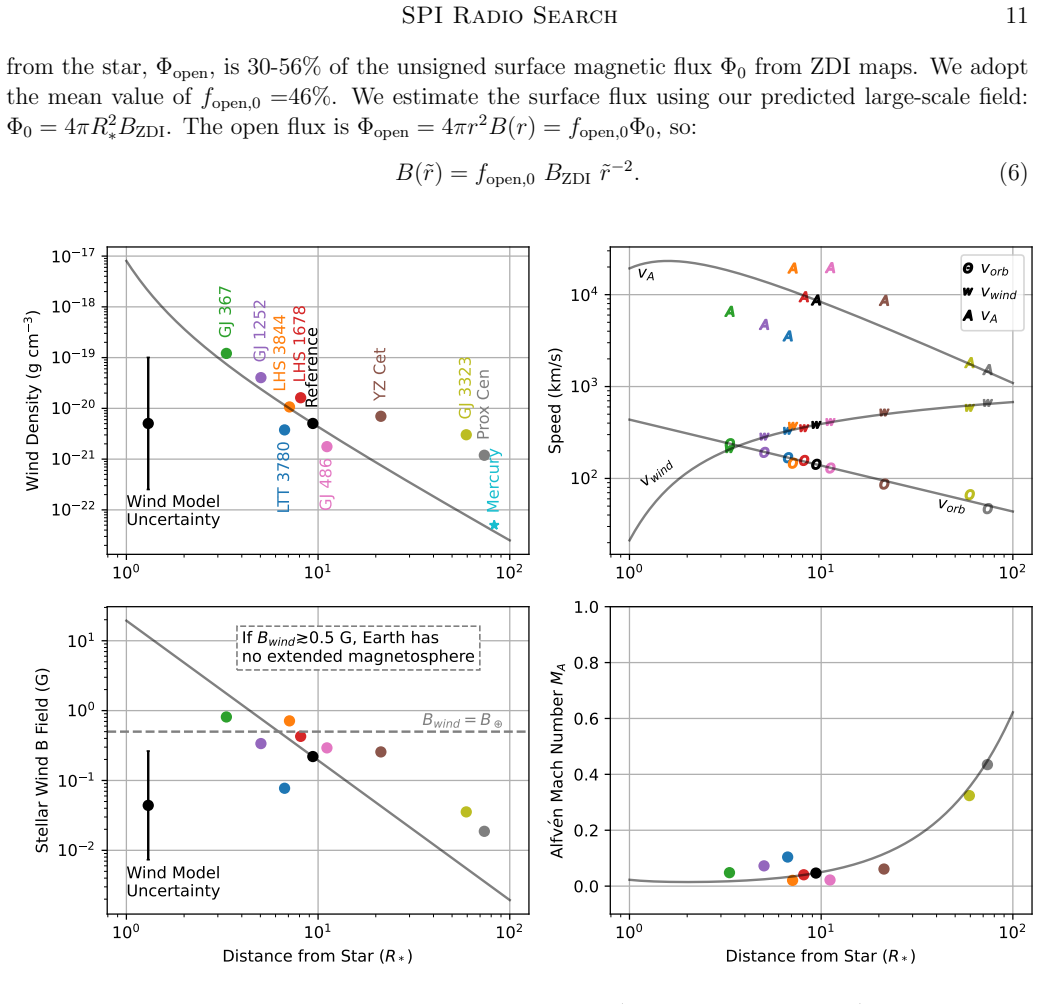
The sub-Alfvénic star-planet interaction (SPI) mechanism that can produce radio emission when a planet's magnetosphere interacts with the stellar wind, combined with conversion of flux-density upper limits into field-strength bounds using modeled wind density and velocity.
If this is right
- If the non-detections are due to insufficient flux density rather than beaming or frequency cutoff, the planets lack extended magnetospheres.
- GJ 367 b is limited to a magnetic field below 0.8 G with no extended magnetosphere under the assumed wind conditions.
- The observed systems have orbital distances that should favor SPI more than most literature candidates, creating a tension that requires either favorable wind or geometry conditions on the candidates or a non-SPI explanation for those detections.
- The results support shifting future searches for radio SPI to sub-GHz frequencies with sensitive arrays such as MeerKAT.
Where Pith is reading between the lines
- Direct measurements of stellar wind parameters for these specific M dwarfs would test whether the derived field limits are robust or artifacts of the rotation-period scaling.
- If non-detections persist at lower frequencies, many reported radio SPI candidates may originate from stellar activity rather than planets.
- The two stars with quiescent radio detections could be used as targets for radio transit searches to separate planetary from stellar signals.
- The approach highlights the value of combining radio non-detections with independent constraints on stellar winds to refine exoplanet magnetosphere statistics.
Load-bearing premise
The stellar wind density and speed are correctly estimated from the stars' rotation periods rather than measured directly.
What would settle it
A direct measurement of the stellar wind parameters for GJ 367's host star that shows density or velocity values differing enough from the rotation-based estimates to raise the allowable exoplanet field strength above 0.8 G.
Figures
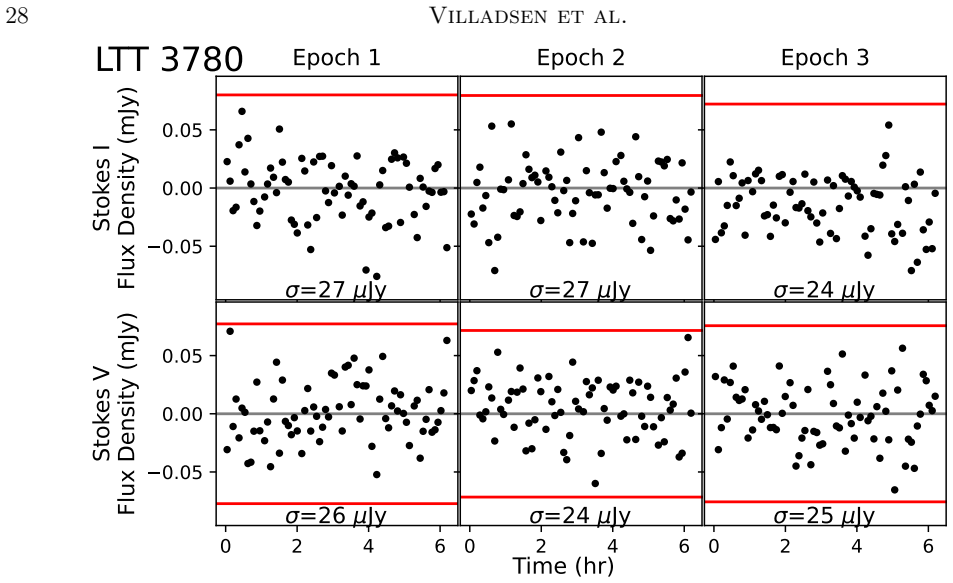
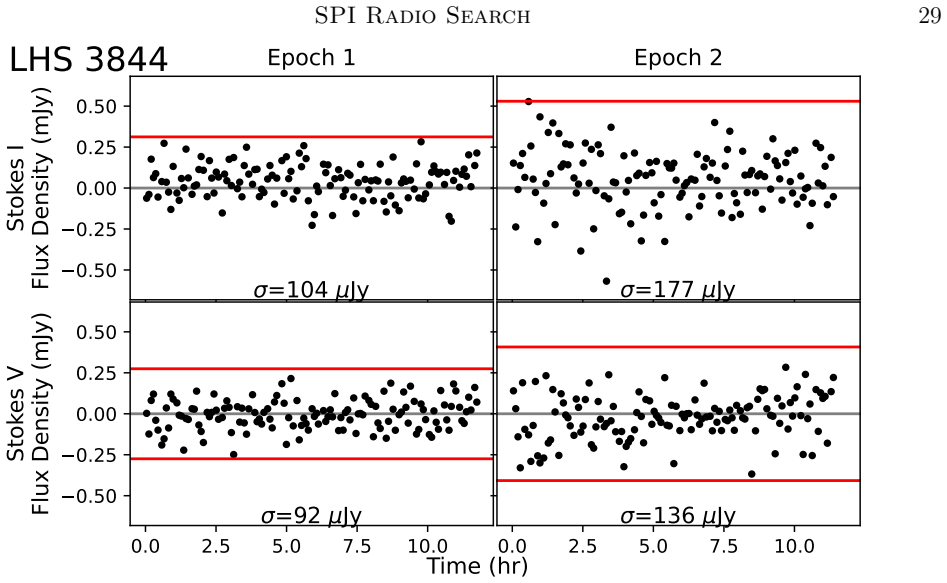
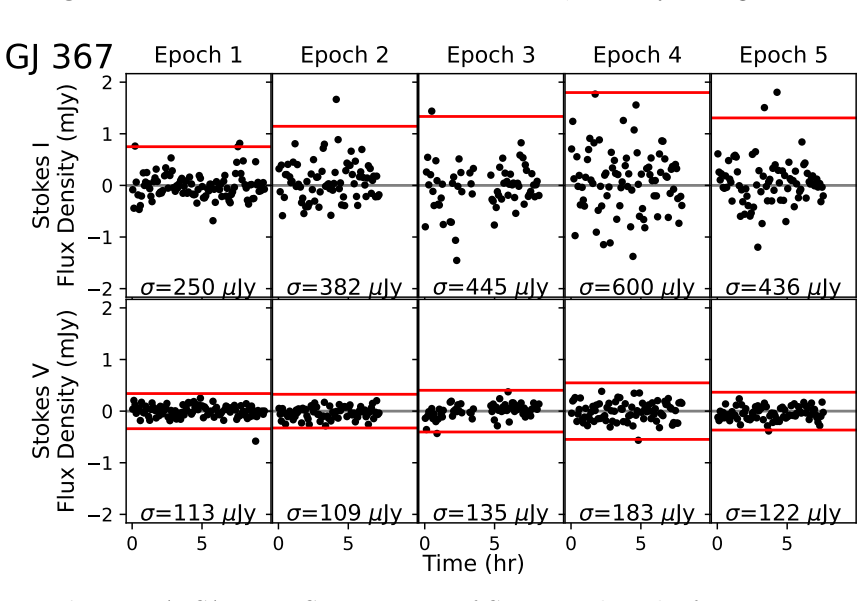
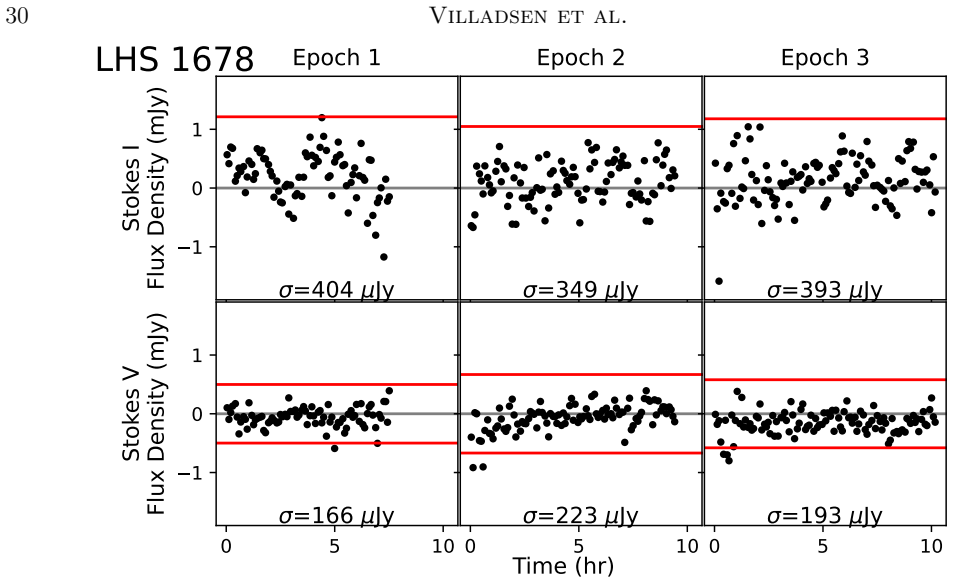
read the original abstract
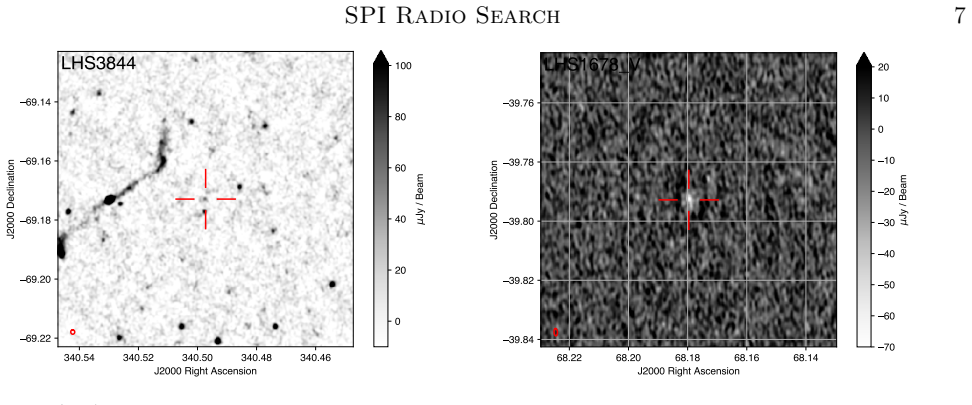
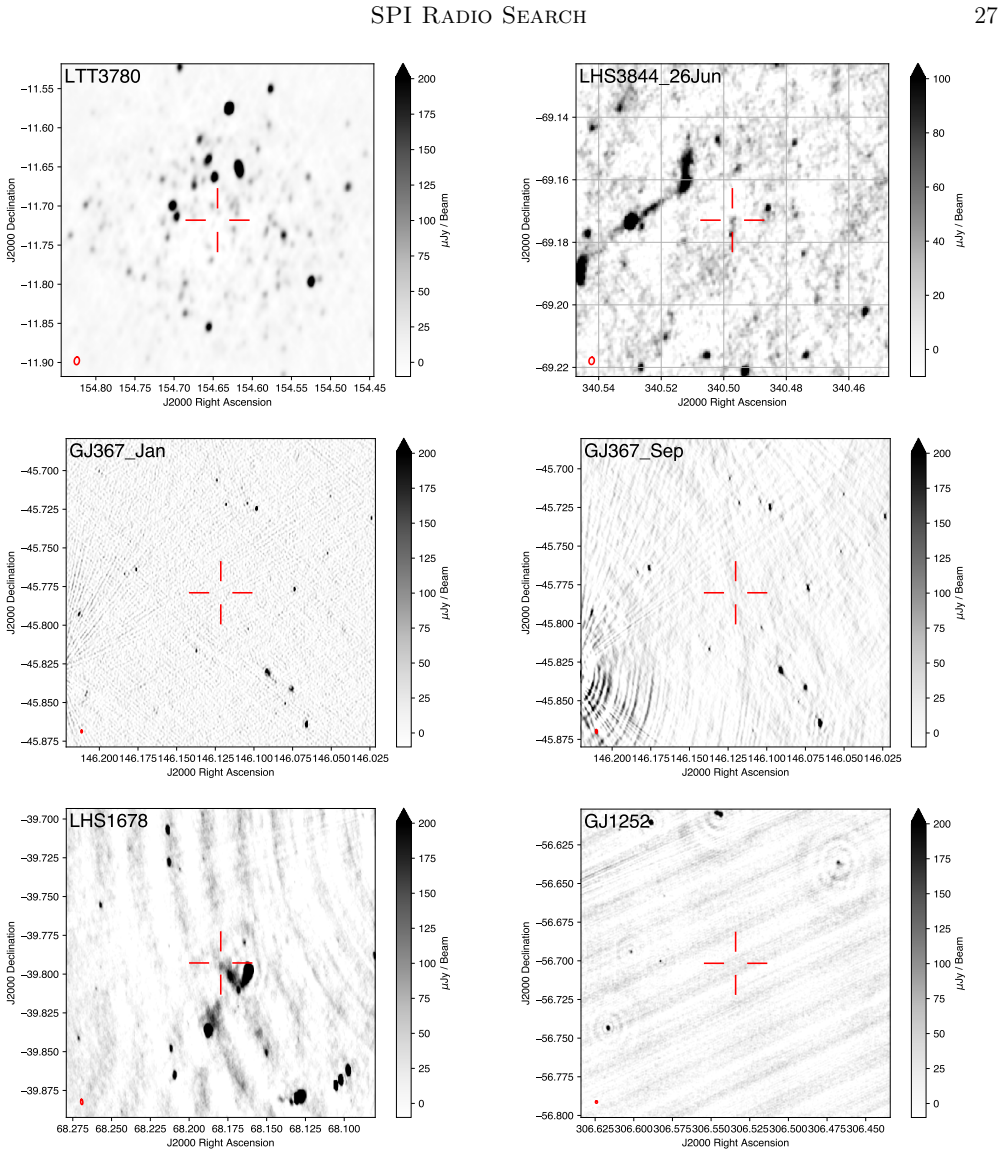
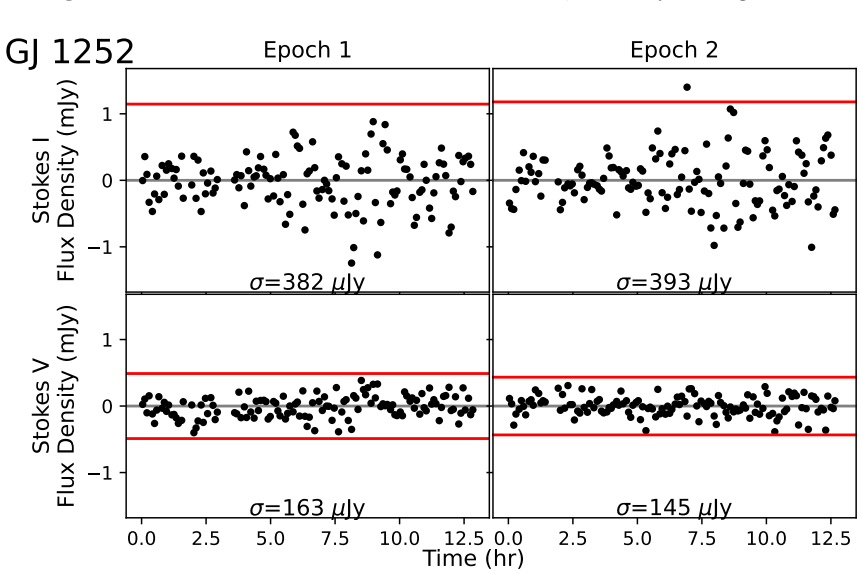
Nearby short-period exoplanet systems may produce detectable stellar radio emission due to sub-Alfv\'enic star-planet interaction (SPI), but there are no confirmed cases yet. We targeted five slowly-rotating M dwarfs with transiting terrestrial planets, observing at GHz frequencies throughout their sub-day orbital periods. We did not detect any bursty SPI-like emission, but detected two stars in quiescence: LHS 3844 (unpolarized) and LHS 1678 (circularly polarized). These detections imply persistent magnetic activity at Gyr ages, especially notable for LHS 1678 given its low photometric variability, and can serve as targets for radio transit experiments. Our SPI non-detections may be due to radio beaming geometry, a sub-GHz maximum emission frequency, or undetectable flux density. If the last case applies, then flux density upper limits constrain the exoplanet magnetosphere. GJ 367 b has the tightest constraints -- no extended magnetosphere and an exoplanet field <0.8 G -- although these results depend strongly on unknown stellar wind parameters inferred from stellar rotation period. Due to their small orbital distance, our non-detection systems a priori appear to have more favorable conditions for SPI than most radio-detected SPI candidate systems in the literature, a tension that can either be resolved by favorable wind/geometry conditions on the detected candidates or by a non-SPI (stellar activity) explanation for those candidate detections. Our results favor the approach of sub-GHz searches for radio SPI, especially with the sensitivity of new/upcoming facilities such as MeerKAT, and underscore the need for observational and theoretical work to constrain the magnetized stellar wind parameters.
Editorial analysis
A structured set of objections, weighed in public.
Referee Report
Summary. The paper reports GHz radio observations of five slowly rotating M dwarfs with transiting terrestrial planets, finding no bursty star-planet interaction (SPI) emission but detecting quiescent emission from LHS 3844 and LHS 1678. From the non-detections it derives upper limits on planet-induced radio flux and, under assumptions about stellar winds, infers constraints on exoplanet magnetospheres, with the strongest limit being no extended magnetosphere and B_p < 0.8 G for GJ 367 b. The work also notes persistent magnetic activity at Gyr ages and discusses tensions with literature SPI candidates, favoring sub-GHz searches.
Significance. If the central non-detection results hold, the paper supplies useful observational upper limits on GHz SPI and identifies targets for future radio transit experiments. The quiescent detections add to the record of magnetic activity in old, low-variability M dwarfs. The discussion of model-dependent magnetosphere bounds and the call for better stellar-wind constraints are constructive, though the quantitative field-strength claim is only as robust as the adopted wind parameters.
major comments (1)
- [GJ 367 b magnetosphere constraints paragraph] The section deriving the GJ 367 b magnetosphere constraints (the paragraph stating 'GJ 367 b has the tightest constraints -- no extended magnetosphere and an exoplanet field <0.8 G'): the reported quantitative bound relies on specific stellar wind density and velocity values inferred from rotation-period scaling relations rather than direct measurement. The manuscript notes the dependence but does not propagate plausible uncertainties in these parameters (which can shift the bound by a factor of several) or present a range of allowed field strengths under different wind conditions; this makes the headline numerical limit load-bearing on unverified external inputs.
minor comments (2)
- [Abstract] The abstract and introduction could more explicitly separate the direct observational non-detections from the subsequent model-dependent interpretation of magnetosphere size and field strength.
- [Methods/Results transition] Notation for stellar wind parameters (n, v) and the Poynting flux calculation should be defined once in a dedicated methods subsection rather than introduced inline in the results.
Simulated Author's Rebuttal
We thank the referee for their constructive review and for recognizing the value of our non-detections and quiescent detections. We address the single major comment below and will incorporate revisions to improve the presentation of the magnetosphere constraints.
read point-by-point responses
-
Referee: [GJ 367 b magnetosphere constraints paragraph] The section deriving the GJ 367 b magnetosphere constraints (the paragraph stating 'GJ 367 b has the tightest constraints -- no extended magnetosphere and an exoplanet field <0.8 G'): the reported quantitative bound relies on specific stellar wind density and velocity values inferred from rotation-period scaling relations rather than direct measurement. The manuscript notes the dependence but does not propagate plausible uncertainties in these parameters (which can shift the bound by a factor of several) or present a range of allowed field strengths under different wind conditions; this makes the headline numerical limit load-bearing on unverified external inputs.
Authors: We agree that explicitly propagating uncertainties in the adopted stellar wind parameters and presenting a range of allowed exoplanet field strengths would make the constraint more robust and transparent. Although the manuscript already states that the results 'depend strongly on unknown stellar wind parameters inferred from stellar rotation period,' we did not quantify the effect of plausible variations. In the revised manuscript we will add a short discussion (and possibly a small table or figure inset) showing how the <0.8 G limit shifts under wind densities and velocities that differ by factors of a few, consistent with the scatter reported in the rotation-period scaling literature. This will contextualize the headline number without altering the central non-detection result. revision: yes
Circularity Check
No significant circularity; results are observational upper limits with external assumptions
full rationale
The paper reports direct non-detections of SPI-like radio emission and derives flux-density upper limits from the observations. The quantitative planetary field bound (<0.8 G) and 'no extended magnetosphere' statement for GJ 367 b are obtained by applying external stellar-wind scaling relations (based on measured rotation periods) to convert those flux limits into magnetospheric constraints. These wind parameters are not fitted from the radio data, nor are they defined in terms of the target result; the paper explicitly flags the dependence. No self-definitional, fitted-input-called-prediction, or self-citation load-bearing steps appear in the derivation chain. The central claims therefore remain independent of the paper's own inputs.
Axiom & Free-Parameter Ledger
free parameters (1)
- stellar wind density and velocity
axioms (1)
- domain assumption Radio emission from star-planet interaction, if present, occurs at GHz frequencies and is not always beamed away from Earth.
Reference graph
Works this paper leans on
-
[1]
Exoplanet-induced radio emission from M-dwarfs
Exoplanet-induced Radio Emission from M Dwarfs. , keywords =. doi:10.3847/1538-4357/aaa59c , archivePrefix =. 1801.01324 , primaryClass =
work page internal anchor Pith review Pith/arXiv arXiv doi:10.3847/1538-4357/aaa59c
-
[2]
New views of the solar wind with the Lambert W function
New views of the solar wind with the Lambert W function. American Journal of Physics , keywords =. doi:10.1119/1.1775242 , archivePrefix =. astro-ph/0406176 , primaryClass =
work page internal anchor Pith review Pith/arXiv arXiv doi:10.1119/1.1775242
-
[3]
Io-controlled decameter arcs and Io-Jupiter interaction. , keywords =. doi:10.1029/98JA02435 , adsurl =
-
[4]
, year = 2001, month = mar, volume =
Flux, power, energy and polarization of Jovian S-bursts. , year = 2001, month = mar, volume =. doi:10.1016/S0032-0633(00)00157-4 , adsurl =
-
[5]
Magnetic energy fluxes in sub-Alfv \'e nic planet star and moon planet interactions. , keywords =. doi:10.1051/0004-6361/201118179 , adsurl =
-
[6]
Wilson and Shkolnik, Evgenya L
Cauley, P. Wilson and Shkolnik, Evgenya L. and Llama, Joe and Bourrier, Vincent and Moutou, Claire , year=. Evidence of Magnetic Star–Planet Interactions in the HD 189733 System from Orbitally Phased Ca ii K Variations , volume=. The Astronomical Journal , publisher=. doi:10.3847/1538-3881/aae841 , number=
-
[7]
Magnetic field strengths of hot Jupiters from signals of star-planet interactions
Magnetic field strengths of hot Jupiters from signals of star-planet interactions. Nature Astronomy , keywords =. doi:10.1038/s41550-019-0840-x , archivePrefix =. 1907.09068 , primaryClass =
work page internal anchor Pith review Pith/arXiv arXiv doi:10.1038/s41550-019-0840-x 1907
-
[8]
Radio Emission from UV Cet: Auroral Emission from a Stellar Magnetosphere. , keywords =. doi:10.3847/1538-4357/ac7d57 , archivePrefix =. 2206.14099 , primaryClass =
-
[9]
154 MHz detection of faint, polarized flares from UV Ceti
154 MHz Detection of Faint, Polarized Flares from UV Ceti. , keywords =. doi:10.3847/2041-8213/aa5ffd , archivePrefix =. 1702.03030 , primaryClass =
work page internal anchor Pith review Pith/arXiv arXiv doi:10.3847/2041-8213/aa5ffd 2041
-
[10]
The population of M dwarfs observed at low radio frequencies. Nature Astronomy , keywords =. doi:10.1038/s41550-021-01483-0 , archivePrefix =. 2110.03713 , primaryClass =
-
[11]
Sebastian and Hallinan, Gregg , year=
Pineda, J. Sebastian and Hallinan, Gregg , year=. A Deep Radio Limit for the TRAPPIST-1 System , volume=. The Astrophysical Journal , publisher=. doi:10.3847/1538-4357/aae078 , number=
-
[12]
Coherent radio bursts from known M-dwarf planet-host YZ Ceti. Nature Astronomy , keywords =. doi:10.1038/s41550-023-01914-0 , archivePrefix =. 2304.00031 , primaryClass =
-
[13]
Coherent radio emission from a quiescent red dwarf indicative of star-planet interaction. Nature Astronomy , keywords =. doi:10.1038/s41550-020-1011-9 , archivePrefix =. 2002.08727 , primaryClass =
-
[14]
, year = 1968, month = mar, volume =
Electrodynamic Effects of Jupiter's Satellite Io. , year = 1968, month = mar, volume =. doi:10.1038/217935a0 , adsurl =
-
[15]
TESS delivers its first Earth-sized planet and a warm sub-Neptune
TESS Delivers Its First Earth-sized Planet and a Warm Sub-Neptune. , keywords =. doi:10.3847/2041-8213/ab12ed , archivePrefix =. 1901.00051 , primaryClass =
work page internal anchor Pith review Pith/arXiv arXiv doi:10.3847/2041-8213/ab12ed 2041
-
[16]
How stars and planets interact: a look through the high-energy window
How stars and planets interact: A look through the high-energy window. Astronomische Nachrichten , keywords =. doi:10.1002/asna.201913619 , archivePrefix =. 1904.03939 , primaryClass =
work page internal anchor Pith review Pith/arXiv arXiv doi:10.1002/asna.201913619 1904
-
[17]
20th Cambridge Workshop on Cool Stars, Stellar Systems and the Sun , year = 2018, series =
How planets affect cool stars. 20th Cambridge Workshop on Cool Stars, Stellar Systems and the Sun , year = 2018, series =. doi:10.5281/zenodo.1460576 , adsurl =
-
[18]
Astronomical Data Analysis Software and Systems XVI , year = 2007, editor =
CASA Architecture and Applications. Astronomical Data Analysis Software and Systems XVI , year = 2007, editor =
2007
-
[19]
Ultra-Wideband Detection of 22 Coherent Radio Bursts on M Dwarfs
Ultra-wideband Detection of 22 Coherent Radio Bursts on M Dwarfs. , keywords =. doi:10.3847/1538-4357/aaf88e , archivePrefix =. 1810.00855 , primaryClass =
work page internal anchor Pith review Pith/arXiv arXiv doi:10.3847/1538-4357/aaf88e
-
[20]
and Vanderburg, Andrew and Ricker, George R
Vanderspek, Roland and Huang, Chelsea X. and Vanderburg, Andrew and Ricker, George R. and Latham, David W. and Seager, Sara and Winn, Joshua N. and Jenkins, Jon M. and Burt, Jennifer and Dittmann, Jason and et al. , year=. TESS Discovery of an Ultra-short-period Planet around the Nearby M Dwarf LHS 3844 , volume=. The Astrophysical Journal , publisher=. d...
-
[21]
Absence of a thick atmosphere on the terrestrial exoplanet LHS 3844b. , keywords =. doi:10.1038/s41586-019-1497-4 , archivePrefix =. 1908.06834 , primaryClass =
-
[22]
Magnetic fields in M dwarfs from the CARMENES survey
Magnetic fields in M dwarfs from the CARMENES survey. , keywords =. doi:10.1051/0004-6361/201935315 , archivePrefix =. 1904.12762 , primaryClass =
work page internal anchor Pith review Pith/arXiv arXiv doi:10.1051/0004-6361/201935315 1904
-
[23]
Planet-induced radio emission from the coronae of M dwarfs: the case of Prox Cen and AU Mic. , keywords =. doi:10.1093/mnras/stab929 , archivePrefix =. 2103.16318 , primaryClass =
-
[24]
Global trends in winds of M dwarf stars. , keywords =. doi:10.1093/mnras/staa798 , archivePrefix =. 2003.08812 , primaryClass =
-
[25]
Detection of 2 4 GHz Continuum Emission from ɛ Eridani. , keywords =. doi:10.3847/1538-4357/abc004 , archivePrefix =. 2010.05929 , primaryClass =
-
[26]
Phenomenology and periodicity of radio emission from the stellar system AU Microscopii. , keywords =. doi:10.1051/0004-6361/202348065 , archivePrefix =. 2312.09071 , primaryClass =
-
[27]
uGMRT Survey of EXoplanets Around M-dwarfs (GS-EXAM): Radio Observations of GJ 1151. , keywords =. doi:10.3847/1538-3881/ad84e4 , archivePrefix =. 2409.18507 , primaryClass =
-
[28]
Modelling the Hidden Magnetic Field of Low-Mass Stars
Modelling the hidden magnetic field of low-mass stars. , keywords =. doi:10.1093/mnras/stu091 , archivePrefix =. 1401.4545 , primaryClass =
work page internal anchor Pith review Pith/arXiv arXiv doi:10.1093/mnras/stu091
-
[29]
Average magnetic field measurements in 292 M dwarfs
Magnetism, rotation, and nonthermal emission in cool stars. Average magnetic field measurements in 292 M dwarfs. , keywords =. doi:10.1051/0004-6361/202243251 , archivePrefix =. 2204.00342 , primaryClass =
-
[30]
On the magnetic topology of partially and fully convective stars
On the magnetic topology of partially and fully convective stars. , keywords =. doi:10.1051/0004-6361:200811450 , archivePrefix =. 0901.1659 , primaryClass =
work page internal anchor Pith review Pith/arXiv arXiv doi:10.1051/0004-6361:200811450
-
[31]
SPIRou reveals unusually strong magnetic fields of slowly rotating M dwarfs. , keywords =. doi:10.1093/mnras/stad3472 , archivePrefix =. 2311.05039 , primaryClass =
-
[32]
The high-energy environment of the heavy sub-Earth GJ 367 b indicates likely complete evaporation of its atmosphere. , keywords =. doi:10.1051/0004-6361/202449351 , archivePrefix =. 2401.17302 , primaryClass =
-
[33]
The UV and X-ray activity of the M dwarfs within 10pc of the Sun
The UV and X-ray activity of the M dwarfs within 10 pc of the Sun. , keywords =. doi:10.1093/mnras/stt225 , archivePrefix =. 1302.1061 , primaryClass =
work page internal anchor Pith review Pith/arXiv arXiv doi:10.1093/mnras/stt225
-
[34]
NEXXUS: A comprehensive ROSAT survey of coronal X-ray emission among nearby solar-like stars
NEXXUS: A comprehensive ROSAT survey of coronal X-ray emission among nearby solar-like stars. , keywords =. doi:10.1051/0004-6361:20030495 , archivePrefix =. astro-ph/0308510 , primaryClass =
work page internal anchor Pith review Pith/arXiv arXiv doi:10.1051/0004-6361:20030495
-
[35]
Searching for star-planet interactions in GJ 486 at radio wavelengths with the uGMRT. , keywords =. doi:10.1051/0004-6361/202451835 , archivePrefix =. 2411.17689 , primaryClass =
-
[36]
The Sun as an X-ray star: Active region evolution, rotational modulation, and implications for stellar X-ray variability. , keywords =. doi:10.1051/0004-6361:20040207 , adsurl =
-
[37]
Radio signatures of star-planet interactions, exoplanets and space weather. Nature Astronomy , keywords =. doi:10.1038/s41550-024-02405-6 , archivePrefix =. 2409.15507 , primaryClass =
-
[38]
A Volume-limited Radio Search for Magnetic Activity in 140 Exoplanets with the Very Large Array. , keywords =. doi:10.3847/1538-3881/ad58be , archivePrefix =. 2404.16940 , primaryClass =
-
[39]
Mass--Spectral Class Relationship for M Dwarfs. , keywords =. doi:10.1086/309988 , adsurl =
-
[40]
Reports on Progress in Physics , year = 1993, month = jun, volume =
Planetary magnetospheres. Reports on Progress in Physics , year = 1993, month = jun, volume =. doi:10.1088/0034-4885/56/6/001 , adsurl =
-
[41]
Identifying the coronal content with HamStar
The SRG/eROSITA all-sky survey. Identifying the coronal content with HamStar. , keywords =. doi:10.1051/0004-6361/202348278 , archivePrefix =. 2401.17282 , primaryClass =
-
[42]
Modelling magnetic star-planet interaction in the iconic M dwarfs Proxima Centauri, YZ Ceti and GJ 1151. , keywords =. doi:10.1093/mnras/staf1467 , archivePrefix =. 2508.20891 , primaryClass =
-
[43]
The magnetic and spin-down properties of slowly rotating fully convective M dwarfs. , keywords =. doi:10.1093/mnras/staf1197 , archivePrefix =. 2507.16986 , primaryClass =
-
[44]
Magnetized Winds of M-type Stars and Star Planet Magnetic Interactions: Uncertainties and Modeling Strategy. , keywords =. doi:10.3847/1538-4357/ad8132 , archivePrefix =. 2410.01621 , primaryClass =
-
[45]
Stellar magnetism: empirical trends with age and rotation
Stellar magnetism: empirical trends with age and rotation. , keywords =. doi:10.1093/mnras/stu728 , archivePrefix =. 1404.2733 , primaryClass =
work page internal anchor Pith review Pith/arXiv arXiv doi:10.1093/mnras/stu728
-
[46]
The Variable Radio Emission of V830 Tau and Its Putative Planet. , keywords =. doi:10.3847/1538-4357/ae03b7 , archivePrefix =. 2509.05082 , primaryClass =
-
[47]
Nature Astronomy , year = 2026, month = jan, doi =
The detection of circularly polarized radio bursts from stellar and exoplanetary systems. Nature Astronomy , year = 2026, month = jan, doi =
2026
-
[48]
A Radio Search for Star-Planet Interaction in TOI-540 and SPECULOOS-3. arXiv e-prints , keywords =. doi:10.48550/arXiv.2512.16852 , archivePrefix =. 2512.16852 , primaryClass =
-
[49]
A New Scaling Law for Non-Dipolar Magnetic Fields in Rapidly Rotating Stars and Planets
A New Scaling Law for Non-Dipolar Magnetic Fields in Rapidly Rotating Stars and Planets. arXiv e-prints , keywords =. doi:10.48550/arXiv.2606.07484 , archivePrefix =. 2606.07484 , primaryClass =
work page internal anchor Pith review Pith/arXiv arXiv doi:10.48550/arxiv.2606.07484
-
[50]
Upper limits on radio emission from the K2-18 system. , keywords =. doi:10.1093/mnras/staf1998 , archivePrefix =. 2511.05427 , primaryClass =
-
[51]
Evaluating Star─Planet Interactions with Zeeman Doppler Imaging: Case Study in YZ Ceti. , keywords =. doi:10.3847/1538-4357/ae2619 , archivePrefix =. 2511.21853 , primaryClass =
-
[52]
Magnetic fields and rotation periods of M dwarfs from SPIRou spectra. , keywords =. doi:10.1093/mnras/stad2301 , archivePrefix =. 2307.14190 , primaryClass =
-
[53]
Stellar winds on the main-sequence. I. Wind model. , keywords =. doi:10.1051/0004-6361/201425300 , archivePrefix =. 1503.06669 , primaryClass =
work page internal anchor Pith review Pith/arXiv arXiv doi:10.1051/0004-6361/201425300
-
[54]
High-energy spectra of LTT 1445A and GJ 486 reveal flares and activity. , keywords =. doi:10.1051/0004-6361/202450107 , archivePrefix =. 2407.00165 , primaryClass =
-
[55]
Detecting Exoplanet Transits with the Next Generation of X-Ray Telescopes. , keywords =. doi:10.3847/1538-3881/ad6d60 , archivePrefix =. 2408.06417 , primaryClass =
-
[56]
The stellar activity-rotation relationship and the evolution of stellar dynamos
The Stellar-activity-Rotation Relationship and the Evolution of Stellar Dynamos. , keywords =. doi:10.1088/0004-637X/743/1/48 , archivePrefix =. 1109.4634 , primaryClass =
work page internal anchor Pith review Pith/arXiv arXiv doi:10.1088/0004-637x/743/1/48
-
[57]
The stellar rotation--activity relationship in fully convective M dwarfs
The stellar rotation-activity relationship in fully convective M dwarfs. , keywords =. doi:10.1093/mnras/sty1670 , archivePrefix =. 1807.03304 , primaryClass =
work page internal anchor Pith review Pith/arXiv arXiv doi:10.1093/mnras/sty1670
-
[58]
New Observational Constraints on the Winds of M dwarf Stars. , keywords =. doi:10.3847/1538-4357/abfda5 , archivePrefix =. 2105.00019 , primaryClass =
-
[59]
M-dwarf stellar winds: the effects of realistic magnetic geometry on rotational evolution and planets. , keywords =. doi:10.1093/mnras/stt2265 , archivePrefix =. 1311.5063 , primaryClass =
work page internal anchor Pith review Pith/arXiv arXiv doi:10.1093/mnras/stt2265
-
[60]
, keywords =
Monitoring the radio emission of Proxima Centauri. , keywords =
-
[61]
, year = 1958, month = nov, volume =
Dynamics of the Interplanetary Gas and Magnetic Fields. , year = 1958, month = nov, volume =. doi:10.1086/146579 , adsurl =
-
[62]
Measurements of Flow Speeds in the Corona Between 2 and 30 R _. , keywords =. doi:10.1086/304338 , adsurl =
-
[63]
, year = 1967, month = apr, volume =
The Angular Momentum of the Solar Wind. , year = 1967, month = apr, volume =. doi:10.1086/149138 , adsurl =
-
[64]
Jupiter radio emission induced by Ganymede and consequences for the radio detection of exoplanets
Jupiter radio emission induced by Ganymede and consequences for the radio detection of exoplanets. , keywords =. doi:10.1051/0004-6361/201833586 , archivePrefix =. 1808.08055 , primaryClass =
work page internal anchor Pith review Pith/arXiv arXiv doi:10.1051/0004-6361/201833586
-
[65]
Star-Planet Interaction at radio wavelengths in YZ Ceti: Inferring planetary magnetic field. arXiv e-prints , keywords =. doi:10.48550/arXiv.2305.00809 , archivePrefix =. 2305.00809 , primaryClass =
-
[66]
Stellar coronal magnetic fields and star-planet interaction
Stellar coronal magnetic fields and star-planet interaction. , keywords =. doi:10.1051/0004-6361/200912367 , archivePrefix =. 0906.1738 , primaryClass =
work page internal anchor Pith review Pith/arXiv arXiv doi:10.1051/0004-6361/200912367
-
[67]
Gallet, F. and Charbonnel, C. and Amard, L. and Brun, S. and Palacios, A. and Mathis, S. , year=. Impacts of stellar evolution and dynamics on the habitable zone: The role of rotation and magnetic activity , volume=. doi:10.1051/0004-6361/201629034 , journal=
-
[68]
Statistical analysis of 26 yr of observations of decametric radio emissions from Jupiter. , keywords =. doi:10.1051/0004-6361/201630025 , adsurl =
-
[69]
The Detectability of Rocky Planet Surface and Atmosphere Composition with the JWST: The Case of LHS 3844b. , keywords =. doi:10.3847/1538-3881/ac9ab3 , archivePrefix =. 2207.08889 , primaryClass =
-
[70]
Hunting for exoplanets via magnetic star-planet interactions: geometrical considerations for radio emission. , keywords =. doi:10.1093/mnras/stad2035 , archivePrefix =. 2307.02555 , primaryClass =
-
[71]
A Panchromatic View of Brown Dwarf Aurorae
A Panchromatic View of Brown Dwarf Aurorae. , keywords =. doi:10.3847/1538-4357/aa8596 , archivePrefix =. 1708.02942 , primaryClass =
work page internal anchor Pith review Pith/arXiv arXiv doi:10.3847/1538-4357/aa8596
-
[72]
Optical Transmission Spectroscopy of the Terrestrial Exoplanet LHS 3844b from 13 Ground-based Transit Observations. , keywords =. doi:10.3847/1538-3881/abaf4f , archivePrefix =. 2008.05444 , primaryClass =
-
[73]
Hot Rocks Survey. IV. Emission from LTT 3780 b Is Consistent with a Bare Rock. , keywords =. doi:10.3847/1538-3881/adfc51 , archivePrefix =. 2508.14210 , primaryClass =
-
[74]
Characterizing M dwarf host stars of two candidate Hycean worlds. , keywords =. doi:10.1093/mnras/staf528 , archivePrefix =. 2503.19908 , primaryClass =
-
[75]
The High-energy Spectrum of the Nearby Planet-hosting Inactive Mid-M Dwarf LHS 3844. , keywords =. doi:10.3847/1538-3881/abfa1c , archivePrefix =. 2104.10522 , primaryClass =
-
[76]
A Volatile-poor Formation of LHS 3844b Based on Its Lack of Significant Atmosphere. , keywords =. doi:10.3847/PSJ/abaab5 , archivePrefix =. 2007.14493 , primaryClass =
-
[77]
Hemispheric Tectonics on LHS 3844b. , keywords =. doi:10.3847/2041-8213/abe400 , archivePrefix =. 2103.02374 , primaryClass =
-
[78]
Flare Rates, Rotation Periods, and Spectroscopic Activity Indicators of a Volume-complete Sample of Mid- to Late-M Dwarfs within 15 pc. , keywords =. doi:10.3847/1538-4357/abc686 , archivePrefix =. 2010.15635 , primaryClass =
-
[79]
Density, not radius, separates rocky and water-rich small planets orbiting M dwarf stars. Science , keywords =. doi:10.1126/science.abl7164 , archivePrefix =. 2209.03871 , primaryClass =
-
[80]
A Pair of TESS Planets Spanning the Radius Valley around the Nearby Mid-M Dwarf LTT 3780. , keywords =. doi:10.3847/1538-3881/ab91c2 , archivePrefix =. 2003.01136 , primaryClass =
discussion (0)
Sign in with ORCID, Apple, or X to comment. Anyone can read and Pith papers without signing in.