REVIEW 2 major objections 1 minor 48 references
A Differentiable Composite Approximation Framework for Autonomous Underwater Vehicle Maneuvering Modeling from Sea-Trial Data
T0 review · 2 major / 1 minor · reviewed 2026-06-26 · grok-4.3
Pith's one-line read A differentiable composite model combining polynomial and neural bases improves recursive AUV trajectory and velocity predictions from sea-trial data.
desk verdict The joint differentiable polynomial-neural calibration with turning-based current compensation is the actual novelty, but the central claims rest on an unverified preprocessing step. read the letter →
The pith
A machine-rendered reading of the paper's core claim, the machinery that carries it, and where it could break.
The reading
What carries the argument
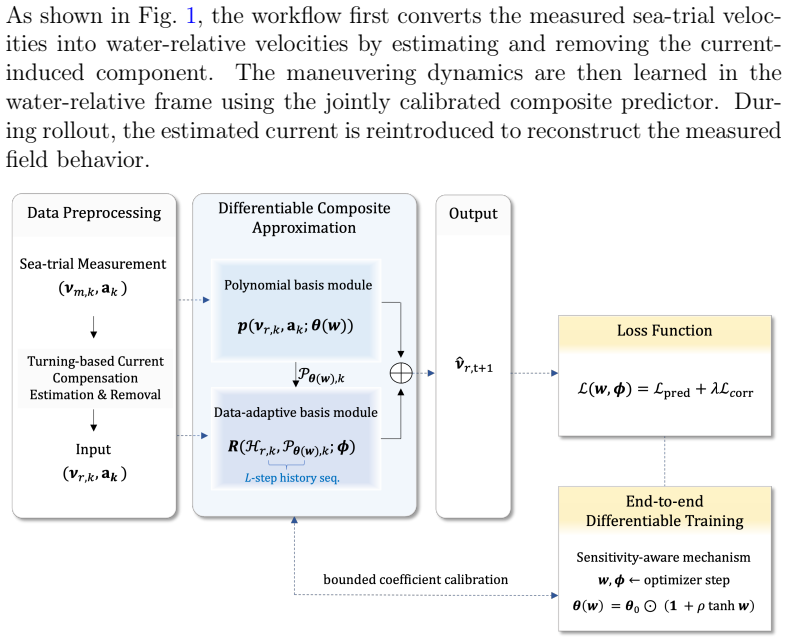
Differentiable composite approximation that treats polynomial bases and neural residuals as co-calibrated elements of one predictor under a shared objective, with sensitivity-aware regulation of the polynomial updates.
What would settle it
An independent sea-trial dataset evaluated with the same recursive rollout metric would falsify the claim if the composite model shows equal or higher trajectory and velocity errors than the strongest baseline.
Extended reading notes
Core claim
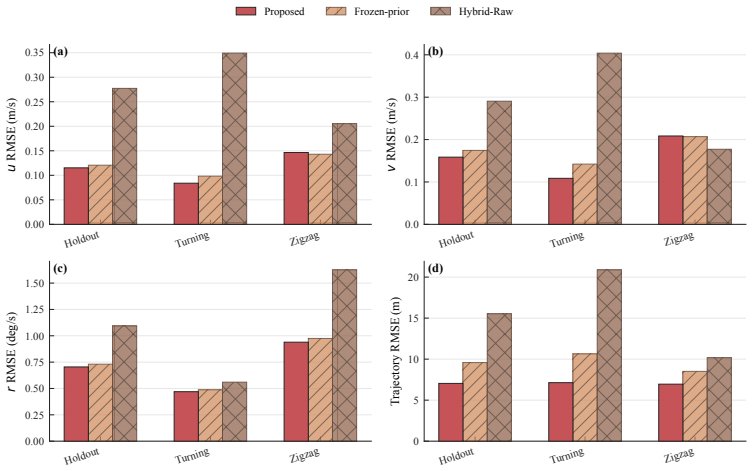
The paper claims that a differentiable composite approximation, in which polynomial-basis and data-adaptive neural components are treated as jointly optimizable parts of a single predictor, produces better recursive trajectory and velocity predictions on sea-trial data after turning-motion-based current compensation than polynomial-only, neural-only, or frozen-prior hybrid baselines.
Load-bearing premise
The turning-motion procedure must produce accurate current-compensated targets and the sensitivity-aware rule must keep polynomial updates bounded without degrading the overall prediction objective.
Editorial extensions
If this is right
- Recursive rollout accuracy for both position and speed improves over single-basis or frozen baselines on field data.
- The method works directly on sea-trial measurements under multiple maneuvering conditions without laboratory models.
- Current compensation isolates vehicle dynamics so the joint training objective can focus on maneuvering effects.
- Gradient co-calibration lets known polynomial structure and data-driven residuals reinforce each other rather than compete.
Reading between the lines
- The same joint-calibration pattern could be applied to surface-vehicle or aircraft models that already contain partial polynomial structure.
- Making the sensitivity bound itself learnable might allow the framework to adapt during online operation on new missions.
- Direct comparison against physics-informed networks on the same AUV logs would clarify whether the explicit polynomial component supplies value beyond end-to-end learning.
Signed reviews
Editorial analysis
A structured set of objections, weighed in public.
Referee Report
Summary. The paper proposes a differentiable composite approximation framework for AUV maneuvering modeling from sea-trial data. Polynomial-basis and data-adaptive (neural) components are treated as differentiable parts of a single predictor and calibrated jointly via gradient-based co-calibration, with a sensitivity-aware mechanism to bound polynomial updates while the neural residual captures remaining discrepancies under a shared objective. A turning-motion-based current estimation and compensation procedure constructs current-compensated targets. Evaluation on sea-trial data from a 7-meter AUV under multiple maneuvers shows improved recursive trajectory and velocity predictions versus polynomial-only, neural-only, and frozen-prior hybrid baselines.
Significance. If the central claims hold after addressing validation gaps, the work offers a practical hybrid modeling route that blends constrained polynomial bases with adaptive neural components for field-data AUV applications. The joint calibration under a shared prediction objective and explicit handling of ocean currents via turning maneuvers address real limitations of pure polynomial or pure neural approaches in robotics. The empirical comparison on actual sea-trial data from a 7m AUV provides a concrete test of applicability.
major comments (2)
- [Abstract] Abstract (and Methods section on current compensation): the turning-motion-based current estimation and compensation procedure is load-bearing for constructing learning targets, yet the manuscript provides no quantitative checks (error metrics, cross-validation against independent current sensors, or sensitivity analysis to non-constant currents or sensor noise). Inaccuracies here would bias both the sensitivity-aware polynomial updates and neural residuals, undermining all baseline comparisons.
- [Abstract] Abstract (joint calibration description): the claim of joint calibration under a shared objective with the neural residual capturing 'remaining nonlinear discrepancies' after polynomial updates risks circularity, as the neural component may simply fit polynomial residuals; the text presents current estimation as an 'independent preprocessing step' but supplies no equations or independence checks to confirm this.
minor comments (1)
- [Abstract] Abstract: the phrase 'differentiable composite-approximation formulation' and 'basis-function view' would benefit from a brief clarifying sentence or reference in the introduction for readers outside the immediate subfield.
Simulated Author's Rebuttal
We thank the referee for the constructive comments on our manuscript. We address each major comment below with point-by-point responses, indicating where revisions will be made to improve clarity and rigor.
read point-by-point responses
-
Referee: [Abstract] Abstract (and Methods section on current compensation): the turning-motion-based current estimation and compensation procedure is load-bearing for constructing learning targets, yet the manuscript provides no quantitative checks (error metrics, cross-validation against independent current sensors, or sensitivity analysis to non-constant currents or sensor noise). Inaccuracies here would bias both the sensitivity-aware polynomial updates and neural residuals, undermining all baseline comparisons.
Authors: We agree that additional quantitative validation of the current estimation is warranted. In the revised manuscript, we will incorporate error metrics (e.g., consistency of estimated currents across repeated turning maneuvers) and a sensitivity analysis to sensor noise. We will also explicitly discuss limitations for non-constant currents. Cross-validation against independent current sensors cannot be performed, as the sea-trial dataset does not contain such measurements; this will be noted as a limitation. revision: partial
-
Referee: [Abstract] Abstract (joint calibration description): the claim of joint calibration under a shared objective with the neural residual capturing 'remaining nonlinear discrepancies' after polynomial updates risks circularity, as the neural component may simply fit polynomial residuals; the text presents current estimation as an 'independent preprocessing step' but supplies no equations or independence checks to confirm this.
Authors: The joint calibration occurs under a single shared prediction loss, with the sensitivity-aware mechanism explicitly bounding polynomial coefficient updates to prevent the neural component from merely absorbing polynomial residuals. The current estimation is a distinct preprocessing step based on kinematic assumptions from turning maneuvers. In the revision, we will add the governing equations for current estimation and a brief discussion of its separation from the co-calibration process to eliminate any ambiguity. revision: yes
- Cross-validation of current estimates against independent current sensors, as no such sensors were present in the sea-trial dataset.
Circularity Check
No significant circularity detected
full rationale
The paper presents a joint calibration of polynomial and neural components under a shared objective, along with a turning-motion-based current estimation procedure for constructing learning targets. These are methodological design choices evaluated empirically against baselines on sea-trial data. No load-bearing step reduces by the paper's own equations or self-citation to a tautological input; the derivation chain remains self-contained with independent content in the composite formulation and recursive prediction comparisons.
Assumptions & free parameters
Cite this review
Pith. "Pith review of A Differentiable Composite Approximation Framework for Autonomous Underwater Vehicle Maneuvering Modeling from Sea-Trial Data." pith.science (2026). https://pith.science/paper/5TXCZXAU
@misc{pith2026260619711,
  author       = {Pith},
  title        = {Pith review of: A Differentiable Composite Approximation Framework for Autonomous Underwater Vehicle Maneuvering Modeling from Sea-Trial Data},
  year         = {2026},
  howpublished = {\url{https://pith.science/paper/5TXCZXAU}},
  note         = {Machine review of arXiv:2606.19711}
}
read the original abstract
Field-based modeling from onboard measurements can produce autonomous underwater vehicle (AUV) maneuvering models that reflect real operating characteristics. From an approximation perspective, conventional maneuvering models use predefined constraint polynomial bases, whereas data-driven models use data-adaptive bases. Motivated by this basis-function view, this paper presents a differentiable composite-approximation formulation, in which the polynomial-basis component and the data-adaptive basis component are treated as differentiable parts of a single predictor and calibrated jointly. A gradient-based co-calibration method is developed for full-scale AUV maneuvering prediction, where a sensitivity-aware mechanism regulates bounded polynomial updates while the neural residual captures remaining nonlinear discrepancies under a shared prediction objective. To account for ocean-current effects in field data, a turning-motion-based current estimation and compensation procedure is incorporated to construct current-compensated learning targets for training and rollout. The framework is evaluated using sea-trial data collected from a 7-meter AUV under multiple maneuvering conditions. Results show that the proposed method improves recursive trajectory and velocity prediction compared with polynomial-only, neural-only, and frozen-prior hybrid baselines, demonstrating its applicability to field-data-based AUV maneuvering modeling.
Figures

Figures from the paper (8 more)




Reference graph
Works this paper leans on
-
[1]
Journal of Computational Physics , volume=
Physics-informed neural networks: A deep learning framework for solving forward and inverse problems involving nonlinear partial differential equations , author=. Journal of Computational Physics , volume=. 2019 , doi=
2019
-
[2]
Advances in Neural Information Processing Systems , volume=
End-to-End Differentiable Physics for Learning and Control , author=. Advances in Neural Information Processing Systems , volume=
-
[3]
Universal Differential Equations for Scientific Machine Learning
Universal Differential Equations for Scientific Machine Learning , author=. arXiv preprint arXiv:2001.04385 , year=
work page Pith review arXiv 2001
-
[4]
IFAC Proceedings Volumes , volume=
How to Incorporate Wind, Waves and Ocean Currents in the Marine Craft Equations of Motion , author=. IFAC Proceedings Volumes , volume=. 2012 , doi=
2012
-
[5]
IEEE Transactions on Instrumentation and Measurement , volume=
A Hybrid Approach to Motion Prediction for Ship Docking---Integration of a Neural Network Model Into the Ship Dynamic Model , author=. IEEE Transactions on Instrumentation and Measurement , volume=. 2021 , doi=
2021
-
[6]
Ocean Engineering , volume=
Machine Learning Enhancement of Manoeuvring Prediction for Ship Digital Twin Using Full-Scale Recordings , author=. Ocean Engineering , volume=. 2022 , doi=
2022
-
[7]
, title =
Fortunato, S. , title =. Phys. Rep.-Rev. Sec. Phys. Lett. , volume =. 2010 , pages =
2010
-
[8]
Control engineering practice , volume=
On the identification of non-linear models of unmanned underwater vehicles , author=. Control engineering practice , volume=. 2004 , publisher=
2004
Show all 48 references
-
[9]
Experimental investigation of the hydrodynamic coefficients of a remotely operated vehicle using a planar motion mechanism , author=
-
[10]
Virtual planar motion mechanism tests of the autonomous underwater vehicle autosub , author=
-
[11]
Applied Ocean Research , volume=
Hydrodynamic derivative determination based on CFD and motion simulation for a tow-fish , author=. Applied Ocean Research , volume=. 2019 , publisher=
2019
-
[12]
2018 OCEANS-MTS/IEEE Kobe Techno-Oceans (OTO) , pages=
Numerical calculation of hydrodynamic interactions of submarine flow on AUV , author=. 2018 OCEANS-MTS/IEEE Kobe Techno-Oceans (OTO) , pages=. 2018 , organization=
2018
-
[13]
Ocean Engineering , volume=
Identification modeling of underwater vehicles' nonlinear dynamics based on support vector machines , author=. Ocean Engineering , volume=. 2013 , publisher=
2013
-
[14]
Journal of Marine Science and Engineering , volume=
Deep Learning-Based Nonparametric Identification and Path Planning for Autonomous Underwater Vehicles , author=. Journal of Marine Science and Engineering , volume=. 2024 , publisher=
2024
-
[15]
2017 IEEE International Conference on Robotics and Automation (ICRA) , pages=
Experimental evaluation of various machine learning regression methods for model identification of autonomous underwater vehicles , author=. 2017 IEEE International Conference on Robotics and Automation (ICRA) , pages=. 2017 , organization=
2017
-
[16]
International Journal of Automation and Computing , volume=
Dynamic system identification of underwater vehicles using multi-output Gaussian processes , author=. International Journal of Automation and Computing , volume=. 2021 , publisher=
2021
-
[17]
Journal of Marine Science and Engineering , volume=
Research on Modeling Method of Autonomous Underwater Vehicle Based on a Physics-Informed Neural Network , author=. Journal of Marine Science and Engineering , volume=. 2024 , publisher=
2024
-
[18]
Ocean engineering , volume=
Experimental evaluation of the hydrodynamic coefficients of a ROV through Morison’s equation , author=. Ocean engineering , volume=. 2011 , publisher=
2011
-
[19]
Ocean engineering , volume=
Experimental investigation of hydrodynamic force coefficients over AUV hull form , author=. Ocean engineering , volume=. 2009 , publisher=
2009
-
[20]
Review of Scientific Instruments , volume=
An apparatus to estimate the hydrodynamic coefficients of autonomous underwater vehicles using water tunnel testing , author=. Review of Scientific Instruments , volume=. 2016 , pages =
2016
-
[21]
2016 3rd IEEE/OES South American International Symposium on Oceanic Engineering (SAISOE) , pages=
Prediction of the hydrodynamic coefficients of an autonomous underwater vehicle , author=. 2016 3rd IEEE/OES South American International Symposium on Oceanic Engineering (SAISOE) , pages=. 2016 , organization=
2016
-
[22]
The use of computational fluid dynamics to determine the dynamic stability of an autonomous underwater vehicle , author=
-
[23]
Journal of marine science and technology , volume=
Estimation of the hydrodynamic coefficients of the complex-shaped autonomous underwater vehicle TUNA-SAND , author=. Journal of marine science and technology , volume=. 2009 , publisher=
2009
-
[24]
2020 , school=
Neural network modeling of the dynamics of autonomous underwater vehicles for Kalman filtering and improved localization , author=. 2020 , school=
2020
-
[25]
IEEE Journal of Oceanic Engineering , volume=
Online system identification of an autonomous underwater vehicle via in-field experiments , author=. IEEE Journal of Oceanic Engineering , volume=. 2015 , publisher=
2015
-
[26]
IEEE Access , volume =
Machine Learning for Modeling Underwater Vehicle Dynamics: Overview and Insights , author=. IEEE Access , volume =. 2024 , publisher=
2024
-
[27]
Ocean Engineering , volume=
Robust estimation of hydrodynamic coefficients of an AUV using Kalman and H filters , author=. Ocean Engineering , volume=. 2019 , publisher=
2019
-
[28]
Ocean Engineering , volume=
Identification of an Autonomous Underwater Vehicle hydrodynamic model using three Kalman filters , author=. Ocean Engineering , volume=. 2021 , publisher=
2021
-
[29]
International Journal of Advanced Robotic Systems , volume=
The parameter identification of the autonomous underwater vehicle based on multi-innovation least squares identification algorithm , author=. International Journal of Advanced Robotic Systems , volume=. 2020 , publisher=
2020
-
[30]
2022 IEEE/OES Autonomous Underwater Vehicles Symposium (AUV) , pages=
In Situ Damping Parameter Estimation for an Underwater Vehicle Using Onboard Sensors , author=. 2022 IEEE/OES Autonomous Underwater Vehicles Symposium (AUV) , pages=. 2022 , organization=
2022
-
[31]
Ocean Engineering , volume=
Experimental and numerical investigation of the hydrodynamic characteristics of autonomous underwater vehicles over sea-beds with complex topography , author=. Ocean Engineering , volume=. 2020 , publisher=
2020
-
[32]
Journal of Field Robotics , volume=
Fast in-field identification of unmanned marine vehicles , author=. Journal of Field Robotics , volume=. 2011 , publisher=
2011
-
[33]
2007 Mediterranean Conference on Control & Automation , pages=
A framework for obtaining steady-state maneuvering characteristics of underwater vehicles using sea-trial data , author=. 2007 Mediterranean Conference on Control & Automation , pages=. 2007 , organization=
2007
-
[34]
OCEANS 2015-MTS/IEEE Washington , pages=
A comparison of hydrodynamic damping models using least-squares and adaptive identifier methods for autonomous underwater vehicles , author=. OCEANS 2015-MTS/IEEE Washington , pages=. 2015 , organization=
2015
-
[35]
Control engineering practice , volume=
Observer Kalman filter identification of an autonomous underwater vehicle , author=. Control engineering practice , volume=. 2007 , publisher=
2007
-
[36]
International Journal of Advanced Robotic Systems , volume=
Parameter identification of unmanned marine vehicle manoeuvring model based on extended Kalman filter and support vector machine , author=. International Journal of Advanced Robotic Systems , volume=. 2019 , publisher=
2019
-
[37]
IEEE Journal of Oceanic Engineering , volume=
Identification of an autonomous underwater vehicle hydrodynamic model using the extended, cubature, and transformed unscented Kalman filter , author=. IEEE Journal of Oceanic Engineering , volume=. 2017 , publisher=
2017
-
[38]
Ocean Engineering , volume=
Survey on traditional and AI based estimation techniques for hydrodynamic coefficients of autonomous underwater vehicle , author=. Ocean Engineering , volume=. 2023 , publisher=
2023
-
[39]
IEEE Journal of oceanic engineering , volume=
Model-based dynamic positioning of underwater robotic vehicles: theory and experiment , author=. IEEE Journal of oceanic engineering , volume=. 2004 , publisher=
2004
-
[40]
2021 , edition =
Handbook of Marine Craft Hydrodynamics and Motion Control , author =. 2021 , edition =
2021
-
[41]
arXiv preprint arXiv:2504.04583 , year =
Modeling of AUV Dynamics with Limited Resources: Efficient Online Learning Using Uncertainty , author =. arXiv preprint arXiv:2504.04583 , year =
-
[42]
2001 , publisher=
Estimation with applications to tracking and navigation: theory algorithms and software , author=. 2001 , publisher=
2001
-
[43]
Comparison of Mathematical Models for the
Hegrenaes, Oyvind and Hallingstad, Oddvar and Jalving, Bjorn , booktitle=. Comparison of Mathematical Models for the. 2007 , month=
2007
-
[44]
Ocean Engineering , volume=
Knowledge and Data in Cooperative Modeling: Case Studies on Ship Trajectory Prediction , author=. Ocean Engineering , volume=. 2022 , doi=
2022
-
[45]
IEEE Transactions on Industrial Informatics , pages=
Incorporating Approximate Dynamics Into Data-Driven Calibrator: A Representative Model for Ship Maneuvering Prediction , author=. IEEE Transactions on Industrial Informatics , pages=. 2021 , doi=
2021
-
[46]
Applied Ocean Research , volume=
Physics-guided neural network for underwater glider flight modeling , author=. Applied Ocean Research , volume=. 2022 , doi=
2022
-
[47]
Mechanism and Machine Theory , volume=
Incremental residual learning-based dynamic modeling and stability analysis for multipower underwater vehicles , author=. Mechanism and Machine Theory , volume=. 2022 , doi=
2022
-
[48]
Journal of Marine Science and Engineering , volume=
A Physics-Guided Hybrid Network for Robust Hydrodynamic Parameter Identification of UUVs Under Lumped Disturbances , author=. Journal of Marine Science and Engineering , volume=. 2026 , doi=
2026
Reviewed June 26, 2026 · model on record in the stance chip above.
Discussion (0). Continue with ORCID to comment.