Sparse positive maps on qutrits with exact nondecomposability thresholds and PPT-entanglement transitions
Pith reviewed 2026-06-26 17:38 UTC · model grok-4.3
The pith
Sparse positive maps on qutrits admit exact positivity boundaries and PPT-entanglement thresholds via block-structured Choi matrices.
A machine-rendered reading of the paper's core claim, the machinery that carries it, and where it could break.
Core claim
For three representative parametric families of sparse positive maps on qutrits, the block structure of the associated Choi matrices reduces the positivity condition to the analysis of a Hermitian biquadratic form. This reduction yields exact positivity boundaries, the exact transition point between decomposable and non-decomposable maps, and exact separability-to-bound-entanglement thresholds for two classes of associated PPT states. In the trace-preserving subclass the gap between positivity and 2-positivity is made fully explicit through comparison with an eigenvalue bound.
What carries the argument
The block structure of the Choi matrices, which reduces positivity verification to the positivity of a Hermitian biquadratic form.
Load-bearing premise
The block structure of the associated Choi matrices reduces positivity to a Hermitian biquadratic form that permits explicit analysis for the chosen parametric families.
What would settle it
A numerical check that finds a map in one of the three families violating positivity inside the analytically claimed positive region, or a PPT state that is separable below the claimed threshold.
Figures
read the original abstract
We study a family of sparse positive maps on qutrits for which positivity, decomposability, and PPT entanglement can all be analysed explicitly. The block structure of the associated Choi matrices reduces positivity to a Hermitian biquadratic form and leads to exact positivity boundaries for three representative parametric families. For the same families we determine the exact transition between decomposable and non-decomposable maps and construct associated PPT states of two classes. The first consists of witness-adapted deformations naturally tied to the non-decomposability analysis. The second consists of analytically tractable families whose full PPT-entangled branch is detected by fixed positive maps, yielding exact thresholds between separability and bound entanglement. For the trace-preserving subclass, we further compare positivity with a recent eigenvalue bound for 2-positive maps, thereby making the gap between positivity and higher-order positivity fully explicit within this family.
Editorial analysis
A structured set of objections, weighed in public.
Referee Report
Summary. The manuscript analyzes sparse positive maps on qutrits for which the block structure of the associated Choi matrices reduces positivity to a Hermitian biquadratic form. For three representative parametric families this reduction yields exact positivity boundaries, exact decomposable-to-non-decomposable transitions, and two classes of associated PPT states whose separability-to-bound-entanglement thresholds are also obtained exactly. For the trace-preserving subclass the gap between positivity and an eigenvalue bound for 2-positive maps is made explicit.
Significance. The explicit algebraic treatment of positivity, decomposability, and PPT entanglement for deliberately chosen sparse families supplies concrete, fully analytical examples in a setting where such thresholds are typically intractable. The construction of witness-adapted PPT states and the fixed-map detection of entire PPT-entangled branches illustrate the utility of sparsity for obtaining falsifiable, parameter-free boundaries. The direct comparison with the 2-positivity eigenvalue bound further clarifies the distinction between positivity and higher-order positivity within the family.
minor comments (2)
- [Abstract] Abstract, final sentence: the phrase 'making the gap between positivity and higher-order positivity fully explicit' would benefit from a parenthetical reference to the specific eigenvalue bound employed, to orient readers unfamiliar with the cited result.
- [Introduction] The three parametric families are introduced as 'representative'; a brief paragraph early in the manuscript explaining the selection criteria (e.g., sparsity pattern, number of free parameters, or coverage of distinct block structures) would strengthen the claim of representativeness without altering the central results.
Simulated Author's Rebuttal
We thank the referee for the positive assessment of our work and the recommendation of minor revision. No specific major comments were provided in the report.
Circularity Check
No significant circularity
full rationale
The paper selects three specific parametric families of sparse positive maps on qutrits such that the block structure of their Choi matrices reduces positivity to a Hermitian biquadratic form, then derives exact boundaries and thresholds by direct algebraic solution of the resulting equations. This reduction is a deliberate feature of the chosen families rather than a general assertion, and the explicit results follow from standard Choi correspondence and polynomial analysis without any parameter fitting, self-definitional loops, or load-bearing self-citations. The derivation chain is therefore self-contained within the stated scope.
Axiom & Free-Parameter Ledger
axioms (2)
- domain assumption Positivity of a linear map on quantum states is equivalent to positivity of its associated Choi matrix.
- domain assumption The block structure of the sparse maps reduces the positivity condition to a Hermitian biquadratic form amenable to explicit solution.
Reference graph
Works this paper leans on
-
[1]
Moreover, Tr[C(3) a,wρ2] = 1 5(2a+ 1−2 √ 2w).(75) 14 The solution ofTr[C(3) a,wρ2] = 0is w= 2a+ 1 2 √ 2
={3/10,3/10,1/5,1/10,1/10,0,0,0,0}. Moreover, Tr[C(3) a,wρ2] = 1 5(2a+ 1−2 √ 2w).(75) 14 The solution ofTr[C(3) a,wρ2] = 0is w= 2a+ 1 2 √ 2 . This line is tangent to the ellipse in Eq. (73) at the point a= 1 4 , w= 3 √ 2 8 . The second state is ρ3 = 1 10 2· · · · · · · − √ 2 ·2· − √ 2· · · · · · ·1 · · · · · · · − √ 2· 1· · · · · · · · ·...
-
[2]
the fixed witnessC(1) 1/2,1/2 detects entanglement whenever 1 + √ 2 2 < k≤ √ 2
-
[3]
the stateρ1(1)is separable and admits the explicit product decomposition given in Eq.(88)
-
[4]
according to the level-2DPS hierarchy with PPT constraints,ρ1(k)is entangled for everyk >1. Proof.Consider the family ρ1(k) = √ 2−1 4 2· · · · · · · −k · √ 2· −k· · · · · · · √ 2 · · · · · · · −k· √ 2· · · · · · · · ·1· · · · · · · · · · · · · · · · · · · √ 2· · · · · · · · · · · −k· · · · · · ·1 ,(85) which is PPT for0...
-
[5]
both are PPT for all0≤k≤ √ 2
-
[6]
the fixed witnessC(3) 1/3,2/3 detects both families for 5 4 < k≤ √ 2
-
[7]
the CCNR criterion proves entanglement for both families whenever k > √ 10−S 4 ≃1.128, whereSis the largest real root ofS 3 + 2S2 −28S−72 = 0
-
[8]
the statesρ2(1)andρ 3(1)are separable
-
[9]
according to the level-2DPS hierarchy with PPT constraints, both families are entangled for everyk >1. Proof.Consider ρ2(k) = 1 10 2· · · · · · · −k ·1· −k· · · · · · ·2 · · · · · · · −k· 2· · · · · · · · ·1· · · · · · · · · · · · · · · · · · · 1· · · · · · · · · · · −k· · · · · · ·1 , ρ 3(k) = 1 10 2·...
-
[10]
the thresholdk=varises from an explicit decomposition into two2×2PPT blocks
-
[11]
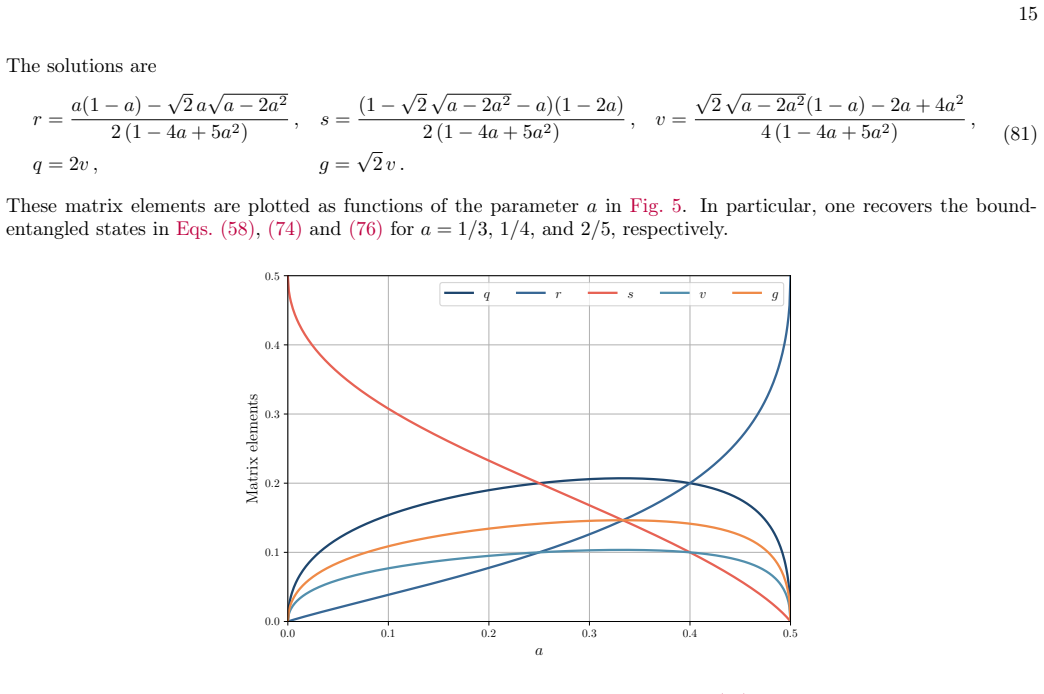
according to the level-2DPS hierarchy with PPT constraints, the state is bound entangled forv < k≤ √ 2v. Proof.Consider the family ξ(a, k) = q· · · · · · · −k ·r· −k· · · · · · ·s · · · · · · · −k· s· · · · · · · · ·v· · · · · · · · · · · · · · · · · · · r· · · · · · · · · · · −k· · · · · · ·v ,(94) with0≤k≤g. Hereq, r,...
-
[12]
Henceσ 1(k)is PPT entangled and detected by the fixed witnessC(1) 1/2,1/2 for every1< k≤ √ 2
=ρ 1, the stateσ1(k)is separable for0≤k≤1and PPT for0≤k≤ √ 2, and Tr C(1) 1/2,1/2 σ1(k) = 1−k 2(1 +k) . Henceσ 1(k)is PPT entangled and detected by the fixed witnessC(1) 1/2,1/2 for every1< k≤ √ 2. Proof.The identityσ 1( √
-
[13]
Moreover, Tr C(1) a,b σ1(k) = a+kb−k 1 +k ,(97) so the choicea=b= 1/2gives the stated expectation value and proves entanglement fork >1
=ρ 1 is immediate from the definitions. Moreover, Tr C(1) a,b σ1(k) = a+kb−k 1 +k ,(97) so the choicea=b= 1/2gives the stated expectation value and proves entanglement fork >1. The stated PPT interval0≤k≤ √ 2follows directly from the2×2principal minors ofσ1(k)and its partial transpose. For0≤k≤1, write σ1(k) = 1 4(1 +k) M1(k) +N 1(k) ,(98) with M1(k) = ...
-
[14]
both families are separable for0≤k≤1
-
[15]
Tr C(3) 1/3,2/3 σ2(k) = Tr C(3) 1/3,2/3 σ3(k) = √ 2−3 15 (k−1), so both are PPT entangled and detected byC(3) 1/3,2/3 for every1< k≤ √ 2
both families are PPT for0≤k≤ √ 2; 4. Tr C(3) 1/3,2/3 σ2(k) = Tr C(3) 1/3,2/3 σ3(k) = √ 2−3 15 (k−1), so both are PPT entangled and detected byC(3) 1/3,2/3 for every1< k≤ √ 2. Proof.For the lower branch0≤k≤1, the two families coincide and admit the block decomposition σ2(k) =σ 3(k) = 1 8 M0(k) +N 0(k) ,(102) with M0(k) = 1 0 0 0 0 1−k0 0−k1 0 0 0 0...
-
[16]
To verify PPT for1≤k≤ √ 2, it is enough to check the two non-trivial determinants of the partial transpose
=ρ 3. To verify PPT for1≤k≤ √ 2, it is enough to check the two non-trivial determinants of the partial transpose. For both families one finds rj(k)sj(k)−g j(k)2 = (k−1)( √ 2−k) 80 ≥0, j= 2,3,(106) and qj(k)vj(k)−g j(k)2 = 14 + 4 √ 2−(8 + 6 √ 2)k+ (2 √ 2−1)k 2 320 ≥0, j= 2,3,(107) throughout the interval1≤k≤ √
-
[17]
Finally, evaluating the fixed witnessC(3) 1/3,2/3 yields the stated expectation value, which is strictly negative for every1< k≤ √ 2
Hence both upper branches are PPT. Finally, evaluating the fixed witnessC(3) 1/3,2/3 yields the stated expectation value, which is strictly negative for every1< k≤ √ 2. The familiesσ 2(k)andσ 3(k)play forρ 2 andρ 3 the same role thatσ1(k)plays forρ 1: they provide explicit inter- polations between a separable regime and a PPT-entangled regime while preser...
-
[18]
Horodecki, P
R. Horodecki, P. Horodecki, M. Horodecki, and K. Horodecki, Rev. Mod. Phys.81, 865 (2009)
2009
-
[19]
Horodecki, P
M. Horodecki, P. Horodecki, and R. Horodecki, Phys. Lett. A223, 1 (1996)
1996
-
[20]
W. A. Majewski and M. Marciniak, J. Phys. A34, 5863 (2001)
2001
-
[21]
Jamiołkowski, Rep
A. Jamiołkowski, Rep. Math. Phys.3, 275 (1972)
1972
-
[22]
Choi, Linear Algebra Its Appl.10, 285 (1975)
M.-D. Choi, Linear Algebra Its Appl.10, 285 (1975)
1975
-
[23]
W. F. Stinespring, Proc. Amer. Math. Soc.6, 211 (1955)
1955
-
[24]
Peres, Phys
A. Peres, Phys. Rev. Lett.77, 1413 (1996)
1996
-
[25]
Benatti, R
F. Benatti, R. Floreanini, and M. Piani, Open Syst. Inf. Dyn.11, 325 (2004)
2004
-
[26]
B. M. Terhal, Linear Algebra Its Appl.323, 61 (2001)
2001
-
[27]
Benatti, R
F. Benatti, R. Floreanini, and M. Piani, Phys. Lett. A326, 187 (2004)
2004
-
[28]
Bhattacharya, S
B. Bhattacharya, S. Goswami, R. Mundra, N. Ganguly, I. Chakrabarty, S. Bhattacharya, and A. Majumdar, J. Phys. Commun.5, 065008 (2021)
2021
-
[29]
S. J. Cho, S.-H. Kye, and S. G. Lee, Linear Algebra Its Appl.171, 213 (1992)
1992
-
[30]
Jafarizadeh, M
M. Jafarizadeh, M. Rezaee, and S. Ahadpour, Phys. Rev. A74, 042335 (2006)
2006
-
[31]
Chruściński, M
D. Chruściński, M. Marciniak, and A. Rutkowski, Acta Math. Vietnam.43, 661 (2018)
2018
-
[32]
Ha and S.-H
K.-C. Ha and S.-H. Kye, Open Syst. Inf. Dyn.20, 1350012 (2013)
2013
-
[33]
Kossakowski, Open Syst
A. Kossakowski, Open Syst. Inf. Dyn.10, 213 (2003)
2003
-
[34]
Chruściński and A
D. Chruściński and A. Kossakowski, Phys. Lett. A373, 2301 (2009)
2009
-
[35]
J. Hou, J. Phys. A43, 385201 (2010)
2010
-
[36]
Marciniak and A
M. Marciniak and A. Rutkowski, Linear Algebra Its Appl.529, 215 (2017)
2017
-
[37]
J. P. Zwolak and D. Chruściński, Rep. Math. Phys.71, 163 (2013)
2013
-
[38]
Müller-Hermes, J
A. Müller-Hermes, J. Math. Phys.59, 102203 (2018)
2018
-
[39]
Majewski, arXiv:1706.07945 [quant-ph] (2017)
W. Majewski, arXiv:1706.07945 [quant-ph] (2017)
Pith/arXiv arXiv 2017
-
[40]
Jannesary, V
V. Jannesary, V. Karimipour, and D. Chruściński, Sci. Rep.15, 5718 (2025)
2025
- [41]
-
[42]
A. R. Morgillo, D. Poderini, F. Anselmi, F. Benatti, M. F. Sacchi, and C. Macchiavello, arXiv:2605.14644 [quant-ph] (2026)
Pith/arXiv arXiv 2026
-
[43]
vom Ende, D
F. vom Ende, D. Chruściński, G. Kimura, and P. Muratore-Ginanneschi, Linear Algebra Its Appl.730, 262 (2026)
2026
-
[44]
S. L. Woronowicz, Rep. Math. Phys.10, 165 (1976)
1976
-
[45]
Sanpera, D
A. Sanpera, D. Bruß, and M. Lewenstein, Phys. Rev. A63, 050301 (2001)
2001
-
[46]
Y. Yang, D. H. Leung, and W.-S. Tang, Linear Algebra Its Appl.503, 233 (2016)
2016
-
[47]
R. A. Horn and C. R. Johnson,Matrix analysis(Cambridge university press, 2012)
2012
-
[48]
Chen and L.-A
K. Chen and L.-A. Wu, Quantum Inf. Comput.3, 193 (2003)
2003
-
[49]
Rudolph, Quantum Inf
O. Rudolph, Quantum Inf. Process.4, 219 (2005)
2005
-
[50]
A. C. Doherty, P. A. Parrilo, and F. M. Spedalieri, Phys. Rev. A69, 022308 (2004). Appendix A: Kraus–Stinespring expansion We derive the Kraus–Stinespring expansion of the map introduced in Eq. (6). According to Eq. (5), once the eigenvectors |ϕα⟩= 3X n=1 |n⟩ ⊗ |ϕαn⟩ of the Choi matrixCΦ in Eq. (7) are known, the corresponding Kraus operators are obtained...
2004
discussion (0)
Sign in with ORCID, Apple, or X to comment. Anyone can read and Pith papers without signing in.