Majorana bound states in a hybrid Kitaev ladder with long-range pairing
Pith reviewed 2026-06-26 17:30 UTC · model grok-4.3
The pith
Hybrid Kitaev ladder transitions from two to four Majorana zero modes via long-range pairing.
A machine-rendered reading of the paper's core claim, the machinery that carries it, and where it could break.
Core claim
We investigate an inter-leg coupled hybrid Kitaev ladder composed of two parallel superconducting chains with distinct pairing interactions. The upper chain hosts conventional p-wave pairing, while the lower chain exhibits long-range pairing that decays algebraically with distance. The mutual influence of long-range pairing exponent, chemical potential, and inter-leg coupling strength gives rise to a rich topological phase diagram characterized by multiple Majorana zero modes and massive Dirac modes. In particular, the inter-leg coupling renormalizes the effective energy scales, leading to a systematic shift of the topological phase boundaries. We identify a transition from a two Majorana ze
What carries the argument
The hybrid Kitaev ladder with conventional p-wave pairing on the upper chain and algebraically decaying long-range pairing on the lower chain, linked by inter-leg coupling.
If this is right
- The inter-leg coupling shifts the boundaries of topological phases.
- Varying the long-range pairing exponent drives a transition between phases with two and four Majorana zero modes.
- Crossover regimes appear where Majorana zero modes hybridize with massive Dirac modes.
- The ladder provides a minimal platform to study long-range pairing effects in topological systems.
- Tunable topological states become possible for quantum information applications.
Where Pith is reading between the lines
- Physical realizations in superconducting nanowire ladders could confirm the mode transitions by tuning effective pairing ranges.
- The observed renormalization of energy scales suggests similar behavior in other coupled long-range systems.
- Edge-bulk hybridization in crossover regimes may limit the utility of Majorana modes for quantum computing.
- Extensions to two-dimensional lattices with long-range pairing might reveal additional topological features.
Load-bearing premise
Algebraic decay of the pairing interaction in the lower chain and uniform inter-leg hopping suffice to determine the phase diagram without disorder or finite-size corrections altering the boundaries.
What would settle it
Spectroscopic measurement or numerical computation of the energy spectrum in the ladder model that fails to show an increase from two to four zero-energy modes when the long-range exponent is decreased through the critical value.
Figures
read the original abstract
We investigate an inter-leg coupled hybrid Kitaev ladder composed of two parallel superconducting chains with distinct pairing interactions. The upper chain of the ladder hosts conventional $p$-wave pairing, while the lower chain exhibits long-range pairing that decays algebraically with distance. We demonstrate that the mutual influence of long-range pairing exponent, chemical potential, and inter-leg coupling strength gives rise to a rich topological phase diagram characterized by multiple Majorana zero modes and massive Dirac modes. In particular, we show that the inter-leg coupling renormalizes the effective energy scales, leading to a systematic shift of the topological phase boundaries and enabling controlled tuning of the Majorana modes. Furthermore, we identify a transition from a two Majorana zero mode phase to a phase encapsulating four Majorana zero modes, as the long-range pairing exponent is varied. This transition is accompanied by a crossover regime in which Majorana zero modes coexist with massive Dirac modes, reflecting hybridization between edge and bulk excitations. This ladder thus provides a minimal and attractive platform for realizing the impact of a long-range pairing on topological phases. Our results highlight the potential of long-range hybrid systems for engineering tunable topological states relevant for quantum information applications.
Editorial analysis
A structured set of objections, weighed in public.
Referee Report
Summary. The manuscript examines an inter-leg coupled hybrid Kitaev ladder with conventional p-wave pairing on the upper chain and algebraically decaying long-range pairing on the lower chain. It reports that tuning the long-range pairing exponent, chemical potential, and inter-leg coupling produces a rich topological phase diagram containing phases with two and four Majorana zero modes, massive Dirac modes, and a crossover regime of coexistence, with the inter-leg term renormalizing phase boundaries.
Significance. If the central claims are confirmed, the work supplies a minimal ladder geometry in which long-range pairing can be used to control the multiplicity of Majorana modes and to shift topological transitions, offering a concrete platform for studying non-local bulk-boundary correspondence in hybrid systems. The numerical exploration of the three-parameter space is standard for such models, but the topological interpretation hinges on evidence that is not yet load-bearing.
major comments (1)
- [Numerical spectrum analysis] The identification of a transition to a four-Majorana-zero-mode phase (Abstract and main numerical results) rests on counting zero-energy eigenvalues of finite ladders. Because long-range pairing produces power-law tails, the bulk-boundary correspondence is non-local; zero modes can hybridize across the ladder via the inter-leg term. Explicit finite-size scaling to the thermodynamic limit together with spatial localization profiles at the four distinct ends are required to distinguish true topological multiplicity from finite-size or hybridization artifacts.
minor comments (1)
- [Model Hamiltonian] Notation for the long-range pairing term (algebraic decay exponent) should be introduced with an explicit equation in the model definition section to avoid ambiguity when scanning the exponent.
Simulated Author's Rebuttal
We thank the referee for the careful review and constructive criticism. We address the single major comment below and will strengthen the topological evidence in the revised manuscript.
read point-by-point responses
-
Referee: The identification of a transition to a four-Majorana-zero-mode phase (Abstract and main numerical results) rests on counting zero-energy eigenvalues of finite ladders. Because long-range pairing produces power-law tails, the bulk-boundary correspondence is non-local; zero modes can hybridize across the ladder via the inter-leg term. Explicit finite-size scaling to the thermodynamic limit together with spatial localization profiles at the four distinct ends are required to distinguish true topological multiplicity from finite-size or hybridization artifacts.
Authors: We agree that the long-range pairing requires stronger confirmation of the four-mode phase. In the revision we will add (i) finite-size scaling of the four lowest eigenvalues versus ladder length N up to N=200, showing convergence to exact zero in the thermodynamic limit, and (ii) the corresponding eigenstate probability densities, demonstrating exponential localization at the four distinct ends with negligible hybridization. These additions will be placed in a new subsection of the numerical results. revision: yes
Circularity Check
Numerical parameter scan of hybrid ladder spectrum is self-contained
full rationale
The paper reports a topological phase diagram obtained by varying the long-range pairing exponent, chemical potential, and inter-leg coupling in a defined Hamiltonian for a finite ladder. The transition between phases with two versus four zero-energy modes is the direct numerical output of that model. No equations or claims reduce the reported transition to a fit, a self-citation chain, or a redefinition of the input parameters themselves. The study is a standard computational exploration of a model; its results are independent of any circular reduction.
Axiom & Free-Parameter Ledger
free parameters (3)
- long-range pairing exponent
- chemical potential
- inter-leg coupling strength
axioms (2)
- domain assumption Pairing in the lower chain decays algebraically with distance
- domain assumption Upper chain hosts conventional p-wave pairing
Reference graph
Works this paper leans on
-
[1]
H=− L−1X i=1 h t c† i ci+1 +d † i di+1 + H.c
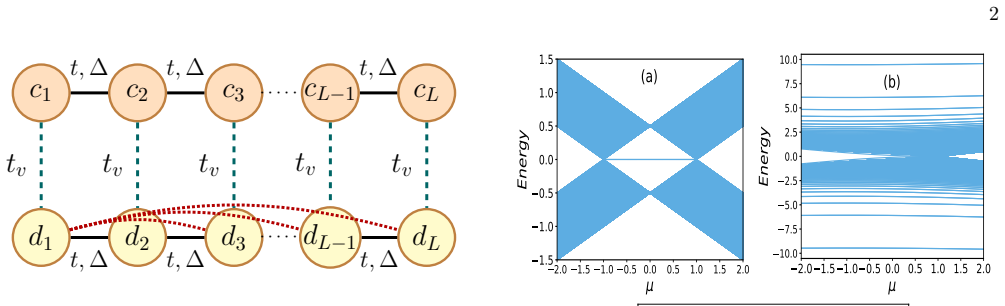
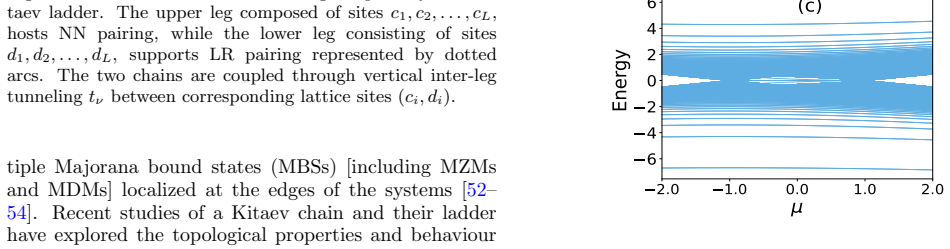
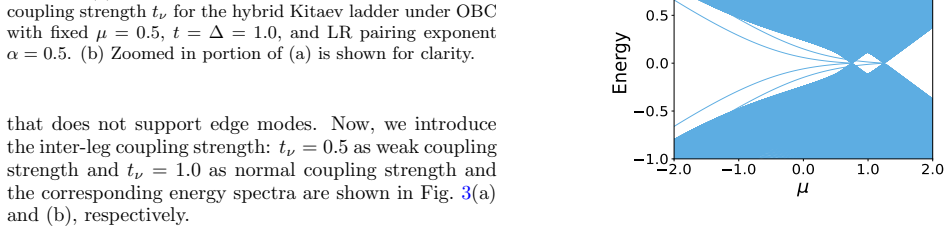
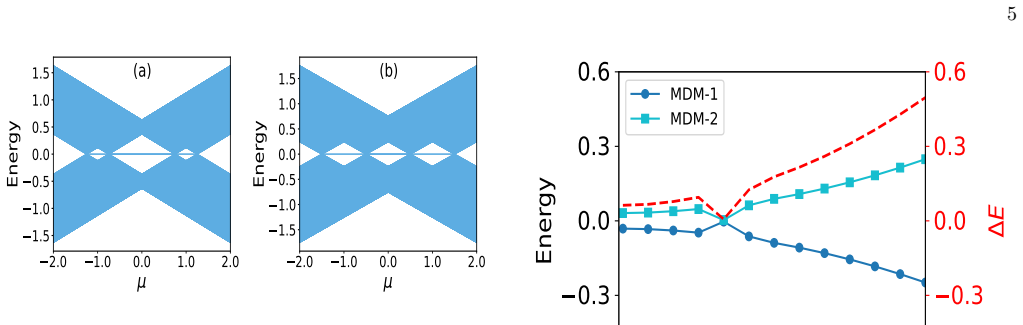
The spectra are shown for different inter-leg coupling strengths: (a)t ν = 0.5 and (b)t ν = 1.0 (c) Zoomed-in view of the region of interest of energy spectrum shown in (a). H=− L−1X i=1 h t c† i ci+1 +d † i di+1 + H.c. −2µ LX i=1 c† i ci +d † i di + L−1X i=1 h ∆ cici+1 + L−jX i<j h 1 δα l didj + H.c. i i +t v LX i=1 c† i di + H.c. i . (2) Here,t ν denote...
-
[2]
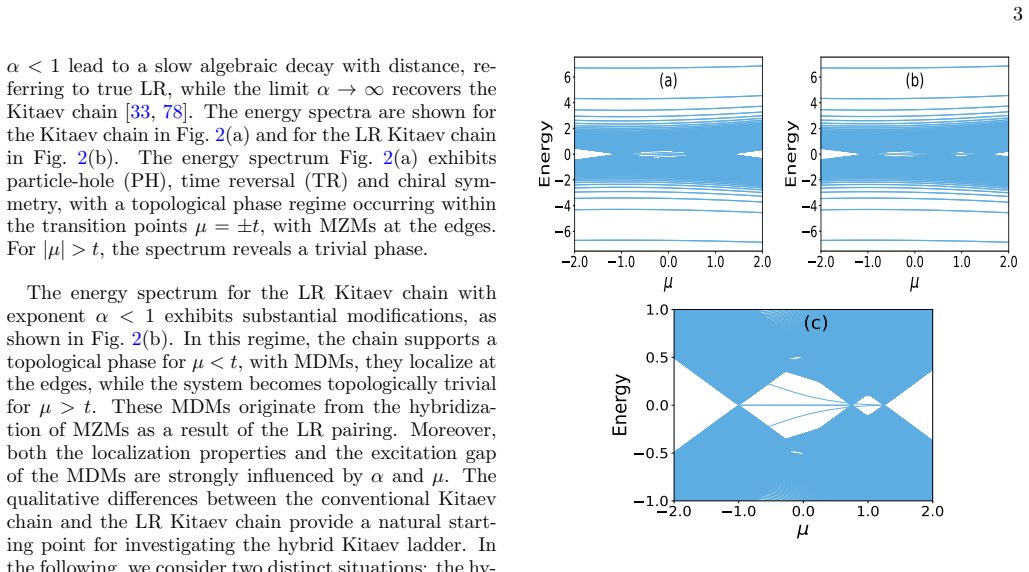
The individual energy spectrum of the Hamiltonian is already shown in Fig
Energy Spectrum for the hybrid Kitaev ladder First of all, we start with the suppressed inter-leg cou- pling strength,t ν = 0, where the hybrid Kitaev ladder is simply two independent chains: the Kitaev chain and an LR Kitaev chain. The individual energy spectrum of the Hamiltonian is already shown in Fig. 2(a) for the conventional Kitaev chain and in Fig...
-
[3]
(2)], namely the LR-LR Kitaev ladder, where both legs host the LR pairing with the same expo- nentsα
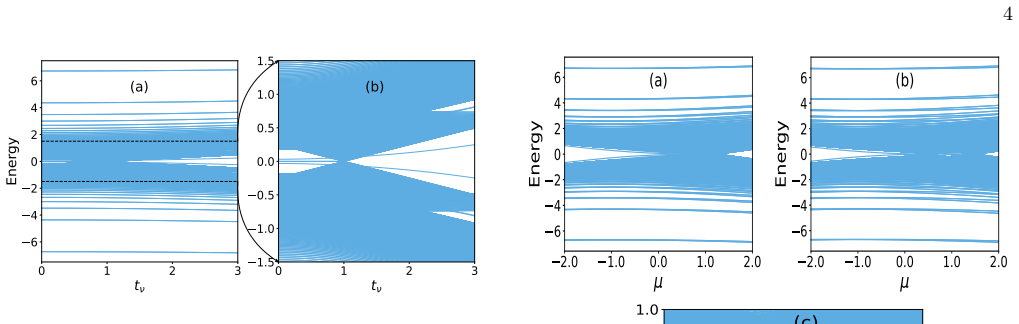
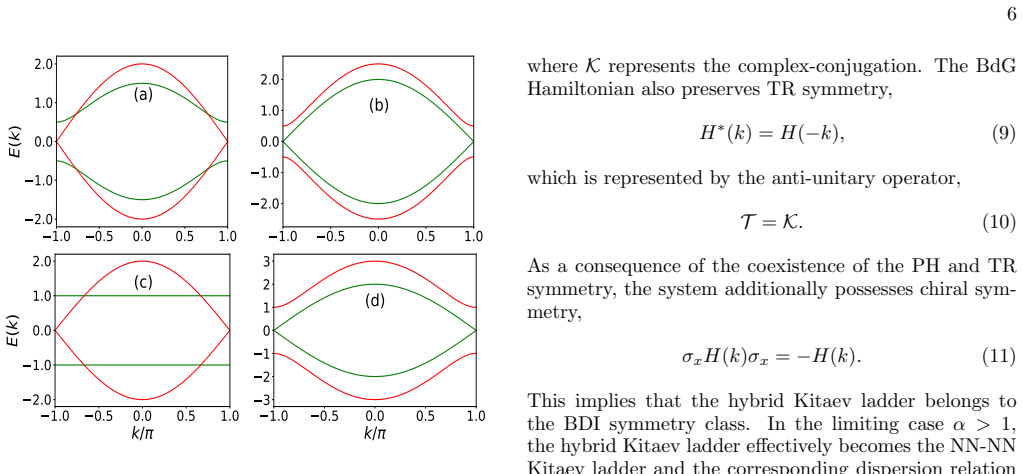
Energy Spectrum of LR-LR Kitaev ladder and NN-NN Kitaev ladder We now discuss a more general realization of the hybrid Kitaev ladder [Eq. (2)], namely the LR-LR Kitaev ladder, where both legs host the LR pairing with the same expo- nentsα. We also consider its limiting case corresponding to the NN-NN Kitaev ladder forα >1. We start by ana- lyzing the LR-L...
-
[4]
shown in Fig
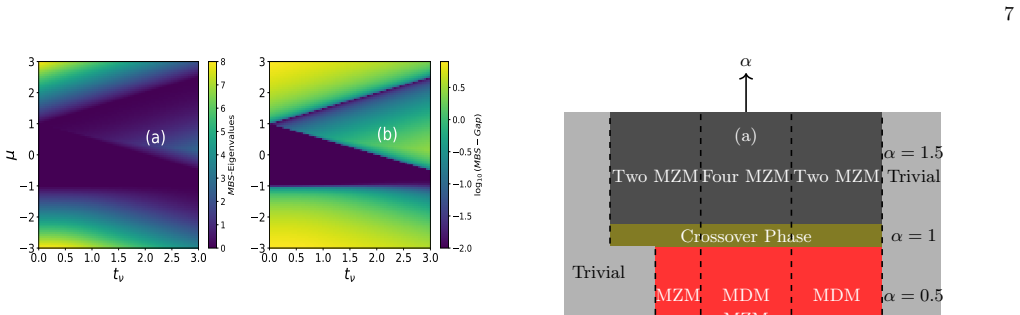
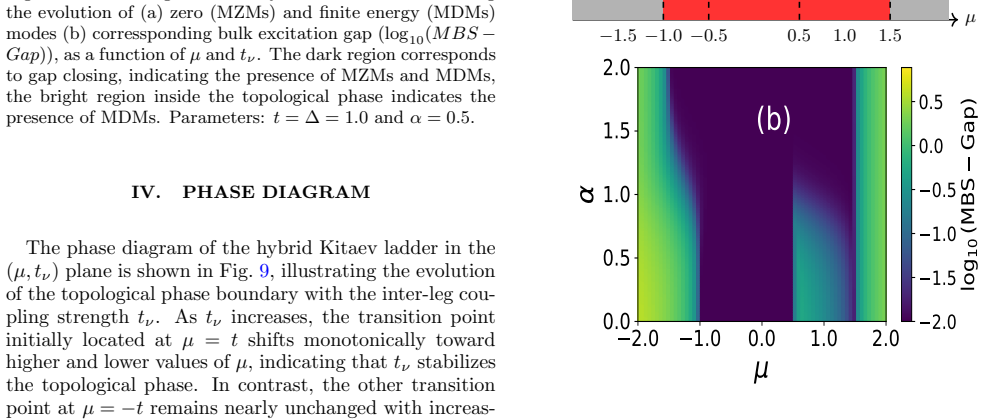
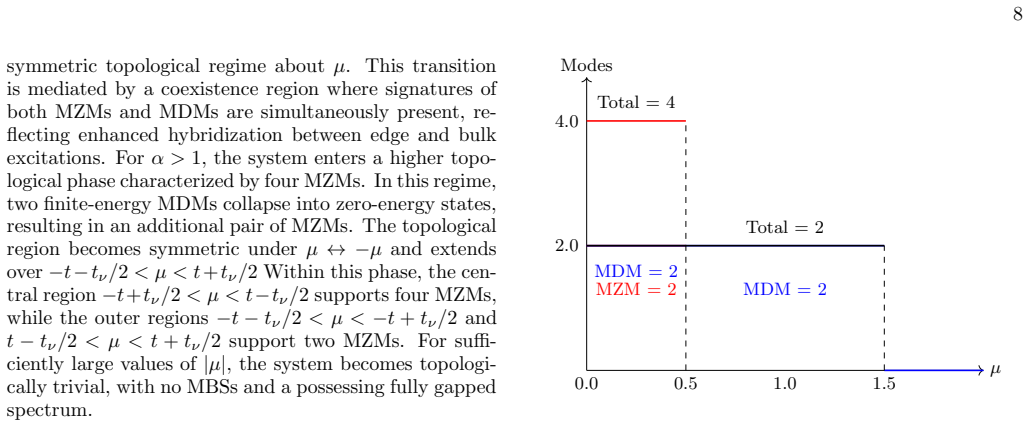
The spectra are shown for different inter-leg coupling strengths: (a)t ν = 0.5 and (b)t ν = 1.0. shown in Fig. 5(b). In this case, the shifted transition points atµ≃t± tν 2 again separate regions hosting four and two MDMs, respectively, with modified topological boundaries. The LR-LR Kitaev ladder therefore exhibits spectral features similar to those of t...
2022
-
[5]
A. Y. Kitaev, Unpaired majorana fermions in quantum wires, Physics-Uspekhi44, 131 (2001)
2001
-
[6]
J. D. Sau, R. M. Lutchyn, S. Tewari, and S. Das Sarma, Generic new platform for topological quantum compu- tation using semiconductor heterostructures, Phys. Rev. Lett.104, 040502 (2010)
2010
-
[7]
Y. Oreg, G. Refael, and F. von Oppen, Helical liquids and majorana bound states in quantum wires, Phys. Rev. Lett.105, 177002 (2010)
2010
-
[8]
Nayak, S
C. Nayak, S. H. Simon, A. Stern, M. Freedman, and S. Das Sarma, Non-abelian anyons and topological quan- tum computation, Rev. Mod. Phys.80, 1083 (2008)
2008
-
[9]
Kitaev, Fault-tolerant quantum computation by anyons, Annals of Physics303, 2 (2003)
A. Kitaev, Fault-tolerant quantum computation by anyons, Annals of Physics303, 2 (2003)
2003
-
[10]
O. A. Awoga, I. Ioannidis, A. Mishra, M. Leijnse, M. Trif, and T. Posske, Controlling majorana hybridization in magnetic chain-superconductor systems, Phys. Rev. Res. 6, 033154 (2024)
2024
-
[11]
Pan and S
H. Pan and S. Das Sarma, Majorana nanowires, ki- taev chains, and spin models, Phys. Rev. B107, 035440 (2023)
2023
-
[12]
Nadj-Perge, I
S. Nadj-Perge, I. K. Drozdov, B. A. Bernevig, and A. Yazdani, Proposal for realizing majorana fermions in chains of magnetic atoms on a superconductor, Phys. Rev. B88, 020407(R) (2013)
2013
-
[13]
V. D. Pham, Y. Pan, S. C. Erwin, F. von Oppen, K. Kanisawa, and S. F¨ olsch, Topological states in dimer- ized quantum-dot chains created by atom manipulation, Phys. Rev. B105, 125418 (2022)
2022
-
[14]
Bahari, J.-H
B. Bahari, J.-H. Choi, Y. G. N. Liu, and M. Khajavikhan, Majorana bound state cavities, Phys. Rev. B104, 235423 (2021)
2021
-
[15]
Das Sarma, K
S. Das Sarma, K. Laubscher, H. Pan, J. D. Sau, and T. D. Stanescu, Rashba spin-orbit coupling and artificially en- gineered topological superconductors, Phys. Rev. B113, 139604 (2026)
2026
-
[16]
R. M. Lutchyn, J. D. Sau, and S. Das Sarma, Ma- jorana fermions and a topological phase transition in semiconductor-superconductor heterostructures, Phys. Rev. Lett.105, 077001 (2010)
2010
-
[17]
Nehra, A
R. Nehra, A. Sharma, and A. Soori, Transport in a long- range kitaev ladder: Role of majorana and subgap an- dreev states, Europhysics Letters130, 27003 (2020)
2020
-
[18]
M. Hell, M. Leijnse, and K. Flensberg, Two-dimensional platform for networks of majorana bound states, Phys. Rev. Lett.118, 107701 (2017)
2017
-
[19]
S. D. Escribano, A. E. Dahl, K. Flensberg, and Y. Oreg, Phase-controlled minimal kitaev chain in multiterminal josephson junctions, Phys. Rev. B111, 195433 (2025)
2025
-
[20]
D. T. Liu, J. Shabani, and A. Mitra, Long-range kitaev chains via planar josephson junctions, Phys. Rev. B97, 235114 (2018)
2018
-
[21]
Samuelson, V
W. Samuelson, V. Svensson, and M. Leijnse, Minimal quantum dot based kitaev chain with only local super- 10 conducting proximity effect, Phys. Rev. B109, 035415 (2024)
2024
-
[22]
Kulesh, S
I. Kulesh, S. L. D. ten Haaf, Q. Wang, V. P. M. Siet- ses, Y. Zhang, S. R. Roelofs, C. G. Prosko, D. Xiao, C. Thomas, M. J. Manfra, and S. Goswami, Flux- controlled two-site kitaev chain, Phys. Rev. Lett.135, 056301 (2025)
2025
-
[23]
F. Zatelli, D. van Driel, D. Xu, G. Wang, C.-X. Liu, A. Bordin, B. Roovers, G. P. Mazur, N. van Loo, J. C. Wolff, A. M. Bozkurt, G. Badawy, S. Gazibegovic, E. P. A. M. Bakkers, M. Wimmer, L. P. Kouwenhoven, and T. Dvir, Robust poor man’s majorana zero modes us- ing yu-shiba-rusinov states, Nature Communications15, 10.1038/s41467-024-52066-2 (2024)
-
[24]
Pan and S
H. Pan and S. Das Sarma, Disorder effects on majo- rana zero modes: Kitaev chain versus semiconductor nanowire, Phys. Rev. B103, 224505 (2021)
2021
-
[25]
T. D. Stanescu and S. Tewari, Fermion parity and quan- tum capacitance oscillation with partially separated ma- jorana and quasi-majorana modes, Phys. Rev. B113, 165422 (2026)
2026
-
[26]
Pan and S
H. Pan and S. Das Sarma, Majorana zero modes in semiconductor-superconductor hybrid structures: Defin- ing topology in short and disordered nanowires through majorana splitting, Phys. Rev. B113, 165420 (2026)
2026
-
[27]
N. Sun, L. Feng, and P. Zhang, Universal bound states in long-range spin chains with an impurity, Phys. Rev. B 113, 134442 (2026)
2026
-
[28]
Peeters, T
C. Peeters, T. Hodge, E. Mascot, and S. Rachel, Effect of impurities and disorder on the braiding dynamics of majorana zero modes, Phys. Rev. B110, 214506 (2024)
2024
-
[29]
A. Naik, B. K. Agarwalla, and M. Kulkarni, Dynamics of number entropy for free fermionic systems in the presence of defects and stochastic processes, Phys. Rev. B113, L161402 (2026)
2026
-
[30]
Read and D
N. Read and D. Green, Paired states of fermions in two dimensions with breaking of parity and time-reversal symmetries and the fractional quantum hall effect, Phys. Rev. B61, 10267 (2000)
2000
-
[31]
Fernandez Becerra and O
V. Fernandez Becerra and O. Dmytruk, Fermion parity switching in a short kitaev chain coupled to a photonic cavity, Phys. Rev. B113, 165410 (2026)
2026
-
[32]
Zhang, I
Y. Zhang, I. Kulesh, S. L. ten Haaf, N. van Loo, F. Za- telli, T. Degroote, C. G. Prosko, and S. Goswami, Gate reflectometry in a minimal kitaev chain device, PRX Quantum7, 020317 (2026)
2026
-
[33]
Smirnov, Fluctuation response of a minimal kitaev chain in nonequilibrium states, Phys
S. Smirnov, Fluctuation response of a minimal kitaev chain in nonequilibrium states, Phys. Rev. B113, 165404 (2026)
2026
-
[34]
Leijnse and K
M. Leijnse and K. Flensberg, Parity qubits and poor man’s majorana bound states in double quantum dots, Phys. Rev. B86, 134528 (2012)
2012
-
[35]
C. W. J. Beenakker, Poor man’s majorana edge mode enabled by specular andreev reflection, Phys. Rev. B110, L180402 (2024)
2024
-
[36]
Cayao, Emergent pair symmetries in systems with poor man’s majorana modes, Phys
J. Cayao, Emergent pair symmetries in systems with poor man’s majorana modes, Phys. Rev. B110, 125408 (2024)
2024
-
[37]
Maity, U
S. Maity, U. Bhattacharya, and A. Dutta, One- dimensional quantum many body systems with long- range interactions, Journal of Physics A: Mathematical and Theoretical53, 013001 (2019)
2019
-
[38]
Patrick, T
K. Patrick, T. Neupert, and J. K. Pachos, Topological quantum liquids with long-range couplings, Phys. Rev. Lett.118, 267002 (2017)
2017
-
[39]
Alecce and L
A. Alecce and L. Dell’Anna, Extended kitaev chain with longer-range hopping and pairing, Phys. Rev. B95, 195160 (2017)
2017
-
[40]
Vodola, L
D. Vodola, L. Lepori, E. Ercolessi, A. V. Gorshkov, and G. Pupillo, Kitaev chains with long-range pairing, Phys. Rev. Lett.113, 156402 (2014)
2014
-
[41]
Hern´ andez-Santana, C
S. Hern´ andez-Santana, C. Gogolin, J. I. Cirac, and A. Ac´ ın, Correlation decay in fermionic lattice systems with power-law interactions at nonzero temperature, Phys. Rev. Lett.119, 110601 (2017)
2017
-
[42]
Mitra, S
A. Mitra, S. Paul, and S. C. L. Srivastava, Quantum criti- cality and universality in the stationary state of the long- range kitaev model, Phys. Rev. B111, 104308 (2025)
2025
-
[43]
Baghran, R
R. Baghran, R. Jafari, and A. Langari, Competition of long-range interactions and noise at a ramped quench dy- namical quantum phase transition: The case of the long- range pairing kitaev chain, Phys. Rev. B110, 064302 (2024)
2024
-
[44]
Y. R. Kartik, R. R. Kumar, S. Rahul, N. Roy, and S. Sarkar, Topological quantum phase transitions and criticality in a longer-range kitaev chain, Phys. Rev. B 104, 075113 (2021)
2021
-
[45]
Viyuela, D
O. Viyuela, D. Vodola, G. Pupillo, and M. A. Martin- Delgado, Topological massive dirac edge modes and long- range superconducting hamiltonians, Phys. Rev. B94, 125121 (2016)
2016
-
[46]
Dutta and A
A. Dutta and A. Dutta, Probing the role of long-range interactions in the dynamics of a long-range kitaev chain, Phys. Rev. B96, 125113 (2017)
2017
-
[47]
C. Li, X. Z. Zhang, G. Zhang, and Z. Song, Topological phases in a kitaev chain with imbalanced pairing, Phys. Rev. B97, 115436 (2018)
2018
-
[48]
S. Lieu, D. K. K. Lee, and J. Knolle, Disorder pro- tected and induced local zero-modes in longer-range ki- taev chains, Phys. Rev. B98, 134507 (2018)
2018
-
[49]
Yan, W.-X
Y. Yan, W.-X. Cui, S. Liu, J. Cao, S. Zhang, and H.-F. Wang, Topological phase in a nonreciprocal kitaev chain, New Journal of Physics25, 123023 (2023)
2023
-
[50]
Bhattacharya, S
U. Bhattacharya, S. Maity, A. Dutta, and D. Sen, Crit- ical phase boundaries of static and periodically kicked long-range kitaev chain, Journal of Physics: Condensed Matter31, 174003 (2019)
2019
-
[51]
Pientka, L
F. Pientka, L. I. Glazman, and F. von Oppen, Topological superconducting phase in helical shiba chains, Phys. Rev. B88, 155420 (2013)
2013
-
[52]
Nadj-Perge, I
S. Nadj-Perge, I. K. Drozdov, J. Li, H. Chen, S. Jeon, J. Seo, A. H. MacDonald, B. A. Bernevig, and A. Yaz- dani, Observation of majorana fermions in ferromagnetic atomic chains on a superconductor, Science346, 602 (2014)
2014
-
[53]
H. Kim, L. R´ ozsa, D. Schreyer, E. Simon, and R. Wiesen- danger, Long-range focusing of magnetic bound states in superconducting lanthanum, Nature Communications 11, 4573 (2020)
2020
-
[54]
Ren, S.-S
J.-T. Ren, S.-S. Ke, Y. Guo, H.-W. Zhang, and H.-F. L¨ u, Signatures of the long-range phase transition in topo- logical josephson junctions, Phys. Rev. B106, 165428 (2022)
2022
-
[55]
Mohanta, T
N. Mohanta, T. Zhou, J.-W. Xu, J. E. Han, A. D. Kent, J. Shabani, I. ˇZuti´ c, and A. Matos-Abiague, Electrical control of majorana bound states using magnetic stripes, Phys. Rev. Appl.12, 034048 (2019). 11
2019
-
[56]
Kumar, R
R. Kumar, R. K. Shukla, L. Chotorlishvili, and S. K. Mishra, Dynamics of majorana zero modes across a hy- brid kitaev chain, Phys. Rev. B112, 235159 (2025)
2025
-
[57]
Quade and M
R. Quade and M. Potthoff, Exchangeless braiding of ma- jorana zero modes in weakly coupled kitaev chains, Phys. Rev. B112, 085411 (2025)
2025
-
[58]
Martin and K
I. Martin and K. Agarwal, Understanding majorana braiding in superconductors with a fixed total number of particles, Phys. Rev. B113, 155149 (2026)
2026
-
[59]
D. E. Almeida, Entanglement entropy in multi-leg kitaev ladders with interface defects, Journal of Statistical Me- chanics: Theory and Experiment2021, 103101 (2021)
2021
-
[60]
Padavi´ c, S
K. Padavi´ c, S. S. Hegde, W. DeGottardi, and S. Vishveshwara, Topological phases, edge modes, and the hofstadter butterfly in coupled su-schrieffer-heeger systems, Phys. Rev. B98, 024205 (2018)
2018
-
[61]
Maiellaro, A
A. Maiellaro, A. Marino, and F. Illuminati, Topologi- cal squashed entanglement: Nonlocal order parameter for one-dimensional topological superconductors, Phys. Rev. Res.4, 033088 (2022)
2022
-
[64]
A. V. Sadovnikov, M. S. Bahovadinov, A. N. Rubtsov, and A. A. Markov, Mobile impurity in the kitaev chain: Phase diagram and signatures of topology, Phys. Rev. B 113, 155146 (2026)
2026
-
[65]
Granet and M
E. Granet and M. Levin, Effect of slowly decaying long- range interactions on topological qubits, Phys. Rev. B 113, 155118 (2026)
2026
-
[66]
Nehra, D
R. Nehra, D. S. Bhakuni, A. Ramachandran, and A. Sharma, Flat bands and entanglement in the kitaev ladder, Phys. Rev. Res.2, 013175 (2020)
2020
-
[67]
Shibata and H
N. Shibata and H. Katsura, Dissipative spin chain as a non-hermitian kitaev ladder, Phys. Rev. B99, 174303 (2019)
2019
-
[68]
Wakatsuki, M
R. Wakatsuki, M. Ezawa, and N. Nagaosa, Majorana fermions and multiple topological phase transition in ki- taev ladder topological superconductors, Phys. Rev. B 89, 174514 (2014)
2014
-
[69]
Huang, Y.-T
C.-Y. Huang, Y.-T. Lin, H. Lee, and D.-W. Wang, Quan- tum degenerate majorana surface zero modes in two- dimensional space, Phys. Rev. A99, 043624 (2019)
2019
-
[70]
Herviou, C
L. Herviou, C. Mora, and K. Le Hur, Phase diagram and entanglement of two interacting topological kitaev chains, Phys. Rev. B93, 165142 (2016)
2016
-
[71]
Defossez, L
A. Defossez, L. Vanderstraeten, L. Peralta Gavensky, and N. Goldman, Dynamic realization of majorana zero modes in a particle-conserving ladder, Phys. Rev. Res.7, 023183 (2025)
2025
-
[72]
Banerjee, R
S. Banerjee, R. Parida, and T. Mishra, Reentrant topol- ogy and reverse pumping in a quasiperiodic flux ladder, Phys. Rev. B113, 024205 (2026)
2026
-
[73]
Sedlmayr, J
N. Sedlmayr, J. M. Aguiar-Hualde, and C. Bena, Ma- jorana bound states in open quasi-one-dimensional and two-dimensional systems with transverse rashba cou- pling, Phys. Rev. B93, 155425 (2016)
2016
-
[74]
Sedlmayr, V
N. Sedlmayr, V. Kaladzhyan, C. Dutreix, and C. Bena, Bulk boundary correspondence and the existence of ma- jorana bound states on the edges of 2d topological super- conductors, Phys. Rev. B96, 184516 (2017)
2017
-
[75]
Maiellaro, F
A. Maiellaro, F. Romeo, and R. Citro, Topological phase diagram of a kitaev ladder, The European Physical Jour- nal Special Topics227, 1397 (2018)
2018
-
[76]
Maiellaro, F
A. Maiellaro, F. Romeo, C. A. Perroni, V. Cataudella, and R. Citro, Unveiling signatures of topological phases in open kitaev chains and ladders, Nanomaterials9, 894 (2019)
2019
-
[77]
Zhang and L
C. Zhang and L. Sheng, Topological phase sensitive to the boundary conditions in a purely hermitian multileg ladder with chiral symmetry, Phys. Rev. B113, 085432 (2026)
2026
-
[78]
Zhong, W.-L
W.-H. Zhong, W.-L. Li, Y.-C. Chen, and X.-J. Yu, Topo- logical edge modes and phase transitions in a critical fermionic chain with long-range interactions, Phys. Rev. A110, 022212 (2024)
2024
-
[79]
Y. B. Shi and Z. Song, Topological phase in a kitaev chain with spatially separated pairing processes, Phys. Rev. B 107, 125110 (2023)
2023
-
[80]
A. D. K. Finck, D. J. Van Harlingen, P. K. Mohseni, K. Jung, and X. Li, Anomalous modulation of a zero- bias peak in a hybrid nanowire-superconductor device, Phys. Rev. Lett.110, 126406 (2013)
2013
-
[81]
Chang, V
W. Chang, V. E. Manucharyan, T. S. Jespersen, J. Nyg˚ ard, and C. M. Marcus, Tunneling spectroscopy of quasiparticle bound states in a spinful josephson junc- tion, Phys. Rev. Lett.110, 217005 (2013)
2013
-
[82]
Mondal, S
S. Mondal, S. Bandyopadhyay, S. Bhattacharjee, and A. Dutta, Detecting topological phase transitions through entanglement between disconnected partitions in a kitaev chain with long-range interactions, Phys. Rev. B105, 085106 (2022)
2022
discussion (0)
Sign in with ORCID, Apple, or X to comment. Anyone can read and Pith papers without signing in.