Xi_(cc)⁺⁺-Xi_(cc)⁺ Transitions as a Two-Charm-Selective Portal to Ultra-Low-Q Charged Currents
Pith reviewed 2026-06-26 17:11 UTC · model grok-4.3
The pith
Transitions between doubly charmed baryons can probe a charged-current new physics portal that evades other constraints.
A machine-rendered reading of the paper's core claim, the machinery that carries it, and where it could break.
Core claim
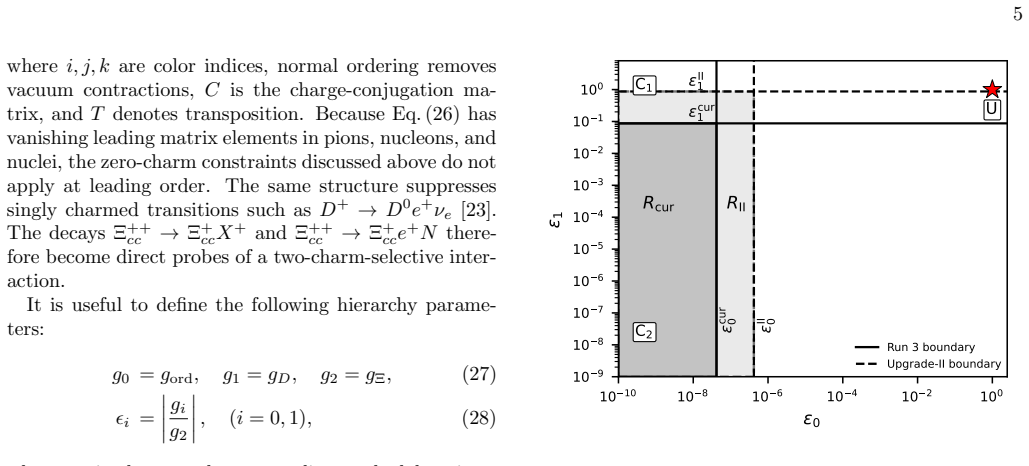
The central claim is that Ξcc++→Ξcc+ transitions provide the leading direct probe of a two-charm-selective charged-current portal; the portal's leading operator has a nonzero matrix element in doubly charmed baryons while vanishing at leading order in pions, nucleons, nuclei, and singly charmed mesons, so that in this class of models the transition is not superseded by other searches.
What carries the argument
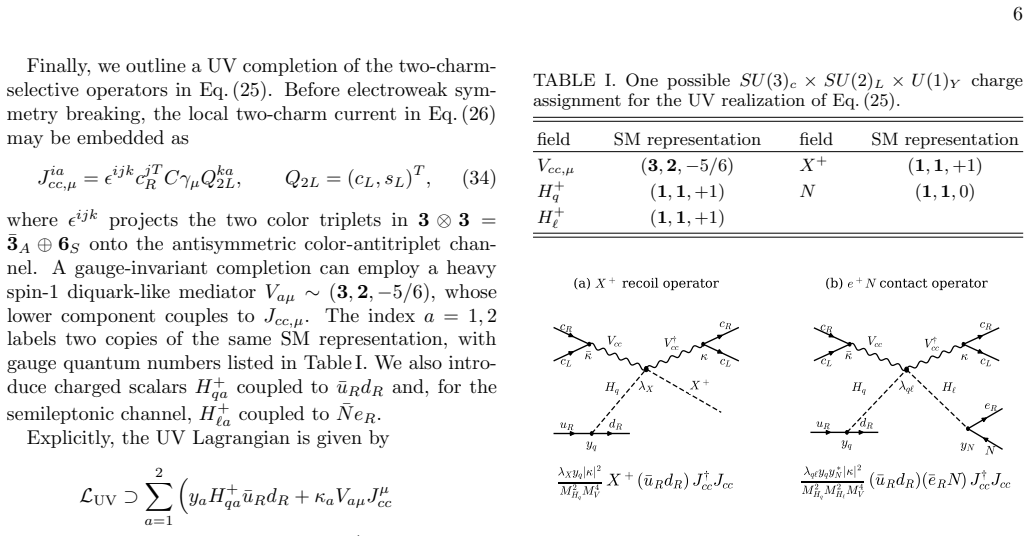
The two-charm-selective charged-current portal, an effective operator whose leading term couples only to states containing two charm quarks.
If this is right
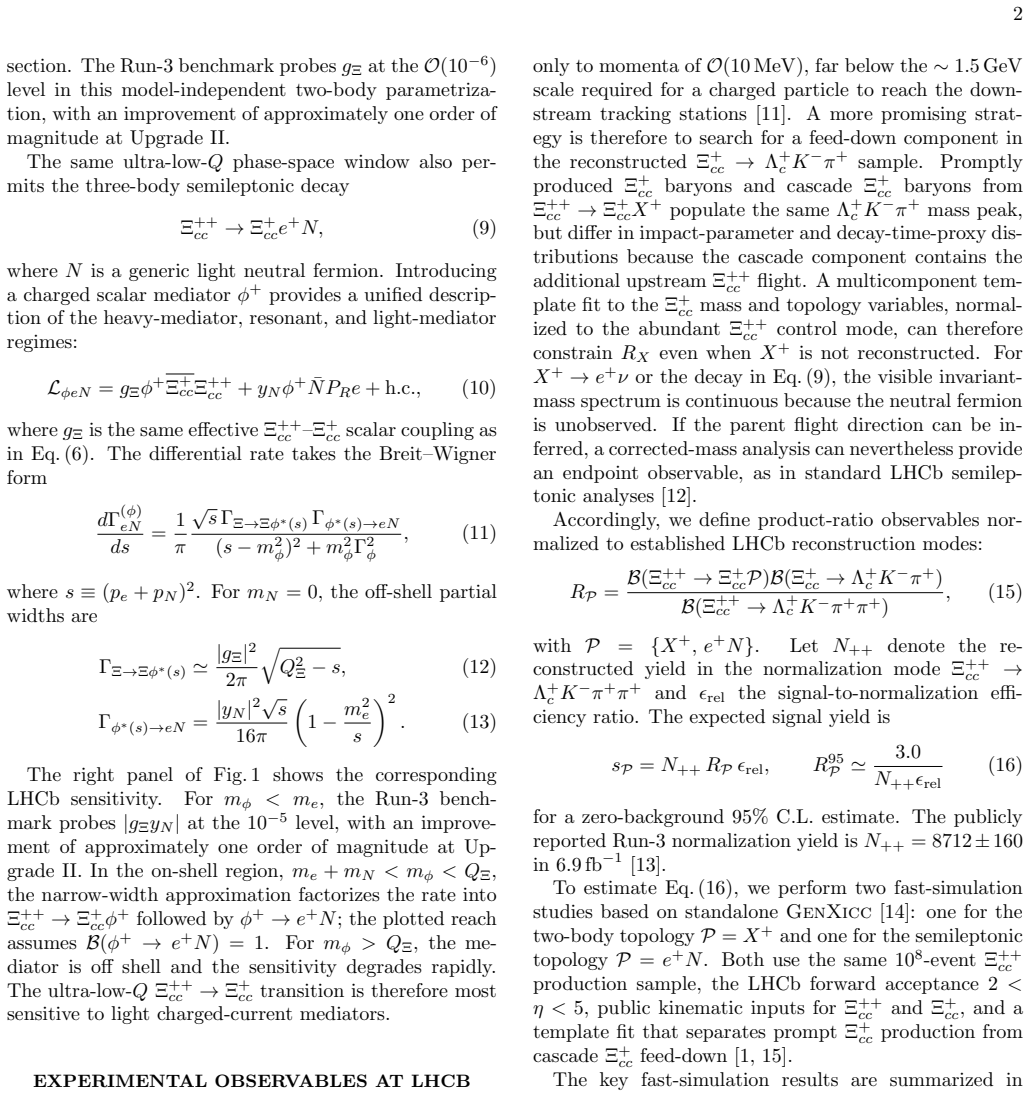
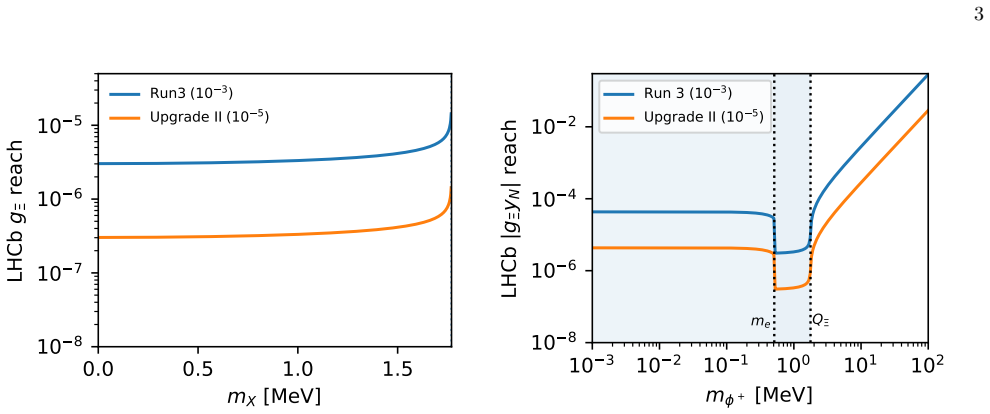
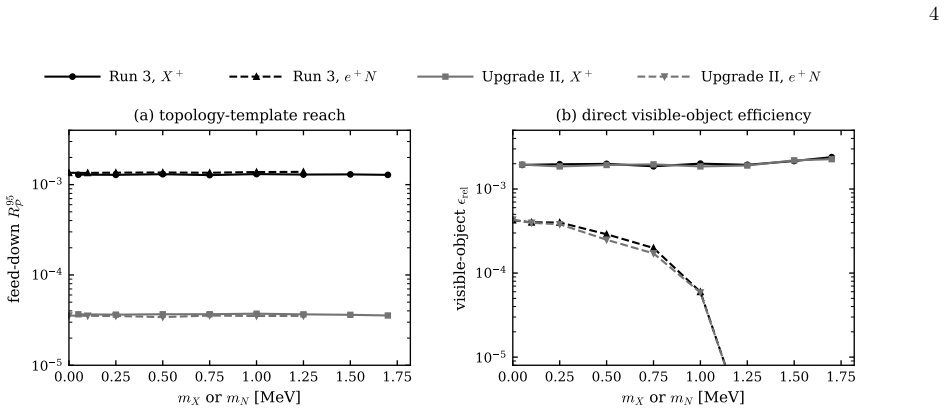
- The transition reaches sensitivity to baryon-level couplings of O(10^{-6}–10^{-7}) at MeV recoil momenta.
- It functions as a null test for charged-current new physics in this selective class of models.
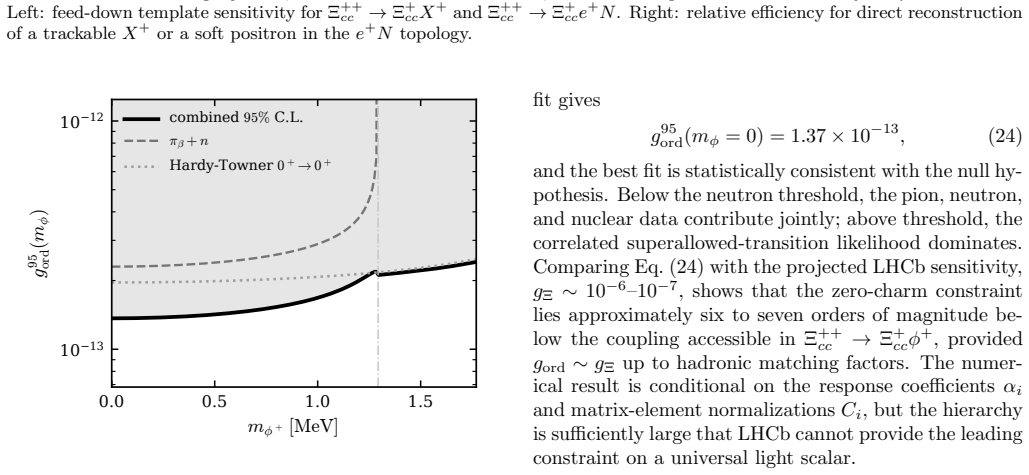
- Existing electroweak-precision and beta-decay constraints remain parametrically stronger for any universal light charged scalar.
- The portal operator produces no leading-order effects in pions, nucleons, nuclei, or singly charmed mesons.
Where Pith is reading between the lines
- Dedicated LHCb analyses of the Ξcc++→Ξcc+ channel could set the first direct limits on such selective portals.
- The same selectivity logic may apply to other multi-heavy-flavor systems where ordinary-matter constraints are absent.
- Theoretical work on the precise matrix element in the doubly charmed baryons would sharpen the projected reach.
Load-bearing premise
The leading operator of the two-charm-selective portal has a nonzero matrix element in doubly charmed baryons but vanishes at leading order in pions, nucleons, nuclei, and singly charmed mesons.
What would settle it
An experimental bound on the Ξcc++→Ξcc+ rate that is stronger than the projected 10^{-6}–10^{-7} coupling sensitivity while beta-decay and electroweak observables remain consistent with the standard model would support the portal's selectivity; a comparable signal appearing first in ordinary beta decay would falsify it.
Figures
read the original abstract
The recent LHCb observation of $\Xi_{cc}^{+}$ opens the ultra-low-$Q$ transition $\Xi_{cc}^{++}\to\Xi_{cc}^{+}$ as an experimentally motivated null test of charged-current new physics. Our two- and three-body analyses show sensitivity to effective baryon-level couplings of $\mathcal{O}(10^{-6}-10^{-7})$ for MeV-scale recoil momenta. We establish a practical no-go result for a universal light charged scalar $\phi^+$: with a first-generation $\phi^+\bar u d$ coupling, existing electroweak-precision and beta-decay constraints are parametrically stronger than the projected LHCb sensitivity. We then identify a two-charm-selective charged-current portal whose leading operator has a nonzero matrix element in doubly charmed baryons but vanishes at leading order in pions, nucleons, nuclei, and singly charmed mesons. In this class of models, $\Xi_{cc}^{++}\to\Xi_{cc}^{+}$ transitions can provide the leading direct probe of the portal interaction.
Editorial analysis
A structured set of objections, weighed in public.
Referee Report
Summary. The manuscript proposes the ultra-low-Q transition Ξcc++ → Ξcc+ as a null test for charged-current new physics. It reports that two- and three-body analyses yield sensitivity to effective baryon-level couplings of O(10^{-6}–10^{-7}), derives a parametric no-go for a universal light charged scalar from electroweak-precision and beta-decay bounds, and constructs a class of two-charm-selective portals in which the leading operator has a nonzero matrix element between doubly charmed baryons while vanishing at leading order in pions, nucleons, nuclei, and singly charmed mesons; in this class the Ξcc transition supplies the leading direct probe.
Significance. If the results hold, the work identifies a targeted experimental channel for charged-current new physics that is automatically selective to doubly charmed systems and therefore evades standard constraints from lighter hadrons. The explicit construction of the selective operator class, the parametric no-go for the universal scalar, and the sensitivity projections grounded in existing LHCb observations constitute the main strengths.
minor comments (2)
- [Abstract] Abstract: the statement that 'two- and three-body analyses show sensitivity' is not accompanied by a reference to the section or equation containing the matrix elements or error estimates; adding such a pointer would improve traceability.
- The explicit form of the two-charm-selective operator and its leading-order matrix elements between Ξcc states versus the listed lighter systems are asserted but not displayed; placing the operator definition and the leading-order vanishing argument in a dedicated subsection would strengthen the presentation.
Simulated Author's Rebuttal
We thank the referee for the positive assessment of our manuscript, including the summary of the proposed Ξcc++ → Ξcc+ transition as a two-charm-selective null test for charged-current new physics, the significance of the selective operator class and parametric no-go result, and the recommendation for minor revision. No specific major comments were raised in the report.
Circularity Check
No significant circularity identified
full rationale
The paper constructs a specific class of models featuring a two-charm-selective charged-current portal by design, then demonstrates that the leading operator has a nonzero matrix element between Ξcc states while vanishing at leading order for pions, nucleons, nuclei, and singly charmed mesons. It derives a parametric no-go for the universal light scalar from existing electroweak-precision and beta-decay constraints (external to this work) and projects LHCb sensitivity to the selective case. No load-bearing step reduces by construction to a fitted parameter from the same data, a self-citation chain, or a self-definitional loop; the central claim remains conditional on the deliberately constructed model class but is independent of the result itself.
Axiom & Free-Parameter Ledger
axioms (2)
- domain assumption Effective baryon-level operators can be matched to quark-level charged-current interactions in the low-energy regime.
- ad hoc to paper Matrix elements of the selective operator vanish at leading order in pions, nucleons, nuclei, and singly charmed mesons.
invented entities (1)
-
two-charm-selective charged-current portal
no independent evidence
Reference graph
Works this paper leans on
-
[1]
Common truth sample and production model.For both the two- and three-body studies, we use a 108-event GenXicctruth-level sample for Ξ ++ cc production
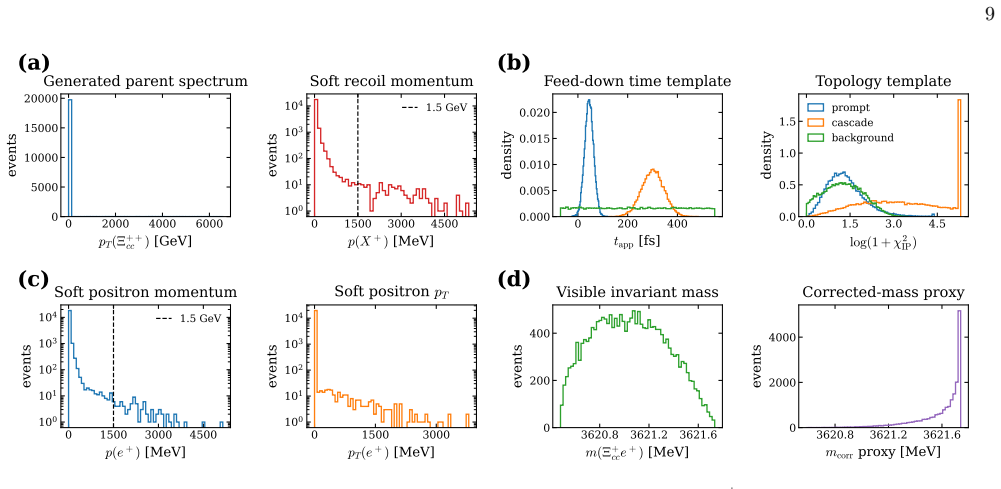
For Upgrade II, we scale these yields by 300/6.9, obtainingN ++ = 3.79×10 5, a prompt-yield proxy of 3.98×10 4, and a background-yield proxy of 7.83×10 4. Common truth sample and production model.For both the two- and three-body studies, we use a 108-event GenXicctruth-level sample for Ξ ++ cc production. After retaining events with positive weights, 79 5...
2000
-
[2]
R. Aaijet al.(LHCb), Observation of the doubly charmed baryon Ξ + cc with the LHCb Run 3 detector, (2026), arXiv:2603.28456 [hep-ex]
arXiv 2026
-
[3]
H.-Y. Cheng and Y.-L. Shi, Lifetimes of doubly charmed baryons, Phys. Rev. D98, 113005 (2018), arXiv:1809.08102 [hep-ph]
Pith/arXiv arXiv 2018
-
[4]
H.-Y. Cheng and C.-W. Liu, Study of doubly heavy baryon lifetimes, (2026), arXiv:2604.10939 [hep-ph]
Pith/arXiv arXiv 2026
-
[5]
L. Dulibi´ c, B. Meli´ c, and I. Niˇ sandˇ zi´ c, New Predictions for the Lifetimes of Doubly Heavy Baryons and theB c Meson, (2026), arXiv:2605.04967 [hep-ph]
Pith/arXiv arXiv 2026
-
[6]
C.-W. Hwang and C.-H. Chung, Isospin mass splittings of heavy baryons in HQS, Phys. Rev. D78, 073013 (2008), arXiv:0804.4044 [hep-ph]
Pith/arXiv arXiv 2008
-
[7]
S. J. Brodsky, F.-K. Guo, C. Hanhart, and U.-G. Meiss- ner, Isospin splittings of doubly heavy baryons, Phys. Lett. B698, 251 (2011), arXiv:1101.1983 [hep-ph]
Pith/arXiv arXiv 2011
-
[8]
K.-W. Wei, B. Chen, and X.-H. Guo, Masses of doubly and triply charmed baryons, Phys. Rev. D92, 076008 (2015), arXiv:1503.05184 [hep-ph]
Pith/arXiv arXiv 2015
-
[9]
M. Karliner and J. L. Rosner, Isospin splittings in baryons with two heavy quarks, Phys. Rev. D96, 033004 (2017), arXiv:1706.06961 [hep-ph]
Pith/arXiv arXiv 2017
-
[10]
S. Borsanyi, S. Durr, Z. Fodor, C. Hoelbling, S. D. Katz, S. Krieg, L. Lellouch, T. Lippert, A. Portelli, K. K. Szabo, and B. C. Toth, Ab initio calculation of the neutron-proton mass difference, Science347, 1452 (2015), arXiv:1406.4088 [hep-lat]
Pith/arXiv arXiv 2015
-
[11]
Aaijet al.(LHCb), Measurement of the lifetime of the doubly charmed baryon Ξ ++ cc , Phys
R. Aaijet al.(LHCb), Measurement of the lifetime of the doubly charmed baryon Ξ ++ cc , Phys. Rev. Lett.121, 052002 (2018), arXiv:1806.02744 [hep-ex]
Pith/arXiv arXiv 2018
-
[12]
Aaijet al.(LHCb), LHCb detector performance, Int
R. Aaijet al.(LHCb), LHCb detector performance, Int. J. Mod. Phys. A30, 1530022 (2015), arXiv:1412.6352 [hep-ex]
Pith/arXiv arXiv 2015
-
[13]
R. Aaijet al.(LHCb), Observation of the semilep- tonic decayB + →p pµ+νµ, JHEP2020(3), 146, arXiv:1911.08187 [hep-ex]
arXiv 1911
-
[14]
S. Han, Search for the doubly charmed baryon Ξ + cc with the upgraded LHCb detector, Rencontres de Moriond 11 Electroweak Interactions and Unified Theories, presen- tation slides (2026), public LHCb Moriond presentation
2026
-
[15]
C.-H. Chang, J.-X. Wang, and X.-G. Wu, GENXICC2.0: An Upgraded Version of the Generator for Hadronic Production of Double Heavy Baryons Xi(cc), Xi(bc) and Xi(bb), Comput. Phys. Commun.181, 1144 (2010), arXiv:0910.4462 [hep-ph]
Pith/arXiv arXiv 2010
-
[16]
Aaijet al.(LHCb), Observation of the doubly charmed baryon Ξ ++ cc , Phys
R. Aaijet al.(LHCb), Observation of the doubly charmed baryon Ξ ++ cc , Phys. Rev. Lett.119, 112001 (2017), arXiv:1707.01621 [hep-ex]
Pith/arXiv arXiv 2017
-
[17]
S. Schaelet al.(ALEPH, DELPHI, L3, OPAL, SLD, LEP Electroweak Working Group, SLD Electroweak Group, SLD Heavy Flavour Group), Precision electroweak mea- surements on theZresonance, Phys. Rept.427, 257 (2006), arXiv:hep-ex/0509008
Pith/arXiv arXiv 2006
-
[18]
Navaset al.(Particle Data Group), Review of particle physics, Phys
S. Navaset al.(Particle Data Group), Review of particle physics, Phys. Rev. D110, 030001 (2024)
2024
-
[19]
M. Escudero, Neutrino decoupling beyond the Standard Model: CMB constraints on the Dark Matter mass with a fast and preciseN eff evaluation, JCAP02, 007, arXiv:1812.05605 [hep-ph]
-
[20]
Y. Du and J.-H. Yu, Neutrino non-standard interactions meet precision measurements of N ef f, JHEP05, 058, arXiv:2101.10475 [hep-ph]
-
[21]
Du, Neff as a new physics probe in the precision era of cosmology, Phys
Y. Du, Neff as a new physics probe in the precision era of cosmology, Phys. Rev. D110, 055030 (2024), arXiv:2310.10034 [hep-ph]
arXiv 2024
-
[22]
Pocanicet al., Precise measurement of theπ + → π0e+νbranching ratio, Phys
D. Pocanicet al., Precise measurement of theπ + → π0e+νbranching ratio, Phys. Rev. Lett.93, 181803 (2004)
2004
-
[23]
J. C. Hardy and I. S. Towner, Superallowed 0 + →0 + nuclearβdecays: 2020 critical survey, with implications forV ud and CKM unitarity, Phys. Rev. C102, 045501 (2020)
2020
-
[24]
Ablikimet al.(BESIII), Search for the rare de- cayD + →D 0e+νe, Phys
M. Ablikimet al.(BESIII), Search for the rare de- cayD + →D 0e+νe, Phys. Rev. D96, 111101 (2017), arXiv:1708.06856 [hep-ex]
Pith/arXiv arXiv 2017
-
[25]
S. L. Glashow, J. Iliopoulos, and L. Maiani, Weak Inter- actions with Lepton-Hadron Symmetry, Phys. Rev. D2, 1285 (1970)
1970
-
[26]
A. Czarnecki, W. J. Marciano, and A. Sirlin, Pion Beta Decay and CKM Unitarity, Phys. Rev. D101, 091301 (2020), arXiv:1911.04685 [hep-ph]
arXiv 2020
-
[27]
National Institute of Standards and Technology, CO- DATA recommended values: neutron-proton mass dif- ference energy equivalent in MeV, NIST Reference on Constants, Units, and Uncertainty (2022)
2022
-
[28]
I. S. Towner and J. C. Hardy, An Improved calculation of the isospin-symmetry-breaking corrections to superal- lowed Fermi beta decay, Phys. Rev. C77, 025501 (2008), arXiv:0710.3181 [nucl-th]
Pith/arXiv arXiv 2008
discussion (0)
Sign in with ORCID, Apple, or X to comment. Anyone can read and Pith papers without signing in.