Simulation of Non-Markovian Quantum Accelerated Dynamics via Time-Fractional Schr\"odinger Equation
Pith reviewed 2026-06-26 17:16 UTC · model grok-4.3
The pith
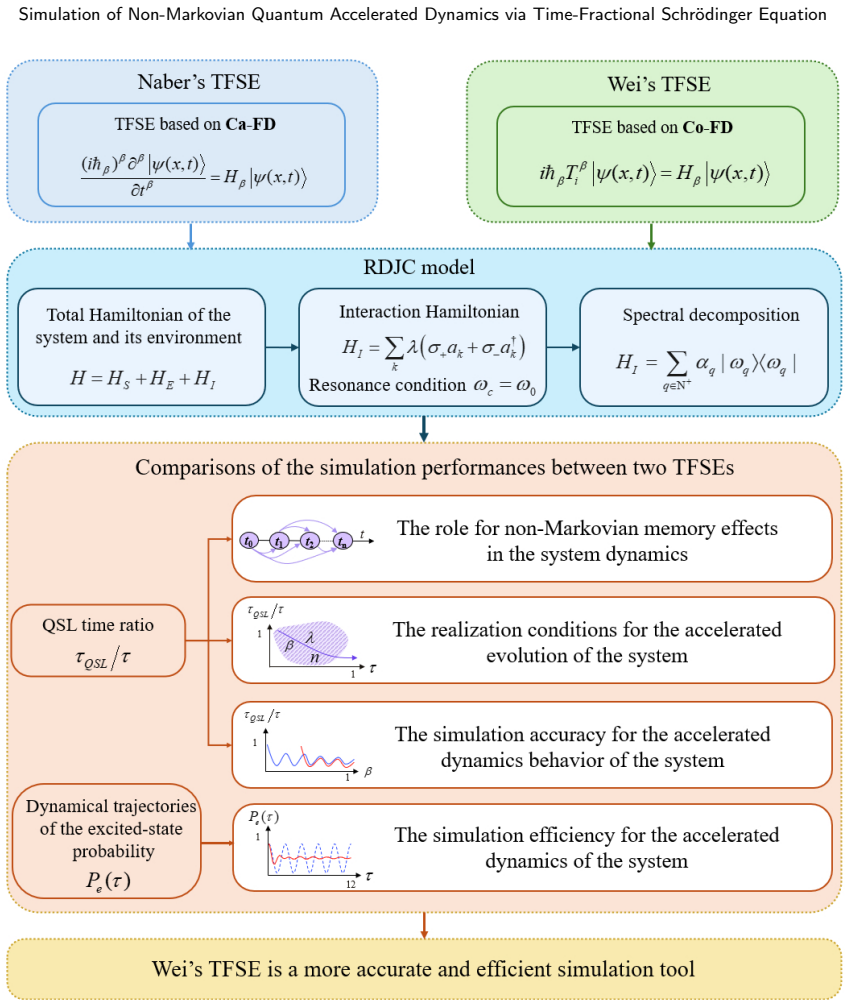
Wei's time-fractional Schrödinger equation reproduces non-Markovian quantum acceleration across the entire fractional-order range, while Naber's version works only in a limited interval and runs slower.
A machine-rendered reading of the paper's core claim, the machinery that carries it, and where it could break.
Core claim
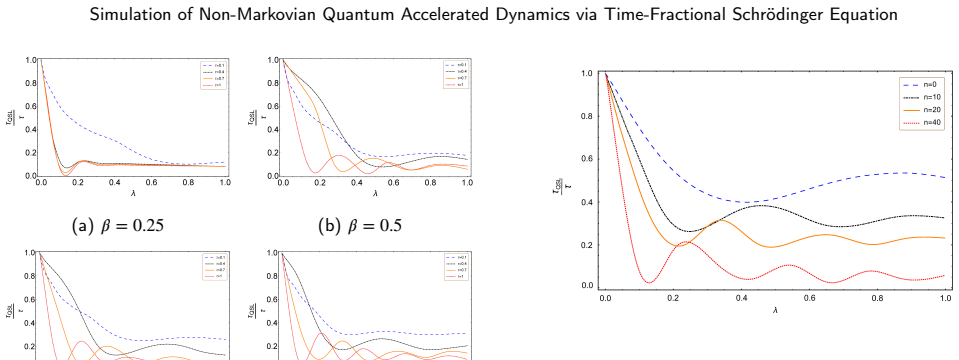
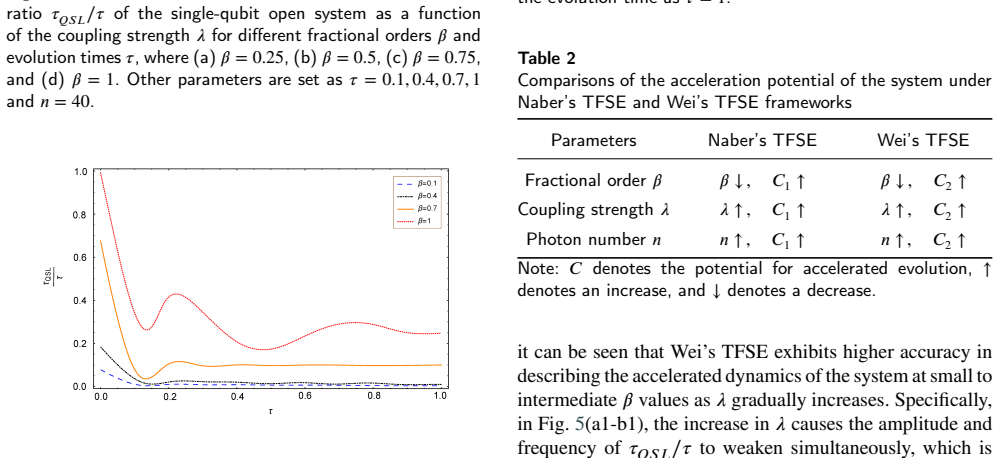
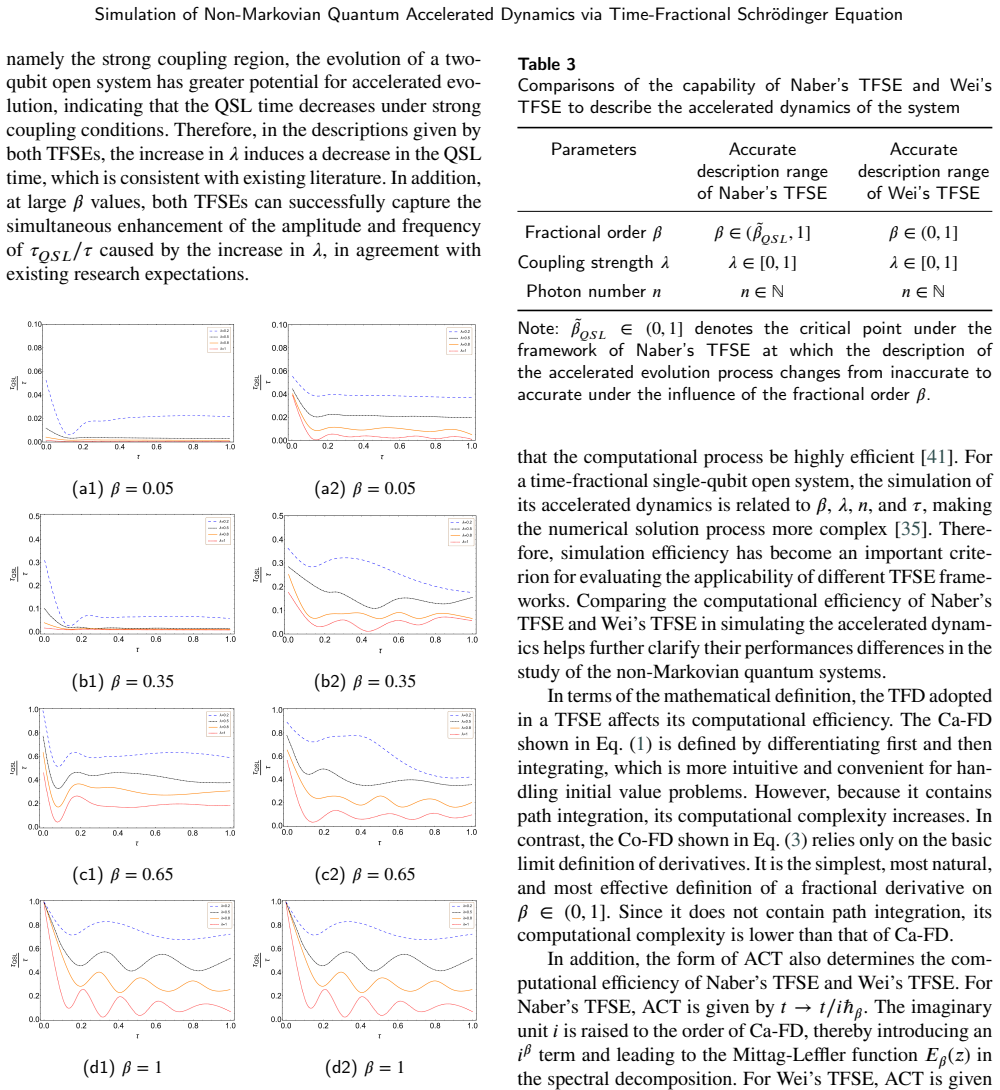
By solving the quantum speed limit time of a time-fractional single-qubit open system, the enhancement mechanism of the system evolution speed induced by the non-Markovian memory effects of the environment is revealed. Further studies show that the optimized acceleration of the system evolution can be achieved by jointly regulating the fractional order, coupling strength, and photon number. Comparative analyses indicate that Wei's TFSE can accurately capture the non-Markovian accelerated dynamical features of the system over the entire fractional order range, whereas Naber's TFSE is applicable only within a limited fractional order interval. In addition, Wei's TFSE has a significant simulati
What carries the argument
Wei's time-fractional Schrödinger equation applied to the resonant dissipative Jaynes-Cummings model, used to compute the quantum speed limit time that quantifies the minimum evolution duration under non-Markovian memory.
If this is right
- Non-Markovian memory effects shorten the quantum speed limit time and thereby accelerate qubit evolution in the resonant dissipative Jaynes-Cummings model.
- Joint adjustment of fractional order, coupling strength, and photon number produces an optimum acceleration point.
- Wei's equation remains accurate for every fractional order between zero and one, while Naber's equation is restricted to a smaller interval.
- Trajectory calculations with Wei's equation require markedly less average computer time than those with Naber's equation.
Where Pith is reading between the lines
- The same fractional-order tuning that speeds up the single-qubit case could be tested on multi-qubit or multi-mode open systems to see whether the acceleration advantage scales.
- If Wei's equation continues to match exact master-equation results at higher photon numbers, it could serve as a low-cost surrogate for exploring regimes where full non-Markovian numerics become prohibitive.
- The computational-efficiency gain suggests that Wei's formulation may be preferable for real-time feedback control loops that must estimate speed limits on the fly.
Load-bearing premise
That the time-fractional Schrödinger equation reproduces the correct non-Markovian memory effects and accelerated speed-limit behavior of the Jaynes-Cummings system without separate verification against the full non-Markovian master equation.
What would settle it
Compute the excited-state probability trajectory or the quantum speed limit time from the exact non-Markovian master equation for the resonant dissipative Jaynes-Cummings model at several fractional-order values outside the interval where Naber's equation works, and check whether Wei's equation matches those reference curves within numerical tolerance.
Figures
read the original abstract
The Time-Fractional Schr\"odinger Equation (TFSE) is an effective tool for simulating the dynamics of non-Markovian quantum systems. The Quantum Speed Limit (QSL) time characterizes the minimum time required for the evolution of a non-Markovian quantum system. In this paper, Wei's TFSE is employed to simulate the non-Markovian quantum accelerated evolution process in the Resonant Dissipative Jaynes-Cummings (RDJC) model. By solving the QSL time of a time-fractional single-qubit open system, the enhancement mechanism of the system evolution speed induced by the non-Markovian memory effects of the environment is revealed. Further studies show that the optimized acceleration of the system evolution can be achieved by jointly regulating the fractional order, coupling strength, and photon number. Comparative analyses indicate that Wei's TFSE can accurately capture the non-Markovian accelerated dynamical features of the system over the entire fractional order range, whereas Naber's TFSE is applicable only within a limited fractional order interval. In addition, the comparisons of the average simulation time for calculating the dynamical trajectory of the excited-state probability demonstrate that Wei's TFSE has a significant simulation advantage in computational efficiency. Therefore, Wei's TFSE is more accurate and efficient for simulating the accelerated dynamics of non-Markovian quantum systems.
Editorial analysis
A structured set of objections, weighed in public.
Referee Report
Summary. The manuscript claims that Wei's time-fractional Schrödinger equation (TFSE) accurately simulates non-Markovian accelerated dynamics and quantum speed limit (QSL) behavior in the resonant dissipative Jaynes-Cummings (RDJC) model over the full fractional-order range α ∈ (0,1], reveals the role of environmental memory effects in speeding up evolution, permits optimization of acceleration by tuning fractional order, coupling strength, and photon number, and outperforms Naber's TFSE in both accuracy (wider applicability) and computational efficiency (shorter average simulation time for excited-state probability trajectories).
Significance. If the central accuracy claim holds after independent validation, the work would supply a potentially efficient fractional-calculus route to non-Markovian open-system simulation and QSL analysis. The comparative efficiency result, if quantified with reproducible code, would be a concrete practical contribution.
major comments (2)
- [Abstract, results] Abstract and results sections: the claim that Wei's TFSE 'accurately capture[s] the non-Markovian accelerated dynamical features … over the entire fractional order range' is load-bearing yet rests solely on internal comparison with Naber's TFSE; no quantitative error metrics, no solution of the corresponding integro-differential non-Markovian master equation for the RDJC model, and no benchmark against exact or numerically exact non-Markovian evolution are supplied.
- [Numerical methods / results] Numerical procedures (implicit in all dynamical plots and QSL calculations): the abstract states comparative accuracy and efficiency results but supplies no discretization scheme, convergence criteria, error tolerances, or baseline comparisons, rendering the efficiency advantage and the 'full-range' accuracy assertion unverifiable from the given information.
minor comments (1)
- [Abstract, introduction] The abstract and introduction should explicitly define or cite the precise form of Wei's TFSE operator and the RDJC Hamiltonian used, including the values of free parameters (fractional order, coupling, photon number) employed in the reported trajectories.
Simulated Author's Rebuttal
We thank the referee for the constructive comments on our manuscript. We address each major point below, indicating where revisions will be made and where the comparative scope of the work limits direct external validation.
read point-by-point responses
-
Referee: [Abstract, results] Abstract and results sections: the claim that Wei's TFSE 'accurately capture[s] the non-Markovian accelerated dynamical features … over the entire fractional order range' is load-bearing yet rests solely on internal comparison with Naber's TFSE; no quantitative error metrics, no solution of the corresponding integro-differential non-Markovian master equation for the RDJC model, and no benchmark against exact or numerically exact non-Markovian evolution are supplied.
Authors: We agree that the phrasing 'accurately capture' implies validation beyond the internal comparison and that quantitative error metrics relative to an external reference would strengthen the claim. The manuscript's central contribution is the demonstration that Wei's TFSE remains well-behaved and produces physically consistent accelerated dynamics for all α ∈ (0,1], while Naber's formulation deviates or becomes inapplicable outside a narrower interval; this is shown through direct side-by-side trajectories and QSL calculations. We did not solve the integro-differential master equation because the TFSE is advanced here as a computationally lighter alternative rather than an exact solver. We will revise the abstract and results sections to replace 'accurately capture' with 'more accurately reproduces the qualitative features of non-Markovian acceleration than Naber's TFSE across the full fractional-order range' and will add explicit deviation measures (e.g., L2 differences between the two TFSE solutions) as quantitative support for the comparison. revision: partial
-
Referee: [Numerical methods / results] Numerical procedures (implicit in all dynamical plots and QSL calculations): the abstract states comparative accuracy and efficiency results but supplies no discretization scheme, convergence criteria, error tolerances, or baseline comparisons, rendering the efficiency advantage and the 'full-range' accuracy assertion unverifiable from the given information.
Authors: We accept that the numerical implementation details are insufficient for reproducibility. The efficiency comparison (average simulation time for excited-state probability trajectories) was obtained by running both TFSE solvers under identical hardware and solver settings, but these settings were not documented. We will add a new subsection detailing the discretization method (Caputo fractional derivative approximated via L1 scheme with uniform time steps), convergence tolerance (relative change < 10^{-6} between successive refinements), and the precise protocol used to measure wall-clock times. This addition will allow independent verification of both the accuracy range and the reported efficiency advantage. revision: yes
- Provision of a direct numerical solution to the integro-differential non-Markovian master equation for the RDJC model as an external benchmark, which lies outside the original scope of the comparative TFSE study and would require a separate, computationally intensive implementation not performed in the manuscript.
Circularity Check
No significant circularity in derivation chain
full rationale
The paper applies Wei's TFSE as a modeling tool to solve for QSL time and excited-state probability in the RDJC model, then compares the resulting trajectories and computational cost against Naber's TFSE. This is a forward simulation from the fractional differential equation rather than a parameter fit to a data subset that is subsequently relabeled as a prediction. No equations are shown reducing the output to the input by construction, no self-citation is invoked as the sole justification for a uniqueness theorem or ansatz, and the fractional operator itself is treated as given rather than redefined in terms of the target non-Markovian features. The derivation chain therefore remains independent of the claimed results.
Axiom & Free-Parameter Ledger
free parameters (3)
- fractional order
- coupling strength
- photon number
axioms (1)
- domain assumption Wei's TFSE correctly encodes non-Markovian memory effects for the RDJC model
Reference graph
Works this paper leans on
-
[1]
H. P. Breuer and F. Petruccione.The Theory of Open Quantum Systems. OxfordUniversityPress,Oxford,2002. doi:10.1093/acprof: oso/9780199213900.001.0001
-
[2]
Lindblad
G. Lindblad. On the generators of quantum dynamical semi- groups.Commun. Math. Phys., 48(2):119–130, 1976. doi: 10.1007/ BF01608499
1976
-
[3]
Colloquium:Non-Markovian dynamics in open quantum systems.Rev
H.P.Breuer,E.M.Laine,J.Piilo,etal. Colloquium:Non-Markovian dynamics in open quantum systems.Rev. Mod. Phys., 88(2):021002,
-
[4]
doi: 10.1103/RevModPhys.88.021002
-
[5]
W. H. Zurek. Decoherence, einselection, and the quantum origins of the classical.Rev. Mod. Phys., 75(3):715, 2003. doi: 10.1103/ RevModPhys.75.715
2003
-
[6]
Weiss,Quantum Dissipative Systems, 4th ed
U.Weiss.Quantum Dissipative Systems. WorldScientific,2012. doi: 10.1142/8334
-
[7]
Measure for the Degree of Non-Markovian Behavior of Quantum Processes in Open Systems
H.P.Breuer,E.M.Laine,andJ.Piilo. MeasureforthedegreeofNon- Markovianbehaviorofquantumprocessesinopensystems.Phys. Rev. Lett., 103(21):210401, 2009. doi: 10.1103/PhysRevLett.103.210401
-
[8]
E. B. Davies. Markovian master equations.Commun. Math. Phys., 39(2):91–110, 1974. doi: 10.1007/BF01608389
-
[9]
Alicki, M
R. Alicki, M. Horodecki, P. Horodecki, et al. Optimal strategy for a single-qubit gate and the trade-off between opposite types of decoherence.Phys. Rev. A, 70(1):010501(R), 2004. doi: 10.1103/ PhysRevA.70.010501
2004
-
[10]
Depolarizing channel as a completely positive map with memory
S. Daffer, K. Wódkiewicz, J. D. Cresser, et al. Depolarizing channel as a completely positive map with memory.Phys. Rev. A, 70(1): 010304(R), 2004. doi: 10.1103/PhysRevA.70.010304
-
[11]
Fault-tolerantquantumcomputationfor local Non-Markovian noise.Phys
B.M.TerhalandG.Burkard. Fault-tolerantquantumcomputationfor local Non-Markovian noise.Phys. Rev. A, 71(1):012336, 2005. doi: 10.1103/PhysRevA.71.012336
-
[12]
Comput.,6:97–165,
P.Aliferis,D.Gottesman,andJ.Preskill.Quantumaccuracythreshold forconcatenateddistance-3codes.Quantum Inf. Comput.,6:97–165,
-
[13]
doi: 10.48550/arXiv.quant-ph/0504218
work page internal anchor Pith review Pith/arXiv arXiv doi:10.48550/arxiv.quant-ph/0504218
-
[14]
Caruso, V
F. Caruso, V. Giovannetti, C. Lupo, et al. Quantum channels and memory effects.Rev. Mod. Phys., 86(4):1203, 2014. doi: 10.1103/ RevModPhys.86.1203
2014
-
[15]
F. A. Mele, G. De Palma, M. Fanizza, et al. Optical fibers with memory effects and their quantum communication capacities.IEEE Trans. Inf. Theory,70(12):8844–8869,2024. doi:10.1109/TIT.2024. 3450501
-
[16]
R. H. Miao, Z. D. Liu, C. X. Ning, et al. Implementation of multiparticlequantumspeedlimitsonobservables.Sci. Adv.,11(44): eadk8765, 2025. doi: 10.1126/sciadv.ady0497
-
[17]
C. Gaikwad, D. Kowsari, C. Brame, et al. Entanglement assisted probeoftheNon-MarkoviantoMarkoviantransitioninopenquantum system dynamics.Phys. Rev. Lett., 132(20):200401, 2024. doi: 10.1103/PhysRevLett.132.200401
-
[18]
N. Lorenzoni, T. Lacroix, J. Lim, et al. Full microscopic simulations uncover persistent quantum effects in primary photosynthesis.Sci. Adv., 11(40):eady6751, 2025. doi: 10.1126/sciadv.ady6751
-
[19]
A. Iomin. Fractional-time quantum dynamics.Phys. Rev. E, 80(2): 022103, 2009. doi: 10.1103/PhysRevE.80.022103
-
[20]
J. N. Wu, C. H. Huang, S. C. Cheng, et al. Spontaneous emission from a two-level atom in anisotropic one-band photonic crystals: A fractional calculus approach.Phys. Rev. A, 81(2):023827, 2010. doi: 10.1103/PhysRevA.81.023827
-
[21]
C. H. Huang, J. N. Wu, Y. Y. Li, et al. Calculation of spontaneous emission from a V-type three-level atom in photonic crystals using fractional calculus.Phys. Rev. A, 84(1):013802, 2011. doi: 10.1103/ PhysRevA.84.013802
2011
-
[22]
D. Z. Zhao and M. K. Luo. Representations of acting processes and memory effects: General fractional derivative and its application to theory of heat conduction with finite wave speeds.Appl. Math. Comput., 346:531–544, 2019. doi: 10.1016/j.amc.2018.10.037
-
[23]
H. Ertik, D. Demirhan, H. Şirin, et al. Time fractional development of quantum systems.J. Math. Phys., 51(8):082102, 2010. doi: 10.1063/1.3464492
-
[24]
N. Laskin. Time fractional quantum mechanics.Chaos Solitons Fractals, 102:16–28, 2017. doi: 10.1016/j.chaos.2017.04.010
-
[25]
M. Naber. Time fractional Schrödinger equation.J. Math. Phys., 45 (8):3339, 2004. doi: 10.1063/1.1769611
-
[26]
doi: 10.1016/0960-0779(95)00125-5
F.Mainardi.Fractionalrelaxation-oscillationandfractionaldiffusion- wave phenomena.Chaos Solitons Fractals, 7(9):1461–1477, 1996. doi: 10.1016/0960-0779(95)00125-5
-
[27]
Zu and X
C. Zu and X. Yu. Time fractional Schrödinger equation with a limit based fractional derivative.Chaos Solitons Fractals, 157:111941,
-
[28]
doi: 10.1016/j.chaos.2022.111941
-
[29]
Wang and M
S. Wang and M. Y. Xu. Generalized fractional Schrödinger equation withspace-timefractionalderivatives.J. Math. Phys.,48(4):043502,
-
[30]
doi: 10.1063/1.2716203. Wei et al.:Preprint submitted to ElsevierPage 9 of 10 Simulation of Non-Markovian Quantum Accelerated Dynamics via Time-Fractional Schrödinger Equation
-
[31]
Space-timefractionalSchrödingerequationwith time-independentpotentials.J
J.DongandM.Xu. Space-timefractionalSchrödingerequationwith time-independentpotentials.J. Math. Anal. Appl.,344(2):1005–1017,
-
[32]
doi: 10.1016/j.jmaa.2008.03.061
-
[33]
P. Xiang, Y. X. Guo, and J. L. Fu. Time and space fractional Schrödinger equation with fractional factor.Commun. Theor. Phys., 71:16–26, 2019. doi: 10.1088/0253-6102/71/1/16
-
[34]
D. M. Wei, H. L. Liu, Y. M. Li, et al. Non-Markovian dynamics of time-fractionalopenquantumsystems.Chaos Solitons Fractals,182: 114816, 2024. doi: 10.1016/j.chaos.2024.114816
-
[35]
S. Deffner and S. Campbell. Quantum speed limits: From Heisen- berg’s uncertainty principle to optimal quantum control.J. Phys. A: Math. Theor.,50(45):453001,2017. doi:10.1088/1751-8121/aa86c6
-
[36]
M. M. Taddei, B. M. Escher, L. Davidovich, et al. Quantum speed limit for physical processes.Phys. Rev. Lett., 110(5):050402, 2013. doi: 10.1103/PhysRevLett.110.050402
-
[37]
S.Lloyd.Ultimatephysicallimitstocomputation.Nature,406(6799): 1047–1054, 2000. doi: 10.1038/35023282
-
[38]
K. Herb and C. L. Degen. Quantum speed limit in quantum sensing. Phys. Rev. Lett., 133(21):210802, 2024. doi: 10.1103/PhysRevLett. 133.210802
-
[39]
Z. Zhu, L. Gao, Z. Bao, et al. Observation of minimal and maximal speed limits for few and many-body states.Nat. Commun., 16(1): 1255, 2025. doi: 10.1038/s41467-025-56451-3
-
[40]
D. M. Wei, H. L. Liu, Y. M. Li, et al. Quantum speed limit for time- fractionalopensystems.Chaos Solitons Fractals,175:114065,2023. doi: 10.1016/j.chaos.2023.114065
-
[41]
Deffner and E
S. Deffner and E. Lutz. Quantum speed limit for Non-Markovian dynamics.Phys. Rev. Lett., 111(1):010402, 2013. doi: 10.1103/ PhysRevLett.111.010402
2013
-
[42]
H. Z. Shen, M. Qin, X. M. Xiu, et al. Exact Non-Markovian master equation for a driven damped two-level system.Phys. Rev. A, 89(6): 062113, 2014. doi: 10.1103/PhysRevA.89.062113
-
[43]
J. F. Huang, J. Q. Liao, and L. M. Kuang. Ultrastrong Jaynes- Cummingsmodel.Phys. Rev. A,101(4):043835,2020. doi:10.1103/ PhysRevA.101.043835
2020
-
[44]
B. W. Li, Q. X. Mei, Y. K. Wu, et al. Observation of Non- Markovian spin dynamics in a Jaynes-Cummings-Hubbard model using a trapped-ion quantum simulator.Phys. Rev. Lett., 129(14): 140501, 2022. doi: 10.1103/PhysRevLett.129.140501
-
[45]
C. Liu, Z. Y. Xu, and S. Q. Zhu. Quantum-speed-limit time for multiqubit open systems.Phys. Rev. A, 91(2):022102, 2015. doi: 10.1103/PhysRevA.91.022102
-
[46]
De Vega and D
I. De Vega and D. Alonso. Dynamics of Non-Markovian open quantum systems.Rev. Mod. Phys., 89(1):015001, 2017. doi: 10. 1103/RevModPhys.89.015001
2017
-
[47]
M. Cygorek, M. Cosacchi, A. Vagov, et al. Simulation of open quan- tum systems by automated compression of arbitrary environments. Nat. Phys., 18:662–668, 2022. doi: 10.1038/s41567-022-01544-9
-
[48]
F. Ivander, L. P. Lindoy, and J. Lee. Unified framework for open quantumdynamicswithmemory.Nat. Commun.,15:8087,2024. doi: 10.1038/s41467-024-52081-3. Wei et al.:Preprint submitted to ElsevierPage 10 of 10
discussion (0)
Sign in with ORCID, Apple, or X to comment. Anyone can read and Pith papers without signing in.