VASTER: The ASKAP real-time fast-imaging pipeline -- overview and discovery of two long period transients
Pith reviewed 2026-06-26 15:47 UTC · model grok-4.3
The pith
VASTER is the first real-time short-timescale imaging and transient detection pipeline on a widefield radio telescope, discovering two long period transients.
A machine-rendered reading of the paper's core claim, the machinery that carries it, and where it could break.
Core claim
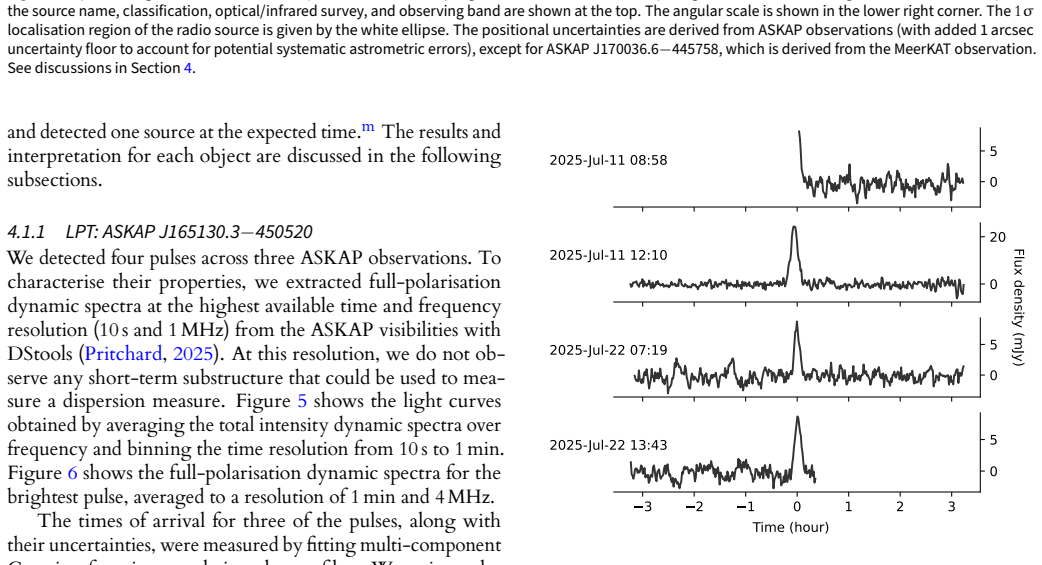
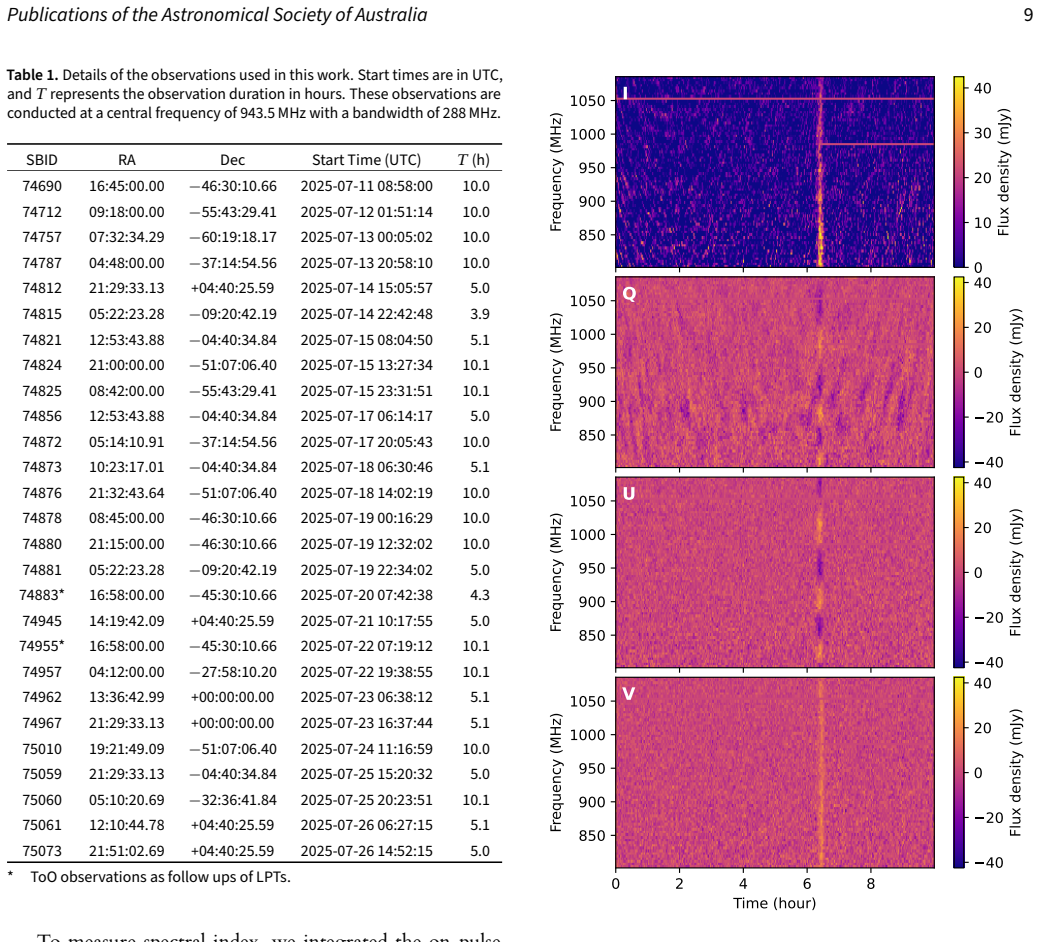
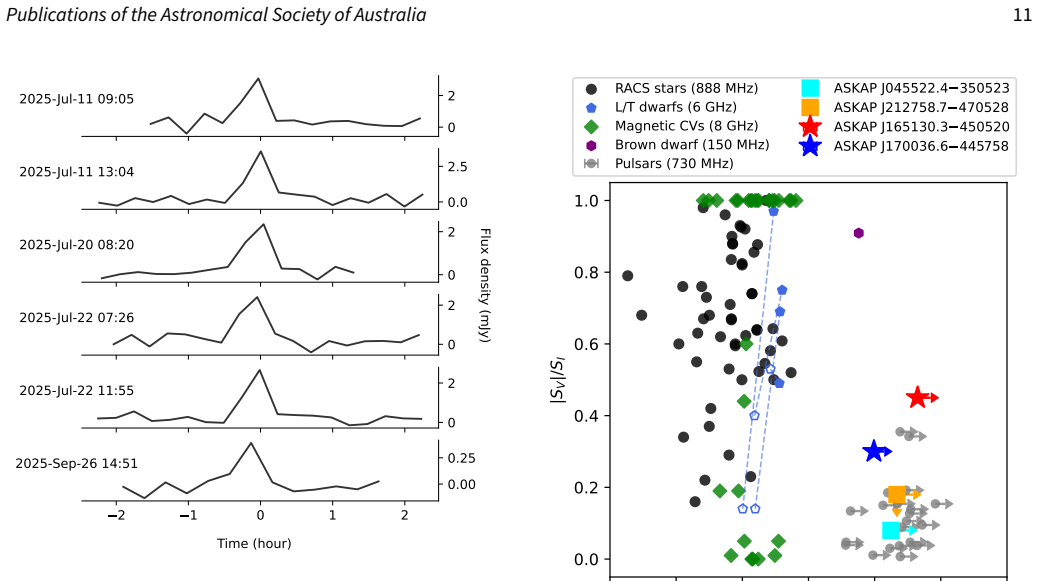
VASTER is the first short-timescale imaging and transient detection pipeline running in real time on a widefield radio telescope. It has been running on the Australian SKA Pathfinder since July 2025 and images most of the ASKAP survey project data on timescales of 15 minutes. In the first two weeks of operation it discovered ASKAP J165130.3-450520 with a period of 6.48 hours and ASKAP J170036.6-445758 with a period of 4.69 hours. The detection of these two sources adds to the small but growing population of long period transients and demonstrates the potential of VASTER to explore this region of transient parameter space.
What carries the argument
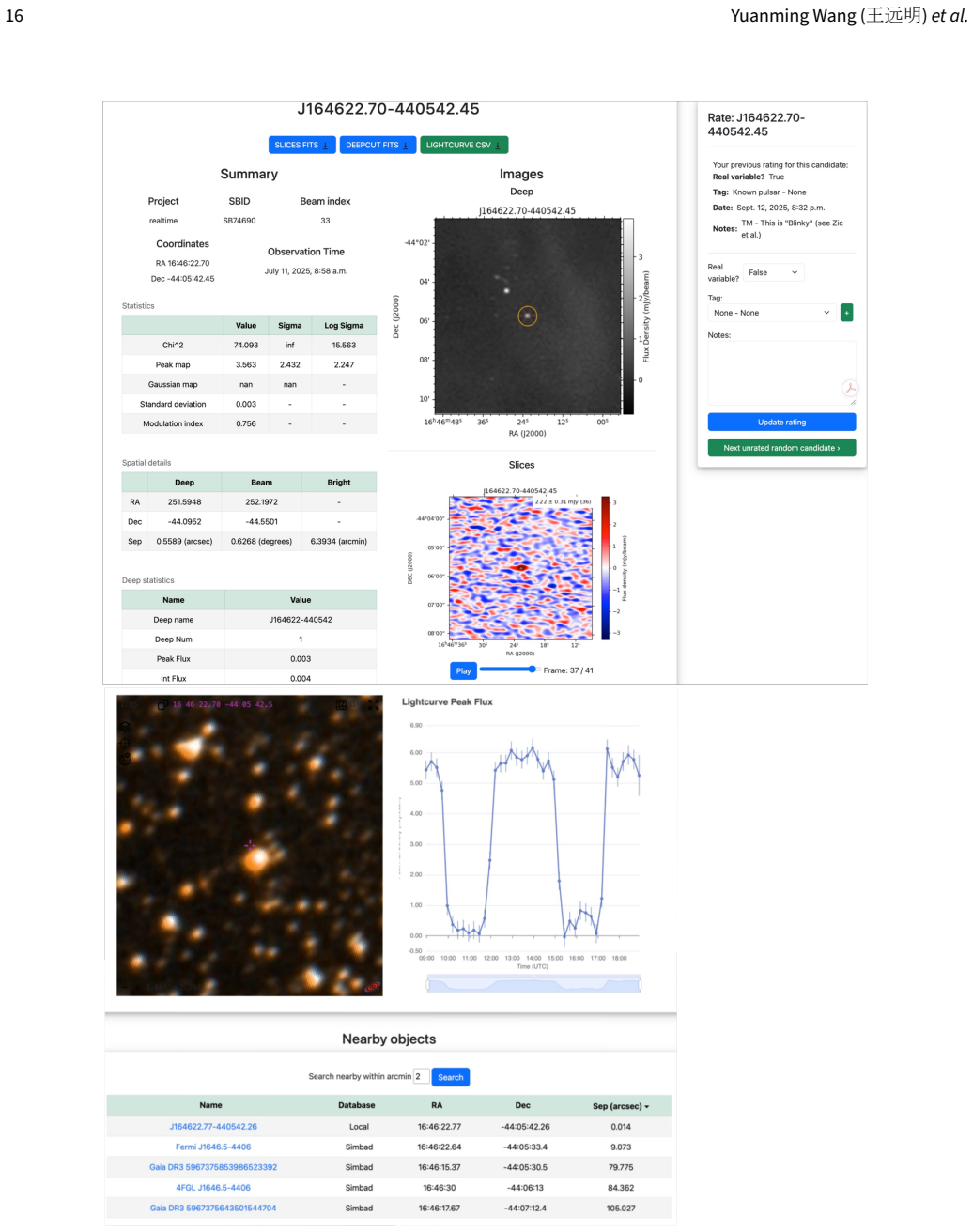
The VASTER real-time fast-imaging pipeline, which performs short-timescale transient detection on widefield radio telescope data.
If this is right
- The detections add two new members to the small but growing population of long period transients.
- Real-time processing on 15-minute timescales allows exploration of transient behavior that archival offline searches have overlooked.
- The pipeline has operated successfully on ASKAP survey data since July 2025.
- The approach shows that real-time imaging and detection are feasible for large volumes of widefield radio data.
Where Pith is reading between the lines
- Real-time detection could enable prompt multi-wavelength follow-up while a transient is still active.
- Continued operation of the pipeline is likely to increase the known sample of long period transients.
- Similar real-time systems could be deployed on other widefield telescopes to expand the search for short-timescale transients.
Load-bearing premise
The two reported sources are genuine astrophysical transients rather than instrumental artifacts produced by calibration or imaging errors.
What would settle it
Independent observations of ASKAP J165130.3-450520 and ASKAP J170036.6-445758 that fail to recover the reported periodic radio signals at 6.48 and 4.69 hours would falsify the discoveries.
Figures
read the original abstract
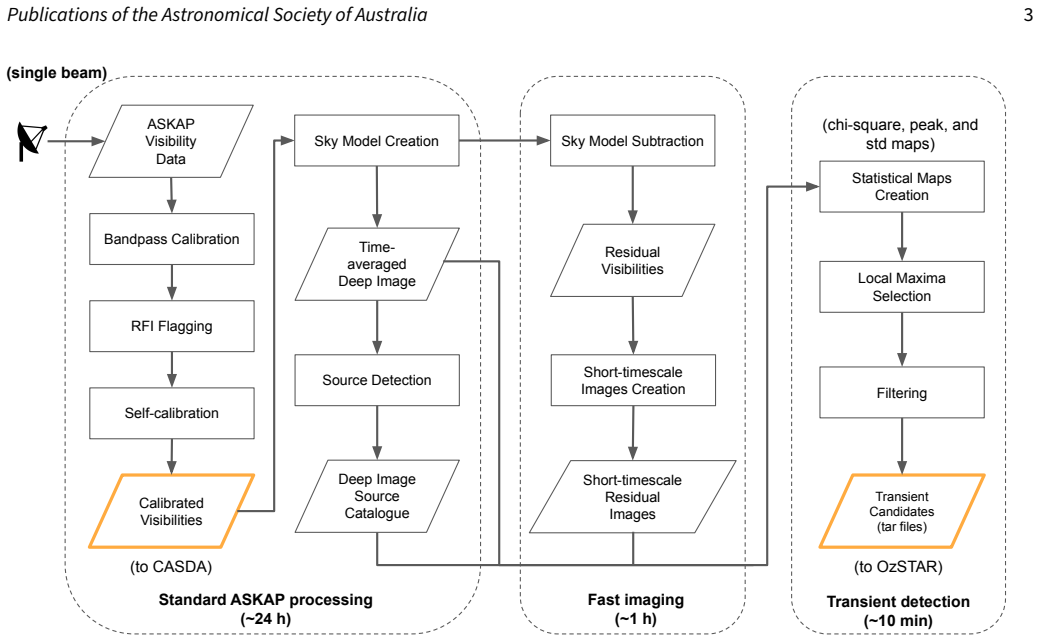
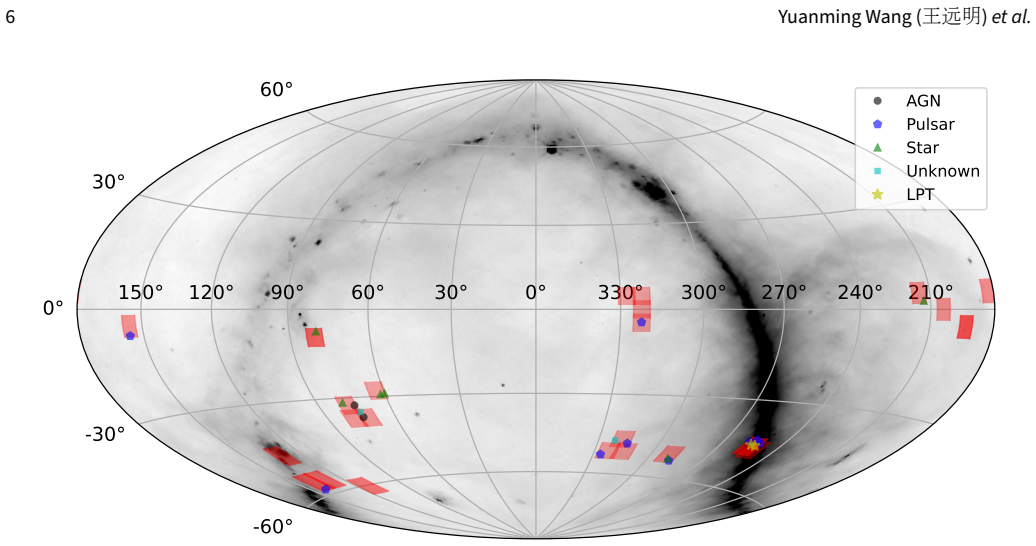
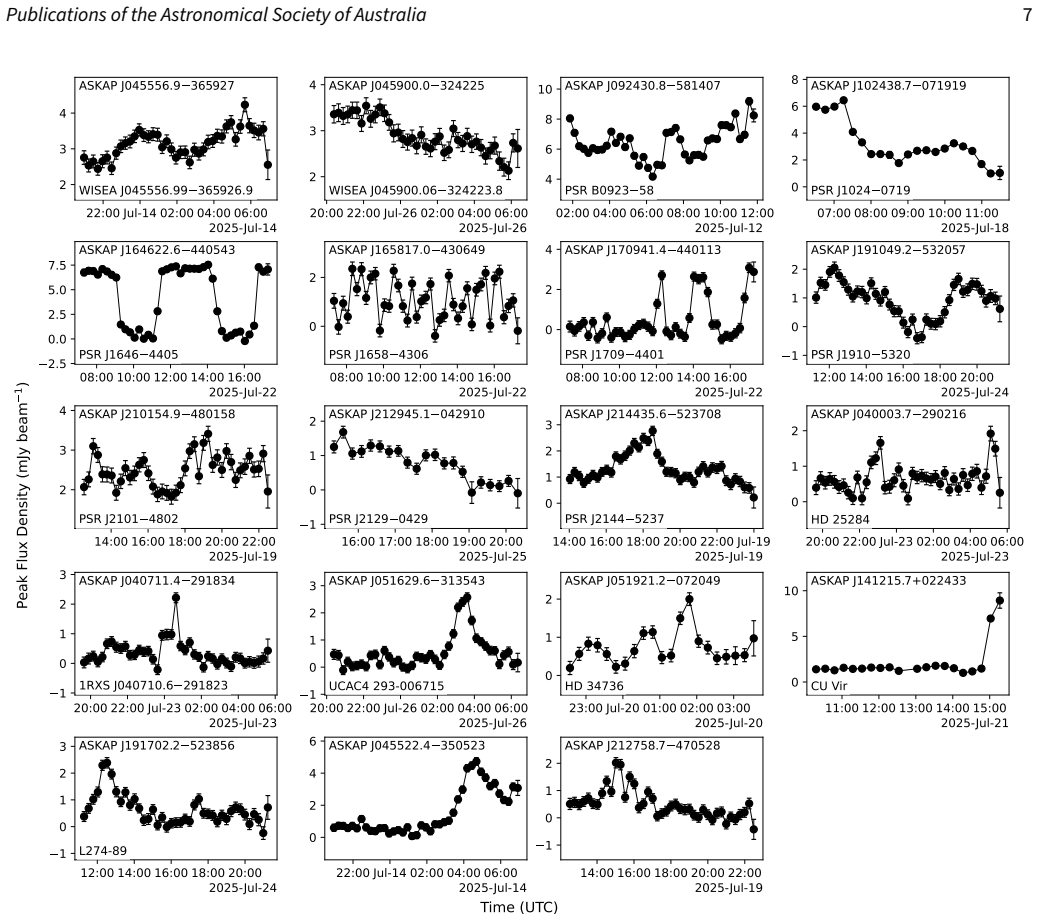
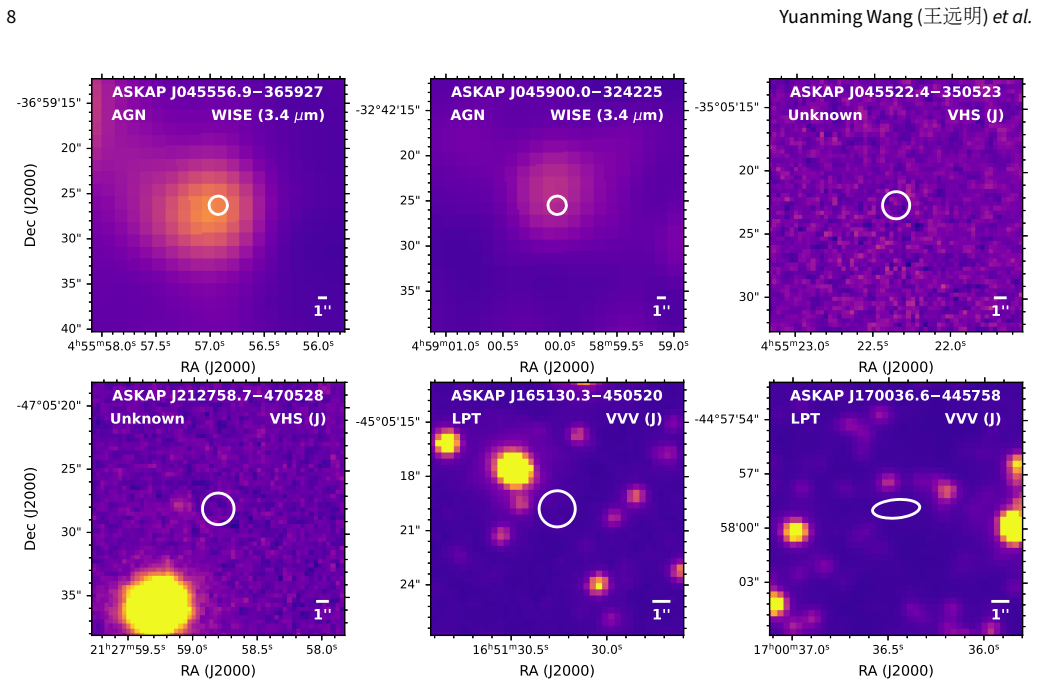
Recent developments in widefield radio telescopes have enabled searches of a new region of parameter space in the time domain: timescales of seconds to minutes, that have been overlooked in traditional surveys. These searches have revealed a new population of sources: long period transients, which typically show periodic behaviour of minutes to hours. In addition they have detected phenomena ranging from extreme scintillation to stellar radio bursts. However, almost all searches to date have involved archival data that has been processed in offline, batch mode. In this context, we present VASTER, the first short-timescale imaging and transient detection pipeline running in real time on a widefield radio telescope. VASTER has been running on the Australian SKA Pathfinder (ASKAP) since July 2025, and images most of the ASKAP survey project data on timescales of 15 minutes. In this paper we describe the VASTER system, and present the results from the first two weeks of operation, including the discovery of two long period transients: ASKAP~J165130.3$-$450520 with a period of 6.48 hours and ASKAP~J170036.6$-$445758 with a period of 4.69 hours. The detection of these two sources adds to the small, but growing, population of long period transients, as well as demonstrating the potential of VASTER to explore this region of transient parameter space.
Editorial analysis
A structured set of objections, weighed in public.
Referee Report
Summary. The manuscript presents VASTER as the first real-time short-timescale (15-minute) imaging and transient detection pipeline operating on the ASKAP widefield radio telescope since July 2025. It describes the system architecture and reports the discovery of two long-period transients from the initial two weeks of operation: ASKAP J165130.3-450520 (period 6.48 hours) and ASKAP J170036.6-445758 (period 4.69 hours).
Significance. If the detections are confirmed as astrophysical, the work would demonstrate the feasibility of real-time processing for uncovering new transient populations on minute-to-hour timescales that have been inaccessible to offline surveys. The real-time aspect is a clear strength for enabling prompt multi-wavelength follow-up.
major comments (1)
- [Abstract] Abstract: The presentation of the two detections supplies no quantitative information on residual image noise, false-positive rates from injected sources, or cross-checks against archival non-detections. This information is load-bearing for the central discovery claim, because the reported periods could arise from periodic systematics in calibration, RFI rejection, or detection thresholds rather than intrinsic source variability.
Simulated Author's Rebuttal
We thank the referee for their constructive feedback on the manuscript. The single major comment is addressed point-by-point below. We will incorporate the requested quantitative information into the revised manuscript.
read point-by-point responses
-
Referee: [Abstract] Abstract: The presentation of the two detections supplies no quantitative information on residual image noise, false-positive rates from injected sources, or cross-checks against archival non-detections. This information is load-bearing for the central discovery claim, because the reported periods could arise from periodic systematics in calibration, RFI rejection, or detection thresholds rather than intrinsic source variability.
Authors: We agree that the abstract as currently written does not include the requested quantitative metrics, and that such information strengthens the discovery claims. The main text (Sections 3 and 4) already reports residual RMS noise levels in the 15-minute images and notes that the two sources are absent from prior ASKAP archival images at the same frequency and sensitivity; however, we did not include explicit false-positive rates from injection tests in the abstract. In the revised manuscript we will (i) add a concise statement to the abstract giving the typical residual noise, the false-positive rate measured from source-injection campaigns, and the archival non-detection result, and (ii) expand the methods and results sections with the corresponding tables and figures so that the quantitative validation is fully documented. revision: yes
Circularity Check
No circularity: observational pipeline report with no derivation chain
full rationale
The paper describes the implementation and first results of the VASTER real-time imaging pipeline on ASKAP, including the detection of two transients with reported periods. No mathematical derivations, fitted parameters presented as predictions, or load-bearing self-citations are present. The central claims rest on the system's operation and the observational data collected, which are independent of any internal reduction to inputs by construction. This is a standard engineering/observational report with no derivation chain to analyze for circularity.
Axiom & Free-Parameter Ledger
Reference graph
Works this paper leans on
-
[1]
C., & Ransom, S
Andersen, B. C., & Ransom, S. M. 2018, ApJ, 863, L13 Astropy Collaboration, Robitaille, T. P., Tollerud, E. J., et al. 2013, A&A, 558, A33 Astropy Collaboration, Price-Whelan, A. M., Sipőcz, B. M., et al. 2018, AJ, 156, 123
2018
-
[2]
J., Mason, P
Barrett, P., Dieck, C., Beasley, A. J., Mason, P. A., & Singh, K. P. 2020, Advances in Space Research, 66, 1226
2020
-
[3]
2022, Nature Astronomy, 6, 828
Caleb, M., Heywood, I., Rajwade, K., et al. 2022, Nature Astronomy, 6, 828
2022
-
[4]
L., et al
Caleb, M., Lenc, E., Kaplan, D. L., et al. 2024, Nature Astronomy, 8, 1159 CASA Team, Bean, B., Bhatnagar, S., et al. 2022, PASP, 134, 114501
2024
-
[5]
M., & Lazio, T
Cordes, J. M., & Lazio, T. J. W. 2002, arXiv e-prints, astro
2002
-
[6]
N., et al
Dai, S., Hobbs, G., Manchester, R. N., et al. 2015, MNRAS, 449, 3223 de Ruiter, I., Meyers, Z. S., Rowlinson, A., et al. 2024, MNRAS, 531, 4805 de Ruiter, I., Dobie, D., Murphy, T., et al. 2026, PASA, 43, e039
2015
-
[7]
Dennett-Thorpe, J., & de Bruyn, A. G. 2002, Nature, 415, 57
2002
-
[8]
M., McClure-Griffiths, N., Gibson, S
Dickey, J. M., McClure-Griffiths, N., Gibson, S. J., et al. 2013, PASA, 30, e003
2013
-
[9]
2023, MNRAS, 519, 4684
Dobie, D., Pritchard, J., Wang, Y., et al. 2023, MNRAS, 519, 4684
2023
-
[10]
S., et al
Dobie, D., Zic, A., Oswald, L. S., et al. 2024, MNRAS, 535, 909
2024
-
[11]
A., Clarke, T
Dong, F. A., Clarke, T. E., Curtin, A., et al. 2025, ApJ, 990, L49
2025
-
[12]
N., Pritchard, J., Murphy, T., et al
Driessen, L. N., Pritchard, J., Murphy, T., et al. 2024, PASA, 41, e084
2024
-
[13]
Dulk, G. A. 1985, ARA&A, 23, 169
1985
-
[14]
Fijma, S., Rowlinson, A., Wijers, R. A. M. J., et al. 2024, MNRAS, 528, 6985 Gaia Collaboration, Vallenari, A., Brown, A. G. A., et al. 2023, A&A, 674, A1
2024
-
[15]
M., Brasseur, C
Ginsburg, A., Sipőcz, B. M., Brasseur, C. E., et al. 2019, AJ, 157, 98 phttps://github.com/IanHeywood/oxkat
2019
-
[16]
2019, ASKAPsoft: ASKAP science data processor software, Astrophysics Source Code Library, record ascl:1912.003, ascl:1912.003
Guzman, J., Whiting, M., V oronkov, M., et al. 2019, ASKAPsoft: ASKAP science data processor software, Astrophysics Source Code Library, record ascl:1912.003, ascl:1912.003
2019
-
[17]
J., Murphy, T., Gaensler, B
Hancock, P. J., Murphy, T., Gaensler, B. M., Hopkins, A., & Curran, J. R. 2012, MNRAS, 422, 1812
2012
-
[18]
J., Trott, C
Hancock, P. J., Trott, C. M., & Hurley-Walker, N. 2018, PASA, 35, e011
2018
-
[19]
H., Kern, J
Hankins, T. H., Kern, J. S., Weatherall, J. C., & Eilek, J. A. 2003, Nature, 422, 141
2003
-
[20]
R., Millman, K
Harris, C. R., Millman, K. J., van der Walt, S. J., et al. 2020, Nature, 585, 357
2020
-
[21]
2020, oxkat: Semi-automated imaging of MeerKA T observations, Astrophysics Source Code Library, record ascl:2009.003, ascl:2009.003
Heywood, I. 2020, oxkat: Semi-automated imaging of MeerKA T observations, Astrophysics Source Code Library, record ascl:2009.003, ascl:2009.003
2020
-
[22]
N., Dunning, A., et al
Hobbs, G., Manchester, R. N., Dunning, A., et al. 2020, PASA, 37, e012
2020
-
[23]
B., Edwards, R
Hobbs, G. B., Edwards, R. T., & Manchester, R. N. 2006, MNRAS, 369, 655 Horváth, C., Hurley-Walker, N., McSweeney, S., Galvin, T. J., & Morgan, J. 2025, PASA, 42, e129
2006
-
[24]
W., Bunton, J
Hotan, A. W., Bunton, J. D., Chippendale, A. P., et al. 2021, PASA, 38, e009
2021
-
[25]
Hunter, J. D. 2007, Computing in Science and Engineering, 9, 90
2007
-
[26]
2022, Nature, 601, 526
Hurley-Walker, N., Zhang, X., Bahramian, A., et al. 2022, Nature, 601, 526
2022
-
[27]
J., et al
Hurley-Walker, N., Rea, N., McSweeney, S. J., et al. 2023, Nature, 619, 487
2023
-
[28]
J., Bahramian, A., et al
Hurley-Walker, N., McSweeney, S. J., Bahramian, A., et al. 2024, ApJ, 976, L21
2024
-
[29]
2007, PASA, 24, 174
Johnston, S., Bailes, M., Bartel, N., et al. 2007, PASA, 24, 174
2007
-
[30]
M., Hallinan, G., Pineda, J
Kao, M. M., Hallinan, G., Pineda, J. S., et al. 2016, ApJ, 818, 24
2016
-
[31]
I., & Pauliny-Toth, I
Kellermann, K. I., & Pauliny-Toth, I. I. K. 1969, ApJ, 155, L71
1969
-
[32]
S., Staveley-Smith, L., Westmeier, T., et al
Koribalski, B. S., Staveley-Smith, L., Westmeier, T., et al. 2020, Ap&SS, 365, 118
2020
-
[33]
G., O’Brien, J
Kramer, M., Lyne, A. G., O’Brien, J. T., Jordan, C. A., & Lorimer, D. R. 2006, Science, 312, 549
2006
-
[34]
Lazio, T. J. W., Clarke, T. E., Lane, W. M., et al. 2010, AJ, 140, 1995
2010
-
[35]
Lee, Y. W. J., Caleb, M., Murphy, T., et al. 2025, Nature Astronomy, 9, 393
2025
-
[36]
Lee, Y. W. J., Wang, Y., Caleb, M., et al. 2026, MNRAS, 545, staf2008
2026
-
[37]
R., Kaplan, D
Lenc, E., Murphy, T., Lynch, C. R., Kaplan, D. L., & Zhang, S. N. 2018, MNRAS, 478, 2835
2018
-
[38]
R., & Kramer, M
Lorimer, D. R., & Kramer, M. 2004, Handbook of Pulsar Astronomy, V ol. 4
2004
-
[39]
Macquart, J.-P., Bailes, M., Bhat, N. D. R., et al. 2010, PASA, 27, 272
2010
-
[40]
N., Hobbs, G
Manchester, R. N., Hobbs, G. B., Teoh, A., & Hobbs, M. 2005, AJ, 129, 1993
2005
-
[41]
L., Lenc, E., et al
McConnell, D., Hale, C. L., Lenc, E., et al. 2020, PASA, 37, e048
2020
-
[42]
G., Banerji, M., Gonzalez, E., et al
McMahon, R. G., Banerji, M., Gonzalez, E., et al. 2013, The Messenger, 154, 35
2013
-
[43]
W., Emerson, J
Minniti, D., Lucas, P. W., Emerson, J. P., et al. 2010, New A, 15, 433
2010
-
[44]
Murphy, T., & Kaplan, D. L. 2026, PASA, 43, e006
2026
-
[45]
L., et al
Murphy, T., Chatterjee, S., Kaplan, D. L., et al. 2013, PASA, 30, e006
2013
-
[46]
L., Stewart, A
Murphy, T., Kaplan, D. L., Stewart, A. J., et al. 2021, PASA, 38, e054
2021
-
[47]
1992, Philosophical Transactions of the Royal Society of London Series A, 341, 151
Narayan, R. 1992, Philosophical Transactions of the Royal Society of London Series A, 341, 151
1992
-
[48]
J., Bailes, M., et al
Ng, C., Champion, D. J., Bailes, M., et al. 2015, MNRAS, 450, 2922
2015
-
[49]
P., Hopkins, A
Norris, R. P., Hopkins, A. M., Afonso, J., et al. 2011, PASA, 28, 215
2011
-
[50]
P., Marvil, J., Collier, J
Norris, R. P., Marvil, J., Collier, J. D., et al. 2021, PASA, 38, e046
2021
-
[51]
S., Taylor, G
Obenberger, K. S., Taylor, G. B., Hartman, J. M., et al. 2015, Journal of Astronomical Instrumentation, 4, 1550004
2015
-
[52]
1996, The VizieR database of astronomical catalogues, doi:10
Ochsenbein, F. 1996, The VizieR database of astronomical catalogues, doi:10. 26093/CDS/VIZIER
1996
-
[53]
2000, A&AS, 143, 23
Ochsenbein, F., Bauer, P., & Marcout, J. 2000, A&AS, 143, 23
2000
-
[54]
R., McKinley, B., Hurley-Walker, N., et al
Offringa, A. R., McKinley, B., Hurley-Walker, N., et al. 2014, MNRAS, 444, 606
2014
-
[55]
2026, PASA, 43, e007
Petrou, F., Wang, Y., Hurley-Walker, N., et al. 2026, PASA, 43, e007
2026
-
[56]
2022, in As- tronomical Society of the Pacific Conference Series, V ol
Pintaldi, S., Stewart, A., O’Brien, A., Kaplan, D., & Murphy, T. 2022, in As- tronomical Society of the Pacific Conference Series, V ol. 532, Astronomical Data Analysis Software and Systems XXX, ed. J. E. Ruiz, F. Pierfedereci, & P. Teuben, 333
2022
-
[57]
Price, D. C. 2016, PyGDSM: Python interface to Global Diffuse Sky Models, Astrophysics Source Code Library, record ascl:1603.013, ascl:1603.013
2016
-
[58]
askap-vast/dstools: v2.0.0 (2025)
Pritchard, J. 2025, askap-vast/dstools: v2.0.0, doi:10.5281/zenodo.15232974 Publications of the Astronomical Society of Australia15
-
[59]
2021, MNRAS, 502, 5438
Pritchard, J., Murphy, T., Zic, A., et al. 2021, MNRAS, 502, 5438
2021
-
[60]
M., Eikenberry, S
Ransom, S. M., Eikenberry, S. S., & Middleditch, J. 2002, AJ, 124, 1788
2002
-
[61]
2023, MNRAS, 518, 4646
Rhee, J., Meyer, M., Popping, A., et al. 2023, MNRAS, 518, 4646
2023
-
[62]
P., et al
Rigney, J., Ramsay, G., Carley, E. P., et al. 2022, MNRAS, 516, 540
2022
-
[63]
2012, APLpy: Astronomical Plotting Library in Python, Astrophysics Source Code Library, record ascl:1208.017, ascl:1208.017
Robitaille, T., & Bressert, E. 2012, APLpy: Astronomical Plotting Library in Python, Astrophysics Source Code Library, record ascl:1208.017, ascl:1208.017
2012
-
[64]
J., et al
Ross, K., Hurley-Walker, N., Galvin, T. J., et al. 2024, PASA, 41, e054
2024
-
[65]
F., & Finkbeiner, D
Schlafly, E. F., & Finkbeiner, D. P. 2011, ApJ, 737, 103
2011
-
[66]
2024, MNRAS, 535, 2812
Semenko, E., Kochukhov, O., Mikulášek, Z., et al. 2024, MNRAS, 535, 2812
2024
-
[67]
M., Bannister, K
Shannon, R. M., Bannister, K. W., Bera, A., et al. 2025, PASA, 42, e036
2025
-
[68]
M., Golden, A., Myburgh, T., et al
Smirnov, O. M., Golden, A., Myburgh, T., et al. 2025b, MNRAS, 538, L89 Van Eck, C. L., R. Purcell, C., Baidoo, L., et al. 2026, ApJS, 283, 28
2026
-
[69]
K., Callingham, J
Vedantham, H. K., Callingham, J. R., Shimwell, T. W., et al. 2020, ApJ, 903, L33
2020
-
[70]
E., et al
Virtanen, P., Gommers, R., Oliphant, T. E., et al. 2020, Nature Medicine, 17, 261 V oronkov, M. 2020, in European Physical Journal Web of Conferences, V ol. 245, European Physical Journal Web of Conferences (EDP), 01038
2020
-
[71]
2021, MNRAS, 502, 3294
Wang, Y., Tuntsov, A., Murphy, T., et al. 2021, MNRAS, 502, 3294
2021
-
[72]
L., et al
Wang, Y., Murphy, T., Kaplan, D. L., et al. 2022, ApJ, 930, 38
2022
-
[73]
2023, MNRAS, 523, 5661
Wang, Y., Murphy, T., Lenc, E., et al. 2023, MNRAS, 523, 5661
2023
-
[74]
W., Panagia, N., Montes, M
Weiler, K. W., Panagia, N., Montes, M. J., & Sramek, R. A. 2002, ARA&A, 40, 387
2002
-
[75]
2000, A&AS, 143, 9
Wenger, M., Ochsenbein, F., Egret, D., et al. 2000, A&AS, 143, 9
2000
-
[76]
M., & Franciosini, E
White, S. M., & Franciosini, E. 1995, ApJ, 444, 342
1995
-
[77]
2012, PASA, 29, 371
Whiting, M., & Humphreys, B. 2012, PASA, 29, 371
2012
-
[78]
L., Eisenhardt, P
Wright, E. L., Eisenhardt, P. R. M., Mainzer, A. K., et al. 2010, AJ, 140, 1868
2010
-
[79]
M., Manchester, R
Yao, J. M., Manchester, R. N., & Wang, N. 2017, ApJ, 835, 29 Y oon, H., Sadler, E. M., Mahony, E. K., et al. 2025, PASA, 42, e088
2017
-
[80]
N., et al
Zhang, L., Hobbs, G., Manchester, R. N., et al. 2019, ApJ, 885, L37
2019
discussion (0)
Sign in with ORCID, Apple, or X to comment. Anyone can read and Pith papers without signing in.