Residual-Space Evolutionary Optimization via Flow-based Generative Models
Pith reviewed 2026-06-26 17:10 UTC · model grok-4.3
The pith
Residual-space evolutionary optimization allows non-differentiable editing in flow-based generative models via self- and cross-pollination.
A machine-rendered reading of the paper's core claim, the machinery that carries it, and where it could break.
Core claim
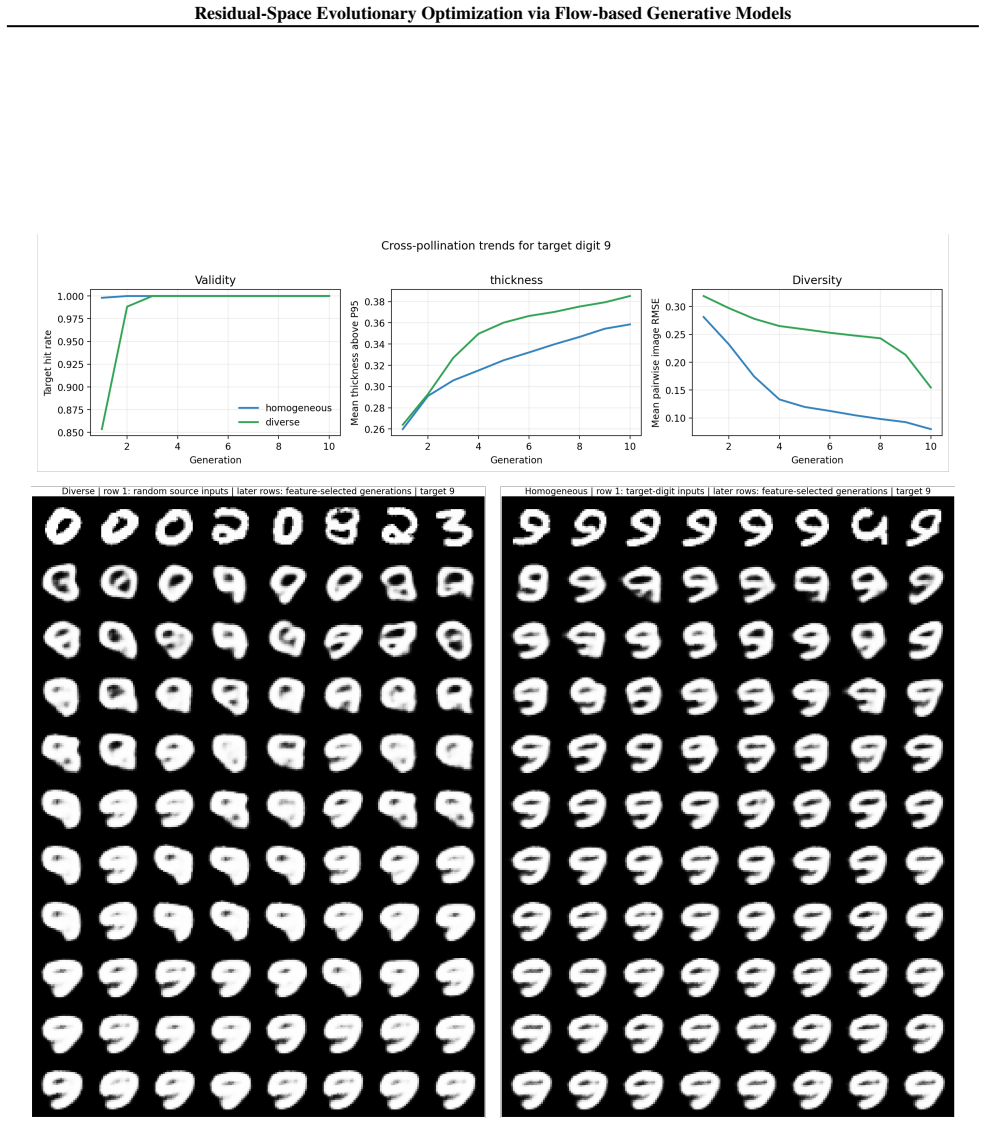
Conditional flow matching can disentangle condition-controlled factors from instance-specific residuals, enabling direct operation in residual space. The framework separates self-pollination, which performs local exploitation through feature-preserving residual refinement, from cross-pollination, which promotes broader exploration by recombining residuals across samples. This exploration-exploitation decomposition balances target alignment, instance preservation, and diversity, as demonstrated on MorphoMNIST for counterfactual generation and on crystal data for scientific domains.
What carries the argument
Residual-space evolutionary optimization, which applies evolutionary algorithms directly in the residual space of conditional flow matching models through self-pollination for exploitation and cross-pollination for exploration.
If this is right
- Non-differentiable or black-box objectives become usable for editing in flow-based generative models.
- Self-pollination and cross-pollination provide a concrete mechanism for trading off alignment against preservation and diversity.
- The framework extends beyond images to real-world scientific data such as crystal structures.
- Validation on MorphoMNIST shows the approach supports counterfactual generation tasks.
Where Pith is reading between the lines
- The same residual decomposition might apply to other flow-matching variants or related generative models if similar disentanglement occurs.
- Testing on additional modalities like molecular graphs could reveal whether instance preservation scales with data complexity.
- Hybridizing the pollination steps with gradient information where available might further accelerate convergence on mixed objectives.
Load-bearing premise
Conditional flow matching can disentangle condition-controlled factors from instance-specific residuals so that edits in residual space preserve instance features while pursuing the target.
What would settle it
If self- and cross-pollination on the crystal dataset produce samples that either lose instance-specific features or fail to improve target alignment relative to direct methods, the residual-space approach would not hold.
Figures


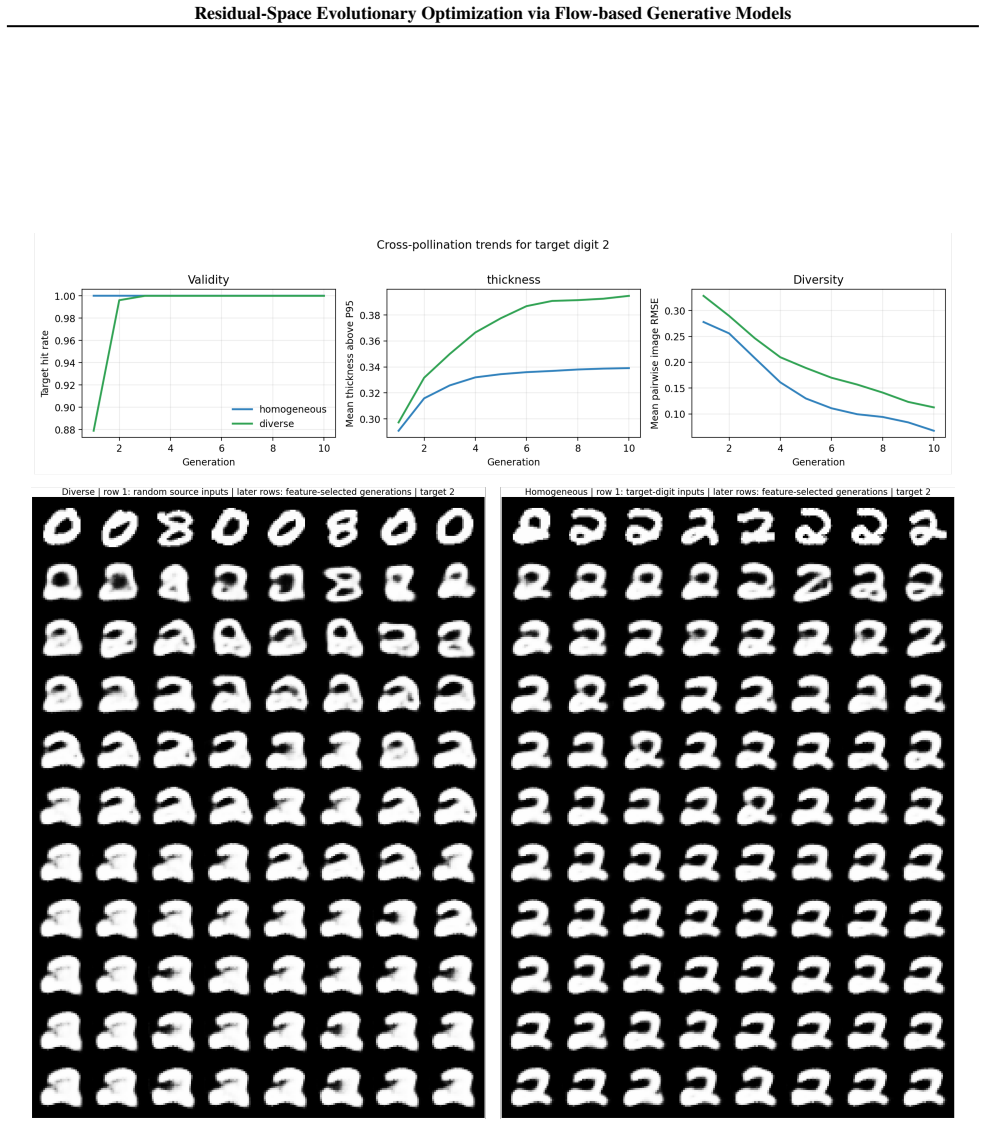

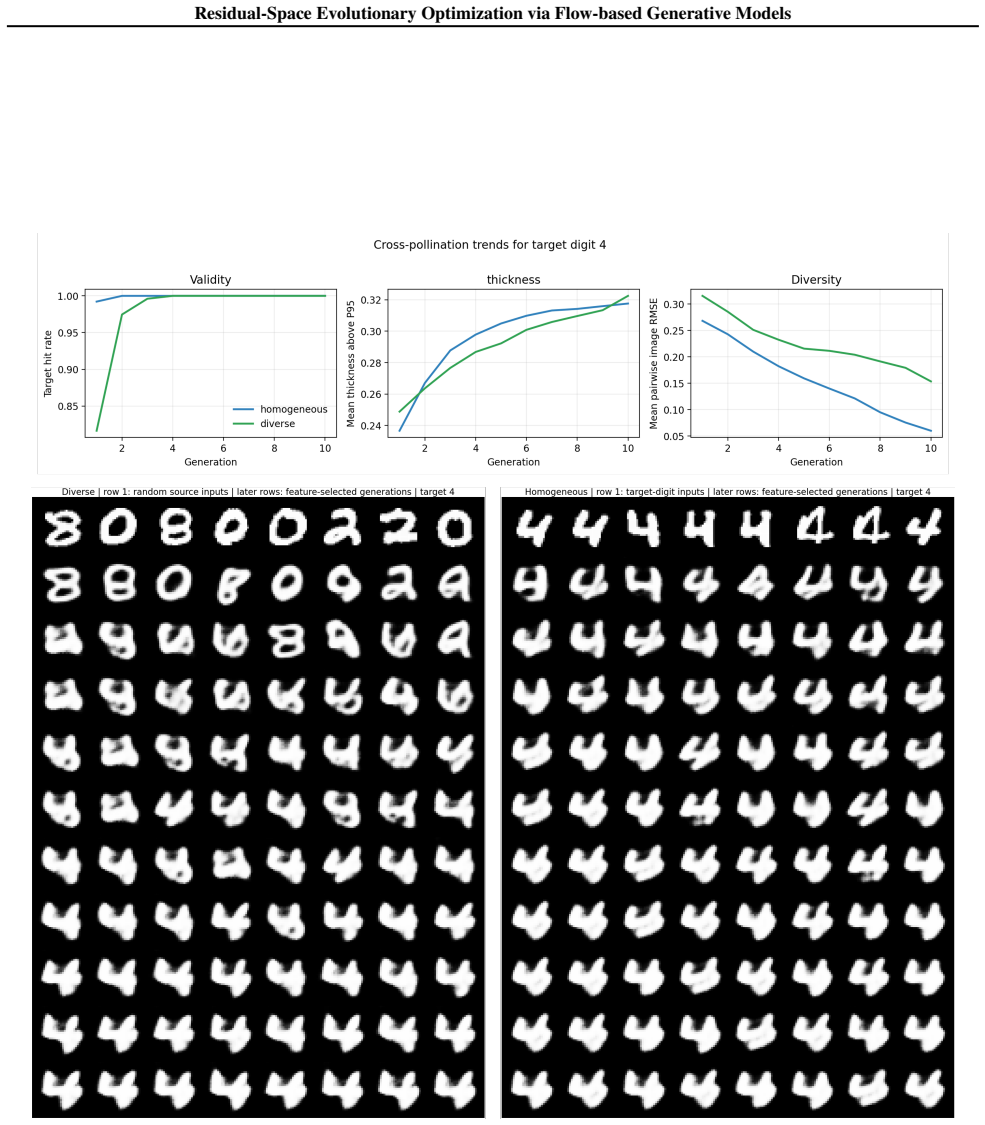

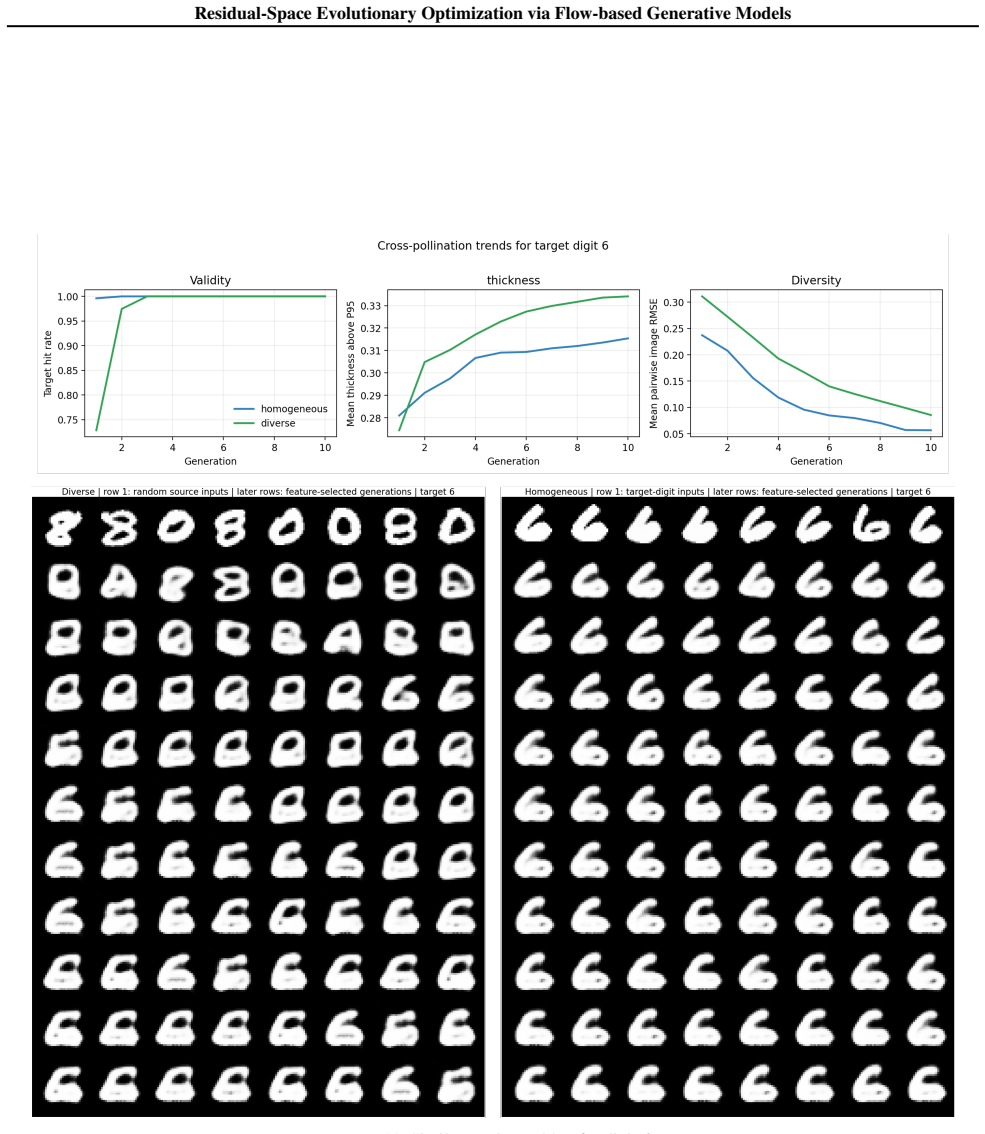

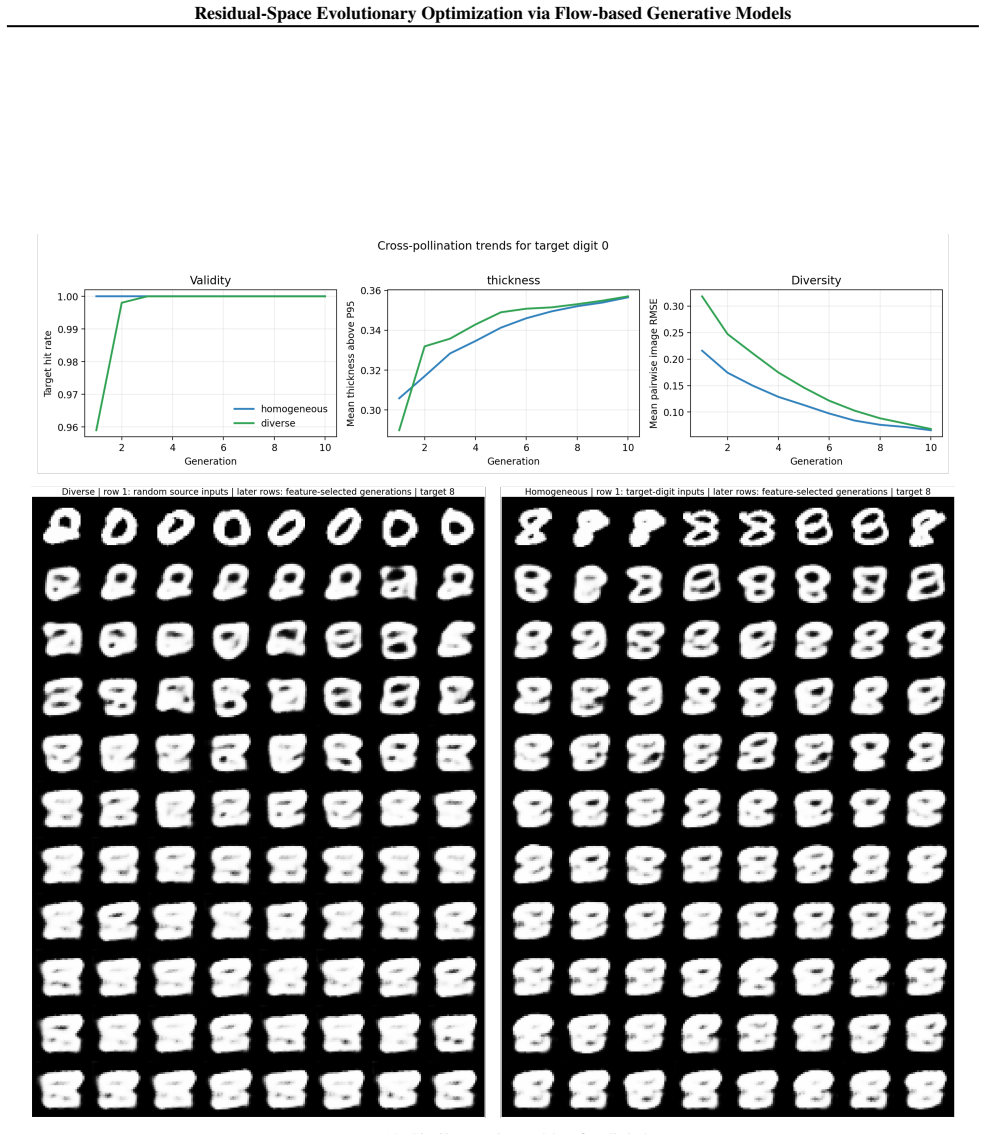
read the original abstract
Data editing with generative methods typically requires differentiable objectives and gradient-based search. However, these assumptions break down in flow-based settings, where edits are performed through forward and backward integration and often involve non-differentiable or black-box objectives. We introduce residual-space evolutionary optimization, a model-agnostic framework that addresses this gap by combining flow-based generative editing with evolutionary algorithms. Building on the observation that conditional flow matching (CFM) can disentangle condition-controlled factors from instance-specific residuals, our framework directly operates in residual space and separates two complementary search regimes: self-pollination performs local exploitation through feature-preserving residual refinement, and cross-pollination promotes broader exploration by recombining residuals across heterogeneous samples. As a proof of concept, we validate on MorphoMNIST, a benchmark dataset for counterfactual generation, and on crystal data, demonstrating that this exploration--exploitation decomposition provides a useful mechanism for balancing target alignment, instance preservation, and diversity, and extends beyond images to real-world scientific domains.
Editorial analysis
A structured set of objections, weighed in public.
Referee Report
Summary. The manuscript proposes residual-space evolutionary optimization, a model-agnostic framework that combines flow-based generative editing with evolutionary algorithms. It builds on the observation that conditional flow matching (CFM) can disentangle condition-controlled factors from instance-specific residuals, enabling direct operation in residual space. The framework separates self-pollination (local exploitation via feature-preserving residual refinement) from cross-pollination (broader exploration via residual recombination), and validates the approach on MorphoMNIST for counterfactual generation and on crystal data, claiming a useful mechanism for balancing target alignment, instance preservation, and diversity that extends to scientific domains.
Significance. If the CFM-based residual disentanglement is rigorously established and the evolutionary operations prove effective without condition leakage, the framework could provide a practical route for generative editing under non-differentiable or black-box objectives, with potential utility in scientific applications such as crystallography.
major comments (2)
- [Abstract] Abstract: The framework's entire residual-space EA construction (self-pollination for exploitation, cross-pollination for exploration) presupposes that residuals can be cleanly isolated from condition effects via CFM. The abstract states this as a building-block observation without describing the subtraction, projection, or training step that produces the residual representation. If the residual still carries condition leakage or loses instance identity, the claimed separation of search regimes collapses and the balancing of alignment/preservation/diversity cannot be attributed to the decomposition.
- [Validation] Validation section: The proof-of-concept results on MorphoMNIST and crystal data are asserted to demonstrate the exploration-exploitation decomposition, but no quantitative metrics, baselines, ablation studies, or details on how target alignment, instance preservation, and diversity are measured or balanced are provided, preventing assessment of whether the empirical results support the central claims.
Simulated Author's Rebuttal
We thank the referee for their constructive comments on our manuscript. We address each major comment below and indicate the revisions we will make to strengthen the presentation.
read point-by-point responses
-
Referee: [Abstract] Abstract: The framework's entire residual-space EA construction (self-pollination for exploitation, cross-pollination for exploration) presupposes that residuals can be cleanly isolated from condition effects via CFM. The abstract states this as a building-block observation without describing the subtraction, projection, or training step that produces the residual representation. If the residual still carries condition leakage or loses instance identity, the claimed separation of search regimes collapses and the balancing of alignment/preservation/diversity cannot be attributed to the decomposition.
Authors: We agree that the abstract, being high-level, does not detail the residual isolation mechanism. The full manuscript explains that residuals are isolated via conditional flow matching by subtracting condition-controlled components from the instance representation. To clarify the foundational step and address potential concerns about leakage, we will revise the abstract to briefly describe the residual extraction process. revision: yes
-
Referee: [Validation] Validation section: The proof-of-concept results on MorphoMNIST and crystal data are asserted to demonstrate the exploration-exploitation decomposition, but no quantitative metrics, baselines, ablation studies, or details on how target alignment, instance preservation, and diversity are measured or balanced are provided, preventing assessment of whether the empirical results support the central claims.
Authors: The referee correctly notes that the current validation section relies on qualitative demonstrations without accompanying quantitative metrics or ablations. As the work is presented as a proof of concept, we will expand the validation section in revision to include explicit metrics for alignment, preservation, and diversity, relevant baselines, and ablation studies to more rigorously support the exploration-exploitation claims. revision: yes
Circularity Check
No circularity; no derivation chain or equations present to inspect
full rationale
The provided abstract and framework description contain no equations, derivations, fitted parameters, or self-citations. The central premise is introduced as 'building on the observation that conditional flow matching (CFM) can disentangle condition-controlled factors from instance-specific residuals' without any shown extraction procedure, subtraction step, or reduction to prior inputs. The exploration-exploitation decomposition via self- and cross-pollination is presented conceptually rather than as a mathematical result that reduces to its own fitted quantities by construction. No load-bearing step matches any of the enumerated circularity patterns, so the paper's claims remain self-contained against external benchmarks with no detectable circularity.
Axiom & Free-Parameter Ledger
Reference graph
Works this paper leans on
-
[1]
Galaxy mor- phology classification with counterfactual explanation
Cao, Z., Krieger, L., Scharr, H., and Assent, I. Galaxy mor- phology classification with counterfactual explanation. arXiv preprint arXiv:2510.14655, 2025a. Cao, Z., Zhao, X., Krieger, L., Scharr, H., and Assent, I. Leapfactual: Reliable visual counterfactual explanation using conditional flow matching. Accepted for publica- tion at The Thirty-Ninth Annua...
- [2]
-
[3]
ECINN: Efficient Counterfactuals from Invertible Neural Networks.arXiv preprint arXiv:2103.13701,
Hvilshøj, F., Iosifidis, A., and Assent, I. ECINN: Efficient Counterfactuals from Invertible Neural Networks.arXiv preprint arXiv:2103.13701,
-
[4]
doi: 10.1109/ICAIRC64177.2024.10900033. Mahendran, A. and Vedaldi, A. Understanding deep image representations by inverting them. InIEEE Conference on Computer Vision and Pattern Recognition,
-
[5]
Nemirovsky, D., Thiebaut, N., Xu, Y ., and Gupta, A. CounteRGAN: Generating Realistic Counterfactuals with Residual Generative Adversarial Nets.arXiv preprint arXiv:2009.05199,
-
[6]
Explanation by Progressive Exaggeration.arXiv preprint arXiv:1911.00483,
Singla, S., Pollack, B., Chen, J., and Batmanghelich, K. Explanation by Progressive Exaggeration.arXiv preprint arXiv:1911.00483,
-
[7]
Zhang, L., Rao, A., and Agrawala, M
doi: 10.1109/ICITISEE63424.2024.10730362. Zhang, L., Rao, A., and Agrawala, M. Adding conditional control to text-to-image diffusion models. InIEEE/CVF International Conference on Computer Vision,
-
[8]
Algorithm 1Residual-Space Evolutionary Optimization Require: Initial inputs P0 ={x (0) j }N j=1, encoder E, decoder D, classifier C, frozen flow model vθ, target condition ctgt, generationsG, population sizeK, child pool sizeM, mode∈ {self,cross} Ensure:Retained target-conditioned samples 1:forg= 1, . . . , Gdo 2:Initialize child set ePg ← ∅ 3:Encode curr...
2048
-
[9]
Table 3.Hyperparameters used for the self-pollination experiment. Hyperparameter Value Random seed2023,2024,2025 Samples per target digit2048 Total evaluated edits20480 Leap step size0.3 Self-pollination generations10 Children per parent32 Mutation noise std.0.5 Selection mode Top-k Target confidence weightλ conf 4.5 Similarity weightλ sim 1.5 Margin weig...
2024
-
[10]
11 Residual-Space Evolutionary Optimization via Flow-based Generative Models Table 4.Hyperparameters used for the cross-pollination experiment. Hyperparameter Value Random seed2023,2024,2025 Optimized feature Thickness Crossover mode Dimension Population size per method512 Cross-pollination generations10 Children per parent32 Leap step size0.2 Crossover t...
2024
-
[11]
Table 5.Hyperparameters used for the crystal cross-pollination experiment. Hyperparameter Value Random seed2023,2024,2025 Target crystal systems7systems Optimized feature Predicted band gap Population size per method256 Cross-pollination generations10 Children per parent32 Leap step size0.2 Cross-pollination generations10 Crossover type Dimension-wise cro...
2024
-
[12]
Results are reported as mean ±STE
12 Residual-Space Evolutionary Optimization via Flow-based Generative Models Table 6.Per-target-digit comparison between leap-only and self-pollination on MorphoMNIST. Results are reported as mean ±STE. Self-pollination denotes the improvement over leap-only. Target Digit Validity↑ Similarity↑ Leap-only Self-pollination Leap-only Self-pollination 0 0.9995...
2099
discussion (0)
Sign in with ORCID, Apple, or X to comment. Anyone can read and Pith papers without signing in.