Multi-Head Attention-Based Feature Extractor Integration with Soft Actor-Critic for Porosity Prediction and Process Parameter Optimization in Additive Manufacturing
Pith reviewed 2026-06-26 17:07 UTC · model grok-4.3
The pith
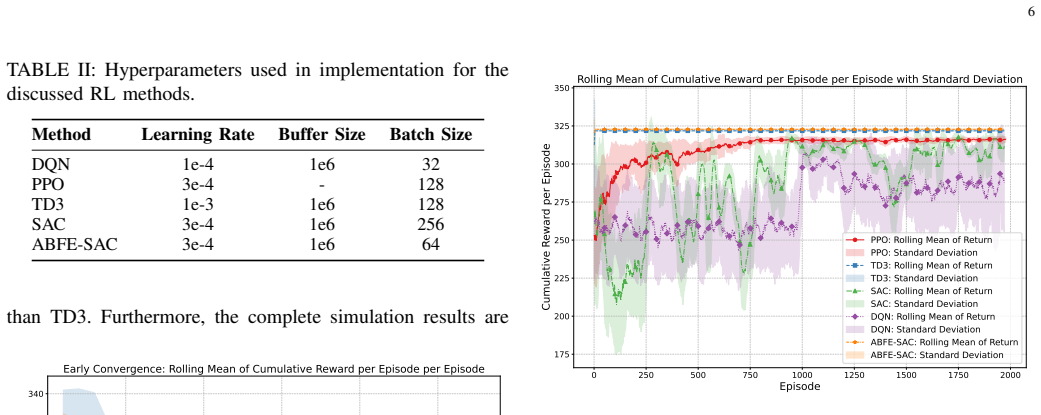
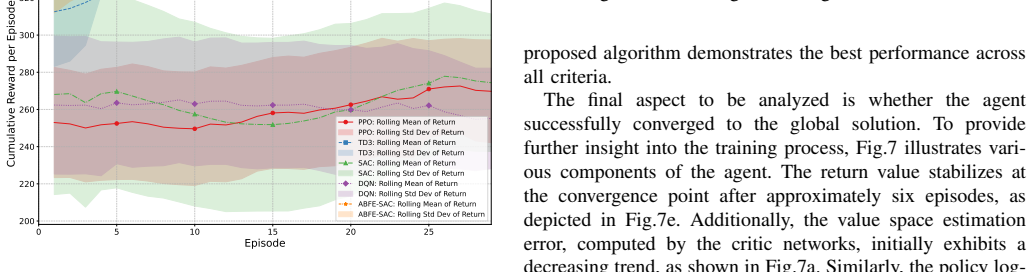
Multi-head attention integrated with Soft Actor-Critic reaches a convergence value of 322.79 in 14 episodes for additive manufacturing parameter optimization.
A machine-rendered reading of the paper's core claim, the machinery that carries it, and where it could break.
Core claim
The proposed methodology integrates a multi-head attention-based feature extractor with the Soft Actor-Critic algorithm, achieving a convergence value of 322.79 within 14 episodes on porosity prediction and process parameter optimization in laser powder bed fusion while outperforming DQN, PPO, TD3, and vanilla SAC and maintaining stability throughout training.
What carries the argument
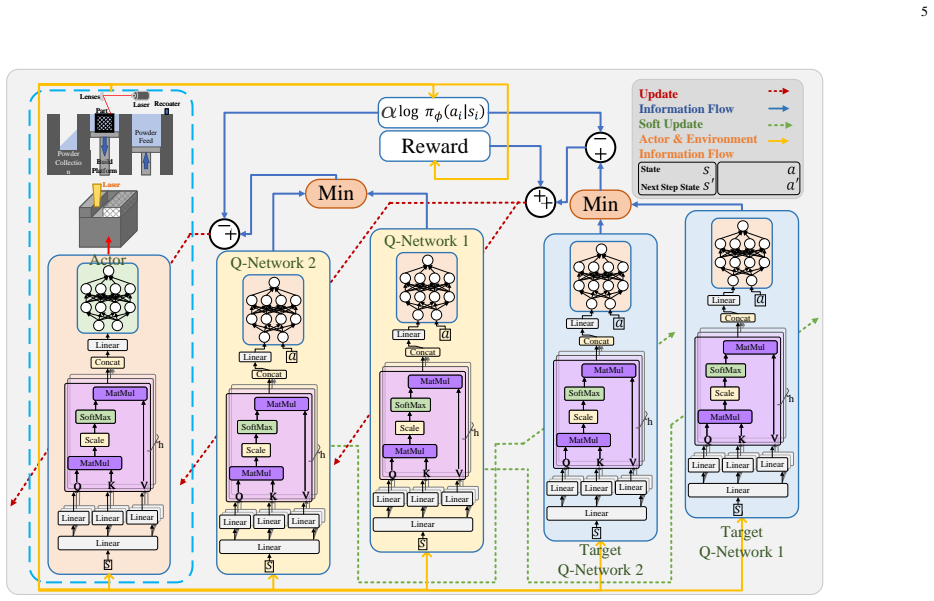
Multi-head attention mechanism serving as a feature extractor inside the Soft Actor-Critic framework to improve capture of subtle variations in low-dimensional inputs and balance exploration-exploitation in continuous action spaces.
If this is right
- The method converges faster than standard RL approaches in continuous action spaces for manufacturing optimization.
- It reaches higher final reward values than DQN, PPO, TD3, and vanilla SAC.
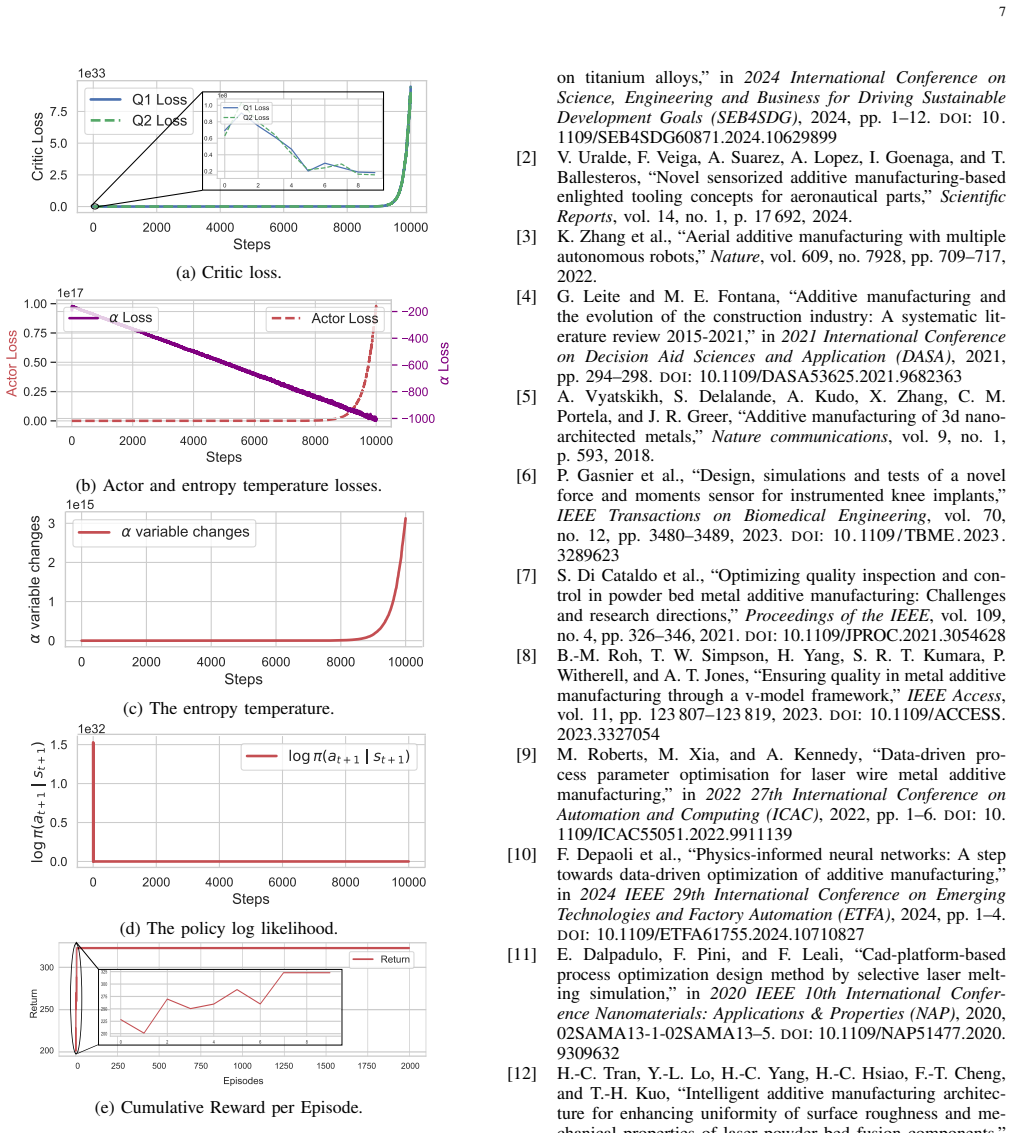
- Training remains stable across episodes while navigating value spaces with local minima.
- Continuous action spaces become practical for high-precision tasks such as porosity minimization.
Where Pith is reading between the lines
- The same attention-augmented SAC structure could be tested on other parameter-optimization tasks that involve low-dimensional sensor data.
- If the performance gain holds, hybrid attention-RL agents might reduce the number of physical trials needed during process development.
- Extending the approach to multi-objective rewards that include build time or energy use would be a direct next step.
Load-bearing premise
The multi-head attention mechanism enhances the agent's ability to capture subtle variations in low-dimensional input features, enabling a more effective exploration-exploitation balance.
What would settle it
A controlled ablation that removes the multi-head attention component and measures whether convergence slows below 14 episodes or the final reward falls below 322.79 on the same laser powder bed fusion task would settle the claim.
Figures
read the original abstract
Additive manufacturing process optimization requires precise parameter control to minimize defects such as porosity. Traditional reinforcement learning (RL) approaches using discrete action spaces suffer from slow convergence and susceptibility to local optima, limiting their effectiveness for high-precision manufacturing tasks. This study addresses these limitations by employing a continuous action space combined with a novel architecture that integrates a multi-head attention mechanism with the Soft Actor-Critic (SAC) algorithm. The attention-based feature extractor enhances the agent's ability to capture subtle variations in low-dimensional input features, enabling more effective exploration-exploitation balance for navigating value spaces with local minima. We validate our approach on porosity prediction and process parameter optimization in laser powder bed fusion, demonstrating faster convergence and higher final reward values compared to standard RL methods including DQN, PPO, TD3, and vanilla SAC. The proposed methodology achieves a convergence value of 322.79 within 14 episodes, outperforming existing approaches while maintaining stability throughout training.
Editorial analysis
A structured set of objections, weighed in public.
Referee Report
Summary. The manuscript proposes integrating a multi-head attention mechanism as a feature extractor with the Soft Actor-Critic (SAC) algorithm to optimize process parameters and predict porosity in laser powder bed fusion additive manufacturing. It claims that this yields faster convergence to a value of 322.79 within 14 episodes while maintaining stability, outperforming DQN, PPO, TD3, and vanilla SAC on the task.
Significance. If the numerical claims can be reproduced with fully specified state/reward definitions and controls, the work could demonstrate a practical benefit of attention-augmented continuous RL for manufacturing optimization. The current text supplies no such specification, so the result cannot yet be evaluated for significance or generality.
major comments (3)
- [Abstract] Abstract: the reward function (e.g., whether it is negative porosity, a shaped potential, or a weighted sum) and the exact state vector are never defined, rendering the headline scalar result of 322.79 uninterpretable and preventing any meaningful comparison to the listed baselines.
- [Abstract] Abstract: no information is supplied on dataset size, number of input features, train/test split, or statistical significance testing, so the claim of outperforming DQN/PPO/TD3/SAC cannot be assessed.
- [Abstract] Abstract: the assertion that multi-head attention improves exploration-exploitation balance on low-dimensional features is presented without ablation studies, attention-weight visualizations, or comparison to a non-attention SAC variant, leaving the architectural contribution unsupported.
Simulated Author's Rebuttal
We thank the referee for the constructive feedback highlighting the need for greater methodological detail and supporting analyses. We agree these elements are necessary for reproducibility and will revise the manuscript accordingly.
read point-by-point responses
-
Referee: [Abstract] Abstract: the reward function (e.g., whether it is negative porosity, a shaped potential, or a weighted sum) and the exact state vector are never defined, rendering the headline scalar result of 322.79 uninterpretable and preventing any meaningful comparison to the listed baselines.
Authors: We agree that explicit definitions are required for interpretability. In the revised manuscript we will add a dedicated subsection specifying the state vector (laser power, scan speed, hatch spacing, layer thickness, and powder bed temperature) and the reward function (negative predicted porosity plus a small penalty on action magnitude to encourage feasible parameters). revision: yes
-
Referee: [Abstract] Abstract: no information is supplied on dataset size, number of input features, train/test split, or statistical significance testing, so the claim of outperforming DQN/PPO/TD3/SAC cannot be assessed.
Authors: We will expand the experimental section to report the dataset size, exact number of input features, train/test split ratio, and results of statistical significance tests (paired t-tests with p-values) between all compared algorithms. revision: yes
-
Referee: [Abstract] Abstract: the assertion that multi-head attention improves exploration-exploitation balance on low-dimensional features is presented without ablation studies, attention-weight visualizations, or comparison to a non-attention SAC variant, leaving the architectural contribution unsupported.
Authors: The manuscript already includes a direct comparison to vanilla SAC. To further substantiate the architectural contribution we will add (i) an ablation replacing multi-head attention with single-head or no attention and (ii) attention-weight heatmaps in the revised version. revision: partial
Circularity Check
No circularity; empirical performance claims lack any derivation chain
full rationale
The manuscript reports an empirical result (convergence to 322.79 in 14 episodes, outperforming DQN/PPO/TD3/SAC) obtained by integrating multi-head attention with SAC on a porosity-prediction task. No equations, reward definitions, state representations, fitted parameters, or derivations appear in the abstract or described text. No self-citations, uniqueness theorems, or ansatzes are invoked to justify the architecture or the numerical outcome. The central claim is therefore an experimental comparison rather than a mathematical reduction, rendering the derivation chain self-contained with no load-bearing steps that collapse to their own inputs.
Axiom & Free-Parameter Ledger
Reference graph
Works this paper leans on
-
[1]
Additive manufacturing for sustainable production: A survey on titanium alloys,
P. Onu, S. M. Gad, A. A. Adediran, and C. Mbohwa, “Additive manufacturing for sustainable production: A survey on titanium alloys,” in2024 International Conference on Science, Engineering and Business for Driving Sustainable Development Goals (SEB4SDG), 2024, pp. 1–12.DOI: 10 . 1109/SEB4SDG60871.2024.10629899
arXiv 2024
-
[2]
Novel sensorized additive manufacturing-based enlighted tooling concepts for aeronautical parts,
V . Uralde, F. Veiga, A. Suarez, A. Lopez, I. Goenaga, and T. Ballesteros, “Novel sensorized additive manufacturing-based enlighted tooling concepts for aeronautical parts,”Scientific Reports, vol. 14, no. 1, p. 17 692, 2024
2024
-
[3]
Aerial additive manufacturing with multiple autonomous robots,
K. Zhang et al., “Aerial additive manufacturing with multiple autonomous robots,”Nature, vol. 609, no. 7928, pp. 709–717, 2022
2022
-
[4]
G. Leite and M. E. Fontana, “Additive manufacturing and the evolution of the construction industry: A systematic lit- erature review 2015-2021,” in2021 International Conference on Decision Aid Sciences and Application (DASA), 2021, pp. 294–298.DOI: 10.1109/DASA53625.2021.9682363
-
[5]
Additive manufacturing of 3d nano- architected metals,
A. Vyatskikh, S. Delalande, A. Kudo, X. Zhang, C. M. Portela, and J. R. Greer, “Additive manufacturing of 3d nano- architected metals,”Nature communications, vol. 9, no. 1, p. 593, 2018
2018
-
[6]
Design, simulations and tests of a novel force and moments sensor for instrumented knee implants,
P. Gasnier et al., “Design, simulations and tests of a novel force and moments sensor for instrumented knee implants,” IEEE Transactions on Biomedical Engineering, vol. 70, no. 12, pp. 3480–3489, 2023.DOI: 10 . 1109 / TBME . 2023 . 3289623
2023
-
[7]
S. Di Cataldo et al., “Optimizing quality inspection and con- trol in powder bed metal additive manufacturing: Challenges and research directions,”Proceedings of the IEEE, vol. 109, no. 4, pp. 326–346, 2021.DOI: 10.1109/JPROC.2021.3054628
-
[8]
B.-M. Roh, T. W. Simpson, H. Yang, S. R. T. Kumara, P. Witherell, and A. T. Jones, “Ensuring quality in metal additive manufacturing through a v-model framework,”IEEE Access, vol. 11, pp. 123 807–123 819, 2023.DOI: 10.1109/ACCESS. 2023.3327054
-
[9]
Data-driven pro- cess parameter optimisation for laser wire metal additive manufacturing,
M. Roberts, M. Xia, and A. Kennedy, “Data-driven pro- cess parameter optimisation for laser wire metal additive manufacturing,” in2022 27th International Conference on Automation and Computing (ICAC), 2022, pp. 1–6.DOI: 10. 1109/ICAC55051.2022.9911139
arXiv 2022
-
[10]
Physics-informed neural networks: A step towards data-driven optimization of additive manufacturing,
F. Depaoli et al., “Physics-informed neural networks: A step towards data-driven optimization of additive manufacturing,” in2024 IEEE 29th International Conference on Emerging Technologies and Factory Automation (ETFA), 2024, pp. 1–4. DOI: 10.1109/ETFA61755.2024.10710827
-
[11]
Cad-platform-based process optimization design method by selective laser melt- ing simulation,
E. Dalpadulo, F. Pini, and F. Leali, “Cad-platform-based process optimization design method by selective laser melt- ing simulation,” in2020 IEEE 10th International Confer- ence Nanomaterials: Applications & Properties (NAP), 2020, 02SAMA13-1-02SAMA13–5.DOI: 10.1109/NAP51477.2020. 9309632
-
[12]
H.-C. Tran, Y .-L. Lo, H.-C. Yang, H.-C. Hsiao, F.-T. Cheng, and T.-H. Kuo, “Intelligent additive manufacturing architec- ture for enhancing uniformity of surface roughness and me- chanical properties of laser powder bed fusion components,” IEEE Transactions on Automation Science and Engineering, vol. 20, no. 4, pp. 2527–2538, 2023.DOI: 10.1109/TASE. 2022.3204847
-
[13]
Process parameter optimization of ad- ditively manufactured parts using intelligent manufacturing,
R. U. Rehman et al., “Process parameter optimization of ad- ditively manufactured parts using intelligent manufacturing,” Sustainability, vol. 14, no. 22, 2022,ISSN: 2071-1050.DOI: 10.3390/su142215475 [Online]. Available: https://www.mdpi. com/2071-1050/14/22/15475
-
[14]
Machine learning to optimize additive manufacturing parameters for laser powder bed fusion of inconel 718,
B. Kappes, S. Moorthy, D. Drake, H. Geerlings, and A. Steb- ner, “Machine learning to optimize additive manufacturing parameters for laser powder bed fusion of inconel 718,” in Proceedings of the 9th International Symposium on Super- alloy 718 & Derivatives: Energy, Aerospace, and Industrial Applications, E. Ott et al., Eds., Cham: Springer International ...
2018
-
[15]
O. Kwon, H. G. Kim, W. Kim, G.-H. Kim, and K. Kim, “A convolutional neural network for prediction of laser power using melt-pool images in laser powder bed fusion,”IEEE Access, vol. 8, pp. 23 255–23 263, 2020.DOI: 10 . 1109 / ACCESS.2020.2970026
arXiv 2020
-
[16]
Optimizing metal 3d printing using artificial neural network based seagull optimization algorithm,
C. Li, “Optimizing metal 3d printing using artificial neural network based seagull optimization algorithm,” in2024 Third International Conference on Distributed Computing and Elec- trical Circuits and Electronics (ICDCECE), 2024, pp. 1–4. DOI: 10.1109/ICDCECE60827.2024.10549345
-
[17]
A New H I Survey of Active Galaxies
A. J. Aghdasian, A. H. Ardakani, K. Aqabakee, and F. Ab- dollahi, “Autonomous driving using residual sensor fusion and deep reinforcement learning,” in2023 11th RSI International Conference on Robotics and Mechatronics (ICRoM), 2023, pp. 265–270.DOI: 10.1109/ICRoM60803.2023.10412516
work page internal anchor Pith review Pith/arXiv arXiv doi:10.1109/icrom60803.2023.10412516 2023
-
[18]
Recursive generalized type-2 fuzzy radial basis function neural networks for joint position estimation and adaptive emg-based impedance control of lower limb exoskeletons,
K. Aqabakee, F. Abdollahi, A. Taghvaeipour, and M.-R. Akbarzadeh-T, “Recursive generalized type-2 fuzzy radial basis function neural networks for joint position estimation and adaptive emg-based impedance control of lower limb exoskeletons,”Biomedical Signal Processing and Control, vol. 100, p. 106 791, 2025,ISSN: 1746-8094.DOI: https : / / doi . org / 10...
2025
-
[19]
A. Heydarian Ardakani and F. Abdollahi, “A fast balance op- timization approach for charging enhancement of lithium-ion battery packs through deep reinforcement learning,”Journal of Energy Storage, vol. 89, p. 111 755, 2024,ISSN: 2352-152X. DOI: https://doi.org/10.1016/j.est.2024.111755 [Online]. Available: https://www.sciencedirect.com/science/article/pi...
-
[20]
Scalable charging optimization of battery energy storage systems with deep reinforcement learning,
A. H. Ardakani, K. Aqabakee, F. Abdollahi, and E. Shirazi, “Scalable charging optimization of battery energy storage systems with deep reinforcement learning,” in2024 IEEE PES Innovative Smart Grid Technologies Europe (ISGT EUROPE), 2024, pp. 1–5.DOI: 10 . 1109 / ISGTEUROPE62998 . 2024 . 10863295
2024
-
[21]
A novel porosity prediction frame- work based on reinforcement learning for process parameter optimization in additive manufacturing,
A. M. Faizan Mohamed, F. Careri, R. H. Khan, M. M. Attallah, and L. Stella, “A novel porosity prediction frame- work based on reinforcement learning for process parameter optimization in additive manufacturing,”Scripta Materialia, vol. 255, p. 116 377, 2025,ISSN: 1359-6462.DOI: https : / / doi . org / 10 . 1016 / j . scriptamat . 2024 . 116377 [Online]. A...
2025
-
[22]
A reinforce- ment learning approach for process parameter optimization in additive manufacturing,
S. Dharmadhikari, N. Menon, and A. Basak, “A reinforce- ment learning approach for process parameter optimization in additive manufacturing,”Additive Manufacturing, vol. 71, p. 103 556, 2023,ISSN: 2214-8604.DOI: https://doi.org/10. 1016/j.addma.2023.103556 [Online]. Available: https://www. sciencedirect.com/science/article/pii/S2214860423001690
arXiv 2023
-
[23]
Reinforcement learning and optimization based path planning for thin-walled structures in wire arc additive manufacturing,
J. Petrik and M. Bambach, “Reinforcement learning and optimization based path planning for thin-walled structures in wire arc additive manufacturing,”Journal of Manufacturing Processes, vol. 93, pp. 75–89, 2023,ISSN: 1526-6125.DOI: https : / / doi . org / 10 . 1016 / j . jmapro . 2023 . 03 . 013 [Online]. Available: https://www.sciencedirect.com/science/a...
2023
-
[24]
Application of machine learning in additive manufacturing of a novel al alloy heat exchanger,
F. Careri, L. Stella, R. H. U. Khan, and M. M. Attallah, “Application of machine learning in additive manufacturing of a novel al alloy heat exchanger,” 2025.DOI: 10.1007/s00170- 025-15389-y
-
[25]
M. Buhairi et al.,Review on volumetric energy density: Influence on morphology and mechanical properties of ti6al4v manufactured via laser powder bed fusion, prog addit manuf 8 (2023) 265–283
2023
-
[26]
Human-level control through deep reinforce- ment learning,
V . Mnih et al., “Human-level control through deep reinforce- ment learning,”nature, vol. 518, no. 7540, pp. 529–533, 2015
2015
-
[27]
Addressing function approximation error in actor-critic methods,
S. Fujimoto, H. van Hoof, and D. Meger, “Addressing function approximation error in actor-critic methods,”CoRR, vol. abs/1802.09477, 2018. arXiv: 1802 . 09477. [Online]. Available: http://arxiv.org/abs/1802.09477
Pith/arXiv arXiv 2018
-
[28]
Proximal policy optimization algorithms,
J. Schulman, F. Wolski, P. Dhariwal, A. Radford, and O. Klimov, “Proximal policy optimization algorithms,”CoRR, vol. abs/1707.06347, 2017. arXiv: 1707 . 06347. [Online]. Available: http://arxiv.org/abs/1707.06347
Pith/arXiv arXiv 2017
-
[29]
T. Haarnoja, A. Zhou, P. Abbeel, and S. Levine, “Soft actor- critic: Off-policy maximum entropy deep reinforcement learn- ing with a stochastic actor,”CoRR, vol. abs/1801.01290, 2018. arXiv: 1801.01290. [Online]. Available: http://arxiv.org/abs/ 1801.01290
Pith/arXiv arXiv 2018
-
[30]
Tensor2tensor for neural machine transla- tion,
A. Vaswani et al., “Tensor2tensor for neural machine transla- tion,”CoRR, vol. abs/1803.07416, 2018. [Online]. Available: http://arxiv.org/abs/1803.07416
Pith/arXiv arXiv 2018
-
[31]
Attention is all you need,
A. Vaswani, “Attention is all you need,”Advances in Neural Information Processing Systems, 2017
2017
- [32]
-
[33]
T. Zhang, H. Gupta, K. Suprabhat, and L. Stella, “A multi- agent reinforcement learning approach to promote cooperation in evolutionary games on networks with environmental feed- back,” in2023 62nd IEEE Conference on Decision and Con- trol (CDC), 2023, pp. 2196–2201.DOI: 10.1109/CDC49753. 2023.10383787 Kianoush Aqabakeereceived the B.S. degree in Electric...
-
[34]
His research interests include computational intelligence, control theory, and biomedical engineering
Since 2025, he has been a PhD student in the Department of Information Technology, Faculty of Engineering and Architecture, Ghent University, Belgium. His research interests include computational intelligence, control theory, and biomedical engineering. Leonardo Stellareceived the Laurea Triennale de- gree in Computer Engineering in 2013 from the Universi...
2025
discussion (0)
Sign in with ORCID, Apple, or X to comment. Anyone can read and Pith papers without signing in.