Predicting gestational age at birth in the context of preterm birth from multi-modal fetal MRI
Pith reviewed 2026-06-26 18:08 UTC · model grok-4.3
The pith
A machine learning pipeline using multi-modal fetal MRI predicts gestational age at birth to within 2.74 weeks on average.
A machine-rendered reading of the paper's core claim, the machinery that carries it, and where it could break.
Core claim
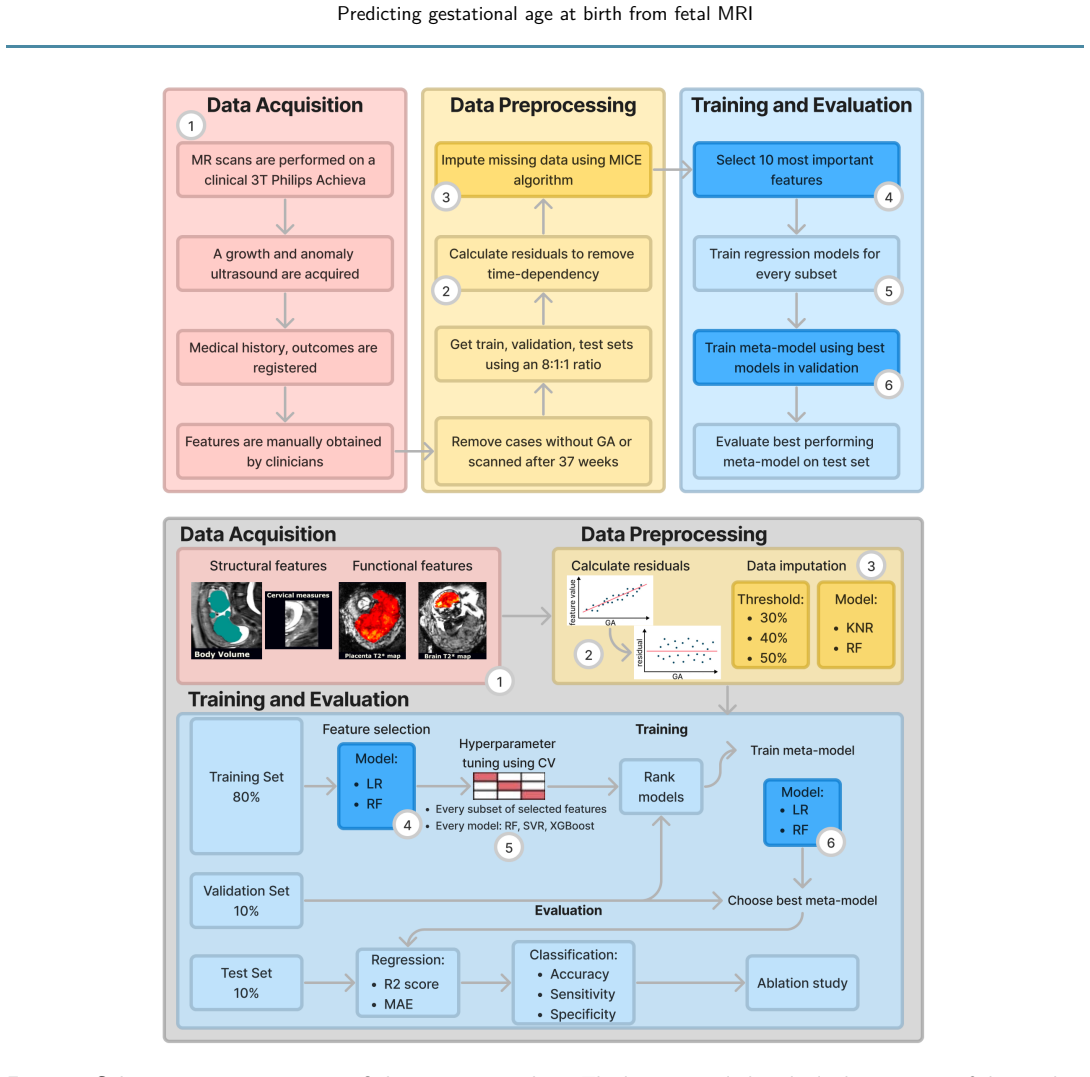
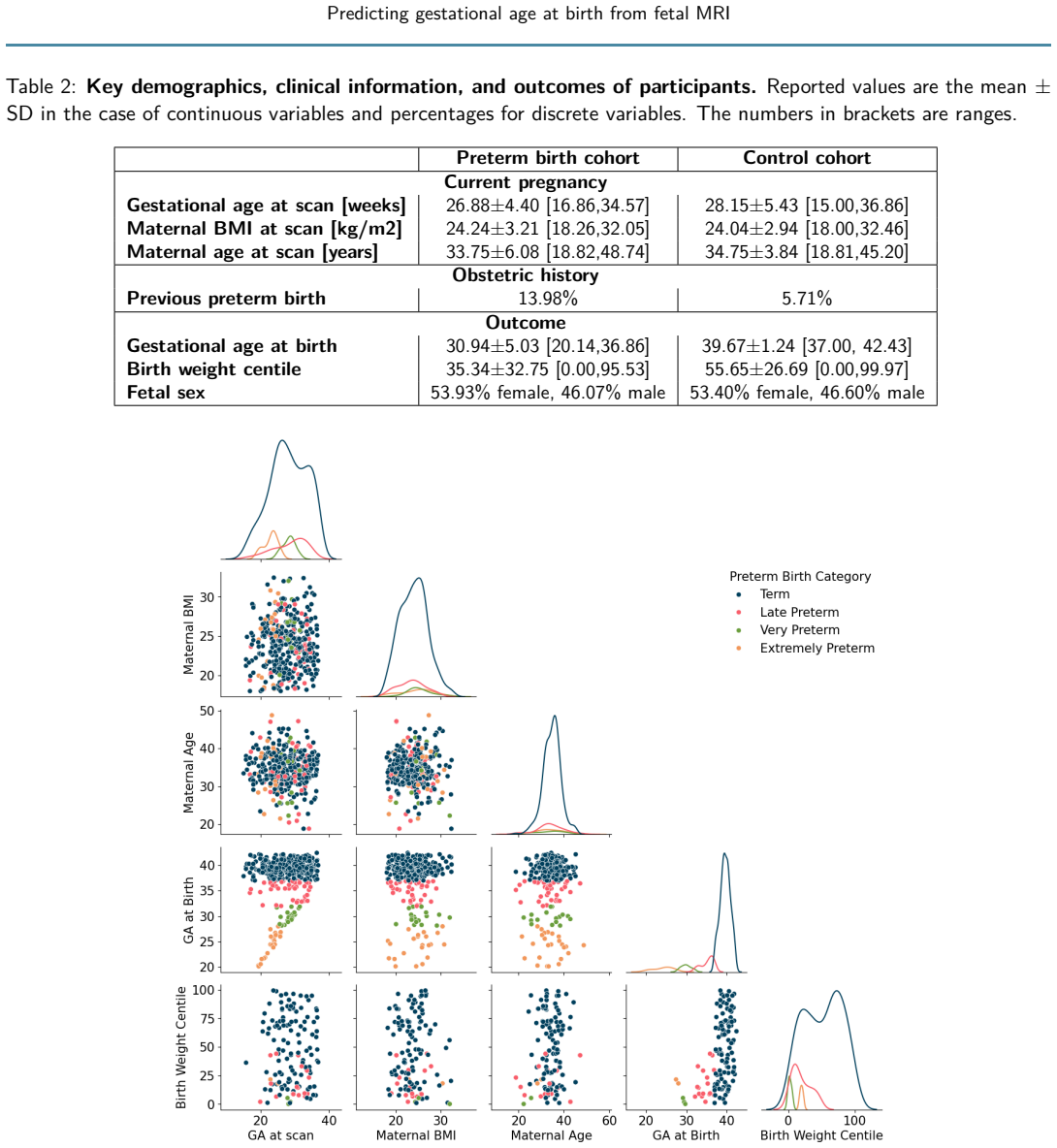
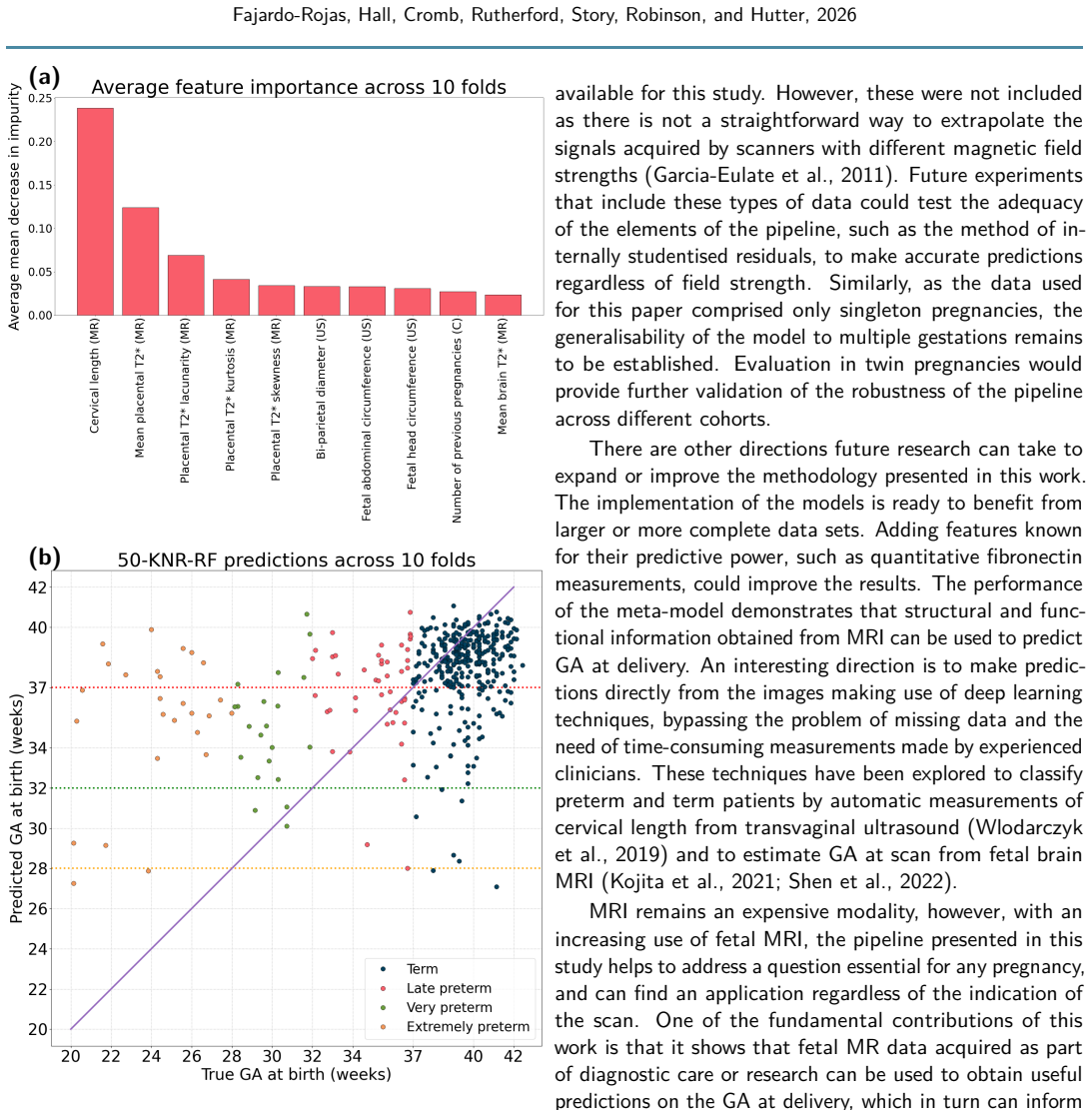
The authors present a pipeline that imputes missing data, selects features, and applies regression to multi-modal fetal MRI to predict gestational age at birth. On 426 cases evaluated with stratified 10-fold cross-validation, the model reaches an R2 score of 0.13 and a mean absolute error of 2.74 weeks for the continuous GA prediction, while achieving 0.77 accuracy, 0.59 sensitivity, and 0.82 specificity for term versus preterm classification. Cervical length and placental T2* statistics are the predominant selected features. This supplies the first regression treatment of preterm birth from multi-modal MRI rather than classification alone.
What carries the argument
A custom pipeline of machine learning methods for data imputation, feature selection, and regression applied to multi-modal fetal MRI data.
If this is right
- Cervical length and placental T2* values carry usable information about birth timing.
- Regression on continuous gestational age extends beyond binary preterm classification.
- Larger cohorts will support finer stratification inside the preterm group.
- Fast motion-robust multi-modal MRI makes repeated fetal imaging practical for this purpose.
Where Pith is reading between the lines
- If performance holds on new data, the predictions could guide decisions on when to administer antenatal steroids or plan delivery.
- Adding routine clinical variables to the MRI features might raise the modest R2 value.
- External validation across scanner vendors would reveal whether the selected features remain stable.
Load-bearing premise
The 93 preterm cases supply enough signal to train a regression model that generalizes beyond this cohort and imaging protocol.
What would settle it
Applying the same pipeline to an independent set of pregnancies scanned under different protocols and obtaining a mean absolute error above 4 weeks or classification accuracy below 65 percent.
Figures
read the original abstract
Preterm birth is associated with significant mortality and a risk for lifelong morbidity. The complex multifactorial aetiology hampers accurate prediction and thus optimal care. A pipeline consisting of bespoke machine learning methods for data imputation, feature selection, and regression models to predict gestational age (GA) at birth was developed and evaluated from comprehensive multi-modal morphological and functional fetal MRI data from 333 control cases and 93 preterm birth cases. The GA at birth predictions were classified into term and preterm categories and their accuracy, sensitivity, and specificity were reported. An ablation study was performed to further validate the design of the pipeline. Performance was evaluated using stratified 10-fold cross-validation. The pipeline achieves an R2 score of 0.13 and a mean absolute error of 2.74 weeks. It also achieves a 0.77 accuracy, 0.59 sensitivity, and 0.82 specificity across folds. The predominant features selected by the pipeline include cervical length and statistics derived from placental T2* values. The confluence of fast, motion-robust and multi-modal fetal MRI techniques and machine learning prediction allowed the prediction of the gestation at birth. This information is essential for any pregnancy. To the best of our knowledge, preterm birth had only been addressed as a classification problem in the literature. Therefore, this work provides a proof of concept. Future work will increase the cohort size to allow for finer stratification within the preterm birth cohort. Our code is available at https://github.com/dfajardorojas/ml-for-preterm-birth-.
Editorial analysis
A structured set of objections, weighed in public.
Referee Report
Summary. The manuscript describes development of a bespoke ML pipeline (imputation, feature selection, regression) to predict continuous gestational age at birth from multi-modal fetal MRI in 426 pregnancies (333 term + 93 preterm). Predictions are then thresholded into term/preterm classes. Using stratified 10-fold CV the pipeline reports R²=0.13, MAE=2.74 weeks, accuracy=0.77, sensitivity=0.59, specificity=0.82; cervical length and placental T2* statistics dominate the selected features. An ablation study is included and code is released.
Significance. If the modest performance holds under external validation, the work supplies a first proof-of-concept for regression-based GA prediction (rather than binary classification) in the preterm setting using MRI. The ablation study and public code release are positive for reproducibility. The low R² nevertheless constrains immediate clinical utility and underscores the need for larger, multi-site cohorts.
major comments (3)
- [Abstract / Results] Abstract and Results: the headline R²=0.13 indicates that the selected features explain only 13 % of GA variance; this low value, obtained on only 93 preterm cases, is load-bearing for the claim that the pipeline constitutes a viable prediction method rather than a marginal signal.
- [Methods / Discussion] Methods (cross-validation description) and Discussion: stratified 10-fold CV is performed entirely within a single cohort; no external-site or protocol-shift test is reported, leaving open whether the mapping from cervical length / T2* statistics to GA generalizes beyond the present imaging protocol and population.
- [Results] Results (performance reporting): neither per-fold standard deviations nor confidence intervals accompany the aggregate R², MAE, or classification metrics, so stability of the regression on the minority (preterm) class cannot be assessed from the given numbers.
minor comments (1)
- [Methods] The exact decision threshold used to convert the continuous GA prediction into the binary term/preterm label is not stated; adding this detail would improve reproducibility.
Simulated Author's Rebuttal
We thank the referee for the thoughtful review and constructive feedback. We address each major comment below, proposing revisions where feasible while acknowledging inherent limitations of the single-cohort design.
read point-by-point responses
-
Referee: [Abstract / Results] Abstract and Results: the headline R²=0.13 indicates that the selected features explain only 13 % of GA variance; this low value, obtained on only 93 preterm cases, is load-bearing for the claim that the pipeline constitutes a viable prediction method rather than a marginal signal.
Authors: We agree that an R² of 0.13 reflects modest explanatory power and that the preterm subsample (n=93) constrains stronger claims. The manuscript already frames the work as a proof-of-concept for regression-based GA prediction (rather than binary classification) in this setting, supported by the ablation study and feature interpretability. We will revise the abstract and discussion to more explicitly qualify the performance as preliminary and to avoid implying immediate clinical viability, while retaining the emphasis on the novel regression framing and public code release. revision: yes
-
Referee: [Methods / Discussion] Methods (cross-validation description) and Discussion: stratified 10-fold CV is performed entirely within a single cohort; no external-site or protocol-shift test is reported, leaving open whether the mapping from cervical length / T2* statistics to GA generalizes beyond the present imaging protocol and population.
Authors: We concur that internal stratified 10-fold CV alone cannot establish generalizability across sites or protocols. The current study is limited to a single-center cohort acquired under one imaging protocol; external validation would require additional multi-site data that are not available. We will expand the discussion to explicitly state this limitation and to underscore the need for future multi-center cohorts, but cannot perform external testing within the scope of the present manuscript. revision: partial
-
Referee: [Results] Results (performance reporting): neither per-fold standard deviations nor confidence intervals accompany the aggregate R², MAE, or classification metrics, so stability of the regression on the minority (preterm) class cannot be assessed from the given numbers.
Authors: We thank the referee for this observation. We will update the results section and tables to report per-fold standard deviations and bootstrap confidence intervals for all metrics (R², MAE, accuracy, sensitivity, specificity), allowing readers to evaluate stability particularly on the preterm subset. revision: yes
- Absence of external-site or protocol-shift validation, which cannot be addressed without new multi-center data collection beyond the current single-cohort study.
Circularity Check
Standard supervised ML pipeline with stratified CV; no derivation chain reduces to fitted inputs or self-citations
full rationale
The paper presents an empirical machine-learning pipeline (imputation, feature selection, regression) evaluated via stratified 10-fold cross-validation on a fixed cohort. No equations, uniqueness theorems, or ansatzes are invoked that would make any reported metric (R², MAE, accuracy) equivalent to its inputs by construction. The central claim is a proof-of-concept empirical result on preterm birth prediction; performance is not forced by definition or prior self-citation. This is the expected non-circular outcome for a standard supervised learning study.
Axiom & Free-Parameter Ledger
free parameters (1)
- ML hyperparameters and feature selection thresholds
axioms (1)
- domain assumption Multi-modal fetal MRI provides independent information about gestational age at birth beyond standard clinical measures.
Reference graph
Works this paper leans on
-
[1]
IEEE transactions on medical imaging , volume=
Deformable slice-to-volume registration for motion correction of fetal body and placenta MRI , author=. IEEE transactions on medical imaging , volume=. 2020 , publisher=
2020
-
[2]
bioRxiv , pages=
BOUNTI: Brain vOlumetry and aUtomated parcellatioN for 3D feTal MRI , author=. bioRxiv , pages=. 2023 , publisher=
2023
-
[3]
Preterm birth , url=
WHO , year=. Preterm birth , url=. World Health Organization , publisher=
-
[4]
Global burden of preterm birth , volume =
Walani, Salimah , year =. Global burden of preterm birth , volume =. International Journal of Gynecology & Obstetrics , doi =
-
[5]
Global, regional, and national estimates of levels of preterm birth in 2014: a systematic review and modelling analysis , journal =. 2019 , issn =. doi:https://doi.org/10.1016/S2214-109X(18)30451-0 , url =
-
[6]
Blencowe, Hannah and Cousens, Simon and Oestergaard, Mikkel and Chou, Doris and Moller, Ann-Beth and Narwal, Rajesh and Adler, Alma and Garcia, Claudia and Rohde, Sarah and Say, Lale and Lawn, Joy , year =. National, regional, and worldwide estimates of preterm birth rates in the year 2010 with time trends since 1990 for selected countries: A systematic a...
2010
-
[7]
Global, regional, and national causes of under-5 mortality in 2000–19: an updated systematic analysis with implications for the Sustainable Development Goals , volume =
Perin, Jamie and Mulick, Amy and Yeung, Diana and Villavicencio, Francisco and Lopez, Gerard and Strong, Kathleen and Prieto-Merino, David and Cousens, Simon and Black, Robert , year =. Global, regional, and national causes of under-5 mortality in 2000–19: an updated systematic analysis with implications for the Sustainable Development Goals , volume =. T...
2000
-
[8]
Our World in Data , author=
Child and infant mortality , url=. Our World in Data , author=. 2019 , month=
2019
-
[9]
Survival and Morbidity of Preterm Children Born at 22 Through 34 Weeks' Gestation in France in 2011: Results of the EPIPAGE-2 Cohort Study , volume =
Ancel, Pierre-Yves and Goffinet, François and Kuhn, Pierre and Langer, Bruno and Matis, Jacqueline and Hernandorena, Xavier and Chabanier, Pierre and Joly-Pedespan, Laurence and Lecomte, Bénédicte and Vendittelli, Françoise and Dreyfus, Michel and Guillois, Bernard and Burguet, Antoine and Sagot, Pierre and Sizun, Jacques and Beuchée, Alain and Rouget, Fl...
2011
-
[10]
Survival of very preterm infants admitted to neonatal care in England 2008-2014: time trends and regional variation , volume =
Santhakumaran, Shalini and Statnikov, Eugene and Gray, Daniel and Battersby, Cheryl and Ashby, Deborah and Modi, Neena , year =. Survival of very preterm infants admitted to neonatal care in England 2008-2014: time trends and regional variation , volume =. Archives of disease in childhood. Fetal and neonatal edition , doi =
2008
-
[11]
Mortality, In-Hospital Morbidity, Care Practices, and 2-Year Outcomes for Extremely Preterm Infants in the US, 2013-2018 , volume =
Bell, Edward and Hintz, Susan and Hansen, Nellie and Bann, Carla and Wyckoff, Myra and Demauro, Sara and Walsh, Michele and Vohr, Betty and Stoll, Barbara and Carlo, Waldemar and Meurs, Krisa and Rysavy, Matthew and Patel, Ravi and Merhar, Stephanie and Sánchez, Pablo and Laptook, Abbot and Hibbs, Anna Maria and Cotten, Charles and D'Angio, Carl and Das, ...
2013
-
[12]
Seminars in Fetal and Neonatal Medicine , volume=
Have outcomes following extremely preterm birth improved over time? , author=. Seminars in Fetal and Neonatal Medicine , volume=. 2020 , organization=
2020
-
[13]
Changes in long-term survival and neurodevelopmental disability in infants born extremely preterm in the post-surfactant era , volume =
Boland, Rosemarie and Cheong, Jeanie and Doyle, Lex , year =. Changes in long-term survival and neurodevelopmental disability in infants born extremely preterm in the post-surfactant era , volume =. Seminars in Perinatology , doi =
-
[14]
Outcomes of Preterm Infants: Morbidity Replaces Mortality , volume =
Allen, Marilee and Cristofalo, Elizabeth and Kim, Christina , year =. Outcomes of Preterm Infants: Morbidity Replaces Mortality , volume =. Clinics in perinatology , doi =
-
[15]
The BMJ , year=
Short term outcomes after extreme preterm birth in England: comparison of two birth cohorts in 1995 and 2006 (the EPICure studies) , author=. The BMJ , year=
1995
-
[16]
Long-Term Medical and Social Consequences of Preterm Birth , volume =
Moster, Dag and Markestad, Trond , year =. Long-Term Medical and Social Consequences of Preterm Birth , volume =. The New England journal of medicine , doi =
-
[17]
Neurological and Developmental Outcome in Extremely Preterm Children Born in England in 1995 and 2006: The EPICure Studies , volume =
Moore, Tamanna and Hennessy, Enid and Myles, Jonathan and Johnson, Samantha and Draper, Elizabeth and Costeloe, Kate and Marlow, Neil , year =. Neurological and Developmental Outcome in Extremely Preterm Children Born in England in 1995 and 2006: The EPICure Studies , volume =. BMJ (Clinical research ed.) , doi =
1995
-
[18]
Neurodevelopmental Outcome After Extreme Prematurity: A Review of The Literature , volume =
Jarjour, Imad , year =. Neurodevelopmental Outcome After Extreme Prematurity: A Review of The Literature , volume =. Pediatric Neurology , doi =
-
[19]
Preterm Birth Lifetime Costs in the United States in 2016: An Update , volume =
Waitzman, Norman and Jalali, Ali and Grosse, Scott , year =. Preterm Birth Lifetime Costs in the United States in 2016: An Update , volume =. Seminars in Perinatology , doi =
2016
-
[20]
The Cost of Preterm Birth Throughout Childhood in England and Wales , volume =
Mangham-Jefferies, Lindsay and Petrou, Stavros and Doyle, Lex and Draper, Elizabeth and Marlow, Neil , year =. The Cost of Preterm Birth Throughout Childhood in England and Wales , volume =. Pediatrics , doi =
-
[21]
The economic burden of prematurity in Canada , volume =
Johnston, Karissa and Gooch, Katherine and Korol, Ellen and Vo, Pamela and Eyawo, Oghenowede and Bradt, Pamela and Levy, Adrian , year =. The economic burden of prematurity in Canada , volume =. BMC pediatrics , doi =
-
[22]
Australian and New Zealand Journal of Obstetrics and Gynaecology , year=
The health and educational costs of preterm birth to 18 years of age in Australia , author=. Australian and New Zealand Journal of Obstetrics and Gynaecology , year=
-
[23]
2019 , doi =
Petrou, Stavros and Yiu, Hei Hang and Kwon, Joseph , title =. 2019 , doi =. https://adc.bmj.com/content/104/5/456.full.pdf , journal =
2019
-
[24]
Classification and heterogeneity of preterm birth , volume =
Moutquin, Jean-Marie , year =. Classification and heterogeneity of preterm birth , volume =. BJOG : an international journal of obstetrics and gynaecology , doi =
-
[25]
Epidemiology and Causes of Preterm Birth , volume =
Goldenberg, Robert and Culhane, Jennifer and Iams, Jay and Romero, Roberto , year =. Epidemiology and Causes of Preterm Birth , volume =. Lancet , doi =
-
[26]
The epidemiology, etiology, and costs of preterm birth , volume =
Frey, Heather and Klebanoff, Mark , year =. The epidemiology, etiology, and costs of preterm birth , volume =. Seminars in Fetal and Neonatal Medicine , doi =
-
[27]
, author=
The enigma of spontaneous preterm birth. , author=. The New England journal of medicine , year=
-
[28]
Maternal-fetal conditions necessitating a medical intervention resulting in preterm birth , volume =
Ananth, Cande and Vintzileos, Anthony , year =. Maternal-fetal conditions necessitating a medical intervention resulting in preterm birth , volume =. American journal of obstetrics and gynecology , doi =
-
[29]
Fetal growth and onset of delivery: A nationwide population-based study of preterm infants , volume =
Morken, Nils-Halvdan and Kallen, Karin and Jacobsson, Bo , year =. Fetal growth and onset of delivery: A nationwide population-based study of preterm infants , volume =. American journal of obstetrics and gynecology , doi =
-
[30]
BJOG: An International Journal of Obstetrics & Gynaecology , year=
The preterm parturition syndrome , author=. BJOG: An International Journal of Obstetrics & Gynaecology , year=
-
[31]
Risk factors for spontaneous preterm delivery , volume =
Cobo, Teresa and Kacerovsky, Marian and Jacobsson, Bo , year =. Risk factors for spontaneous preterm delivery , volume =. International Journal of Gynecology & Obstetrics , doi =
-
[32]
Kramer, Michael and Papageorghiou, Aris T. and Culhane, Jennifer and Bhutta, Zulfiqar and Goldenberg, Robert and Gravett, Michael and Iams, Jay and Conde-Agudelo, Agustin and Waller, Sarah and Barros, Fernando and Knight, Hannah and Villar, José , year =. Challenges in defining and classifying the preterm birth syndrome , volume =. American journal of obs...
-
[33]
The prediction of preterm delivery: What is new? , volume =
Suff, Natalie and Story, Lisa and Shennan, Andrew , year =. The prediction of preterm delivery: What is new? , volume =. Seminars in Fetal and Neonatal Medicine , doi =
-
[34]
Preterm Labor: One Syndrome, Many Causes , volume =
Romero, Roberto and Dey, Sudhansu and Fisher, Susan , year =. Preterm Labor: One Syndrome, Many Causes , volume =. Science (New York, N.Y.) , doi =
-
[35]
Quantitative Fetal Fibronectin to Predict Preterm Birth in Asymptomatic Women at High Risk , volume =
Abbott, Danielle and Hezelgrave, Natasha and Seed, Paul and Norman, Jane and David, Anna and Bennett, Phillip and Girling, Joanna and Chandirimani, Manju and Stock, Sarah and Carter, Jenny and Cate, Ruth and Kurtzman, James and Tribe, Rachel and Shennan, Andrew , year =. Quantitative Fetal Fibronectin to Predict Preterm Birth in Asymptomatic Women at High...
-
[36]
and Abbott, Danielle and Seed, Paul and Kemp, Joy and Shennan, Andrew , year =
Radford, Samara K. and Abbott, Danielle and Seed, Paul and Kemp, Joy and Shennan, Andrew , year =. Quantitative fetal fibronectin for the prediction of preterm birth in symptomatic women , volume =. Archives of Disease in Childhood - Fetal and Neonatal Edition , doi =
-
[37]
PLoS Medicine , year=
Evaluating the use of the QUiPP app and its impact on the management of threatened preterm labour: A cluster randomised trial , author=. PLoS Medicine , year=
-
[38]
Development and validation of prediction models for the QUiPP App v.2: a tool for predicting preterm birth in women with symptoms of threatened preterm labor , volume =
Carter, Jenny and Seed, Paul and Watson, Helena and David, Anna and Sandall, Jane and Shennan, Andrew and Tribe, Rachel , year =. Development and validation of prediction models for the QUiPP App v.2: a tool for predicting preterm birth in women with symptoms of threatened preterm labor , volume =. Ultrasound in Obstetrics & Gynecology , doi =
-
[39]
Cost-effectiveness anlysis of cervical length measurement and fibronectin testing in women with threatened preterm labor
Baaren, Gert-Jan and Vis, Jolande and Grobman, William and Bossuyt, Patrick and Opmeer, Brent and Mol, Ben W , year =. Cost-effectiveness anlysis of cervical length measurement and fibronectin testing in women with threatened preterm labor. , volume =. American journal of obstetrics and gynecology , doi =
-
[40]
Cost-effectiveness of diagnostic tests for threatened preterm labor in singleton pregnancy in France , volume =
Desplanches, Thomas and Lejeune, Catherine and Jonathan, Cottenet and Sagot, Paul and Quantin, Catherine , year =. Cost-effectiveness of diagnostic tests for threatened preterm labor in singleton pregnancy in France , volume =. Cost Effectiveness and Resource Allocation , doi =
-
[41]
Hutter, Jana and Slator, Paddy J. and Jackson, Laurence and Gomes, Ana Dos Santos and Ho, Alison and Story, Lisa and O’Muircheartaigh, Jonathan and Teixeira, Rui P. A. G. and Chappell, Lucy C. and Alexander, Daniel C. and Rutherford, Mary A. and Hajnal, Joseph V. , title =. Magnetic Resonance in Medicine , volume =. doi:https://doi.org/10.1002/mrm.27447 ,...
-
[42]
The use of antenatal fetal Magnetic Resonance Imaging in the assessment of patients at high risk of preterm birth , volume =
Story, Lisa and Hutter, Jana and Zhang, Tong and Shennan, Andrew and Rutherford, Mary , year =. The use of antenatal fetal Magnetic Resonance Imaging in the assessment of patients at high risk of preterm birth , volume =. European Journal of Obstetrics & Gynecology and Reproductive Biology , doi =
-
[43]
Antenatal thymus volumes in fetuses that delivered <32 weeks gestation: An MRI pilot study , volume =
Story, Lisa and Zhang, Tong and Uus, Alena and Hutter, Jana and Egloff, Alexia and Gibbons, Deena and Alison, Ho and Al-Adnani, Mudher and Knight, Caroline and Theodoulou, Iakovos and Deprez, Maria and Seed, Paul and Tribe, Rachel and Shennan, Andrew and Rutherford, Mary , year =. Antenatal thymus volumes in fetuses that delivered <32 weeks gestation: An ...
-
[44]
Foetal lung volumes in pregnant women who deliver very preterm: a pilot study , volume =
Story, Lisa and Zhang, Tong and Steinweg, Johannes and Hutter, Jana and Matthew, Jacqueline and Dassios, Theodore and Seed, Paul and Pasupathy, Dharmintra and Allsop, Joanna and Hajnal, Joseph and Greenough, Anne and Shennan, Andrew and Rutherford, Mary , year =. Foetal lung volumes in pregnant women who deliver very preterm: a pilot study , volume =. Ped...
-
[45]
MRI safety considerations during pregnancy , volume =
Lum, Mark and Tsiouris, Apostolos , year =. MRI safety considerations during pregnancy , volume =. Clinical Imaging , doi =
-
[46]
Association Between MRI Exposure During Pregnancy and Fetal and Childhood Outcomes , volume =
Ray, Joel and Vermeulen, Marian and Bharatha, Aditya and Montanera, Walter and Park, Alison , year =. Association Between MRI Exposure During Pregnancy and Fetal and Childhood Outcomes , volume =. JAMA , doi =
-
[47]
MRI Evaluation and Safety in the Developing Brain , volume =
Tocchio, Shannon and Kline-Fath, Beth and Kanal, Emanuel and Schmithorst, Vincent and Panigrahy, Ashok , year =. MRI Evaluation and Safety in the Developing Brain , volume =. Seminars in perinatology , doi =
-
[48]
and Price, David L
De Wilde, Janet and Rivers, A.W. and Price, David L. , year =. A review of the current use of magnetic resonance imaging in pregnancy and safety implications for the fetus , volume =. Progress in biophysics and molecular biology , doi =
-
[49]
Quantitative fetal fibronectin for prediction of preterm birth in asymptomatic twin pregnancy , volume =
Kuhrt, Katy and Hezelgrave, Natasha and Stock, Sarah and Tribe, Rachel and Seed, Paul and Shennan, Andrew , year =. Quantitative fetal fibronectin for prediction of preterm birth in asymptomatic twin pregnancy , volume =. Acta Obstetricia et Gynecologica Scandinavica , doi =
-
[50]
The hemodynamics of late onset intrauterine growth restriction by MRI , volume =
Zhu, Meng Yuan and Milligan, Natasha and Keating, Sarah and Windrim, Rory and Keunen, Johannes and Thakur, Varsha and Ohman, Annika and Portnoy, Sharon and Sled, John and Kelly, Edmond and Yoo, Shi-Joon and Gross-Wortmann, Lars and Jaeggi, Edgar and Macgowan, Christopher and Kingdom, John and Seed, Mike , year =. The hemodynamics of late onset intrauterin...
-
[51]
Guidelines for Developing and Reporting Machine Learning Predictive Models in Biomedical Research: A Multidisciplinary View , volume =
Luo, Wei and Phung, Dinh and Tran, Truyen and Gupta, Sunil and Rana, Santu and Karmakar, Chandan and Shilton, Alistair and Yearwood, John and Dimitrova, Nevenka and Ho, Bao and Venkatesh, Svetha and Berk, Michael , year =. Guidelines for Developing and Reporting Machine Learning Predictive Models in Biomedical Research: A Multidisciplinary View , volume =...
-
[52]
Machine Learning Methods for Preterm Birth Prediction: A Review , volume =
Wlodarczyk, Tomasz and Płotka, Szymon and Szczepański, Tomasz and Rokita, Przemyslaw and Sochacki-Wójcicka, Nicole and Wójcicki, Jakub and Lipa, Michal and Trzcinski, Tomasz , year =. Machine Learning Methods for Preterm Birth Prediction: A Review , volume =. Electronics , doi =
-
[53]
Wlodarczyk, Tomasz and Płotka, Szymon and Trzcinski, Tomasz and Rokita, Przemyslaw and Sochacki-Wójcicka, Nicole and Lipa, Michal and Wójcicki, Jakub , year =
-
[54]
Machine Learning Approach for Preterm Birth Prediction Based on Maternal Chronic Conditions , isbn =
Prema, Nisana Siddegowda and Pushpalatha, Mullur Puttabuddi , year =. Machine Learning Approach for Preterm Birth Prediction Based on Maternal Chronic Conditions , isbn =
-
[55]
Applying Data Preprocessing Methods to Predict Premature Birth , year=
Esty, Alana and Frize, Monique and Gilchrist, Jeff and Bariciak, Erika , booktitle=. Applying Data Preprocessing Methods to Predict Premature Birth , year=
-
[56]
A comparison of various linear and non-linear signal processing techniques to separate uterine EMG records of term and pre-term delivery groups , volume =
Fele-Zorz, Gašper and Kavsek, Gorazd and Novak-Antolic, Živa and Jager, Franc , year =. A comparison of various linear and non-linear signal processing techniques to separate uterine EMG records of term and pre-term delivery groups , volume =. Medical & biological engineering & computing , doi =
-
[57]
Relevant Features Selection for Automatic Prediction of Preterm Deliveries from Pregnancy ElectroHysterograhic (EHG) records , volume =
Sadi-Ahmed, Nafissa and Kacha, Baya and Taleb, Hamza and Kedir-Talha, Malika , year =. Relevant Features Selection for Automatic Prediction of Preterm Deliveries from Pregnancy ElectroHysterograhic (EHG) records , volume =. Journal of Medical Systems , doi =
-
[58]
A Machine Learning Approach for an Early Prediction of Preterm Delivery , doi =
Despotović, Danica and Zec, Aleksandra and Mladenovic, Katarina and Radin, Nevena and Loncar-Turukalo, Tatjana , year =. A Machine Learning Approach for an Early Prediction of Preterm Delivery , doi =
-
[59]
Deep neural network for semi-automatic classification of term and preterm uterine recordings , volume =
Chen, Lili and Xu, Huoyao , year =. Deep neural network for semi-automatic classification of term and preterm uterine recordings , volume =. Artificial Intelligence in Medicine , doi =
-
[60]
Deep Multimodal Learning From MRI and Clinical Data for Early Prediction of Neurodevelopmental Deficits in Very Preterm Infants , volume =
He, Lili and Li, Hailong and Chen, Ming and Wang, Jinghua and Altaye, Mekibib and Dillman, Jonathan and Parikh, Nehal , year =. Deep Multimodal Learning From MRI and Clinical Data for Early Prediction of Neurodevelopmental Deficits in Very Preterm Infants , volume =. Frontiers in Neuroscience , doi =
-
[61]
and Noble, Julia , year =
Namburete, Ana and Stebbing, Richard and Kemp, Bryn and Yaqub, Mohammad and Papageorghiou, Aris T. and Noble, Julia , year =. Learning-Based Prediction of Gestational Age from Ultrasound Images of the Fetal Brain , volume =. Medical Image Analysis , doi =
-
[62]
Deep learning model for predicting gestational age after the first trimester using fetal MRI , volume =
Kojita, Yasuyuki and Matsuo, Hidetoshi and Kanda, Tomonori and Nishio, Mizuho and Sofue, Keitaro and Nogami, Munenobu and Kono, Atsushi and Hori, Masatoshi and Murakami, Takamichi , year =. Deep learning model for predicting gestational age after the first trimester using fetal MRI , volume =. European Radiology , doi =
-
[63]
Attention-guided deep learning for gestational age prediction using fetal brain MRI , volume =
Shen, Liyue and Zheng, Jimmy and Lee, Edward and Shpanskaya, Katie and McKenna, Emily and Atluri, Mahesh and Plasto, Dinko and Mitchell, Courtney and Lai, Lillian and Guimaraes, Carolina and Dahmoush, Hisham and Chueh, Jane and Halabi, Safwan and Pauly, John and Xing, Lei and Lu, Quin and Oztekin, Ozgur and Kline-Fath, Beth and Yeom, Kristen , year =. Att...
-
[64]
Predicting preterm birth using multimodal fetal imaging
Riine Heinsalu and Logan Williams and Aditi Ranjan and Avena Zampieri , Carla and Alena Uus and Emma Robinson and Mary Rutherford and Lisa Story and Jana Hutter. Predicting preterm birth using multimodal fetal imaging. Proceedings of the MICCAI PIPPI workshop. 2021
2021
-
[65]
Functional bold MRI: Advantages of the 3 T vs
Garcia-Eulate, Reyes and Garcia-Garcia, David and Domínguez, Pablo and Noguera, Jose and Luis, Esther and Rodriguez-Oroz, Maria and Zubieta, Jose , year =. Functional bold MRI: Advantages of the 3 T vs. the 1.5 T , volume =. Clinical imaging , doi =
-
[66]
1986 , publisher=
Residuals and Influence in Regression , author=. 1986 , publisher=
1986
-
[67]
2014 , publisher=
Statistical Analysis with Missing Data , author=. 2014 , publisher=
2014
-
[68]
From predictive methods to missing data imputation: An optimization approach , volume =
Bertsimas, Dimitris and Pawlowski, Colin and Zhuo, Ying , year =. From predictive methods to missing data imputation: An optimization approach , volume =
-
[69]
A Benchmark for Data Imputation Methods , volume =
Jäger, Sebastian and Allhorn, Arndt and Biessmann, Felix , year =. A Benchmark for Data Imputation Methods , volume =. Frontiers in Big Data , doi =
-
[70]
Multiple Imputation by Chained Equations: What is it and how does it work? , volume =
Azur, Melissa and Stuart, Elizabeth and Frangakis, Constantine and Leaf, Philip , year =. Multiple Imputation by Chained Equations: What is it and how does it work? , volume =. International journal of methods in psychiatric research , doi =
-
[71]
Random Forests , volume =
Breiman, Leo , year =. Random Forests , volume =. Machine Learning , doi =
-
[72]
Weighted K-Nearest Neighbor revisited , doi =
Bicego, Manuele and Loog, Marco , year =. Weighted K-Nearest Neighbor revisited , doi =
-
[73]
A tutorial on support vector regression , volume =
Smola, Alex and Schölkopf, Bernhard , year =. A tutorial on support vector regression , volume =
-
[74]
Cross-validation pitfalls when selecting and assessing regression and classification models , volume =
Krstajic, Damjan and Buturovic, Ljubomir and Leahy, David and Thomas, Simon , year =. Cross-validation pitfalls when selecting and assessing regression and classification models , volume =. Journal of cheminformatics , doi =
-
[75]
2002 , pages=556, publisher=
Statistical Inference , author=. 2002 , pages=556, publisher=
2002
-
[76]
Epidemiology of preterm birth , volume =
Purisch, Stephanie and Gyamfi, Cynthia , year =. Epidemiology of preterm birth , volume =. Seminars in Perinatology , doi =
-
[77]
XGBoost: A Scalable Tree Boosting System
Tianqi Chen and Carlos Guestrin , title =. CoRR , volume =. 2016 , url =. 1603.02754 , timestamp =
work page internal anchor Pith review Pith/arXiv arXiv 2016
-
[78]
Carla L. Avena-Zampieri and Jana Hutter and Mary Rutherford and Anna Milan and Megan Hall and Alexia Egloff and David F.A. Lloyd and Surabhi Nanda and Anne Greenough and Lisa Story , keywords =. Assessment of the fetal lungs in utero , journal =. 2022 , issn =. doi:https://doi.org/10.1016/j.ajogmf.2022.100693 , url =
-
[79]
and Hutter, Jana and Palombo, Marco and Jackson, Laurence H
Slator, Paddy J. and Hutter, Jana and Palombo, Marco and Jackson, Laurence H. and Ho, Alison and Panagiotaki, Eleftheria and Chappell, Lucy C. and Rutherford, Mary A. and Hajnal, Joseph V. and Alexander, Daniel C. , title =. Magnetic Resonance in Medicine , volume =. doi:https://doi.org/10.1002/mrm.27733 , url =. https://onlinelibrary.wiley.com/doi/pdf/10...
-
[80]
Noninvasive Fetal Lung Assessment Using Diffusion Weighted Imaging , volume =
Lee, Wonyeoul and Krisko, Ashlee and Shetty, Anil and Yeo, Lami and Hassan, Sonia and Gotsch, Francesca and Mody, Swati and GONCALVES, Luis and Romero, Roberto , year =. Noninvasive Fetal Lung Assessment Using Diffusion Weighted Imaging , volume =. Ultrasound in obstetrics & gynecology : the official journal of the International Society of Ultrasound in O...
discussion (0)
Sign in with ORCID, Apple, or X to comment. Anyone can read and Pith papers without signing in.