Quantum-Accelerated Self-Consistent Field: A Hybrid Algorithm
Pith reviewed 2026-06-26 17:03 UTC · model grok-4.3
The pith
GAS-SCF uses quantum arithmetic to build an oracle marking energy-improving Fock states and applies amplitude amplification for quadratic speedup in SCF.
A machine-rendered reading of the paper's core claim, the machinery that carries it, and where it could break.
Core claim
GAS-SCF leverages quantum arithmetic to construct an efficient oracle that marks target states (Fock states) which improve upon some initial classical energy estimate. Amplitude amplification then increases the probability of measuring these states. This approach offers a theoretical quadratic speed-up for the optimization problem encountered in SCF quantum chemistry and establishes a baseline against which structured optimization algorithms, such as QAOA and DQI may be compared.
What carries the argument
Quantum oracle constructed via arithmetic operations that identifies Fock states lowering the energy estimate, enabling amplitude amplification.
If this is right
- Quadratic reduction in evaluations needed to locate lower-energy Fock states during SCF iterations.
- Supplies an explicit reference point for assessing QAOA and DQI performance on the same SCF task.
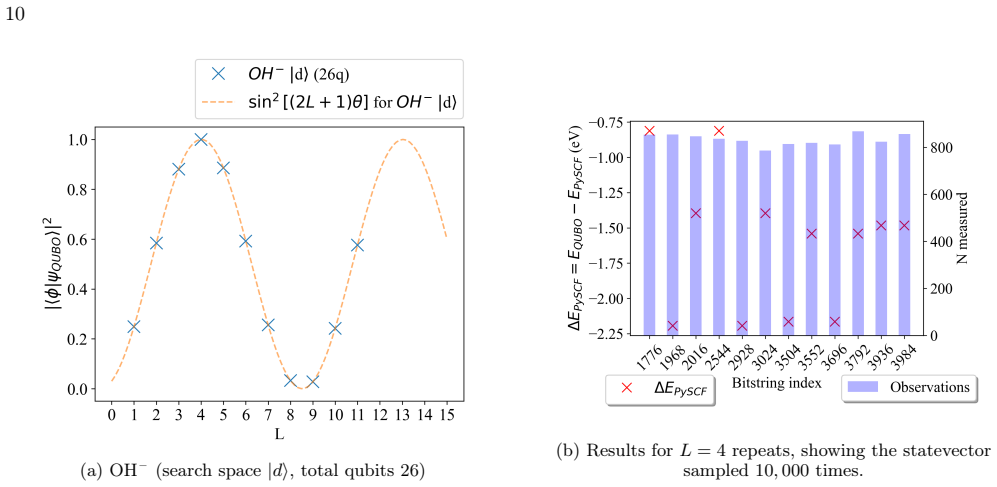
- Classical simulations confirm correctness on systems up to 26 qubits.
- Resource analysis for systems up to 330 qubits indicates fault-tolerant hardware is required for chemical accuracy.
Where Pith is reading between the lines
- If oracle overhead stays modest, the same marking-plus-amplification pattern could accelerate other iterative searches over discrete configuration spaces in chemistry.
- The method isolates the pure search component of SCF, making it easier to quantify how much additional structure from variational algorithms is actually needed.
- Practical deployment would require co-design of the arithmetic circuits with error-correction overhead to preserve the theoretical scaling.
Load-bearing premise
The oracle marking energy-improving Fock states can be built with quantum arithmetic at a cost low enough that the quadratic gain from amplitude amplification remains intact.
What would settle it
Implementation on quantum hardware that measures total oracle queries required to reach a target energy improvement and shows the count scales as the square root of the classical search space size.
Figures
read the original abstract
We present the Grover adaptive search self-consistent field (GAS-SCF) algorithm. GAS-SCF leverages quantum arithmetic to construct an efficient oracle that marks target states (Fock states) which improve upon some initial classical energy estimate. Amplitude amplification then increases the probability of measuring these states. This approach offers a theoretical quadratic speed-up for the optimization problem encountered in SCF quantum chemistry and establishes a baseline against which structured optimization algorithms, such as QAOA and DQI may be compared. In this work, we classically simulate three examples as proofs of concept of the algorithm, the largest consisting of 26 qubits. We then extend our analysis to two larger systems, with O3 representing the largest case at 330 qubits. These examples are chosen to probe classically challenging SCF regimes. Achieving chemically relevant applications of GAS-SCF will require large-scale, fault-tolerant quantum hardware.
Editorial analysis
A structured set of objections, weighed in public.
Referee Report
Summary. The paper introduces the Grover Adaptive Search Self-Consistent Field (GAS-SCF) algorithm. It uses quantum arithmetic to construct an oracle marking Fock states that improve on an initial classical energy estimate, followed by amplitude amplification to increase the probability of sampling such states. This is claimed to yield a theoretical quadratic speedup for the optimization step in SCF quantum chemistry. Classical simulations are shown for three small examples (largest 26 qubits) as proofs of concept, with extrapolation to two larger systems (O3 at 330 qubits).
Significance. If the oracle resource costs can be shown to preserve a net quadratic advantage, the work supplies a baseline unstructured quantum search algorithm for SCF optimization against which structured methods such as QAOA can be compared. The simulations provide concrete proof-of-concept data, but the significance hinges on whether the claimed speedup survives realistic gate counts.
major comments (1)
- [oracle construction and complexity analysis] The central quadratic-speedup claim (abstract and algorithm description) rests on the oracle being realizable with gate cost low enough that O(√N) calls (N = Fock-space dimension) still yields asymptotic improvement. No section derives the total T-count or circuit depth of the quantum-arithmetic energy evaluation and comparison (which must incorporate O(M^4) two-electron integrals) as a function of system size and shows it remains o(√N). Without this bound the net advantage over classical direct-SCF heuristics is not established.
minor comments (2)
- [Abstract] Abstract states simulations up to 26 qubits but supplies no error bars, success-probability scaling, or explicit verification that the oracle preserves the Grover quadratic scaling in the reported runs.
- [results and extrapolation] The 330-qubit extrapolation for O3 is mentioned without detailing the scaling assumptions or resource model used.
Simulated Author's Rebuttal
We thank the referee for their constructive review. The major comment raises an important point about establishing the net complexity advantage, which we address directly below.
read point-by-point responses
-
Referee: [oracle construction and complexity analysis] The central quadratic-speedup claim (abstract and algorithm description) rests on the oracle being realizable with gate cost low enough that O(√N) calls (N = Fock-space dimension) still yields asymptotic improvement. No section derives the total T-count or circuit depth of the quantum-arithmetic energy evaluation and comparison (which must incorporate O(M^4) two-electron integrals) as a function of system size and shows it remains o(√N). Without this bound the net advantage over classical direct-SCF heuristics is not established.
Authors: We agree that the manuscript does not contain an explicit derivation of the total T-count or circuit depth for the oracle as a function of system size. The claimed quadratic speedup is with respect to the number of oracle calls (O(√N) versus O(N) for unstructured classical search). Each oracle invocation evaluates the energy via quantum arithmetic on the two-electron integrals. This evaluation requires O(M^4) terms but can be realized with a reversible circuit whose gate count (including T-count for fault-tolerant implementation) scales as O(poly(M) · b), where b is the bit precision; the dominant cost is polynomial in M because the integrals can be loaded and accumulated using standard quantum arithmetic primitives (addition, multiplication) whose depth is polylogarithmic in the value range. Since the Fock-space dimension satisfies N = 2^Θ(M) in the qubit encoding used, poly(M) · √N remains exponentially smaller than any classical exhaustive enumeration of the N states. We acknowledge that a side-by-side comparison with the best classical direct-SCF heuristics (which are already sub-exponential) would further strengthen the claim and will add a new subsection in the revised manuscript that (i) states the per-oracle gate complexity explicitly and (ii) shows that the total quantum cost is still asymptotically advantageous relative to brute-force classical search over Fock space. This addition will also include a brief resource estimate for the 330-qubit O3 example. revision: yes
Circularity Check
No circularity; speedup follows from standard amplitude amplification
full rationale
The paper claims a quadratic speedup for SCF optimization via Grover adaptive search, where an oracle marks improving Fock states using quantum arithmetic and amplitude amplification is applied. This rests on the established properties of amplitude amplification (external to the paper) rather than any self-definitional loop, fitted parameter renamed as prediction, or load-bearing self-citation. The 26-qubit simulations and 330-qubit extrapolations are presented as proofs of concept without altering the theoretical claim. No equation or section reduces the result to its own inputs by construction.
Axiom & Free-Parameter Ledger
axioms (2)
- standard math Standard properties of Grover amplitude amplification yield quadratic speedup when an efficient oracle exists.
- domain assumption Quantum arithmetic can construct an oracle that correctly marks Fock states improving an initial energy estimate.
Reference graph
Works this paper leans on
-
[1]
Have a negative value in the QUBO cost function
-
[2]
To achieve this, a multi-controlled X gate is used, with controls defined by the bitstring representation of the de- sired binary occupation state
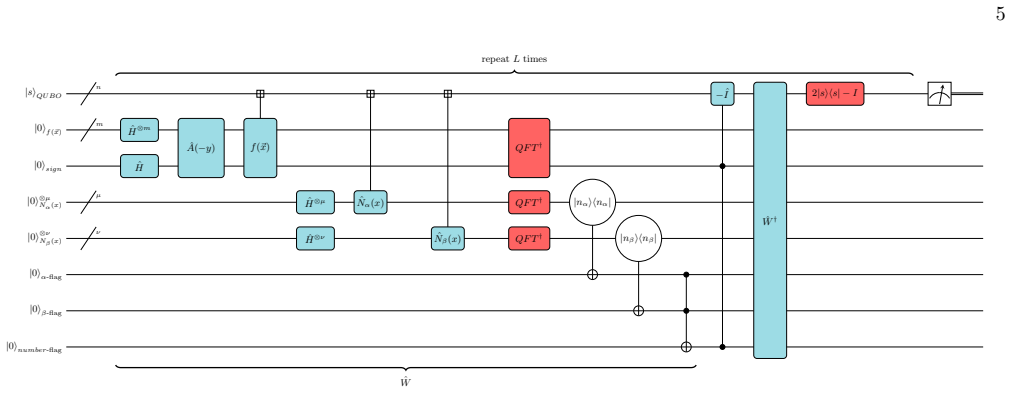
Satisfy the correct number of alpha and beta elec- trons. To achieve this, a multi-controlled X gate is used, with controls defined by the bitstring representation of the de- sired binary occupation state. In Figure 2 this is repre- sented by the projectors in each control. See Figure S.6 in the supporting information for further details. This gate acts o...
-
[3]
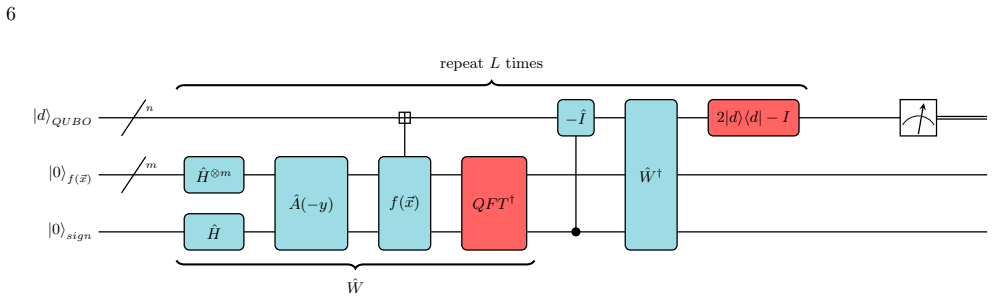
Initialize a uniform superposition over all (or a se- lected subset of) bitstrings in then-qubit QUBO register; in this work, this state is denoted by|s⟩ or|d⟩
-
[4]
Initializetheregisterof(m+1)-qubits, whichstores the current value of the QUBO function, with the chosen starting value:−y(in the Fourier basis)
-
[5]
3: Outline of the full quantum circuit to implement Grover Adaptive Search Self-Consistent Field (GAS-SCF) algorithm searching over Dicke states
Conditioned on then-qubit QUBO register, which encodes the bitstring inputs for the QUBO cost 6 |d⟩QU BO |0⟩f(⃗ x) |0⟩sign n m ˆH⊗m ˆH ˆA(−y) f(⃗ x) QF T† −ˆI ˆW† 2|d⟩⟨d| −I ˆW repeatLtimes FIG. 3: Outline of the full quantum circuit to implement Grover Adaptive Search Self-Consistent Field (GAS-SCF) algorithm searching over Dicke states. Here, a Dicke st...
-
[6]
Mark all bitstrings (in the QUBO register) with a negative sign if their value is less thanyandif they have the correct number of electrons
-
[7]
Undo steps 2 and 3 (W† in circuit)
-
[8]
In then-qubit QUBO register, apply a reflection around the input state (|s⟩or|d⟩) to increase the amplitude of marked states
-
[9]
Repeat the amplification routine (steps 2-6)L times to increase the probability of measuring marked bitstrings
-
[10]
With high probabil- ity, this yields a marked bitstring, representing an improved QUBO solution
Measure the QUBO register. With high probabil- ity, this yields a marked bitstring, representing an improved QUBO solution
-
[11]
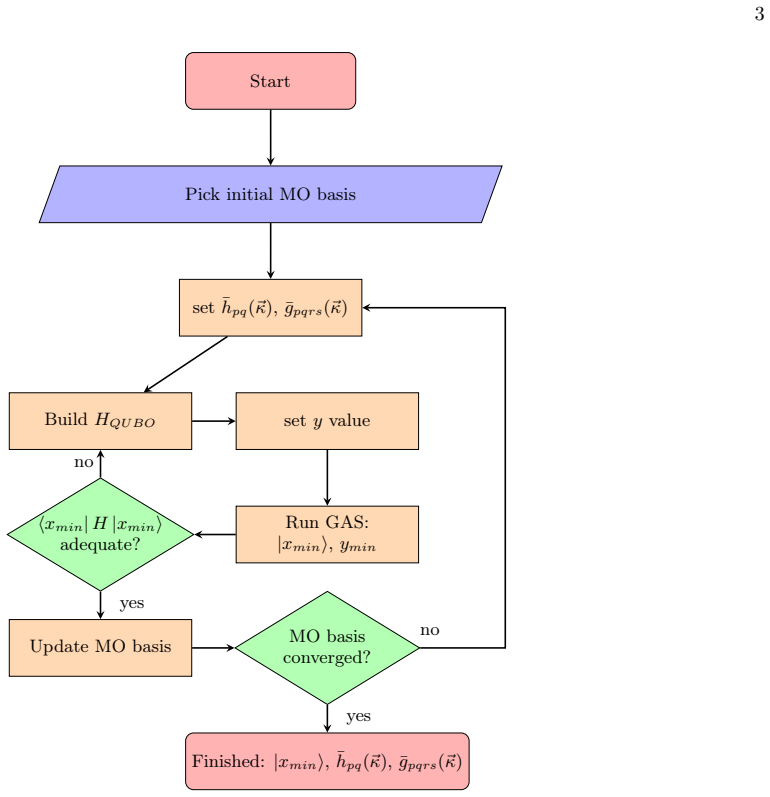
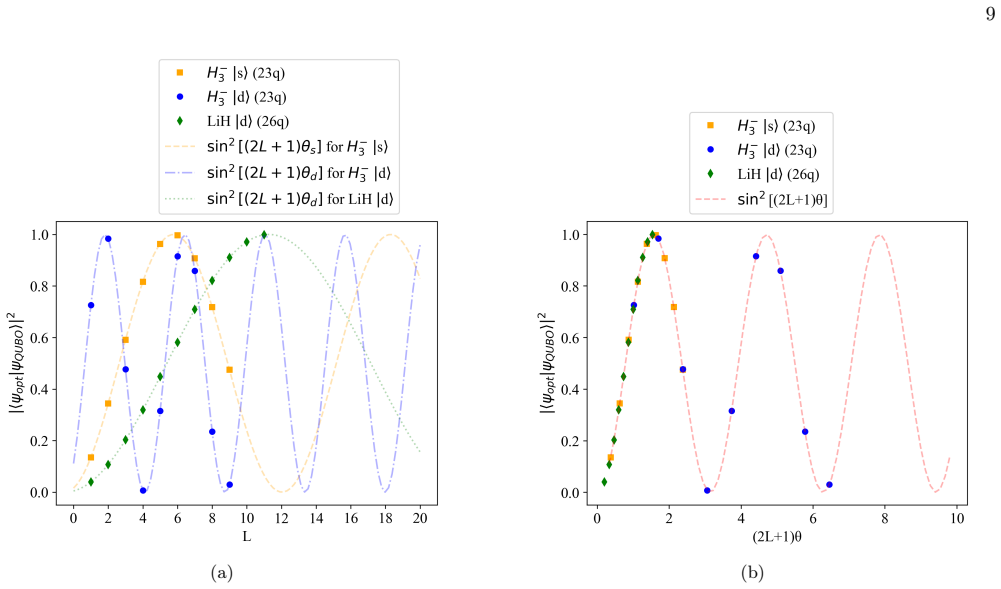
Setyto be the new QUBO value of this improved bitstring and repeat from step 1 until convergence. 7 The amplification routine should be repeatedLtimes where [46, 47]: L= π 4 " 1 arcsin q T N # − 1 2 < π 4 r N T − 1 2 , (6) Lshould be rounded to the nearest integer based on the toplineofthisequation(weassume0< T < N 2 ). Here,T is the number of marked stat...
-
[12]
The bond lengths studied were1.0Å,1.5Å and3.0Å respectively
and OH–in the 6-31G basis set [75] in a (6o, (3e,3e)) active space. The bond lengths studied were1.0Å,1.5Å and3.0Å respectively. A restricted Hartree-Fock (RHF) calculation was performed for each problem. All Hamil- tonian operators were then written in the canonical ba- sis, where their coefficients were multiplied by a con- stant then rounded to integer...
-
[13]
13 ACKNOWLEDGMENTS A.R
and GAS-SCF establishes a useful baseline for fu- ture quantum improvements of SCF methods. 13 ACKNOWLEDGMENTS A.R. and T.W. are supported by QMatter, Inc. T.M.B. is supported by theEngineeringand PhysicalSci- ences Research Council (grant numbers EP/T517793/1, EP/W524335/1). P.V.C. is grateful for funding from the EuropeanCommissionforVECMA(800925)andEPS...
-
[14]
Aspuru-Guzik, A
A. Aspuru-Guzik, A. D. Dutoi, P. J. Love, and M. Head- Gordon, Science309, 1704 (2005)
2005
-
[15]
Y. Cao, J. Romero, J. P. Olson, M. Degroote, P. D. John- son, M. Kieferová, I. D. Kivlichan, T. Menke, B. Per- opadre, N.P.Sawaya,et al.,Chemicalreviews119,10856 (2019)
2019
-
[16]
Santagati, A
R. Santagati, A. Aspuru-Guzik, R. Babbush, M. Deg- roote, L. González, E. Kyoseva, N. Moll, M. Oppel, R. M. Parrish, N. C. Rubin,et al., Nature Physics20, 549 (2024)
2024
- [17]
-
[18]
Babbush, N
R. Babbush, N. Wiebe, J. McClean, J. McClain, H. Neven, and G. K.-L. Chan, Physical Review X8, 011044 (2018)
2018
-
[19]
Babbush, C
R. Babbush, C. Gidney, D. W. Berry, N. Wiebe, J. Mc- Clean, A. Paler, A. Fowler, and H. Neven, Physical Re- view X8, 041015 (2018)
2018
-
[20]
I. D. Kivlichan, J. McClean, N. Wiebe, C. Gidney, A. Aspuru-Guzik, G. K.-L. Chan, and R. Babbush, Physical review letters120, 110501 (2018)
2018
-
[21]
Babbush, D
R. Babbush, D. W. Berry, J. R. McClean, and H. Neven, npj Quantum Information5, 92 (2019)
2019
-
[22]
J. Lee, D. W. Berry, C. Gidney, W. J. Huggins, J. R. McClean, N. Wiebe, and R. Babbush, PRX quantum2, 030305 (2021)
2021
-
[23]
Y. Su, D. W. Berry, N. Wiebe, N. Rubin, and R. Bab- bush, PRX Quantum2, 040332 (2021)
2021
-
[24]
D. W. Berry, Y. Tong, T. Khattar, A. White, T. I. Kim, G. H. Low, S. Boixo, Z. Ding, L. Lin, S. Lee,et al., PRX Quantum6, 020327 (2025)
2025
-
[25]
G. H. Low, R. King, D. W. Berry, Q. Han, A. E. De- Prince III, A. F. White, R. Babbush, R. D. Somma, and N. C. Rubin, Physical Review X15, 041016 (2025)
2025
-
[26]
S. Lee, J. Lee, H. Zhai, Y. Tong, A. M. Dalzell, A. Ku- mar, P. Helms, J. Gray, Z.-H. Cui, W. Liu,et al., Nature communications14, 1952 (2023)
1952
-
[27]
Classical solution of the femo-cofactor model to chemical accuracy and its implications,
H. Zhai, C. Li, X. Zhang, Z. Li, S. Lee, and G. K.- L. Chan, “Classical solution of the femo-cofactor model to chemical accuracy and its implications,” (2026), arXiv:2601.04621 [physics.chem-ph]
Pith/arXiv arXiv 2026
-
[28]
Babbush, W
R. Babbush, W. J. Huggins, D. W. Berry, S. F. Ung, A. Zhao, D. R. Reichman, H. Neven, A. D. Baczewski, and J. Lee, Nature Communications14, 4058 (2023)
2023
-
[29]
D. R. Hartree, Mathematical Proceedings of the Cam- bridge Philosophical Society24, 89–110 (1928)
1928
-
[30]
Szabo and N
A. Szabo and N. S. Ostlund,Modern Quantum Chem- istry: Introduction to Advanced Electronic Structure The- ory, Dover Books on Chemistry (Dover Publications, Mi- neola, NY, 1996)
1996
-
[31]
Helgaker, P
T. Helgaker, P. Jorgensen, and J. Olsen,Molecular electronic-structure theory(John Wiley & Sons, 2013)
2013
-
[32]
J. D. Whitfield and Z. Zimborás, The Journal of chemical physics141(2014), https://doi.org/10.1063/1.4903453
-
[33]
Ralli, T
A. Ralli, T. Weaving, P. V. Coveney, and P. J. Love, Journal of Chemical Theory and Computation21, 9511 (2025), pMID: 40985214
2025
-
[34]
G. M. J. Barca, D. L. Poole, J. L. G. Vallejo, M. Alkan, C. Bertoni, A. P. Rendell, and M. S. Gordon, inPro- ceedings of the International Conference for High Per- formance Computing, Networking, Storage and Analysis, SC ’20 (IEEE Press, 2020)
2020
-
[35]
A. J. Coleman, inReduced-Density-Matrix Mechanics: with applications to many-electron atoms and molecules (Wiley Online Library, 2007)
2007
-
[36]
D. A. Mazziotti, Phys. Rev. Lett.106, 083001 (2011)
2011
-
[37]
D. A. Mazziotti, Phys. Rev. A102, 052819 (2020)
2020
-
[38]
Farhi, J
E. Farhi, J. Goldstone, S. Gutmann, J. Lapan, A. Lund- gren, and D. Preda, Science292, 472 (2001)
2001
-
[39]
A quan- tum approximate optimization algorithm,
E. Farhi, J. Goldstone, and S. Gutmann, “A quan- tum approximate optimization algorithm,” (2014), arXiv:1411.4028 [quant-ph]
Pith/arXiv arXiv 2014
-
[40]
S. P. Jordan, N. Shutty, M. Wootters, A. Zalcman, A. Schmidhuber, R. King, S. V. Isakov, T. Khattar, and R. Babbush, Nature646, 831 (2025)
2025
- [41]
-
[42]
L.K.Grover,inProceedings of the Twenty-Eighth Annual ACM Symposium on Theory of Computing, STOC ’96 (Association for Computing Machinery, New York, NY, USA, 1996) p. 212–219
1996
-
[43]
Quan- tum amplitude amplification and estimation,
G. Brassard, P. Høyer, M. Mosca, and A. Tapp, “Quan- tum amplitude amplification and estimation,” (2002)
2002
-
[44]
Babbush, J
R. Babbush, J. R. McClean, M. Newman, C. Gidney, S. Boixo, and H. Neven, PRX Quantum2, 010103 (2021)
2021
-
[45]
Hoefler, T
T. Hoefler, T. Häner, and M. Troyer, Communications of the ACM66, 82 (2023)
2023
-
[46]
Campbell, A
E. Campbell, A. Khurana, and A. Montanaro, Quantum 3, 167 (2019)
2019
-
[47]
Y. R. Sanders, D. W. Berry, P. C. Costa, L. W. Tessler, N. Wiebe, C. Gidney, H. Neven, and R. Babbush, PRX Quantum1, 020312 (2020)
2020
-
[48]
M. Cain, Q. Xu, R. King, L. R. Picard, H. Levine, M. En- dres, J. Preskill, H.-Y. Huang, and D. Bluvstein, arXiv preprint arXiv:2603.28627 (2026)
Pith/arXiv arXiv 2026
-
[49]
Grover Adaptive Search,
A. Ralli and T. Bickley, “Grover Adaptive Search,” https://github.com/qmatter-labs/GAS(2025)
2025
-
[50]
A quantum algorithm for finding the minimum,
C. Durr and P. Hoyer, “A quantum algorithm for finding the minimum,” (1999), arXiv:quant-ph/9607014 [quant- ph]
Pith/arXiv arXiv 1999
-
[51]
Bulger, W
D. Bulger, W. P. Baritompa, and G. R. Wood, Journal of optimization theory and applications116, 517 (2003)
2003
-
[52]
Thouless, Nuclear Physics21, 225 (1960)
D. Thouless, Nuclear Physics21, 225 (1960). 14
1960
-
[53]
Gilliam, S
A. Gilliam, S. Woerner, and C. Gonciulea, Quantum5, 428 (2021)
2021
-
[54]
W. P. Baritompa, D. W. Bulger, and G. R. Wood, SIAM Journal on Optimization15, 1170 (2005)
2005
-
[55]
Addition on a quantum computer,
T. G. Draper, “Addition on a quantum computer,” (2000), arXiv:quant-ph/0008033 [quant-ph]
Pith/arXiv arXiv 2000
-
[56]
F. Orts, G. Ortega, E. Combarro, and E. Garzón, Jour- nal of Network and Computer Applications170, 102810 (2020)
2020
-
[57]
Bärtschi and S
A. Bärtschi and S. Eidenbenz, inFundamentals of Com- putation Theory, edited by L. A. Gąsieniec, J. Jansson, and C. Levcopoulos (Springer International Publishing, Cham, 2019) pp. 126–139
2019
-
[58]
Bärtschi and S
A. Bärtschi and S. Eidenbenz, in2022 IEEE Interna- tional Conference on Quantum Computing and Engineer- ing (QCE)(2022) pp. 87–96
2022
-
[59]
Boyer, G
M. Boyer, G. Brassard, P. Høyer, and A. Tapp, Fortschritte der Physik: Progress of Physics46, 493 (1998)
1998
-
[60]
M. A. Nielsen and I. L. Chuang,Quantum computation and quantum information(Cambridge university press, 2010)
2010
-
[61]
Ominato, T
H. Ominato, T. Ohyama, and K. Yamaguchi, IEEE Ac- cess12, 74619 (2024)
2024
-
[62]
Brassard, Science275, 627 (1997)
G. Brassard, Science275, 627 (1997)
1997
-
[63]
L. K. Grover, Phys. Rev. Lett.95, 150501 (2005)
2005
-
[64]
T. J. Yoder, G. H. Low, and I. L. Chuang, Phys. Rev. Lett.113, 210501 (2014)
2014
-
[65]
Cremer, WIREs Computational Molecular Science3, 482 (2013)
D. Cremer, WIREs Computational Molecular Science3, 482 (2013)
2013
-
[66]
P. G. Szalay, T. Muller, G. Gidofalvi, H. Lischka, and R. Shepard, Chemical reviews112, 108 (2012)
2012
-
[67]
Norimoto, R
M. Norimoto, R. Mori, and N. Ishikawa, IEEE Transac- tions on Communications71, 1926 (2023)
1926
-
[68]
Q. Sun, Journal of Computa- tional Chemistry36, 1664 (2015), https://onlinelibrary.wiley.com/doi/pdf/10.1002/jcc.23981
-
[69]
W. A. Simon, C. M. Gustin, K. Serafin, A. Ralli, G. R. Goldstein, and P. J. Love, Quantum9, 1953 (2025)
1953
-
[70]
Faro and F
S. Faro and F. P. Marino, inProceedings of the 34th International Symposium on High-Performance Parallel and Distributed Computing, HPDC ’25 (Association for Computing Machinery, New York, NY, USA, 2025)
2025
-
[71]
Almlöf, K
J. Almlöf, K. Fægri Jr, and K. Korsell, Journal of Com- putational Chemistry3, 385 (1982)
1982
-
[72]
Van Lenthe, R
J. Van Lenthe, R. Zwaans, H. J. Van Dam, and M. Guest, Journal of computational chemistry27, 926 (2006)
2006
-
[73]
Lehtola, Journal of chemical theory and computation 15, 1593 (2019)
S. Lehtola, Journal of chemical theory and computation 15, 1593 (2019)
2019
-
[74]
N. C. Rubin, J. Lee, and R. Babbush, Journal of Chem- ical Theory and Computation18, 1480 (2022)
2022
-
[75]
J. C. Slater, Phys. Rev.34, 1293 (1929)
1929
-
[76]
E. U. Condon, Phys. Rev.36, 1121 (1930)
1930
-
[77]
M. X. Goemans and D. P. Williamson, inProceedings of the twenty-sixth annual ACM symposium on Theory of computing(1994) pp. 422–431
1994
-
[78]
A. D. Daniels and G. E. Scuseria, Phys. Chem. Chem. Phys.2, 2173 (2000)
2000
-
[79]
A. C. Vaucher and M. Reiher, Journal of Chemical The- ory and Computation13, 1219 (2017)
2017
-
[80]
A reusable library for second-order orbital optimization usingthetrustregionmethod,
J. Greiner, I.-M. Høyvik, S. Lehtola, and J. J. Eriksen, “A reusable library for second-order orbital optimization usingthetrustregionmethod,” (2025),arXiv:2509.13931 [physics.chem-ph]
arXiv 2025
discussion (0)
Sign in with ORCID, Apple, or X to comment. Anyone can read and Pith papers without signing in.