Optimal multi-spectral squeezing via deterministic 2D-phase optimization
Pith reviewed 2026-06-26 16:58 UTC · model grok-4.3
The pith
A deterministic sequential algorithm reaches the global maximum visibility for multi-spectral squeezing detection by optimizing 2D phase in a pixel basis.
A machine-rendered reading of the paper's core claim, the machinery that carries it, and where it could break.
Core claim
By focusing on the physical description of the optical process, the deterministic sequential algorithm provably reaches the global maximum of the visibility in a pixel basis, scales linearly with the number of pixels, and provides an efficient, interpretable alternative to agnostic optimization for enhancing multimode squeezing readout.
What carries the argument
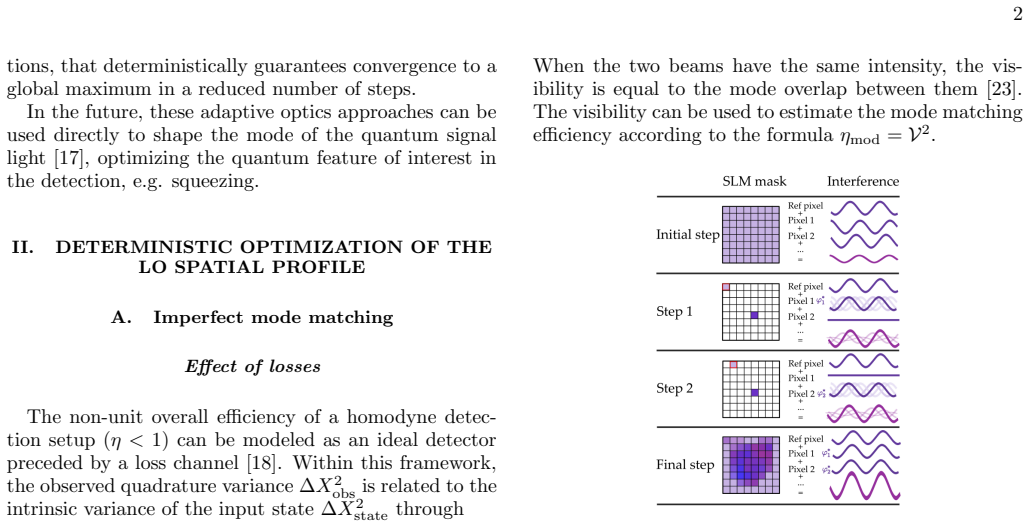
The deterministic sequential algorithm that performs pixel-by-pixel phase updates to maximize visibility according to the optical interference model.
If this is right
- Visibility rises from 76 percent to 84 percent after mask optimization.
- Mode-matching efficiency gains 20 percent.
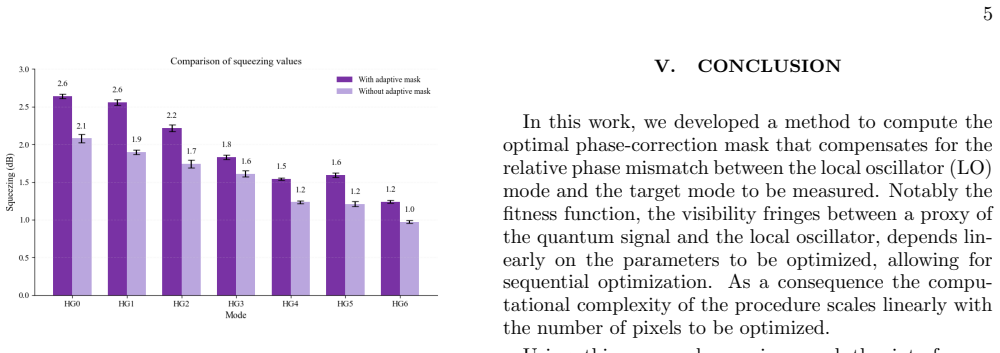
- Squeezing in the strongest spectral mode improves from -2.08 dB to -2.64 dB.
- Computation time grows only linearly with pixel number.
Where Pith is reading between the lines
- The same sequential update logic could be tested on other multimode quantum-light platforms where local-oscillator shaping is required.
- If the underlying interference model remains accurate, the method could replace gradient-based or genetic optimizers in real-time control loops.
- Adding a small noise term to the model would allow checking whether the linear scaling and global guarantee survive modest experimental imperfections.
Load-bearing premise
The physical model of the optical interference process permits a sequential deterministic update rule that is guaranteed to reach the global visibility optimum without local maxima.
What would settle it
Running the algorithm on a test interference pattern whose global visibility optimum is known by exhaustive search and observing that it converges to a lower value would falsify the global-maximum claim.
Figures
read the original abstract
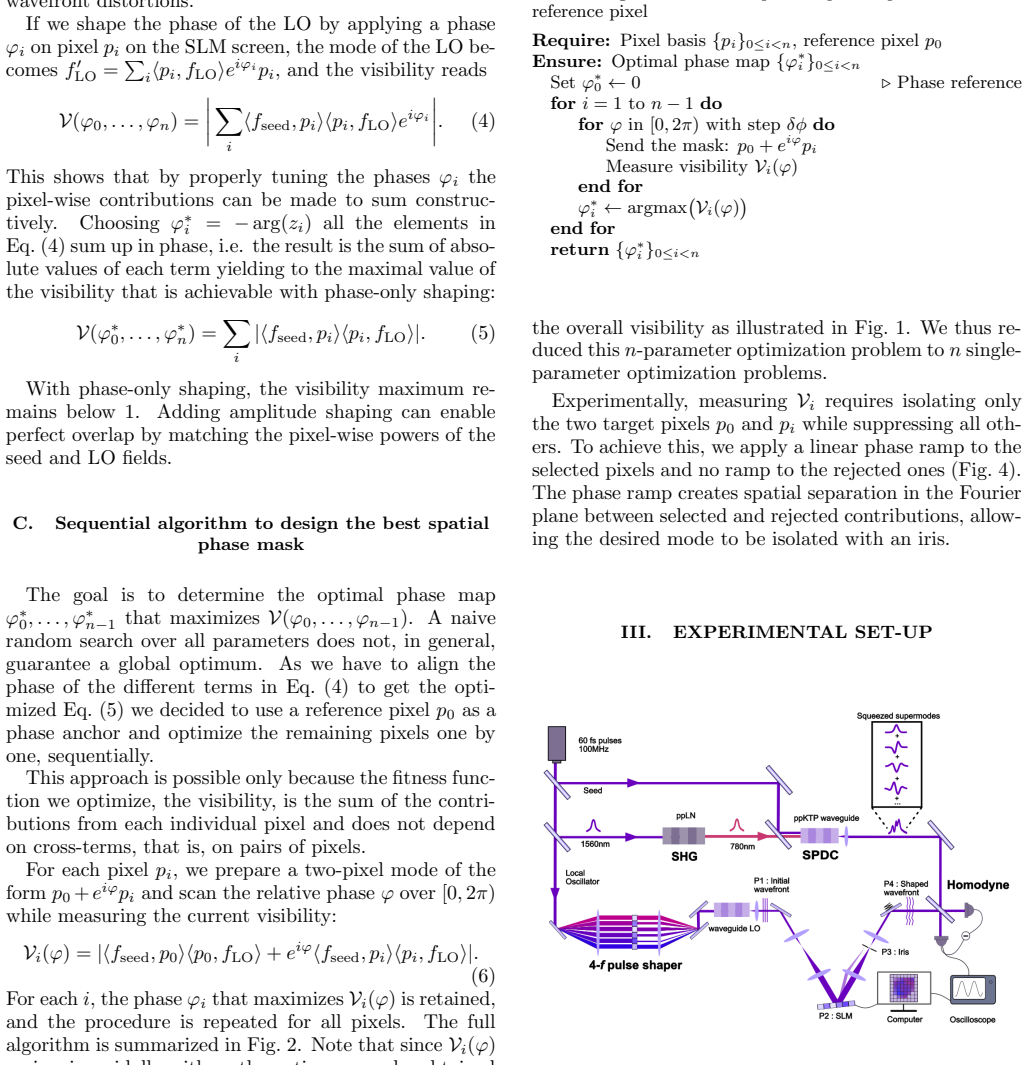
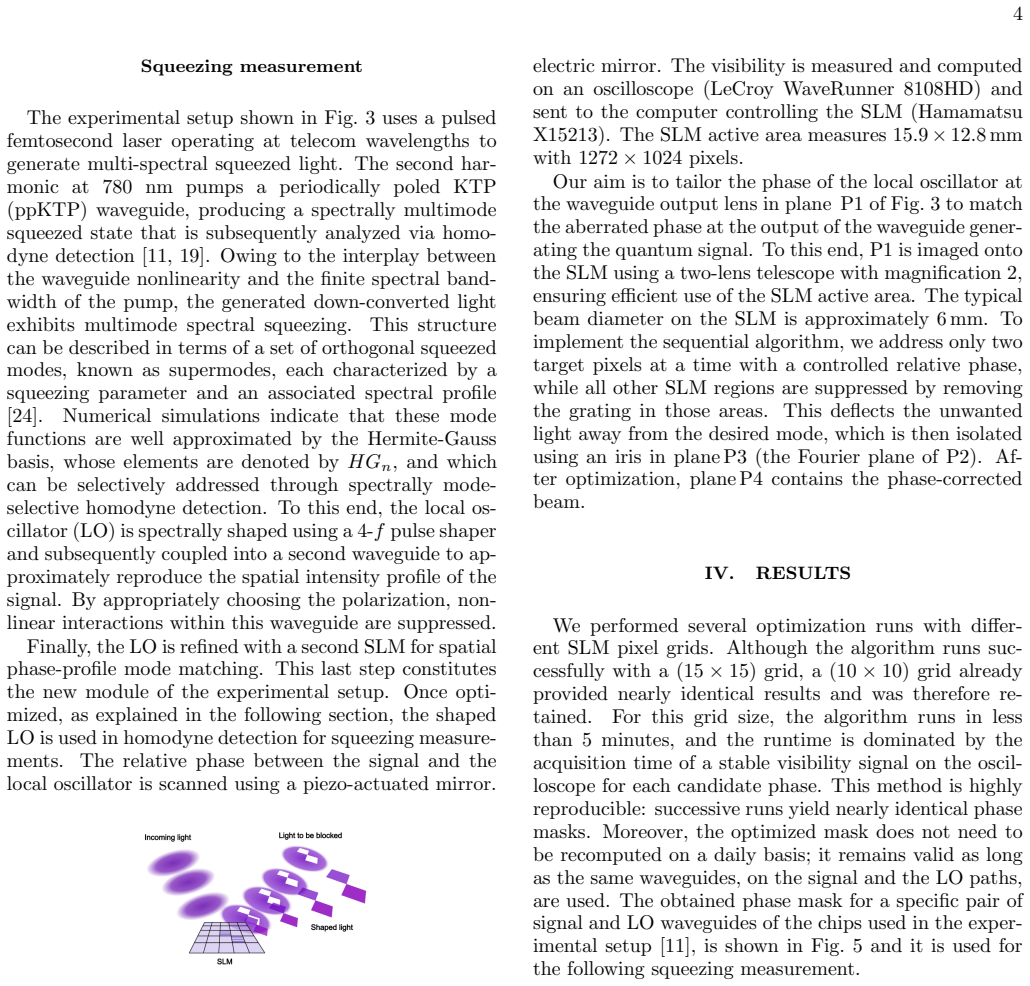
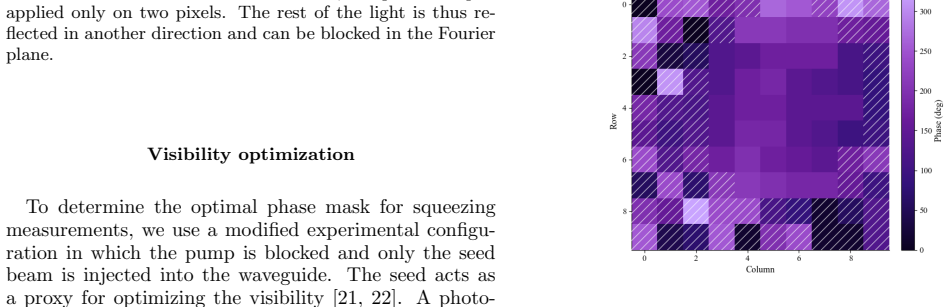
Optimization routines are ubiquitous in quantum information technologies and essential to reach the resource levels required by quantum protocols. Specifically, multi-spectral squeezing for use in such protocols requires that losses be kept minimal at every stage, including coherent detection, which is performed by interfering the signal with a classical local-oscillator beam. This in turn requires control over all optical degrees of freedom of the beam in order to optimize the detection. The most general framework for this optimization relies on agnostic, off-the-shelf machine-learning techniques. Here we take the opposite approach: by focusing on a physical description of the specific optical process, we develop a deterministic sequential algorithm that provably reaches the global maximum of the visibility in a pixel basis and scales linearly with the number of pixels, thereby offering an efficient and theoretically grounded alternative to black-box optimization. In our waveguide-based setup, the optimized mask increases the visibility from 76% to 84%, corresponding to a 20% gain in mode-matching efficiency. Multi-spectral squeezing measurements confirm that this improvement translates directly into quantum readout: for the most squeezed spectral mode, the squeezing increases from $-2.08$ dB to $-2.64$ dB, consistent with the inferred efficiency gain. These results establish deterministic spatial phase shaping as an effective, interpretable route to enhanced multimode squeezing in waveguide platforms.
Editorial analysis
A structured set of objections, weighed in public.
Referee Report
Summary. The manuscript presents a deterministic sequential algorithm for 2D-phase optimization of the local oscillator in multi-spectral squeezing, derived from the physical model of optical interference in a waveguide platform. The algorithm is claimed to provably reach the global maximum visibility in a pixel basis while scaling linearly with pixel number, providing an interpretable alternative to black-box optimization. Experiments report visibility improvement from 76% to 84% (20% gain in mode-matching efficiency) and squeezing enhancement from -2.08 dB to -2.64 dB in the most squeezed spectral mode, consistent with the efficiency gain.
Significance. If the optimality proof and linear scaling hold, the work supplies a valuable, physically motivated tool for mode-matching optimization in multimode quantum optics, with direct applicability to quantum information protocols requiring high-efficiency detection. The experimental consistency between visibility and squeezing gains provides independent support for the method's utility.
minor comments (3)
- [Abstract] Abstract: the statement that the algorithm 'provably reaches the global maximum' would benefit from a one-sentence outline of the key physical assumption enabling the sequential update rule.
- [Experimental results] The experimental results section would be strengthened by explicit reporting of measurement uncertainties or repeated trials for the visibility and squeezing values.
- [Algorithm development] Notation for the pixel-basis visibility function and the sequential update rule should be introduced with a clear equation reference in the algorithm development section.
Simulated Author's Rebuttal
We thank the referee for the positive assessment of our work and the recommendation for minor revision. The provided summary accurately captures the contributions of the deterministic sequential algorithm for 2D-phase optimization in multi-spectral squeezing.
Circularity Check
No significant circularity identified
full rationale
The paper derives a deterministic sequential algorithm from the physical model of optical interference to optimize visibility in a pixel basis, claiming it provably reaches the global maximum with linear scaling in pixel number. No load-bearing steps reduce by construction to self-defined quantities, fitted inputs renamed as predictions, or self-citation chains; the algorithm is presented as following from the interference process description, with experimental visibility and squeezing gains (76% to 84%, -2.08 dB to -2.64 dB) providing independent validation outside any internal fit. The derivation remains self-contained.
Axiom & Free-Parameter Ledger
axioms (1)
- domain assumption The optical interference process admits a sequential deterministic update rule guaranteed to reach the global visibility maximum.
Reference graph
Works this paper leans on
-
[1]
N. C. Menicucci, P. van Loock, M. Gu, C. Weedbrook, T. C. Ralph, and M. A. Nielsen, Universal quantum com- putation with continuous-variable cluster states, Phys- ical Review Letters97, 10.1103/physrevlett.97.110501 (2006). 6
-
[2]
M. Chen, N. C. Menicucci, and O. Pfister, Experimental realization of multipartite entanglement of 60 modes of a quantum optical frequency comb, Phys. Rev. Lett.112, 120505 (2014)
2014
-
[3]
Y. Cai, J. Roslund, G. Ferrini, F. Arzani, X. Xu, C. Fabre, and N. Treps, Multimode entanglement in re- configurable graph states using optical frequency combs, Nat. Commun.8, 15645 (2017)
2017
-
[4]
Yokoyama, R
S. Yokoyama, R. Ukai, S. C. Armstrong, C. Sornphiphat- phong, T. Kaji, S. Suzuki, J.-i. Yoshikawa, H. Yonezawa, N. C. Menicucci, and A. Furusawa, Ultra-large-scale continuous-variable cluster states multiplexed in the time domain, Nature Photonics7, 982 (2013)
2013
-
[5]
Asavanant, Y
W. Asavanant, Y. Shiozawa, S. Yokoyama, B. Charoen- sombutamon, H. Emura, R. Alexander, S. Takeda, J. Yoshikawa, N. Menicucci, H. Yonezawa, and A. Fu- rusawa, Generation of time-domain-multiplexed two- dimensional cluster state, Science366, 373 (2019)
2019
-
[6]
M. V. Larsen, X. Guo, C. R. Breum, J. S. Neergaard- Nielsen, and U. L. Andersen, Deterministic generation of a two-dimensional cluster state, Science366, 369–372 (2019)
2019
-
[7]
H. Vahlbruch, M. Mehmet, K. Danzmann, and R. Schn- abel, Detection of 15 db squeezed states of light and their application for the absolute calibration of photo- electric quantum efficiency, Physical Review Letters117, 10.1103/physrevlett.117.110801 (2016)
-
[8]
Shajilal, O
B. Shajilal, O. Thearle, A. Tranter, Y. Lu, E. Hunt- ington, S. Assad, P. K. Lam, and J. Janousek, 12.6 db squeezed light at 1550 nm from a bow-tie cavity for long- term high duty cycle operation, Optics Express30, 37213 (2022)
2022
-
[9]
Kashiwazaki, T
T. Kashiwazaki, T. Yamashima, K. Enbutsu, T. Kazama, A. Inoue, K. Fukui, M. Endo, T. Umeki, and A. Furu- sawa, Over-8-db squeezed light generation by a broad- band waveguide optical parametric amplifier toward fault-tolerant ultra-fast quantum computers, Applied Physics Letters122, 234003 (2023)
2023
-
[10]
Kouadou, F
T. Kouadou, F. Sansavini, M. Ansquer, J. Henaff, N. Treps, and V. Parigi, Spectrally shaped and pulse- by-pulse multiplexed multimode squeezed states of light, APL Photonics8, 086113 (2023)
2023
-
[11]
Surpassing the en- ergy resolution limit with ferromagnetic torque sensors,
V. Roman-Rodriguez, D. Fainsin, G. L. Zanin, N. Treps, E. Diamanti, and V. Parigi, Multimode squeezed state for reconfigurable quantum networks at telecommunication wavelengths, Physical Review Research6, 10.1103/phys- revresearch.6.043113 (2024)
-
[12]
Froehly, B
C. Froehly, B. Colombeau, and M. Vampouille, Ii shaping and analysis of picosecond light pulses (Elsevier, 1983) pp. 63–153
1983
-
[13]
Monmayrant, S
A. Monmayrant, S. J. Weber, and B. Chatel, A new- comer’s guide to ultrashort pulse shaping and charac- terization, Journal of Physics B: Atomic, Molecular and Optical Physics43, 103001 (2010)
2010
-
[14]
Kashiwazaki, N
T. Kashiwazaki, N. Takanashi, T. Yamashima, T. Kazama, K. Enbutsu, R. Kasahara, T. Umeki, and A. Furusawa, Continuous-wave 6-db-squeezed light with 2.5-thz-bandwidth from single-mode ppln waveguide, APL Photonics5(2020)
2020
-
[15]
Amari, J
J. Amari, J. Takai, and T. Hirano, Highly efficient mea- surement of optical quadrature squeezing using a spa- tial light modulator controlled by machine learning, Opt. Continuum2, 933 (2023)
2023
-
[16]
G. Ha, K. Hirota, T. Kashiwazaki, T. Suzuki, A. Kawasaki, W. Asavanant, M. Endo, and A. Fu- rusawa, Generation of 12 db squeezed light from a waveguide optical parametric amplifier using a machine- learning-controlled spatial light modulator (2026), arXiv:2603.02744 [quant-ph]
arXiv 2026
-
[17]
P. Cameron, B. Courme, C. Verni` ere, R. Pandya, D. Faccio, and H. Defienne, Adaptive optical imag- ing with entangled photons, Science383, 1142 (2024), https://www.science.org/doi/pdf/10.1126/science.adk7825
-
[18]
Leonhardt and H
U. Leonhardt and H. Paul, Measuring the quantum state of light, Progress in Quantum Electronics19, 89 (1995)
1995
-
[19]
T. Kouadou, E. Gozlan, L. Garcia, D. Polizzi, D. Fainsin, I. Paparelle, R. L. R. Celis, B. Oriot, A. A. Aad, P. Nam- dar, G. Roland, N. Treps, B. Argence, and V. Parigi, Homodyne detection for pulse-by-pulse squeezing mea- surements (2025), arXiv:2511.04578 [quant-ph]
arXiv 2025
-
[20]
A. I. Lvovsky and M. G. Raymer, Continuous-variable optical quantum-state tomography, Reviews of Modern Physics81, 299–332 (2009)
2009
-
[21]
Aichele, A
T. Aichele, A. I. Lvovsky, and S. Schiller, Optical mode characterization of single photons prepared by means of conditional measurements on a biphoton state, European Physical Journal D18, 237 (2002)
2002
-
[22]
Grosshans and P
F. Grosshans and P. Grangier, Effective quantum effi- ciency in the pulsed homodyne detection of a n-photon state, European Physical Journal D14, 119 (2001)
2001
-
[23]
MANDEL and E
L. MANDEL and E. WOLF, Coherence properties of op- tical fields, Rev. Mod. Phys.37, 231 (1965)
1965
-
[24]
Patera, N
G. Patera, N. Treps, C. Fabre, and G. J. de Valc´ arcel, Quantum theory of synchronously pumped type i optical parametric oscillators: characterization of the squeezed supermodes, The European Physical Journal D56, 123–140 (2009)
2009
-
[25]
Roslund, R
J. Roslund, R. M. de Ara´ ujo, S. Jiang, C. Fabre, and N. Treps, Wavelength-multiplexed quantum networks with ultrafast frequency combs, Nature Photonics8, 109–112 (2013)
2013
discussion (0)
Sign in with ORCID, Apple, or X to comment. Anyone can read and Pith papers without signing in.