Augmenting Game AI with Deep Reinforcement Learning
Pith reviewed 2026-06-26 17:25 UTC · model grok-4.3
The pith
A framework with game-specific requirements allows reinforcement learning to train believable AI for video games.
A machine-rendered reading of the paper's core claim, the machinery that carries it, and where it could break.
Core claim
The authors propose a framework for training reinforcement learning models with a set of requirements in mind that are suited towards game AI and game development, present examples of games with reinforcement learning-augmented game AI, describe the practicalities of deploying player-facing machine learning agents in modern games, and identify bottlenecks and hard problems that offer promising research directions.
What carries the argument
The proposed framework of training requirements tailored for game AI and game development.
If this is right
- Reinforcement learning agents can be trained and deployed in player-facing roles inside modern commercial games.
- Identified bottlenecks become concrete targets for future research to speed industry adoption.
- Game development teams gain a structured way to move beyond hand-coded AI toward learned behavior.
Where Pith is reading between the lines
- The framework could shorten iteration cycles in game studios by letting designers specify high-level requirements rather than detailed rules.
- Similar requirement-driven training might apply to other real-time interactive systems such as robotics or training simulators.
- If the bottlenecks are resolved, game AI quality could scale with compute rather than with manual authoring effort.
Load-bearing premise
Current research limitations block broad deployment of reinforcement learning across game genres, so a specialized framework is required.
What would settle it
Successful application of unmodified general-purpose reinforcement learning methods to a wide variety of game genres with production-level performance would show the tailored framework is unnecessary.
Figures
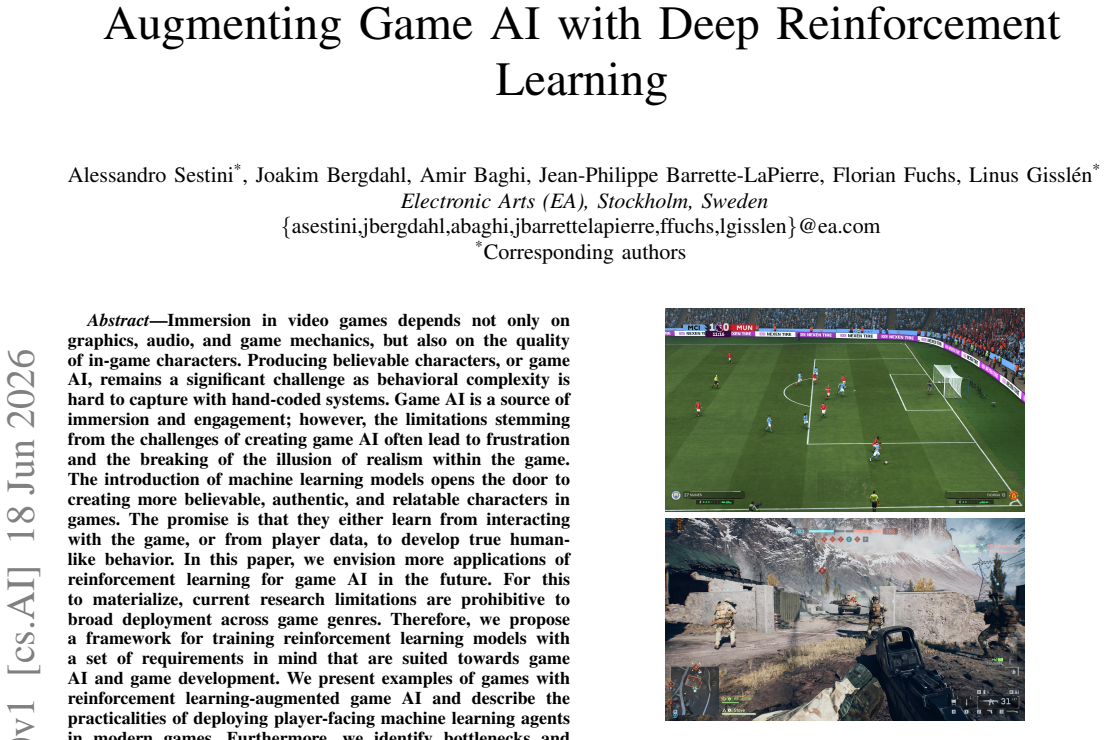

read the original abstract
Immersion in video games depends not only on graphics, audio, and game mechanics, but also on the quality of in-game characters. Producing believable characters, or game AI, remains a significant challenge as behavioral complexity is hard to capture with hand-coded systems. Game AI is a source of immersion and engagement; however, the limitations stemming from the challenges of creating game AI often lead to frustration and the breaking of the illusion of realism within the game. The introduction of machine learning models opens the door to creating more believable, authentic, and relatable characters in games. The promise is that they either learn from interacting with the game, or from player data, to develop true human-like behavior. In this paper, we envision more applications of reinforcement learning for game AI in the future. For this to materialize, current research limitations are prohibitive to broad deployment across game genres. Therefore, we propose a framework for training reinforcement learning models with a set of requirements in mind that are suited towards game AI and game development. We present examples of games with reinforcement learning-augmented game AI and describe the practicalities of deploying player-facing machine learning agents in modern games. Furthermore, we identify bottlenecks and hard problems in these areas, which we believe offer promising research directions to accelerate the adoption of machine learning in game AI for the video game industry.
Editorial analysis
A structured set of objections, weighed in public.
Referee Report
Summary. The manuscript argues that limitations in current reinforcement learning research prevent broad deployment of RL for game AI across genres, and therefore proposes a high-level framework for training RL models with game-AI-specific requirements in mind. It discusses examples of RL-augmented game AI, practical issues in deploying player-facing agents in modern games, and identifies bottlenecks as promising research directions.
Significance. A well-specified and validated framework could help translate RL advances into industry practice by focusing on game-specific constraints such as believability, scalability, and integration with existing engines. The identification of hard problems offers a useful research agenda. However, because the manuscript presents only a conceptual proposal without formal definitions, concrete requirements, or any empirical results, its significance remains prospective rather than demonstrated.
major comments (2)
- [Abstract] Abstract: the central motivation—that 'current research limitations are prohibitive to broad deployment across game genres'—is asserted without citing specific studies, failure modes, or quantitative evidence, which is load-bearing for justifying the need for a new framework.
- [Framework proposal (main body)] Framework proposal: the manuscript states that it proposes 'a framework for training reinforcement learning models with a set of requirements in mind' but provides neither an explicit enumeration of those requirements nor a formal description of the framework components, training procedure, or evaluation criteria, rendering the core contribution unevaluable.
minor comments (1)
- [Abstract] The abstract refers to 'examples of games with reinforcement learning-augmented game AI' and 'practicalities of deploying player-facing machine learning agents' without indicating which sections contain the details or how many examples are provided.
Simulated Author's Rebuttal
We thank the referee for the detailed and constructive report. We address each major comment below and indicate the revisions we will make to strengthen the manuscript.
read point-by-point responses
-
Referee: [Abstract] Abstract: the central motivation—that 'current research limitations are prohibitive to broad deployment across game genres'—is asserted without citing specific studies, failure modes, or quantitative evidence, which is load-bearing for justifying the need for a new framework.
Authors: We agree that the motivation would be strengthened by explicit citations to studies documenting RL limitations in game AI. In the revision we will add references to relevant work on sample inefficiency, poor cross-genre generalization, and integration difficulties with existing game engines, thereby grounding the claim that these issues currently limit broad deployment. revision: yes
-
Referee: [Framework proposal (main body)] Framework proposal: the manuscript states that it proposes 'a framework for training reinforcement learning models with a set of requirements in mind' but provides neither an explicit enumeration of those requirements nor a formal description of the framework components, training procedure, or evaluation criteria, rendering the core contribution unevaluable.
Authors: The paper is a conceptual vision piece whose primary goal is to articulate why game-specific requirements matter and to outline high-level research directions. We therefore did not include formal definitions or a training procedure. We accept that an explicit (even if high-level) enumeration of the key requirements and framework components would make the proposal more actionable. In revision we will add a concise section that enumerates the main requirements (believability, scalability, engine integration, etc.) and sketches the corresponding framework elements without introducing empirical results or formal algorithms. revision: partial
Circularity Check
No significant circularity; position paper without derivations
full rationale
The manuscript is a high-level vision and position statement proposing a framework for RL-augmented game AI. It contains no equations, fitted parameters, formal derivations, or testable predictions that could reduce to inputs by construction. The argument rests on a stated premise about current research limitations and the need for tailored requirements, but this premise is presented as motivation rather than derived from any self-referential step or self-citation chain within the paper. No load-bearing technical claims exist that match any of the enumerated circularity patterns.
Axiom & Free-Parameter Ledger
axioms (1)
- domain assumption Reinforcement learning models can develop true human-like behavior from interacting with the game or from player data.
invented entities (1)
-
Framework for training RL models with game-AI-specific requirements
no independent evidence
Reference graph
Works this paper leans on
-
[1]
Grandmaster level in starcraft ii using multi-agent reinforcement learning,
O. Vinyals, I. Babuschkin, W. M. Czarnecki, M. Mathieu, A. Dudzik et al., “Grandmaster level in starcraft ii using multi-agent reinforcement learning,”Nature, 2019
2019
-
[2]
Outracing champion gran turismo drivers with deep reinforcement learning,
P. R. Wurman, S. Barrett, K. Kawamoto, J. MacGlashan, K. Subrama- nian, T. J. Walsh, R. Capobianco, A. Devlic, F. Eckert, F. Fuchset al., “Outracing champion gran turismo drivers with deep reinforcement learning,”Nature, 2022
2022
-
[3]
Dota 2 with Large Scale Deep Reinforcement Learning
C. Berner, G. Brockman, B. Chanet al., “Dota 2 with large scale deep reinforcement learning,”arXiv preprint arXiv:1912.06680, 2019
work page internal anchor Pith review Pith/arXiv arXiv 1912
-
[4]
Minimax exploiter: A data efficient approach for competitive self-play,
D. Bairamian, P. Marcotte, J. Romoff, G. Robert, and D. Nowrouzezahrai, “Minimax exploiter: A data efficient approach for competitive self-play,” inProceedings of the 23rd International Conference on Autonomous Agents and Multiagent Systems, 2024
2024
-
[5]
Honor of kings arena: an environment for gen- eralization in competitive reinforcement learning,
H. Wei, J. Chen, X. Ji, H. Qin, M. Deng, S. Li, L. Wang, W. Zhang, Y . Yu, L. Lincet al., “Honor of kings arena: an environment for gen- eralization in competitive reinforcement learning,”Advances in Neural Information Processing Systems, 2022
2022
-
[6]
Towards informed design and validation assistance in computer games using imitation learning,
A. Sestini, J. Bergdahl, K. Tollmar, A. D. Bagdanov, and L. Gissl ´en, “Towards informed design and validation assistance in computer games using imitation learning,” inIEEE Conference on Games (CoG), 2023
2023
-
[7]
Automated gameplay testing and validation with curiosity-conditioned proximal trajectories,
A. Sestini, L. Gissl ´en, J. Bergdahl, K. Tollmar, and A. D. Bagdanov, “Automated gameplay testing and validation with curiosity-conditioned proximal trajectories,”IEEE Transactions on Games, 2022
2022
-
[8]
Technical challenges of deploying reinforcement learning agents for game testing in aaa games,
J. Gillberg, J. Bergdahl, A. Sestini, A. Eakins, and L. Gissl ´en, “Technical challenges of deploying reinforcement learning agents for game testing in aaa games,” inIEEE Conference on Games (CoG), 2023
2023
-
[9]
modl.ai,
modl, “modl.ai,” 2026, https://modl.ai/ [Accessed: 2026]
2026
-
[10]
nunu, “nunu,” 2026, https://nunu.ai/ [Accessed: 2026]
2026
-
[11]
Human-like goalkeeping in a realistic football simulation: a sample-efficient reinforcement learning approach,
A. Sestini, J. Bergdahl, J.-P. Barrette-LaPierre, F. Fuchs, B. Chen, M. Jones, and L. Gissl ´en, “Human-like goalkeeping in a realistic football simulation: a sample-efficient reinforcement learning approach,” inReinforcement Learning Conference, 2026
2026
-
[12]
Deepcrawl: Deep re- inforcement learning for turn-based strategy games,
A. Sestini, A. Kuhnle, and A. D. Bagdanov, “Deepcrawl: Deep re- inforcement learning for turn-based strategy games,”arXiv preprint arXiv:2012.01914, 2020
-
[13]
“it’s unwieldy and it takes a lot of time
M. Jacob, S. Devlin, and K. Hofmann, ““it’s unwieldy and it takes a lot of time”—challenges and opportunities for creating agents in commercial games,” inAAAI Conference on Artificial Intelligence and Interactive Digital Entertainment, 2020
2020
-
[14]
Ai methods for games,
G. N. Yannakakis and J. Togelius, “Ai methods for games,” inArtificial Intelligence and Games. Springer, 2025
2025
-
[15]
Improving the performance of backward chained behavior trees that use reinforcement learning,
M. Kartasev, J. Saler, and P. ¨Ogren, “Improving the performance of backward chained behavior trees that use reinforcement learning,” in 2023 IEEE/RSJ International Conference on Intelligent Robots and Systems (IROS), 2023
2023
-
[16]
Applying goal-oriented action planning to games,
O. Jeff, “Applying goal-oriented action planning to games,”AI game programming wisdom, 2003
2003
-
[17]
Pufferlib 2.0: Reinforcement learning at 1m steps/s,
J. Suarez, “Pufferlib 2.0: Reinforcement learning at 1m steps/s,” in Reinforcement Learning Conference, 2025
2025
-
[18]
Soft Actor-Critic Algorithms and Applications
T. Haarnoja, A. Zhou, K. Hartikainen, G. Tucker, S. Ha, J. Tan, V . Ku- mar, H. Zhu, A. Gupta, P. Abbeelet al., “Soft actor-critic algorithms and applications,”arXiv preprint arXiv:1812.05905, 2018
work page internal anchor Pith review Pith/arXiv arXiv 2018
-
[19]
Replay across experiments: A natural extension of off-policy rl,
D. Tirumala, T. Lampe, J. E. Chen, T. Haarnoja, S. Huang, G. Lever, B. Moran, T. Hertweck, L. Hasenclever, M. Riedmilleret al., “Replay across experiments: A natural extension of off-policy rl,”arXiv preprint arXiv:2311.15951, 2023
-
[20]
Human-like bots for tactical shooters using compute-efficient sensors,
N. Justesen, M. Kaselimi, S. Snodgrass, M. V ozaru, M. Schlegelet al., “Human-like bots for tactical shooters using compute-efficient sensors,” IEEE Transactions on Games, 2025
2025
-
[21]
Deep reinforce- ment learning for navigation in aaa video games,
E. Alonso, M. Peter, D. Goumard, and J. Romoff, “Deep reinforce- ment learning for navigation in aaa video games,”arXiv preprint arXiv:2011.04764, 2020
-
[22]
Counter-strike deathmatch with large-scale behavioural cloning,
T. Pearce and J. Zhu, “Counter-strike deathmatch with large-scale behavioural cloning,” inIEEE Conference on Games (CoG), 2022
2022
-
[23]
Training language models to follow instructions with human feedback,
L. Ouyang, J. Wu, X. Jiang, D. Almeida, C. Wainwrightet al., “Training language models to follow instructions with human feedback,”Advances in neural information processing systems, 2022
2022
-
[24]
Flora: sample-efficient preference-based rl via low-rank style adaptation of reward functions,
D. Marta, S. Holk, M. Vasco, J. Lundell, T. Homberger, F. Buschet al., “Flora: sample-efficient preference-based rl via low-rank style adaptation of reward functions,” inIEEE International Conference on Robotics and Automation (ICRA), 2025
2025
-
[25]
Win- ning is not everything: Enhancing game development with intelligent agents,
Y . Zhao, I. Borovikov, F. de Mesentier Silva, A. Beirami, J. Rupert, C. Somers, J. Harder, J. Kolen, J. Pinto, R. Pourabolghasemet al., “Win- ning is not everything: Enhancing game development with intelligent agents,”IEEE Transactions on Games, 2020
2020
-
[26]
Bigger, better, faster: Human-level atari with human-level efficiency,
M. Schwarzer, J. S. O. Ceron, A. Courvilleet al., “Bigger, better, faster: Human-level atari with human-level efficiency,” inInternational Conference on Machine Learning, 2023
2023
-
[27]
SPEQ: Offline stabilization phases for efficient q-learning in high update-to-data ratio reinforcement learning,
C. Romeo, G. Macaluso, A. Sestini, and A. D. Bagdanov, “SPEQ: Offline stabilization phases for efficient q-learning in high update-to-data ratio reinforcement learning,” inReinforcement Learning Conference, 2025
2025
-
[28]
Optimistic critics can empower small actors,
O. Mastikhina, D. Sreenivas, and P. S. Castro, “Optimistic critics can empower small actors,”arXiv preprint arXiv:2506.01016, 2025
-
[29]
Bigger, regularized, optimistic: scaling for compute and sample efficient continuous control,
M. Nauman, M. Ostaszewski, K. Jankowski,et al., “Bigger, regularized, optimistic: scaling for compute and sample efficient continuous control,” Advances in neural information processing systems, 2024
2024
-
[30]
Fine-tuning reinforcement learning models is secretly a forgetting mitigation problem,
M. Wołczyk, B. Cupiał, M. Ostaszewski, and M. e. a. Bortkiewicz, “Fine-tuning reinforcement learning models is secretly a forgetting mitigation problem,”arXiv preprint arXiv:2402.02868, 2024
-
[31]
A Study on Overfitting in Deep Reinforcement Learning
C. Zhang, O. Vinyals, R. Munos, and S. Bengio, “A study on overfitting in deep reinforcement learning,”arXiv preprint arXiv:1804.06893, 2018
work page internal anchor Pith review Pith/arXiv arXiv 2018
-
[32]
M. Faldor, J. Zhang, A. Cully, and J. Clune, “Omni-epic: Open- endedness via models of human notions of interestingness with environ- ments programmed in code,”arXiv preprint arXiv:2405.15568, 2024
-
[33]
Loss of plasticity in deep continual learning,
S. Dohare, J. F. Hernandez-Garcia, Q. Lanet al., “Loss of plasticity in deep continual learning,”Nature, 2024
2024
-
[34]
Efficient visibility approxima- tion for game ai using neural omnidirectional distance fields,
Z. Ying, N. Edwards, and M. Kutuzov, “Efficient visibility approxima- tion for game ai using neural omnidirectional distance fields,”ACM on Computer Graphics and Interactive Techniques, 2024
2024
-
[35]
Scaling behavior cloning improves causal reasoning: An open model for real- time video game playing,
Y . Yue, I. Salia, S. Hunt, C. Green, W. Shi, and J. J. Hunt, “Scaling behavior cloning improves causal reasoning: An open model for real- time video game playing,”arXiv preprint arXiv:2601.04575, 2026
-
[36]
Nitrogen: An open foundation model for generalist gaming agents,
L. Magne, A. Awadalla, G. Wang, Y . Xuet al., “Nitrogen: An open foundation model for generalist gaming agents,”arXiv preprint arXiv:2601.02427, 2026
-
[37]
Generating personas for games with multimodal adversarial imitation learning,
W. Ahlberg, A. Sestini, K. Tollmar, and L. Gissl´en, “Generating personas for games with multimodal adversarial imitation learning,” inIEEE Conference on Games (CoG), 2023
2023
-
[38]
Policy fusion for adaptive and customizable reinforcement learning agents,
A. Sestini, A. Kuhnle, and A. D. Bagdanov, “Policy fusion for adaptive and customizable reinforcement learning agents,” inIEEE Conference on Games (CoG), 2021
2021
-
[39]
Learning Robust Rewards with Adversarial Inverse Reinforcement Learning
J. Fu, K. Luo, and S. Levine, “Learning robust rewards with adversarial inverse reinforcement learning,”arXiv preprint arXiv:1710.11248, 2017
work page internal anchor Pith review Pith/arXiv arXiv 2017
-
[40]
Deep learning for video game playing,
N. Justesen, P. Bontrager, J. Togelius, and S. Risi, “Deep learning for video game playing,”IEEE Transactions on Games, 2019
2019
-
[41]
Large language models and games: A survey and roadmap,
R. Gallotta, G. Todd, M. Zammit, S. Earle, A. Liapis, J. Togelius, and G. N. Yannakakis, “Large language models and games: A survey and roadmap,”IEEE Transactions on Games, 2024
2024
discussion (0)
Sign in with ORCID, Apple, or X to comment. Anyone can read and Pith papers without signing in.