TOI-2147 b and TOI-6019 b: Two eccentric warm Jupiters detected and characterized with TESS and MaHPS
Pith reviewed 2026-06-26 15:47 UTC · model grok-4.3
The pith
Two eccentric warm Jupiters on 14.5- and 26.2-day orbits show inflated radii from tidal heating and support high-eccentricity migration.
A machine-rendered reading of the paper's core claim, the machinery that carries it, and where it could break.
Core claim
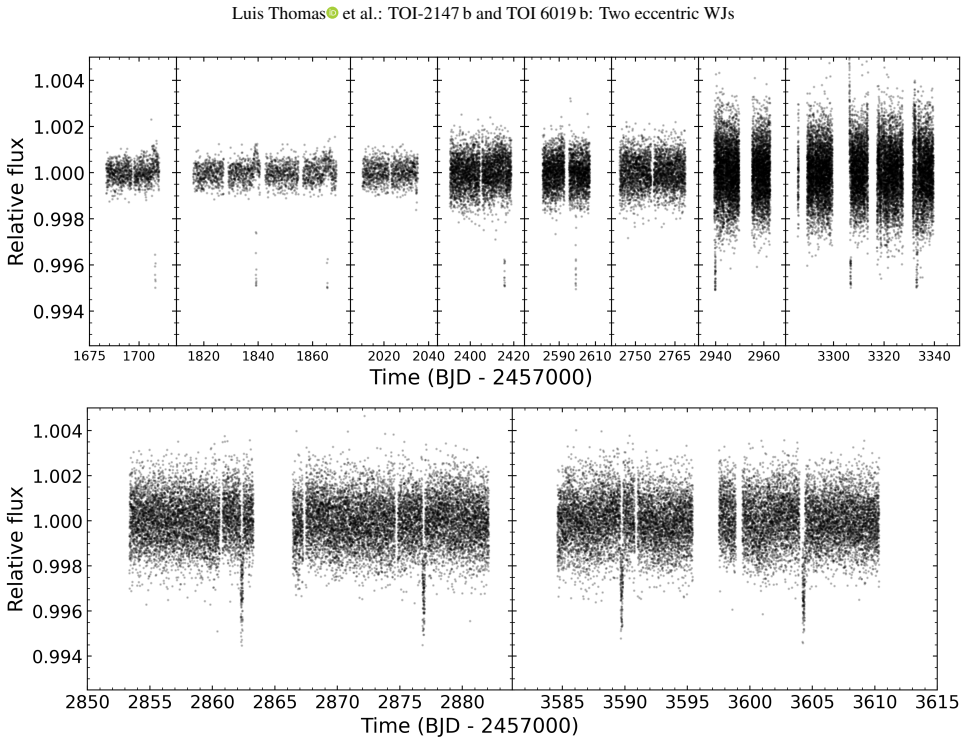
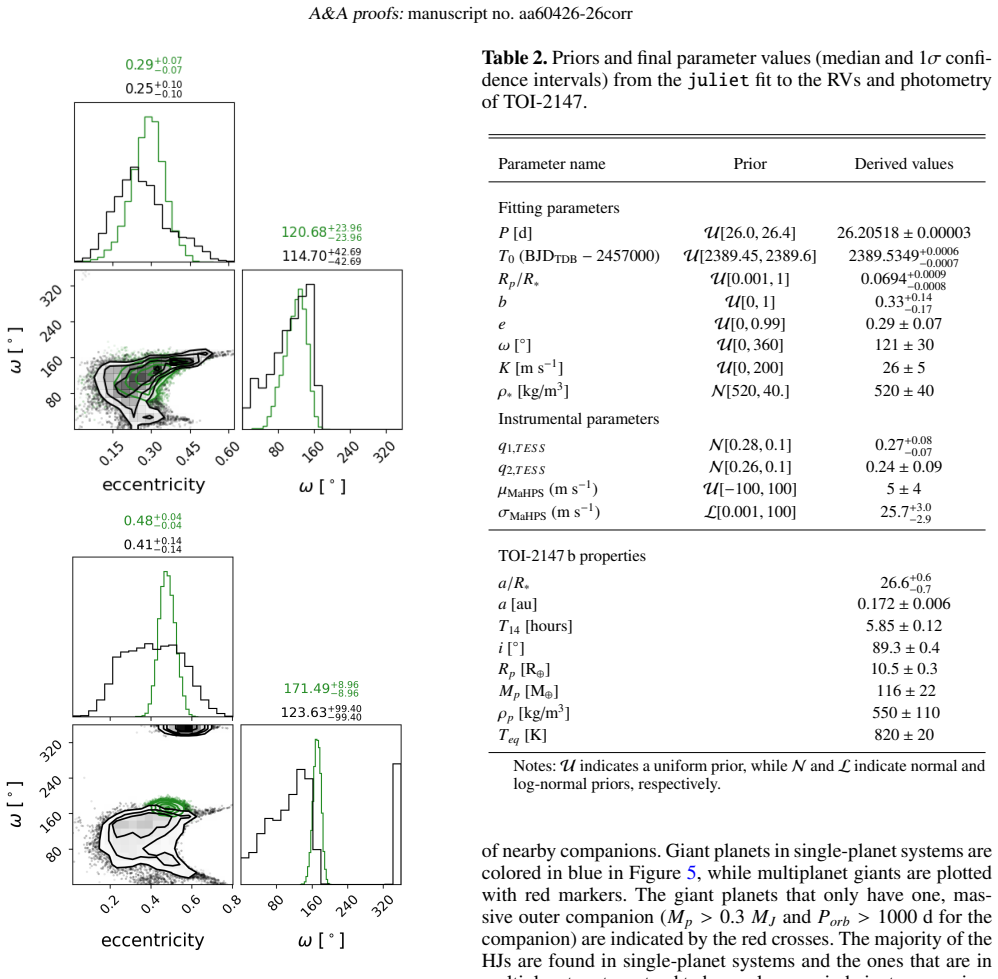
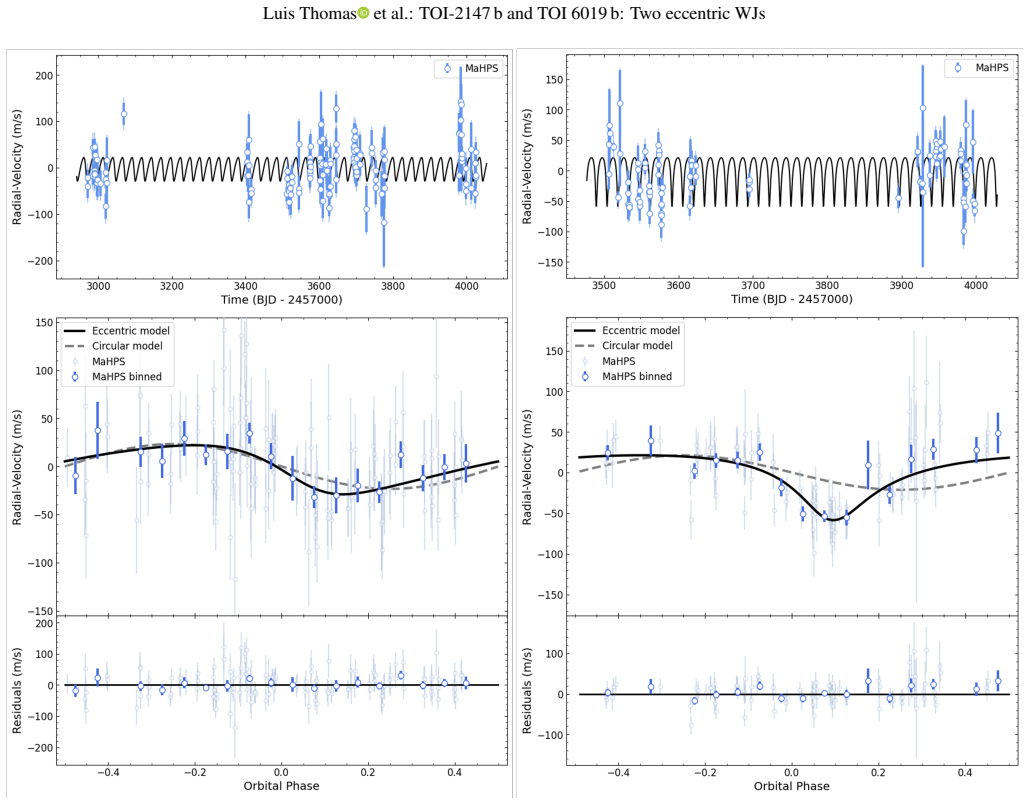
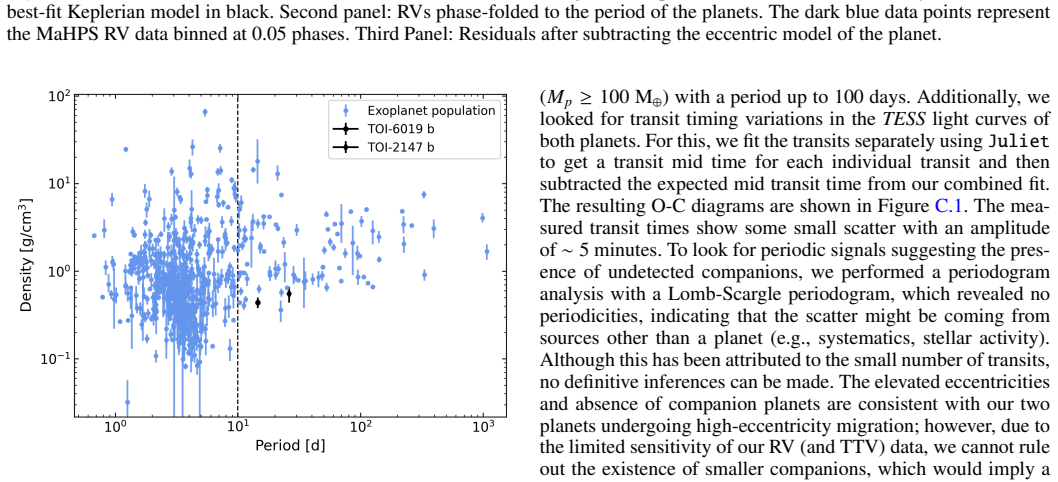
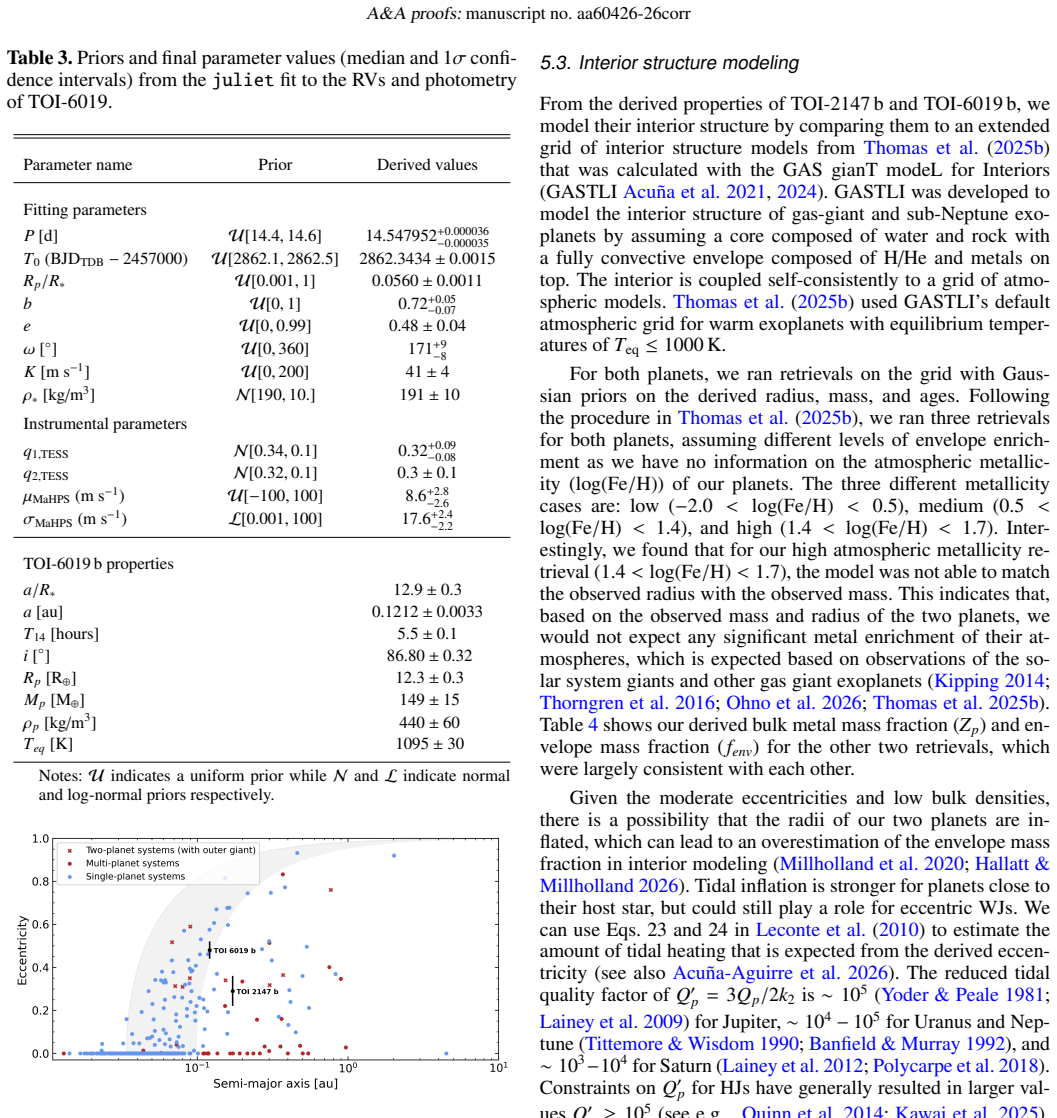
TOI-2147 b (period 26.2 days, eccentricity 0.29, radius 10.5 Earth radii, mass 116 Earth masses) and TOI-6019 b (period 14.5 days, eccentricity 0.48, radius 12.3 Earth radii, mass 149 Earth masses) are confirmed eccentric warm Jupiters whose bulk densities below Jupiter's value are explained by tidal heating in GASTLI models, disfavoring large atmospheric metal enrichment and aligning with a high-eccentricity migration origin.
What carries the argument
Joint modeling of TESS photometry and MaHPS radial-velocity time series to extract orbital periods, eccentricities, and masses, followed by GASTLI interior structure calculations that incorporate tidal heating to match the observed radii.
If this is right
- High-eccentricity migration is a viable pathway for warm Jupiters in this period range.
- Tidal heating is the dominant mechanism maintaining the observed radius inflation.
- Atmospheres of these planets are unlikely to be heavily metal-enriched.
- Absence of additional companions in both systems is consistent with the migration scenario.
- Similar eccentric warm Jupiters should exhibit comparable radius inflation.
Where Pith is reading between the lines
- Adding these two systems increases the sample size available for statistical tests that separate migration channels in the warm-Jupiter population.
- Atmospheric transmission or emission spectroscopy could directly test the low metal-enrichment prediction from the interior models.
- Longer-baseline radial-velocity monitoring would further constrain the presence of distant companions that might have driven the eccentricity excitation.
- Repeating the GASTLI analysis on other eccentric warm Jupiters would show whether tidal heating is a general explanation for their radii.
Load-bearing premise
The observed radial-velocity curves and transit signals arise solely from the two planets, with negligible stellar activity, data systematics, or hidden additional bodies, and the GASTLI models correctly capture how tidal heating inflates these specific planets.
What would settle it
A new radial-velocity campaign that reveals a significant additional periodic signal, or revised radius and mass measurements that bring both densities to or above Jupiter's value without requiring tidal heating.
Figures
read the original abstract
The population of Jupiter-sized exoplanets with orbital periods between 10 and 200 days (WJs) exhibits a broad range of orbital eccentricities and system architectures, suggesting a diversity of formation and migration pathways. In this work, we report the detection and characterization of two new eccentric WJs, TOI-2147 b and TOI-6019 b, initially identified as planet candidates by the Transiting Exoplanet Survey Satellite (TESS). We combined TESS photometry with ground-based follow-up observations, including multiband photometry from LCOGT and MuSCAT2, high-angular-resolution speckle imaging, and high-precision radial velocity measurements from the high-resolution Manfred Hirt Planet Finder Spectrograph (MaHPS). Using these data, we were able to confirm the planetary nature of both candidates. TOI-2147 b has a radius of $10.5 \pm 0.3\,\mathrm{R}_\oplus$ and a mass of $116 \pm 22\,\mathrm{M}_\oplus$. It orbits its slightly metal-poor ($\mathrm{[Fe/H]} = -0.29^{+0.07}_{-0.08}$) G-type host star on an eccentric orbit ($e = 0.29 \pm 0.07$) with a period of 26.2 days. TOI-6019 b has a radius of $12.3 \pm 0.3\,\mathrm{R}_\oplus$ and a mass of $149 \pm 15\,\mathrm{M}_\oplus$. It orbits a slightly evolved, solar-metallicity G-type sub-giant with a period of 14.5 days on a significantly eccentric orbit ($e = 0.48^{+0.05}_{-0.04}$). Both planets have bulk densities below that of Jupiter, indicating mildly inflated radii, with interior structure modeling using GASTLI. This suggests that tidal heating from the nonzero eccentricities likely contributes to this inflation and disfavors large atmospheric metal enrichment. No significant signals from additional companions were detected in the radial velocity time series or transit timing variations. Together with the elevated eccentricities, this is consistent with a high-eccentricity migration origin for both systems.
Editorial analysis
A structured set of objections, weighed in public.
Referee Report
Summary. The manuscript reports the detection and characterization of two eccentric warm Jupiters, TOI-2147 b (R = 10.5 ± 0.3 R⊕, M = 116 ± 22 M⊕, P = 26.2 d, e = 0.29 ± 0.07) and TOI-6019 b (R = 12.3 ± 0.3 R⊕, M = 149 ± 15 M⊕, P = 14.5 d, e = 0.48^{+0.05}_{-0.04}), initially identified by TESS and confirmed using LCOGT/MuSCAT2 photometry, speckle imaging, and MaHPS radial velocities. Both planets orbit G-type hosts, exhibit sub-Jupiter densities, and the paper concludes via GASTLI interior modeling that tidal heating from their eccentricities contributes to radius inflation while disfavoring large metal enrichment; the eccentricities and lack of additional companions are presented as consistent with high-eccentricity migration.
Significance. If the reported masses, radii, and eccentricities hold under the combined datasets and the GASTLI results are robust, the work adds two well-characterized systems to the warm Jupiter population, strengthening evidence for diverse migration pathways. The multi-instrument confirmation and density measurements enable direct comparison to migration models and interior structure calculations.
major comments (2)
- [Abstract] Abstract, final paragraph: The claim that 'tidal heating from the nonzero eccentricities likely contributes to this inflation and disfavors large atmospheric metal enrichment' is load-bearing for the interpretive conclusions, yet the manuscript provides no quantitative details on GASTLI inputs (dissipation factor, core-mass grid, or irradiation treatment) or output comparisons to rule out alternative explanations such as stellar irradiation or composition; this directly affects whether the sub-Jupiter densities support the tidal-heating interpretation.
- [Confirmation and interpretation sections] RV and TTV analysis section (referenced in abstract confirmation steps): The statement 'No significant signals from additional companions were detected in the radial velocity time series or transit timing variations' underpins both the planet-only assumption and the high-eccentricity migration consistency claim, but the provided text does not report activity-indicator analysis (e.g., log R'HK or bisector spans) or formal upper limits on additional companion masses, leaving open the possibility that stellar activity or undetected bodies contribute to the observed eccentricities (0.29 and 0.48).
minor comments (2)
- [Abstract] Abstract: The eccentricity uncertainty for TOI-6019 b is written as 0.48^{+0.05}_{-0.04} while TOI-2147 b uses ±0.07; ensure uniform asymmetric-uncertainty notation throughout the manuscript and tables.
- [Abstract] Host-star parameters: The [Fe/H] value for TOI-2147 is given with asymmetric uncertainties, but the method of determination (spectroscopic analysis or isochrone fitting) is not referenced in the abstract; add a brief citation or section pointer for consistency with the MaHPS data description.
Simulated Author's Rebuttal
We thank the referee for their constructive and detailed comments on our manuscript. We have carefully considered each point and provide point-by-point responses below. Where the comments identify areas needing additional detail or clarification, we have revised the manuscript accordingly.
read point-by-point responses
-
Referee: [Abstract] Abstract, final paragraph: The claim that 'tidal heating from the nonzero eccentricities likely contributes to this inflation and disfavors large atmospheric metal enrichment' is load-bearing for the interpretive conclusions, yet the manuscript provides no quantitative details on GASTLI inputs (dissipation factor, core-mass grid, or irradiation treatment) or output comparisons to rule out alternative explanations such as stellar irradiation or composition; this directly affects whether the sub-Jupiter densities support the tidal-heating interpretation.
Authors: We agree that the GASTLI modeling section would benefit from explicit quantitative details to support the tidal-heating interpretation. In the revised manuscript we have expanded the relevant section (and added a short appendix) to specify the GASTLI inputs: a constant tidal quality factor Q = 10^5, a core-mass grid spanning 0–60 M⊕ in 5 M⊕ steps, and irradiation handled via the stellar effective temperature and semi-major axis. We also include direct model–data comparisons showing that (i) pure irradiation models under-predict the observed radii by >1.5 σ, (ii) adding tidal heating reproduces the radii within 1 σ, and (iii) metal mass fractions >0.3 are ruled out because they would require unrealistically high dissipation to match the data. These additions make the interpretive claim quantitatively grounded. revision: yes
-
Referee: [Confirmation and interpretation sections] RV and TTV analysis section (referenced in abstract confirmation steps): The statement 'No significant signals from additional companions were detected in the radial velocity time series or transit timing variations' underpins both the planet-only assumption and the high-eccentricity migration consistency claim, but the provided text does not report activity-indicator analysis (e.g., log R'HK or bisector spans) or formal upper limits on additional companion masses, leaving open the possibility that stellar activity or undetected bodies contribute to the observed eccentricities (0.29 and 0.48).
Authors: We acknowledge that the original text did not present the activity diagnostics or companion-mass limits with sufficient prominence. The revised manuscript now includes a dedicated paragraph in the RV analysis section reporting: (i) bisector-span and log R'HK time series extracted from the MaHPS spectra, which show no significant correlation with the RV residuals (Pearson r < 0.2); (ii) 3-σ upper limits on additional companions of <18 M⊕ for periods <100 d derived from the RV residuals after subtracting the two-planet model; and (iii) a brief TTV analysis confirming no significant timing variations at the 1-min level. These additions strengthen the planet-only interpretation and the high-eccentricity migration discussion. revision: yes
Circularity Check
Derivation chain self-contained from direct observations; no circular reductions
full rationale
The planetary parameters (masses, radii, eccentricities) are obtained by fitting TESS transit photometry and MaHPS radial-velocity time series, which constitute independent observational inputs. The abstract's statements on high-eccentricity migration consistency and tidal-heating contributions to inflation are interpretive inferences drawn after the fits, not quantities that reduce by the paper's own equations to the fitted values themselves. No self-citations, ansatzes smuggled via prior work, or fitted inputs relabeled as predictions appear in the load-bearing steps. The derivation therefore remains externally falsifiable against the raw data and does not exhibit any of the enumerated circularity patterns.
Axiom & Free-Parameter Ledger
free parameters (2)
- orbital eccentricity and period
- planet mass and radius
axioms (2)
- domain assumption Radial velocity variations are produced by Keplerian planetary orbits with no significant stellar activity contamination.
- domain assumption GASTLI interior structure models correctly predict radius inflation from tidal heating for these eccentricities and masses.
Reference graph
Works this paper leans on
-
[1]
PyTransit: Fast and Easy Exoplanet Transit Modelling in Python
Parviainen, Hannu , year =. Monthly Notices of the Royal Astronomical Society , volume =. doi:10.1093/mnras/stv894 , archiveprefix =. 1504.07433 , pages =
work page internal anchor Pith review Pith/arXiv arXiv doi:10.1093/mnras/stv894
-
[2]
TOI-5108 b and TOI 5786 b: Two transiting sub-Saturns detected and characterized with TESS, MaHPS, and SOPHIE. , keywords =. doi:10.1051/0004-6361/202451676 , archivePrefix =. 2501.03803 , primaryClass =
-
[3]
Thermal Tides in Short Period Exoplanets
Thermal Tides in Short Period Exoplanets. arXiv e-prints , keywords =. doi:10.48550/arXiv.0901.0735 , archivePrefix =. 0901.0735 , primaryClass =
work page internal anchor Pith review Pith/arXiv arXiv doi:10.48550/arxiv.0901.0735
-
[4]
The In Situ Formation of Giant Planets at Short Orbital Periods
The In Situ Formation of Giant Planets at Short Orbital Periods. , keywords =. doi:10.3847/2041-8205/817/2/L17 , archivePrefix =. 1510.04276 , primaryClass =
work page internal anchor Pith review Pith/arXiv arXiv doi:10.3847/2041-8205/817/2/l17 2041
-
[5]
In Situ Formation and Dynamical Evolution of Hot Jupiter Systems
In Situ Formation and Dynamical Evolution of Hot Jupiter Systems. , keywords =. doi:10.3847/0004-637X/829/2/114 , archivePrefix =. 1511.09157 , primaryClass =
work page internal anchor Pith review Pith/arXiv arXiv doi:10.3847/0004-637x/829/2/114
-
[6]
On the Location of the Snow Line in a Protoplanetary Disk
On the Location of the Snow Line in a Protoplanetary Disk. , keywords =. doi:10.1086/500287 , archivePrefix =. astro-ph/0602217 , primaryClass =
work page internal anchor Pith review Pith/arXiv arXiv doi:10.1086/500287
-
[7]
Planet formation around stars of various masses: The snow line and the frequency of giant planets
Planet Formation around Stars of Various Masses: The Snow Line and the Frequency of Giant Planets. , keywords =. doi:10.1086/524130 , archivePrefix =. 0710.1065 , primaryClass =
work page internal anchor Pith review Pith/arXiv arXiv doi:10.1086/524130
-
[8]
B., Hubickyj, O., Bodenheimer, P., et al
Formation of the Giant Planets by Concurrent Accretion of Solids and Gas. , year = 1996, month = nov, volume =. doi:10.1006/icar.1996.0190 , adsurl =
-
[9]
Ohmic Heating Suspends, not Reverses, the Cooling Contraction of Hot Jupiters
Ohmic Heating Suspends, Not Reverses, the Cooling Contraction of Hot Jupiters. , keywords =. doi:10.1088/0004-637X/763/1/13 , archivePrefix =. 1202.0026 , primaryClass =
work page internal anchor Pith review Pith/arXiv arXiv doi:10.1088/0004-637x/763/1/13
-
[10]
Ohmic Dissipation in the Atmospheres of Hot Jupiters
Ohmic Dissipation in the Atmospheres of Hot Jupiters. , keywords =. doi:10.1088/0004-637X/724/1/313 , archivePrefix =. 1009.3273 , primaryClass =
work page internal anchor Pith review Pith/arXiv arXiv doi:10.1088/0004-637x/724/1/313
-
[11]
Inflating Hot Jupiters With Ohmic Dissipation
Inflating Hot Jupiters with Ohmic Dissipation. , keywords =. doi:10.1088/2041-8205/714/2/L238 , archivePrefix =. 1002.3650 , primaryClass =
work page internal anchor Pith review Pith/arXiv arXiv doi:10.1088/2041-8205/714/2/l238 2041
-
[12]
Possible Solutions to the Radius Anomalies of Transiting Giant Planets
Possible Solutions to the Radius Anomalies of Transiting Giant Planets. , keywords =. doi:10.1086/514326 , archivePrefix =. astro-ph/0612703 , primaryClass =
work page internal anchor Pith review Pith/arXiv arXiv doi:10.1086/514326
-
[13]
Structure and evolution of super-Earth to super-Jupiter exoplanets. I. Heavy element enrichment in the interior. , keywords =. doi:10.1051/0004-6361:20079321 , archivePrefix =. 0802.1810 , primaryClass =
work page internal anchor Pith review Pith/arXiv arXiv doi:10.1051/0004-6361:20079321
-
[14]
On the Tidal Inflation of Short-Period Extrasolar Planets. , keywords =. doi:10.1086/318667 , adsurl =
-
[15]
Slow Cooling and Fast Reinflation for Hot Jupiters. , keywords =. doi:10.3847/2041-8213/abe86d , archivePrefix =. 2101.05285 , primaryClass =
-
[16]
The California Legacy Survey. I. A Catalog of 178 Planets from Precision Radial Velocity Monitoring of 719 Nearby Stars over Three Decades. , keywords =. doi:10.3847/1538-4365/abe23c , archivePrefix =. 2105.11583 , primaryClass =
-
[17]
Migrating Planets. Science , keywords =. doi:10.1126/science.279.5347.69 , archivePrefix =. astro-ph/9801138 , primaryClass =
work page internal anchor Pith review Pith/arXiv arXiv doi:10.1126/science.279.5347.69
-
[18]
, year = 1996, month = apr, volume =
Orbital migration of the planetary companion of 51 Pegasi to its present location. , year = 1996, month = apr, volume =. doi:10.1038/380606a0 , adsurl =
-
[19]
Dynamical instabilities and the formation of extrasolar planetary systems. Science , keywords =. doi:10.1126/science.274.5289.954 , adsurl =
-
[20]
Chaotic tides in migrating gas giants: forming hot and transient warm Jupiters via Lidov-Kozai migration. , keywords =. doi:10.1093/mnras/stz354 , archivePrefix =. 1812.05618 , primaryClass =
work page internal anchor Pith review Pith/arXiv arXiv doi:10.1093/mnras/stz354
-
[21]
Secular Chaos and the Production of Hot Jupiters
Secular Chaos and the Production of Hot Jupiters. , keywords =. doi:10.1088/0004-637X/735/2/109 , archivePrefix =. 1012.3475 , primaryClass =
work page internal anchor Pith review Pith/arXiv arXiv doi:10.1088/0004-637x/735/2/109
-
[22]
TOI-1130: A photodynamical analysis of a hot Jupiter in resonance with an inner low-mass planet. , keywords =. doi:10.1051/0004-6361/202244617 , archivePrefix =. 2305.15565 , primaryClass =
-
[23]
TOI-1408: Discovery and Photodynamical Modeling of a Small Inner Companion to a Hot Jupiter Revealed by Transit Timing Variations. , keywords =. doi:10.3847/2041-8213/ad65fd , archivePrefix =. 2407.17798 , primaryClass =
-
[24]
Giant planets orbiting metal-rich stars show signatures of planet-planet interactions
Giant Planets Orbiting Metal-rich Stars Show Signatures of Planet-Planet Interactions. , keywords =. doi:10.1088/2041-8205/767/2/L24 , archivePrefix =. 1302.6244 , primaryClass =
work page internal anchor Pith review Pith/arXiv arXiv doi:10.1088/2041-8205/767/2/l24 2041
-
[25]
Hot Stars with Hot Jupiters Have High Obliquities
Hot Stars with Hot Jupiters Have High Obliquities. , keywords =. doi:10.1088/2041-8205/718/2/L145 , archivePrefix =. 1006.4161 , primaryClass =
work page internal anchor Pith review Pith/arXiv arXiv doi:10.1088/2041-8205/718/2/l145 2041
-
[26]
A dichotomy of the mass─metallicity relation of exoplanetary atmospheres demarcated by their birthplace. , keywords =. doi:10.1093/pasj/psaf157 , archivePrefix =. 2506.16060 , primaryClass =
-
[27]
Mass-Metallicity Trends in Transiting Exoplanets from Atmospheric Abundances of H _ 2 O, Na, and K. , keywords =. doi:10.3847/2041-8213/ab5a89 , archivePrefix =. 1912.04904 , primaryClass =
-
[28]
The bulk metal content of WASP-80 b from joint interior-atmosphere retrievals: Breaking degeneracies and exploring biases with panchromatic spectra. , keywords =. doi:10.1051/0004-6361/202556519 , archivePrefix =. 2511.13483 , primaryClass =
-
[29]
MuSCAT2 multicolour validation of TESS candidates: an ultra-short-period substellar object around an M dwarf. , keywords =. doi:10.1051/0004-6361/201935958 , archivePrefix =. 1911.04366 , primaryClass =
-
[30]
Speckle Camera Observations for the NASA Kepler Mission Follow-up Program. , keywords =. doi:10.1088/0004-6256/142/1/19 , adsurl =
-
[31]
, year = 2018, month = may, volume =
The NN-explore Exoplanet Stellar Speckle Imager: Instrument Description and Preliminary Results. , year = 2018, month = may, volume =. doi:10.1088/1538-3873/aab484 , adsurl =
-
[32]
Identifying Close-in Jupiters that Arrived via Disk Migration: Evidence of Primordial Alignment, Preference of Nearby Companions and Hint of Runaway Migration. , keywords =. doi:10.3847/1538-3881/ae0a11 , archivePrefix =. 2509.16322 , primaryClass =
-
[33]
HD 285507b: An Eccentric Hot Jupiter in the Hyades Open Cluster
HD 285507b: An Eccentric Hot Jupiter in the Hyades Open Cluster. , keywords =. doi:10.1088/0004-637X/787/1/27 , archivePrefix =. 1310.7328 , primaryClass =
work page internal anchor Pith review Pith/arXiv arXiv doi:10.1088/0004-637x/787/1/27
-
[34]
Strong tidal energy dissipation in Saturn at Titan's frequency as an explanation for Iapetus orbit
Strong tidal energy dissipation in Saturn at Titan's frequency as an explanation for Iapetus orbit. , keywords =. doi:10.1051/0004-6361/201833930 , archivePrefix =. 1809.11065 , primaryClass =
work page internal anchor Pith review Pith/arXiv arXiv doi:10.1051/0004-6361/201833930
-
[35]
ROVIBRATIONAL LINE LISTS FOR NINE ISOTOPOLOGUES OF THE CO MOLECULE IN THE X 1 Σ + GROUND ELECTRONIC STATE , url =. , month =. doi:10.1088/0067-0049/216/1/15 , issn =
-
[36]
Prospects for Characterizing the Haziest Sub-Neptune Exoplanets with High-resolution Spectroscopy , url =. , month =. doi:10.3847/1538-3881/abb46b , issn =
-
[37]
Astronomy & Astrophysics , month =
Combining low- to high-resolution transit spectroscopy of HD 189733b: Linking the troposphere and the thermosphere of a hot gas giant , url =. Astronomy & Astrophysics , month =. doi:10.1051/0004-6361/201731244 , issn =
-
[38]
Strong tidal dissipation in Saturn and constraints on Enceladus' thermal state from astrometry
Strong Tidal Dissipation in Saturn and Constraints on Enceladus' Thermal State from Astrometry. , keywords =. doi:10.1088/0004-637X/752/1/14 , archivePrefix =. 1204.0895 , primaryClass =
work page internal anchor Pith review Pith/arXiv arXiv doi:10.1088/0004-637x/752/1/14
-
[39]
A dynamical history of the inner Neptunian satellites. , keywords =. doi:10.1016/0019-1035(92)90155-Z , adsurl =
-
[40]
Tidal evolution of the Uranian satellites III. Evolution through the Miranda-Umbriel 3:1, Miranda-Ariel 5:3, and Ariel-Umbriel 2:1 mean-motion commensurabilities. , keywords =. doi:10.1016/0019-1035(90)90125-S , adsurl =
-
[41]
, year = 2009, month = jun, volume =
Strong tidal dissipation in Io and Jupiter from astrometric observations. , year = 2009, month = jun, volume =. doi:10.1038/nature08108 , adsurl =
-
[42]
The tides of Io. , keywords =. doi:10.1016/0019-1035(81)90088-9 , adsurl =
-
[43]
Coupled Planetary Interior and Tidal Evolution. , keywords =. doi:10.3847/1538-4357/ae129d , archivePrefix =. 2509.22923 , primaryClass =
-
[44]
The Mass-Metallicity Relation for Giant Planets
The Mass-Metallicity Relation for Giant Planets. , keywords =. doi:10.3847/0004-637X/831/1/64 , archivePrefix =. 1511.07854 , primaryClass =
work page internal anchor Pith review Pith/arXiv arXiv doi:10.3847/0004-637x/831/1/64
-
[45]
A Precise Water Abundance Measurement for the Hot Jupiter WASP-43b
A Precise Water Abundance Measurement for the Hot Jupiter WASP-43b. , keywords =. doi:10.1088/2041-8205/793/2/L27 , archivePrefix =. 1410.2255 , primaryClass =
work page internal anchor Pith review Pith/arXiv arXiv doi:10.1088/2041-8205/793/2/l27 2041
-
[46]
Stellar Obliquities in Exoplanetary Systems. , keywords =. doi:10.1088/1538-3873/ac6c09 , archivePrefix =. 2203.05460 , primaryClass =
-
[47]
arXiv e-prints, under review at AJ , keywords =
The Occurrence Rate of Nearby Planetary Companions to Hot Jupiters. arXiv e-prints, under review at AJ , keywords =
-
[48]
Origins of Hot Jupiters from the Stellar Obliquity Distribution. , keywords =. doi:10.3847/2041-8213/ac502d , archivePrefix =. 2201.11768 , primaryClass =
-
[49]
A Tendency Toward Alignment in Single-star Warm-Jupiter Systems. , keywords =. doi:10.3847/1538-3881/ac8153 , archivePrefix =. 2207.06511 , primaryClass =
-
[50]
Giant Planet Occurrence in the Stellar Mass-Metallicity Plane
Giant Planet Occurrence in the Stellar Mass-Metallicity Plane. , keywords =. doi:10.1086/655775 , archivePrefix =. 1005.3084 , primaryClass =
work page internal anchor Pith review Pith/arXiv arXiv doi:10.1086/655775
-
[51]
The Planet-Metallicity Correlation. , keywords =. doi:10.1086/428383 , adsurl =
-
[52]
Spectroscopic [Fe/H] for 98 extra-solar planet-host stars. Exploring the probability of planet formation. , keywords =. doi:10.1051/0004-6361:20034469 , archivePrefix =. astro-ph/0311541 , primaryClass =
work page internal anchor Pith review Pith/arXiv arXiv doi:10.1051/0004-6361:20034469
-
[53]
Warm Jupiters in TESS Full-frame Images: A Catalog and Observed Eccentricity Distribution for Year 1. , keywords =. doi:10.3847/1538-4365/abf73c , archivePrefix =. 2104.01970 , primaryClass =
-
[54]
Search for giant planets in M 67 V: A warm Jupiter orbiting the turn-off star S1429. , keywords =. doi:10.1051/0004-6361/202449233 , archivePrefix =. 2403.02911 , primaryClass =
-
[55]
Search for giant planets in M 67. IV. Survey results. , keywords =. doi:10.1051/0004-6361/201527562 , archivePrefix =. 1703.04296 , primaryClass =
work page internal anchor Pith review Pith/arXiv arXiv doi:10.1051/0004-6361/201527562
-
[56]
Evidence for Hidden Nearby Companions to Hot Jupiters. , keywords =. doi:10.3847/1538-3881/acbf3f , archivePrefix =. 2302.12778 , primaryClass =
-
[57]
Discovery of a cold giant planet and mass measurement of a hot super-Earth in the multi-planetary system WASP-132. , keywords =. doi:10.1051/0004-6361/202348177 , archivePrefix =. 2406.15986 , primaryClass =
-
[58]
Hot Jupiters Have Giant Companions: Evidence for Coplanar High-eccentricity Migration. , keywords =. doi:10.3847/2041-8213/acfdab , archivePrefix =. 2310.01567 , primaryClass =
-
[59]
Friends of Hot Jupiters. I. A Radial Velocity Search for Massive, Long-period Companions to Close-in Gas Giant Planets. , keywords =. doi:10.1088/0004-637X/785/2/126 , archivePrefix =. 1312.2954 , primaryClass =
work page internal anchor Pith review Pith/arXiv arXiv doi:10.1088/0004-637x/785/2/126
-
[60]
Journal of Physics: Conference Series , month =
Atmospheric transmission and thermal background emission in the mid-infrared at Mauna Kea , url =. Journal of Physics: Conference Series , month =. doi:10.1088/1742-6596/595/1/012023 , issn =
-
[61]
Adaptive Optics Systems VI , doi =
SCExAO, an instrument with a dual purpose: perform cutting-edge science and develop new technologies , url =. Adaptive Optics Systems VI , doi =
-
[62]
The Astrophysical Journal Letters , month =
Possible Carbon Dioxide above the Thick Aerosols of GJ 1214 b , url =. The Astrophysical Journal Letters , month =. doi:10.3847/2041-8213/ad7fef , issn =
-
[63]
Ground-based and Airborne Instrumentation for Astronomy VII , doi =
The infrared Doppler (IRD) instrument for the Subaru telescope: instrument description and commissioning results , url =. Ground-based and Airborne Instrumentation for Astronomy VII , doi =
-
[64]
The destruction of inner planetary systems during high-eccentricity migration of gas giants
The Destruction of Inner Planetary Systems during High-eccentricity Migration of Gas Giants. , keywords =. doi:10.1088/0004-637X/808/1/14 , archivePrefix =. 1502.06971 , primaryClass =
work page internal anchor Pith review Pith/arXiv arXiv doi:10.1088/0004-637x/808/1/14
-
[65]
Hot Jupiters from Coplanar High-eccentricity Migration
Hot Jupiters from Coplanar High-eccentricity Migration. , keywords =. doi:10.1088/0004-637X/805/1/75 , archivePrefix =. 1409.8296 , primaryClass =
work page internal anchor Pith review Pith/arXiv arXiv doi:10.1088/0004-637x/805/1/75
-
[66]
Warm Jupiters from secular planet-planet interactions
Warm Jupiters from Secular Planet-Planet Interactions. , keywords =. doi:10.3847/0004-637X/829/2/132 , archivePrefix =. 1604.00010 , primaryClass =
work page internal anchor Pith review Pith/arXiv arXiv doi:10.3847/0004-637x/829/2/132
-
[67]
Formation of Hot Jupiters through Secular Chaos and Dynamical Tides
Formation of hot Jupiters through secular chaos and dynamical tides. , keywords =. doi:10.1093/mnras/stz1011 , archivePrefix =. 1901.05006 , primaryClass =
work page internal anchor Pith review Pith/arXiv arXiv doi:10.1093/mnras/stz1011 1901
-
[68]
The Eccentric Kozai-Lidov Effect and Its Applications
The Eccentric Kozai-Lidov Effect and Its Applications. , keywords =. doi:10.1146/annurev-astro-081915-023315 , archivePrefix =. 1601.07175 , primaryClass =
work page internal anchor Pith review Pith/arXiv arXiv doi:10.1146/annurev-astro-081915-023315
-
[69]
Shrinking binary and planetary orbits by Kozai cycles with tidal friction
Shrinking Binary and Planetary Orbits by Kozai Cycles with Tidal Friction. , keywords =. doi:10.1086/521702 , archivePrefix =. 0705.4285 , primaryClass =
work page internal anchor Pith review Pith/arXiv arXiv doi:10.1086/521702
-
[70]
Planet Migration and Binary Companions: the case of HD 80606b
Planet Migration and Binary Companions: The Case of HD 80606b. , keywords =. doi:10.1086/374598 , archivePrefix =. astro-ph/0303010 , primaryClass =
work page internal anchor Pith review Pith/arXiv arXiv doi:10.1086/374598
-
[71]
Dynamical Outcomes of Planet-Planet Scattering
Dynamical Outcomes of Planet-Planet Scattering. , keywords =. doi:10.1086/590227 , archivePrefix =. astro-ph/0703166 , primaryClass =
work page internal anchor Pith review Pith/arXiv arXiv doi:10.1086/590227
-
[72]
TOI-3362b: A Proto Hot Jupiter Undergoing High-eccentricity Tidal Migration. , keywords =. doi:10.3847/2041-8213/ac2600 , archivePrefix =. 2109.03771 , primaryClass =
-
[73]
, year = 2024, month = aug, volume =
A hot-Jupiter progenitor on a super-eccentric retrograde orbit. , year = 2024, month = aug, volume =. doi:10.1038/s41586-024-07688-3 , adsurl =
-
[74]
On the Tidal Interaction between Protoplanets and the Protoplanetary Disk. III. Orbital Migration of Protoplanets. , keywords =. doi:10.1086/164653 , adsurl =
-
[75]
Disk-satellite interactions. , keywords =. doi:10.1086/158356 , adsurl =
-
[76]
Origins of Hot Jupiters. , keywords =. doi:10.1146/annurev-astro-081817-051853 , archivePrefix =. 1801.06117 , primaryClass =
work page internal anchor Pith review Pith/arXiv arXiv doi:10.1146/annurev-astro-081817-051853
-
[77]
Is tidal heating sufficient to explain bloated exoplanets? Consistent calculations accounting for finite initial eccentricity. , keywords =. doi:10.1051/0004-6361/201014337 , archivePrefix =. 1004.0463 , primaryClass =
work page internal anchor Pith review Pith/arXiv arXiv doi:10.1051/0004-6361/201014337
-
[78]
An open-source coupled interior-atmosphere model to unveil gas-giant composition
GASTLI. An open-source coupled interior-atmosphere model to unveil gas-giant composition. , keywords =. doi:10.1051/0004-6361/202450559 , archivePrefix =. 2406.10032 , primaryClass =
-
[79]
Evidence of a gap in the envelope mass fraction of sub-Saturns. , keywords =. doi:10.1051/0004-6361/202556560 , archivePrefix =. 2509.12120 , primaryClass =
-
[80]
Experimental Astronomy , keywords =
Ground-breaking exoplanet science with the ANDES spectrograph at the ELT. Experimental Astronomy , keywords =. doi:10.1007/s10686-025-10000-4 , archivePrefix =. 2311.17075 , primaryClass =
discussion (0)
Sign in with ORCID, Apple, or X to comment. Anyone can read and Pith papers without signing in.